
Transportation of Dangerous Goods Regulations (SOR/2001-286)
Full Document:
- HTMLFull Document: Transportation of Dangerous Goods Regulations (Accessibility Buttons available) |
- XMLFull Document: Transportation of Dangerous Goods Regulations [3532 KB] |
- PDFFull Document: Transportation of Dangerous Goods Regulations [10729 KB]
Regulations are current to 2026-09-30 and last amended on 2026-07-01. Previous Versions
Table of Contents
Transportation of Dangerous Goods Regulations
SOR/2001-286
TRANSPORTATION OF DANGEROUS GOODS ACT, 1992
Registration 2001-08-01
Transportation of Dangerous Goods Regulations
P.C. 2001-1366 2001-08-01
Whereas, pursuant to 30(1) of the Transportation of Dangerous Goods Act, 1992Footnote a, a copy of the proposed Transportation of Dangerous Goods Regulations, substantially in the annexed form, was published in the Canada Gazette, Part I, on August 7, 1999 and a reasonable opportunity was afforded to interested persons to make representations to the Minister with respect to the proposed Regulations;
Return to footnote aS.C. 1992, c. 34
Therefore, His Excellency the Governor General in Council, on the recommendation of the Minister of Transport, pursuant to section 27 of the Transportation of Dangerous Goods Act, 1992Footnote a, makes the annexed Transportation of Dangerous Goods Regulations.
PART 1Interpretation, General Provisions and Special Cases
- SOR/2023-155, s. 1
1.1 [Repealed, SOR/2023-155, s. 2]
1.2 [Repealed, SOR/2023-155, s. 2]
Interpretation
1.3 (1) [Repealed, SOR/2020-23, s. 1]
(2) In these Regulations,
(a) “must” is imperative and “may” is permissive;
(b) the words “on”, “on board”, “in” or “by” are synonymous when they are associated with the defined terms aircraft, railway vehicle, road vehicle or vessel;
(c) pressure expressed in kPa is gauge pressure unless designated as absolute pressure, except for vapour pressure, which is always absolute pressure;
(d) [Repealed, SOR/2026-112, s. 1]
(e) a symbol set out in column 1 of the following table represents the corresponding unit of measure set out in column 2:
TABLE
Column 1 Column 2 Symbol Unit of Measure Bq becquerel °C degree Celsius ft3 cubic foot g gram h hour Hz hertz J joule J/g joules per gram kg kilogram kBq/kg kilobecquerels per kilogram km kilometre km/h kilometres per hour kPa kilopascal L litre L/kg litres per kilogram LC lethal concentration LD lethal dose m metre m3 cubic metre mg milligram mg/kg milligrams per kilogram mg/L milligrams per litre mL millilitre mL/m3 millilitres per cubic metre mm millimetre mph miles per hour MPa megapascal mSv/h millisieverts per hour µSv/h microsieverts per hour µm micrometre (f) the words “placard” and “label” refer, respectively, to any placard or label required by Part 4 and illustrated in the appendix to that Part or in Chapter 5.2 or 5.3 of the UN Recommendations;
(g) the word “or” is used in the inclusive sense unless the associated text clearly indicates otherwise;
(h) when a shipping document or a document is required, the requirement refers to
(i) the original shipping document or original document, or
(ii) a copy of the shipping document or document;
(i) when it is necessary to convert between number of articles and net explosives quantity, one kilogram net explosives quantity must be counted as 100 articles and each 100 articles must be counted as one kilogram net explosives quantity;
(j) when dangerous goods are in a means of containment, it is the minimum required means of containment if
(i) all other means of containment containing it are removed, the means of containment and the dangerous goods it contains would be in compliance with the Act and these Regulations for the purposes of offering for transport, handling or transport of dangerous goods, and
(ii) all other means of containment containing it and the means of containment itself are removed, some of the dangerous goods it contains would no longer be in a means of containment that is in compliance with the Act and these Regulations for the purposes of offering for transport, handling or transport of dangerous goods;
(k) when the words “means of containment” are used, they refer to the minimum required means of containment unless the associated text clearly indicates otherwise;
(l) the words “gross mass of all dangerous goods” in sections 1.15, 1.16, 1.21 and 1.22 refer to dangerous goods that require shipping documents or that are intended to be transported in accordance with those sections; and
(m) if text, other than a shipping name, must, in accordance with these Regulations, be included on a document or displayed, the elements of that text may be written in upper or lower case letters, spelled or punctuated as those elements appear in 49 CFR, the UN Recommendations, the ICAO Technical Instructions or the IMDG Code.
(3) For the purposes of interpreting the provisions of a document that is incorporated by reference in these Regulations, in the French version of such a document, a reference to “numéro ONU” is to be read as a reference to “numéro UN”.
- SOR/2002-306, s. 3
- SOR/2003-400, s. 1
- SOR/2005-216, s. 1
- SOR/2005-279, s. 1
- SOR/2007-179, s. 1
- SOR/2008-34, s. 2
- SOR/2012-245, s. 2(F)
- SOR/2014-159, s. 2
- SOR/2017-137, s. 2
- SOR/2017-253, ss. 2(E), 52
- SOR/2020-23, s. 1
- SOR/2023-155, s. 3
- SOR/2026-112, s. 1
Definitions — Safety Standards and Safety Requirement Documents
1.3.1 The following definitions apply in these Regulations.
- ANSI/WSC PST
ANSI/WSC PST means the ANSI/WSC PST 2000/2016, Pressurized Water Storage Tank Standard, February 2016, published by the Water Systems Council. (ANSI/WSC PST)
- ASTM D 4359
ASTM D 4359 means the ASTM D 4359-90, Standard Test Method for Determining Whether a Material Is a Liquid or a Solid, July 1990, published by the American Society for Testing and Materials (ASTM). (ASTM D 4359)
- ASTM F 852
ASTM F 852[Repealed, SOR/2026-112, s. 2]
- CGA C-7
CGA C-7 means the CGA Standard C-7, Guide to Classification and Labeling of Compressed Gases, published by the Compressed Gas Association, Inc. (CGA), as amended from time to time. (CGA C-7)
- CGA P-20
CGA P-20 means the CGA P-20 — 2009, Standard for Classification of Toxic Gas Mixtures, Fourth Edition, 2009, published by the Compressed Gas Association, Inc. (CGA). (CGA P-20)
- CGSB-32.301
CGSB-32.301[Repealed, SOR/2026-112, s. 2]
- CGSB-43.123
CGSB-43.123 means the National Standard of Canada CAN/CGSB-43.123, Aerosol containers and gas cartridges for transport of dangerous goods, published by the Canadian General Standards Board (CGSB), as amended from time to time. (CGSB-43.123)
- CGSB-43.125
CGSB-43.125 means the National Standard of Canada CAN/CGSB-43.125, Packaging of Category A and Category B infectious substances (Class 6, Division 6.2) and clinical, (bio) medical or regulated medical waste, published by the Canadian General Standards Board (CGSB), as amended from time to time. (CGSB-43.125)
- CGSB-43.126
CGSB-43.126[Repealed, SOR/2026-112, s. 2]
- CGSB-43.145
CGSB-43.145 means the National Standard of Canada CAN/CGSB-43.145, Design, manufacture and use of large packagings for the transportation of dangerous goods, classes 3, 4, 5, 6.1, 8, and 9, published by the Canadian General Standards Board (CGSB), as amended from time to time. (CGSB-43.145)
- CGSB-43.146
CGSB-43.146 means the National Standard of Canada CAN/CGSB-43.146, Design, manufacture and use of intermediate bulk containers for the transportation of dangerous goods, classes 3, 4, 5, 6.1, 8 and 9, published by the Canadian General Standards Board (CGSB), as amended from time to time. (CGSB-43.146)
- CGSB-43.147
CGSB-43.147 means the National Standard of Canada CAN/CGSB-43.147, Containers for transport of dangerous goods by rail, published by the Canadian General Standards Board (CGSB), as amended from time to time. (CGSB-43.147)
- CGSB-43.149
CGSB-43.149 means the National Standard of Canada CAN/CGSB-43.149, Ton containers for the transportation of dangerous goods, published by the Canadian General Standards Board (CGSB), as amended from time to time. (CGSB-43.149)
- CGSB-43.150
CGSB-43.150 means the National Standard of Canada CAN/CGSB-43.150, Design, manufacture and use of UN standardized drums, jerricans, boxes, bags, combination packaging, composite packaging and other packagings for the transport of dangerous goods, classes 3, 4, 5, 6.1, 8, and 9, published by the Canadian General Standards Board (CGSB), as amended from time to time. (CGSB-43.150)
- CGSB-43.151
CGSB-43.151 means the National Standard of Canada CAN/CGSB-43.151, Packaging, handling, offering for transport and transport of Explosives (Class 1), published by the Canadian General Standards Board (CGSB), as amended from time to time. (CGSB-43.151)
- CSA B339
CSA B339 means the CSA Standard B339, Cylinders, spheres, and tubes for the transportation of dangerous goods, published by the Canadian Standards Association (CSA), as amended from time to time. (CSA B339)
- CSA B340
CSA B340 means the CSA Standard B340, Selection and use of cylinders, spheres, tubes, and other containers for the transportation of dangerous goods, Class 2, published by the Canadian Standards Association (CSA), as amended from time to time. (CSA B340)
- CSA B341
CSA B341 means the CSA Standard B341, UN pressure receptacles and multiple-element gas containers for the transport of dangerous goods, published by the Canadian Standards Association (CSA), as amended from time to time. (CSA B341)
- CSA B342
CSA B342 means the CSA Standard B342, Selection and use of UN pressure receptacles, multiple-element gas containers, and other pressure receptacles for the transport of dangerous goods, Class 2, published by the Canadian Standards Association (CSA), as amended from time to time. (CSA B342)
- CSA B620
CSA B620 means the CSA Standard B620, Highway tanks and TC portable tanks for the transportation of dangerous goods, published by the Canadian Standards Association (CSA), as amended from time to time. (CSA B620)
- CSA B621
CSA B621 means the CSA Standard B621, Selection and use of highway tanks, TC portable tanks, and other large containers for the transportation of dangerous goods, Classes 3, 4, 5, 6.1, 8, and 9, published by the Canadian Standards Association (CSA), as amended from time to time. (CSA B621)
- CSA B622
CSA B622 means the CSA Standard B622, Selection and use of highway tanks, TC portable tanks, and ton containers for the transportation of dangerous goods, Class 2, published by the Canadian Standards Association (CSA), as amended from time to time. (CSA B622)
- CSA B625
CSA B625 means the CSA Standard B625, Portable tanks for the transport of dangerous goods, published by the Canadian Standards Association (CSA), as amended from time to time. (CSA B625)
- 49 CFR
49 CFR means Parts 171 to 180 of Title 49 of the Code of Federal Regulations of the United States, as amended from time to time. (49 CFR)
- ICAO Technical Instructions
ICAO Technical Instructions means the Technical Instructions for the Safe Transport of Dangerous Goods by Air, published by the International Civil Aviation Organization (ICAO), as amended from time to time. (Instructions techniques de l’OACI)
- IMDG Code
IMDG Code means Volumes 1 and 2 of the International Maritime Dangerous Goods Code, published by the International Maritime Organization (IMO), as amended from time to time. (Code IMDG)
- ISO 2431
ISO 2431 means the International Standard ISO 2431:1993(E), Paints and varnishes — Determination of the flow time by use of flow cups, Fourth Edition, February 15, 1993, published by the International Organization for Standardization (ISO). (ISO 2431)
- ISO 2592
ISO 2592 means the International Standard ISO 2592:2000(E), Determination of flash and fire points — Cleveland open cup method, Second Edition, September 15, 2000, published by the International Organization for Standardization (ISO). (ISO 2592)
- ISO 7225
ISO 7225 means the International Standard ISO 7225:2005(E), Gas cylinders — Precautionary labels, Second Edition, July 15, 2005, published by the International Organization for Standardization (ISO). (ISO 7225)
- ISO 8115
ISO 8115 means the International Standard ISO 8115:1986(E), Cotton bales — Dimensions and density, First Edition, November 15, 1986, published by the International Organization for Standardization (ISO). (ISO 8115)
- ISO 10156
ISO 10156 means the International Standard ISO 10156:1996(E), Gases and gas mixtures — Determination of fire potential and oxidizing ability for the selection of cylinder valve outlets, Second Edition, February 15, 1996, published by the International Organization for Standardization (ISO). (ISO 10156)
- ISO 10298
ISO 10298 means the International Standard ISO 10298:1995(E), Determination of toxicity of a gas or gas mixture, First Edition, December 15, 1995, published by the International Organization for Standardization (ISO). (ISO 10298)
- Manual of Tests and Criteria
Manual of Tests and Criteria means the Manual of Tests and Criteria, published by the United Nations (UN), as amended from time to time. (Manuel d’épreuves et de critères)
- MIL-D-23119G
MIL-D-23119G[Repealed, SOR/2026-112, s. 2]
- MIL-T-52983G
MIL-T-52983G[Repealed, SOR/2026-112, s. 2]
- OECD Guideline 404
OECD Guideline 404 means the OECD Guideline for the Testing of Chemicals No. 404, Acute Dermal Irritation/Corrosion, April 24, 2002, published by the Organization for Economic Co-operation and Development. (OECD) (Ligne directrice de l’OCDE 404)
- OECD Guideline 430
OECD Guideline 430 means the OECD Guideline for the Testing of Chemicals No. 430, In Vitro Skin Corrosion: Transcutaneous Electrical Resistance Test Method (TER), July 26, 2013, published by the Organization for Economic Co-operation and Development. (OECD) (Ligne directrice de l’OCDE 430)
- OECD Guideline 431
OECD Guideline 431 means the OECD Guideline for the Testing of Chemicals No. 431, In vitro skin corrosion: reconstructed human epidermis (RHE) test method, July 26, 2013, published by the Organization for Economic Co-operation and Development. (OECD) (Ligne directrice de l’OCDE 431)
- OECD Guideline 435
OECD Guideline 435 means the OECD Guideline for the Testing of Chemicals No. 435, In Vitro Membrane Barrier Test Method for Skin Corrosion, July 19, 2006, published by the Organization for Economic Co-operation and Development. (OECD) (Ligne directrice de l’OCDE 435)
- Supplement to the ICAO Technical Instructions
Supplement to the ICAO Technical Instructions means the Supplement to the Technical Instructions for the Safe Transport of Dangerous Goods by Air, published by the International Civil Aviation Organization (ICAO), as amended from time to time. (Supplément aux Instructions techniques de l’OACI)
- TP 14850
TP 14850[Repealed, SOR/2026-112, s. 2]
- TP 14877
TP 14877[Repealed, SOR/2026-127, s. 1]
- ULC Standard S504
ULC Standard S504 means the National Standard of Canada CAN/ULC-S504-02, Standard for Dry Chemical Fire Extinguishers, Second Edition, August 14, 2002, as amended January 2007, August 2007 and April 2009, published by Underwriters’ Laboratories of Canada. (ULC-S504)
- ULC Standard S507
ULC Standard S507 means the National Standard of Canada CAN/ULC-S507-05, Standard for Water Fire Extinguishers, Fourth Edition, February 28, 2005, as amended January 2007, published by Underwriters’ Laboratories of Canada. (ULC-S507)
- ULC Standard S512
ULC Standard S512 means the National Standard of Canada CAN/ULC-S512-M87, Standard for Halogenated Agent Hand and Wheeled Fire Extinguishers, April 1987, as amended March 1989, March 1990, April 1993, September 1996, September 1997 and April 1999, and reaffirmed February 2007, published by Underwriters’ Laboratories of Canada. (ULC-S512)
- ULC Standard S554
ULC Standard S554 means the National Standard of Canada CAN/ULC-S554-05, Standard for Water Based Agent Fire Extinguishers, Second Edition, February 28, 2005, and reaffirmed 2010, published by Underwriters’ Laboratories of Canada. (ULC-S554)
- UN Recommendations
UN Recommendations means the Recommendations on the Transport of Dangerous Goods, published by the United Nations (UN), as amended from time to time. (Recommandations de l’ONU)
- SOR/2008-34, s. 3
- SOR/2011-60, s. 1
- SOR/2012-245, s. 3(F)
- SOR/2014-152, s. 2
- SOR/2014-159, s. 3
- SOR/2014-306, s. 2
- SOR/2016-95, s. 2
- SOR/2017-137, s. 3
- SOR/2019-75, s. 2
- SOR/2020-23, s. 14
- SOR/2026-112, s. 2
- SOR/2026-127, s. 1
Transitional Period
1.3.2 If any of the following documents is amended after the day on which this section comes into force, instead of the current version of the document, the previous version of the document may be complied with for a period that ends on the last day of the sixth month after the month in which the current version is published:
(a) CGA C-7;
(a.1) CGSB-43.123;
(b) CGSB-43.125;
(c) CGSB-43.145;
(d) CGSB-43.146;
(d.1) CGSB-43.147;
(d.2) CGSB-43.149;
(d.3) CGSB-43.150;
(e) CGSB-43.151;
(f) CSA B339;
(g) CSA B340;
(h) CSA B341;
(i) CSA B342;
(j) CSA B620;
(k) CSA B621;
(l) CSA B622;
(m) CSA B625; and
(n) CSA B626.
- SOR/2017-137, s. 4
- SOR/2026-112, s. 3
- SOR/2026-127, s. 2
1.3.3 [Repealed, SOR/2026-127, s. 3]
Interpretation of CGSB-43.150
1.3.4 For the purposes of these Regulations, clause 10.4.10 of CGSB-43.150 must be read as “Starting on July 1, 2029, the requirements of 7.1.3 apply.”
Definitions
1.4 The following definitions apply in these Regulations.
- Act
Act means the Transportation of Dangerous Goods Act, 1992. (Loi)
- adsorbed gas
adsorbed gas means a gas that when packaged for transport is adsorbed onto a solid porous material resulting in an internal receptacle pressure of less than 101.3 kPa at 20°C and less than 300 kPa at 50°C. (gaz adsorbé)
- aerosol container
aerosol container means an article consisting of any non-refillable means of containment that contains a substance under pressure and that is fitted with a self-closing device that allows the contents to be ejected as
(a) solid or liquid particles in suspension in a gas;
(b) a foam, paste or powder; or
(c) a liquid or gas. (bombe aérosol)
- aircraft
aircraft has the same meaning as in subsection 3(1) of the Aeronautics Act. (aéronef)
- biological product
biological product means a product that is derived from living organisms and that is used to prevent, treat or diagnose disease in humans or animals or for development, experiment or investigation purposes and includes finished or unfinished products, live vaccines or attenuated live vaccines. (produit biologique)
- CANUTEC
CANUTEC means the Canadian Transport Emergency Centre of the Department of Transport. (CANUTEC)
- capacity
capacity means, for a means of containment used to contain
(a) a liquid or a gas, the maximum volume of water, normally expressed in litres, that the means of containment can hold at 15°C and at an absolute pressure of 101.325 kPa; and
(b) dangerous goods other than a liquid or a gas, the maximum volume, normally expressed in cubic metres, that the means of containment can hold. (capacité)
- cargo aircraft
cargo aircraft[Repealed, SOR/2026-112, s. 5]
- cargo transport unit
cargo transport unit means a highway tank, road vehicle used to transport freight, tank car, railway vehicle used to transport freight, intermodal container, portable tank or multiple-element gas container. (engin de transport)
- carrier
carrier means a person who has or will have possession of dangerous goods while they are in transport. (transporteur)
- Category A
Category A means an infectious substance that is transported in a form such that, when it is released outside of its means of containment and there is physical contact with humans or animals, it is capable of causing permanent disability or life-threatening or fatal disease to humans or animals. (catégorie A)
- Category B
Category B means an infectious substance that does not meet the criteria for inclusion in Category A. (catégorie B)
- certification safety mark
certification safety mark[Repealed, SOR/2023-155, s. 4]
- class
class means, when the word “class” is followed by
(a) one digit, the class of dangerous goods listed in the schedule to the Act; and
(b) two digits separated by a point, the class of dangerous goods listed in the schedule to the Act and its division. (classe)
- classification
classification means, for dangerous goods, as applicable, the shipping name, the primary class, the compatibility group, the subsidiary class, the UN number, the packing group, and the infectious substance category. (classification)
- compatibility group
compatibility group means one of the 13 groups of explosives described in Appendix 2 of Part 2 (Classification). (groupe de compatibilité)
- consignment
consignment means a quantity of dangerous goods transported at the same time in one or more means of containment from one consignor at one location to one consignee at another location. (envoi)
- consignor
consignor means a person in Canada who
(a) is identified in a shipping document or transport document as the consignor;
(b) imports or who will import dangerous goods into Canada; or
(c) if paragraphs (a) and (b) do not apply, has possession of dangerous goods immediately before they are in transport. (expéditeur)
- consolidation bin
consolidation bin means a bin that is used in a road vehicle
(a) to secure one or more small means of containment so that, under normal conditions of transport, they will not shift in a way that might compromise their integrity; and
(b) to allow small means of containment to be added or removed during transport. (conteneur de groupage)
- culture
culture means the result of a process by which pathogens in a specimen are intentionally propagated. This definition does not include specimens taken from a human or animal patient and that are intended to be processed in a laboratory. (culture)
- cylinder
cylinder means a small means of containment, other than an aerosol container, that is cylindrical or spherical in shape and that is capable of withstanding an internal absolute pressure of 275 kPa. (bouteille à gaz)
- dangerous goods safety mark
dangerous goods safety mark[Repealed, SOR/2023-155, s. 4]
- descriptive text
descriptive text means the lower case text after the shipping name in column 2 of Schedule 1. (texte descriptif)
- Director General
Director General[Repealed, SOR/2023-155, s. 4]
- drum
drum means a flat-ended or convex-ended cylindrical means of containment made of metal, fibreboard, plastic or other similar material, with a maximum capacity of 450 L, or for a drum made of plywood, a maximum capacity of 250 L. This definition includes means of containment of other shapes such as pail-shaped or round with a tapered neck, but does not include a wood barrel or jerrican (that is, a means of containment of rectangular or polygonal cross-section). (fût)
- dust
dust means a mixture of solid particles and air in which 90% or more of the solid particles have a diameter less than or equal to 10 µm. (poussière)
- emergency
emergency means an immediate danger to public safety
(a) requiring the use of dangerous goods to avert or mitigate the danger; or
(b) arising directly or indirectly from dangerous goods. (urgence)
- employer
employer means a person who
(a) employs one or more individuals; or
(b) provides the services of one or more individuals and from whom the individuals receive their remuneration. (employeur)
- ERAP
ERAP means an emergency response assistance plan. (PIU)
- farmer
farmer means a person engaged in farming in Canada for commercial purposes. (agriculteur)
- farming
farming means the production of field-grown crops, cultivated and uncultivated and horticultural crops, the raising of livestock, poultry and fur-bearing animals, the production of eggs, milk, honey, maple syrup, tobacco, fibre and fodder crops, but does not include aquaculture. (agriculture)
- fire point
fire point means the lowest temperature at which a substance will ignite and will continue to burn for at least 5 seconds. (point d’inflammation)
- flash point
flash point means the lowest temperature at which the application of an ignition source causes the vapours of a liquid to ignite near the surface of the liquid or within a test vessel. (point d’éclair)
- fuel cell
fuel cell means an electrochemical device that converts the chemical energy of a fuel to electrical energy, heat and reaction products. (pile à combustible)
- fuel cell cartridge
fuel cell cartridge means an article that stores fuel for discharge into a fuel cell through one or more valves that control the discharge of the fuel into the fuel cell. (cartouche pour pile à combustible)
- fuel cell engine
fuel cell engine means a device that is used to power equipment and that consists of a fuel cell and its fuel supply, whether integrated with or separate from the fuel cell, and includes all appurtenances necessary to fulfil its function. (moteur pile à combustible)
- gas
gas means a substance that at 50°C has a vapour pressure greater than 300 kPa or that is completely gaseous at 20°C at an absolute pressure of 101.3 kPa and that is
(a) compressed, other than in solution, so that when it is packaged under pressure for transport it remains entirely gaseous at −50°C;
(b) liquefied so that when it is packaged for transport it is partially liquid at −50°C;
(c) refrigerated so that when it is packaged for transport it is made partially liquid because of its low temperature; or
(d) in solution so that when it is packaged for transport it is dissolved in a solvent. (gaz)
- gross mass
gross mass means
(a) for a means of containment, the mass of the means of containment and all of its contents; or
(b) for a quantity of dangerous goods, the gross mass of all minimum required means of containment used to contain the dangerous goods. (masse brute)
- IBC
IBC has the same meaning as intermediate bulk container or IBC in section 3 of CGSB-43.146. (GRV)
- import
import[Repealed, SOR/2023-155, s. 4]
- infectious substance
infectious substance means a substance known or reasonably believed to contain viable micro-organisms such as bacteria, viruses, rickettsia, parasites, fungi and other agents such as prions that are known or reasonably believed to cause disease in humans or animals and that are listed in Appendix 3 to Part 2 (Classification) or that exhibit characteristics similar to a substance listed in Appendix 3. (matière infectieuse)
- inland voyage
inland voyage has the same meaning as in section 1 of the Vessel Safety Certificates Regulations. (voyage en eaux internes)
- in standard
in standard means that a means of containment meets the requirements set out in section 5.2 of Part 5 (Means of Containment). (en règle)
- in transport
in transport means that a person has possession of dangerous goods for the purposes of transportation or for the purposes of storing them in the course of transportation. (en transport)
- large means of containment
large means of containment means a means of containment with a capacity greater than 450 L. (grand contenant)
- large packaging
large packaging means a means of containment that contains articles or inner packagings, is designed for mechanical handling, has a net mass of more than 400 kg and has a volume of 3 m3 or less. (grand emballage)
- LC50
LC50 means the lowest concentration of gas, vapour, mist or dust that, when administered by continuous inhalation to both male and female young adult albino rats for one hour, results in the death within 14 days of one half of the animals. (CL50)
- LD50 (dermal)
LD50 (dermal) means the lowest amount of a substance that, when administered by continuous contact with the bare skin of both male and female young adult albino rabbits for 24 hours, results in the death within 14 days of one half of the animals. (DL50 (absorption cutanée))
- LD50 (oral)
LD50 (oral) means the lowest amount of a substance that, when administered by mouth to both male and female young adult albino rats, results in the death within 14 days of one half of the animals. (DL50 (ingestion))
- liquid
liquid means a substance that
(a) at 50°C has a vapour pressure of 300 kPa or less, is not completely gaseous at 20°C at a pressure of 101.3 kPa and has a melting point or initial melting point of 20°C or less at a pressure of 101.3 kPa; or
(b) is a viscous substance for which a specific melting point cannot be determined but that is determined to be a liquid in accordance with ASTM D 4359. (liquide)
- lithium content
lithium content means the mass of lithium in the anode of a lithium metal or lithium alloy cell. (quantité de lithium)
- marine pollutant
marine pollutant means a substance
(a) for which the letter “P” is set out in column 4 of Schedule 3;
(b) that meets the criteria to be considered as an “environmentally hazardous substance (aquatic environment)” under section 2.9.3 of the IMDG Code; or
(c) is a marine pollutant as defined in Chapter 2.10 of the IMDG Code. (polluant marin)
- mist
mist means a mixture of liquid particles and air in which 90% or more of the liquid particles have a diameter not greater than 10 µm. (brouillard)
- net explosives quantity
net explosives quantity means the net mass of explosives, excluding the mass of any means of containment. (quantité nette d’explosifs)
- neutron radiation detector
neutron radiation detector means a device that detects neutron radiation and includes a device in which a gas may be contained in a hermetically sealed electron tube transducer that converts neutron radiation into a measureable electric signal. (détecteur de rayonnement neutronique)
- offer for transport
offer for transport means, for dangerous goods not in transport, to select or allow the selection of a carrier to transport the dangerous goods, to prepare or allow the preparation of the dangerous goods so that a carrier can take possession of them for transport or to allow a carrier to take possession of the dangerous goods for transport. (demande de transport or présentation au transport)
- overpack
overpack means an enclosure that is used by a single consignor to consolidate one or more small means of containment for ease of handling but that is not a minimum required means of containment. This definition does not include a large means of containment or a unit load device, as defined in the ICAO Technical Instructions, that is intended for transport by aircraft. (suremballage)
- packing group
packing group means a group in which dangerous goods are included based on the inherent danger of the dangerous goods; Packing Group I indicates great danger, Packing Group II indicates medium danger and Packing Group III indicates minor danger. (groupe d’emballage)
- passenger
passenger means
(a) for a vessel, a passenger within the meaning of section 2 of the Canada Shipping Act, 2001; and
(b) for a road vehicle, a railway vehicle or an aircraft, a person carried on board the means of transport but does not include
(i) a crew member,
(ii) a person who is accompanying dangerous goods or other cargo,
(iii) an operator, owner or charterer of the means of transport,
(iv) an employee of the operator, owner or charterer of the means of transport, who is acting in the course of employment, or
(v) a person carrying out inspection or investigation duties under an Act of Parliament or of a provincial legislature. (passager)
- passenger carrying aircraft
passenger carrying aircraft[Repealed, SOR/2026-112, s. 5]
- passenger carrying railway vehicle
passenger carrying railway vehicle means a railway vehicle that is carrying one or more passengers. (véhicule ferroviaire de passagers)
- passenger carrying road vehicle
passenger carrying road vehicle means a road vehicle that is carrying one or more passengers. (véhicule routier de passagers)
- passenger carrying vessel
passenger carrying vessel means a vessel that is carrying one or more passengers. (bâtiment à passagers)
- permit for equivalent level of safety
permit for equivalent level of safety[Repealed, SOR/2023-155, s. 4]
- primary class
primary class means the first class shown in column 3 of Schedule 1. (classe primaire)
- protective direction
protective direction means a direction issued under section 32 of the Act to cease an activity or to conduct other activities to reduce any danger to public safety. (ordre)
- radiation detection system
radiation detection system means an apparatus that contains a radiation detector as a component. (système de détection des rayonnements)
- railway vehicle
railway vehicle means any vehicle that is designed to be drawn or propelled on rails by any power other than muscle power and that is being prepared for use or being used on rails. (véhicule ferroviaire)
- residue
residue means the dangerous goods remaining in a means of containment after its contents have been emptied to the maximum extent feasible and before the means of containment is either refilled or cleaned of dangerous goods and purged to remove any vapours. (résidu)
- road vehicle
road vehicle means any vehicle that is designed to be drawn or propelled on land, including on ice roads, by any power other than muscle power and includes a machine designed to derive support in the atmosphere from reactions against the earth’s surface of air expelled from the machine, but does not include a railway vehicle that operates exclusively on rails. (véhicule routier)
- ro-ro ship
ro-ro ship has the same meaning as in section 1.2.1 of the IMDG Code. (navire roulier)
- safety mark
safety mark[Repealed, SOR/2023-155, s. 4]
- sheltered waters voyage
sheltered waters voyage has the same meaning as in section 1 of the Vessel Safety Certificates Regulations. (voyage en eaux abritées)
- shipping document
shipping document means a document that relates to dangerous goods that are being offered for transport, handled or transported and that contains the information required by Part 3 relating to the goods but does not include an electronic record. (document d’expédition)
- shipping name
shipping name means an entry in upper case letters in column 2 of Schedule 1 and includes any qualifying word added in accordance with section 1.6.2 and any of the following elements if they form an integral part of the entry:
(a) a number;
(b) a Greek letter written in Latin characters;
(c) the letter “m”, “n”, “o” or “p”;
(d) the prefix “tert”. (appellation réglementaire)
- small means of containment
small means of containment means a means of containment with a capacity less than or equal to 450 L. (petit contenant)
- solid
solid means a substance that is not a liquid or a gas. (solide)
- special provision
special provision means an item of Schedule 2 referred to in column 5 of Schedule 1. (disposition particulière)
- standardized means of containment
standardized means of containment[Repealed, SOR/2023-155, s. 4]
- subsidiary class
subsidiary class means a class shown in parentheses in column 3 of Schedule 1. (classe subsidiaire)
- substance
substance includes an article. (matière)
- technical name
technical name means the chemical name or another name currently used in a scientific or technical handbook, journal or text but does not include a trade name. (appellation technique)
- train
train means
(a) a train, as defined in the Canadian Rail Operating Rules, published by The Railway Association of Canada and approved by the Minister under the Railway Safety Act on January 16, 1990, as amended to July 1, 2000; or
(b) a number of railway vehicles coupled together moving at a velocity exceeding 24 km/h (15 mph) with at least one railway vehicle providing propulsion and at least one railway vehicle containing dangerous goods for which a placard is required to be displayed in accordance with Part 4. (train)
- transport document
transport document means, unless the context otherwise requires, the document referred to in the ICAO Technical Instructions that relates to dangerous goods that are imported, offered for transport, handled or transported in accordance with the requirements of Part 12. (document de transport)
- transport index
transport index has the same meaning as determined under the Packaging and Transport of Nuclear Substances Regulations, 2015. (indice de transport)
- tube
tube means a large means of containment that is cylindrical in shape and that is capable of withstanding an internal absolute pressure of 12.4 MPa. (tube)
- Type P620 means of containment
Type P620 means of containment means a means of containment that is in compliance with the requirements of CGSB-43.125 for Type P620 packaging or, if it is manufactured outside Canada, is in compliance with the requirements of Chapter 6.3 and Packing Instruction P620 of the UN Recommendations and the national regulations of the country of manufacture. (contenant de type P620)
- Type P650 means of containment
Type P650 means of containment means a means of containment that is in compliance with the requirements of CGSB-43.125 for Type P650 packaging or, if it is manufactured outside Canada, is in compliance with the requirements of Packing Instruction P650 of the UN Recommendations and the national regulations of the country of manufacture. (contenant de type P650)
- UN number
UN number means an entry in column 1 of Schedule 1. (numéro UN)
- UN standardized means of containment
UN standardized means of containment means a means of containment that meets the requirements set out in section 5.6 of Part 5 (Means of Containment). (contenant normalisé UN)
- vapour
vapour means the dispersion in air of imperceptible particles of a substance that is liquid or solid in its normal state. (vapeur)
- watt-hour
watt-hour or Wh the electrical energy developed by a power of 1 watt (W) during 1 hour (h) and expressed as watt-hour (Wh). (wattheure ou Wh)
- SOR/2002-306, s. 4
- SOR/2003-400, s.. 2
- SOR/2005-216, s. 2
- SOR/2008-34, s. 4
- SOR/2011-60, s. 2
- SOR/2012-245, s. 4
- DORS/2014-73, art. 3
- SOR/2014-152, s. 3
- SOR/2014-159, s. 4
- SOR/2014-306, s. 3
- SOR/2016-95, s. 3
- SOR/2017-137, s. 5
- SOR/2017-253, ss. 3, 52
- SOR/2019-101, s. 1
- SOR/2020-23, s. 15
- SOR/2021-135, s. 25
- SOR/2023-155, s. 4
- SOR/2026-112, s. 5
General Provisions
1.5 [Repealed, SOR/2026-112, s. 6]
Schedule 2: Special Provisions
1.5.1 (1) When there is a special provision in Schedule 2 for dangerous goods, that special provision applies.
(2) When there is a conflict between a special provision in Schedule 2 and other provisions in these Regulations, the special provision applies.
(3) The UN numbers set out in italics after a special provision of Schedule 2 indicate the dangerous goods in respect of which the special provision applies. They are for information only and are not part of the Regulations.
- SOR/2008-34, s. 6
- SOR/2020-23, s. 2
Schedules 1 and 3: Forbidden Dangerous Goods
1.5.2 (1) If the word “Forbidden” is set out in column 3 of Schedule 1 or column 2 of Schedule 3 for dangerous goods, a person must not import, offer for transport, handle or transport those dangerous goods.
(2) If the word “Forbidden” is set out in column 8 or 9 of Schedule 1 for dangerous goods, a person must not import, offer for transport, handle or transport those dangerous goods by the means of transport set out in the heading of that column.
- SOR/2008-34, s. 6
- SOR/2014-306, s. 4
- SOR/2026-112, s. 7
Schedule 1: Quantity Limits in Columns 8 and 9
1.6 (1) When there is a number shown in column 8 of Schedule 1, that number is a quantity limit per means of containment for the corresponding dangerous goods in column 2. A person must not load onto a passenger carrying vessel, or transport on a road vehicle or a railway vehicle on board a passenger carrying vessel, dangerous goods that exceed the quantity limit. Dangerous goods exceed the quantity limit if
(a) in the case of a solid, they have a mass that is greater than the number when that number is expressed in kilograms;
(b) in the case of a liquid, they have a volume that is greater than the number when that number is expressed in litres;
(c) in the case of a gas, including a gas in a liquefied form, they are contained in a means of containment the capacity of which is greater than the number when that number is expressed in litres; and
(d) in the case of an explosive
(i) not subject to special provision 85 or 86, they have a net explosives quantity that is greater than the number when that number is expressed in kilograms, or
(ii) subject to special provision 85 or 86, they exceed 100 articles.
(2) When there is a number shown in column 9 of Schedule 1, that number is a quantity limit per means of containment for the corresponding dangerous goods in column 2. A person must not offer for transport or transport by passenger carrying road vehicle or passenger carrying railway vehicle dangerous goods that exceed the quantity limit. Dangerous goods exceed the quantity limit if
(a) in the case of a solid, they have a mass that is greater than the number when that number is expressed in kilograms;
(b) in the case of a liquid, they have a volume that is greater than the number when that number is expressed in litres;
(c) in the case of a gas, including a gas in a liquefied form, they are contained in a means of containment the capacity of which is greater than the number when that number is expressed in litres; and
(d) in the case of an explosive
(i) not subject to special provision 85 or 86, they have a net explosives quantity that is greater than the number when that number is expressed in kilograms, or
(ii) subject to special provision 85 or 86, they exceed 100 articles.
(3) If a quantity limit in column 8 or 9 of Schedule 1 conflicts with any other quantity limit in these Regulations, other than a quantity limit in special provisions, the quantity limit in that column takes precedence.
- SOR/2008-34, s. 6
- SOR/2014-306, s. 5
- SOR/2016-95, s. 4
- SOR/2017-253, s. 53
Shipping Names — General Requirements
1.6.1 (1) If a person is required or permitted, by these Regulations, to indicate a shipping name with respect to dangerous goods, the shipping name may be
(a) written in the singular or the plural;
(b) written with or without punctuation marks;
(c) written with any descriptive text;
(d) spelled as it is spelled in 49 CFR, the UN Recommendations, the ICAO Technical Instructions or the IMDG Code;
(e) written in upper or lower case letters; or
(f) written in a different word order, if the word order does not change the meaning of the shipping name.
(2) If the person writes the shipping name with its descriptive text and the descriptive text includes a concentration range, the person may write, instead of the concentration range, the actual concentration of the dangerous goods.
Shipping Names — Qualifying Words
1.6.2 (1) If a person is required or permitted, by these Regulations, to indicate a shipping name with respect to a substance that is dangerous goods — except for a self-reactive substance or organic peroxide — and the substance, without stabilization, is liable to react dangerously under normal conditions of transport, the person must add the following qualifying words as part of the shipping name, if they are not already part of it:
(a) the word “STABILIZED” or “STABILISÉ”; or
(b) the words “TEMPERATURE CONTROLLED” or “AVEC RÉGULATION DE TEMPÉRATURE”, if the substance is stabilized by temperature control.
(2) In the case of dangerous goods in the form of a solid that are offered for transport or transported in a molten state, the person must add the qualifying word “MOLTEN” or “FONDU” as part of the shipping name, if it is not already part of it.
(3) In the case of dangerous goods in the form of a solution or mixture, the person may add the following qualifying words as part of the shipping name, if they are not already part of it:
(a) the word “SOLUTION”, “MIXTURE” or “MÉLANGE”, as applicable; or
(b) the applicable word referred to in paragraph (a) and the concentration of the solution or mixture.
Safety Requirements, Documents and Safety Marks
- SOR/2023-155, s. 5
1.7 As provided for in section 5 of the Act, a person must not import, offer for transport, handle or transport dangerous goods unless
(a) the person complies with all applicable prescribed safety requirements;
(b) the dangerous goods are accompanied by all applicable prescribed documents; and
(c) the means of containment and transport comply with all applicable prescribed safety standards and display all applicable prescribed safety marks.
1.8 [Repealed, SOR/2026-112, s. 9]
1.9 [Repealed, SOR/2017-137, s. 6]
Requirements Respecting the Transportation of Dangerous Goods on Board Passenger Carrying Vessels
1.10 (1) The requirements of these Regulations respecting the transportation of dangerous goods, other than those included in Class 1, on board a passenger carrying vessel apply to a passenger carrying vessel transporting more than 25 passengers or more than one passenger for each 3 m of the length of the vessel.
(2) The requirements of these Regulations respecting the transportation of dangerous goods included in Class 1 on board a passenger carrying vessel apply to a passenger carrying vessel transporting more than 12 passengers.
- SOR/2014-152, s. 5
- SOR/2017-253, s. 4
- SOR/2026-112, s. 10
Use of 49 CFR for Non-Regulated Dangerous Goods
1.11 If a substance is regulated in the United States by 49 CFR but is not regulated in Canada by these Regulations, a person may transport the substance from Canada to the United States or vice versa by road vehicle or railway vehicle in accordance with all or part of 49 CFR.
Evidence — Marks and Prescribed Documents
1.12 As provided for in section 42 of the Act, in any prosecution for an offence, evidence that a means of containment or a means of transport bore a dangerous goods mark — or another mark likely to be mistaken for a dangerous goods mark — or was accompanied by a shipping record is, in the absence of evidence to the contrary, proof of the presence and identification of the dangerous goods indicated by the dangerous goods mark, or other mark, or the shipping record.
Defence — Due Diligence
1.13 As provided for in section 40 of the Act, a person is not to be found guilty of an offence if it is established that the person took all reasonable measures to comply with the Act or to prevent the commission of the offence.
1.14 [Repealed, SOR/2002-306, s. 5]
Special Cases
150 kg Gross Mass
- SOR/2026-127, s. 4
1.15 (1) Parts 3 to 6, 8 and 17 do not apply to the offering for transport, handling or transporting of dangerous goods if
(a) in the case of
(i) dangerous goods included in Class 2, Gases, they are in one or more small means of containment in compliance with the requirements for transporting gases in Part 5 (Means of Containment), except that, in the case of dangerous goods that are UN1950, AEROSOLS, or UN2037, GAS CARTRIDGES, the requirement in section 8.1.7 of CGSB-43.123 that aerosol containers and gas cartridges be tightly packed in a strong outer packaging does not apply, or
(ii) dangerous goods not included in Class 2, they are in one or more small means of containment designed, constructed, filled, closed, secured and maintained so that under normal conditions of transport, including handling, there will be no release of the dangerous goods that could endanger public safety;
(b) except for dangerous goods included in Class 2, Gases, the dangerous goods are contained in one or more means of containment each of which has a gross mass less than or equal to 30 kg;
(c) the gross mass of all dangerous goods
(i) is less than or equal to 150 kg, in the case of dangerous goods transported on a road vehicle or railway vehicle, or
(ii) is less than or equal to 150 kg, in the case of dangerous goods transported on a vessel on a domestic voyage, excluding dangerous goods on a road vehicle or railway vehicle transported on the vessel;
(d) the dangerous goods are in a quantity or concentration available to the general public and are transported
(i) by a user or purchaser of the dangerous goods, or
(ii) by a retailer to or from a user or purchaser of the dangerous goods.
(2) Subsection (1) does not apply to dangerous goods that
(a) are in a quantity or concentration that requires an ERAP;
(b) require a control or emergency temperature;
(c) are included in Class 1, Explosives, except for UN numbers UN0012, UN0014, UN0044, UN0055, UN0105, UN0131, UN0161, UN0173, UN0186, UN0191, UN0197, UN0276, UN0312, UN0323, UN0335 if classified as a consumer firework, UN0336, UN0337, UN0351, UN0373, UN0378, UN0404, UN0405, UN0431, UN0432, UN0454, UN0499, UN0501, UN0503, UN0505 to UN0507, UN0509 and UN0510;
(d) are included in Class 2.1, Flammable Gases, and are in a cylinder with a capacity greater than 46 L;
(e) are included in Class 2.3, Toxic Gases;
(f) are included in Class 4, Flammable Solids; Substances Liable to Spontaneous Combustion; Substances that on Contact with Water Emit Flammable Gases (Water-reactive Substances); and in Packing Group I;
(g) are included in Class 5.2, Organic Peroxides, unless they are allowed to be transported as limited quantities in accordance with section 1.17 and column 6(a) of Schedule 1;
(h) are liquids included in Class 6.1, Toxic Substances, and Packing Group I;
(i) are included in Class 6.2, Infectious Substances; or
(j) are included in Class 7, Radioactive Materials, and are required to be licensed by the Canadian Nuclear Safety Commission.
- SOR/2008-34, ss. 7, 8
- SOR/2011-239, s. 1
- SOR/2012-245, s. 7
- SOR/2014-152, s. 6
- SOR/2014-159, s. 5
- SOR/2014-306, s. 6
- SOR/2016-95, ss. 5, 41
- SOR/2017-137, s. 7
- SOR/2017-253, s. 52
- SOR/2019-101, s. 22
- SOR/2023-155, s. 8
- SOR/2026-112, s. 12
- SOR/2026-127, s. 5
500 kg Gross Mass
- SOR/2026-127, s. 6
1.16 (1) Parts 3 to 5 do not apply to the offering for transport, handling or transporting of dangerous goods on a road vehicle, a railway vehicle or a vessel on a domestic voyage if
(a) in the case of
(i) dangerous goods included in Class 2, Gases, they are in one or more small means of containment in compliance with the requirements for transporting gases in Part 5 (Means of Containment), or
(ii) dangerous goods not included in Class 2, Gases, they are in one or more means of containment
(A) each of which has a gross mass less than or equal to 30 kg and that is designed, constructed, filled, closed, secured and maintained so that under normal conditions of transport, including handling, there will be no release of the dangerous goods that could endanger public safety, or
(B) that are drums in compliance with the requirements of section 5.12 of Part 5 (Means of Containment), for transporting dangerous goods in drums;
(b) the gross mass of all dangerous goods
(i) is less than or equal to 500 kg, in the case of dangerous goods transported on a road vehicle or railway vehicle, or
(ii) is less than or equal to 500 kg, in the case of dangerous goods transported on a vessel on a domestic voyage, excluding dangerous goods on a road vehicle or railway vehicle transported on the vessel;
(c) each means of containment has displayed on one side, other than a side on which it is intended to rest or to be stacked during transport,
(i) the dangerous goods marks required by Part 4 (Dangerous Goods Marks), or
(ii) for dangerous goods, other than dangerous goods included in Class 2, Gases, the shipping name of the dangerous goods and the marks required for them in one of the following Acts and regulations, as long as those marks are legible and visible during handling and transporting in the same manner as dangerous goods marks:
(A) the Pest Control Products Act and its regulations,
(B) the Hazardous Products Act and its regulations, or
(C) the Canada Consumer Product Safety Act and its regulations;
(d) the dangerous goods are accompanied by a shipping document or document that is located, for a road or railway vehicle or a vessel, in accordance with the requirements for location of a shipping document in sections 3.7 to 3.9 of Part 3 (Documentation); and
(e) any document referred to in paragraph (d), other than a shipping document, includes the following information in the following order:
(i) the primary class of the dangerous goods, after the word “Class”, “Classe” or “Division”, and
(ii) the total number of means of containment, on which a dangerous goods mark is required to be displayed, for each primary class, following the words “number of means of containment” or “nombre de contenants”.
(2) Subsection (1) does not apply to dangerous goods that
(a) are in a quantity or concentration that requires an ERAP;
(b) require a control or emergency temperature;
(c) are included in Class 1, Explosives, except for
(i) explosives included in Class 1.4 and in compatibility group S, or
(ii) UN numbers UN0191, UN0197, UN0276, UN0312, UN0336, UN0403, UN0431, UN0453 and UN0493;
(d) are included in Class 2.1, Flammable Gases, and are in a cylinder with a capacity greater than 46 L;
(e) are included in Class 2.3, Toxic Gases;
(f) are included in Class 4, Flammable Solids; Substances Liable to Spontaneous Combustion; Substances that on Contact with Water Emit Flammable Gases (Water-reactive Substances); and in Packing Group I;
(g) are included in Class 5.2, Organic Peroxides, unless they are allowed to be transported as limited quantities in accordance with section 1.17 and column 6(a) of Schedule 1;
(h) are liquids included in Class 6.1, Toxic Substances, and Packing Group I;
(i) are included in Class 6.2, Infectious Substances; or
(j) are included in Class 7, Radioactive Materials, and are required to be licensed by the Canadian Nuclear Safety Commission.
- SOR/2002-306, s. 6
- SOR/2008-34, s. 8
- SOR/2012-245, s. 8
- SOR/2014-306, s. 7
- SOR/2017-253, s. 52
- SOR/2019-101, s. 22
- SOR/2023-155, s. 9
- SOR/2026-112, s. 13
- SOR/2026-112, s. 297
- SOR/2026-127, s. 114
Limited Quantities
- SOR/2026-127, s. 7
1.17 (1) A quantity of dangerous goods, other than explosives, is a limited quantity if
(a) the dangerous goods are in one or more means of containment designed, constructed, filled, closed, secured and maintained so that under normal conditions of transport, including handling, there is no release of the dangerous goods that could endanger public safety; and
(b) each outer means of containment has a gross mass that is less than or equal to 30 kg and
(i) if the dangerous goods are a solid or a liquid, the goods in each inner means of containment are in a quantity that is less than or equal to the number shown in column 6(a) of Schedule 1, or
(ii) if the dangerous goods are a gas, including a gas in a liquefied form, each means of containment in which they are contained has a capacity less than or equal to the number shown in column 6(a) of Schedule 1.
(2) Parts 3 to 8 and 17 do not apply to the offering for transport, handling or transporting of limited quantities of dangerous goods if each means of containment is legibly and durably marked on one side, other than a side on which it is intended to rest or be stacked during transport, with the mark illustrated in subsection (5).
(3) When a limited quantity of dangerous goods is in a means of containment that is inside another means of containment, the inner means of containment is not required to be marked if
(a) the gross mass of the outer means of containment is less than or equal to 30 kg;
(b) the outer means of containment is not intended to be opened during transport; and
(c) the outer means of containment is legibly and visibly marked, on a contrasting background, with the mark illustrated in subsection (5).
(4) If a limited quantity of dangerous goods is in a means of containment that is inside an overpack, the following information must be displayed on the overpack unless the marks on the means of containment are visible through the overpack:
(a) the word “Overpack” or “Suremballage”, in characters at least 12 mm high on a contrasting background; and
(b) the mark illustrated in subsection (5), legibly and visibly marked on a contrasting background.
(5) The mark is a square on point, and the line forming the square on point must be at least 2 mm wide. The top and bottom portions must be black and the central portion must be white or a contrasting colour. Each side of the mark must be at least 100 mm long. The letter “Y” may be displayed in the centre of the mark if the limited quantity is in compliance with the ICAO Technical Instructions. If the size of the means of containment so requires, the length of each side may be reduced to not less than 50 mm, provided that the mark remains clearly visible.


(6) [Repealed, SOR/2026-112, s. 14]
(7) [Repealed, SOR/2026-112, s. 14]
- SOR/2003-273, s. 1
- SOR/2008-34, s. 8
- SOR/2014-159, s. 6
- SOR/2014-306, s. 8
- SOR/2016-95, s. 41
- SOR/2017-253, s. 52
- SOR/2023-155, s. 10
- SOR/2026-112, s. 14
- SOR/2026-127, s. 8
Excepted Quantities
- SOR/2026-127, s. 9
1.17.1 (1) A quantity of dangerous goods, other than explosives, is an excepted quantity if
(a) the dangerous goods are in an inner means of containment and outer means of containment that are designed, constructed, filled, closed, secured and maintained so that under normal conditions of transport, including handling, there is no release of the dangerous goods that could endanger public safety;
(b) any of the dangerous goods in the inner means of containment,
(i) if solids, have a mass that is less than or equal to the number shown in column 1 of the table to subsection (2) for the corresponding alphanumeric code in column 6(b) of Schedule 1, when that number is expressed in grams,
(ii) if liquids, have a volume that is less than or equal to the number shown in column 1 of the table to subsection (2) for the corresponding alphanumeric code in column 6(b) of Schedule 1, when that number is expressed in millilitres, or
(iii) if gases, including a gas in a liquefied form, are contained in one or more means of containment each of which has a capacity less than or equal to the number shown in column 1 of the table to subsection (2) for the corresponding alphanumeric code in column 6(b) of Schedule 1, when that number is expressed in millilitres; and
(c) any of the dangerous goods in the outer means of containment,
(i) if solids, have a mass that is less than or equal to the number shown in column 2 of the table to subsection (2) for the corresponding alphanumeric code in column 6(b) of Schedule 1, when that number is expressed in grams,
(ii) if liquids, have a volume that is less than or equal to the number shown in column 2 of the table to subsection (2) for the corresponding alphanumeric code in column 6(b) of Schedule 1, when that number is expressed in millilitres, or
(iii) if gases, including a gas in a liquefied form, are contained in one or more means of containment each of which has a capacity less than or equal to the number shown in column 2 of the table to subsection (2) for the corresponding alphanumeric code in column 6(b) of Schedule 1, when that number is expressed in millilitres.
(2) When dangerous goods in excepted quantities for which different alphanumeric codes are assigned are together in an outer means of containment, the total quantity of dangerous goods must not exceed the lowest maximum net quantity per outer means of containment that is set out in column 2 of the table to this subsection for any of the dangerous goods.
TABLE
Excepted Quantities
Column 1 Column 2 Alphanumeric Code Maximum net quantity per inner means of containment (in g for solids and mL for liquids and gases) Maximum net quantity per outer means of containment (in g for solids and mL for liquids and gases, or sum of g and mL in the case of mixed packing) E0 Not permitted as Excepted Quantity E1 30 1 000 E2 30 500 E3 30 300 E4 1 500 E5 1 300 (3) Parts 3 to 8 and 17 do not apply to the offering for transport, handling or transporting of dangerous goods in excepted quantities if each means of containment is marked on one side, other than a side on which it is intended to rest or to be stacked during transport, with the excepted quantities mark illustrated below.
Excepted Quantities Mark

Black or red: Hatching around edge of square and symbol White (or a colour that contrasts, as applicable, with black or red): Background Size: Square, and each side must be at least 100 mm The symbol is a stylized capital E enclosed in a circle and all three cross bars of the letter E must touch the perimeter of the circle Replace * with the primary class Replace ** with the name of the consignor or the consignee (4) When dangerous goods in excepted quantities are in a means of containment that is inside an overpack, the following information must be displayed on the overpack, unless that information is on the means of containment and is visible through the overpack:
(a) the word “Overpack” or “Suremballage”, in characters at least 12 mm high on a contrasting background; and
(b) the mark illustrated in subsection (3).
(5) The number of outer means of containment containing dangerous goods in excepted quantities on a road vehicle, a railway vehicle or an intermodal container must not exceed 1 000.
(6) When dangerous goods in excepted quantities are in an inner means of containment that is inside an outer means of containment, the inner means of containment is not required to be marked in accordance with subsection (3) if
(a) the outer means of containment is not intended to be opened during transport; and
(b) the outer means of containment is marked, legibly and visibly on a contrasting background, with the mark illustrated in that subsection.
(7) If a shipping document or any other document accompanies dangerous goods in excepted quantities, the document must include the words “dangerous goods in excepted quantities” or “marchandises dangereuses en quantités exceptées” and must indicate the number of outer means of containment.
(8) These Regulations, except for Parts 1 and 2, do not apply to the offering for transport, handling or transport of dangerous goods in excepted quantities that are assigned to alphanumeric codes E1, E2, E4 and E5 in column 6(b) of Schedule 1 if
(a) the net quantity of the dangerous goods per inner means of containment is less than or equal to 1 g for solids or 1 mL for liquids and gases; and
(b) the net quantity of the dangerous goods per outer means of containment is less than or equal to 100 g for solids or 100 mL for liquids and gases.
- SOR/2003-273, s. 1
- SOR/2008-34, s. 8
- SOR/2014-159, s. 6
- SOR/2014-306, s. 8
- SOR/2016-95, ss. 6(F), 41
- SOR/2023-155, s. 11
- SOR/2023-206, s. 1
- SOR/2026-112, s. 15
- SOR/2026-127, s. 10(F)
Medical Device or Article
1.18 These Regulations do not apply to the transport of
(a) a medical device, wheelchair or medical article if
(i) the medical device is attached to or implanted in an individual or an animal, or
(ii) the wheelchair or medical article is in transport and is intended for the personal use of a specific individual;
(b) a cylinder containing compressed oxygen used during transport by an individual or animal for medical purposes.
- SOR/2002-306, s. 7
- SOR/2008-34, s. 9
- SOR/2012-245, s. 9
- SOR/2017-253, s. 52
- SOR/2026-112, s. 16
- SOR/2026-127, s. 11
Class 7, Radioactive Materials, Medical Purposes
1.18.1 These Regulations do not apply to the offering for transport, handling or transporting of dangerous goods included in Class 7 on a road vehicle, a railway vehicle or a vessel on a domestic voyage
(a) that have been implanted in or administered to an individual or animal for medical diagnosis or treatment purposes or that subsist in their remains;
(b) that are contained in a sample of material taken for bioassay purposes;
(c) that are contained in human or animal tissue samples, animal remains or a liquid scintillation medium, as set out in paragraph 2(2)(e) of the Packaging and Transport of Nuclear Substances Regulations, 2015; or
(d) that are in or on an individual who is transported for medical treatment because the individual has been subject to an accidental or deliberate intake or contamination.
Samples for Inspection or Investigation
- SOR/2026-127, s. 13
1.19 These Regulations do not apply to samples of goods, including forensic samples, that are reasonably believed to be dangerous goods if, for the purposes of inspection or investigation duties under an Act of Parliament or of a provincial legislature, the samples are
(a) in transport under the direct supervision of a federal, provincial or municipal government employee acting in the course of employment; and
(b) in one or more means of containment designed, constructed, filled, closed, secured and maintained so that under normal conditions of transport, including handling, there will be no release of the dangerous goods that could endanger public safety.
- SOR/2003-273, s. 2
- SOR/2008-34, s. 10
- SOR/2017-253, s. 5
- SOR/2023-155, s. 12
Samples for Classifying, Analyzing or Testing
- SOR/2026-127, s. 14
1.19.1 Parts 2 to 7 and 17 do not apply to samples of goods that the consignor reasonably believes to be dangerous goods whose classification or exact chemical composition is unknown and cannot be readily determined if
(a) in the case of
(i) samples that are reasonably believed to be a gas, including a gas in a liquefied form, they are in one or more means of containment in compliance with the requirements for transporting gases in Part 5 (Means of Containment), or
(ii) samples that are reasonably believed not to be a gas, they are in one or more means of containment designed, constructed, filled, closed, secured and maintained so that under normal conditions of transport, including handling, there will be no release of the dangerous goods that could endanger public safety;
(b) the samples are in transport for the purposes of classifying, analysing or testing;
(c) the samples are believed not to contain explosives, infectious substances or radioactive materials;
(d) the dangerous goods are contained in one or more means of containment each of which has a gross mass less than or equal to 10 kg;
(e) the samples are accompanied by a document that includes the name and address of the consignor and the words “test samples” or “échantillons d’épreuve”; and
(f) each means of containment has marked on it the words “test samples” or “échantillons d’épreuve” and the words are legible and displayed on a contrasting background.
- SOR/2008-34, s. 10
- SOR/2023-155, s. 13
- SOR/2023-206, s. 2
Samples for Demonstration
- SOR/2026-127, s. 15
1.19.2 Parts 3, 4 and 17 do not apply to samples of dangerous goods if
(a) in the case of
(i) samples included in Class 2, Gases, they are in one or more means of containment in compliance with the requirements for transporting gases in Part 5 (Means of Containment), or
(ii) samples not included in Class 2, they are in one or more means of containment designed, constructed, filled, closed, secured and maintained so that under normal conditions of transport, including handling, there will be no release of the dangerous goods that could endanger public safety;
(b) the samples are in transport for demonstration purposes;
(c) the samples are in the custody of an agent of the manufacturer or distributor who is acting in the course of employment;
(d) the samples are not for sale;
(e) the samples are not transported in a passenger carrying road vehicle, passenger carrying railway vehicle or passenger carrying vessel other than a passenger carrying vessel that operates over the most direct water route between two points that are not more than 5 km apart;
(f) the dangerous goods are contained in one or more means of containment each of which has a gross mass less than or equal to 10 kg; and
(g) each means of containment has marked on it the words “demonstration samples” or “échantillons de démonstration” and the words are legible and displayed on a contrasting background.
- SOR/2008-34, s. 10
- SOR/2023-155, s. 14
- SOR/2023-206, s. 3
- SOR/2026-112, s. 17
National Defence
1.20 For the purposes of paragraph 3(4)(a) of the Act, any activity or thing related to the transportation of dangerous goods is under the sole direction or control of the Minister of National Defence if the dangerous goods are in or on a means of transport
(a) owned and operated by the Department of National Defence or operated on behalf of the Department of National Defence by
(i) an employee of the Department of National Defence,
(ii) a member of the Canadian Forces, or
(iii) civilian personnel who are not employed by the Department of National Defence if the means of transport is accompanied at all times by, and is under the direct responsibility of, an employee of the Department of National Defence or a member of the Canadian Forces;
(b) owned and operated by the military establishment of a member country of the North Atlantic Treaty Organization or operated on behalf of such an establishment by
(i) military or civilian personnel of that establishment, or
(ii) civilian personnel who are not employed by that establishment if the means of transport is accompanied at all times by, and is under the direct responsibility of, military or civilian personnel of that establishment; or
(c) owned and operated by the military establishment of another country under an agreement with the Department of National Defence or operated on behalf of such an establishment by
(i) military or civilian personnel of that establishment, or
(ii) civilian personnel who are not employed by that establishment if the means of transport is accompanied at all times by, and is under the direct responsibility of, military or civilian personnel of that establishment.
- SOR/2003-273, s. 3
Agriculture — 1 500 kg Gross Mass on Farm Vehicle
- SOR/2026-127, s. 16
1.21 (1) Parts 3 to 6 and 17 do not apply to the offering for transport, handling or transporting of dangerous goods on a road vehicle licensed as a farm vehicle if
(a) in the case of
(i) dangerous goods included in Class 2, Gases, they are in one or more means of containment in compliance with the requirements for transporting gases in Part 5 (Means of Containment), or
(ii) dangerous goods not included in Class 2, they are in one or more means of containment designed, constructed, filled, closed, secured and maintained so that under normal conditions of transport, including handling, there will be no release of the dangerous goods that could endanger public safety;
(b) the gross mass of all dangerous goods on the road vehicle is less than or equal to 1 500 kg;
(c) the dangerous goods are to be or have been used by a farmer for farming purposes;
(d) the dangerous goods are transported solely on land and the distance on public roads is less than or equal to 100 km; and
(e) the dangerous goods are not included in
(i) Class 1, unless they are included in Class 1.4 and in compatibility group S,
(ii) Class 2.1, if they are in a cylinder with a capacity greater than 46 L,
(iii) Class 2.3,
(iv) Class 6.2, or
(v) Class 7.
(2) Despite the exemption from Part 3 (Documentation) in subsection (1), when an ERAP is required under Part 7 (Emergency Response Assistance Plan), the dangerous goods for which the plan is required must be accompanied by a shipping document.
- SOR/2008-34, s. 11
- SOR/2019-101, s. 22
- SOR/2023-155, s. 15
- SOR/2026-112, s. 18
- SOR/2026-112, s. 297
- SOR/2026-127, s. 17
Agriculture — 3 000 kg Gross Mass for Retail
- SOR/2026-127, s. 18
1.22 (1) Parts 3 to 5 and 17 do not apply to the handling, offering for transport or transporting of dangerous goods on a road vehicle if
(a) in the case of
(i) dangerous goods included in Class 2, Gases, they are in one or more means of containment in compliance with the requirements for transporting gases in Part 5 (Means of Containment), or
(ii) dangerous goods not included in Class 2, they are in one or more means of containment designed, constructed, filled, closed, secured and maintained so that under normal conditions of transport, including handling, there will be no release of the dangerous goods that could endanger public safety;
(b) the dangerous goods are transported solely on land between a retail place of purchase and place of destination and the distance on public roads is less than or equal to 100 km;
(c) the gross mass of all dangerous goods on the road vehicle is less than or equal to 3 000 kg;
(d) the dangerous goods are to be or have been used by a farmer for farming purposes; and
(e) the dangerous goods are not included in
(i) Class 1, unless they are included in Class 1.4 and in compatibility group S,
(ii) Class 2.1, if they are in a cylinder with a capacity greater than 46 L,
(iii) Class 2.3,
(iv) Class 6.2, or
(v) Class 7.
(2) Despite the exemption from Part 3 (Documentation) in subsection (1), when an ERAP is required under Part 7 (Emergency Response Assistance Plan) the dangerous goods for which the plan is required must be accompanied by a shipping document.
- SOR/2008-34, s. 11
- SOR/2019-101, s. 22
- SOR/2023-155, s. 16
- SOR/2023-206, s. 4
- SOR/2026-112, s. 19
Agriculture — Pesticides
- SOR/2026-127, s. 19
1.23 (1) Part 3, the requirements for the display of a UN number in section 4.15 and Parts 6 and 17 do not apply to a solution of pesticides in transport on a road vehicle if
(a) the dangerous goods are transported solely on land for a distance less than or equal to 100 km;
(b) the dangerous goods are in a large means of containment that
(i) has a capacity that is less than or equal to 6 000 L, and
(ii) is used to prepare the dangerous goods for application or to apply the dangerous goods; and
(c) only one large means of containment containing the solution of pesticides is in transport on the road vehicle.
(2) Despite the exemption for documentation in subsection (1), when an ERAP is required under Part 7 (Emergency Response Assistance Plan), the dangerous goods must be accompanied by a shipping document.
- SOR/2008-34, s. 12
- SOR/2019-101, s. 22
- SOR/2026-112, s. 297
- SOR/2026-127, s. 20
Agriculture — Anhydrous Ammonia
- SOR/2026-127, s. 21
1.24 Parts 3, 7 and 17 do not apply to UN1005, ANHYDROUS AMMONIA if it is
(a) in transport on a road vehicle solely on land and the distance on public roads is less than or equal to 100 km; and
(b) in a large means of containment with a capacity that is less than or equal to 10 000 L and is used for the field application of anhydrous ammonia.
- SOR/2002-306, s. 8
- SOR/2008-34, s. 13
- SOR/2026-112, s. 20(E)
- SOR/2026-127, s. 22
Transportation within a Facility
1.25 These Regulations do not apply to dangerous goods that are transported solely within a manufacturing or processing facility to which public access is controlled.
Emergency Response
- SOR/2026-127, s. 23
1.26 These Regulations do not apply to dangerous goods that are in quantities necessary to respond to an emergency that endangers public safety and that are in transport in a means of transport dedicated to emergency response, unless the dangerous goods are forbidden for transport in Schedule 1 or 3.
- SOR/2008-34, s. 14
- SOR/2026-112, s. 21
Law Enforcement Officers
1.26.1 These Regulations do not apply to the offering for transport, handling or transporting of dangerous goods by a federal, provincial or municipal officer if the dangerous goods are in quantities necessary to allow the officer to carry out their duties with respect to the enforcement of federal, provincial or municipal law.
Operation of a Means of Transport or a Means of Containment
1.27 (1) These Regulations do not apply to dangerous goods on a means of transport that are required for
(a) the propulsion of the means of transport and that are
(i) intended to remain on the means of transport until used, and
(ii) contained in a fuel tank permanently installed on the means of transport;
(b) the safety of individuals on board the means of transport;
(c) the operation or safety of the means of transport including, while installed in the means of transport and used or likely to be used for purposes related to transport, air bags, air brakes, flares, lighting, shock absorbers or fire extinguishers; or
(d) aeration, oxygenation, ventilation, refrigeration or heating units that are necessary to maintain environmental conditions within a means of containment in transport on the means of transport and are intended to remain with the units or on the means of transport until used.
(2) The exemption in subsection (1) does not apply to
(a) ammunition; or
(b) dangerous goods being delivered to a destination and from which a portion is drawn off during transport for propulsion of the means of transport.
- SOR/2008-34, s. 14
- SOR/2026-127, s. 25
Transportation between Two Properties
1.28 These Regulations do not apply to dangerous goods, other than Class 1, Explosives, or Class 7, Radioactive Materials, that are in transport on a road vehicle between two properties owned or leased by the manufacturer, producer or user of the dangerous goods if
(a) the dangerous goods are transported a distance less than or equal to 3 km on a public road;
(b) the road vehicle has displayed on it
(i) the placards required under Part 4 for a large means of containment, or
(ii) the DANGER placard, if the requirements set out in section 4.16 are met;
(c) the dangerous goods are in one or more means of containment designed, constructed, filled, closed, secured and maintained so that under normal conditions of transport, including handling, there will be no release of the dangerous goods that could endanger public safety.
(d) [Repealed, SOR/2026-127, s. 26]
- SOR/2008-34, s. 15
- SOR/2023-155, s. 17
- SOR/2026-127, s. 26
1.29 [Repealed, SOR/2017-137, s. 8]
Ferries
1.30 Paragraph 3.5(1)(f), subsection 4.16(3), paragraph 4.16.1(2)(d) and Part 17 do not apply to dangerous goods in transport on a road vehicle or railway vehicle that is being transported on a vessel that is operating over the most direct water route between two points that are not more than 5 km apart.
- SOR/2008-34, s. 17
- SOR/2017-253, s. 6
- SOR/2026-112, s. 22
- SOR/2026-127, s. 27
Propane and Gasoline in Highway Tanks on Board Passenger Carrying Vessels
1.30.1 Subsection 1.6(1), paragraph 3.5(1)(f) and Part 17 do not apply to dangerous goods that are UN1203, GASOLINE or MOTOR SPIRIT or PETROL or UN1978, PROPANE, and are in a highway tank that is being transported by a tank truck on a passenger carrying vessel that is operating over the most direct water route between two points that are not more than 5 km apart if the following conditions are met:
(a) no more than two tank trucks transporting dangerous goods that are UN1203, GASOLINE or UN1978, PROPANE are on board the passenger carrying vessel;
(b) before the tank truck is placed on board the passenger carrying vessel, the highway tank is visually inspected by its driver for dents or evidence of leakage;
(c) the tank truck is located on an open deck;
(d) a safety perimeter of at least 1 m is established around the tank truck while it is on board the passenger carrying vessel;
(e) the tank truck’s parking brakes are set securely throughout the journey until the passenger carrying vessel has completed docking;
(f) the tank truck’s engine is either left running at all times or is shut off and not restarted until the passenger carrying vessel has completed docking;
(g) the tank truck’s driver remains with the tank truck while it is on board the passenger carrying vessel;
(h) notices prohibiting smoking, the use of an open flame and the use of spark-producing equipment on the passenger carrying vessel are placed in full view of passengers;
(i) fixed extinguishing equipment, including foam cannon units that are capable of reaching the highway tank, is installed on board the passenger carrying vessel;
(j) absorbent material that is compatible with flammable liquids is available on board the passenger carrying vessel;
(k) a flammable gas detector is available on board the passenger carrying vessel; and
(l) the passenger carrying vessel’s master ensures that the tank truck is constantly monitored by a crew member while it is on board the passenger carrying vessel.
- SOR/2017-253, s. 6
- SOR/2023-155, s. 18
- SOR/2026-112, s. 23
- SOR/2026-127, s. 28
Class 1, Explosives
- SOR/2026-127, s. 29
1.31 Part 3 (Documentation), Part 4 (Dangerous Goods Marks), Part 6 (Training), Part 9 (Road) and Part 10 (Rail) do not apply to the handling, offering for transport or transporting on a road vehicle or a railway vehicle dangerous goods included in Class 1, Explosives, if
(a) the quantity of each explosive in the road vehicle or railway vehicle that is not subject to special provision 85 or 86 is less than or equal to the number shown in column 6(a) of Schedule 1 for that explosive;
(b) the quantity of each explosive in the road vehicle or railway vehicle that is subject to special provision 85 or 86 is less than or equal to the number shown in special provision 85 or 86 for that explosive;
(c) each means of containment has displayed on it the class, compatibility group and UN number of the explosives contained inside it; and
(d) a placard is displayed in accordance with Part 4 (Dangerous Goods Marks) if the explosives are included in Class 1.1, 1.2, 1.3 or 1.5
(i) in any quantity exceeding 10 kg net explosives quantity, or
(ii) in any number of articles exceeding 1 000 for explosives subject to special provision 85 or 86.
- SOR/2008-34, s. 18
- SOR/2014-159, s. 7
- SOR/2014-306, s. 11
- SOR/2023-155, s. 19
- SOR/2026-112, s. 297
1.32 [Repealed, SOR/2026-127, s. 30]
Class 2, Gases, that May Be Identified as UN1075, LIQUEFIED PETROLEUM GAS
1.32.1 (1) The following dangerous goods may be identified by the UN number UN1075 and the shipping name LIQUEFIED PETROLEUM GASES instead of the UN number and shipping name identified for them:
(a) UN1011, BUTANE;
(b) UN1012, BUTYLENE;
(c) UN1055, ISOBUTYLENE;
(d) UN1077, PROPYLENE;
(e) UN1969, ISOBUTANE; and
(f) UN1978, PROPANE.
(2) The shipping name of the dangerous goods listed in paragraphs (1)(a) to (f) may be shown on the shipping document, in parentheses, following the words “LIQUEFIED PETROLEUM GASES”.
(3) If either UN1077, PROPYLENE, or UN1978, PROPANE, is to be transported on a road vehicle or railway vehicle on board a vessel and is identified as LIQUEFIED PETROLEUM GASES on the shipping document in accordance with subsection (1), the shipping name PROPYLENE or PROPANE, as appropriate, must be shown on the shipping document, in parentheses, following the words “LIQUEFIED PETROLEUM GASES”.
- SOR/2008-34, s. 18
- SOR/2012-245, s. 11(E)
- SOR/2017-253, s. 52
Class 2.2, Non-flammable, Non-toxic Gases, Absolute Pressure less than 280 kPa
1.32.2 (1) Gases that are non-flammable and non-toxic transported at an absolute pressure of less than 280 kPa at 20°C that are not liquefied or refrigerated gases may be offered for transport, handled or transported as if they were included in Class 2.2. In that case, the requirements of these Regulations that relate to gases included in Class 2.2 must be complied with.
(2) For greater certainty, a dangerous goods mark displayed in accordance with the requirements of subsection (1) is not misleading as to the presence or nature of any danger.
- SOR/2008-34, s. 18
- SOR/2012-245, s. 12
- SOR/2017-253, s. 52
- SOR/2026-112, s. 24
Class 2, Gases, in Small Means of Containment
- SOR/2026-127, s. 31
1.32.3 Parts 3, 6 and 17 do not apply to dangerous goods that are transported in one or more small means of containment on a road vehicle solely on land if
(a) the dangerous goods are
(i) UN1001, ACETYLENE, DISSOLVED,
(ii) UN1002, AIR, COMPRESSED,
(iii) UN1006, ARGON, COMPRESSED,
(iv) UN1013, CARBON DIOXIDE,
(v) UN1060, METHYLACETYLENE AND PROPADIENE MIXTURE, STABILIZED,
(vi) UN1066, NITROGEN, COMPRESSED,
(vii) UN1072, OXYGEN, COMPRESSED, or
(viii) UN1978, PROPANE;
(b) the dangerous goods are contained in no more than five small means of containment;
(c) the gross mass of the dangerous goods is less than or equal to 500 kg; and
(d) the labels displayed on the small means of containment can be seen from outside the road vehicle.
- SOR/2008-34, s. 18
- SOR/2012-245, s. 13(F)
- SOR/2026-127, s. 32
Class 3, Flammable Liquids
- SOR/2026-127, s. 33
1.33 Parts 3 to 7, 9, 10 and 17 do not apply to the offering for transport, handling or transporting of dangerous goods included in Class 3 if they
(a) have no subsidiary class;
(b) are included in Packing Group III and have a flash point greater than 37.8°C; and
(c) are in one or more small means of containment designed, constructed, filled, closed, secured and maintained so that under normal conditions of transport, including handling, there will be no release of the dangerous goods that could endanger public safety.
- SOR/2008-34, s. 19
- SOR/2017-253, s. 52
- SOR/2023-155, s. 20
- SOR/2026-112, s. 25
- SOR/2026-127, s. 34
Class 3, Flammable Liquids, Flash Point Greater Than 60°C but Less Than or Equal to 93°C
1.34 (1) Substances that have a flash point greater than 60°C but less than or equal to 93°C may be transported as if they were included in Class 3 and Packing Group III. In that case, the requirements of these Regulations that relate to flammable liquids included in Class 3 must be met, except those set out in paragraph 7.2(1)(f) and Part 17.
(2) For greater certainty, a dangerous goods mark displayed in accordance with the requirements of subsection (1) is not misleading as to the presence or nature of any danger.
- SOR/2008-34, s. 19
- SOR/2017-253, s. 52
- SOR/2026-112, s. 26
- SOR/2026-127, s. 35
1.34.1 [Repealed, SOR/2017-137, s. 9]
UN1202, DIESEL FUEL or UN1203, GASOLINE
1.35 Part 3, sections 4.12 and 4.15.2 and Parts 6 and 17 do not apply to the offering for transport, handling or transporting, on a road vehicle, of dangerous goods that are UN1202, DIESEL FUEL or UN1203, GASOLINE, if
(a) the dangerous goods are in one or more means of containment;
(b) each means of containment has at least one label or placard that is visible from outside the road vehicle during transport;
(c) each means of containment is secured to the road vehicle to prevent unintended movement during transport; and
(d) the total capacity of the means of containment is less than or equal to 2 000 L.
- SOR/2003-273, s. 4
- SOR/2008-34, s. 19
- SOR/2017-137, s. 10
- SOR/2026-112, s. 297
- SOR/2026-127, s. 36
Class 3, Flammable Liquids, Alcoholic Beverages and Aqueous Solutions of Alcohol
1.36 Parts 3 to 10 and 17 do not apply to the offering for transport, handling or transporting of
(a) an alcoholic beverage if the alcoholic beverage
(i) contains alcohol that is less than or equal to 24% by volume,
(ii) is included in Packing Group II and is contained in a means of containment with a capacity that is less than or equal to 5 L, or
(iii) is included in Packing Group III and is contained in a means of containment with a capacity that is less than or equal to 450 L; or
(b) an aqueous solution of alcohol if the aqueous solution has a flash point greater than 23°C and
(i) contains alcohol that is less than or equal to 50% by volume and at least 50% by volume of a substance that is not dangerous goods, and
(ii) is contained in a small means of containment.
- SOR/2002-306, s. 9
- SOR/2008-34, s. 19
- SOR/2016-95, s. 41
- SOR/2017-253, s. 52
- SOR/2026-112, s. 27
- SOR/2026-127, s. 37
1.37 [Repealed, SOR/2008-34, s. 19]
1.38 [Repealed, SOR/2026-112, s. 28]
Class 6.2, Infectious Substances, UN3373, BIOLOGICAL SUBSTANCE, CATEGORY B
- SOR/2026-127, s. 38
1.39 Parts 3 and 4, except section 4.22.1, and Part 17 do not apply to the offering for transport, handling or transporting of infectious substances that are included in Category B if
(a) one external surface of the means of containment for the substances measures at least 100 mm × 100 mm;
(b) the means of containment is in compliance with Part 5 (Means of Containment) and has displayed on the external surface
(i) the mark illustrated in Part 4 (Dangerous Goods Marks) for infectious substances included in Category B, and
(ii) the shipping name, on a contrasting background, next to the mark in letters at least 6 mm high; and
(c) the 24-hour telephone number required under paragraph 3.5(1)(j) is displayed next to the shipping name on the means of containment.
- SOR/2002-306, s. 10
- SOR/2008-34, s. 21
- SOR/2014-159, s. 8
- SOR/2023-206, s. 6
- SOR/2026-112, s. 297
- SOR/2026-112, s. 298
1.40 [Repealed, SOR/2008-34, s. 21]
Biological Products
- SOR/2026-127, s. 39
1.41 Parts 3 to 8 and 17 do not apply to the offering for transport, handling or transporting of biological products if they
(a) are prepared in accordance with the Food and Drugs Act or the Health of Animals Act;
(b) are in a means of containment that is designed, constructed, filled, closed, secured and maintained so that under normal conditions of transport, including handling, there will be no release of the dangerous goods that could endanger public safety; and
(c) are in a means of containment that is marked with the words “Biological Product” or “Produit biologique” in black letters at least 6 mm high on a contrasting background.
- SOR/2008-34, s. 21
- SOR/2016-95, s. 41
- SOR/2017-137, s. 11
- SOR/2023-155, s. 21
- SOR/2023-206, s. 7
- SOR/2026-127, s. 40
Human or Animal Specimens
- SOR/2023-206, s. 8(F)
- SOR/2026-127, s. 41
1.42 (1) Parts 3 to 8 and 17 do not apply to the importing, offering for transport, handling or transporting of human or animal specimens for which a competent professional has determined that there is minimal likelihood that infectious substances are present.
(1.1) In making the determination, the professional must take into account the medical history, symptoms and relevant circumstances of the human or animal and the endemic local conditions applicable to the human or animal.
(2) The human or animal specimens referred to in subsection (1) must be in a means of containment that is marked with the words “Exempt Human Specimen” or “spécimen humain exempté” or “Exempt Animal Specimen” or “spécimen animal exempté” and that is designed, constructed, filled, closed, secured and maintained so that under normal conditions of transport, including handling, there will be no release of the specimen.
- SOR/2008-34, s. 21
- SOR/2016-95, s. 41
- SOR/2017-137, s. 12
- SOR/2023-155, s. 22
- SOR/2023-206, s. 9
- SOR/2026-112, s. 29
Tissues or Organs for Transplant
- SOR/2026-127, s. 42
1.42.1 These Regulations do not apply to the offering for transport, handling or transport of tissues or organs for transplant.
- SOR/2008-34, s. 21
- SOR/2023-155, s. 23
Blood or Blood Components
- SOR/2026-127, s. 43
1.42.2 (1) Parts 3 to 8 and 17 do not apply to the offering for transport, handling or transporting of blood or blood components that are intended for transfusion or for the preparation of blood products and are reasonably believed not to contain infectious substances.
(2) The blood or blood components referred to in subsection (1) must be in a means of containment that is designed, constructed, filled, closed, secured and maintained so that under normal conditions of transport, including handling, there will be no release of the blood or blood components.
- SOR/2008-34, s. 21
- SOR/2016-95, s. 41
- SOR/2017-137, s. 13
- SOR/2023-206, s. 10
Medical or Clinical Waste
1.42.3 Part 3, sections 4.10 to 4.12 and Parts 5 to 8 and 17 do not apply to the offering for transport, handling or transporting of dangerous goods that are medical waste or clinical waste if
(a) the dangerous goods are UN3291, CLINICAL WASTE, UNSPECIFIED, N.O.S., (BIO) MEDICAL WASTE, N.O.S., or REGULATED MEDICAL WASTE, N.O.S.;
(b) the dangerous goods are in a means of containment that is in compliance with CGSB-43.125; and
(c) the following information is displayed on the means of containment:
(i) the biohazard symbol; and
(ii) the word “BIOHAZARD” or “BIORISQUE”.
- SOR/2014-306, s. 12
- SOR/2016-95, s. 41
- SOR/2017-137, s. 14
- SOR/2023-206, s. 11
- SOR/2026-127, s. 44
Class 7, Radioactive Materials
- SOR/2026-127, s. 45
1.43 Parts 3 to 7, 9 to 11 and 17 do not apply to the offering for transport, handling or transporting of dangerous goods included in Class 7 if the dangerous goods
(a) satisfy the conditions in the Packaging and Transport of Nuclear Substances Regulations, 2015 for transport in an excepted package;
(b) are in an excepted package; and
(c) are accompanied by a document that includes the information referred to in subparagraphs 29(2)(a)(i) to (v) of the Packaging and Transport of Nuclear Substances Regulations, 2015.
- SOR/2008-34, s. 21
- SOR/2023-206, s. 12
- SOR/2026-112, s. 30
- SOR/2026-127, s. 46
Radioactive Materials — Unknown Classification
1.43.1 Parts 2 to 7, 9 and 17 do not apply to the offering for transport, handling or transporting of goods that include radioactive materials whose classification is unknown and cannot be readily determined, and that satisfy the conditions set out in paragraph 2(2)(n) or (o) of the Packaging and Transport of Nuclear Substances Regulations, 2015.
Residues of Dangerous Goods in a Drum or IBC
1.44 Parts 2 to 4, 7 and 17 do not apply to a residue contained in a drum or an IBC, except for a residue of dangerous goods included in Packing Group I or in Class 1, 4.3, 6.2 or 7, if
(a) in the case of a residue contained in a drum,
(i) the drum is being transported to a facility for the purpose of reconditioning, remanufacturing or repair in accordance with CGSB-43.150,
(ii) the drum is accompanied by a document that includes the primary class of each residue and the words “Residue Drum(s)” or “fût(s) de résidu”, preceded by the number of drums containing dangerous goods in that primary class, and
(iii) if more than 10 drums are on a road vehicle or railway vehicle, the DANGER placard is displayed on each side and each end of the vehicle in accordance with Part 4, except for section 4.16; and
(b) in the case of a residue contained in an IBC,
(i) the IBC is being transported to a facility for the purpose of conducting IBC leak tests and inspections in accordance with CGSB-43.146,
(ii) the IBC is accompanied by a document that includes the primary class of each residue and the words “Residue IBC(s)” or “GRV de résidu”, preceded by the number of IBCs containing dangerous goods in that primary class, and
(iii) if an IBC is on a road vehicle or railway vehicle, the DANGER placard is displayed on each side and each end of the vehicle in accordance with Part 4, except for section 4.16.
- SOR/2002-306, s. 11
- SOR/2008-34, s. 22
- SOR/2014-152, s. 8
- SOR/2017-137, s. 15
- SOR/2017-253, s. 52
- SOR/2019-101, s. 3
- SOR/2026-112, s. 31
- SOR/2026-112, s. 297
- SOR/2026-127, s. 47
Fumigation of Cargo Transport Unit
1.45 (1) These Regulations, except for Part 1, sections 3.1 and 3.2, subsection 3.4(1) and section 4.21, do not apply in respect of a cargo transport unit, or the contents of a cargo transport unit, being fumigated with dangerous goods if the fumigant is the only dangerous goods in the cargo transport unit and the cargo transport unit and its contents are accompanied by a document that includes the following information:
(a) the shipping name “FUMIGATED CARGO TRANSPORT UNIT” or “ENGIN DE TRANSPORT SOUS FUMIGATION”;
(b) the class, Class 9;
(c) the UN number, UN3359;
(d) the quantity and type of the fumigant;
(e) the date and time of fumigation; and
(f) instructions for the disposal of residues of the fumigant and, if applicable, for the disposal of any fumigation devices used.
(2) For the purposes of this section, a reference to “shipping document” in sections 3.1 and 3.2 and subsection 3.4(1) is to be read as a reference to the document referred to in subsection (1).
Marine Pollutants
1.45.1 Parts 3, 4 and 17 do not apply to a substance that is included in Class 9 under subparagraph 2.43(b)(ii) if it is in transport on a road vehicle or railway vehicle solely on land. However, the substance may be identified as a marine pollutant on a shipping document and the required dangerous goods marks may be displayed while the substance is in transport by road vehicle or railway vehicle.
- SOR/2008-34, s. 23
- SOR/2026-112, s. 33
- SOR/2026-127, s. 48
Miscellaneous Special Cases
1.46 These Regulations, except for Parts 1 and 2, do not apply to the following dangerous goods:
(a) ammoniating fertilizer solutions with an absolute pressure of ammonia less than or equal to 276 kPa at 41°C;
(b) [Repealed, SOR/2026-112, s. 34]
(c) charcoal or carbons that are
(i) non-activated carbon blacks of mineral origin,
(ii) carbons made by a steam activation process, or
(iii) activated or non-activated carbons that do not undergo dangerous self-heating in the course of a self-heating test carried out in accordance with section 33.4.3.3 of the Manual of Tests and Criteria;
(d) [Repealed, SOR/2026-112, s. 34]
(e) cyclohexanone peroxides with 70% or more inert inorganic solid, by mass;
(f) Di-4-chlorobenzoyl peroxide or p-chlorobenzoyl peroxide with 70% or more inert inorganic solid, by mass;
(g) 1,3-Di-(2-tert-butylperoxyisopropyl) benzene or 1,4-Di-(2-tert-butylperoxyisopropyl) benzene, or mixtures of both, 60% or more, by mass, of which consists of an inert solid, if the substance is in a means of containment in a total quantity less than or equal to 200 kg;
(h) dibenzoyl peroxide or benzoyl peroxide that is in a concentration less than 35.5%, by mass, with finely ground starch, calcium sulphate dihydrate or dicalcium phosphate dihydrate, or that is in a concentration less than 30%, by mass, with 70% or more, by mass, inert solid;
(i) dicumyl peroxide with 60% or more inert inorganic solid, by mass;
(j) [Repealed, SOR/2026-112, s. 34]
(k) fish-meal that is acidified and is wetted with 40% or more water, by mass;
(l) [Repealed, SOR/2017-253]
(m) [Repealed, SOR/2008-34]
(n) [Repealed, SOR/2026-112, s. 34]
(o) [Repealed, SOR/2026-112, s. 34]
(p) wood or wood products treated with wood preservatives; or
(q) light bulbs, other than ones that contain mercury in quantities above those specified in special provision 127 or radioactive material, that :
(i) are collected from individuals for transport to a collection or recycling facility,
(ii) contain not more than 1 g of dangerous goods and are individually packaged so that
(A) there is not more than 30 g of dangerous goods per means of containment, and
(B) the light bulbs are in inner packagings separated by dividers or are surrounded with cushioning material to protect them, or
(iii) contain no dangerous goods, other than dangerous goods included in Class 2.2, and are packaged so that any pieces of a ruptured bulb are contained by the packaging.
- SOR/2008-34, s. 24
- SOR/2017-253, s. 7
- SOR/2026-112, s. 34
- SOR/2026-127, s. 49
UN1044, FIRE EXTINGUISHERS
- SOR/2026-127, s. 50
1.47 Subsection 5.10(1) and Part 17 do not apply to the offering for transport, handling or transporting of UN1044, FIRE EXTINGUISHERS if the fire extinguishers
(a) do not contain dangerous goods included in Class 2.3, 6.1 or 8;
(b) are contained in an outer means of containment;
(c) have a capacity less than 18 L or, if they contain liquefied gas, a capacity less than 0.6 L;
(d) have an internal pressure less than or equal to 1 650 kPa at 21°C; and
(e) are manufactured, tested, maintained, marked and used in accordance with ULC Standard S504, ULC Standard S507, ULC Standard S512 or ULC Standard S554.
- SOR/2002-306, s. 12
- SOR/2008-34, s. 25
- SOR/2012-245, s. 14
- SOR/2014-306, s. 13
- SOR/2023-155, s. 24
- SOR/2023-206, s. 13
- SOR/2026-112, s. 35
1.48 [Repealed, SOR/2026-112, s. 36]
Cylinders
- SOR/2026-127, s. 51
1.49 (1) Subsection 5.1.1(1), section 5.10 and Part 17 do not apply to the offering for transport, handling or transporting of dangerous goods in a cylinder on a road vehicle or an aircraft if
(a) the cylinder is from or for a vessel or an aircraft;
(b) the cylinder is transported solely for the purpose of refilling, exchanging or requalification;
(c) the cylinder is accompanied by a shipping document or transport document that includes the words “Cylinder in transport for purpose of refilling, exchanging or requalification in compliance with section 1.49 of the TDGR” or “Bouteille à gaz en transport aux fins de remplissage, d’échange ou de requalification en conformité avec l’article 1.49 du RTMD”;
(d) the cylinder is closed and secured so that under normal conditions of transport, including handling, there will be no release of the dangerous goods that could endanger public safety;
(e) in the case of a cylinder from or for a vessel that is a Canadian vessel as defined in section 2 of the Canada Shipping Act, 2001, the cylinder conforms, as applicable, to
(i) the Fire Detection and Extinguishing Equipment Regulations, as they read immediately before being repealed,
(ii) the Life Saving Equipment Regulations,
(iii) the Large Fishing Vessel Inspection Regulations,
(iv) the Fishing Vessel Safety Regulations,
(v) the Small Vessel Regulations, and
(vi) the Vessel Fire Safety Regulations;
(f) in the case of a cylinder from or for a vessel that is a foreign vessel as defined in section 2 of the Canada Shipping Act, 2001 and that is a Safety Convention vessel as defined in that section, the cylinder is used for a purpose related to the operation or navigation of the vessel, including a life-saving or emergency purpose; and
(g) in the case of a cylinder from or for an aircraft, the cylinder serves an aeronautical purpose, including a life-saving or emergency purpose.
(2) When the cylinder has been requalified or filled, the exemption set out in subsection (1) applies only if the cylinder was requalified in accordance with clause 6.5.1(b) of CSA B340 and filled in compliance with clause 6.5.1(c) of CSA B340.
- SOR/2014-306, s. 14
- SOR/2017-137, s. 16
- SOR/2017-253, s. 52
- SOR/2023-155, s. 25
- SOR/2026-112, s. 37
- SOR/2026-127, s. 52
Hot Air Balloon Cylinders
- SOR/2026-127, s. 53
1.50 (1) Sections 5.1.1, 5.2 and 5.5, subsection 5.10(1) and Part 17 do not apply to the offering for transport, handling or transporting of UN1978, PROPANE in a cylinder if
(a) the cylinder is for use in a hot air balloon and is marked clearly and visibly, in letters at least 5 mm high, with the words “FOR USE IN HOT AIR BALLOONS ONLY” or “POUR UTILISATION DANS LES BALLONS SEULEMENT”;
(b) a flight authority, as defined in subsection 101.01(1) of the Canadian Aviation Regulations, has been issued in respect of the hot air balloon;
(c) the cylinder is designed, constructed, filled, closed, secured and maintained so that under normal conditions of transport, including handling, there will be no release of dangerous goods that could endanger public safety;
(d) subject to paragraph (e), the cylinder
(i) is manufactured, selected and used in accordance with CSA B340, except clause 5.3.1.4 of that standard,
(ii) is manufactured, selected and used in accordance with CSA B342,
(iii) is manufactured, selected and used in accordance with 49 CFR and, in the case of a requalified cylinder, is marked with the requalification markings required by CSA B339 or 49 CFR,
(iv) is manufactured and selected in accordance with the ADR, is marked with the symbol π (Pi) in accordance with the TPED and is used in accordance with clauses 4.1.1.2, 4.1.3, 4.1.4, 4.2, 4.3.1, 4.3.2, 4.3.7, 4.3.8, 4.3.9, 5.1.1, 5.1.2, 5.1.3(b) to (e), 5.1.8 and 5.3.1.1 of CSA B340, or
(v) was manufactured before January 1, 2017, and is used in accordance with clauses 4.1.1.2, 4.1.3, 4.1.4, 4.2, 4.3.1, 4.3.2, 4.3.7, 4.3.8, 4.3.9, 5.1.1, 5.1.2, 5.1.3(b) to (e), 5.1.8 and 5.3.1.1 of CSA B340; and
(e) the liquid phase of the propane is less than or equal to 85% of the capacity of the cylinder at 15°C.
(2) For the purposes of subparagraph (1)(d)(iv), ADR means the European Agreement concerning the International Carriage of Dangerous Goods by Road, published by the United Nations, as amended from time to time and TPED means the Transportable Pressure Equipment Directive, Directive 2010/35/EU, June 16, 2010, published by the Council of the European Union.
(3) Subject to subsection (4), a cylinder referred to in subparagraph (1)(d)(iv) or (v) must be requalified within
(a) 10 years after its date of manufacture; or
(b) 10 years after its most recent requalification date as marked on the cylinder.
(4) A cylinder that must be requalified on or before January 1, 2018 may be requalified within a 12-month grace period that starts on the day on which this section comes into force.
(5) When it is requalified, a cylinder referred to in subparagraph (1)(d)(iv) or (v) must
(a) be requalified with a proof pressure retest and an internal and external visual inspection in accordance with clause 24 of CSA B339 by a facility that holds a valid certificate of registration referred to in clause 25.3 of CSA B339; or
(b) be subjected to a periodic inspection and test in accordance with clause 19 of CSA B341.
- SOR/2017-137, s. 17
- SOR/2023-155, s. 26
- SOR/2026-112, s. 38
- SOR/2026-127, s. 54
Water Pump System Tank
1.51 Parts 3 to 6, 8 and 17 do not apply to the importing, offering for transport, handling or transporting of dangerous goods that are UN1002, AIR, COMPRESSED, UN1046, HELIUM, COMPRESSED or UN1066, NITROGEN, COMPRESSED if
(a) the dangerous goods are contained in and are not intended to be discharged from a water pump system tank that
(i) is designed, manufactured, tested and marked in accordance with ANSI/WSC PST,
(ii) is filled, closed, secured and maintained so that under normal conditions of transport, including handling, there is no release of the dangerous goods that could endanger public safety, and
(iii) is made of steel or composite material, has ends concave to pressure and has a maximum outside diameter of 660.4 mm;
(b) the pressure in the tank when filled for transport with the dangerous goods is less than or equal to 280 kPa at 20°C; and
(c) the tank is packed in a strong outer packaging.
Engines and Machinery
1.52 (1) These Regulations, except for Parts 1, 2 and 4, do not apply to the importing, offering for transport, handling or transporting of dangerous goods that are an engine or piece of machinery and that meet the conditions set out in special provision 154 under which the dangerous goods are to be transported under any UN number to which that provision applies if, despite Part 4, the following is displayed on two opposite sides of each engine or piece of machinery:
(a) the UN number of the dangerous goods and a placard for its primary class, or
(b) the UN number and shipping name of the dangerous goods and a label for its primary class.
(2) These Regulations, except for Parts 1 and 2, do not apply to the importing, offering for transport, handling or transporting of dangerous goods, other than fuel, that are contained in an engine or piece of machinery referred to in subsection (1) and that are required for the functioning or safe operation of the engine or piece of machinery or for the safety of its operator if the dangerous goods are securely installed in the engine or piece of machinery and the engine or piece of machinery is on a road vehicle, railway vehicle or vessel.
(3) Despite subsection (2), the condition set out in paragraph 2.43.1(2)(a) does not apply to lithium cells and batteries that
(a) are pre-production prototypes transported for the purpose of testing; and
(b) are of a production run of 100 or fewer cells or batteries.
PART 2Classification
Determining When Substances Are Dangerous Goods
2.1 A substance is dangerous goods when
(a) it is listed by name in Schedule 1 and is in any form, state or concentration that meets the criteria in this Part for inclusion in at least one of the nine classes of dangerous goods; or
(b) it is not listed by name in Schedule 1 but meets the criteria in this Part for inclusion in at least one of the nine classes of dangerous goods.
Responsibility for Classification
2.2 (1) Before allowing a carrier to take possession of dangerous goods for transport, the consignor must determine the classification of the dangerous goods in accordance with this Part.
(2) When importing dangerous goods into Canada, the consignor must ensure that they have the correct classification before they are transported in Canada.
(3) A consignor must use the following classifications:
(a) for substances included in Class 1, Explosives, the classification determined in accordance with the Explosives Act; and
(b) for radioactive materials, the classification determined in accordance with the Packaging and Transport of Nuclear Substances Regulations, 2015.
(c) [Repealed, SOR/2014-152]
(d) [Repealed, SOR/2014-152]
(3.1) For substances included in Class 6.2, Infectious Substances, a consignor may use a classification determined by the Public Health Agency of Canada or the Canadian Food Inspection Agency.
(4) A consignor may use the appropriate classification in the ICAO Technical Instructions, the IMDG Code or the UN Recommendations to transport dangerous goods within Canada by a road vehicle, a railway vehicle or a vessel on a domestic voyage if these Regulations or the document from which the classification is taken does not forbid their transport.
(5) If an error in classification is noticed or if there are reasonable grounds to suspect an error in classification, the consignor must not allow a carrier to take possession of the dangerous goods for transport until the classification has been verified or corrected.
(6) A carrier who notices an error in classification or has reasonable grounds to suspect an error in classification while the dangerous goods are in transport must advise the consignor and must stop transporting the dangerous goods until the consignor verifies or corrects the classification. The consignor must immediately verify or correct the classification and ensure that the carrier is provided with the verified or corrected classification.
- SOR/2008-34, s. 28
- SOR/2014-152, s. 11
- SOR/2014-306, s. 17
- SOR/2017-253, s. 52
- SOR/2026-112, s. 40
Proof of Classification
2.2.1 (1) A consignor who allows a carrier to take possession of dangerous goods for transport or who imports dangerous goods into Canada must, during a five-year period that begins on the date that appears on the shipping document, make a proof of classification available to the Minister on reasonable notice given by the Minister.
(2) For the purposes of this section, a proof of classification is
(a) a test report;
(b) a lab report; or
(c) a document that explains how the dangerous goods were classified.
(3) A proof of classification must include the following information:
(a) the date on which the dangerous goods were classified;
(b) if applicable, the technical name of the dangerous goods;
(c) the classification of the dangerous goods; and
(d) if applicable, the classification method used under this Part or under Chapter 2 of the UN Recommendations.
(4) Despite subsections (2) and (3), in the case of lithium cells and batteries manufactured after June 30, 2003, other than button cells installed in equipment, the proof of classification is the test summary referred to in subsection 38.3.5 of Part III of the Manual of Tests and Criteria.
- SOR/2014-152, s. 12
- SOR/2026-112, s. 41
Classifying Substances That Are Listed by Name in Schedule 1
2.3 If a name of dangerous goods is shown as a shipping name in column 2 of Schedule 1, that name must be used as the shipping name. That shipping name and the corresponding data for that shipping name in columns 1, 3 and 4 of Schedule 1 must be used as the classification of the dangerous goods.
Classifying Substances That Are Included in Only One Class and One Packing Group
2.4 If, in accordance with the criteria and tests in this Part, a substance is included in only one class and one packing group, the substance is dangerous goods and the shipping name in column 2 of Schedule 1 that most precisely describes the dangerous goods and that is most consistent with the class and the packing group determined by the criteria and tests must be selected as the shipping name. That shipping name and the corresponding data for that shipping name in columns 1, 3 and 4 of Schedule 1 must be used as the classification of the dangerous goods.
Classifying Substances That Are Included in More Than One Class or Packing Group
2.5 If, in accordance with the criteria and tests in this Part, a substance meets the criteria for inclusion in more than one class or packing group, the substance is dangerous goods and its classification is determined in the following manner:
(a) the classes in which the dangerous goods are included are ranked in order of precedence in accordance with section 2.8 to determine the primary class and the potential subsidiary class or classes;
(b) the potential packing group is the one with the lowest roman numeral;
(c) the shipping name in column 2 of Schedule 1 that most precisely describes the dangerous goods and for which the corresponding data in columns 1, 3 and 4 are the most consistent with the primary class, the potential subsidiary class or classes and the potential packing group is selected; and
(d) the shipping name and the corresponding data in columns 1, 3 and 4 of Schedule 1 are used as the classification of the dangerous goods.
- SOR/2008-34, s. 29(E)
Descriptive Text Following a Shipping Name
2.5.1 When applying section 2.4 or 2.5, the descriptive text written in lower case letters following a shipping name must be used in determining the shipping name that most precisely describes the dangerous goods.
- SOR/2008-34, s. 30
Classifying a Mixture or Solution
2.6 A mixture or solution of substances that are not dangerous goods and one substance that is dangerous goods and that is listed by name in Schedule 1 has the classification shown for the dangerous goods in that Schedule if the mixture or solution is still dangerous goods in accordance with paragraph 2.1(a) and the mixture or solution is not identified by a shipping name in Schedule 1. However, if the classification for the dangerous goods does not precisely describe the mixture or solution but the mixture or solution meets the criteria in this Part for inclusion in at least one of the nine classes of dangerous goods, then sections 2.4 and 2.5 must be used to determine its classification.
2.7 [Repealed, SOR/2026-112, s. 42]
Precedence of Classes
2.8 (1) When dangerous goods meet the criteria for inclusion in more than one class but meet the criteria for inclusion in only one of the following classes, that one class is the primary class. The classes are
(a) Class 1, Explosives;
(b) Class 2, Gases, and within this class, Class 2.3, Toxic Gases, takes precedence over Class 2.1, Flammable Gases, and Class 2.1, Flammable Gases, takes precedence over Class 2.2, Non-flammable and Non-toxic Gases;
(c) Class 4.1, Flammable Solids, desensitized explosives included in Packing Group I or self-reactive substances;
(d) Class 4.2, Substances Liable to Spontaneous Combustion, pyrophoric solids or liquids included in Packing Group I;
(e) Class 5.2, Organic Peroxides;
(f) Class 6.1, Toxic Substances, that are included in Packing Group I, due to inhalation toxicity;
(g) Class 6.2, Infectious Substances; and
(h) Class 7, Radioactive Materials.
(2) Despite paragraph (1)(f), Class 8 is the primary class when a substance meets the criteria for inclusion in
(a) Class 8, Corrosives;
(b) Packing Group I due to inhalation toxicity of dusts or mists; and
(c) Packing Group III due to oral or dermal toxicity.
(3) A consignor must determine the order of precedence among classes that are not listed in subsection (1) in accordance with the following table, except that Class 6.1 takes precedence if a substance is a pesticide under the Pesticide Act and is included in Class 6.1, Packing Group III, and in Class 3, Packing Group III.
TABLE
Precedence of Classes — Class and Packing Group
Class 4.2 4.3 5.1 5.1 5.1 6.1 6.1 6.1 6.1 8 8 8 8 8 8 Packing Group All All I II III I I II III I I II II III III Code D O X X L S L S L S 3 I 3 3 3 3 3 3 3 3 II 3 3 3 3 8 3 3 3 III 6.1 6.1 6.1 3 8 8 3 4.1 II 4.2 4.3 5.1 4.1 4.1 6.1 6.1 4.1 4.1 8 4.1 4.1 4.1 III 4.2 4.3 5.1 4.1 4.1 6.1 6.1 6.1 4.1 8 8 4.1 4.2 II 4.3 5.1 4.2 4.2 6.1 6.1 4.2 4.2 8 8 4.2 4.2 4.2 4.2 4.2 III 4.3 5.1 5.1 4.2 6.1 6.1 6.1 4.2 8 8 8 8 4.2 4.2 4.3 I 5.1 4.3 4.3 6.1 4.3 4.3 4.3 4.3 4.3 4.3 4.3 4.3 4.3 4.3 II 5.1 4.3 4.3 6.1 4.3 4.3 4.3 8 8 4.3 4.3 4.3 4.3 4.3 III 5.1 5.1 4.3 6.1 6.1 6.1 4.3 8 8 8 8 4.3 4.3 5.1 I 5.1 5.1 5.1 5.1 5.1 5.1 5.1 5.1 5.1 5.1 5.1 II 6.1 5.1 5.1 5.1 8 8 5.1 5.1 5.1 5.1 5.1 III 6.1 6.1 6.1 5.1 8 8 8 8 5.1 5.1 6.1 I D 8 6.1 6.1 6.1 6.1 6.1 6.1 I O 8 6.1 6.1 6.1 6.1 6.1 6.1 II i 8 6.1 6.1 6.1 6.1 6.1 6.1 II D 8 6.1 6.1 6.1 6.1 6.1 6.1 II O 8 8 8 6.1 6.1 6.1 6.1 III X 8 8 8 8 8 8 Code:
D = dermal
O = oral
i = by inhalation
X = any route of exposure - D, O or i
State:
S = solid
L = liquid
Articles Containing Dangerous Goods N.O.S.
2.8.1 (1) Any article that contains one or more dangerous goods that are necessary for its functioning and that cannot be removed for the purpose of transport may be classified in accordance with this section instead of sections 2.3 to 2.6 and 2.8, except in the following cases:
(a) the article is dangerous goods and its name is a shipping name set out in column 2 of Schedule 1;
(b) a shipping name exists in Schedule 1 that more precisely describes the article than any shipping name assigned to the article under this section; or
(c) the article contains dangerous goods that are radioactive or are included in Class 1, 6.2 or 7.
(2) If the article contains a single substance that is dangerous goods, even if the substance is contained more than once in the article, its primary class and subsidiary classes, if any, are determined in accordance with sections 2.3 to 2.6 and 2.8.
(3) If the article contains multiple dangerous goods,
(a) the primary class of each of the dangerous goods is determined in accordance with sections 2.3 to 2.6 and 2.8;
(b) the primary class of the article is determined by ranking the classes that were determined under paragraph (a) in order of precedence in accordance with section 2.8 and by placing Class 9, if applicable, at the lowest rank; and
(c) the remaining classes that were determined under paragraph (a) are the article’s subsidiary classes.
(4) The article must be imported, offered for transport, handled or transported with one of UN numbers UN3537 to UN3548 and the shipping name, set out in columns 1 and 2, respectively, of Schedule 1, that correspond to the primary class in which it is included in accordance with subsections (2) or (3).
Class 1, Explosives
General
2.9 Substances are included in Class 1, Explosives, if they are
(a) capable, by chemical reaction, of producing gas at a temperature, pressure and speed that would damage the surroundings; or
(b) designed to produce an explosive or pyrotechnic effect by heat, light, sound, gas or smoke or a combination of those means as a result of non-detonative, self-sustaining exothermic chemical reactions.
Divisions
2.10 Class 1, Explosives, has six divisions:
(a) Class 1.1, mass explosion hazard;
(b) Class 1.2, projection hazard but not a mass explosion hazard;
(c) Class 1.3, fire hazard and either a minor blast hazard or a minor projection hazard or both but not a mass explosion hazard;
(d) Class 1.4, no significant hazard beyond the package in the event of ignition or initiation during transport;
(e) Class 1.5, very insensitive substances with a mass explosion hazard; and
(f) Class 1.6, extremely insensitive articles with no mass explosion hazard.
Compatibility Groups
2.11 Explosives are divided into 13 compatibility groups as described in Appendix 2, Description of Compatibility Groups, Class 1, Explosives, to this Part.
Packing Groups
2.12 Explosives are included in Packing Group II.
Class 2, Gases
General
2.13 A substance is included in Class 2, Gases, if it is
(a) a gas included in one of the three divisions set out in section 2.14;
(b) a mixture of gases;
(c) a mixture of one or more gases with one or more vapours of substances included in other classes;
(d) an article charged with a gas;
(e) tellurium hexafluoride; or
(f) an aerosol.
- SOR/2008-34, s. 31
Divisions
2.14 Class 2, Gases, has three divisions:
(a) Class 2.1, Flammable Gases, which consists of gases that, at 20°C and an absolute pressure of 101.3 kPa,
(i) are ignitable when in a mixture of 13% or less by volume with air, or
(ii) have a flammability range with air of at least 12 percentage points determined in accordance with tests or calculations in ISO 10156;
(b) Class 2.2, Non-flammable and Non-toxic Gases, which consists of gases that are transported at an absolute pressure greater than or equal to 280 kPa at 20°C, or as refrigerated liquids, and that are not included in Class 2.1, Flammable Gases, or Class 2.3, Toxic Gases; and
(c) Class 2.3, Toxic Gases, which consists of gases that
(i) are known to be toxic or corrosive to humans according to CGA P-20, ISO Standard 10298 or other documentary evidence published in technical journals or government publications, or
(ii) have an LC50 value less than or equal to 5 000 mL/m3.
Aerosols
2.14.1 (1) Dangerous goods contained in an aerosol container must be transported under UN1950, AEROSOLS.
(2) The dangerous goods are included
(a) in Class 2.1, Flammable Gases, if the dangerous goods contain at least 85% by mass of flammable components and the chemical heat of combustion is greater than or equal to 30 kJ/g; or
(b) in Class 2.2, Non-flammable and Non-toxic Gases, if the dangerous goods contain not more than 1% by mass of flammable components and the heat of combustion is less than 20 kJ/g.
(3) The dangerous goods must be classified in accordance with section 31 of Part III of the Manual of Tests and Criteria.
(4) The dangerous goods must not contain gases included in Class 2.3, Toxic Gases.
(5) The dangerous goods must have a subsidiary class of 6.1, Toxic Substances, or Class 8, Corrosive Substances, if the dangerous goods – other than the propellant to be ejected from the aerosol container – are included in Class 6.1, Toxic Substances, Packing Groups II or III, or Class 8, Corrosive Substances, Packing Groups II or III.
(6) The dangerous goods are forbidden for transport when they are included in Packing Group I for toxicity or corrosiveness.
- SOR/2014-306, s. 19
Exemption
2.14.2 These Regulations, except for Parts 1 and 2, do not apply to gases included in Class 2.2 that are contained
(a) in foodstuffs, including carbonated beverages other than UN1950;
(b) in balls intended for use in sports; or
(c) in tires.
- SOR/2014-306, s. 19
- SOR/2026-127, s. 56
Packing Groups
2.15 There are no packing groups for Class 2, Gases.
Determination of LC50
2.16 LC50 values for a single or pure gas or for a mixture of gases must be determined
(a) by using LC50 values published in CGA P-20, ISO Standard 10298, technical journals or government publications;
(b) in accordance with paragraphs 2.2.3(b) and (c) of Chapter 2.2 of the UN Recommendations; or
(c) for a mixture of gases, in accordance with section 2.17.
Determination of LC50 of a Mixture of Gases
2.17 To determine the LC50 of a mixture of gases when the LC50 of each of the gases is known, use 5 000 mL/m3 as the toxic limit and,
(a) if the mixture contains only one gas with an LC50 less than or equal to the toxic limit (called “Gas A”), use the following calculation:
LC50 of the mixture = (LC50 of Gas A) ÷ (fraction by volume of Gas A in the mixture)
or
(b) if the mixture contains more than one gas with an LC50 less than or equal to the toxic limit (called “Gas A”, “Gas B”, etc.),
(i) determine the contributing number (CN) of each of the gases with an LC50 less than or equal to the toxic limit using the formula
CN Gas A = (LC50 of Gas A) ÷ (fraction by volume of Gas A in the mixture)
(ii) combine the contributing numbers (CN) of each gas with an LC50 less than or equal to the toxic limit using the formula
T = 1 ÷ (CN Gas A) + 1 ÷ (CN Gas B) + (as needed)
and
(iii) obtain the LC50 of the mixture by dividing 1 by the number T (LC50 of the mixture = 1 / T).
Class 3, Flammable Liquids
General
2.18 (1) Substances that are liquids or liquids containing solids in solution or suspension are included in Class 3, Flammable Liquids, if they
(a) have a flash point less than or equal to 60ºC using the closed-cup test method referred to in Chapter 2.3 of the UN Recommendations; or
(b) are intended or expected to be at a temperature that is greater than or equal to their flash point at any time while the substances are in transport.
(2) Despite paragraph (1)(a), liquids that have a flash point greater than 35°C are not included in Class 3, Flammable Liquids, if they
(a) do not sustain combustion, as determined in accordance with the sustained combustibility test referred to in section 2.3.1.3 of Chapter 2.3 of the UN Recommendations;
(b) have a fire point greater than 100°C, as determined in accordance with ISO 2592; or
(c) are water-miscible solutions with a water content greater than 90% by mass.
- SOR/2008-34, s. 32
Packing Groups
2.19 (1) Flammable liquids included in Class 3, Flammable Liquids, are included in one of the following packing groups:
(a) Packing Group I, if they have an initial boiling point of 35°C or less at an absolute pressure of 101.3 kPa and any flash point;
(b) Packing Group II, if they have an initial boiling point greater than 35°C at an absolute pressure of 101.3 kPa and a flash point less than 23°C; or
(c) Packing Group III, if the criteria for inclusion in Packing Group I or II are not met.
(2) Despite subsection (1), for dangerous goods included in Class 3, Flammable Liquids,
(a) when the packing group is unknown, the consignor may include the dangerous goods in Packing Group I; or
(b) when the packing group is reasonably believed or is known to be Packing Group II or III, the consignor may include the dangerous goods in Packing Group II but, if the substance has the same characteristics as UN1203, GASOLINE, it may also be transported as Packing Group II.
(3) Despite paragraph (1)(b), a viscous flammable liquid that has a flash point less than 23°C may be included in Packing Group III if
(a) the liquid or any separated solvent does not meet the criteria for inclusion in Class 6.1 or Class 8;
(b) less than 3% of the clear solvent layer separates when the solvent separation test set out in subsection 32.5.1 of Part III of the Manual of Tests and Criteria is carried out;
(c) the viscosity and flash-point of the liquid are in accordance with the table to this subsection; and
(d) the viscosity test is carried out in accordance with the procedure set out in subsection 32.4 of Part III of the Manual of Tests and Criteria or the procedure set out in ISO 2431.
TABLE
Kinematic viscosity extrapolated ν (at near-zero shear rate) mm2/s at 23°C Flow time t (seconds) Jet diameter (mm) Flash point, closed cup (°C) 20 < ν ≤ 80 20 < t ≤ 60 4 above 17 80 < ν ≤ 135 60 < t ≤ 100 4 above 10 135 < ν ≤ 220 20 < t ≤ 32 6 above 5 220 < ν ≤ 300 32 < t ≤ 44 6 above -1 300 < ν ≤ 700 44 < t ≤ 100 6 above -5 700 < ν 100 < t 6 No limit (3.1) If a liquid referred to in subsection (3) is a non-Newtonian substance or a flow cup method of viscosity determination is unsuitable, a variable shear-rate viscometer must be used to determine the dynamic viscosity coefficient of the liquid, at 23°C, at a number of shear rates. The values obtained must be plotted against shear rate and then extrapolated to zero shear rate. The dynamic viscosity value thus obtained, divided by the density, gives the apparent kinematic viscosity at near-zero shear rate.
- SOR/2008-34, s. 33(F)
- SOR/2017-137, s. 19
Class 4, Flammable Solids; Substances Liable to Spontaneous Combustion; Substances That on Contact with Water Emit Flammable Gases (Water-reactive Substances)
General
2.20 Substances are included in Class 4 if they are flammable solids, substances liable to spontaneous combustion or substances that on contact with water emit flammable gases (water-reactive substances) and meet the criteria for inclusion in one of the divisions and packing groups of Class 4.
Divisions
2.21 (1) Class 4 has three divisions:
(a) Class 4.1, Flammable Solids, which consists of substances that are
(i) readily combustible, as determined in accordance with section 2.4.2.2 of Chapter 2.4 of the UN Recommendations,
(ii) under normal conditions of transport, liable to cause fire through friction,
(iii) solid desensitized explosives, which are solid explosives desensitized through wetting with water or alcohols or diluted with other substances to form a homogeneous solid mixture to suppress their explosive properties so that they are not included in Class 1, Explosives,
(iv) self-reactive substances that are liable to undergo a strongly exothermic decomposition even without the participation of oxygen (air), as determined in accordance with section 2.4.2.3 of Chapter 2.4 of the UN Recommendations, but Class 4.1 does not include substances that have
(A) a primary class of Class 1, Explosives, Class 5.1, Oxidizing Substances, or Class 5.2, Organic Peroxides,
(B) a heat of decomposition less than 300 J/g, or
(C) a self-accelerating decomposition temperature (SADT) that is greater than 75°C for a 50 kg means of containment, as determined in accordance with section 2.4.2.3.4 of Chapter 2.4 of the UN Recommendations,
(iv.1) polymerizing substances that, without stabilization, are liable to undergo a strongly exothermic reaction resulting in the formation of larger molecules or resulting in the formation of polymers under conditions normally encountered in transport,
(v) identified by one of the following UN numbers: UN2956, UN3241, UN3242 or UN3251, or
(vi) are in the list of currently assigned self-reactive substances in section 2.4.2.3.2.3 of Chapter 2.4 of the UN Recommendations;
(b) Class 4.2, Substances Liable to Spontaneous Combustion, which consists of
(i) pyrophoric substances that spontaneously ignite within 5 minutes after coming into contact with air, as determined in accordance with section 2.4.3.2 of Chapter 2.4 of the UN Recommendations, and
(ii) self-heating substances that, when in large amounts (kilograms), spontaneously ignite on contact with air after long periods (hours or days), as determined in accordance with section 2.4.3.2 of Chapter 2.4 of the UN Recommendations; and
(c) Class 4.3, Water-reactive Substances, which consists of substances that, in tests performed in accordance with section 2.4.4.2 of Chapter 2.4 of the UN Recommendations, emit a flammable gas at a rate greater than 1 L/kg of substance per hour or spontaneously ignite at any step in the test procedure.
(2) For the purposes of subparagraph (1)(a)(iv.1), a substance is considered to be a polymerizing substance of Class 4.1 if it
(a) has a self-accelerating polymerization temperature (SAPT) that is less than or equal to 75°C under the conditions in which the substance or mixture is to be transported, with or without chemical stabilization as offered for transport, and in the means of containment in which the substance or mixture is to be transported;
(b) exhibits a heat of reaction of more than 300 J/g; and
(c) does not meet any other criteria for inclusion in Classes 1 to 8.
- SOR/2017-137, s. 20
Polymerizing Substances
2.21.1 A person must not offer for transport, handle or transport the following polymerizing substances unless they are stabilized by temperature control:
(a) a polymerizing substance that is in a small means of containment prescribed by CGSB-43.150 or Chapter 6.1 of the UN Recommendations or in an IBC and whose self-accelerating polymerization temperature (SAPT) is 50°C or less in the small means of containment or IBC; and
(b) a polymerizing substance that is in a large means of containment that is not an IBC and whose SAPT is 45°C or less in the large means of containment.
- SOR/2017-137, s. 21
- SOR/2026-112, s. 45
Packing Groups
2.22 (1) Substances included in Class 4.1, Flammable Solids, are included in one of the following packing groups:
(a) Packing Group I, if the substances meet the criterion in subparagraph 2.21(1)(a)(iii), except that substances that have one of the following UN numbers are included in Packing Group II: UN2555, UN2556, UN2557, UN2907, UN3270, UN3319 or UN3344;
(b) Packing Group II, if
(i) the substances meet the criteria for inclusion in Class 4.1 in subparagraph 2.21(1)(a)(iv) or (v), except that substances that have one of the following UN numbers are included in Packing Group III: UN2956, UN3241 or UN3251,
(ii) in tests referred to in section 33.2.1 of Part III of the Manual of Tests and Criteria for readily combustible solids, excluding metal powders, the burning time of the substances is less than 45 seconds and the flame passes the wetted zone, or
(iii) in tests referred to in section 33.2.1 of Part III of the Manual of Tests and Criteria, for readily combustible solids that are powders of metals or metal alloys, the zone of reaction of the substances spreads over the whole length of the sample in 5 minutes or less; or
(c) Packing Group III, if
(i) in tests referred to in section 33.2.1 of Part III of the Manual of Tests and Criteria, for readily combustible solids, excluding metal powders, the burning time of the substances is less than 45 seconds and the wetted zone stops the flame propagation for at least 4 minutes,
(ii) in tests referred to in section 33.2.1 of Part III of the Manual of Tests and Criteria, for readily combustible solids that are powders of metals or metal alloys, the zone of reaction of the substances spreads over the whole length of the sample in more than 5 minutes but not more than 10 minutes, or
(iii) the substances are solids that are liable to cause fire through friction.
(2) Substances included in Class 4.2, Substances Liable to Spontaneous Combustion, are included in one of the following packing groups:
(a) Packing Group I, if the substances are pyrophoric solids or liquids;
(b) Packing Group II, if the substances are self-heating substances that give a positive result, as determined in accordance with section 2.4.3.2 of Chapter 2.4 of the UN Recommendations using a 25 mm sample cube at 140°C; or
(c) Packing Group III for all other substances.
(3) Substances included in Class 4.3, Water-reactive Substances, are included in one of the following packing groups:
(a) Packing Group I, if the substances
(i) react vigorously with water at ambient temperatures and demonstrate a tendency for the gas produced to ignite spontaneously, or
(ii) react readily with water at ambient temperatures so that the rate of evolution of flammable gas is greater than or equal to 10 L/kg of substance over any one minute;
(b) Packing Group II, if
(i) the substances react readily with water at ambient temperatures so that the rate of evolution of flammable gas is greater than or equal to 20 L/kg of substance per hour, and
(ii) the criteria for inclusion in Packing Group I are not met; or
(c) Packing Group III, if
(i) the substances react slowly with water at ambient temperatures so that the rate of evolution of flammable gas is greater than or equal to 1 L/kg of substance per hour, and
(ii) the criteria for inclusion in Packing Group I or II are not met.
- SOR/2017-137, s. 22
Class 5, Oxidizing Substances and Organic Peroxides
General
2.23 Substances are included in Class 5 if they are oxidizing substances or organic peroxides and meet the criteria for inclusion in one of the divisions of Class 5.
Divisions
2.24 Class 5 has two divisions:
(a) Class 5.1, Oxidizing Substances, which consists of substances that yield oxygen thereby causing or contributing to the combustion of other material, as determined in accordance with section 2.5.2 of Chapter 2.5 of the UN Recommendations; and
(b) Class 5.2, Organic Peroxides, which consists of substances that
(i) are thermally unstable organic compounds that contain oxygen in the bivalent “-O-O-” structure, as determined in accordance with section 2.5.3 of Chapter 2.5 of the UN Recommendations,
(ii) are liable to undergo exothermic self-accelerating decomposition,
(iii) have one or more of the following characteristics:
(A) they are liable to explosive decomposition,
(B) they burn rapidly,
(C) they are sensitive to impact or friction,
(D) they react dangerously with other substances, or
(E) they cause damage to the eyes, or
(iv) are in the list of currently assigned organic peroxides in section 2.5.3.2.4 of Chapter 2.5 of the UN Recommendations.
- SOR/2017-137, s. 23(E)
Packing Groups
2.25 (1) The packing group for a substance that is included in Class 5.1, Oxidizing Substances, must be determined by using a test sample of the substance that
(a) in the case of a solid, is prepared in accordance with section 2.5.2.2 of Chapter 2.5 of the UN Recommendations; and
(b) in the case of a liquid, is prepared in accordance with section 2.5.2.3 of Chapter 2.5 of the UN Recommendations.
(2) In the case of a solid substance included in Class 5.1, Oxidizing Substances, the test procedure set out in either subsection 34.4.1 (test O.1) or subsection 34.4.3 (test O.3) of Part III of the Manual of Tests and Criteria must be carried out on the test sample. The substance is included in
(a) Packing Group I, if the test sample exhibits an average burning time that is
(i) less than the mean burning time of a 3:2 potassium bromate/cellulose mixture by mass when test O.1 is used, or
(ii) greater than the mean burning rate of a 3:1 calcium peroxide/cellulose mixture by mass when test O.3 is used;
(b) Packing Group II, if the criteria for Packing Group I are not met and the test sample exhibits an average burning time that is
(i) less than or equal to the mean burning time of a 2:3 potassium bromate/cellulose mixture by mass, when test O.1 is used, or
(ii) equal to or greater than the mean burning rate of a 1:1 calcium peroxide/cellulose mixture by mass, when test O.3 is used; or
(c) Packing Group III, if the criteria for Packing Groups I and II are not met and the test sample exhibits an average burning time that is
(i) less than or equal to the mean burning time of a 3:7 potassium bromate/cellulose mixture by mass, when test O.1 is used, or
(ii) equal to or greater than the mean burning rate of a 1:2 calcium peroxide/cellulose mixture by mass, when test O.3 is used.
(2.1) In the case of a liquid substance included in Class 5.1, Oxidizing Substances, the test procedure set out in sub-section 34.4.2 (test O.2) of Part III of the Manual of Tests and Criteria must be carried out on the test sample. The substance is included in
(a) Packing Group I, if the test sample in a 1:1 mixture by mass of substance and cellulose spontaneously ignites or the mean pressure rise time is less than that of a 1:1 mixture by mass of 50% perchloric acid and cellulose;
(b) Packing Group II, if the mean pressure rise time is less than or equal to the mean pressure rise time of a 1:1 mixture by mass of 40% aqueous sodium chlorate solution and cellulose and the criteria for inclusion in Packing Group I are not met; or
(c) Packing Group III, if the mean pressure rise time is less than or equal to the mean pressure rise time of a 1:1 mixture by mass of 65% aqueous nitric acid solution and cellulose and the criteria for inclusion in Packing Group I or II are not met.
(3) Class 5.2, Organic Peroxides, are included in Packing Group II.
(4) The type, B to F, of organic peroxides must be determined in accordance with section 2.5.3.3 of Chapter 2.5 of the UN Recommendations.
- SOR/2017-137, s. 24
Class 6, Toxic and Infectious Substances
General
2.26 Substances are included in Class 6 if they are
(a) liable to cause death or serious injury or to harm human health if swallowed or inhaled or if they come into contact with human skin; or
(b) infectious substances.
Divisions
2.27 Class 6 has two divisions:
(a) Class 6.1, Toxic Substances, which consists of substances that are liable to cause death or serious injury or to harm human health if swallowed or inhaled or if they come into contact with human skin; and
(b) Class 6.2, Infectious Substances, which consists of infectious substances.
Criteria for Inclusion in Class 6.1, Toxic Substances
2.28 A substance is included in Class 6.1
(a) due to oral toxicity if its LD50 (oral) is less than or equal to 300 mg/kg;
(b) due to dermal toxicity if its LD50 (dermal) is less than or equal to 1 000 mg/kg; or
(c) due to inhalation toxicity
(i) by dust or mist if dust or mist is likely to be produced in a transport accident and its LC50 (inhalation) is less than or equal to 4 mg/L, or
(ii) by vapour if its LC50 (inhalation) is less than or equal to 5 000 mL/m3.
- SOR/2008-34, s. 34
Packing Groups
2.29 (1) When a substance is known to be included in Class 6.1 and that knowledge is based on documentary evidence published in technical journals or government publications and testing is not done to determine the packing group, the substance must be included in Packing Group I.
(2) Substances that are included in Class 6.1 due to
(a) oral toxicity are included in one of the following packing groups:
(i) Packing Group I, if the LD50 (oral) is less than or equal to 5 mg/kg,
(ii) Packing Group II, if the LD50 (oral) is greater than 5 mg/kg but less than or equal to 50 mg/kg, or
(iii) Packing Group III, if the LD50 (oral) is greater than 50 mg/kg but less than or equal to 300 mg/kg;
(b) dermal toxicity are included in one of the following packing groups:
(i) Packing Group I if the LD50 (dermal) is less than or equal to 50 mg/kg,
(ii) Packing Group II if the LD50 (dermal) is greater than 50 mg/kg but less than or equal to 200 mg/kg, or
(iii) Packing Group III if the LD50 (dermal) is greater than 200 mg/kg but less than or equal to 1 000 mg/kg;
(c) inhalation toxicity by dust or mist are included in one of the following packing groups:
(i) Packing Group I if the LC50 (inhalation) is less than or equal to 0.2 mg/L,
(ii) Packing Group II if the LC50 (inhalation) is greater than 0.2 mg/L but less than or equal to 2 mg/L, or
(iii) Packing Group III if the LC50 (inhalation) is greater than 2 mg/L but less than or equal to 4 mg/L; or
(d) inhalation toxicity by vapour are included in one of the following packing groups, where “V” is the saturated vapour concentration in millilitres per cubic metre of air at 20°C and at 101.3 kPa:
(i) Packing Group I, if
(A) V is greater than or equal to 10 multiplied by the LC50, and
(B) the LC50 is less than or equal to 1 000 mL/m3,
(ii) Packing Group II, if
(A) V is greater than or equal to the LC50,
(B) the LC50 is less than or equal to 3 000 mL/m3, and
(C) the criteria for Packing Group I are not met, or
(iii) Packing Group III, if
(A) V is greater than or equal to 0.2 multiplied by the LC50,
(B) the LC50 is less than or equal to 5 000 mL/m3, and
(C) the criteria for inclusion in Packing Group I or II are not met.
- SOR/2008-34, s. 35
- SOR/2012-245, s. 16(E)
Determination of LD50 (oral or dermal)
2.30 LD50 (oral or dermal) values for solid or liquid substances or for a mixture of solid or liquid substances must be determined
(a) by using the LD50 values published in technical journals or in government publications;
(b) in accordance with section 2.6.2.3 of Chapter 2.6 of the UN Recommendations; or
(c) for a mixture of solid or liquid substances, in accordance with section 2.31.
Determination of LD50 (oral or dermal) of a Mixture of Substances
2.31 To determine the LD50 of a mixture of solid or liquid substances when the LD50 of each of the substances is known, use 1 000 mg/kg as the toxic limit and
(a) if the mixture contains only one substance with an LD50 less than or equal to the toxic limit (called “Substance A”), use the following calculation:
LD50 of the mixture = (LD50 of Substance A) ÷ (fraction by mass of Substance A in the mixture)
or
(b) if the mixture contains more than one substance with an LD50 less than or equal to the toxic limit (called “Substance A”, “Substance B”, etc.),
(i) determine the lowest LD50 of all substances, assign that LD50 to all substances whose actual LD50 is less than or equal to the toxic limit, then use the calculation in paragraph (a) using that assigned LD50 and taking as the mass of Substance A in the formula the total of the masses of all substances whose actual LD50 is less than or equal to the toxic limit, or
(ii) use the following calculations:
(A) determine the contributing number (CN) of each of the substances with an LD50 less than or equal to the toxic limit using the formula
CN for Substance A= (LD50 of Substance A) ÷ (fraction by mass of Substance A in the mixture)
(B) combine the contributing numbers (CN) of each substance with an LD50 less than or equal to the toxic limit as
T = 1 ÷ (CN Substance A) + 1 ÷ (CN Substance B) + (as needed)
and
(C) obtain the LD50 of the mixture by dividing 1 by the number T (LD50 of the mixture = 1 / T).
Determination of LC50 (dust, mist or vapour)
2.32 LC50 values for a substance in the form of a dust, mist or vapour or for a mixture of substances in the form of a dust, mist or vapour must be determined
(a) by using the LC50 values published in technical journals or in government publications;
(b) in accordance with sections 2.6.2.2.4.2 to 2.6.2.2.4.7 of Chapter 2.6 of the UN Recommendations; or
(c) for a mixture of substances, in accordance with section 2.33.
Determination of LC50 (dust, mist or vapour) of a Mixture of Substances
2.33 To determine the LC50 of a mixture of substances that are in the form of a dust, mist or vapour, when the LC50 of each of the substances is known, make the determination in accordance with section 2.17, except that for a dust use 10 mg/L as the toxic limit and for a mist use 2 mg/L as the toxic limit. For a substance in the form of vapour the toxic limit is the same as for a gas, which is 5 000 mL/m3.
- SOR/2002-306, s. 13
Determination of the Packing Group of a Mixture of Liquids with an Inhalation Toxicity by Vapour
2.34 (1) The first step in determining the packing group of a mixture of liquids with an inhalation toxicity by vapour when one or more of the substances has an LC50 (vapour) less than or equal to 5 000 mL/m3, and the LC50 of each substance is known, is to determine the following data:
(a) determine the LC50 (vapour) for the mixture in accordance with section 2.33;
(b) where Pi is the vapour pressure of the ith substance in kPa at 20°C and an absolute pressure of 101.3 kPa, determine the volatility, Vi, of each substance in the mixture as
Vi = Pi multiplied by 106 then divided by 101.3;
(c) determine the ratio of the volatility of a substance to its LC50 for each substance with an LC50 less than or equal to 5 000 mL/m3 as
Ri = Vi divided by the LC50 of the ith substance;
and
(d) set R equal to the sum of the Ri for each of the substances with an LC50 less than or equal to 5 000 mL/m3 as
R = R1 + R2 + ... + (as needed).
(2) Using the data determined in accordance with subsection (1), the mixture is included in one of the following packing groups:
(a) Packing Group I, if
(i) R is greater than or equal to 10, and
(ii) the LC50 (mixture) is less than or equal to 1 000 mL/m3;
(b) Packing Group II, if
(i) R is greater than or equal to 1,
(ii) the LC50 (mixture) is less than or equal to 3 000 mL/m3, and
(iii) the criteria for inclusion in Packing Group I are not met; or
(c) Packing Group III, if
(i) R is greater than or equal to 0.2,
(ii) the LC50 (mixture) is less than or equal to 5 000 mL/m3, and
(iii) the criteria for inclusion in Packing Group I or II are not met.
Determination of the Packing Group of a Mixture of Liquids with an Inhalation Toxicity and an Unknown LC50
2.35 (1) A mixture of liquids with an inhalation toxicity and an unknown LC50 is included in Packing Group I if it meets the following criteria:
(a) when a sample of the mixture is vapourized and diluted with air to create a test atmosphere of 1 000 mL/m3 and 10 young adult albino rats (5 male and 5 female) are exposed to the test atmosphere for 1 hour and observed for 14 days, the result is the death of 5 or more of the animals within the 14-day observation period; and
(b) when a sample of the vapour in equilibrium with the mixture at 20°C is diluted with 9 equal volumes of air to form a test atmosphere and 10 young adult albino rats (5 male and 5 female) are exposed to the test atmosphere for 1 hour and observed for 14 days, the result is the death of 5 or more of the animals within the 14-day observation period.
(2) A mixture of liquids with an inhalation toxicity and an unknown LC50 is included in Packing Group II if it meets the following criteria and the criteria for inclusion in Packing Group I are not met:
(a) when a sample of the mixture is vapourized and diluted with air to create a test atmosphere of 3 000 mL/m3 and 10 young adult albino rats (5 male and 5 female) are exposed to the test atmosphere for 1 hour and observed for 14 days, the result is the death of 5 or more of the animals within the 14-day observation period; and
(b) when a sample of the vapour in equilibrium with the mixture at 20°C is used to form a test atmosphere and 10 young adult albino rats (5 male and 5 female) are exposed to the test atmosphere for 1 hour and observed for 14 days, the result is the death of 5 or more of the animals within the 14-day observation period.
(3) A mixture of liquids with an inhalation toxicity and an unknown LC50 is included in Packing Group III if it meets the following criteria and the criteria for inclusion in Packing Group I or II are not met:
(a) when a sample of the mixture is vapourized and diluted with air to create a test atmosphere of 5 000 mL/m3 and 10 young adult albino rats (5 male and 5 female) are exposed to the test atmosphere for 1 hour and observed for 14 days, the result is the death of 5 or more of the animals within the 14-day observation period; and
(b) when the vapour pressure of the mixture is measured, the vapour concentration is greater than or equal to 1 000 mL/m3.
(4) If only LC50 data relating to 4-hour exposures to dust or mist are available, those figures can be multiplied by 4 and the result taken as the LC50 data for 1 hour, that is LC50 4 hours (dust or mist) multiplied by 4 is equivalent to LC50 1 hour.
(5) If only LC50 data relating to 4-hour exposures to vapour are available, those figures can be multiplied by 2 and the result taken as the LC50 data for 1 hour, that is LC50 4 hours (vapour) multiplied by 2 is equivalent to LC50 1 hour.
Infectious Substances
2.36 (1) Substances are included in Class 6.2, Category A or Category B if they are infectious substances and are listed in Appendix 3 to this Part or exhibit characteristics similar to a substance listed in that appendix.
(2) Infectious substances that are included in Category A and that are in a form other than a culture may be handled, offered for transport or transported as Category B in accordance with the conditions set out in paragraphs 1.39(a) to (c) of Part 1 (Coming into Force, Repeal, Interpretation, General Provisions and Special Cases).
(3) Despite subsection (2), the following infectious substances included in Category A, and any substance that exhibits characteristics similar to these substances, must always be handled, offered for transport or transported as Category A:
(a) Crimean-Congo Hemorrhagic fever virus;
(b) Ebola virus;
(c) Flexal virus;
(d) Guanarito virus;
(e) Hantaviruses causing hemorrhagic fever with renal syndrome;
(f) Hantaviruses causing pulmonary syndrome;
(g) Hendra virus;
(h) Herpes B virus (Cercopithecine Herpesvirus-1);
(i) Junin virus;
(j) Kyasanur Forest virus;
(k) Lassa virus;
(l) Machupo virus;
(m) Marburg virus;
(n) Monkeypox virus;
(o) Nipah virus;
(p) Omsk hemorrhagic fever virus;
(q) Russian Spring – Summer encephalitis virus;
(r) Sabia virus; and
(s) Variola (smallpox virus).
- SOR/2008-34, s. 36
Medical or Clinical Waste
2.36.1 Dangerous goods that are medical or clinical waste must be classified
(a) under UN2814 or, as applicable, under UN2900, if they contain Category A infectious substances;
(b) under UN3291, if they contain Category B infectious substances; or
(c) under UN3291, if the shipper has reasonable grounds to believe that they have a low probability of containing infectious substances.
- SOR/2014-306, s. 20
- SOR/2016-95, s. 7(E)
Class 7, Radioactive Materials
General
2.37 Radioactive material, as defined in subsection 1(1) of the Packaging and Transport of Nuclear Substances Regulations, 2015, is included in Class 7.
- SOR/2008-34, s. 36
- SOR/2026-112, s. 46
Divisions
2.38 There are no divisions for Class 7.
Packing Groups
2.39 There are no packing groups for Class 7.
Class 8, Corrosives
General
2.40 Substances are included in Class 8, Corrosives, if they
(a) are known to cause full thickness destruction of human skin, that is, skin lesions that are permanent and destroy all layers of the outer skin through to the internal tissues;
(b) cause full thickness skin destruction, as determined in accordance with OECD Guideline 430 or OECD Guideline 431; or
(c) do not cause full thickness destruction of skin, but exhibit a corrosion rate that exceeds 6.25 mm per year at a test temperature of 55°C, as determined in accordance with section 37 of Part III of the Manual of Tests and Criteria.
- SOR/2014-306, s. 21
- SOR/2017-137, s. 25
Divisions
2.41 There are no divisions for Class 8.
Packing Groups
2.42 (1) If a substance is known to be included in Class 8, Corrosives, and that knowledge is based on documentary evidence published in technical journals or government publications and testing is not done to determine the packing group, the substance must be included in Packing Group I.
(2) Class 8, Corrosives, are included in one of the following packing groups:
(a) Packing Group I, if
(i) they are known to cause full thickness destruction of human skin, that is, skin lesions that are permanent and that destroy all layers of the outer skin through to the internal tissues, or
(ii) full thickness destruction of intact skin tissue occurs within an observation period of 60 minutes after an exposure time of 3 minutes or less, as determined in accordance with OECD Guideline 404 or OECD Guideline 435;
(b) Packing Group II, if full thickness destruction of skin occurs within an observation period of 14 days after an exposure time of more than 3 minutes but not more than 60 minutes, as determined in accordance with OECD Guideline 404 or OECD Guideline 435; or
(c) Packing Group III, if
(i) full thickness destruction of intact skin tissue occurs within an observation period of 14 days after an exposure time of more than 60 minutes but not more than 4 hours, as determined in accordance with OECD Guideline 404 or OECD Guideline 435, or
(ii) they exhibit a corrosion rate that exceeds 6.25 mm per year at a test temperature of 55°C on steel or aluminum surfaces as determined in accordance with subparagraph 2.8.2.5(c)(ii) of the UN Recommendations.
TABLE
Packing Group Exposure Time Observation Period Effect I ≤ 3 minutes ≤ 60 minutes Full thickness destruction of intact skin II > 3 minutes ≤ 1 h ≤ 14 days Full thickness destruction of intact skin III > 1 h ≤ 4 h ≤ 14 days Full thickness destruction of intact skin III - - Corrosion rate that exceeds 6.25 mm a year on either steel or aluminum surfaces at a test temperature of 55°C when tested on both materials
(3) An in vitro test may be used instead of the test in the OECD Guidelines.
- SOR/2014-306, s. 22
Class 9, Miscellaneous Products, Substances or Organisms
General
2.43 A substance is included in Class 9, Miscellaneous Products, Substances or Organisms, if it
(a) is included in Class 9 in column 3 of Schedule 1; or
(b) is not included in Class 9 in column 3 of Schedule 1 and does not meet the criteria for inclusion in any of Classes 1 to 8 and
(i) [Repealed, SOR/2014-306]
(ii) is a marine pollutant, or
(iii) except for asphalt or tar, is offered for transport or transported at a temperature greater than or equal to 100°C if it is in a liquid state or at a temperature greater than or equal to 240°C if it is in a solid state.
(iv) [Repealed, SOR/2008-34]
(v) [Repealed, SOR/2008-34]
- SOR/2008-34, s. 37
- SOR/2014-306, s. 23
- SOR/2026-112, s. 47
Lithium Cells and Batteries
2.43.1 (1) A person must not offer for transport, handle or transport lithium cells and batteries under any of the following shipping names unless the cells and batteries meet the conditions set out in subsection (2) or (3), as applicable:
(a) UN3090, LITHIUM METAL BATTERIES;
(b) UN3091, LITHIUM METAL BATTERIES CONTAINED IN EQUIPMENT or LITHIUM METAL BATTERIES PACKED WITH EQUIPMENT;
(c) UN3480, LITHIUM ION BATTERIES; or
(d) UN3481, LITHIUM ION BATTERIES CONTAINED IN EQUIPMENT or LITHIUM ION BATTERIES PACKED WITH EQUIPMENT.
(2) Except in the case of a battery referred to in subsection (3), the conditions are as follows:
(a) the cell or battery type meets the applicable test requirements set out in subsection 38.3 of Part III of the Manual of Tests and Criteria;
(b) each cell or battery has a safety venting device or is designed to prevent a violent rupture under normal conditions of transport;
(c) each cell or battery is equipped to prevent external short circuits; and
(d) each battery containing cells or a series of cells connected in parallel is equipped with diodes, fuses or other devices that prevent dangerous reverse current flow.
(3) In the case of a battery that is not designed to be externally charged and that contains both primary lithium metal cells and rechargeable lithium ion cells, the conditions are those set out in paragraphs (2)(b) to (d) with respect to the battery, in addition to the following:
(a) the battery meets the applicable test requirements for primary lithium batteries set out in subsection 38.3 of Part III of the Manual of Tests and Criteria;
(b) the battery is designed in a manner that prevents overcharging of its rechargeable lithium ion cells;
(c) the cells contained in the battery meet the applicable test requirements set out in subsection 38.3 of Part III of the Manual of Tests and Criteria; and
(d) the rechargeable lithium ion cells contained in the battery can be charged only from its primary lithium metal cells.
- SOR/2014-306, s. 24
- SOR/2017-137, s. 26
- SOR/2026-112, s. 48
Marine pollutants
2.43.2 A marine pollutant included in Class 9 under subparagraph 2.43(b)(ii) must be imported, offered for transport, handled or transported under the following UN number and shipping name:
(a) for a solid, UN3077, ENVIRONMENTALLY HAZARDOUS SUBSTANCE, SOLID, N.O.S; or
(b) for a liquid, UN3082, ENVIRONMENTALLY HAZARDOUS SUBSTANCE, LIQUID, N.O.S.
Divisions
2.44 There are no divisions for Class 9.
Packing Groups
2.45 Substances included in Class 9, Miscellaneous Products, Substances and Organisms, are included in Packing Group III unless they are included in a different packing group shown for them in column 4 of Schedule 1.
APPENDIX 1[Repealed, SOR/2014-306, s. 25]
APPENDIX 2
Description of Compatibility Groups, Class 1, Explosives
| Column 1 | Column 2 | Column 3 | |
|---|---|---|---|
| Item | Description | Compatibility Group | Possible Class |
| 1 | Primary explosive substance | A | 1.1 |
| 2 | Article containing a primary explosive substance and not containing two or more effective protective features. Some articles (such as detonators for blasting, detonator assemblies for blasting and primers, cap-type) are included in the compatibility group set out in column 2 even though they do not contain primary explosives | B | 1.1 1.2 1.4 |
| 3 | Propellant explosive substance or other deflagrating explosive substance or article containing such an explosive substance | C | 1.1 1.2 1.3 1.4 |
| 4 | Secondary detonating explosive substance or black powder or article containing a secondary detonating explosive substance, in each case without means of initiation and without a propelling charge or article containing a primary explosive substance and containing two or more effective protective features | D | 1.1 1.2 1.4 1.5 |
| 5 | Article containing a secondary detonating explosive substance, without means of initiation, with a propelling charge (other than one containing a flammable liquid, flammable gel or hypergolic liquids) | E | 1.1 1.2 1.4 |
| 6 | Article containing a secondary detonating explosive substance with its own means of initiation, with a propelling charge (other than one containing a flammable liquid, flammable gel or hypergolic liquids) or without a propelling charge | F | 1.1 1.2 1.3 1.4 |
| 7 | Pyrotechnic substance, an article containing a pyrotechnic substance or an article containing an explosive substance and an illuminating, incendiary, tear- or smoke-producing substance (other than a water-activated article or one containing white phosphorus, phosphides, a pyrophoric substance, a flammable liquid, flammable gel or hypergolic liquids) | G | 1.1 1.2 1.3 1.4 |
| 8 | Article containing an explosive substance and white phosphorus | H | 1.2 1.3 |
| 9 | Article containing an explosive substance and a flammable liquid or flammable gel | J | 1.1 1.2 1.3 |
| 10 | Article containing an explosive substance and a toxic substance | K | 1.2 1.3 |
| 11 | Explosive substance or article containing an explosive substance and presenting a special risk (e.g., that is due to water activation or to the presence of hypergolic liquids, phosphides or a pyrophoric substance) that needs isolation of each type | L | 1.1 1.2 1.3 |
| 12 | Articles containing only extremely insensitive detonating substances | N | 1.6 |
| 13 | Substance or article packed or designed so that any hazardous effects arising from accidental functioning are confined within the means of containment unless the means of containment has been degraded by fire, in which case all blast or projection effects are limited to the extent that they do not significantly hinder or prevent fire fighting or other emergency response efforts in the immediate vicinity of the means of containment | S | 1.4 |
- SOR/2008-34, s. 38
APPENDIX 3Guide to Category A and Category B Assignment
For the “Category A” tables: * = requires an ERAP.
For the “Category B” tables: @ = infectious substance that affects animals only.
UN2814, Category A — Virus and Bacteria
Virus
| Item | Column 1 | Column 2 | Column 3 |
|---|---|---|---|
| Family | Genus | Species | |
| 1 (1) | Arenaviridae | Arenavirus |
|
| 2 (2) | Bunyaviridae |
|
|
| Crimean-Congo hemorrhagic fever virus* | ||
| Rift Valley Fever virus | ||
| 3 (3) | Coronaviridae | Coronavirus | Human Coronavirus — SARS, Severe Acute Respiratory Syndrome |
| 4 (4) | Filoviridae | Filovirus |
|
| 5 (5) | Flaviviridae | Flavivirus |
|
| 6 (6) | Hepadnaviridae | Orthohepadna virus | Hepatitis B virus |
| 7 (7) | Herpesviridae (Alphaherpesvirinae) | Simplexvirus | Herpes B virus* (Cercopithecine Herpesvirus-1):
|
| 8 (8) | Orthomyxoviridae | Influenzavirus A, B and C | Highly pathogenic avian influenza virus |
| 9 (9) | Paramyxoviridae | Henipa virus (formerly: Morbillivirus) |
|
| 10 (10) | Picornaviridae | Enterovirus | Polioviruses |
| 11 (11) | Poxviridae | Orthopoxvirus |
|
| 12 (12) | Retroviridae | Lentivirus | Human Immunodeficiency virus |
| 13 (13) | Rhabdoviridae | Lyssavirus | Rabies virus |
| 14 (14) | Togaviridae | Alphavirus |
|
Bacteria
| Item | Column 1 | Column 2 | Column 3 |
|---|---|---|---|
| Family | Genus | Species | |
| 1 (1) | Bacillus | anthracis | |
| 2 (2) | Brucella |
| |
| 3 (3) | Burkholderia |
| |
| 4 (4) | Chlamydia | psittaci (avian strains) | |
| 5 (5) | Clostridium | botulinum | |
| 6 (6) | Cocidioides | Immitis | |
| 7 (7) | Coxiella | burnetti | |
| 8 (8) | Escherichia | coli verotoxigenic — ETEC | |
| 9 (9) | Francisella | tularensis | |
| 10 (10) | Mycobacterium | tuberculosis | |
| 11 (11) | Rickettsia |
| |
| 12 (12) | Shigella | dysenteriae (Type 1) | |
| 13 (13) | Yersinia | Pestis |
UN2900, Category A — Virus and Bacteria
Virus
| Item | Column 1 | Column 2 | Column 3 |
|---|---|---|---|
| Family | Genus | Species | |
| 1 (1) | Flaviviridae | Pestivirus | Hog Cholera virus (Classical Swine Fever) |
| 2 (2) | Paramyxoviridae | Morbillivirus |
|
| 3 (3) | Paramyxoviridae (subfamily Paramyxovirinae) | Rubulavirus | Avian paramyxovirus Type 1 Velogenic Newcastle virus |
| 4 (4) | Picornaviridae |
| Foot and mouth disease virus* |
| Swine vesicular disease virus | ||
| 5 (5) | Poxviridae | Capripoxvirus |
|
| 6 (6) | Rhabdoviridae | Vesiculovirus | Vesicular stomatitis virus |
| 7 (7) | Unclassified | Unclassified | African Swine fever virus |
Bacteria
| Item | Column 1 | Column 2 | Column 3 |
|---|---|---|---|
| Family | Genus | Species | |
| 1 (1) | Mycoplasma | mycoïdes |
UN3373, Category B — Virus, Bacteria and Fungi
Virus
| Item | Column 1 | Column 2 | Column 3 |
|---|---|---|---|
| Family | Genus | Species | |
| 1 (1) | Adenoviridae |
| Animal, all isolates@ |
|
| ||
| 2 (2) | Arenaviridae | Arenavirus |
|
| 3 (3) | Arteviridae | Arterivirus |
|
| 4 (4) | Astroviridae | Astrovirus | All serotypes |
| 5 (5) | Birnaviridae | Birnavirus |
|
| 6 (6) | Bornaviridae | Bornavirus | Borna disease virus (CNS-encephalo-myelitis) |
| 7 (7) | Bunyaviridae |
|
|
|
| ||
|
| ||
|
| ||
| 8 (8) | Caliciviridae | Calicivirus |
|
| 9 (9) | Circoviridae | Circovirus |
|
| 10 (10) | Coronaviridae |
|
|
|
| ||
| 11 (11) | Flaviviridae |
|
|
| Hepatitis C virus | ||
|
| ||
| 12 (12) | Hepadnaviridae |
| Hepatitis D (Delta) virus |
| Duck hepatitis B virus@ | ||
|
| ||
| 13 (13) | Herpesviridae (Alphaherpes- virinae) |
|
|
|
| ||
|
| ||
| 14 (14) | Herpesviridae (Betaherpes- virinae) |
|
|
| Caviid herpesvirus (guinea-pig cytomegalovirus)@ | ||
| Equine cytomegalovirus (equine herpesvirus 2)@ | ||
| 15 (15) | Herpesviridae (Gammaherpes virinae) |
|
|
|
| ||
| 16 (16) | Orthomyxovi- ridae | Influenzavirus A, B and C | Influenza A, B, C and all isolates except influenza A — avian H5 and H7, Human H2 and 1918 H1N1 Spanish flu strain |
| 17 (17) | Paramyxoviridae | Pneumovirus | Turkey rhinotracheitis virus@ |
| 18 (18) | Paramyxoviridae (subfamily Paramyxoviri- nae) |
|
|
| Parainfluenza types 1-4 | ||
|
| ||
|
| ||
| 19 (19) | Paramyxoviridae (subfamily Pneumovirinae) | Pneumovirus |
|
| 20 (20) | Parvoviridae | Parvovirus | All isolates |
| 21 (21) | Picornaviridae |
|
|
|
| ||
| All isolates (including Hepatitis A, human enterovirus type 72) | ||
|
| ||
| 22 (22) | Poxviridae |
|
|
|
| ||
|
| ||
|
| ||
| 23 (23) | Reoviridae |
| Coltivirus |
|
| ||
|
| ||
| Animal, all isolates@ | ||
|
| ||
| 24 (24) | Retroviridae |
| Mason-Pfizer monkey virus@ |
|
| ||
| Human T-cell lymphotrophic viruses (HTLV) | ||
| 25 (25) | Retroviridae (subfamily Spumavirinae) |
| All isolates |
| Bovine leukemia virus@ | ||
| 26 (26) | Rhabdoviridae |
|
|
|
| ||
| 27 (27) | Togaviridae |
|
|
| Equine arteritis virus@ | ||
| Border disease virus | ||
| Rubella virus | ||
| 28 (28) | Transmissible Spongiform Encephalopathies |
| |
| 29 (29) | Unclassified | Unclassified | Swine hepatitis E virus@ |
Bacteria
| Item | Column 1 | Column 2 |
|---|---|---|
| Genus | Species | |
| 1 (1) | Acholeplasma | oculi@ |
| 2 (2) | Acinetobacter |
|
| 3 (3) | Actinobacillus |
|
| 4 (4) | Actinomadura |
|
| 5 (5) | Actinomyces |
|
| 6 (6) | Aeromonas |
|
| 7 (7) | Afipia | spp |
| 8 (8) | Agrobacterium | Radiobacter |
| 9 (9) | Alcaligenes | spp |
| 10 (10) | Amycolata | Autotrophica |
| 11 (11) | Anaplasma |
|
| 12 (12) | Arcanobacterium |
|
| 13 (13) | Arcobacter |
|
| 14 (14) | Arizona | spp |
| 15 (15) | Bacillus | Cereus |
| 16 (16) | Bacteroides |
|
| 17 (17) | Bartonella |
|
| 18 (18) | Bordetella |
|
| 19 (19) | Borrelia |
|
| 20 (20) | Brachyspira |
|
| 21 (21) | Brucella |
|
| 22 (22) | Burkholderia |
|
| 23 (23) | Campylobacter |
|
| 24 (24) | Capnocytophaga | spp |
| 25 (25) | Cardiobacterium | hominis |
| 26 (26) | Chlamydia |
|
| 27 (27) | Chryseobacterium | meningosepticum |
| 28 (28) | Citrobacter |
|
| 29 (29) | Clostridium |
|
| 30 (30) | Corynebacterium |
|
| 31 (31) | Dietzia | maris |
| 32 (32) | Dermabacter | hominis |
| 33 (33) | Dermatophilus | congolensis |
| 34 (34) | Dichelobacter | nodosus |
| 35 (35) | Edwardsiella | tarda |
| 36 (36) | Eikenella | corrodens |
| 37 (37) | Enterobacter |
|
| 38 (38) | Enterococcus |
|
| 39 (39) | Ehrlichia |
|
| 40 (40) | Erysipelothrix | Tonsillarum |
| 41 (41) | Escherichia |
|
| 42 (42) | Eubacterium | suis@ |
| 43 (43) | Fluoribacter | Bozemaniae |
| 44 (44) | Francisella |
|
| 45 (45) | Fusobacterium |
|
| 46 (46) | Gardnerella | vaginalis |
| 47 (47) | Gordonia | spp |
| 48 (48) | Haemophilus |
|
| 49 (49) | Helicobacter |
|
| 50 (50) | Hemobartonella | felis@ |
| 51 (51) | Kingella | kingae |
| 52 (52) | Klebsiella |
|
| 53 (53) | Lactococcus | garvieae |
| 54 (54) | Lawsonia | intracellularis@ |
| 55 (55) | Legionella |
|
| 56 (56) | Leptospira |
|
| 57 (57) | Listeria |
|
| 58 (58) | Mannheimia | haemolytica |
| 59 (59) | Moraxella |
|
| 60 (60) | Morganella | morganii |
| 61 (61) | Mycobacterium |
|
| 62 (62) | Mycoplasma |
|
| 63 (63) | Neisseria |
|
| 64 (64) | Neorickettsia | helminthoeca@ |
| 65 (65) | Nocardia |
|
| 66 (66) | Ochrobactrum | spp |
| 67 (67) | Oligella | spp |
| 68 (68) | Ornithobacterium | rhinotracheale@ |
| 69 (69) | Pandoraea | spp |
| 70 (70) | Pantoea | agglomerans |
| 71 (71) | Pasteurella |
|
| 72 (72) | Peptostreptococcus |
|
| 73 (73) | Plesiomonas | shigelloides |
| 74 (74) | Porphyromonas | spp |
| 75 (75) | Prevotella |
|
| 76 (76) | Propionibacterium | propionicum |
| 77 (77) | Proteus |
|
| 78 (78) | Providencia |
|
| 79 (79) | Psychrobacter |
|
| 80 (80) | Pseudomonas |
|
| 81 (81) | Ralstonia | spp |
| 82 (82) | Rhodococcus |
|
| 83 (83) | Rickettsia |
|
| 84 (84) | Rothia |
|
| 85 (85) | Salmonella |
|
| 86 (86) | Serpulina | spp |
| 87 (87) | Serratia |
|
| 88 (88) | Shigella |
|
| 89 (89) | Staphylococcus |
|
| 90 (90) | Stenotrophomonas | maltophilia |
| 91 (91) | Streptobacillus |
|
| 92 (92) | Streptococcus |
|
| 93 (93) | Taylorella | equigenitalis@ |
| 94 (94) | Treponema |
|
| 95 (95) | Tsukamurella | spp |
| 96 (96) | Ureaplasma | urealyticum |
| 97 (97) | Vagococcus | salmoninarum@ |
| 98 (98) | Vibrio |
|
| 99 (99) | Yersinia |
|
Fungi
| Item | Column 1 | Column 2 |
|---|---|---|
| Genus | Species | |
| 1 (1) | Aspergillus |
|
| 2 (2) | Blastomyces | dermatitidis (formerly: Ajellomyces dermatitidis) |
| 3 (3) | Candida |
|
| 4 (4) | Cladophialophora | bantiana (formerly: Cladosporium bantianum) |
| 5 (5) | Cladosporium | carrionii |
| 6 (6) | Cryptococcus | neoformans |
| 7 (7) | Emmonsia | parva |
| 8 (8) | Epidermophyton | floccosum |
| 9 (9) | Histoplasma |
|
| 10 (10) | Loboa | loboi |
| 11 (11) | Microsporum |
|
| 12 (12) | Paracoccidioides | brasiliensis |
| 13 (13) | Penicillium | marneffei |
| 14 (14) | Sporothrix |
|
| 15 (15) | Trichophyton |
|
- SOR/2002-306, ss. 14, 15
- SOR/2008-34, s. 38
- SOR/2011-239, s. 2
- SOR/2012-245, s. 17(E)
- SOR/2019-101, s. 22
- SOR/2020-23, s. 4
APPENDIX 4[Repealed, SOR/2008-34, s. 38]
APPENDIX 5[Repealed, SOR/2008-34, s. 38]
PART 3Documentation
Consignor Responsibilities
3.1 (1) Before allowing a carrier to take possession of dangerous goods for transport, the consignor must prepare and give to that carrier a shipping document or, if the carrier agrees, an electronic copy of the shipping document.
(2) When dangerous goods are imported into Canada, the consignor must, before the dangerous goods are transported in Canada, ensure that the carrier has a shipping document or, with the agreement of the carrier, an electronic copy of the shipping document that contains the information required by these Regulations.
Carrier Responsibilities
3.2 (1) A carrier must not take possession of dangerous goods for transport unless the carrier has the shipping document for the dangerous goods.
(2) A carrier who accepts an electronic copy of a shipping document must produce a shipping document from the electronic copy before taking possession of the dangerous goods for transport.
(3) Dangerous goods in transport are in the possession of a carrier from the time the carrier takes possession of them for transport until another person takes possession of them.
(4) While the dangerous goods are in transport and in the possession of a carrier, the carrier must keep the shipping document in the location specified by sections 3.7 to 3.10.
(5) At or before the time another carrier takes possession of the dangerous goods, the carrier must give the shipping document or a copy of the shipping document to that other carrier or, with that other carrier’s agreement, an electronic copy of it.
(6) At or before the time a person, other than another carrier, takes possession of the dangerous goods, the carrier of the dangerous goods must give to that person a document that identifies the dangerous goods or, with that person’s agreement, an electronic copy of a document that identifies the dangerous goods.
(7) A carrier may replace a shipping document provided by the consignor with a new shipping document or with a copy of the shipping document in a different format.
Consist for Transport by Rail
3.3 (1) When a train includes a railway vehicle containing dangerous goods for which a placard is required to be displayed in accordance with Part 4 (Dangerous Goods Marks), the person in charge of the train must prepare and give a consist to a member of the train crew. The information on the consist must be kept up to date by the train crew and kept with the shipping document.
(2) The consist must include, for each railway vehicle containing dangerous goods for which a placard is required to be displayed in accordance with Part 4 (Dangerous Goods Marks),
(a) the numerical location of the railway vehicle in the train, numbering the first vehicle at the head of the train as 1, the next vehicle as 2 and so on, excluding the locomotive or locomotives wherever they are located in the train;
(b) the reporting mark of the railway vehicle;
(c) for a tank car, the shipping name or UN number of the dangerous goods in the tank car; and
(d) for a railway vehicle other than a tank car,
(i) the shipping name or UN number of the dangerous goods, if the railway vehicle contains only dangerous goods with the same shipping name and UN number, or
(ii) the words “Dangerous Goods” or “Marchandises dangereuses”, if the railway vehicle contains dangerous goods that have different shipping names or UN numbers.
(3) A carrier must be able to immediately provide to CANUTEC a copy of a consist whenever the train to which the consist applies is in operation or is involved in an accident.
- SOR/2002-306, s. 16
- SOR/2026-112, s. 297
Legibility and Language
3.4 (1) The information required on a shipping document and on a consist must be easy to identify, legible, in indelible print and in English or French.
(2) When the information related to dangerous goods is on the same shipping document with information related to non-dangerous goods, the dangerous goods information must be shown
(a) before the information related to the non-dangerous goods and under the heading “Dangerous Goods” or “Marchandises dangereuses”;
(b) printed or highlighted in a colour that contrasts with the print or highlight used for the information related to the non-dangerous goods; or
(c) following the letter “X” opposite the UN number in a column under the heading “DG” or “MD”.
Information on a Shipping Document
3.5 (1) The following information must be included on a shipping document:
(a) the name and address of the place of business in Canada of the consignor;
(b) the date on which the shipping document or an electronic copy of it was prepared or was first given to a carrier;
(c) a description of each of the dangerous goods to which the shipping document relates that includes the following elements in the following order, without any additional information interspersed unless otherwise provided in these Regulations:
(i) the UN number,
(ii) the shipping name and, unless it is already part of the shipping name,
(A) the word “WASTE” before the shipping name or the word “DÉCHET” before or after the shipping name, if the dangerous goods are waste,
(B) the word “HOT” before the shipping name or the words “À HAUTE TEMPÉRATURE” after the shipping name, if the dangerous goods are transported in a liquid state at a temperature greater than or equal to 100°C or in a solid state at a temperature greater than or equal to 240°C and if the shipping name does not include words that convey the elevated temperature of the dangerous goods, such as “MOLTEN”, “ELEVATED TEMPERATURE”, “FONDU” or “TEMPÉRATURE ÉLEVÉE”, and
(C) the words “NON-ODOURIZED”,
“NONODORIZED”, “NOT ODOURIZED” or “SANS ODORISANT” before or after the shipping name, if the dangerous goods are a liquified petroleum gas that has not been odorized,
(iii) the number of the primary class in which the dangerous goods are included after or under the word “Class”, “Classe” or “Division”,
(iv) the compatibility group letter, if the dangerous goods are included in Class 1,
(v) any subsidiary class numbers, between parentheses after or under the words “subsidiary class”, “classe subsidiaire”, “Class”, “Classe” or “Division”, and
(vi) the packing group Roman numeral after or under the letters “PG” or “GE” or the words “Packing Group” or “Groupe d’emballage”;
(d) for each shipping name, the quantity of dangerous goods and the unit of measure used to express the quantity which, if the shipping document prepared in Canada, must
(i) be included in the International System of Units or acceptable for use under that system,
(ii) expressed in net explosives quantity, in the case of dangerous goods in Class 1, and
(iii) expressed in number of articles or net explosives quantity, in the case of explosives with UN numbers subject to special provision 85 or 86;
(e) for dangerous goods in one or more small means of containment that requires a label to be displayed on it in accordance with Part 4, the number of small means of containment for each shipping name;
(f) for dangerous goods in transport by vessel,
(i) in the case of dangerous goods included in Class 3, the flash point, and
(ii) in the case of dangerous goods that are marine pollutants, the words “marine pollutant” or “polluant marin” and, if the marine pollutants are pesticides, the technical name and concentration of the most active substance in each pesticide between parentheses;
(g) the control and emergency temperatures, for any of the following dangerous goods that are stabilized by temperature control:
(i) self-reactive substances and polymerizing substances included in Class 4.1,
(ii) organic peroxides included in Class 5.2,
(iii) dangerous goods that include the word “STABILIZED” or “STABILISÉ” as part of the shipping name;
(h) for dangerous goods included in Class 7, the information that a consignor must include in the transport documents under section 29 of the Packaging and Transport of Nuclear Substances Regulations, 2015;
(i) for dangerous goods for which an approved ERAP is required under subsection 7(1) of the Act,
(i) the ERAP reference number issued by Transport Canada, preceded or followed by the letters “ERAP” or “PIU”, and
(ii) the ERAP telephone number required under paragraph 7.3(2)(f) of these Regulations, preceded or followed by the letters “ERAP” or “PIU”; and
(j) the words “24-Hour Number” or “Numéro 24 heures”, an abbreviation of these words or words with an equivalent meaning, followed by a telephone number, including the area code, at which the consignor can be reached immediately for technical information about the dangerous goods that are being handled or are in transport without breaking the telephone connection made by the caller.
(2) The telephone number referred to in paragraph (1)(j) may, instead of being a telephone number at which the consignor can be reached, be the telephone number of an organization or agency, such as CANUTEC, that is capable of providing the technical information, in English or French, required by that paragraph without breaking the telephone connection made by the caller, if
(a) in the case of CANUTEC, the consignor receives permission, in writing, from CANUTEC; and
(b) in the case of an organization or agency other than CANUTEC, the consignor ensures that the organization or agency has current and accurate information about the dangerous goods that the consignor offers for transport and, if the organization or agency is located outside Canada, the consignor includes the country code and the area code.
(3) Paragraph (1)(d) does not apply to a means of containment containing a residue of dangerous goods, other than a residue of dangerous goods included in Class 2 that is contained in a small means of containment or a residue of dangerous goods included in Class 7, and the words “Residue” or “Résidu” or “Residue – Last Contained” or “Résidu – dernier contenu” may be added before or after the description of the dangerous goods if
(a) any indication of the quantity of dangerous goods has been crossed out; and
(b) in the case of a compartmentalized means of containment, every compartment contains a residue.
(4) If the quantity of dangerous goods included on the shipping document under paragraph (1)(d) or the number of small means of containment included on the shipping document under paragraph (1)(e) changes during transport, the carrier must write those changes on the shipping document or on a document attached to the shipping document.
- SOR/2002-306, s. 17
- SOR/2005-216, s. 3, SOR/2008-34, s. 40
- SOR/2014-306, s. 26
- SOR/2017-253, s. 52
- SOR/2019-101, s. 4
- SOR/2023-155, s. 28
- SOR/2026-112, s. 50
- SOR/2026-127, s. 57
3.6 [Repealed, SOR/2026-112, s. 50]
Consignor’s Certification
3.6.1 (1) A shipping document must include, after the information required under section 3.5, one of the following certifications:
(a) “I hereby declare that the contents of this consignment are fully and accurately described above by the proper shipping name, are properly classified and packaged, have dangerous goods marks properly affixed or displayed on them, and are in all respects in proper condition for transport according to the Transportation of Dangerous Goods Regulations.”;
(b) the certification set out in section 172.204 of 49 CFR;
(c) the certification set out in section 5;4.1.6 of the ICAO Technical Instructions;
(d) the certification set out in section 5.4.1.6 of the IMDG Code; or
(e) the certification set out in section 5.4.1.6 of the UN Recommendations.
(2) The certification must be made by an individual who is the consignor or by an individual acting on behalf of the consignor and must set out that individual’s name.
(3) This section does not apply in respect of a large means of containment that contains a residue.
- SOR/2014-152, s. 15
- SOR/2016-95, s. 8(F)
- SOR/2017-137, s. 27
- SOR/2019-101, s. 6
- SOR/2023-155, s. 30
- SOR/2026-112, s. 297
Location of a Shipping Document: Road
3.7 The driver of a power unit that is attached to or is part of the cargo unit of a road vehicle transporting dangerous goods must ensure that a copy of the shipping document is kept, as follows:
(a) if the driver is in the power unit, in a pocket mounted on the driver’s door or within the driver’s reach; or
(b) if the driver is out of the power unit, in a pocket mounted on the driver’s door, on the driver’s seat or in a location that is clearly visible to anyone entering through the driver’s door.
Location of a Shipping Document and Consist: Rail
3.8 The person in charge of a train transporting dangerous goods must ensure that a copy of the shipping document and, when a consist is required, a copy of the consist are kept,
(a) when one or more members of the train crew are present, in the possession of one of them; or
(b) when no member of the train crew is present, in the first locomotive.
Location of a Shipping Document: Marine
3.9 (1) The master of a vessel containing dangerous goods or the master in control of a vessel containing dangerous goods must have readily available on or near the bridge of the vessel a paper copy or electronic copy of
(a) the shipping document; or
(b) a list that includes the classification of the dangerous goods.
(2) If dangerous goods are transported by vessel on board a road vehicle that is accompanied by one or more drivers or a railway vehicle that is accompanied by one or more members of the train crew, a driver or a member of the train crew must notify the master of the vessel or the marine carrier of the presence of the dangerous goods and make available to the master a copy of the shipping document. However, the shipping document must be kept, for the road vehicle, in accordance with section 3.7 and, for the railway vehicle, in the possession of a member of the train crew.
- SOR/2008-34, s. 42
- SOR/2017-253, s. 52
Location of a Shipping Document: Storage in the Course of Transportation
3.10 (1) A carrier must ensure that a shipping document is placed in a waterproof receptacle that is securely attached to or near the means of containment containing the dangerous goods, at a readily identifiable and accessible location, when the dangerous goods are in transport if
(a) they are left in an unsupervised area
(i) after being unloaded from a means of transport,
(ii) after the cargo unit of a road vehicle containing them has been disconnected from the power unit, or
(iii) when the railway vehicle containing them is no longer part of a train; and
(b) possession of the dangerous goods has not been transferred to another person.
(2) When dangerous goods in transport are left in a supervised area, the person in charge of the supervised area is considered to have taken possession of the dangerous goods. The carrier must leave a copy of the shipping document with that person, who must keep it and give it to the next person who takes possession of the dangerous goods.
(3) When the person in charge of a supervised area is absent from the area, that person must ensure that the copy of the shipping document is
(a) placed in a waterproof receptacle securely attached to or near the means of containment containing the dangerous goods, at a readily identifiable and accessible location; or
(b) left in the possession of an employee who is present in the supervised area and is designated for this purpose by the person in charge of the supervised area.
(4) Despite the locations specified in subsections (1) to (3), when dangerous goods that are in transport by road vehicle, railway vehicle or vessel are stored in a supervised or unsupervised area, the shipping document or an electronic copy of it may be left at the office of a person referred to in one of the following paragraphs if the conditions in subsections (5) and (6) are complied with:
(a) the rail dispatcher for the area in which the railway vehicle is located;
(b) the person responsible for the port at which the dangerous goods are located; or
(c) the marine terminal manager at the terminal where the dangerous goods are located.
(5) When a shipping record is left at the office of a person referred to in subsection (4),
(a) use of the telephone number of that office must be approved in accordance with subsection (6); and
(b) that person or that person’s representative must provide immediately, at the request of a federal, provincial or municipal official including a member of a fire department, a facsimile or electronic copy of the shipping record or, if requested, a voice description of the information on the shipping record.
(6) The telephone number of the office of a person referred to in subsection (4) must not be used to comply with subsection (5), unless that person gives CANUTEC the following information and receives approval, in writing, from CANUTEC to use that telephone number:
(a) the name and address of the person;
(b) the telephone number of the office of the person;
(c) the physical area to which the telephone number applies and, in the case of a port or a marine terminal, evidence that public access to the area is controlled;
(d) the period of time, not to exceed 5 years, for which CANUTEC’s approval is requested; and
(e) the dangerous goods to which the approval applies.
(7) The Minister may revoke, in writing, the approval to use a telephone number if
(a) the person referred to in subsection (4), or that person’s representative, does not answer the telephone;
(b) the person referred to in subsection (4), or that person’s representative, does not provide immediately, at the request of a federal, provincial or municipal official including a member of a fire department, a facsimile or an electronic copy of the shipping record or, if requested, a voice description of the information on the shipping record; or
(c) public access to a port or marine terminal is not controlled.
- SOR/2017-253, s. 52
- SOR/2023-155, s. 31
Keeping Shipping Document Information
3.11 (1) A consignor must be able to produce a copy of any shipping document
(a) for two years after the date the shipping document or an electronic copy of it was prepared or given to a carrier by the consignor;
(b) for dangerous goods imported into Canada, for two years after the date the consignor ensured that the carrier, on entry into Canada, had a shipping document or an electronic copy of one; and
(c) within 15 days after the day on which the consignor receives a written request from an inspector.
(2) When dangerous goods are no longer in transport, each carrier who transported the dangerous goods must be able to produce a copy of the shipping document that related to the dangerous goods and was required to be in the possession of that carrier while the dangerous goods were in transport
(a) for two years after the date the dangerous goods are no longer in transport; and
(b) within 15 days after the day on which the carrier receives a written request from an inspector.
(3) Subsection (2) does not apply to a carrier who transported dangerous goods
(a) from a place outside Canada, through Canada to a place outside Canada or for a portion of such transportation; or
(b) entirely outside Canada, on board a vessel.
(4) Subsection (2) does not apply to a carrier who is involved only in handling the dangerous goods, including storing them in the course of transport.
(5) The shipping documents referred to in this section may be kept as electronic copies.
- SOR/2008-34, s. 43
- SOR/2017-253, s. 52
- SOR/2026-112, s. 51
PART 4Dangerous Goods Marks
Requirements for Dangerous Goods Marks
4.1 A person must not import, offer for transport, handle or transport a means of containment or an unpackaged article that contains dangerous goods unless each dangerous goods mark required by this Part and illustrated in the appendix to this Part or in Chapter 5.2 or 5.3 of the English or French version of the UN Recommendations is displayed on the means of containment or unpackaged article in accordance with this Part.
- SOR/2003-273, s. 5
- SOR/2012-245, s. 18
- SOR/2026-112, s. 52
- SOR/2026-127, s. 58
Voluntary Display of Dangerous Goods Marks
4.1.1 If a person transports dangerous goods on a road vehicle or railway vehicle and the person voluntarily displays dangerous goods marks on the vehicle, the following provisions apply:
(a) section 4.2;
(b) section 4.6;
(b.1) section 4.8;
(c) subsection 4.9(2);
(d) sections 4.14 to 4.15.1;
(e) paragraphs 4.15.3(1)(a) and (b); and
(f) section 4.16.
- SOR/2014-159, s. 11
- SOR/2026-112, s. 53
- SOR/2026-127, s. 59
Misleading Dangerous Goods Marks
4.2 (1) As provided for in section 6.1 of the Act, a person must not display a dangerous goods mark on a means of containment or a means of transport if the mark is misleading as to the presence or nature of any danger.
(2) As provided for in section 6.1 of the Act, a person must not display a mark other than a dangerous goods mark on a means of containment or a means of transport if the other mark is likely to be mistaken for a dangerous goods mark or is misleading as to the presence or nature of any danger.
- SOR/2014-159, s. 12
- SOR/2026-112, s. 297
Display of Dangerous Goods Marks Before Loading or Packing a Large Means of Containment
4.3 A person must not load or pack dangerous goods into a large means of containment for transport unless, immediately before the loading or packing, the large means of containment has displayed on it the dangerous goods marks that will be required when the loading or packing is complete.
Consignor Responsibilities
4.4 (1) Before importing dangerous goods or allowing a carrier in Canada to take possession of dangerous goods for transport, the consignor must
(a) display or ensure the display of the required dangerous goods marks on each small means of containment that contains the dangerous goods;
(b) display or ensure the display of the required dangerous goods marks on each large means of containment that contains the dangerous goods; and
(c) provide to the carrier the dangerous goods marks for the dangerous goods that the consignor is importing or offering for transport and that are to be transported in a large means of containment.
(2) The consignor is not required to provide the dangerous goods marks referred to in paragraph (1)(c) if they
(a) are already displayed on the large means of containment; or
(b) are not the correct ones to display because of the presence of other dangerous goods in the large means of containment.
- SOR/2008-34, s. 45
- SOR/2023-155, s. 32
Carrier Responsibilities
4.5 (1) The carrier of dangerous goods must
(a) ensure that the required dangerous goods marks remain displayed on the small means of containment while the dangerous goods are in transport;
(b) display the required dangerous goods marks on the large means of containment, unless they are already displayed on it, and ensure that they remain displayed while the dangerous goods are in transport;
(c) provide and display, or completely cover or remove, the dangerous goods marks, if the conditions requiring the display of dangerous goods marks change while the dangerous goods are in transport; and
(d) in the case of a means of containment in transport that does not contain dangerous goods but that displays any dangerous goods marks,
(i) completely cover those dangerous goods marks,
(ii) remove those dangerous goods marks, or
(iii) flatten the means of containment, if the means of containment is a fibreboard large packaging, fibreboard box, bag, fibreboard IBC or flexible IBC.
(2) For the purposes of paragraph (1)(c) and subparagraph (1)(d)(i), the material used to cover the dangerous goods marks must be durable and weather-resistant and withstand the conditions to which the material is exposed while the means of containment is in transport without substantial detachment or deterioration.
(3) For greater certainty, a dangerous goods mark is not misleading as to the presence of danger or the nature of any danger if the carrier complies with this section.
- SOR/2008-34, s. 46
- SOR/2026-112, s. 54
- SOR/2026-112, s. 297
Visibility, Legibility and Colour
4.6 Dangerous goods marks must be
(a) visible, legible and displayed either against a background of contrasting colour or within a border that is a solid or dotted line;
(b) made of durable and weather-resistant material that will withstand the conditions to which they will be exposed without substantial detachment or deterioration of their colour, symbols, letters, text or numbers; and
(c) displayed in the colours specified in
(i) the appendix to this Part, which colours must conform to the following standards in the PANTONE ® Formula Guide, published by Pantone Inc., 590 Commerce Boulevard, Carlstadt, New Jersey 07072-3098, United States:
(A) for blue, PANTONE 285,
(B) for green, PANTONE 335,
(C) for orange, PANTONE 151,
(D) for red, PANTONE 186, and
(E) for yellow, PANTONE 109,
(ii) Part 172 of 49 CFR, or
(iii) Chapters 5.2 and 5.3 of the UN Recommendations.
Labels — Size, Orientation and Text
4.7 (1) A label must be square and must be displayed on a means of containment in the same orientation as it appears in the appendix to this Part, relative to the bottom of the means of containment, so that the square is on point if the means of containment is upright.
(2) Each side of a label must be at least 100 mm in length and have a line running approximately 5 mm inside the edge.
(3) Despite subsection (2), except for a Class 7 label,
(a) each side of a label may be reduced in length by the same amount but must not be reduced to less than 30 mm, if
(i) the label is displayed on the shoulder of a cylinder, or
(ii) the label would not be visible, because of the shape or size of the means of containment, from the same viewpoint as the other dangerous goods marks required to be displayed on the means of containment by this Part; and
(b) each side of a label that must be displayed on a non-refillable UN pressure receptacle may be reduced in length in accordance with ISO 7225, if
(i) the label would not be visible from the same viewpoint as all the other dangerous goods marks required to be displayed on the means of containment by this Part, even if the sides of the label were reduced to 30 mm, and
(ii) the label would not be visible from that viewpoint because of the shape or size of the receptacle or the mechanisms for securing the receptacle during transport.
(4) If each side of a label is reduced in length under subsection (3), every element required on that label must be reduced proportionally.
(5) Except for a Class 7 label and for the Class 9 label specific to lithium batteries, a person may include text on a label that describes the danger that the dangerous goods pose and that is illustrated on that label if
(a) the text is located under the symbol or, in the case of a label for Class 1.4, 1.5 or 1.6, under the class number illustrated in the top corner;
(b) the text, if it is in a language other than English or French, includes a translation in English or French; and
(c) the text and the translation, if any, does not obscure any symbol or other text on the label.
- SOR/2008-34, s. 47
- SOR/2026-112, s. 56
Placards — Size, Orientation and Text
4.8 (1) A placard must be square and must be displayed on a means of containment, in the same orientation as it appears in the appendix to this Part, relative to the bottom of the means of containment, so that the square is on point if the means of containment is upright.
(2) Each side of a placard must be at least 250 mm in length and, except for the DANGER placard and a Class 7 placard, have a line running approximately 12.5 mm inside the edge.
(3) Each side of a Class 7 placard must have a line running approximately 5 mm inside the edge.
(4) Despite subsection (2), except for a Class 7 placard, each side of a placard may be reduced in length to not less than 100 mm if the placard would not be visible, because of the shape or size of the means of containment, from the same viewpoint as the other dangerous goods marks required to be displayed on the means of containment by this Part.
(5) If each side of a placard is reduced in length under subsection (4), every element required on that placard must be reduced proportionally.
(6) Except for a Class 7 placard, a person may include text on a placard that describes the danger that the dangerous goods pose and that is illustrated on that placard if
(a) the text is located under the symbol or, in the case of a placard for Class 1.4, 1.5 or 1.6, under the class number illustrated in the top corner;
(b) the text, if it is in a language other than English or French, includes a translation in English or French; and
(c) the text and the translation, if any, does not obscure any symbol or other text on the placard.
- SOR/2008-34, s. 48
- SOR/2026-112, s. 56
Removal or Change of Dangerous Goods Marks
- SOR/2026-112, s. 297
4.9 (1) If the conditions that require the display of a dangerous goods mark change, the person having the charge, management or control of the means of containment must determine, as a result of the new conditions, whether the dangerous goods mark must be changed, covered or removed.
(2) The person who neutralizes the contents of the means of containment or who unloads, unpacks, cleans or purges the means of containment must cover or remove the dangerous goods mark when the danger indicated by the dangerous goods mark is no longer present in the means of containment.
(2.1) For the purposes of subsections (1) and (2), the material used to cover the dangerous goods mark must be durable and weather-resistant and withstand the conditions to which the material is exposed without substantial detachment or deterioration.
(2.2) Despite subsections (1) and (2), if the means of containment no longer contains dangerous goods, the person may flatten the means of containment, if the means of containment is a fibreboard large packaging, fibreboard box, bag, fibreboard IBC or flexible IBC, instead of changing, covering or removing the dangerous goods mark displayed on it.
(2.3) For greater certainty, a dangerous goods mark is not misleading as to the presence or nature of any danger if the person complies with this section.
(3) When the DANGER placard is permitted to be displayed on a large means of containment, a person may continue to display that placard, in place of any other placard, until the large means of containment no longer contains any of the dangerous goods identified by that placard.
- SOR/2008-34, s. 49
- SOR/2014-159, s. 13
- SOR/2026-112, s. 57
- SOR/2026-112, s. 297
Labels on a Small Means of Containment
- SOR/2014-159, s. 14
4.10 (1) Subject to subsections (2) to (8), for each of the dangerous goods in transport in a small means of containment, one label must be displayed on the small means of containment for the primary class and one for each subsidiary class, if any.
(2) A label is not required to be displayed on the small means of containment if the small means of containment is inside another small means of containment that displays the label and that is not opened during loading or unloading or while the dangerous goods are in transport.
(3) Instead of the labels referred to in subsection (1), the oxidizing gas label may be displayed on the small means of containment if the small means of containment contains any of the following dangerous goods:
(a) UN1072, OXYGEN, COMPRESSED;
(b) UN1073, OXYGEN, REFRIGERATED LIQUID;
(c) UN3156, COMPRESSED GAS, OXIDIZING, N.O.S.;
(d) UN3157, LIQUEFIED GAS, OXIDIZING, N.O.S.
(4) If the small means of containment contains dangerous goods included in Class 7, the applicable label for Class 7 must be displayed on two opposite sides of the small means of containment, in addition to any subsidiary class labels required under subsection (1).
(5) If the dangerous goods are included in Class 2 and are contained in a combination of cylinders, each cylinder having a capacity greater than 225 L, that are a single unit as a result of being interconnected through a piping arrangement and are permanently mounted on a structural frame for transport, the combination of cylinders may be placarded as one large means of containment, instead of displaying the labels required under subsection (1).
(6) If the dangerous goods are included in Class 2 and are contained in a cylinder, the cylinder may be marked in accordance with Appendix A of CGA C-7 instead of displaying the labels required under subsection (1).
(7) If the dangerous goods are contained in a non-specification container referred to in section 5.5.4 or 5.5.5 of CSA B340, no labels are required to be displayed on the container.
(8) Despite subsection (4), a Class 7 label is not required to be displayed on a small means of containment that contains radioactive material if the shipping name and UN number of the radioactive material are displayed on the small means of containment and
(a) the radioactive material is contained in an exposure device, as defined in section 1 of the Nuclear Substances and Radiation Devices Regulations, and the small means of containment is marked in accordance with paragraph 28(2)(a) of the Packaging and Transport of Nuclear Substances Regulations, 2015; or
(b) the radioactive material is LSA-I material, within the meaning of subsection 5(1) of the Packaging and Transport of Nuclear Substances Regulations, 2015, and does not have any subsidiary classes and the small means of containment is marked in accordance with subparagraphs 28(2)(c)(iii) and (iv) of those Regulations.
(9) For the purposes of subsection (1), the primary class label that must be displayed on a small means of containment that contains any of the following dangerous goods is the Class 9 label specific to lithium batteries:
(a) UN3090, LITHIUM METAL BATTERIES;
(b) UN3091, LITHIUM METAL BATTERIES CONTAINED IN EQUIPMENT or LITHIUM METAL BATTERIES PACKED WITH EQUIPMENT;
(c) UN3480, LITHIUM ION BATTERIES;
(d) UN3481, LITHIUM ION BATTERIES CONTAINED IN EQUIPMENT or LITHIUM ION BATTERIES PACKED WITH EQUIPMENT.
(10) A label required by this Part must be displayed
(a) on any side of the outer surface of the small means of containment, other than the side on which the small means of containment is intended to rest or to be stacked during transport, as long as the label and all other dangerous goods marks required to be displayed on the small means of containment under this Part are visible from the same viewpoint;
(b) on or near the shoulder of a cylinder containing dangerous goods; or
(c) in the case of a label for dangerous goods included in Class 7, on two opposite sides of the outer surface of the small means of containment but not on the side on which the small means of containment is intended to rest or to be stacked during transport.
(11) Despite subsection (10), a label with sides that are reduced in length to not less than 30 mm in length under subsection 4.7(3) may be displayed on a tag that is securely attached to the small means of containment.
- SOR/2002-306, s. 19
- SOR/2008-34, s. 50
- SOR/2014-159, s. 15
- SOR/2017-137, s. 29
- SOR/2026-112, s. 58
Dangerous Goods Marks on an Overpack
- SOR/2023-155, s. 33
4.10.1 (1) When a dangerous goods mark is required by this Part to be displayed on a small means of containment and the small means of containment is inside an overpack, the person who prepares the overpack must display
(a) the word “Overpack” or “Suremballage”, in letters that are at least 12 mm high on a contrasting background, on at least one side of the overpack;
(b) the information required by subsection (3) on one side of the overpack, if its capacity is less than 1.8 m3 (64 cubic feet); and
(c) the information required by subsection (3) on two opposite sides of the overpack, if its capacity is greater than or equal to 1.8 m3 (64 cubic feet).
(2) Subsection (1) does not apply if the information described in subsection (3) is visible through the overpack.
(3) The information referred to in paragraphs (1)(b) and (c) is the following:
(a) the shipping name and UN number of each of the dangerous goods contained in the overpack; and
(b) any other dangerous goods marks required to be displayed on the small means of containment by this Part with respect to each of the dangerous goods contained in the overpack.
(3.1) For greater certainty, if any of the dangerous goods marks referred to in paragraph (3)(b) applies to two or more of the dangerous goods contained in the overpack, the mark is required to be displayed, for the purposes of paragraph (1)(b), only once on one side of the overpack and, for the purposes of paragraph (1)(c), only once on each of the two opposite sides of the overpack.
(4) When dangerous goods included in Class 7 are transported in an overpack and a label is required to be displayed by this Part, the overpack must be prepared in accordance with section 28 of the Packaging and Transport of Nuclear Substances Regulations, 2015.
- SOR/2014-159, s. 16
- SOR/2017-137, s. 30
- SOR/2023-155, s. 34
- SOR/2026-112, s. 59
Dangerous Goods Marks on a Consolidation Bin
- SOR/2023-155, s. 35
4.10.2 When a label is required by this Part to be displayed on a small means of containment that is inside a consolidation bin, an indication of each class of dangerous goods contained in the consolidation bin must be clearly and legibly marked on a tag or fixed display device that is attached to the bin.
- SOR/2014-159, s. 16
Shipping Name on Small Means of Containment or Tag
4.11 If dangerous goods are in a small means of containment on which the primary class label for the dangerous goods is displayed, the shipping name of the dangerous goods must be displayed next to the label or, if the label is displayed on a tag, on the tag.
- SOR/2008-34, s. 51
- SOR/2014-159, s. 17(F)
- SOR/2014-306, s. 27
- SOR/2026-112, s. 60
UN Numbers on a Small Means of Containment or on a Tag
4.12 (1) If dangerous goods are in a small means of containment on which the primary class label is displayed, the UN number for the dangerous goods must be displayed
(a) next to the label; or
(b) within a white rectangle located on the label without the prefix “UN”, if the white rectangle does not obscure any symbol or text on the label.
(2) If the label is displayed on a tag, the UN number must be displayed on the tag in accordance with paragraph (1)(a) or (b).
(3) For the purposes of paragraph (1)(a), the UN number must be written
(a) for a means of containment with a capacity of 5 L or less or with a net mass of 5 kg or less, in characters that are visible, legible and sized appropriately for the size of the means of containment;
(b) for a cylinder with a capacity of 60 L or less and for any other means of containment with a capacity of 30 L or less but more than 5 L or with a net mass of 30 kg or less but more than 5 kg, in characters at least 6 mm high; or
(c) for all other small means of containment, in characters at least 12 mm high.
4.13 [Repealed, SOR/2017-253, s. 11]
Class 7, Radioactive Material
4.14 (1) For dangerous goods included in Class 7, the label or placard required to be displayed by this Part must be determined in accordance with the Packaging and Transport of Nuclear Substances Regulations, 2015.
(2) For dangerous goods included in Class 7, the following information must be determined in accordance with the Packaging and Transport of Nuclear Substances Regulations, 2015 and must be displayed on the Class 7 label for those dangerous goods:
(a) the name or symbol of the radionuclide, except that if there is a mixture of radionuclides, the name or symbol of the most restrictive of the radionuclides in the mixture; and
(b) the activity and the transport index of the dangerous goods.
- SOR/2008-34, s. 52
- SOR/2023-155, s. 36
- SOR/2026-112, s. 62
Placards on a Large Means of Containment
4.15 (1) The primary class placard for each of the dangerous goods contained in a large means of containment, other than any part of a vessel, must be displayed on each side and on each end of the large means of containment.
(2) If two or more dangerous goods have different UN numbers but are identified by the same placard or placards, the placard or placards are required to be displayed only once on each side and on each end of a large means of containment.
- SOR/2008-34, s. 52
- SOR/2014-159, s. 18
- SOR/2017-253, s. 52
- SOR/2026-112, s. 63
Subsidiary Class Placards on a Large Means of Containment
4.15.1 The following placards must be displayed next to the primary class placard for dangerous goods, on each side and on each end of a large means of containment that contains the dangerous goods, if the dangerous goods require an ERAP:
(a) the placard for Class 4.3, if the dangerous goods have a subsidiary class of 4.3;
(b) either of the placards for Class 6.1, if the dangerous goods have a subsidiary class of 6.1 and, due to inhalation toxicity, are included in Packing Group I; and
(c) the applicable placard for Class 6.1 and the placard for Class 8, if the dangerous goods are UN2977, RADIOACTIVE MATERIAL, URANIUM HEXAFLUORIDE, FISSILE or UN2978, RADIOACTIVE MATERIAL, URANIUM HEXAFLUORIDE.
- SOR/2014-159, s. 18
- SOR/2019-101, s. 22
- SOR/2026-112, s. 64
UN Numbers on a Large Means of Containment
4.15.2 (1) The UN number for each of the dangerous goods in a large means of containment, other than dangerous goods included in Class 1, must be displayed on the large means of containment if the dangerous goods
(a) are in a quantity or concentration for which an ERAP is required; or
(b) are a liquid or a gas in direct contact with the large means of containment.
(2) Subject to subsection 4.15.3(2), the UN number must be written without the prefix “UN” in black characters at least 65 mm high and displayed
(a) on an orange panel next to the primary class placard for the dangerous goods or next to the oxidizing gas placard, in the case of dangerous goods that are referred to in section 4.18.1; or
(b) within a white rectangle located on the primary class placard for the dangerous goods — or on the oxidizing gas placard, in the case of dangerous goods that are referred to in section 4.18.1 — if the white rectangle does not obscure any symbol or text on the placard.
- SOR/2014-159, s. 18
- SOR/2019-101, s. 22
- SOR/2026-112, s. 65
Placards and UN Numbers on a Large Means of Containment
4.15.3 (1) A placard, or a placard and UN number, must be displayed on each side and on each end of a large means of containment, except that
(a) in the case of a large means of containment that is permanently connected to a frame, such as a truck frame or a supporting frame for the means of containment, the placard, or the placard and UN number, may be displayed on the frame if the resulting position of the placard, or the placard and UN number, is equivalent on each side and on each end of the means of containment;
(b) in the case of a large means of containment that is a trailer unit, the placard, or the placard and UN number, may be displayed on the front of the vehicle that is attached to the trailer unit rather than on the leading end of the trailer unit; and
(c) in the case of a large means of containment with a capacity less than or equal to 3 000 L that is an IBC or large packaging, the following may be displayed on two opposite sides of the means of containment:
(i) the placard and UN number for each of the dangerous goods in the means of containment, or
(ii) the label for the primary class and the label for each subsidiary class, if any, as well as the UN number and shipping name for each of the dangerous goods in the means of containment.
(2) In the case of an IBC or large packaging that has a label, UN number and shipping name displayed on it in accordance with subparagraph (1)(c)(ii), the following conditions apply:
(a) the shipping name and UN number must be displayed next to the label or, in the case of the UN number, within a white rectangle located on the label without the prefix “UN”, if the white rectangle does not obscure any symbol or any text on the label;
(b) if the UN number is displayed next to the label, the UN number must be written in black characters at least 25 mm high; and
(c) if the dangerous goods are subject to special provision 16, the technical name must be determined in accordance with that provision and, subject to subsections (2) to (4) of that provision, displayed in parentheses after the shipping name.
- SOR/2014-159, s. 18
- SOR/2026-112, s. 66
Visibility of Placards and UN Numbers on a Large Means of Containment
4.15.4 (1) If a large means of containment that has labels, placards, labels and UN numbers, or placards and UN numbers displayed on it is inside another large means of containment or inside a means of transport that is a road vehicle or railway vehicle and those labels, placards, labels and UN numbers, or placards and UN numbers are not visible, the placards or placards and UN numbers required by this Part must be displayed on the outer large means of containment or on the means of transport.
(2) If a large means of containment that has labels, placards, labels and UN numbers, or placards and UN numbers displayed on it is loaded onto another large means of containment or means of transport that is a road vehicle or railway vehicle and those labels, placards, labels and UN numbers, or placards and UN numbers, are visible, the placards or placards and UN numbers are not required to be displayed on the other large means of containment or on the means of transport.
- SOR/2014-159, s. 18
- SOR/2026-127, s. 60
DANGER Placard
4.16 (1) Except in the case of the dangerous goods listed in subsection (2) or a flammable gas referred to in subsection (3), a DANGER placard is permitted to be displayed on a large means of containment instead of any other placard required by section 4.15, if
(a) the large means of containment contains two or more dangerous goods that require different placards; and
(b) the dangerous goods loaded into the large means of containment are contained in two or more small means of containment.
(2) The DANGER placard referred to in subsection (1) must not be displayed on a large means of containment for
(a) dangerous goods that have a gross mass greater than 1 000 kg, are included in the same class and are offered for transport by one consignor;
(b) dangerous goods that require an ERAP;
(c) dangerous goods included in Class 1, Explosives;
(d) dangerous goods included in Class 2.3, Toxic Gases;
(e) dangerous goods included in Class 4.3, Water-reactive Substances;
(f) dangerous goods included in Class 5.2, Organic Peroxides, Type B, liquid or solid, that require a control or emergency temperature;
(g) dangerous goods included in Class 6.1, Toxic Substances, that are subject to special provision 23; and
(h) dangerous goods included in Class 7, Radioactive Materials, that require a Category III — Yellow label.
(3) If a road vehicle or railway vehicle to be transported by vessel contains a flammable gas, the placard for Class 2.1 must be displayed on the road vehicle or railway vehicle.
- SOR/2014-159, s. 18
- SOR/2017-253, s. 52
- SOR/2019-101, s. 22
- SOR/2023-155, s. 37(F)
- SOR/2026-112, s. 67
Placarding Exemption for Dangerous Goods Having a Gross Mass of 500 kg or Less
4.16.1 (1) Except in the case of the dangerous goods listed in subsection (2), a placard is not required to be displayed on a road vehicle or railway vehicle if the dangerous goods in or on the road vehicle or railway vehicle have a gross mass that is less than or equal to 500 kg.
(2) The exemption set out in subsection (1) does not apply to dangerous goods
(a) requiring an ERAP;
(b) requiring the display of a subsidiary class placard in accordance with section 4.15.1;
(c) included in Class 1, Explosives, except for
(i) explosives referred to in subsection 4.17(1), and
(ii) explosives included in Class 1.1, 1.2, 1.3 or 1.5, if
(A) the explosives are not subject to special provision 85 or 86 and have a net explosives quantity that is less than or equal to 10 kg, or
(B) the explosives are subject to special provision 85 or 86 and the number of articles of explosives is less than or equal to 1 000;
(d) included in Class 2.1, Flammable Gases, if the road vehicle or railway vehicle is to be transported by vessel;
(e) included in Class 2.3, Toxic Gases;
(f) included in Class 4.3, Water-reactive Substances;
(g) included in Class 5.2, Organic Peroxides, Type B, liquid or solid, that require a control or emergency temperature;
(h) included in Class 6.1, Toxic Substances, that are subject to special provision 23; or
(i) included in Class 7, Radioactive Materials, that require a Category III – Yellow label.
- SOR/2014-159, s. 18
- SOR/2017-253, s. 52
- SOR/2019-101, s. 22
Class 1, Explosives
- SOR/2014-159, s. 19
4.17 (1) Despite section 4.15, a placard is not required to be displayed for explosives that are included in
(a) Class 1.4, except for UN0301, AMMUNITION, TEAR-PRODUCING, and are in a quantity that is less than or equal to 1 000 kg net explosives quantity; or
(b) Class 1.4 and compatibility group S.
(2) Despite section 4.15, only the placard for the explosives with the lowest division number is required to be displayed for explosives that are included in more than one division and are in a large means of containment, except in the following cases:
(a) when explosives included in Class 1.2 and Class 1.5 are transported together, the placard for Class 1.1 must be displayed; and
(b) when explosives included in Class 1.4 and Class 1.5 are transported together, the placard for Class 1.5 must be displayed.
(3) [Repealed, SOR/2014-159, s. 20]
- SOR/2008-34, s. 53
- SOR/2014-159, s. 20
- SOR/2019-101, s. 7
- SOR/2026-112, s. 68
Options for Class 2, Gases
4.18 Despite section 4.15, if a road vehicle transporting toxic gases, flammable gases or oxygen, or gases included in Class 2.2, Non-Flammable and Non-toxic Gases, is placarded with the Toxic Gases placard, the following placards are not required to be displayed on the road vehicle:
(a) the Flammable Gases placard;
(b) the Oxidizing Gases placard; and
(c) the Non-Flammable and Non-toxic Gases placard.
- SOR/2002-306, s. 20
- SOR/2008-34, s. 54
- SOR/2014-159, s. 21
Class 2, Gases: Placards for Oxidizing Gases
4.18.1 If any of the following dangerous goods are contained in a large means of containment, the means of containment must have displayed on it either the placard for Class 5.1 next to the placard for Class 2.2 or the oxidizing gas placard:
(a) UN1072, OXYGEN, COMPRESSED;
(b) UN1073, OXYGEN, REFRIGERATED LIQUID;
(c) UN3156, COMPRESSED GAS, OXIDIZING, N.O.S.;
(d) UN3157, LIQUEFIED GAS, OXIDIZING, N.O.S.
- SOR/2014-159, s. 21
- SOR/2019-101, s. 22
- SOR/2026-112, s. 69
Class 2, Gases: Placards for UN1005, ANHYDROUS AMMONIA
4.18.2 When UN1005, ANHYDROUS AMMONIA, is contained in a large means of containment, the large means of containment must have displayed on it
(a) the Class 2.3 placard and a UN number; or
(b) the anhydrous ammonia placard and, on at least two sides, the words “Anhydrous Ammonia, Inhalation Hazard” or “Ammoniac anhydre, dangereux par inhalation” in letters
(i) at least 6 mm wide and 100 mm high in the case of a tank car,
(ii) at least 4 mm wide and 25 mm high in the case of a portable tank, and
(iii) at least 6 mm wide and 50 mm high in the case of all other large means of containment.
- SOR/2014-159, s. 21
- SOR/2017-137, s. 31
- SOR/2017-253, s. 12
Class 2, Gases: Placards for Tube Trailers
4.18.3 When dangerous goods included in Class 2, Gases, are contained in a combination of tubes that are a single unit as a result of being interconnected through a piping arrangement and are permanently mounted on a structural frame for transport, the combination of tubes may be placarded as if it were one large means of containment.
- SOR/2014-159, s. 21
Placards and UN Numbers on a Compartmentalized Large Means of Containment
- SOR/2014-159, s. 22
4.19 (1) When dangerous goods included in different primary classes are transported in different compartments of a compartmentalized large means of containment,
(a) the primary class placard and the UN number for the dangerous goods in each compartment must be displayed on each side of that compartment; and
(b) each placard and UN number displayed in accordance with paragraph (a) must be displayed on each end of the compartmentalized large means of containment but each specific placard need only be displayed once on each end.
(2) When all compartments in a compartmentalized large means of containment contain dangerous goods included in the same primary class,
(a) the primary class placard must be displayed on each side and on each end of the compartmentalized large means of containment; and
(b) the UN number of the dangerous goods in a compartment must be displayed on each side of that compartment and on each end of the compartmentalized large means of containment, except that, if all the dangerous goods are included in Class 3, Flammable Liquids, only the UN number of the dangerous goods with the lowest flash point is required to be displayed on each side and on each end of the compartmentalized large means of containment.
(3) Despite paragraph (2)(b), if a compartmentalized large means of containment contains UN3475, ETHANOL AND GASOLINE MIXTURE, the UN number for ETHANOL AND GASOLINE MIXTURE must be displayed, in addition to the UN number of the dangerous goods with the lowest flash point, on each side and on each end of the compartmentalized large means of containment.
- SOR/2008-34, s. 55
- SOR/2014-159, s. 23
- SOR/2017-137, s. 32
- SOR/2023-155, s. 38
Elevated Temperature Sign
4.20 (1) In addition to the requirements for placards and UN numbers in section 4.15, the elevated temperature sign must be displayed for dangerous goods that are contained in a large means of containment and that are offered for transport or transported at a temperature greater than or equal to
(a) 100°C if the dangerous goods are in a liquid state; and
(b) 240°C if the dangerous goods are in a solid state.
(2) The elevated temperature sign must be displayed on each side and on each end of the large means of containment next to each primary class placard for the dangerous goods or, if there is a subsidiary class placard, next to the subsidiary class placard.
- SOR/2014-306, s. 28
Fumigation Sign
4.21 (1) If the fumigation of a cargo transport unit is done using dangerous goods, the consignor must ensure that the fumigation sign
(a) is displayed at or immediately next to each entryway through which a person can enter into the cargo transport unit; and
(b) displays the name of the fumigant, the date and time the fumigant was applied and the date of ventilation.
(2) The fumigation sign must continue to be displayed on a cargo transport unit that has been fumigated until
(a) the cargo transport unit has been ventilated to remove harmful concentrations of the fumigant; and
(b) the dangerous goods that were in the cargo transport unit during the fumigation have been unloaded.
- SOR/2014-159, s. 24
- SOR/2026-112, s. 70
Marine Pollutant Mark
4.22 (1) For dangerous goods that are marine pollutants and are in transport by vessel, the marine pollutant mark must be displayed in the following locations:
(a) on a small means of containment, next to the primary class label for the dangerous goods or, if there is a subsidiary class label, next to the subsidiary class label; and
(b) on each side and each end of a large means of containment next to the placard that is required to be displayed for the dangerous goods.
(1.1) If the shape or size of the means of containment so requires, each side of the mark may be reduced in length by the same amount, provided that the mark remains legible and that every element required on the mark is reduced proportionally.
(2) The marine pollutant mark is not required to be displayed when marine pollutants are
(a) on board a road vehicle or railway vehicle on a ro-ro ship; or
(b) contained in
(i) a small means of containment and are in a quantity that is less than or equal to 5 L for a liquid marine pollutant or 5 kg for a solid marine pollutant, or
(ii) a large means of containment and
(A) are in a quantity that is less than or equal to 500 kg,
(B) are transported by vessel on a domestic voyage, and
(C) the large means of containment does not contain dangerous goods included in Class 1 — other than Class 1.4 — or in Class 5.2, 6.1 or 7.
(3) The placard and UN number for substances included in Class 9 under subparagraph 2.43(b)(ii) are not required to be displayed if the marine pollutant mark is not required to be displayed under subsection (2).
- SOR/2008-34, s. 56
- SOR/2014-306, s. 29
- SOR/2017-253, ss. 13(E), 14, 52
- SOR/2026-112, s. 71
Category B Mark
4.22.1 The Category B mark must be displayed, instead of the Class 6.2 label, on a small means of containment that contains infectious substances that are UN3373, BIOLOGICAL SUBSTANCE, CATEGORY B.
- SOR/2008-34, s. 57
- SOR/2014-159, s. 25
- SOR/2026-112, s. 72
Toxic – Inhalation Hazard
4.23 A person must not import, offer for transport, handle or transport dangerous goods that are toxic by inhalation and are included in Class 2.3 or 6.1 unless, in addition to any other dangerous goods marks required by this Part, the following is displayed on the means of containment:
(a) in the case of a small means of containment, the words “inhalation hazard” or “dangereux par inhalation” in characters at least 12 mm high next to the shipping name, unless those words are already part of the shipping name or already displayed on one of the dangerous goods marks displayed on the means of containment; or
(b) in the case of a large means of containment,
(i) either of the placards for Class 2.3 or either of the placards for Class 6.1, as applicable, and
(ii) if the displayed placard is not the placard specific to toxic-by-inhalation gases or the placard specific to toxic-by-inhalation substances the words “inhalation hazard” or “dangereux par inhalation” — unless those words already appear on one of the dangerous goods marks displayed on the means of containment — on two opposite sides of the means of containment in characters at least
(A) 6 mm wide and 100 mm high, in the case of a tank car,
(B) 4 mm wide and 25 mm high, in the case of a portable tank or an IBC, or
(C) 6 mm wide and 50 mm high, in the case of all other large means of containment.
- SOR/2014-159, s. 26
- SOR/2017-137, s. 33
- SOR/2026-112, s. 73
Lithium Battery Mark
4.24 (1) For the purposes of special provision 34, the lithium battery mark must indicate
(a) “UN3090” for lithium metal cells or batteries;
(b) “UN3480” for lithium ion cells or batteries; and
(c) “UN3091” or “UN3481”, as appropriate, for lithium cells or batteries that are contained in, or packed with, equipment.
(2) When a means of containment contains lithium cells or batteries assigned to different UN numbers, all applicable UN numbers must be indicated on one or more marks.
(3) The mark must be a square or rectangle that is at least 100 mm wide and 100 mm high and have a hatching that is at least 5 mm wide.
(4) If the mark and all other dangerous goods marks required by this Part cannot be displayed on the means of containment such that they are all visible from the same viewpoint because of the shape or size of the means of containment, each side of the mark may be reduced in length, despite subsection (3), provided that
(a) the mark is at least 100 mm wide and 70 mm high; and
(b) every symbol, letter and number required on the mark is reduced proportionally.
- SOR/2017-137, s. 34
- SOR/2026-112, s. 74
Non-odorized Liquefied Petroleum Gases
4.25 (1) A person must not import, offer for transport, handle or transport any of the following dangerous goods if they are non-odorized unless the words “NON-ODOURIZED”, “NONODORIZED”, “NOT ODOURIZED” or “SANS ODORISANT” are displayed on the means of containment in which the dangerous goods are contained:
(a) UN1011, BUTANE;
(b) UN1012, BUTYLENE;
(c) UN1055, ISOBUTYLENE;
(d) UN1075, LIQUEFIED PETROLEUM GASES or PETROLIUM GASSES, LIQUIFIED;
(e) UN1077, PROPYLENE;
(f) UN1969, ISOBUTANE;
(g) UN1978, PROPANE.
(2) The words must be displayed
(a) in the case of a small means of containment, in characters at least 6.3 mm high next to the shipping name; or
(b) in the case of a large means of containment, on two opposite sides of the large means of containment in characters at least
(i) 6 mm wide and 100 mm high, in the case of a tank car,
(ii) 4 mm wide and 12 mm high, in the case of a portable tank that has a capacity of less than 3 785 L, or
(iii) 6 mm wide and 50 mm high, in the case of all other large means of containment.
APPENDIXIllustration of Dangerous Goods Marks
Labels and Placards
Class 1, Explosives
Classes 1.1, 1.2 and 1.3  Label and Placard – Text VersionOrange square on point with, in black: a line inside running parallel to the edge, the exploding bomb symbol in the top corner and the number “1” in the bottom corner underneath two horizontally-centred asterisks above one horizontally-centred asterisk. Label and Placard |
| Black: Symbol, numbers, letter and line inside edge |
| Orange: Background |
| Symbol: exploding bomb |
| ** place for division – to be left blank if label or placard is required to be displayed for dangerous goods not included in Class 1 |
| * place for the compatibility group letter – to be left blank if label or placard is required to be displayed for dangerous goods not included in Class 1 |
Class 1.4  Image DescriptionOrange square on point with, in black: a line inside running parallel to the edge, the number “1.4” in the top corner, and the number “1” in the bottom corner under a horizontally-centred asterisk. | Class 1.5  Image DescriptionOrange square on point with, in black: a line inside running parallel to the edge, the number “1.5” in the top corner, and the number “1” in the bottom corner under a horizontally-centred asterisk. | Class 1.6  Image DescriptionOrange square on point with, in black: a line inside running parallel to the edge, the number “1.6” in the top corner, and the number “1” in the bottom corner under a horizontally-centred asterisk. |
| Label and Placard | ||
| Black: Numbers, letter and line inside edge | ||
| Orange: Background | ||
| * place for the compatibility group letter | ||
Class 2, Gases
Class 2.1, Flammable Gases  Label and Placard – Text VersionRed square on point with, in white: a line inside running parallel to the edge, the flame symbol in the top corner and the number “2” in the bottom corner. Label and Placard |
| Black or White: Symbol, number and line inside edge |
| Red: Background |
| Symbol: Flame |
Class 2.2, Non-flammable, Non-toxic Gases  Label and Placard – Text VersionGreen square on point with, in black or in white: a line inside running parallel to the edge, the gas-cylinder symbol in the top corner and the number “2” in the bottom corner. Label and Placard |
| Black or White: Symbol, number and line inside edge |
| Green: Background |
| Symbol: Gas cylinder |
Class 2.3, Toxic Gases 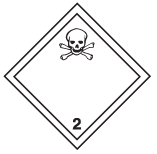 Label and Placard – Text VersionWhite square on point with, in black: a line inside running parallel to the edge, the skull-and-crossbones symbol in the top corner and the number “2” in the bottom corner. Label and Placard |
| Black: Symbol, number and line inside edge |
| White: Background |
| Symbol: Skull and crossbones |
Class 2.3, Toxic-by-Inhalation Gases  Label and Placard – Text VersionWhite square on point with, in black: a line inside running parallel to the edge, a square on point in the top corner the words “INHALATION HAZARD” in the centre and the number “2” in the bottom corner. In white, the skull-and-crossbones symbol in the black square on point. Label and Placard |
| Black: Number, text, line inside edge and a square on point in the top corner |
| White: Symbol and background |
| Symbol: Skull and crossbones |
| Text: “INHALATION HAZARD” |
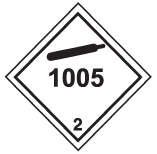 Placard for UN1005, ANHYDROUS AMMONIA – Text VersionWhite square on point with, in black: a line inside running parallel to the edge, the gas-cylinder symbol in the top corner, the number “1005” in the centre of the square and the number “2” in the bottom corner. Placard for UN1005, ANHYDROUS AMMONIA |
| Black: Numbers, symbol and line inside edge |
| White: Background |
| Symbol: Gas cylinder |
Oxidizing Gases 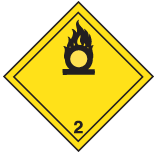 Label and Placard – Text VersionYellow square on point with, in black: a line inside running parallel to the edge, the symbol of a flame over a circle (underlined flaming letter “o”) in the top corner and the number “2” in the bottom corner. Label and Placard |
| Black: Symbol, number and line inside edge |
| Yellow: Background |
| Symbol: Flame over a circle (underlined flaming letter “o”) |
Class 3, Flammable Liquids
Class 3, Flammable Liquids  Label and Placard – Text VersionRed square on point with, in black or white: a line inside running parallel to the edge, the flame symbol in the top corner and the number “3” in the bottom corner. Label and Placard |
| Black or White: Symbol, number and line inside edge |
| Red: Background |
| Symbol: Flame |
Class 4, Flammable Solids; Substances Liable to Spontaneous Combustion; Substances That on Contact with Water Emit Flammable Gases (Water-reactive Substances)
Class 4.1, Flammable Solids  Label and Placard – Text VersionWhite square on point with seven red vertical stripes resulting in 13 red and white stripes of equal width. In black: a line inside running parallel to the edge, the flame symbol in the top corner and the number “4” in the bottom corner. Label and Placard |
| Black: Symbol, number and line inside edge |
| Red: Seven vertical stripes |
| White: Background |
| Symbol: Flame |
Class 4.2, Substances Liable to Spontaneous Combustion  Label and Placard – Text VersionSquare on point with the upper half in white and the lower half in red. In black: a line inside running parallel to the edge, the flame symbol in the top corner and the number “4” in the bottom corner. Label and Placard |
| Black: Symbol, number and line inside edge |
| Red: Lower half of background |
| White: Upper half of background |
| Symbol: Flame |
Class 4.3, Water-reactive Substances  Label and Placard – Text VersionBlue square on point with, in black or white: a line inside running parallel to the edge, the flame symbol in the top corner and the number “4” in the bottom corner. Label and Placard |
| Black or White: Symbol, number and line inside edge |
| Blue: Background |
| Symbol: Flame |
Class 5, Oxidizing Substances and Organic Peroxides
Class 5.1, Oxidizing Substances  Label and Placard – Text VersionYellow square on point with, in black: a line inside running parallel to the edge, the symbol of a flame over a circle (underlined flaming letter “o”) in the top corner and the number “5.1” in the bottom corner. Label and Placard |
| Black: Symbol, number and line inside edge |
| Yellow: Background |
| Symbol: Flame over a circle (underlined flaming letter “o”) |
Class 5.2, Organic Peroxides 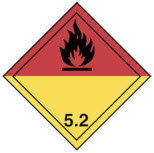 Label and Placard – Text VersionSquare on point with the upper half in red and the lower half in yellow. In black: a line inside running parallel to the edge and the number “5.2” in the bottom corner. In black or white: the flame symbol on the upper half. Label and Placard |
| Black: Number and line inside edge |
| Black or White: Symbol |
| Yellow: Lower half of background |
| Red: Upper half of background |
| Symbol: Flame |
Class 6, Toxic and Infectious Substances
Class 6.1, Toxic Substances 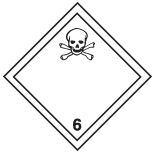 Label and Placard – Text VersionWhite square on point with, in black: a line inside running parallel to the edge, the-skull-and-crossbones symbol in the top corner and the number “6” in the bottom corner. Label and Placard | |
| Black: Symbol, number and line inside edge | |
| White: Background | |
| Symbol: Skull and crossbones |
Class 6.1, Toxic-by-Inhalation Substances  Label and Placard – Text VersionWhite square on point with, in black: a line inside running parallel to the edge, a square on point in the top corner, the words “INHALATION HAZARD” in the centre and the number “6” in the bottom corner. In white: the skull-and-crossbones-symbol in the black square on point. Label and Placard | |
| Black: Number, text, line inside edge and square on point in the top corner | |
| White: Symbol and background | |
| Symbol: Skull and crossbones | |
| Text: “INHALATION HAZARD” |
Class 6.2, Infectious Substances  Label – Text VersionWhite square on point with, in black: a line inside running parallel to the edge, the biohazard symbol (three crescents superimposed on a circle) in the top corner and the number “6” in the bottom corner underneath bilingual text that reads as follows: “INFECTIOUS IN CASE OF DAMAGE OR LEAKAGE IMMEDIATELY NOTIFY LOCAL AUTHORITIES AND CANUTEC 613-996-6666 / INFECTIEUX EN CAS DE DOMMAGE OU DE FUITE COMMUNIQUER IMMÉDIATEMENT AVEC LES AUTORITÉS LOCALES ET CANUTEC 613-996-6666”. Label | |
| Black: Symbol, number, text and line inside edge | |
| White: Background | |
| Symbol: Three crescents superimposed on a circle | |
| Text: | |
|
|
| |

Class 6.2, Infectious Substances  Placard – Text VersionWhite square on point with, in black: a line inside running parallel to the edge, the biohazard symbol (three crescents superimposed on a circle) in the top corner and the number “6” in the bottom corner. Placard |
| Black: Symbol, number and line inside edge |
| White: Background |
| Symbol: Three crescents superimposed on a circle |
Class 7, Radioactive Material
Class 7, Radioactive Material Category I – White  Label and Optional Placard – Text VersionWhite square on point with, in black: a line inside running parallel to the edge, a horizontal line dividing the square (excluding the border) in half, the radioactivity (trefoil) symbol in the upper half and text in the lower half. In the lower half, the word “RADIOACTIVE” in the upper part followed by a red vertical bar and, underneath, bilingual text that reads as follows: “CONTENTS — CONTENU; ACTIVITY — ACTIVITÉ”. The number “7” in the bottom corner. Label and Optional Placard |
| Black: Symbol, number, text, line inside edge and horizontal line dividing the square (excluding the border) in half |
| Red: One vertical bar after the word “RADIOACTIVE” |
| White: Background |
| Symbol: Radioactive trefoil |
| Text under the word “RADIOACTIVE”: CONTENTS ACTIVITY |
Class 7, Radioactive Material Category II – Yellow  Label and Optional Placard – Text VersionWhite square on point with, in black: a line inside running parallel to the edge, a horizontal line dividing the square (excluding the border) in half, the radioactivity (trefoil) symbol in the upper half and text in the lower half. In the lower half, the word “RADIOACTIVE” in the upper part followed by two red vertical bars and, underneath, bilingual text that reads as follows: “CONTENTS — CONTENU, ACTIVITY — ACTIVITÉ — INDICE DE TRANSPORT INDEX”. In the lower half, the number “7” in the bottom corner and an empty square above the number “7”. Yellow upper half (excluding the border). Label and Optional Placard |
| Black: Symbol, number, text, line inside edge and horizontal line dividing the square (excluding the border) in half |
| Red: Two vertical bars after the word “RADIOACTIVE” |
| Yellow: Upper half (excluding the border) |
| White: Lower half and border |
| Symbol: Radioactive trefoil |
| The text and shape under the word “RADIOACTIVE”: CONTENTS ACTIVITY INDICE DE TRANSPORT INDEX  |
Class 7, Radioactive Material Category III – Yellow  Label and Optional Placard – Text VersionWhite square on point with, in black: a line inside running parallel to the edge, a horizontal line dividing the square (excluding the border) in half, the radioactivity (trefoil) symbol in the upper half and text in the lower half. In the lower half, the word “RADIOACTIVE” in the upper part followed by three red vertical bars and, underneath, bilingual text that reads as follows: “CONTENTS — CONTENU, ACTIVITY — ACTIVITÉ — INDICE DE TRANSPORT INDEX”. In the lower half, the number “7” in the bottom corner and an empty square above the number “7”. Yellow upper half (excluding the border). Label and Optional Placard |
| Black: Symbol, number, text, line inside edge and horizontal line dividing the square (excluding the border) in half |
| Red: Three vertical bars after the word “RADIOACTIVE” |
| Yellow: Upper half (excluding the border) |
| White: Lower half and border |
| Symbol: Radioactive trefoil |
| The text and shape under the word “RADIOACTIVE”: CONTENTS ACTIVITY INDICE DE TRANSPORT INDEX |
Class 7, Radioactive Material  Placard – Text VersionWhite square on point with, in black: a line inside running parallel to the edge, a horizontal line dividing the square (excluding the border) in half, the radioactivity (trefoil) symbol in the upper half. In the lower half, the word “RADIOACTIVE” in the upper part and the number “7” in the bottom corner. Yellow upper half (excluding the border). Placard |
| Black: Symbol, number, text, line inside edge and horizontal line dividing the square (excluding the border) in half |
| Yellow: Upper half (excluding the border) |
| White: Lower half and border |
| Symbol: Radioactive trefoil |
| Optional text: “RADIOACTIVE” |
Class 7, Fissile Material  Label – Text VersionWhite square on point with, in black: a line inside running parallel to the edge, a horizontal line dividing the square (excluding the border) in half, the word “FISSILE” in the upper half, the words “CRITICALITY SAFETY INDEX” in a rectangle in the lower half and the number “7” in the bottom corner. Label |
| Black: Number, text, outline of rectangle in lower half, line through centre of label and line inside edge |
| White: Background |
| Text: |
|
Class 8, Corrosives
Class 8, Corrosives  Label and Placard – Text VersionWhite square on point with, in black: a line inside running parallel to the edge, the lower half (excluding the border) and a symbol consisting of liquid spilling from two transparent test tubes and corroding a hand and metal bar in the upper half. In white: the border and the number “8” in the bottom corner. Label and Placard |
| White: Number, upper half and border |
| Black: Symbol, line inside edge and lower half (excluding the border) |
| Symbol: Liquid spilling from two transparent test tubes and corroding a hand and metal bar |
Class 9, Miscellaneous Products, Substances or Organisms
Class 9, Miscellaneous Products, Substances or Organisms  Label and Placard – Text VersionWhite square on point with, in black: a line inside the edge, seven vertical stripes in the upper half resulting in 13 black and white stripes of equal width. Also in black: the number “9” in the bottom corner and the underlining of the number. Label and Placard |
| Black: Seven vertical stripes in the upper half, symbol, number, underlining and line inside edge |
| White: Background |
| Number 9 underlined |
Class 9, Lithium Batteries 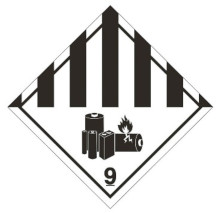 Label – Text VersionWhite square on point with seven black vertical stripes in the upper half resulting in 13 black and white stripes of equal width. Also in black: a line inside running parallel to the edge, a group of batteries (one damaged and emitting flame) in the lower half, the number “9” in the bottom corner and the underlining. Label |
| Black: Seven vertical stripes in the upper half, symbol, number, underlining and line inside edge |
| White: Background |
| Symbol: A group of batteries (one broken and emitting flame) in the lower half |
| Number 9 underlined |
Other Placards
Danger Placard  Placard |
| Black: Text |
| White: Centre horizontal band forming the background for the word “DANGER” |
| Red: Background except for the centre band |
| The symbol is the word DANGER, with each letter at least 50 mm high and at least 10 mm wide. |
Signs
Elevated Temperature Sign  |
| Red: Symbol and border |
| White: Background |
| Size: Equilateral triangle with sides of at least 250 mm in length |
| The symbol is a thermometer. |
Fumigation Sign 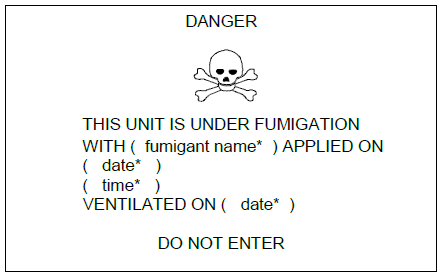 |
| Black: Symbol and text |
| White: Background |
| Size: Rectangle, at least 400 mm wide and 300 mm high with an outer line that is at least 2 mm wide |
| Symbol: The word “DANGER” centered on top of skull and crossbones |
| The lettering must be at least 25 mm high |
| The additional text under the symbol is: THIS UNIT IS UNDER FUMIGATION WITH * APPLIED ON ** *** VENTILATED ON **** DO NOT ENTER * Replace with name of fumigant ** Replace with date *** Replace with time of fumigation **** Replace with date of ventilation |
Marks
Marine Pollutant Mark  |
| Black: Symbol |
| White: Background |
| Size: For small means of containment, a square on point with each side at least 100 mm in length. For large means of containment, a square on point with each side at least 250 mm in length. |
| The symbol is a fish and a tree. |
Category B Mark  |
| Black: Letters and numbers at least 6 mm high and line at least 2 mm wide |
| White: Background, except that the background may be the colour of the means of containment if it contrasts with the letters, numbers and line |
| Size: Square on point with each side at least 50 mm in length |
Lithium Battery Mark  Image DescriptionWhite rectangle with red border hatching and, in black: a group of batteries (one damaged and emitting flame) above a horizontally-centred asterisk. |
|
| Black: Symbol |
| White: Background |
| Red: Border hatching, at least 5 mm wide |
| Size: Rectangle or square, at least 100 mm wide x 100 mm high |
| Symbol: A group of batteries, one damaged and emitting flame, above the UN number for lithium ion or lithium metal batteries or cells |
Panels
Orange Panel  |
| Black: Numbers and border |
| Orange: Background |
| Size: Rectangle, at least 120 mm high and 300 mm wide with a border 10 mm wide. |
| Replace * with the four digits of the UN number which must be at least 65 mm high. |
- SOR/2008-34, ss. 58 to 61
- SOR/2014-159, ss. 27 to 30 (s. 29 Erratum, Vol. 148, No. 15, page 2161)
- SOR/2017-137, ss. 35 to 37
- SOR/2026-112, s. 76
PART 5Means of Containment
5.1 [Repealed, SOR/2019-75, s. 6]
Selecting and Using Means of Containment
5.1.1 (1) A person must not import, offer for transport, handle or transport dangerous goods in a means of containment unless the means of containment is required or permitted by this Part to be used for the transportation of the dangerous goods.
(2) A person must not offer for transport, handle or transport dangerous goods in a standardized means of containment unless the standardized means of containment is in standard.
(3) A person must not offer for transport, handle or transport dangerous goods in a means of containment that is required or permitted by this Part unless the means of containment is designed, constructed, filled, closed, secured and maintained so that under normal conditions of transport, including handling, there will be no release of the dangerous goods that could endanger public safety.
- SOR/2017-137, s. 39
- SOR/2023-155, s. 39
Requirements for a Standardized Means of Containment to Be in Standard
5.2 A standardized means of containment is in standard with a specific safety standard if
(a) it has displayed on it the compliance marks required by the standard;
(b) it was in compliance with the requirements of the standard when each compliance mark was first displayed; and
(c) it remains in compliance with the requirements of the standard that had to be complied with when each compliance mark was first displayed.
Compliance Marks on a Means of Containment
5.3 Any mark required by a safety standard is a compliance mark and must be visible and legible when it is displayed on a means of containment.
Loading and Securing
5.4 A person must load and secure dangerous goods in a means of containment and must load and secure the means of containment on a means of transport in such a way as to prevent, under normal conditions of transport, damage to the means of containment or to the means of transport that could lead to a release of the dangerous goods.
Filling Limits
5.5 (1) A person filling a means of containment with dangerous goods must not exceed the maximum quantity limit specified in a safety standard or safety requirement applicable to that means of containment.
(2) If the maximum quantity limit for a means of containment is not specified in a safety standard or safety requirement, the person filling the means of containment with dangerous goods
(a) must not exceed the maximum quantity limit established by the manufacturer for the means of containment; and
(b) must ensure that the means of containment could not become liquid full at any temperature that is less than or equal to 55°C.
- SOR/2008-34, s. 65
- SOR/2012-245, s. 19
5.5.1 [Repealed, SOR/2015-100, s. 3]
UN Standardized Means of Containment
5.6 A means of containment is a UN standardized means of containment if it has displayed on it the applicable UN marks illustrated in Chapter 6.1, 6.3, 6.5 or 6.6 of the UN Recommendations and
(a) it is in compliance with
(i) sections 2 and 3 and Part I of CGSB-43.125, for a Type P620 means of containment,
(i.1) sections 2 and 3 and Part I of CGSB-43.145,
(ii) sections 2 and 3 and Part I of CGSB-43.146, or
(iii) sections 2 and 3 and Part I of CGSB-43.150; or
(b) it was manufactured outside Canada in compliance with Chapter 6.1, 6.3, 6.5 or 6.6 of the UN Recommendations and with the national regulations of the country of manufacture.
- SOR/2002-306, s. 22
- SOR/2014-152, s. 18
- SOR/2017-137, s. 40
- SOR/2026-112, s. 77
Class 1, Explosives
Compatibility Groups
5.7 (1) A person must not load or transport with other explosives in the same means of transport, except for a vessel, explosives that have a compatibility group letter listed in column 1 of a row in the following table unless the compatibility group letter of the other explosives is listed in column 2 of the same row:
TABLE
Column 1 Column 2 A A B B, S C C, D, E, N, S D C, D, E, N, S E C, D, E, N, S F F, S G G, S H H, S J J, S K K, S L L N C, D, E, N, S S B, C, D, E, F, G, H, J, K, N, S (2) For a mixed load of two or more explosives with compatibility groups C, D, E, N or S, the compatibility group of the mixed load is the first compatibility group of E, D, C, N or S present in the mixed load.
(3) Despite subsection (1), detonators in compatibility group B may be loaded or transported in the same road vehicle with explosives in compatibility group D or N. The compatibility group of the mixed load is D.
(4) Despite subsection (1), explosive articles included in compatibility group G, except for fireworks with UN number UN0333, UN0334, UN0335 or UN0336, may be loaded or transported in the same road vehicle together with explosive articles included in compatibility group C, D or E. The compatibility group of the mixed load is E.
(5) For a mixed load of two explosives with one of the compatibility groups being S, the compatibility group of the mixed load is that of the other compatibility group.
- SOR/2008-34, s. 66
- SOR/2017-253, s. 52
Means of Containment for Class 1, Explosives
5.8 A person must not offer for transport, handle or transport dangerous goods included in Class 1, unless they are in a means of containment that is selected and used in accordance with CGSB-43.151.
- SOR/2014-306, s. 31
- SOR/2023-155, s. 41
5.9 [Repealed, SOR/2008-34, s. 67]
Class 2, Gases
Means of Containment for Class 2, Gases
5.10 (1) A person must not offer for transport, handle or transport dangerous goods included in Class 2, Gases, in a means of containment unless the means of containment is manufactured, selected and used in accordance with
(a) for transport by road vehicle,
(i) CGSB-43.123, if the gas is included in Class 2.1, Flammable Gases or Class 2.2, Non-flammable and Non-toxic Gases,
(ii) CSA B340,
(iii) CSA B342,
(iv) CSA B622,
(v) CSA B625, or
(vi) CGSB-43.149;
(b) for transport by railway vehicle,
(i) CGSB-43.123, if the gas is included in Class 2.1, Flammable Gases or Class 2.2, Non-flammable and Non-toxic Gases,
(ii) CGSB-43.147,
(iii) CSA B340,
(iv) CSA B342, or
(v) CSA B625;
(c) for transport by aircraft,
(i) CGSB-43.123, if the gas is included in Class 2.1, Flammable Gases or Class 2.2, Non-flammable and Non-toxic Gases,
(ii) CSA B340, or
(iii) CSA B342; and
(d) for transport by vessel,
(i) CGSB-43.123, if the gas is included in Class 2.1, Flammable Gases or Class 2.2, Non-flammable and Non-toxic Gases,
(ii) CGSB-43.147,
(ii.1) CGSB-43.149,
(iii) CSA B340,
(iv) CSA B342,
(v) CSA B622, or
(vi) CSA B625.
(2) [Repealed, SOR/2023-155, s. 42]
(3) [Repealed, SOR/2023-155, s. 42]
(4) [Repealed, SOR/2023-155, s. 42]
(5) [Repealed, SOR/2023-155, s. 42]
(6) For the purposes of this section, the following requirements apply in respect of a report of requalification, repair, reheat treatment or rebuilding that is referred to in clause 24.7 of CSA B339:
(a) the person who prepares the report must give a copy of it to the owner of the means of containment;
(b) the person who prepares the report and the owner must each keep a copy of the report for 10 years; and
(c) the owner must, during the 10-year period, give a copy of the report to any person to whom ownership of the means of containment is transferred.
(7) [Repealed, SOR/2023-155, s. 42]
(8) [Repealed, SOR/2023-155, s. 42]
(9) [Repealed, SOR/2023-155, s. 42]
(10) [Repealed, SOR/2023-155, s. 42]
(11) For the purposes of this section, a person who uses a standardized means of containment in accordance with CSA B622 must use a means of containment that
(a) is manufactured in accordance with CSA B620 if it was manufactured in Canada on or after August 31, 2008; and
(b) is tested and inspected in accordance with CSA B620 if its most recent periodic re-test or periodic inspection was performed in Canada on or after August 31, 2008.
(12) [Repealed, SOR/2026-112, s. 78]
(13) [Repealed, SOR/2026-112, s. 78]
- SOR/2002-306, s. 23
- SOR/2003-273, s. 6
- SOR/2005-216, s. 4
- SOR/2005-279, s. 2
- SOR/2008-34, s. 68
- SOR/2012-245, s. 20
- SOR/2014-152, s. 19
- SOR/2017-137, s. 41
- SOR/2017-253, s. 52
- SOR/2023-155, s. 42
- SOR/2026-112, s. 78
- SOR/2026-127, s. 61
UN1950, AEROSOLS, and UN2037, GAS CARTRIDGES
5.11 Despite section 5.10, a person must not offer for transport, handle or transport dangerous goods that are UN1950, AEROSOLS, or UN2037, GAS CARTRIDGES, unless they are contained in a means of containment that is manufactured, selected and used in accordance with CGSB-43.123.
- SOR/2002-306, s. 24
- SOR/2008-34, s. 69
- SOR/2014-152, s. 20
- SOR/2023-155, s. 43
Classes 3, 4, 5, 6.1, 8 and 9 Dangerous Goods
Small Means of Containment
5.12 (1) A person must not import, offer for transport, handle or transport dangerous goods included in Class 3, 4, 5, 6.1, 8 or 9 in a small means of containment unless it is selected and used in accordance with sections 2 and 3 and Part II of CGSB-43.146 or selected and used in accordance with sections 2 and 3 and Part II of CGSB-43.150.
(2) The manufacturer or distributor of a small means of containment that is a UN standardized means of containment manufactured in Canada must provide the means of containment information to the initial user in accordance with clause 4.4 of CGSB-43.150.
(3) The manufacturer or distributor of a UN standardized means of containment that is an IBC manufactured in Canada must provide a notice to the initial user in accordance with clause 4.8 of CGSB-43.146.
(4) A person must not reuse an IBC for liquids or solids that is filled or discharged under pressure to offer for transport, handle or transport dangerous goods included in Class 3, 4, 5, 6.1, 8 or 9 unless it has been leak-tested and inspected in accordance with clause 12.6 of CGSB-43.146.
(5) In addition to the requirements set out in subsection (1), a person who uses a means of containment that is required under CGSB-43.146 for the offering for transport of dangerous goods must follow the requirements of clauses 12.2, 12.3 and 12.4 of CGSB-43.146.
- SOR/2002-306, s. 25
- SOR/2003-273, s. 7
- SOR/2011-60, s. 4
- SOR/2014-152, s. 21
- SOR/2017-137, s. 42
- SOR/2026-112, s. 79
5.13 [Repealed, SOR/2014-152, s. 22]
Large Means of Containment
5.14 (1) A person must not import, offer for transport, handle or transport dangerous goods included in Class 3, 4, 5, 6.1, 8 or 9 in a large means of containment unless it is manufactured, selected and used in accordance with
(a) for transport by road vehicle,
(i) Part II of CGSB-43.145,
(ii) Part II of CGSB-43.146,
(iii) CSA B621,
(iv) CSA B625, or
(v) CGSB-43.149, if the means of containment is a ton container;
(b) for transport by railway vehicle,
(i) Part II of CGSB-43.145,
(ii) Part II of CGSB-43.146,
(iii) CSA B625, or
(iv) CGSB-43.147; and
(c) for transport by vessel,
(i) Part II of CGSB-43.145,
(ii) Part II of CGSB-43.146,
(iii) CSA B621,
(iv) CSA B625,
(v) CGSB-43.147, or
(vi) CGSB-43.149.
(1.1) [Repealed, SOR/2019-75, s. 7]
(2) A person who uses a standardized means of containment required by CSA B621 to offer for transport dangerous goods included in Class 3, 4, 5, 6.1, 8 or 9 must use a means of containment that is
(a) manufactured in accordance with CSA B620 if the means of containment was manufactured in Canada on or after August 31, 2008; and
(b) tested and inspected in accordance with CSA B620 when the most recent periodic re-test or periodic inspection is performed in Canada on or after August 31, 2008.
(3) [Repealed, SOR/2017-137, s. 43]
(4) [Repealed, SOR/2017-137, s. 43]
- SOR/2002-306, s. 27
- SOR/2005-279, s. 3
- SOR/2007-179, s. 3
- SOR/2008-34, s. 70
- SOR/2012-245, s. 21
- SOR/2014-152, s. 23
- SOR/2015-100, s. 4
- SOR/2017-137, s. 43
- SOR/2017-253, ss. 15, 52
- SOR/2019-75, s. 7
- SOR/2026-112, s. 80
- SOR/2026-127, s. 62
5.14.1 [Repealed, SOR/2019-75, s. 8]
5.14.2 [Repealed, SOR/2019-75, s. 8]
5.14.3 [Repealed, SOR/2019-75, s. 8]
5.15 [Repealed, SOR/2019-75, s. 8]
5.15.1 [Repealed, SOR/2019-75, s. 8]
5.15.2 [Repealed, SOR/2019-75, s. 8]
5.15.3 [Repealed, SOR/2019-75, s. 8]
5.15.4 [Repealed, SOR/2019-75, s. 8]
5.15.5 [Repealed, SOR/2019-75, s. 8]
5.15.6 [Repealed, SOR/2019-75, s. 8]
5.15.7 [Repealed, SOR/2019-75, s. 8]
5.15.8 [Repealed, SOR/2019-75, s. 8]
5.15.9 [Repealed, SOR/2019-75, s. 8]
5.15.10 [Repealed, SOR/2019-75, s. 8]
5.15.11 [Repealed, SOR/2019-75, s. 8]
Class 6.2, Infectious Substances
Means of Containment for Class 6.2, Infectious Substances
5.16 (1) A person must not offer for transport, handle or transport dangerous goods included in Category A or Category B of Class 6.2, Infectious Substances, unless the dangerous goods are in a means of containment that is manufactured, selected and used in accordance with CGSB-43.125.
(2) If the means of containment is a packaging made available as a kit, the packaging manufacturer or distributor must provide the packaging information required under clause 4.4 of CGSB-43.125 to the packaging purchaser at the initial purchase and to a packaging user on request.
- SOR/2008-34, s. 72
- SOR/2017-137, s. 52
- SOR/2017-253, s. 16
- SOR/2026-112, s. 81
5.16.1 [Repealed, SOR/2017-137, s. 53]
5.16.2 [Repealed, SOR/2017-137, s. 53]
Class 7, Radioactive Materials
Means of Containment for Class 7, Radioactive Materials
5.17 A person must not offer for transport, handle or transport dangerous goods included in Class 7 in a means of containment unless the means of containment is in compliance with the Packaging and Transport of Nuclear Substances Regulations, 2015.
Consolidation Bins
Consolidation Bins
5.18 A person must not use a consolidation bin to handle or transport dangerous goods in a road vehicle unless
(a) the capacity of the consolidation bin is less than or equal to 1.8 m3 (64 cubic feet);
(b) the consolidation bin is reusable and constructed of plastic, wood or metal; and
(c) the consolidation bin is blocked or braced within the road vehicle.
PART 6Training
Training Certificate Requirements
6.1 (1) A person who handles, offers for transport or transports dangerous goods must
(a) be adequately trained and hold a training certificate in accordance with this Part; or
(b) perform those activities in the presence and under the direct supervision of a person who is adequately trained and who holds a training certificate in accordance with this Part.
(2) An employer must not direct or allow an employee to handle, offer for transport or transport dangerous goods unless the employee
(a) is adequately trained and holds a training certificate in accordance with this Part; or
(b) performs those activities in the presence and under the direct supervision of a person who is adequately trained and who holds a training certificate in accordance with this Part.
Adequate Training
6.2 A person is adequately trained if the person has a sound knowledge of all the topics listed in paragraphs (a) to (m) that relate directly to the person’s duties and to the dangerous goods the person is expected to handle, offer for transport or transport:
(a) the classification criteria and test methods in Part 2 (Classification);
(b) shipping names;
(c) the use of Schedules 1, 2 and 3;
(d) the shipping document and train consist requirements in Part 3 (Documentation);
(e) the dangerous goods marks requirements in Part 4 (Dangerous Goods Marks);
(f) the compliance marks requirements, safety requirements and safety standards in Part 5;
(g) the ERAP requirements in Part 7 (Emergency Response Assistance Plan);
(h) the report requirements in Part 8 (Reporting Requirements);
(i) safe handling and transportation practices for dangerous goods, including the characteristics of the dangerous goods;
(j) the proper use of any equipment used to handle or transport the dangerous goods;
(k) the reasonable emergency measures the person must take to reduce or eliminate any danger to public safety that results or may reasonably be expected to result from a release of the dangerous goods;
(l) for air transport, the aspects of training set out in Chapter 4, Training, of Part 1, General, of the ICAO Technical Instructions for the persons named in that Chapter and the requirements in Part 12 (Air) of these Regulations; and
(m) for marine transport, the requirements of the IMDG Code and the requirements of Part 11 (Marine) of these Regulations.
- SOR/2002-306, s. 29
- SOR/2016-95, s. 41
- SOR/2017-253, s. 17
- SOR/2019-101, s. 22
- SOR/2026-112, s. 82
- SOR/2026-112, s. 297
- SOR/2026-127, s. 114
Issuance and Contents of a Training Certificate
6.3 (1) An employer who has reasonable grounds to believe that an employee is adequately trained and will perform duties to which the training relates must issue a training certificate to the employee that includes the following information:
(a) the name and address of the place of business of the employer;
(b) the employee’s name;
(c) the date the training certificate expires, preceded by the words “Expires on” or “Date d’expiration”; and
(d) the aspects of handling, offering for transport or transporting dangerous goods for which the employee is trained, including the specific topics set out in section 6.2.
(2) A self-employed person who has reasonable grounds to believe that he or she is adequately trained and who will perform duties to which the training relates must issue to himself or herself a training certificate that includes the information required by subsection (1).
(3) The training certificate must be signed
(a) by the employee and by the employer or another employee acting on behalf of the employer; or
(b) in the case of a self-employed person, by that person.
(4) Despite subsection (1), if the employer of a person who is a member of a vessel’s complement has reasonable grounds to believe that the person’s certificate of competency issued in accordance with the Marine Certification Regulations is acceptable evidence that the person is adequately trained, the employer is not required to issue the training certificate. The certificate of competency is a valid training certificate for the purposes of these Regulations when the certificate of competency is valid in Canada.
- SOR/2017-253, s. 52
Foreign Carriers
6.4 (1) A document that is issued to a driver of a road vehicle licensed in the United States or to a member of the crew of a train subject to 49 CFR for the transportation of dangerous goods and that indicates that the driver or the crew member is trained in accordance with sections 172.700 to 172.704 of 49 CFR is a valid training certificate for the purposes of these Regulations when that document is valid in the United States.
(2) A document that is issued to a foreign member of the flight crew of an aircraft registered in a country that is a Member State of the International Civil Aviation Organization and that indicates that the crew member is trained to transport dangerous goods by air is a valid training certificate for the purposes of these Regulations, in accordance with Article 33 of the Convention on International Civil Aviation, when that document is valid in the Member State.
(3) A document that is issued to a foreign member of the crew of a vessel registered in a country that is a Member State of the International Maritime Organization and that indicates that the crew member is trained to transport dangerous goods by vessel is a valid training certificate for the purposes of these Regulations when that document is valid in the Member State.
- SOR/2017-253, s. 52
Expiry of a Training Certificate
6.5 A training certificate expires
(a) for transport by aircraft, 24 months after its date of issuance; and
(b) for transport by road vehicle, railway vehicle or vessel, 36 months after its date of issuance.
- SOR/2017-253, s. 52
Keeping Proof of Training: Employer’s and Self-Employed Person’s Responsibility
6.6 An employer or a self-employed person must keep a record of training or a statement of experience, as well as a copy of a training certificate, in electronic or paper form, beginning on the date the training certificate is issued and continuing until two years after the date it expires.
Showing Proof of Training: Employer’s and Self-Employed Person’s Responsibility
6.7 Within 15 days after the date of a written request by an inspector, the employer of a person who holds a training certificate or a self-employed person must provide a copy of the training certificate to the inspector and, if applicable, a copy of the record of training or the statement of experience and a description of the training material used in the person’s training.
Showing Proof of Training: Trained Person’s Responsibility
6.8 A person who handles, offers for transport or transports dangerous goods, or who directly supervises another person engaged in these activities, must give his or her training certificate, or a copy of it, to an inspector immediately on request.
PART 7Emergency Response Assistance Plan
Application
7.1 This Part sets out
(a) the requirement to have an approved ERAP;
(b) the approval of an ERAP;
(c) the authorization to use an approved ERAP;
(d) the implementation of an approved ERAP; and
(e) the compensation for the authorized implementation of an approved ERAP.
- SOR/2002-306, s. 30
- SOR/2008-34, s. 74
- SOR/2011-239, s. 4
- SOR/2014-152, s. 25
- SOR/2014-306, s. 33 (Erratum, Vol. 149, No. 2, page 329)
- SOR/2015-100, s. 6
Requirement to Have an Approved ERAP
7.2 (1) For the purposes of subsection 7(1) of the Act, an approved ERAP is required for
(a) dangerous goods that have the same UN number and that are contained in a single means of containment, if the quantity of those dangerous goods exceeds the ERAP index in column 7 of Schedule 1;
(b) dangerous goods, in a road vehicle or a railway vehicle, that have the same UN number and that are contained in more than one means of containment, if the total quantity of those dangerous goods exceeds the ERAP index in column 7 of Schedule 1 and are included in one of the following classes:
(i) Class 3, if they are assigned a subsidiary class of Class 6.1,
(ii) Class 4,
(iii) Class 5.2, if they are Type B or Type C,
(iv) Class 6.1, if they are included in Packing Group I;
(c) dangerous goods, in a road vehicle or a railway vehicle, that have the same UN number, and that are contained in more than one large means of containment, if the total quantity of those dangerous goods exceeds the ERAP index in column 7 of Schedule 1;
(d) dangerous goods, in a road vehicle or a railway vehicle, that are included in Class 1, Explosives, and that are contained in one or more means of containment, if the total quantity of those dangerous goods exceeds the ERAP index in column 7 of Schedule 1 for the explosives with the lowest index number in that column;
(e) dangerous goods that are included in Class 2, Gases, that have the same UN number, that are contained in more than one means of containment — each of which has a capacity greater than 225 L — that are a single unit as a result of being interconnected through a piping arrangement and that are permanently mounted on a structural frame for transport, if the total quantity of those dangerous goods exceeds the ERAP index in column 7 of Schedule 1;
(f) any of the following dangerous goods that are transported by rail in a tank car, if the quantity of those dangerous goods in the tank car exceeds 10 000 L:
(i) UN1170, ETHANOL with more than 24% ethanol, by volume, ETHANOL SOLUTION with more than 24% ethanol, by volume, ETHYL ALCOHOL with more than 24% ethanol, by volume, or ETHYL ALCOHOL SOLUTION with more than 24% ethanol, by volume,
(ii) UN1202, DIESEL FUEL, GAS OIL, or HEATING OIL, LIGHT,
(iii) UN1203, GASOLINE, MOTOR SPIRIT, or PETROL,
(iv) UN1267, PETROLEUM CRUDE OIL,
(v) UN1268, PETROLEUM DISTILLATES, N.O.S., or PETROLEUM PRODUCTS, N.O.S.,
(vi) UN1863, FUEL, AVIATION, TURBINE ENGINE,
(vii) UN1987, ALCOHOLS, N.O.S.,
(viii) UN1993, FLAMMABLE LIQUID, N.O.S.,
(ix) UN3295, HYDROCARBONS, LIQUID, N.O.S.,
(x) UN3475, ETHANOL AND GASOLINE MIXTURE, with more than 10% ethanol, ETHANOL AND MOTOR SPIRIT MIXTURE, with more than 10% ethanol, or ETHANOL AND PETROL MIXTURE, with more than 10% ethanol, and
(xi) UN3494, PETROLEUM SOUR CRUDE OIL, FLAMMABLE, TOXIC; and
(g) any quantity of dangerous goods that are Risk Group 4 human pathogens within the meaning of the Human Pathogens and Toxins Act, other than dangerous goods that are UN3549, MEDICAL WASTE, CATEGORY A, AFFECTING HUMANS or MEDICAL WASTE, CATEGORY A, AFFECTING ANIMALS.
(2) An approved ERAP is required for dangerous goods classified in accordance with the ICAO Technical Instructions, the IMDG Code, the UN Recommendations or 49 CFR, in accordance with subsection 2.2(4) or Parts 9, 10, 11 or 12, as applicable, if the dangerous goods would require an approved ERAP if they were classified in accordance with Part 2 other than subsection 2.2(4).
Application for Approval of an ERAP
7.3 (1) A person must apply to the Minister in writing for the approval of an ERAP.
(2) The application for approval must be signed by the applicant and must include a copy of the ERAP and the following information:
(a) the name and contact information of the applicant;
(b) a description of the applicant’s operations;
(c) the name and contact information of any third party who assisted in the preparation of the application;
(d) the classification of the dangerous goods to which the ERAP relates and the mode of transport used;
(e) for each mode of transport used,
(i) the frequency of the transportation of the dangerous goods,
(ii) the type and specification of the means of containment used to transport the dangerous goods, and
(iii) the geographical area in which the dangerous goods are transported;
(f) the ERAP telephone number, including the area code, at which a person identified in the ERAP can be reached at any time while the dangerous goods are handled or transported;
(g) a description of the communications systems that will be available at the location of a release or anticipated release of dangerous goods;
(h) the name and contact information of any third-party emergency responders, their role and a copy of the agreement between the applicant and the third party;
(i) the following information regarding the ERAP response equipment:
(i) a detailed list of the equipment,
(ii) the location of the equipment,
(iii) the name of the person responsible for the operation of the equipment at each location,
(iv) for each location, the dangerous goods in respect of which the equipment is to be used during emergency measures, and
(v) the geographical areas where the equipment at each location is to be used;
(j) the following information respecting the ERAP response personnel, including technical advisors, team leaders and response teams:
(i) their names and contact information,
(ii) their responsibilities,
(iii) any training they have taken, and
(iv) description of their knowledge and experience in respect of the dangerous goods;
(k) the response capability in respect of the dangerous goods, including
(i) the measures that can be taken in response to the release or anticipated release,
(ii) the persons responsible for taking the measures referred to in subparagraph (i), and
(iii) the ERAP equipment that will be used to take those measures;
(l) an estimate of the time required for the response personnel and equipment to reach the location of the release or anticipated release and a description of the mobilization and deployment steps in respect of the response personnel and equipment; and
(m) a potential incident analysis, including
(i) the following scenarios:
(A) an anticipated release of dangerous goods,
(B) the release of less than 1% of the dangerous goods in a means of containment,
(C) the release of more than 50% of the dangerous goods in a means of containment, and
(D) the exposure to fire of a means of containment that contains dangerous goods,
(ii) the possible consequences of the release or anticipated release for each scenario,
(iii) the measures, organized by tier in accordance with section 7.8, to be taken in response to the release or anticipated release for each scenario, and
(iv) the identification of the persons responsible for taking the measures referred to in subparagraph (iii).
Application for Approval of an ERAP – Emergency Response Contractors
7.4 A person who is not required to have an approved ERAP under subsection 7(1) of the Act, but who is able to take measures to respond to a release or anticipated release of dangerous goods for the purposes of paragraph 7.1(b) of the Act, may apply to the Minister in writing for the approval of an ERAP. The application must include a copy of the ERAP and the information referred to in paragraphs 7.3(2)(a), (b), (d), (g) and (i) to (l).
Application for Approval of Changes to Approved ERAP
7.5 (1) A person with an approved ERAP must, as soon as possible, apply to the Minister in writing for an approval of changes if any of the information referred to in paragraphs 7.3(2)(a) to (l) has changed since its approval.
(2) The application referred to in subsection (1) must be signed by the applicant and include
(a) a copy of the ERAP; and
(b) the information referred to in paragraphs 7.3(2)(a) to (l) that has changed.
Request for Review of Decision
7.6 (1) A person may request a review of the decision to refuse an application for approval of an ERAP or to revoke an ERAP approval within 30 days after being notified of the decision.
(2) The request must be made to the Minister in writing and must include the reasons why the decision should be revised.
Authorization to Use an Approved ERAP
7.7 (1) A person who is required to have an ERAP under subsection 7(1) of the Act may use, as an authorized user, the ERAP of another person who received approval for the ERAP if
(a) the authorized user is not the producer of the dangerous goods to which the ERAP relates;
(b) the ERAP applies to the dangerous goods, the mode of transport, the means of containment and the geographical area in which the dangerous goods will be in transport;
(c) the person who received approval for the ERAP agrees to take measures to respond to a release or anticipated release of the dangerous goods to which the ERAP relates; and
(d) the person who received approval for the ERAP provides a written authorization to the authorized user before the information referred to in paragraph 3.5(1)(i) is entered on the shipping document or before the information referred to in subsection 12.16(3) is entered on the transport document, as applicable.
(2) The authorized user must be able to produce a copy of the authorization referred to in paragraph (1)(d)
(a) for two years after the day on which the authorization is no longer in effect; and
(b) within 15 days after the day on which the authorized user receives a written request from the Minister.
Implementation of an Approved ERAP
7.8 (1) A person with an approved ERAP must implement it to tier 1 or tier 2 in response to a release or anticipated release of dangerous goods.
(2) A person who implements an approved ERAP to tier 1 must
(a) provide technical or emergency response advice as soon as possible after a request for the advice; and
(b) remotely monitor the response to the release or anticipated release.
(3) A person who implements an approved ERAP to tier 2 must
(a) provide technical or emergency response advice as soon as possible after a request for the advice;
(b) monitor the response to the release or anticipated release; and
(c) send ERAP emergency response resources to the location of the release or anticipated release.
(4) A person must not prevent another person who has an approved ERAP from taking emergency measures in response to a release or anticipated release.
Compensation for the Authorized Implementation of an Approved ERAP
7.9 (1) If a person implements an approved ERAP in accordance with paragraph 7.1(b) of the Act, the following expenses are authorized for the purposes of compensation under section 7.2 of the Act:
(a) expenses related to the death, disability or injury of the person or to the death, disability or injury of any of the person’s employees or contractors if
(i) the person, the employee or the contractor is killed, disabled or injured during the implementation of the ERAP, and
(ii) the death, disability or injury is the result of an act or omission that was committed by the person in good faith and without negligence;
(b) the cost of the person’s employees or contractors who are reasonably required to implement the ERAP;
(c) the cost of using the person’s tools and other equipment, such as vehicles, pumps, hoses and generators, that are reasonably required to implement the ERAP;
(d) travel expenses, such as those incurred for meals, accommodation, fuel, oil and flights, for persons who are reasonably required to implement the ERAP;
(e) rental fees for heavy equipment, such as cranes, bulldozers, pumps, compressors and generators, that are reasonably required to implement the ERAP;
(f) other overhead costs that can reasonably be attributed to the implementation of the ERAP;
(g) the cost of repairing tools and other equipment that are damaged during the implementation of the ERAP;
(h) the cost of replacing
(i) single-use equipment and supplies, such as packaging, personal protective equipment, personal protective clothing, chemicals and other consumables, that are reasonably required to implement the ERAP,
(ii) tools and other equipment that are lost during the implementation of the ERAP, and
(iii) tools and other equipment that are damaged beyond repair during the implementation of the ERAP;
(i) the cost of repairing or replacing personal property or movables or real property or immovables that have to be damaged to implement the ERAP;
(j) the cost of defending any legal action for which there is no personal liability under paragraph 20(c) of the Act; and
(k) the cost of cleaning up after an incident, including handling and disposal costs for dangerous goods and contaminated materials.
(2) The following expenses are not authorized for the purposes of compensation under section 7.2 of the Act:
(a) the cost of purchasing new equipment to implement the approved ERAP; and
(b) the cost of lost business or production during the implementation of the approved ERAP.
Compensation Limits
7.10 (1) Compensation under paragraph 7.9(1)(a) is limited to the compensation that would be paid in relation to the dead, disabled or injured person if the person were insured under
(a) the Public Service Management Insurance Plan;
(b) the Public Service Health Care Plan, with hospital coverage at level III; and
(c) the Public Service Dental Care Plan.
(2) Compensation under paragraph 7.9(1)(h) in relation to the replacement of the items listed in subparagraphs 7.9(1)(h)(i), (ii) and (iii) is limited to the cost of an item of equivalent capability and quality.
(3) Compensation under paragraph 7.9(1)(i) in relation to damaged property is limited to the fair market value of the property immediately before it is damaged by the person who implements the approved ERAP.
- SOR/2011-210, s. 2
Claims for Compensation
7.11 Claims for compensation must be submitted with supporting documentation to the Minister no later than three months after completion of the emergency response work.
- SOR/2011-210, s. 2
PART 8Reporting Requirements
Application and Interpretation
8.1 This Part applies in respect of
(a) the release or anticipated release of dangerous goods that are being offered for transport, handled or transported by road vehicle, railway vehicle or vessel;
(b) the loss or theft of dangerous goods;
(c) unlawful interference with dangerous goods; and
(d) the implementation of an approved ERAP.
(e) [Repealed, SOR/2026-112, s. 85]
- SOR/2003-273, s. 8
- SOR/2008-34, ss. 75, 76
- SOR/2016-95, s. 10
- SOR/2017-253, s. 52
- SOR/2026-112, s. 85
Road, Rail and Marine Reports
Emergency Report — Road, Rail or Marine
8.2 A person who is required by subsection 18(1) of the Act to report a release or anticipated release of dangerous goods that are being offered for transport, handled or transported by road vehicle, railway vehicle or vessel must, as soon as possible after a release or anticipated release, make an emergency report to any local authority that is responsible for responding to emergencies at the geographic location of the release or anticipated release if the dangerous goods are, or could be, in excess of the quantity set out in the following table:
TABLE
| Class | Packing Group or Category | Quantity |
|---|---|---|
| 1 | Not applicable | Any quantity |
| 2 | Not applicable | Any quantity |
| 3, 4, 5, 6.1 or 8 | I or II | Any quantity |
| 3, 4, 5, 6.1 or 8 | III, or without packing group | 30 L or 30 kg |
| 6.2 | A or B | Any quantity |
| 7 | Not applicable | A level of ionizing radiation greater than the level established in section 39 of the Packaging and Transport of Nuclear Substances Regulations, 2015 |
| 9 | II or III, or without packing group | 30 L or 30 kg |
- SOR/2016-95, s. 10
- SOR/2017-253, s. 52
- SOR/2019-101, s. 9
- SOR/2026-127, s. 63
Information To Be Included in an Emergency Report — Road, Rail or Marine
8.3 An emergency report referred to in section 8.2 must include the following information:
(a) the name and contact information of the person making the report;
(b) in the case of a release of dangerous goods, the date, time and geographic location of the release;
(c) in the case of an anticipated release of dangerous goods, the date, time and geographic location of the incident that led to the anticipated release;
(d) the mode of transport used;
(e) the shipping name or UN number of the dangerous goods;
(f) the quantity of dangerous goods that was in the means of containment before the release or anticipated release;
(g) in the case of a release of dangerous goods, the quantity of dangerous goods estimated to have been released; and
(h) if applicable, the type of incident leading to the release or anticipated release, including a collision, roll-over, derailment, overfill, fire, explosion or load-shift.
- SOR/2016-95, s. 10
Release or Anticipated Release Report — Road, Rail or Marine
8.4 (1) Subject to subsection (2), a person who has made an emergency report referred to in section 8.2 must, as soon as possible after making it, make a report to the persons listed in subsection (4).
(2) Subject to subsection (3), the person is not required to make a report referred to in subsection (1) if the release or anticipated release did not result in
(a) the death of a person;
(b) a person sustaining injuries that required immediate medical treatment by a health care provider;
(c) an evacuation of people or their shelter in place; or
(d) the closure of
(i) a facility used in the loading and unloading of dangerous goods, or
(ii) a road, a main railway line or a main waterway.
(3) The person is required to make a report referred to in subsection (1) if
(a) a means of containment has been damaged to the extent that its integrity is compromised; or
(b) the centre sill or stub sill of a tank car is broken or there is a crack in the metal equal to or greater than 15 cm (6 in.).
(4) For the purposes of subsection (1), the persons to whom a report must be made are
(a) CANUTEC, at 1-888-CANUTEC (1-888-226-8832) or 613-996-6666;
(b) the consignor of the dangerous goods;
(c) in the case of dangerous goods included in Class 7, Radioactive Materials, the Canadian Nuclear Safety Commission; and
(d) in the case of a vessel, a Vessel Traffic Services Centre or a Canadian Coast Guard radio station.
- SOR/2016-95, s. 10
- SOR/2017-253, s. 52
Information To Be Included in a Release or Anticipated Release Report — Road, Rail or Marine
8.5 A release or anticipated release report referred to in section 8.4 must include the following information:
(a) the name and contact information of the person making the report;
(b) in the case of a release of dangerous goods, the date, time and geographic location of the release;
(c) in the case of an anticipated release of dangerous goods, the date, time and geographic location of the incident that led to the anticipated release;
(d) the mode of transport used;
(e) the shipping name or UN number of the dangerous goods;
(f) the quantity of dangerous goods that was in the means of containment before the release or anticipated release;
(g) in the case of a release of dangerous goods, the quantity of dangerous goods estimated to have been released;
(h) if applicable, the type of incident leading to the release or anticipated release, including a collision, rollover, derailment, overfill, fire, explosion or load-shift;
(i) if applicable, the name and geographic location of any road, main railway line or main waterway that was closed;
(j) a description of the means of containment containing the dangerous goods;
(k) if applicable, an estimate of the number of people evacuated or sheltered in place; and
(l) if applicable, the number of deaths and the number of persons who sustained injuries that required immediate medical treatment by a health care provider.
- SOR/2016-95, s. 10
30-Day Follow-up Report
8.6 A person who has made a report referred to in section 8.4, or the person’s employer, must make a follow-up report in writing to the Minister within 30 days after the day on which the report was made.
- SOR/2016-95, s. 10
- SOR/2019-101, s. 24
Information To Be Included in a 30-Day Follow-up Report
8.7 A follow-up report referred to in section 8.6 must include the following information:
(a) the name and contact information of the person making the report;
(b) the names and contact information of the consignor, consignee and carrier;
(c) in the case of a release of dangerous goods, the date, time and geographic location of the release;
(d) in the case of an anticipated release of dangerous goods, the date, time and geographic location of the incident that led to the anticipated release;
(e) the mode of transport used;
(f) the classification of the dangerous goods;
(g) the quantity of dangerous goods that was in the means of containment before the release or anticipated release;
(h) in the case of a release of dangerous goods, the quantity of dangerous goods estimated to have been released;
(i) a description of the means of containment containing the dangerous goods;
(j) if applicable, a description of any failure of or damage to the means of containment;
(k) information about the events leading to the release or anticipated release of dangerous goods;
(l) information as to whether there was an explosion or fire;
(m) the name and geographic location of any facility used in the loading or unloading of the dangerous goods that was closed, and the duration of the closure;
(n) the name and geographic location of any road, main railway line or main waterway that was closed, and the duration of the closure;
(o) if applicable, an estimate of the number of people evacuated or sheltered in place and the duration of the evacuation or shelter in place;
(p) if applicable, the number of deaths and the number of persons who sustained injuries that required immediate medical treatment by a health care provider;
(q) the ERAP reference number, if applicable, and
(i) the name of the person who was required to have the ERAP under subsection 7(1) of the Act, and
(ii) the date and time that the ERAP incident report referred to in section 8.20 was made;
(r) the date on which the report referred to in section 8.4 was made; and
(s) an estimate of any financial loss incurred as a result of the release or anticipated release, and any emergency response cost or remediation costs related to it.
- SOR/2016-95, s. 10
- SOR/2019-101, s. 10
30-Day Follow-up Report — Notice and Retention of Report
8.8 (1) A person who has made a follow-up report referred to in section 8.6 must, as soon as possible, notify the Minister of any change to the information referred to in paragraph 8.7(f), (i), (j), (k), (l), (p) or (s) that occurs within one year after the day on which the follow-up report was made.
(2) The person must keep a copy of the report for two years after the day on which it is made.
(3) The person must make the report available to an inspector within 15 days after the day on which the person receives a written request from the inspector.
- SOR/2016-95, s. 10
- SOR/2019-101, s. 24
8.9 [Repealed, SOR/2026-112, s. 86]
8.10 [Repealed, SOR/2026-112, s. 86]
8.11 [Repealed, SOR/2026-112, s. 86]
8.12 [Repealed, SOR/2026-112, s. 86]
8.13 [Repealed, SOR/2026-112, s. 86]
8.14 [Repealed, SOR/2026-112, s. 86]
8.15 [Repealed, SOR/2026-112, s. 86]
8.15.1 [Repealed, SOR/2026-112, s. 86]
8.15.2 [Repealed, SOR/2026-112, s. 86]
Security Reports
Loss or Theft Report
8.16 (1) A person who is required by subsection 18(3) of the Act to report the loss or theft of dangerous goods must, as soon as possible after the loss or theft, report it by telephone to the persons listed in subsection (3) if the lost or stolen dangerous goods are in excess of the quantity set out in subsection (2).
(2) For the purposes of subsection (1), the quantities of dangerous goods are
(a) any quantity, in the case of the following dangerous goods:
(i) UN1261, NITROMETHANE,
(ii) UN1357, UREA NITRATE, WETTED, with not less than 20% water, by mass,
(iii) UN1485, POTASSIUM CHLORATE,
(iv) UN1486, POTASSIUM NITRATE,
(v) UN1487, POTASSIUM NITRATE AND SODIUM NITRITE MIXTURE,
(vi) UN1489, POTASSIUM PERCHLORATE,
(vii) UN1495, SODIUM CHLORATE,
(viii) UN1498, SODIUM NITRATE,
(ix) UN1499, SODIUM NITRATE AND POTASSIUM NITRATE MIXTURE,
(x) UN1511, UREA HYDROGEN PEROXIDE,
(xi) UN1796, NITRATING ACID MIXTURE with more than 50% nitric acid,
(xii) UN1826, NITRATING ACID MIXTURE, SPENT, with more than 50% nitric acid,
(xiii) UN1942, AMMONIUM NITRATE with not more than 0.2% combustible substances, including any organic substance calculated as carbon, to the exclusion of any other added substance,
(xiv) UN2014, HYDROGEN PEROXIDE, AQUEOUS SOLUTION with not less than 20% but not more than 60% hydrogen peroxide (stabilized as necessary),
(xv) UN2015, HYDROGEN PEROXIDE, AQUEOUS SOLUTION, STABILIZED with more than 60% hydrogen peroxide, or HYDROGEN PEROXIDE, STABILIZED,
(xvi) UN2031, NITRIC ACID, other than red fuming,
(xvii) UN2032, NITRIC ACID, RED FUMING,
(xviii) UN3149, HYDROGEN PEROXIDE AND PEROXYACETIC ACID MIXTURE with acid(s), water and not more than 5% peroxyacetic acid, STABILIZED, and
(xix) UN3370, UREA NITRATE, WETTED, with not less than 10% water by mass;
(b) any quantity, in the case of dangerous goods included in any of the following primary or subsidiary classes:
(i) Class 1.1, 1.2 or 1.3,
(ii) Class 2.3,
(iii) Class 5.2, if the dangerous goods are Type B, liquid or solid, temperature controlled,
(iv) Class 6.1, if the dangerous goods are included in Packing Group I,
(v) Class 6.2,
(vi) Class 7; and
(c) a quantity of 450 kg or more, in the case of dangerous goods included in any of the following primary or subsidiary classes:
(i) Class 1.4, if the dangerous goods are not included in compatibility group S, or Class 1.5 or 1.6,
(ii) Class 2.1,
(iii) Class 3,
(iv) Class 4.1, if the dangerous goods are desensitized explosives,
(v) Class 4.2, if the dangerous goods are a pyrophoric substance and are included in Packing Group I or II,
(vi) Class 4.3, 5.1 or 8, if the dangerous goods are included in Packing Group I or II.
(3) For the purposes of subsection (1), the persons to whom the report must be made are
(a) CANUTEC, at 1-888-CANUTEC (1-888-226-8832) or 613-996-6666;
(b) in the case of dangerous goods included in Class 1, Explosives, or referred to in paragraph (2)(a) or subparagraph (2)(b)(i) or (c)(i), a Natural Resources Canada inspector, at 613-995-5555; and
(c) in the case of dangerous goods included in Class 7, Radioactive Materials, the Canadian Nuclear Safety Commission.
(4) A person who made the report referred to in subsection (1) must notify the persons referred to in subsection (3) if that person finds the dangerous goods that were lost or stolen.
- SOR/2016-95, s. 10
- SOR/2017-137, s. 56(F)
- SOR/2026-112, s. 87
Information To Be Included in a Loss or Theft Report
8.17 A loss or theft report referred to in section 8.16 must include the following information:
(a) the name and contact information of the person making the report;
(b) the names and contact information of the consignor, the consignee and the carrier;
(c) information as to whether the dangerous goods were lost or stolen;
(d) the shipping name or UN number of the lost or stolen dangerous goods;
(e) the quantity of the lost or stolen dangerous goods;
(f) a description of the means of containment containing the lost or stolen dangerous goods; and
(g) the approximate date, time and geographic location of the loss or theft.
- SOR/2016-95, s. 10
Unlawful Interference Report
8.18 (1) If there has been unlawful interference with dangerous goods while they were being imported, offered for transport, handled or transported, the person who had the charge, management or control of the goods must, as soon as possible after the discovery of the unlawful interference, report it by telephone to the persons listed in subsection (2).
(2) For the purposes of subsection (1), the persons to whom the unlawful interference must be reported are
(a) CANUTEC, at 1-888-CANUTEC (1-888-226-8832) or 613-996-6666;
(b) in the case of dangerous goods included in Class 1, Explosives, or referred to in paragraph 8.16(2)(a) or subparagraph 8.16(2)(b)(i) or (c)(i), a Natural Resources Canada inspector, at 613-995-5555; and
(c) in the case of dangerous goods included in Class 7, Radioactive Materials, the Canadian Nuclear Safety Commission.
- SOR/2016-95, s. 10
Information To Be Included in an Unlawful Interference Report
8.19 A report referred to in section 8.18 must include the following information:
(a) the name and contact information of the person making the report;
(b) the names and contact information of the consignor, the consignee and the carrier;
(c) a detailed description of the unlawful interference;
(d) the shipping name or UN number of the dangerous goods;
(e) a description of the means of containment containing the dangerous goods, and the number of means of containment; and
(f) the approximate date, time and geographic location of the unlawful interference.
- SOR/2016-95, s. 10
ERAP Reports
ERAP Incident Report
8.20 A person who is required under subsection 18(1) of the Act to report a release or anticipated release of dangerous goods in respect of which an approved ERAP is required under subsection 7(1) of the Act must, as soon as possible after the release or anticipated release, make an ERAP incident report, by telephone, using the ERAP telephone number included on the shipping document in accordance with subparagraph 3.5(1)(i)(ii) or on the transport document in accordance with paragraph 12.16(3)(b), if the dangerous goods are, or could be, in excess of the quantity set out in the table to this section.
TABLE
| Class | Quantity |
|---|---|
| 1, 2, 3, 4, 5, 6 or 8 | Any quantity |
| 7 | A level of ionizing radiation greater than the level established in section 39 of the Packaging and Transport of Nuclear Substances Regulations, 2015 |
- SOR/2019-101, s. 11
- SOR/2026-112, s. 88
Information To Be Included in an ERAP Incident Report
8.21 An ERAP incident report referred to in section 8.20 must include the following information:
(a) the name and contact information of the person making the report;
(b) the ERAP reference number;
(c) in the case of a release of dangerous goods, the date, time and geographic location of the release;
(d) in the case of an anticipated release of dangerous goods, the date, time and geographic location of the incident that led to the anticipated release;
(e) the mode of transport used;
(f) the shipping name or UN number of the dangerous goods;
(g) the quantity of dangerous goods that was in the means of containment before the release or anticipated release;
(h) in the case of a release, the quantity of dangerous goods estimated to have been released;
(i) a description of the means of containment containing the dangerous goods;
(j) an indication of whether a means of containment has been damaged to the extent that its integrity could be compromised;
(k) an indication of whether a transfer of the dangerous goods to another means of containment is anticipated or required; and
(l) if applicable, the type of incident leading to the release or anticipated release, including a collision, rollover, derailment, overfill, fire, explosion or load-shift.
- SOR/2019-101, s. 11
ERAP Implementation Report
8.22 Each time a person implements an approved ERAP to tier 1 or tier 2, the person must, as soon as possible, make an ERAP implementation report to CANUTEC, at 1-888-CANUTEC (1-888‑226‑8832) or 613‑996‑6666.
- SOR/2019-101, s. 11
Information To Be Included in an ERAP Implementation Report
8.23 An ERAP implementation report referred to in section 8.22 must include the following information:
(a) the name and contact information of the person making the report;
(b) the ERAP reference number;
(c) if applicable, the person authorized under subsection 7.7(1) to use the ERAP;
(d) whether the ERAP was implemented to tier 1 or 2;
(e) the date and time that the ERAP was implemented to tier 1 or 2;
(f) the shipping name or UN number of the dangerous goods in relation to which the ERAP was implemented; and
(g) the measures taken to respond to the release or anticipated release.
- SOR/2019-101, s. 11
PART 9Road
Transporting Dangerous Goods from Canada to the United States or from the United States to Canada or through Canada
- SOR/2026-112, s. 89
9.1 (1) Despite the requirements set out in Parts 2 to 4, a person may import, offer for transport, handle or transport dangerous goods by road vehicle from a place in Canada to a place in the United States, from a place in the United States to a place in Canada or from a place in the United States through Canada to a place outside Canada in accordance with the classification, marking, labelling, placarding and documentation requirements of 49 CFR if
(a) the information required on the shipping document is easy to identify, legible, in indelible print, in English or French and includes
(i) when dangerous goods are transported to or from a place in Canada, the name and address of the place of business in Canada of the consignor,
(ii) when dangerous goods are transported from a place in the United States through Canada to a place outside Canada, the name and the address of the place of business of each consignor, except that in this case the name and address may be shown on a separate document attached to the shipping document and is required only while that person is the consignor,
(iii) the classification in Schedule 1 or in the UN Recommendations, for dangerous goods that have the letter “D” assigned to them in column 1 of the table to section 172.101 of 49 CFR, except for dangerous goods with the shipping name “Consumer commodity”, and
(iv) if applicable, the information relating to the approved ERAP referred to in paragraph 3.5(1)(i);
(b) the person complies with the following sections in Part 3 (Documentation):
(i) section 3.2, Carrier responsibilities,
(ii) section 3.7, Location of a shipping document: road, and
(iii) section 3.10, Location of a shipping document: storage in the course of transportation.
(c) [Repealed, SOR/2026-112, s. 90]
(2) Subsection (1) does not apply to dangerous goods that
(a) are forbidden for transport by these Regulations;
(b) are not regulated by 49 CFR but are regulated by these Regulations; or
(c) [Repealed, SOR/2017-137, s. 57]
(d) are given dangerous goods mark or packaging exceptions in 49 CFR that are not permitted by these Regulations.
(3) A person who imports, offers for transport, handles or transports dangerous goods by road vehicle in accordance with an exemption issued under Subpart B of Part 107 of 49 CFR may do so if the exemption number appears on the shipping document and the dangerous goods are transported
(a) from a place in Canada to a place in the United States, if the means of containment contains a residue of dangerous goods;
(b) from a place in the United States to a place in Canada; or
(c) from a place in the United States through Canada to a place outside Canada.
(4) If there is a conflict between the requirements of Part 2 (Classification), Part 3 (Documentation), Part 4 (Dangerous Goods Marks) or Part 5 (Means of Containment) and an exemption referred to in subsection (3), the exemption prevails to the extent of the conflict.
- SOR/2002-306, s. 31
- SOR/2008-34, s. 78
- SOR/2017-137, s. 57
- SOR/2019-101, s. 12
- SOR/2026-112, s. 90
- SOR/2026-112, s. 297
- SOR/2026-112, s. 299
Transporting Dangerous Goods to or from an Aircraft, an Aerodrome or an Air Cargo Facility
9.2 (1) Despite the requirements set out in Parts 2 to 5, a person may also handle or transport dangerous goods by road vehicle to or from an aircraft, aerodrome or air cargo facility in accordance with the classification, marking, labelling, documentation and packing requirements set out in Part 12, if transport has been or is to be by aircraft and the person complies with
(a) paragraph 3.5(1)(j) and, if applicable, subsection 3.5(2);
(b) section 3.7; and
(c) section 3.10.
(1.1) For the purposes of subsection (1), a reference to “shipping document” in sections 3.5, 3.7 and 3.10 is to be read as a reference to “transport document”.
(2) Subsection (1) does not apply if these Regulations forbid the transport of the dangerous goods or if the dangerous goods are not regulated by the ICAO Technical Instructions but are regulated by these Regulations.
(3) When dangerous goods are transported to or from an aircraft, an aerodrome or an air cargo facility, by a road vehicle, the road vehicle, or any means of containment visible from outside the road vehicle, must have placards displayed on it in accordance with Part 4 (Dangerous Goods Marks).
- SOR/2002-306, s. 32
- SOR/2008-34, s. 79
- SOR/2019-101, s. 13
- SOR/2026-112, s. 91
- SOR/2026-112, s. 297
Transporting Dangerous Goods to or from a Vessel, a Port Facility or a Marine Terminal
9.3 (1) Despite the requirements in Part 2 (Classification), Part 3 (Documentation), and Part 4 (Dangerous Goods Marks), if transport has been or is to be by vessel, a person may handle or transport by road vehicle an international consignment of dangerous goods to or from a vessel, a port facility or a marine terminal in accordance with the classification, marking, labelling, placarding and documentation requirements of the IMDG Code if
(a) the information required on the shipping document is easy to identify, legible, in indelible print, in English or French and includes, if applicable, the information relating to the approved ERAP referred to in paragraph 3.5(1)(i); and
(b) the person complies with the following provisions in Part 3 (Documentation):
(i) section 3.2, Carrier responsibilities,
(ii) paragraph 3.5(1)(j) and subsection 3.5(2), concerning a 24-hour number on a shipping document,
(iii) section 3.7, Location of a shipping document: road, and
(iv) section 3.10, Location of a shipping document: storage in the course of transportation.
(2) Subsection (1) does not apply if these Regulations forbid the transport of the dangerous goods or if the dangerous goods are not regulated by the IMDG Code but are regulated by these Regulations.
(3) When dangerous goods are transported in a large means of containment to or from a vessel, a port facility or a marine terminal, the large means of containment must have placards displayed on it in accordance with Part 4 (Dangerous Goods Marks) or the IMDG Code.
- SOR/2002-306, s. 33
- SOR/2008-34, s. 80
- SOR/2012-245, s. 23
- SOR/2017-253, s. 52
- SOR/2019-101, s. 14
- SOR/2026-112, s. 297
- SOR/2026-112, s. 298
- SOR/2026-112, s. 299
Reshipping in Canada
9.4 (1) When a consignment of dangerous goods is transported from a place outside Canada to a place in Canada and is reshipped within Canada by road vehicle, the dangerous goods marks displayed in accordance with 49 CFR, the ICAO Technical Instructions or the IMDG Code at the time of entry into Canada may continue to be displayed, except that the large means of containment containing the dangerous goods must have placards displayed on it in accordance with Part 4 (Dangerous Goods Marks).
(2) The shipping document that accompanies the dangerous goods must include a notation that the dangerous goods marks are in accordance with 49 CFR, the ICAO Technical Instructions or the IMDG Code, if they differ from the ones required to be displayed by Part 4 (Dangerous Goods Marks).
- SOR/2012-245, s. 24
- SOR/2026-112, s. 297
Maximum Net Explosives Quantity in a Road Vehicle
9.5 The total net explosives quantity of all explosives that are transported together in a road vehicle must be less than or equal to the following limits:
(a) 25 kg if any of the explosives are UN0190, SAMPLES, EXPLOSIVE;
(b) 2 000 kg, if any of the explosives are included in Class 1.1 and in compatibility group A; and
(c) 20 000 kg.
- SOR/2008-34, s. 81
- SOR/2026-112, s. 92
PART 10Rail
Transporting Dangerous Goods from Canada to the United States or from the United States to Canada or through Canada
- SOR/2026-112, s. 93
10.1 (1) Despite the requirements set out in Parts 2 to 4, a person may import, offer for transport, handle or transport dangerous goods by railway vehicle from a place in Canada to a place in the United States, from a place in the United States to a place in Canada or from a place in the United States through Canada to a place outside Canada in accordance with the classification, marking, labelling, placarding and documentation requirements of 49 CFR if
(a) the information required on the shipping document is easy to identify, legible, in indelible print, in English or French and includes
(i) when dangerous goods are transported to or from a place in Canada, the name and address of the place of business in Canada of the consignor,
(ii) when dangerous goods are transported from a place in the United States through Canada to a place outside Canada, the name and the address of the place of business of each consignor, except that in this case the name and address may be shown on a separate document attached to the shipping document and is required only while that person is the consignor,
(iii) the classification in Schedule 1 or in the UN Recommendations, for dangerous goods that have the letter “D” assigned to them in column 1 of the table to section 172.101 of 49 CFR, except for dangerous goods with the shipping name “Consumer commodity”, and
(iv) if applicable, the information relating to the approved ERAP referred to in paragraph 3.5(1)(i);
(b) the person complies with the following sections in Part 3 (Documentation):
(i) section 3.2, Carrier responsibilities,
(ii) section 3.8, Location of a shipping document and consist: rail, and
(iii) section 3.10, Location of a shipping document: storage in the course of transportation.
(c) [Repealed, SOR/2026-112, s. 94]
(2) Subsection (1) does not apply to dangerous goods that
(a) are forbidden for transport by these Regulations;
(b) are not regulated by 49 CFR but are regulated by these Regulations; or
(c) [Repealed, SOR/2017-137]
(d) are given dangerous goods mark or packaging exceptions in 49 CFR that are not permitted by these Regulations.
(3) A person who imports, offers for transport, handles or transports dangerous goods by railway vehicle in accordance with an exemption issued under Subpart B of Part 107 of 49 CFR may do so if the exemption number appears on the shipping document and the dangerous goods are transported
(a) from a place in Canada to a place in the United States, if the means of containment contains a residue of dangerous goods;
(b) from a place in the United States to a place in Canada; or
(c) from a place in the United States through Canada to a place outside Canada.
(4) If there is a conflict between the requirements of Part 2 (Classification), Part 3 (Documentation), Part 4 (Dangerous Goods Marks) or Part 5 (Means of Containment) and an exemption referred to in subsection (3), the exemption prevails to the extent of the conflict.
- SOR/2002-306, s. 34
- SOR/2008-34, s. 83
- SOR/2017-137, s. 58
- replaced, SOR/2019-101, s. 15
- SOR/2026-112, s. 94
- SOR/2026-112, s. 297
- SOR/2026-112, s. 299
Railway Vehicle Reciprocity
10.1.1 Despite the requirements of Part 5, a person may import, offer for transport, handle or transport dangerous goods by railway vehicle in accordance with the requirements of Parts 172, 173, 174, 179 and 180 of 49 CFR, except by tank car if the dangerous goods are included in Class 3 and are referred to in clause 10.5.5 of CGSB-43.147, as follows:
(a) from a place in Canada to a place in the United States, if the means of containment contains a residue of dangerous goods;
(b) from a place in the United States to a place in Canada; or
(c) from a place in the United States through Canada to a place outside Canada.
- SOR/2019-75, s. 10
- SOR/2026-112, s. 95
- SOR/2026-127, s. 64
Transporting Dangerous Goods to or from an Aircraft, an Aerodrome or an Air Cargo Facility
10.2 (1) Despite the requirements set out in Parts 2 to 5, a person may also handle or transport dangerous goods by railway vehicle to or from an aircraft, aerodrome or air cargo facility in accordance with the classification, marking, labelling, documentation and packing requirements set out in Part 12, if transport has been or is to be by aircraft and the person complies with
(a) paragraph 3.5(1)(j) and, if applicable, subsection 3.5(2);
(b) section 3.8; and
(c) section 3.10.
(1.1) For the purposes of subsection (1), a reference to “shipping document” in sections 3.5, 3.8 and 3.10 is to be read as a reference to “transport document”.
(2) Subsection (1) does not apply if these Regulations forbid the transport of the dangerous goods or if the dangerous goods are not regulated by the ICAO Technical Instructions but are regulated by these Regulations.
(3) When dangerous goods are transported to or from an aircraft, an aerodrome or an air cargo facility, by railway vehicle, the railway vehicle, or any means of containment visible from outside the railway vehicle must have placards displayed on it in accordance with Part 4 (Dangerous Goods Marks).
- SOR/2002-306, s. 35
- SOR/2008-34, s. 84
- SOR/2019-101, s. 16
- SOR/2026-112, s. 96
- SOR/2026-112, s. 297
Transporting Dangerous Goods to or from a Vessel, a Port Facility or a Marine Terminal
10.3 (1) Despite the requirements in Part 2 (Classification), Part 3 (Documentation), and Part 4 (Dangerous Goods Marks), if transport has been or is to be by vessel, a person may handle an international consignment of dangerous goods or transport it by railway vehicle to or from a vessel, a port facility or a marine terminal in accordance with the classification, marking, labelling, placarding and documentation requirements of the IMDG Code if
(a) the information required on the shipping document is easy to identify, legible, in indelible print, in English or French and includes, if applicable, the information relating to the approved ERAP referred to in paragraph 3.5(1)(i); and
(b) the person complies with the following provisions in Part 3 (Documentation):
(i) section 3.2, Carrier responsibilities,
(ii) paragraph 3.5(1)(j) and subsection 3.5(2), concerning a 24-hour number on a shipping document,
(iii) section 3.8, Location of a shipping document and consist: rail, and
(iv) section 3.10, Location of a shipping document: storage in the course of transportation.
(2) Subsection (1) does not apply if these Regulations forbid the transport of the dangerous goods or if the dangerous goods are not regulated by the IMDG Code but are regulated by these Regulations.
(3) When dangerous goods are transported in a large means of containment to or from a vessel, a port facility or a marine terminal, the large means of containment must have placards displayed on it in accordance with Part 4 (Dangerous Goods Marks) or the IMDG Code.
- SOR/2002-306, s. 36
- SOR/2008-34, s. 85
- SOR/2012-245, s. 25
- SOR/2017-253, s. 52
- SOR/2019-101, s. 17
- SOR/2026-112, s. 297
- SOR/2026-112, s. 298
- SOR/2026-112, s. 299
Reshipping in Canada
10.4 (1) When a consignment of dangerous goods is transported from a place outside Canada to a place in Canada and is reshipped within Canada by railway vehicle, the dangerous goods marks displayed in accordance with 49 CFR, the ICAO Technical Instructions or the IMDG Code at the time of entry into Canada may continue to be displayed, except that the large means of containment containing the dangerous goods must have placards displayed on it in accordance with Part 4 (Dangerous Goods Marks).
(2) The shipping document that accompanies the dangerous goods must include a notation that the dangerous goods marks are in accordance with 49 CFR, the ICAO Technical Instructions or the IMDG Code, if they differ from the ones required to be displayed by Part 4 (Dangerous Goods Marks).
- SOR/2012-245, s. 26
- SOR/2026-112, s. 297
10.5 [Repealed, SOR/2008-34, s. 86]
Location of Placarded Railway Vehicle in a Train
10.6 (1) A person must not transport by railway vehicle dangerous goods described in column 1 of the table to this subsection for which a placard is required to be displayed in accordance with Part 4 if the railway vehicle is placed, in a train, next to a railway vehicle described in column 2. For the purposes of this section, each unit of an articulated intermodal railway vehicle is considered to be a separate railway vehicle.
TABLE
Item Column 1 Column 2 Dangerous Goods Railway Vehicle 1 Any class of dangerous goods (a) [Repealed, SOR/2026-127, s. 65]
(b) an occupied railway vehicle, including an occupied engine or tender;
(c) a railway vehicle that has a continual source of ignition; or
(d) any open railway vehicle,
(i) when the lading protrudes beyond the railway vehicle and may shift during transport, or
(ii) when the lading is higher than the top of the railway vehicle and may shift during transport.
2 Dangerous goods included in Class 1.1 or Class 1.2 Any railway vehicle that is required to have a placard displayed on it for Class 2, 3, 4 or 5 3 UN1008, BORON TRIFLUORIDE COMPRESSED
UN1026, CYANOGEN
UN1051, HYDROGEN CYANIDE, STABILIZED
UN1067, DINITROGEN TETROXIDE or NITROGEN DIOXIDE
UN1076, PHOSGENE
UN1589, CYANOGEN CHLORIDE, STABILIZED
UN1614, HYDROGEN CYANIDE, STABILIZED
UN1660, NITRIC OXIDE, COMPRESSED
UN1911, DIBORANE, COMPRESSED
UN1975, NITRIC OXIDE AND DINITROGEN TETROXIDE MIXTURE or NITRIC OXIDE AND NITROGEN DIOXIDE MIXTURE
UN2188, ARSINE
UN2199, PHOSPHINE
UN2204, CARBONYL SULPHIDE or CARBONYL SULFIDE
UN3294, HYDROGEN CYANIDE, SOLUTION IN ALCOHOL
Any railway vehicle that is required to have a placard displayed on it for Class 1, 2, 3, 4 or 5 unless the railway vehicle next to it contains the same dangerous goods (2) Dangerous goods that are being transported in railway vehicles in a train from the United States to Canada or from the United States through Canada to a place outside Canada may be located in the train in accordance with sections 174.84 and 174.85 of 49 CFR.
(3) Despite subsection (1), a person may transport by railway vehicle dangerous goods described in column 1 of the table to subsection (1) if the railway vehicle is placed, in a train, next to a railway vehicle described in column 2 that is unoccupied if any other placement in the train would negatively impact train dynamics.
- SOR/2008-34, s. 87
- SOR/2026-112, s. 297
- SOR/2026-127, s. 65
Coupling of Railway Vehicles
10.7 (1) A person must not couple a railway vehicle with another railway vehicle at a relative coupling speed greater than 9.6 km/h (6 mph) if either of the railway vehicles that make contact on coupling contains dangerous goods for which a placard is required to be displayed in accordance with Part 4 (Dangerous Goods Marks).
(2) Despite subsection (1), a person may couple a single railway vehicle moving under its own momentum at a relative coupling speed less than or equal to 12 km/h (7.5 mph) when the ambient temperature is above -25ºC.
(3) If a person couples a tank car that contains dangerous goods for which a placard is required to be displayed in accordance with Part 4 (Dangerous Goods Marks), with another railway vehicle and the three conditions in any one of the four rows set out in the table to this subsection apply, the person must
(a) visually inspect the underframe assembly and coupling and cushioning components of the tank car to ensure their integrity before the tank car is moved more than 2 km from the place where the coupling occurred; and
(b) report, in writing, to the owner of the tank car within 10 days after the coupling and include a copy of the text of this section and information about any damage that compromises the integrity of the underframe assembly or draft gear of the tank car discovered as a result of the inspection.
TABLE
Item Column 1 Column 2 Column 3 Combined Coupling Mass: Tank Car and Other Railway Vehicle, and their Contents, in Kilograms Ambient Temperature: in Degrees Celsius Relative Coupling Speed: in Kilometres per hour 1 > 150 000 ≤ -25 > 9.6 2 > 150 000 > -25 > 12 3 ≤ 150 000 ≤ -25 > 12.9 4 ≤ 150 000 > -25 > 15.3 (4) The owner of a tank car who receives the report must not use the tank car or permit the tank car to be used to transport dangerous goods, other than the dangerous goods that were contained in the tank car at the time of the coupling, until the tank car undergoes
(a) a visual inspection in accordance with clause 9.5.6(a) of CGSB-43.147 and a structural integrity inspection in accordance with clause 9.5.7 of that standard; and
(b) for a tank car equipped with a stub sill, a stub sill inspection covering at least the following areas:
(i) the termination of the stub sill reinforcement pad closest to the mid-point of the tank car and associated welds for a 30-cm length from that point back towards the other end of the pad,
(ii) all welds
(A) connecting the head brace to the stub sill,
(B) between the head brace and the head reinforcement pad, and
(C) between the tank and the head reinforcement pad and, if the head reinforcement pad is connected to the stub sill reinforcement pad, 2.5 cm past that connection towards the centre of the tank,
(iii) all metal of the stub sill assembly, other than welds, from the body bolster to the coupler, and
(iv) the draft gear pocket.
(5) This section does not apply if either the tank car or the other railway vehicle that was coupled is equipped with a cushioning device designed for a displacement of 15 cm (6 in.) or more in compression and capable of limiting the maximum coupler force to 4 448 kilonewtons (1,000,000 lbf) when impacted at 16.1 km/h (10 mph) by a railway vehicle having a gross mass of 99 790 kg (220,000 lb).
- SOR/2002-306, s. 37
- SOR/2008-34, s. 88
- SOR/2014-152, s. 26
- SOR/2019-75, s. 11
- SOR/2026-112, s. 297
- SOR/2026-127, s. 66
Reporting
10.8 A consignor must, on reasonable notice given by the Minister, provide the Minister with the following information:
(a) the number of tank cars owned or leased by the consignor that meet the requirements of CGSB-43.147 for TC117R tank cars;
(b) the number of tank cars owned or leased by the consignor that meet the requirements of CGSB-43.147 for TC117P tank cars;
(c) the number of tank cars owned or leased by the consignor and used for importing, offering for transport or handling dangerous goods included in Class 3 that meet the requirements of CGSB-43.147 for Class 111 tank cars; and
(d) the number of tank cars owned or leased by the consignor and used for importing, offering for transport or handling dangerous goods included in Class 3 that meet the requirements of CGSB-43.147 for enhanced Class 111 tank cars.
- SOR/2019-75, s. 12
- SOR/2026-127, s. 67
PART 11Marine
Marine Transport — IMDG Code
- SOR/2017-253, s. 21
11.1 (1) A person who imports, offers for transport, handles or transports dangerous goods by vessel must comply with the IMDG Code if the dangerous goods are in transport between
(a) two points in Canada on a voyage during which
(i) the vessel goes more than 120 nautical miles from shore,
(ii) on the Atlantic coast, the vessel goes south of the port of New York, or
(iii) on the Pacific coast, the vessel goes south of Portland, Oregon;
(b) Canada and another country, if the voyage is not an inland voyage or a sheltered waters voyage that is within the waters described in paragraphs (a) and (b) of the definition inland voyage in section 1 of the Vessel Safety Certificates Regulations; or
(c) two points outside Canada on board a vessel registered in Canada.
(2) In addition to the requirements in subsection (1), a person who offers for transport, handles or transports dangerous goods by vessel must do so in accordance with the following provisions of these Regulations:
(a) the following provisions in Part 3 (Documentation):
(i) section 3.2, Carrier responsibilities,
(ii) subsection 3.4(1), Legibility and language,
(iii) paragraph 3.5(1)(j) and subsection 3.5(2), concerning a 24-hour number on a shipping document,
(iv) section 3.9, Location of a shipping document: marine, and
(v) section 3.10, Location of a shipping document: storage in the course of transportation;
(b) the following provisions in Part 4 (Dangerous Goods Marks):
(i) section 4.2, Misleading dangerous goods marks,
(ii) section 4.4, Consignor responsibilities,
(iii) section 4.5, Carrier responsibilities, and
(iv) section 4.6, Visibility, legibility and colour;
(c) the following provisions in Part 5 (Means of Containment):
(i) section 5.2, Requirements for a standardized means of containment to be in standard,
(ii) section 5.3, Compliance marks on a means of containment,
(iii) section 5.6, UN standardized means of containment, and
(iv) section 5.10, Means of containment for Class 2, Gases, and section 5.11, UN1950, AEROSOLS, and UN2037, GAS CARTRIDGES;
(d) Part 8 (Reporting Requirements); and
(e) Part 17 (Site Registration Requirements).
(3) The means of containment used to transport the dangerous goods must be designed, constructed, filled, closed, secured and maintained so that under normal conditions of transport, including handling, there will be no release of the dangerous goods that could endanger public safety.
- SOR/2002-306, s. 38
- SOR/2008-34, s. 90
- SOR/2014-152, s. 27
- SOR/2016-95, s. 41
- SOR/2017-253, ss. 21, 52
- SOR/2021-135, s. 26
- SOR/2023-155, s. 45
- SOR/2026-112, s. 97
- SOR/2026-112, s. 297
- SOR/2026-112, s. 298
Marine Transport — Transportation of Dangerous Goods Regulations
11.2 A person who imports, offers for transport, handles or transports dangerous goods by vessel must comply with these Regulations if the dangerous goods are in transport between
(a) two points in Canada on a voyage during which the vessel is always within 120 nautical miles from shore and
(i) on the Atlantic coast, the vessel does not go south of the port of New York, and
(ii) on the Pacific coast, the vessel does not go south of Portland, Oregon; or
(b) Canada and another country, if the voyage is an inland voyage or a sheltered waters voyage that is within the waters described in paragraphs (a) and (b) of the definition inland voyage in section 1 of the Vessel Safety Certificates Regulations.
- SOR/2017-253, s. 22
- SOR/2021-135, s. 27
Transporting Dangerous Goods from One Country through Canada to Another Country
11.3 A person who transports dangerous goods by vessel from one country through Canada to another country must comply with the IMDG Code and Part 8 (Reporting Requirements) of these Regulations.
- SOR/2016-95, s. 41
- SOR/2017-253, s. 52
11.4 [Repealed, SOR/2017-253, s. 23]
PART 12Air
Application and Interpretation
12.1 (1) Unless otherwise provided in this Part, only this Part and the following provisions and Parts apply to the importing, offering for transport, handling or transporting of dangerous goods by aircraft:
(a) paragraph 1.3(2)(b);
(b) sections 1.3.1, 1.3.2, 1.4 and 4.2; and
(c) Parts 7 and 13 to 17.
(2) Section 1.3 of Part 1 of the ICAO Technical Instructions applies to the interpretation of the provisions of those Instructions that are incorporated by reference in this Part, except with respect to terms that are defined in Part 1 of these Regulations.
(3) Despite subsection (2) and section 1.4 of these Regulations, for the purposes of this Part, UN number has the same meaning as in section 3.1.1 of Part 1 of the ICAO Technical Instructions.
(4) For the purpose of interpreting the provisions of the ICAO Technical Instructions that are incorporated by reference in this Part, a reference to “shipper” is to be read as a reference to “consignor”, a reference to “operator” is to be read as a reference to “carrier” and a reference to “packaging” is to be read as a reference to “means of containment”.
(5) The following definitions apply in this Part.
- limited access location
limited access location means a location to which there is no year-round access by a mode of transport other than air. (lieu à accès limité)
- MIL-T-52983G
MIL-T-52983G means the standard entitled Military Specification: Tanks, Fabric, Collapsible: 3,000, 10,000, 20,000 and 50,000 Gallon, Fuel, May 11, 1994, published by the United States Department of Defense. (MIL-T-52983G)
- remotely piloted aircraft
remotely piloted aircraft has the same meaning as in subsection 101.01(1) of the Canadian Aviation Regulations. (aéronef télépiloté)
- Table 3-1
Table 3-1 means Table 3-1, Dangerous Goods List, of Chapter 2 of Part 3 of the ICAO Technical Instructions. (Tableau 3-1)
(6) The notes that appear with the provisions of the ICAO Technical Instructions that are incorporated by reference in this Part do not form part of these Regulations.
- SOR/2002-306, s. 39
- SOR/2008-34, s. 93
- SOR/2016-95, s. 41
- SOR/2017-137, s. 59
- SOR/2019-101, s. 22
- SOR/2023-155, s. 46
- SOR/2026-112, s. 98
ICAO Technical Instructions — Compliance
General
12.2 (1) Unless otherwise provided in this Part, a person who imports, offers for transport, handles or transports dangerous goods by aircraft must do so in accordance with the requirements of the ICAO Technical Instructions.
(2) Despite subsection (1), a person who imports, offers for transport, handles or transports dangerous goods by aircraft may do so in accordance with section 1.19 or 1.20 of these Regulations.
- SOR/2002-306, s. 40
- SOR/2008-34, s. 94
- SOR/2026-112, s. 98
Documentation
12.3 Any information that must, under this Part, be included on a document must be written in English or French.
- SOR/2002-306, s. 41
- SOR/2014-152, s. 29
- SOR/2017-253, s. 24
- SOR/2026-112, s. 98
ICAO Technical Instructions — Part 1 (General)
Training
12.4 (1) Chapter 4 of Part 1 of the ICAO Technical Instructions applies to the offering for transport, handling or transporting of dangerous goods by aircraft.
(2) Subject to subsection (3), Part 6 of these Regulations applies to the offering for transport, handling or transporting of dangerous goods by aircraft.
(3) Despite section 6.6 of these Regulations, the period of time for which an employer or a self-employed person must keep a record of training or statement of experience, as well as a copy of a training certificate, in electronic or paper form, is 36 months beginning on the first day of the month in which the most recent training and assessment was completed.
- SOR/2002-306, s. 42
- SOR/2003-400, s. 3(F)
- SOR/2008-34, s. 95
- SOR/2014-152, s. 30
- SOR/2017-253, s. 25
- SOR/2022-268, s. 9
- SOR/2026-112, s. 98
Security, Accident and Incident Reporting
12.5 Chapters 5 and 7 of Part 1 of the ICAO Technical Instructions do not apply to the importing, offering for transport, handling or transporting of dangerous goods by aircraft.
- SOR/2002-306, s. 43
- SOR/2014-152, s. 31
- SOR/2017-253, s. 26
- SOR/2026-112, s. 98
Medical Aid Exemption
12.6 (1) Despite paragraph 1.1.5.1(a) of Part 1 of the ICAO Technical Instructions, dangerous goods included in Class 2 must be contained in a means of containment that is manufactured, selected and used in accordance with section 5.10 or 5.11 of these Regulations.
(2) Despite section 1.1.5.4 of Part 1 of the ICAO Technical Instructions, dangerous goods that were transported under paragraph 1.1.5.1(a) of that Part may be transported on a flight made by an aircraft other than the one on which the dangerous goods were transported if
(a) the conditions set out in paragraph 1.1.5.4(a) to (i) of that Part are met;
(b) the dangerous goods are transported as soon as possible after the flight on which the dangerous goods were transported; and
(c) the dangerous goods are transported to the departure aerodrome of the flight on which the dangerous goods were transported.
Exemption — Aerial Work and Fire Suppression
12.7 (1) These Regulations do not apply to the transport by aircraft of
(a) dangerous goods that are in quantities necessary to carry out the aerial work operations specified in subsection 702.01(1) of the Canadian Aviation Regulations and that are not exempt under paragraph 1.1.5.1(c) of Part 1 of the ICAO Technical Instructions;
(b) dangerous goods that are being transported to a location for the purpose of being used to suppress fire; or
(c) dangerous goods that are transported from a location where they were used to suppress fire.
(2) A person must not transport dangerous goods under subsection (1) unless all of the following conditions are met:
(a) the dangerous goods are classified in accordance with this Part;
(b) in the case of dangerous goods that are included in Class 2, the dangerous goods are contained in a means of containment that is manufactured, selected and used in accordance with section 5.10 or 5.11;
(c) in the case of dangerous goods that are not included in Class 2, except those for which “A87” is set out in column 7 of Table 3-1, the dangerous goods are contained in
(i) a tank, a container or an apparatus that is an integral part of the aircraft or that is attached to the aircraft,
(ii) a collapsible fabric tank that is transported suspended from a helicopter and is constructed of material and seamed in accordance with MIL-T-52983G, or
(iii) a small means of containment that is designed, constructed, filled, closed, secured and maintained so that under normal conditions of transport, including handling, there is no release of the dangerous goods that could endanger public safety;
(d) the means of containment is marked with the UN number and shipping name of the dangerous goods;
(e) in the case of dangerous goods that are liquid, except dangerous goods referred to in section 1.1.13.1 of Part 4 of the ICAO Technical Instructions, the means of containment is marked with package orientation labels in accordance with the requirements set out in paragraph 3.2.12(b) of Part 5 of those Instructions; and
(f) if the pilot-in-command of the aircraft did not load or directly supervise the loading of the dangerous goods, the person who loaded and secured the dangerous goods gives the pilot-in-command the following information with respect to the dangerous goods:
(i) the shipping name, UN number and class,
(ii) the gross mass of the dangerous goods and, for explosives, the net explosives quantity, and
(iii) the location of the dangerous goods on board the aircraft.
(3) The air carrier must ensure that
(a) the person who loads and secures the dangerous goods on board the aircraft is trained, or works under the direct supervision of a person who is trained, in accordance with Part 6 of these Regulations and with Chapter 4 of Part 1 of the ICAO Technical Instructions;
(b) if the dangerous goods are handled or transported by a person other than an employee of the air carrier, that person is trained in accordance with Part 6 of these Regulations and with Chapter 4 of Part 1 of the ICAO Technical Instructions; and
(c) the person who loads and secures the dangerous goods or directly supervises the loading and securing of the dangerous goods on board the aircraft
(i) complies with section 3.1 of Chapter 3 of Part 7 of the ICAO Technical Instructions, and
(ii) segregates the means of containment that contain dangerous goods that could react dangerously with one another in case of a release, in accordance with Table 7-1 of Chapter 2 of Part 7 of the ICAO Technical Instructions.
Exemption — Operation and Safety of an Aircraft
12.8 (1) These Regulations do not apply to the transport by aircraft of dangerous goods required for the safety of individuals on board the aircraft or for the operation or safety of the aircraft.
(2) If the dangerous goods referred to in subsection (1) are not installed in the aircraft, they must be contained in a means of containment that is
(a) designed, constructed, filled, closed, secured and maintained so that under normal conditions of transport, including handling, there is no release of the dangerous goods that could endanger public safety;
(b) marked with the shipping name or common name of the dangerous goods; and
(c) in the case of dangerous goods that are liquid, except dangerous goods referred to in paragraph 1.1.13.1(a), (b) or (c) of Part 4 of the ICAO Technical Instructions, the means of containment is marked with package orientation labels in accordance with the requirements set out in paragraph 3.2.12(b) of Part 5 of those Instructions.
(3) Subsection (2) does not apply to dangerous goods for which “A87” is set out in column 7 of Table 3-1.
- SOR/2002-306, s. 46
- SOR/2003-273, s. 9
- SOR/2017-253, s. 28
- SOR/2026-112, s. 98
Excepted Packages Exemption
12.9 Subsection 12.4(2) of these Regulations and, despite paragraph 6.1.5.1(a) of Part 1 of the ICAO Technical Instructions, the “Radioactive material, excepted package” handling label requirement under paragraph 3.2.12(e) of Part 5 of those Instructions do not apply to the importing, offering for transport, handling or transporting of
(a) UN2908, RADIOACTIVE MATERIAL, EXCEPTED PACKAGE - EMPTY PACKAGING;
(b) UN2909, RADIOACTIVE MATERIAL, EXCEPTED PACKAGE - ARTICLES MANUFACTURED FROM NATURAL URANIUM or DEPLETED URANIUM or NATURAL THORIUM;
(c) UN2910, RADIOACTIVE MATERIAL, EXCEPTED PACKAGE - LIMITED QUANTITY OF MATERIAL;
(d) UN2911, RADIOACTIVE MATERIAL, EXCEPTED PACKAGE - INSTRUMENTS or ARTICLES; and
(e) UN3507, URANIUM HEXAFLUORIDE, RADIOACTIVE MATERIAL, EXCEPTED PACKAGE.
- SOR/2002-306, s. 47
- SOR/2003-400, s. 5
- SOR/2008-34, s. 98
- SOR/2014-152, s. 33
- SOR/2016-95, s. 41
- SOR/2017-253, s. 29
- SOR/2026-112, s. 98
ICAO Technical Instructions — Part 2 (Classification of Dangerous Goods)
Class 1
12.10 (1) Despite the Introductory Chapter and Chapter 1 of Part 2 of the ICAO Technical Instructions, a substance included in Class 1 must be classified in accordance with paragraph 2.2(3)(a) and sections 2.9, 2.10 and 2.11 of these Regulations.
(2) A reference to Chapter 1 of Part 2 of the ICAO Technical Instructions in the provisions of those Instructions that are incorporated by reference in this Part is to be read as a reference to paragraph 2.2(3)(a) and sections 2.9, 2.10 and 2.11 of these Regulations.
Class 7
12.11 Despite Chapter 7 of Part 2 of the ICAO Technical Instructions, dangerous goods that are LSA-I or LSA-II material must be classified in accordance with section 5 of the Packaging and Transport of Nuclear Substances Regulations, 2015.
Class 9
12.12 (1) Despite section 9.1.2 of Part 2 of the ICAO Technical Instructions, genetically modified micro-organisms and genetically modified organisms are not dangerous goods.
(2) Despite the requirements set out in the column entitled “Notes” of Table 2-16 in section 9.2 of Part 2 of the ICAO Technical Instructions for UN3077 and UN3082, substances or mixtures that do not meet the criteria for inclusion in any of Classes 1 to 8 nor in Class 9, other than the criteria specified under section 2.9.3 and Chapter 2.10 of the IMDG Code, must be assigned to Packing Group III and designated as UN3077, ENVIRONMENTALLY HAZARDOUS SUBSTANCE, SOLID, N.O.S. or UN3082, ENVIRONMENTALLY HAZARDOUS SUBSTANCE, LIQUID, N.O.S., as applicable.
- SOR/2002-306, s. 48
- SOR/2008-34, s. 99
- SOR/2014-152, s. 34
- SOR/2016-95, s. 41
- SOR/2017-253, s. 30
- SOR/2026-112, s. 98
ICAO Technical Instructions — Part 3 (Dangerous Goods List, Special Provisions and Limited and Excepted Quantities)
12.13 Despite the word “FORBIDDEN” set out in columns 10 and 11 or 12 and 13 of Table 3-1, a person may offer for transport, handle or transport by aircraft dangerous goods included in Class 1 in accordance with this Part if
(a) the dangerous goods are transported between two points in Canada, directly to or from a location that is a limited access location;
(b) the aircraft is not carrying any person other than a flight crew member or a person required to accompany the dangerous goods;
(c) the dangerous goods are in quantities that do not exceed 75 kg net quantity per means of containment;
(d) the dangerous goods are packed in accordance with the packing instruction indicated, in respect of those dangerous goods, in column 12 of Table S-3-1 of Part S-3 of the Supplement to the ICAO Technical Instructions; and
(e) the dangerous goods are transported in accordance with section 2.3 of Part S-7 of the Supplement to the ICAO Technical Instructions.
- SOR/2002-306, s. 49
- SOR/2014-152, s. 35
- SOR/2017-253, s. 31
- SOR/2026-112, s. 98
ICAO Technical Instructions — Part 4 (Packing Instructions)
12.14 Despite section 9.2.5 of Part 4 of the ICAO Technical Instructions, dangerous goods that are LSA material or surface contaminated objects must be packaged in accordance with section 27 of the Packaging and Transport of Nuclear Substances Regulations, 2015.
- SOR/2002-306, s. 50
- SOR/2008-34, s. 100
- SOR/2014-152, s. 36
- SOR/2016-95, s. 41
- SOR/2017-253, s. 32
- SOR/2026-112, s. 98
ICAO Technical Instructions — Part 5 (Shipper’s Responsibilities)
Oxidizing Gas Label
12.15 (1) Despite sections 3.1.1, 3.1.2 and 3.5.1.1 of Part 5 of the ICAO Technical Instructions, the oxidizing gas label illustrated in the appendix to Part 4 of these Regulations may be displayed on a small means of containment that contains any of the following dangerous goods instead of the labels for the primary and subsidiary class assigned to those dangerous goods:
(a) UN1072, OXYGEN, COMPRESSED;
(b) UN1073, OXYGEN, REFRIGERATED LIQUID;
(c) UN3156, COMPRESSED GAS, OXIDIZING, N.O.S.;
(d) UN3157, LIQUEFIED GAS, OXIDIZING, N.O.S.
(2) For the purpose of interpreting the provisions of the ICAO Technical Instructions referred to in subsection (1), unless the context otherwise requires,
(a) a reference to “class hazard” or “division” is to be read as a reference to “class”;
(b) a reference to “primary hazard” is to be read as a reference to “primary class”;
(c) a reference to “subsidiary hazard” is to be read as a reference to “subsidiary class”; and
(d) a reference to “danger label” or “danger class label” is to be read as a reference to “class label”.
Transport Document
12.16 (1) Despite section 4.1.1.1 of Part 5 of the ICAO Technical Instructions, a transport document for dangerous goods transported by aircraft must be provided on paper.
(2) Despite section 4.1.2.1 of Part 5 of the ICAO Technical Instructions, the transport document for dangerous goods transported by aircraft must have, in the left and right margins, red hatching oriented to the right or left.
(3) In addition to the information required under section 4.1.4.1 of Part 5 of the ICAO Technical Instructions, the transport document for dangerous goods for which an approved ERAP is required under subsection 7(1) of the Act must include
(a) the ERAP reference number issued by Transport Canada, preceded or followed by the letters “ERAP” or “PIU”; and
(b) the ERAP telephone number required under paragraph 7.3(2)(f) of the Regulations, preceded or followed by the letters “ERAP” or “PIU”.
(4) Despite section 4.4.1 of Part 5 of the ICAO Technical Instructions, a consignor must be able to produce a copy of any transport document required under this Part for a period of one year after the day on which it was prepared.
ICAO Technical Instructions — Part 6 (Packaging Nomenclature, Marking, Requirements and Tests)
Class 2
12.17 (1) Chapter 5 of Part 6 of the ICAO Technical Instructions does not apply to the importing, offering for transport, handling or transporting by aircraft of dangerous goods included in Class 2.
(2) The requirements set out in sections 5.10 and 5.11 of these Regulations apply to the importing, offering for transport, handling or transporting by aircraft of dangerous goods included in Class 2.
(3) The exemptions related to fire extinguishers and cylinders set out in sections 1.47 and 1.49 of these Regulations, respectively, apply to the importing, offering for transport, handling or transporting by aircraft of dangerous goods included in Class 2.
- SOR/2002-306, s. 53
- SOR/2026-112, s. 98
Class 7
12.18 (1) Despite section 7.21.2 of Part 6 of the ICAO Technical Instructions, the design of a Type B(U) or Type C package used to transport radioactive material must be certified in accordance with section 10 of the Packaging and Transport of Nuclear Substances Regulations, 2015.
(2) The requirements set out in section 5.17 of these Regulations apply to the importing, offering for transport, handling or transporting by aircraft of dangerous goods included in Class 7.
ICAO Technical Instructions — Part 7 (Operator’s Responsibilities)
Loading on passenger aircraft
12.19 Despite section 2.1.1 of Part 7 of the ICAO Technical Instructions, dangerous goods may be transported in a main deck cargo compartment of a passenger aircraft that does not have a Class B or Class C cargo compartment if the dangerous goods are
(a) referred to in sections 2.2.2 and 2.2.3 of Part S-7 of the Supplement to the ICAO Technical Instructions; or
(b) transported in accordance with section 12.30 of these Regulations.
Training
12.20 Despite section 4.10 of Part 7 of the ICAO Technical Instructions, a carrier must ensure that any employee, self-employed person or other person who is acting on behalf of the carrier and offering for transport, handling or transporting dangerous goods by aircraft is trained in accordance with Part 6 of these Regulations and with Chapter 4 of Part 1 of the ICAO Technical Instructions.
Documentation
12.21 (1) Despite section 4.1.6 of Part 7 of the ICAO Technical Instructions, information provided to a pilot-in-command must be presented on a dedicated form.
(2) Despite section 4.11.1 of Part 7 of the ICAO Technical Instructions, a carrier must be able to produce a copy of any transport document required under this Part for a period of one year after the day of the flight on which the dangerous goods were transported.
Reporting of Dangerous Goods Accidents or Incidents
12.22 (1) A carrier must make the report referred to in section 4.4 of Part 7 of the ICAO Technical Instructions as soon as possible after a dangerous goods accident or incident to CANUTEC at 1-888-CANUTEC (1-888-226-8832) or 613-996-6666 and, if the accident or incident involved dangerous goods included in Class 7, to the Canadian Nuclear Safety Commission.
(2) The report must include
(a) the name and contact information of the individual making the report;
(b) the name of the carrier;
(c) the date, time and geographic location of the accident or incident;
(d) the shipping name or UN number of the dangerous goods;
(e) a description of any means of containment that was involved in the accident or incident;
(f) in the case of an accident or incident involving a release of dangerous goods from a means of containment,
(i) the date, time and geographic location of the release,
(ii) the quantity of dangerous goods that was in the means of containment before the release occurred,
(iii) the quantity of dangerous goods estimated to have been released, and
(iv) the type of accident or incident leading to the release;
(g) in the case of an accident or incident involving damage to a means of containment to the extent that its integrity is compromised,
(i) the quantity of dangerous goods that was in the means of containment before the damage occurred, and
(ii) the type of accident or incident leading to the damage;
(h) if applicable, the number of deaths and the number of persons who sustained injuries; and
(i) if applicable, an estimate of the number of persons evacuated or sheltered in place.
30-Day Follow-up Report — Dangerous Goods Accidents or Incidents
12.23 (1) A carrier who has made the report referred to in subsection 12.22(1) must make a follow-up report in writing to the Minister within 30 days after the day on which the report was submitted.
(2) The follow-up report must include
(a) the name and contact information of the individual making the report;
(b) the names and contact information of the consignor, consignee and carrier;
(c) the classification of the dangerous goods;
(d) a description of any means of containment that was involved in the accident or incident;
(e) in the case of an accident or incident involving a release of dangerous goods from a means of containment,
(i) the date, time and geographic location of the release,
(ii) the quantity of dangerous goods that was in the means of containment before the release occurred,
(iii) the quantity of dangerous goods estimated to have been released, and
(iv) information about the events leading to the release;
(f) in the case of an accident or incident involving damage to a means of containment to the extent that its integrity is compromised,
(i) the date, time and geographic location of the accident or incident that led to the damage,
(ii) the quantity of dangerous goods that was in the means of containment before the damage occurred, and
(iii) information about the events leading to the damage;
(g) if applicable, a description of any failure of or damage to a means of containment;
(h) information as to whether there was an explosion or fire;
(i) the name and geographic location of any aerodrome, air cargo facility or runway that was closed, and the duration of the closure;
(j) if applicable, the number of deaths and the number of persons who sustained injuries;
(k) if applicable, an estimate of the number of persons evacuated or sheltered in place, and the duration of the evacuation or shelter in place;
(l) if any, the ERAP reference number;
(m) the date on which the report referred to in subsection 12.22(1) was made;
(n) an estimate of any financial loss incurred as a result of the accident or incident and any emergency response costs or remediation costs related to the accident or incident;
(o) a description of the route by which the dangerous goods were, or were to be, transported, including the names of any aerodromes along the route;
(p) a description of any serious jeopardy to persons on board any aircraft or to the aircraft itself; and
(q) a description of any damage to property or to the environment.
(3) The carrier must, as soon as possible, notify the Minister of any change to the information referred to in paragraph (2)(c), (d), (g), (h), (k) or (n) that occurs within one year after the day on which the follow-up report was made.
(4) The carrier must keep a copy of the follow-up report for two years after the day on which it was made.
(5) The carrier must make the follow-up report available to an inspector within 15 days after the day on which the carrier received a written request from the inspector.
Reporting of Undeclared or Misdeclared Dangerous Goods
12.24 (1) A carrier must make the report referred to in section 4.5 of Part 7 of the ICAO Technical Instructions electronically to the Minister
(a) for dangerous goods discovered in cargo or mail, as soon as possible; and
(b) for dangerous goods discovered in the baggage or on the person of a passenger or crew member, within 10 days after the last day of the month during which the dangerous goods were discovered.
(2) The report must, in the case of a discovery of dangerous goods referred to in paragraph (1)(a), include
(a) the name and contact information of the individual making the report;
(b) the name of the carrier;
(c) the names and contact information of the consignor and consignee;
(d) the date of the discovery of the dangerous goods;
(e) the shipping name and UN number of the dangerous goods;
(f) a description of the means of containment containing the dangerous goods;
(g) the number of means of containment and the quantity of dangerous goods per means of containment;
(h) the names of the departure and destination aerodromes for the flight on which the dangerous goods were, or were to be, transported and the name of the aerodrome at which the dangerous goods were discovered; and
(i) the air waybill number, if applicable.
(3) The report must, in the case of the discovery of dangerous goods referred to in paragraph (1)(b), include
(a) the name and contact information of the individual making the report;
(b) the name of the carrier;
(c) the date of the discovery of the dangerous goods;
(d) a description of the dangerous goods; and
(e) the names of the departure and destination aerodromes for the flight on which the dangerous goods were, or were to be, transported and the name of the aerodrome at which the dangerous goods were discovered.
Reporting of Dangerous Goods Occurrences
12.25 (1) A carrier must make the report referred to in section 4.6 of Part 7 of the ICAO Technical Instructions to the Minister within seven days after the day on which the dangerous goods were discovered.
(2) The report must be in writing and include
(a) the name and contact information of the individual making the report;
(b) the name of the carrier;
(c) the names and contact information of the consignor and consignee;
(d) the date of the discovery of the occurrence referred to in paragraph 4.6(a) or (b) of Part 7 of the ICAO Technical Instructions;
(e) the shipping name and UN number of the dangerous goods;
(f) a description of the means of containment containing the dangerous goods;
(g) the gross mass or capacity of the means of containment and the number of means of containment;
(h) a description of the route by which the dangerous goods were, or were to be, transported, including the names of any aerodromes along the route; and
(i) a detailed description of the circumstances that led to the discovery of the occurrence referred to in paragraph 4.6(a) or (b) of Part 7 of the ICAO Technical Instructions.
Security Reports
12.26 Sections 8.16 to 8.19 apply to the importing, offering for transport, handling or transporting of dangerous goods by aircraft.
ERAP Reports
12.27 Sections 8.20 to 8.23 apply to the importing, offering for transport, handling or transporting of dangerous goods by aircraft.
Explosives, Class 1.4 and compatibility group S
12.28 Parts 4 and 5 and Chapter 1 and section 4.1 of Part 7 of the ICAO Technical Instructions do not apply to the offering for transport, handling or transporting by aircraft of dangerous goods if
(a) the dangerous goods are
(i) UN0012, CARTRIDGES FOR WEAPONS, INERT PROJECTILE or CARTRIDGES, SMALL ARMS, if the calibre in respect of the cartridges is
(A) less than .50 calibres, in the case of cartridges for a rifle or pistol, or
(B) greater than or equal to 8 gauge, in the case of cartridges for a shotgun,
(ii) UN0014, CARTRIDGES FOR WEAPONS, BLANK or CARTRIDGES, SMALL ARMS, BLANK or CARTRIDGES FOR TOOLS, BLANK, if the calibre in respect of the cartridges is
(A) less than .50 calibres, in the case of cartridges for a rifle or pistol, or
(B) greater than or equal to 8 gauge, in the case of cartridges for a shotgun,
(iii) UN0044, PRIMERS, CAP TYPE,
(iv) UN0055, CASES, CARTRIDGE, EMPTY, WITH PRIMER,
(v) UN0323, CARTRIDGES, POWER DEVICE,
(vi) UN0373, SIGNAL DEVICES, HAND, or
(vii) UN0405, CARTRIDGES, SIGNAL;
(b) the net mass of each means of containment is less than or equal to 25 kg;
(c) the dangerous goods are placed in metal or plastic clips or in partitions and are placed in an inner means of containment that is a box that fits snugly in an outer means of containment designed, constructed, filled, closed, secured and maintained so that under normal conditions of transport, including handling, there is no release of the dangerous goods that could endanger public safety; and
(d) the outer means of containment is marked with the net mass in kilograms and the words “Explosives — Excepted” or “Explosifs — Exceptés”, in letters at least 25 mm high and in a colour that contrasts with the background colour of the means of containment.
Medical or Clinical Waste
12.29 Part 7, subsection 12.4(2) and sections 12.20 and 12.22 to 12.27 of these Regulations and Part 4, Chapters 2 to 4 of Part 5, Part 6 and Chapter 1 of Part 7 of the ICAO Technical Instructions do not apply to the offering for transporting, handling or transporting by aircraft of dangerous goods that are UN3291, BIOMEDICAL WASTE N.O.S. or CLINICAL WASTE UNSPECIFIED, N.O.S. or MEDICAL WASTE N.O.S. or REGULATED MEDICAL WASTE, N.O.S. if
(a) the dangerous goods are in a means of containment that complies with CGSB-43.125; and
(b) the following information is displayed on the means of containment:
(i) the biohazard symbol illustrated in Figure 5-19 of Chapter 3 of Part 5 of the ICAO Technical Instructions; and
(ii) the word “BIOHAZARD” or “BIORISQUE”.
Limited Access Location — General Requirements
12.30 (1) Subject to the requirements of this Part and despite any provisions to the contrary in the ICAO Technical Instructions, a carrier may transport the dangerous goods referred to in any of the following provisions by aircraft, other than a remotely piloted aircraft, directly to or from a limited access location:
(a) subsections 12.31(1) and (2);
(b) section 12.32;
(c) subsection 12.33(1);
(d) subsection 12.34(1);
(e) subsection 12.35(1);
(f) subsection 12.36(1);
(g) subsection 12.37(1);
(h) subsection 12.38(1).
(2) If a carrier is transporting dangerous goods under subsection (1), the requirements set out in Part 5 of the ICAO Technical Instructions that apply to the consignor are to be read as applying to the carrier.
(3) The following requirements of Part 5 of the ICAO Technical Instructions do not apply to the transport of dangerous goods under subsection (1) of these Regulations:
(a) the requirements related to consignor and consignee identification under section 2.4.2 of Chapter 4;
(b) the requirements related to handling labels under paragraphs 3.2.12(a) and (c) to (g) of Chapter 4; or
(c) the requirements related to transport documents under Chapter 4.
(4) Despite section 1.3.1 of Part 7 of the ICAO Technical Instructions, before transporting dangerous goods under subsection (1) of these Regulations, the carrier must use a checklist to verify that
(a) the requirements set out in this Part are met with respect to
(i) the quantity of the dangerous goods per means of containment and per aircraft,
(ii) the means of containment, and
(iii) the display of any marks, labels, words or letters on the means of containment and, if applicable, on the overpack;
(b) the means of containment or overpack does not contain dangerous goods that must be separated from each other in accordance with Table 7-1 of section 2.2 of Part 7 of the ICAO Technical Instructions; and
(c) the means of containment, overpack, freight container or unit load device is not leaking and there is no indication that its integrity is compromised.
(5) Despite section 4.11.1 of Part 7 of the ICAO Technical Instructions, the carrier must keep a copy of the information referred to in section 4.1 of Part 7 of the ICAO Technical Instructions for a period of one year after the day of the flight on which the dangerous goods were transported.
Limited Access Location — Class 2.1
12.31 (1) Dangerous goods that have a primary class of Class 2.1, except UN1950, AEROSOLS, may be offered for transport, handled or transported in accordance with section 12.30 if Table 3-1 does not forbid the transport of the dangerous goods.
(2) Despite the word “FORBIDDEN” set out in columns 10 and 11 of Table 3-1, dangerous goods may be offered for transport, handled or transported on board a passenger aircraft in accordance with section 12.30 if
(a) the dangerous goods are
(i) UN1001, ACETYLENE, DISSOLVED,
(ii) UN1011, BUTANE,
(iii) UN1012, BUTYLENE,
(iv) UN1049, HYDROGEN, COMPRESSED,
(v) UN1055, ISOBUTYLENE,
(vi) UN1060, METHYLACETYLENE AND PROPADIENE MIXTURE, STABILIZED,
(vii) UN1077, PROPYLENE,
(viii) UN1954, COMPRESSED GAS, FLAMMABLE, N.O.S.,
(ix) UN1969, ISOBUTANE,
(x) UN1971, METHANE, COMPRESSED or NATURAL GAS, COMPRESSED, or
(xi) UN1978, PROPANE;
(b) the dangerous goods are contained in a cylinder with a water capacity of less than or equal to 110 L; and
(c) the total water capacity of all cylinders containing the dangerous goods transported on board the aircraft is less than or equal to 132 L.
(3) The dangerous goods referred to in subparagraphs (2)(a)(ii), (iii), (v), (vii), (ix) and (xi) may be identified by UN1075 and the shipping name PETROLEUM GASES, LIQUEFIED instead of the UN number and shipping name identified for them.
Limited Access Location — Class 2.2
12.32 Dangerous goods that have a primary class of Class 2.2, except UN1950, AEROSOLS, may be offered for transport, handled or transported in accordance with section 12.30 if Table 3-1 does not forbid the transport of the dangerous goods.
Limited Access Location — Class 3
12.33 (1) Any of the following dangerous goods may be offered for transport, handled or transported in accordance with section 12.30:
(a) UN1170, ETHANOL or ETHANOL SOLUTION or ETHYL ALCOHOL or ETHYL ALCOHOL SOLUTION;
(b) UN1202, DIESEL FUEL or GAS OIL or HEATING OIL, LIGHT;
(c) UN1203, GASOLINE or MOTOR SPIRIT or PETROL;
(d) UN1219, ISOPROPANOL or ISOPROPYL ALCOHOL;
(e) UN1223, KEROSENE;
(f) UN1230, METHANOL;
(g) UN1268, PETROLEUM DISTILLATES, N.O.S., or PETROLEUM PRODUCTS, N.O.S., Packing Groups II and III only;
(h) UN1863, FUEL, AVIATION, TURBINE ENGINE, Packing Groups II and III only;
(i) UN1987, ALCOHOLS, N.O.S.
(2) Despite the packing instructions and quantity limits set out in columns 10 to 13 of Table 3-1, the dangerous goods referred to in subsection (1) may be offered for transport, handled or transported by aircraft if they are in a large means of containment — that is a tank, container or apparatus that is an integral part of the aircraft or is attached to the aircraft — or in one of the following means of containment:
(a) for quantities less than or equal to 25 L, a small means of containment that is
(i) designed, constructed, filled, closed, secured and maintained so that under normal conditions of transport, including handling, there is no release of the dangerous goods that could endanger public safety, and
(ii) capable of withstanding, without leakage, a pressure differential of not less than 95 kPa; or
(b) for quantities greater than 25 L, a UN standardized means of containment that is
(i) a jerrican with the packaging code UN 3A1, UN 3B1 or UN 3H1 and a capacity of less than or equal to 60 L, or
(ii) a drum with the packaging code UN 1A1, UN 1B1, UN 1N1 or UN 1H1 and a capacity of less than or equal to 220 L.
(3) If the dangerous goods referred to in subsection (1) are transported on board a passenger aircraft and the total capacity of all the means of containment referred to in paragraphs 2(a) and (b) on board the aircraft is less than or equal to 230 L, one of the following letters must be displayed on the means of containment referred to in paragraph (2)(b):
(a) in the case of Packing Group I or II, the letter “X”, or
(b) in the case of Packing Group II, the letter “Y”.
(4) If the dangerous goods referred to in subsection (1) are contained in a large means of containment that is transported suspended from a helicopter, the large means of containment must be a collapsible fabric tank that is constructed of material and seamed in accordance with MIL-T-52983G.
Limited Access Location — UN0312, CARTRIDGES, SIGNAL (Bear Bangers)
12.34 (1) Despite the word “FORBIDDEN” set out in columns 10 and 11 of Table 3-1, bear bangers that are UN0312, CARTRIDGES, SIGNAL may be offered for transport, handled or transported in accordance with section 12.30 if
(a) the bear bangers are in an outer means of containment designed, constructed, filled, closed, secured and maintained so that under normal conditions of transport, including handling, there is no release of the dangerous goods that could endanger public safety;
(b) the words “Bear bangers” or “Artifices d’effarouchement d’ours” are displayed on the means of containment; and
(c) in the case of an aircraft that has a baggage or cargo compartment that is separate from the passenger cabin, the bear bangers are transported in that compartment.
(2) Despite subsection 12.2(1) of these Regulations, Chapter 3 of Part 5 of the ICAO Technical Instructions does not apply if dangerous goods that are bear bangers are transported in accordance with this section.
Limited Access Location — UN1950, AEROSOLS and Bear Sprays
12.35 (1) Dangerous goods that are UN1950, AEROSOLS may be offered for transport, handled or transported in accordance with section 12.30 of these Regulations if Table 3-1 does not forbid the transport of the dangerous goods.
(2) If the dangerous goods referred to in subsection (1) are bear sprays,
(a) the dangerous goods must be in an outer means of containment designed, constructed, filled, closed, secured and maintained so that under normal conditions of transport, including handling, there is no release of the dangerous goods that could endanger public safety;
(b) the words “Bear spray” or “Répulsif à ours” must be displayed on the outer means of containment; and
(c) in the case of an aircraft that has a baggage or cargo compartment that is separate from the passenger cabin, the dangerous goods are transported in that compartment.
(3) Despite subsection 12.2(1) of these Regulations, Chapter 3 of Part 5 of the ICAO Technical Instructions does not apply if dangerous goods that are bear sprays are transported in accordance with this section.
Limited Access Location — UN1263, PAINT or PAINT RELATED MATERIAL
12.36 (1) Dangerous goods that are UN1263, PAINT or PAINT RELATED MATERIAL may be offered for transport, handled or transported in accordance with section 12.30.
(2) Despite the quantity limits set out in Packing Instruction Y341 of section 5.1 of Part 4 of the ICAO Technical Instructions and column 11 of Table 3-1, dangerous goods that are UN1263, PAINT or PAINT RELATED MATERIAL and are included in Packing Group II may be offered for transport, handled or transported under subsection (1) in limited quantities in a metal inner packaging with a capacity of 5 L or less and if the total quantity of dangerous goods per means of containment is less than or equal to 5 L.
Limited Access Location — Wet Batteries
12.37 (1) Dangerous goods that are UN2794, BATTERIES, WET, FILLED WITH ACID, UN2795, BATTERIES, WET, FILLED WITH ALKALI or UN2800, BATTERIES, WET, NON-SPILLABLE may be offered for transport, handled or transported in accordance with section 12.30.
(2) Despite the requirements related to outer packaging in Packing Instruction 870 in section 10.12 of Part 4 of the ICAO Technical Instructions, dangerous goods that are offered for transport, handled or transported in accordance with subsection (1) may be transported in an outer packaging that is not listed in that Packing Instruction and does not meet Packing Group II performance requirements if the outer packaging
(a) is rigid, is a wooden slatted crate or is a pallet; and
(b) is designed, constructed, secured and maintained so that under normal conditions of transport, including handling, there is no release of the dangerous goods that could endanger public safety.
(3) Despite the quantity limits set out in Packing Instruction 870 in section 10.12 of Part 4 of the ICAO Technical Instructions and column 11 of Table 3-1, the total quantity per means of containment of dangerous goods that are UN2794, BATTERIES, WET, FILLED WITH ACID or UN2795, BATTERIES, WET, FILLED WITH ALKALI must not exceed 120 kg if these dangerous goods are transported on board a passenger aircraft.
Limited Access Location — Vehicles, Engines and Machinery
12.38 (1) Any of the following dangerous goods may be offered for transport, handled or transported in accordance with section 12.30:
(a) UN3166, VEHICLE, FLAMMABLE GAS POWERED;
(b) UN3166, VEHICLE, FLAMMABLE LIQUID POWERED;
(c) UN3166, VEHICLE, FUEL CELL, FLAMMABLE GAS POWERED;
(d) UN3166, VEHICLE, FUEL CELL, FLAMMABLE LIQUID POWERED;
(e) UN3528, ENGINE, INTERNAL COMBUSTION, FLAMMABLE LIQUID POWERED;
(f) UN3528, ENGINE, FUEL CELL, FLAMMABLE LIQUID POWERED;
(g) UN3528, MACHINERY, INTERNAL COMBUSTION, FLAMMABLE LIQUID POWERED;
(h) UN3528, MACHINERY, FUEL CELL, FLAMMABLE LIQUID POWERED;
(i) UN3529, ENGINE, INTERNAL COMBUSTION, FLAMMABLE GAS POWERED;
(j) UN3529, ENGINE, FUEL CELL, FLAMMABLE GAS POWERED;
(k) UN3529, MACHINERY, INTERNAL COMBUSTION, FLAMMABLE GAS POWERED;
(l) UN3529, MACHINERY, FUEL CELL, FLAMMABLE GAS POWERED;
(m) UN3530, ENGINE, INTERNAL COMBUSTION;
(n) UN3530, MACHINERY, INTERNAL COMBUSTION.
(2) Despite the word “FORBIDDEN” set out in columns 10 and 11 of Table 3-1, dangerous goods that are UN3529 may be offered for transport, handled or transported under subsection (1) in accordance with the packing instructions and quantity limits set out in columns 12 and 13 of that Table for those dangerous goods.
Enforcement Officer Exemption
12.39 These Regulations do not apply to the offering for transport, handling or transporting by aircraft of dangerous goods by a federal, provincial or municipal officer if the dangerous goods are in quantities necessary to allow the officer to carry out their duties with respect to the enforcement of federal, provincial or municipal law.
Emergency Response Exemption
12.40 These Regulations do not apply to the offering for transport, handling or transporting by aircraft of dangerous goods in quantities necessary to respond to an emergency that endangers public safety.
PART 13Protective Direction
Effective Date and Expiry of a Protective Direction
13.1 (1) A protective direction takes effect on the date on which it is signed by the Minister or at a later date indicated in the protective direction. However, after the effective date of the protective direction, any non-compliance with it must not be enforced against a person unless the person has received the original signed protective direction or an electronic copy of it, or reasonable steps have been taken to make the person aware of the protective direction.
(2) A protective direction expires on the expiry date specified in it. If no expiry date is specified in the protective direction, it expires 12 months after the date on which it is signed.
Requesting a Review of a Protective Direction
13.2 (1) A person may request a review of a protective direction at any time after it is signed.
(2) The request must be made, in writing, to the Minister and must include the following information:
(a) the name and address of the place of business of the person requesting the review;
(b) the result the person expects from the review; and
(c) all the information necessary to support the request for the review.
13.3 [Repealed, SOR/2023-155, s. 49]
PART 14Equivalency Certificate
- SOR/2023-155, s. 50
Applying for an Equivalency Certificate
- SOR/2023-155, s. 50
14.1 A person must apply to the Minister in writing for an equivalency certificate and must include the following information:
(a) if the applicant is an individual, the name of the individual;
(b) if the applicant is a company or an association, the name of the company or association and each association member, as the names appear in letters patent, articles of incorporation or any other document that shows the legal identity of the company or the association and each association member;
(c) the address of the place of business of the applicant;
(d) the telephone number, including the area code, and, if applicable, the electronic mailing address and the facsimile number of the applicant;
(e) if a person submits an application on behalf of a company or an association, the person’s name and position and the telephone number, including the area code, and address of the person’s place of business;
(f) the classification of the dangerous goods and, if the dangerous goods are in a solution or mixture, the composition and percentage (specified by volume, mass or net explosives quantity) of each chemical;
(g) the method of packaging the dangerous goods, including a description of the means of containment and the quantity of dangerous goods in each means of containment;
(h) whether the equivalency certificate is requested for transport by road vehicle, railway vehicle, aircraft or vessel;
(i) a description of the proposal for an equivalency certificate, including
(i) the requirements of the Act or these Regulations that the applicant proposes not to comply with,
(ii) the manner in which the activity will be carried out and how that manner will provide a level of safety at least equivalent to that provided by compliance with the Act and these Regulations, and
(iii) drawings, plans, calculations, procedures, test results and any other information necessary to support the proposal;
(j) the length of time or the schedule of activities for which the equivalency certificate is requested; and
(k) the name, position and business telephone number, including the area code, of the person who can be contacted regarding the application for an equivalency certificate and who is authorized by the applicant to speak on the applicant’s behalf.
- SOR/2008-34, s. 102
- SOR/2017-253, s. 52
- SOR/2023-155, s. 51
Issuance or Refusal of an Equivalency Certificate
14.2 If an application for an equivalency certificate is refused, the Minister must notify the applicant, in writing, of the refusal and the reasons for the refusal.
Applying for Renewal of an Equivalency Certificate
- SOR/2023-155, s. 53
14.3 A person must apply to the Minister in writing to renew an equivalency certificate and must include the following information:
(a) if the applicant is an individual, the name of the individual;
(b) if the applicant is a company or an association, the name of the company or association and each association member, as the names appear in letters patent, articles of incorporation or any other document that shows the legal identity of the company or the association and each association member;
(c) the address of the place of business of the applicant;
(d) the telephone number, including the area code, and, if applicable, the electronic mailing address and the facsimile number of the applicant;
(e) if a person submits an application on behalf of a company or an association, the person’s name and position and the telephone number, including the area code, and address of the person’s place of business;
(f) certification that the information provided in the original application in accordance with paragraphs 14.1(f) to (i) is still applicable and complete;
(g) the length of time or the schedule of activities for which the renewal is requested; and
(h) the name, position and business telephone number, including the area code, of the person who can be contacted regarding the application for a renewal and who is authorized by the applicant to speak on the applicant’s behalf.
Renewal or Refusal of a Renewal of an Equivalency Certificate
14.4 (1) The Minister may renew an equivalency certificate if the Minister is satisfied, on the basis of the information available and the information submitted with the application for a renewal, that the activity authorized by the equivalency certificate will provide a level of safety at least equivalent to that provided by compliance with the Act and these Regulations.
(2) If an application for a renewal is refused, the Minister must notify the applicant, in writing, of the refusal and the reasons for the refusal.
Revoking an Equivalency Certificate
14.5 The Minister must notify a person, in writing, of the revocation of an equivalency certificate under subsection 31(6) of the Act and the reasons for the revocation.
Requesting a Review of a Decision to Refuse or Revoke an Equivalency Certificate
- SOR/2023-155, s. 57
14.6 (1) A person may request a review of a decision to refuse or revoke an equivalency certificate within 30 days after the day on which the notification of the decision is received.
(2) The request must be made in writing to the Minister and must include the following information:
(a) the name and address of the place of business of the person requesting the review;
(b) the reasons why the decision should be reversed; and
(c) all of the information necessary to support the request for the review.
Processing a Request for a Review
14.7 The Minister may issue an equivalency certificate that was refused or reissue an equivalency certificate that was revoked if the Minister is satisfied, on the basis of the information available and the information submitted with the request for review, that the activity authorized by the equivalency certificate will provide a level of safety at least equivalent to that provided by compliance with the Act and these Regulations.
Notification of a Decision
14.8 The Minister must notify, in writing, the person who made the request for a review of the decision and the reasons for the decision.
PART 15Court Order
Payment of Money for Research
15.1 A person who is subject to a court order that requires payment of an amount of money under paragraph 34(1)(d) of the Act to be used to conduct programs of research must
(a) provide a summary of the order, in writing, to the Minister within 30 days after the day on which the order is made; and
(b) give to the Minister the amount in the form of a certified cheque, money order or bank draft, payable to the Receiver General for Canada, within the period established by the court or, if no period is established, within 90 days after the day on which the order is made.
PART 16Inspectors
16.1 [Repealed, SOR/2026-127, s. 68]
Certificate of Inspection
- SOR/2026-127, s. 69(E)
16.2 A certificate issued by an inspector to a person under subsection 16.1(1) of the Act must include the following information:
(a) the seal number of any seal removed from a means of containment;
(b) the seal number of any new seal applied to a means of containment after the inspection or sampling;
(c) the UN number, shipping name and quantity of any dangerous goods subject to inspection or sampling;
(d) the quantity of any sample taken;
(e) a description of any means of containment opened and, if applicable, the serial number of the means of containment;
(f) a description of the means of transport used or to be used;
(g) the name, contact information and signature of the person to whom the certificate is issued;
(h) the name, certificate of designation number and signature of the inspector issuing the certificate; and
(i) the geographic location and date of the inspection or sampling.
Detention of Dangerous Goods or Means of Containment
16.3 (1) An inspector who, under subsection 17(1) of the Act, detains dangerous goods or a means of containment must issue a notice of detention to the person who has the charge, management or control of the dangerous goods or means of containment. The notice must include the following information:
(a) the UN number and shipping name of any dangerous goods detained;
(b) a description of any means of containment detained and, if applicable, the serial number of the means of containment;
(c) a description of any non-compliance, including the applicable references to the Act and these Regulations;
(d) the name and contact information of the person to whom the notice is issued;
(e) the name, certificate of designation number and signature of the inspector issuing the notice;
(f) the geographic location where the notice is issued; and
(g) the date on which the notice is issued.
(2) The detention expires 12 months after the day on which the notice is issued, but it may be revoked earlier, in writing, by the inspector.
(3) A person may request a review of the detention at any time after it takes effect and the notice has been issued to the person who has the charge, management or control of the dangerous goods or means of containment. The request must be made in writing to the Minister and must include the following information:
(a) the name and address of the place of business of the person requesting the review;
(b) a copy of the notice;
(c) the reasons why the detention should be revoked; and
(d) all of the information necessary to support the request for review.
- SOR/2008-34, s. 104
- SOR/2026-127, s. 70
Direction to Remedy Non-compliance
16.4 (1) An inspector who, under subsection 17(2) of the Act, directs a person to take measures necessary to remedy non-compliance with the Act must issue a notice of direction to that person. The notice must include the following information:
(a) a description of any non-compliance, including the applicable references to the Act and these Regulations;
(b) a description of the measures in the inspector’s direction;
(c) the name and contact information of the person to whom the notice is issued;
(d) the name, certificate of designation number and signature of the inspector issuing the notice;
(e) the geographic location where the notice is issued; and
(f) the date on which the notice is issued.
(2) Before a notice is issued to the person directed by the inspector to take necessary measures under subsection (1), the notice must be signed and dated by one of the following Department of Transport officials:
(a) the Director, Compliance Support Branch, Transportation of Dangerous Goods Program Hub;
(b) the Supervisor of the Inspector, Transportation of Dangerous Goods Program Hub; or
(c) the Chief, Oversight Advisory Team.
(3) The direction expires 12 months after the day on which the notice is issued, but it may be revoked earlier, in writing, by the inspector.
(4) A person may request a review of the direction at any time after it takes effect and the notice has been issued to the person who has the charge, management or control of the dangerous goods or means of containment. The request must be made in writing to the Minister and must include the following information:
(a) the name and address of the place of business of the person requesting the review;
(b) a copy of the notice;
(c) the reasons why the direction should be revoked; and
(d) all of the information necessary to support the request for review.
- SOR/2008-34, s. 104
- SOR/2026-127, s. 70
Direction Not to Import or to Return to Place of Origin
16.5 (1) An inspector who, under subsection 17(3) of the Act, directs that dangerous goods or a means of containment not be imported into Canada or that they be returned to their place of origin must issue a notice of direction to the person who has the charge, management or control of the dangerous goods or means of containment. The notice must include the following information:
(a) the UN number and shipping name of any dangerous goods subject to the notice;
(b) a description of any means of containment and, if applicable, the serial number of the means of containment;
(c) a description of any non-compliance, including the relevant references to the Act and these Regulations, as well as the reasons why measures to remedy the non-compliance are not possible or desirable;
(d) the name and contact information of the person to whom the notice is issued;
(e) the name, certificate of designation number and signature of the inspector issuing the notice;
(f) the geographic location where the notice is issued; and
(g) the date on which the notice is issued.
(2) The direction expires 12 months after the day on which the notice is issued, but it may be revoked earlier, in writing, by the inspector.
(3) A person may request a review of the direction at any time after it takes effect and the notice has been issued to the person who has the charge, management or control of the dangerous goods or means of containment. The request must be made in writing to the Minister and must include the following information:
(a) the name and address of the place of business of the person requesting the review;
(b) a copy of the notice;
(c) the reasons why the direction should be revoked; and
(d) all of the information necessary to support the request for review.
- SOR/2008-34, s. 104
- SOR/2026-127, s. 70
PART 17Site Registration Requirements
Definition
17.1 In this Part, site means a permanent location where dangerous goods are imported, offered for transport, handled or transported and are in the direct possession of a person conducting these activities, but does not include a location where dangerous goods are used only in the scope of a person’s work or as raw materials in products that they manufacture.
Application
17.2 (1) Subject to subsection (2), this Part applies to a person who imports, offers for transport, handles or transports dangerous goods at a site located in Canada that they own or operate.
(2) Subsection (1) does not apply to
(a) a person who imports, offers for transport, handles or transports dangerous goods originating from outside Canada and passing through Canada to a destination outside Canada without any handling being done in Canada;
(b) a person conducting cross-border movements who does not have a headquarters in Canada or who does not operate a site in Canada where importing, offering for transport, handling or transporting activities take place;
(c) a person who offers for transport, handles or transports dangerous goods at a site that are in quantities necessary for a federal, provincial or municipal officer to carry out their duties with respect to the enforcement of federal, provincial or municipal law; or
(d) a person operating one or more oil wells.
Registration
17.3 (1) A person must not import, offer for transport, handle or transport dangerous goods at a site that they own or operate in Canada unless they are registered in the registration database relating to dangerous goods on the Department of Transport website in accordance with subsection (2) and comply with sections 17.4 and 17.5.
(2) A person registers in the database by providing the following information:
(a) the business number assigned to them by the Canada Revenue Agency, if any;
(b) their name and the address of their headquarters;
(c) the phone numbers and email addresses of both a contact person and their replacement when absent;
(d) the addresses of all sites where dangerous goods are imported, offered for transport, handled or transported;
(e) the mode of transport of dangerous goods used at each site;
(f) for each site, the classes and divisions of dangerous goods that were imported, offered for transport, handled or transported within the previous fiscal year, if any; and
(g) for each site, the importing, offering for transport, handling or transporting activities that were undertaken in the previous fiscal year, if any.
17.3.1 [Repealed, SOR/2023-206, s. 14]
Renewal
17.4 A person must renew their registration annually within 30 days of the anniversary date of their initial registration by validating or, if applicable, updating the information referred to in subsection 17.3(2) in the registration database relating to dangerous goods on the Department of Transport website.
Changes to Information
17.5 A person must update the information in the registration database relating to dangerous goods on the Department of Transport website within 60 days after the day on which any change occurs to the information that they provided under paragraphs 17.3(2)(a) to (e) on their initial registration or annual renewal.
SCHEDULE 1(Sections 1.4, 1.5.2 and 1.6, paragraphs 1.6.1(1)(c), 1.15(2)(g), 1.16(2)(g), 1.17(1)(b) and 1.17.1(1)(b) and (c), subsection 1.17.1(8), section 1.26, paragraphs 1.31(a) and 2.1(a) and (b), sections 2.3 and 2.4, paragraphs 2.5(c) and (d), section 2.6, paragraphs 2.8.1(1)(a) and (b), subsection 2.8.1(4), paragraphs 2.43(a) and (b), section 2.45, paragraph 6.2(c), paragraphs 7.2(1)(a) to (e), subparagraphs 9.1(1)(a)(iii) and 10.1(1)(a)(iii), special provision 59, subparagraph (1)(a)(i) and clause (1)(a)(ii)(A) of special provision 65, paragraphs (1)(a) and (b) of special provision 75, special provisions 85 to 88, paragraph (2)(a) of special provision 146, paragraphs (2)(a) and (4)(a) of special provision 153, subparagraph (1)(b)(i) and paragraph (1)(d) of special provision 167 and columns 2 and 3 of the legend to Schedule 3)Classes 1 to 9
LEGEND
| Column 1 | UN Number. This column gives the UN numbers for the shipping names of the dangerous goods. The shipping names are listed in alphabetical order in Schedule 3. |
| Column 2 | Shipping Name and Descriptive Text. This column indicates the shipping names for the dangerous goods. Each shipping name is written in upper case letters. Any descriptive text is written in lower case letters and is used to determine the classification of dangerous goods. A semicolon and the word “or” between shipping names indicate that there is more than one shipping name for the dangerous goods. The abbreviation N.O.S. means “not otherwise specified”. |
| Column 3 | Class. This column indicates the primary class of the dangerous goods. For dangerous goods with a primary class of Class 1, the compatibility group letter appears after the primary class. Any subsidiary classes appear in parentheses under the primary class. There is no priority between or among subsidiary classes. |
| The word “Forbidden” in this column means that the dangerous goods must not be imported, offered for transport, handled or transported. Schedule 3 includes dangerous goods that are forbidden for transport but that do not have a UN number. A person may apply for an equivalency certificate in accordance with Part 14 to import, offer for transport, handle or transport the dangerous goods. | |
| Column 4 | Packing Group/Category. This column gives the packing group or category for the dangerous goods. |
| Column 5 | Special Provisions. This column gives the numbers of the special provisions that apply to the dangerous goods. The special provisions are set out in Schedule 2. |
| Column 6(a) | Explosive Limit and Limited Quantity Index. This column gives the maximum quantity of dangerous goods that may be offered for transport, handled or transported. The quantity limit is expressed in kilograms for solids, in litres for liquids and, for gases, as the capacity in litres of the means of containment. For Class 1, the quantity limit is expressed either in kilograms of net explosives quantity or, if the explosives are subject to special provision 85 or 86, in number of articles. |
| Column 6(b) | Excepted Quantity Index. This column provides an alphanumeric code, set out in the table to subsection 1.17.1(2) of Part 1 (Coming into Force, Repeal, Interpretation, General Provisions and Special Cases) that indicates the maximum quantity of dangerous goods that may be handled, offered for transport or transported in accordance with section 1.17.1 of Part 1 (Coming into Force, Repeal, Interpretation, General Provisions and Special Cases), in the case of dangerous goods included in any of Classes 2 to 9. |
| Column 7 | ERAP Index. This column indicates the quantity above which an approved ERAP is required in accordance with section 7.2. |
| The quantity is expressed in kilograms for solids, in litres for liquids, and, for gases, as the capacity in litres of the means of containment. For Class 1, Explosives, the quantity is expressed either in kilograms of net explosives quantity or, if the explosives are subject to special provision 85 or 86, number of articles. | |
| For dangerous goods included in Class 3, Flammable Liquids, with the UN number UN1170, UN1202, UN1203, UN1267, UN1268, UN1863, UN1987, UN1993, UN3295, UN3475 or UN3494, see paragraph 7.2(1)(f) of Part 7 (Emergency Response Assistance Plan), which sets out the ERAP requirements for those dangerous goods. For Class 6.2, Infectious Substances, see paragraph 7.2(1)(g) of Part 7 (Emergency Response Assistance Plan), which sets out the ERAP requirements for certain human pathogens. | |
| The quantity applies to the row in this Schedule in which it appears. For example, UN1986 may require an ERAP for Packing Group I but not for Packing Group II or III. | |
| If no index is shown, an ERAP is not required unless the dangerous goods are subject to special provision 84 or 150. | |
| Column 8 | Passenger Carrying Vessel Index. This column gives the maximum quantity of dangerous goods that may be transported, per means of containment, on board a passenger carrying vessel. The quantity limit is expressed in kilograms for solids, in litres for liquids, and, for gases, as the capacity in litres of the means of containment. For Class 1, Explosives, the quantity is expressed either in kilograms of net explosives quantity or, if the explosives are subject to special provision 85 or 86, in number of articles. There may be special stowage requirements or restrictions for some of these dangerous goods, and the consignor should contact the marine carrier for more information. |
| The word “Forbidden” in this column means that the dangerous goods must not be transported in any quantity on board a passenger carrying vessel. | |
| If no index number is shown, there is no quantity limit. | |
| Column 9 | Passenger Carrying Road Vehicle or Passenger Carrying Railway Vehicle Index. This column gives the maximum quantity of dangerous goods that may be transported, per means of containment, on board a passenger carrying road vehicle or a passenger carrying railway vehicle. The quantity limit is expressed in kilograms for solids, in litres for liquids, and, for gases, as the capacity in litres of the means of containment. For Class 1, Explosives, the quantity is expressed either in kilograms of net explosives quantity or, if the explosives are subject to special provision 85 or 86, in number of articles. |
| The word “Forbidden” in this column means that the dangerous goods must not be transported in any quantity on board a passenger carrying road vehicle or a passenger carrying railway vehicle. | |
| If no index number is shown, there is no quantity limit. |
| Column 1 | Column 2 | Column 3 | Column 4 | Column 5 | Column 6 | Column 7 | Column 8 | Column 9 | |
|---|---|---|---|---|---|---|---|---|---|
| UN Number | Shipping Name and Descriptive Text | Class | Packing Group/ Category | Special Provisions | 6(a) Explosive Limit and Limited Quantity Index | 6(b) Excepted Quantities | ERAP Index | Passenger Carrying Vessel Index | Passenger Carrying Road Vehicle or Passenger Carrying Railway Vehicle Index |
| UN0004 | AMMONIUM PICRATE dry or wetted with less than 10% water, by mass | 1.1D | II | 5 | E0 | 75 | 10 | Forbidden | |
| UN0005 | CARTRIDGES FOR WEAPONS with bursting charge | 1.1F | II | 0 | E0 | 75 | Forbidden | Forbidden | |
| UN0006 | CARTRIDGES FOR WEAPONS with bursting charge | 1.1E | II | 0 | E0 | 75 | 10 | Forbidden | |
| UN0007 | CARTRIDGES FOR WEAPONS with bursting charge | 1.2F | II | 0 | E0 | 75 | Forbidden | Forbidden | |
| UN0009 | AMMUNITION, INCENDIARY with or without burster, expelling charge or propelling charge | 1.2G | II | 0 | E0 | 75 | 10 | Forbidden | |
| UN0010 | AMMUNITION, INCENDIARY with or without burster, expelling charge or propelling charge | 1.3G | II | 0 | E0 | 10 | Forbidden | ||
| UN0012 | CARTRIDGES FOR WEAPONS, INERT PROJECTILE; or CARTRIDGES, SMALL ARMS | 1.4S | II | 125 | 25 | E0 | |||
| UN0014 | CARTRIDGES FOR WEAPONS, BLANK; CARTRIDGES, SMALL ARMS, BLANK; or CARTRIDGES FOR TOOLS, BLANK | 1.4S | II | 125 | 25 | E0 | |||
| UN0015 | AMMUNITION, SMOKE with or without burster, expelling charge or propelling charge | 1.2G | II | 0 | E0 | 75 | Forbidden | ||
| UN0016 | AMMUNITION, SMOKE with or without burster, expelling charge or propelling charge | 1.3G | II | 0 | E0 | Forbidden | |||
| UN0018 | AMMUNITION, TEAR-PRODUCING with burster, expelling charge or propelling charge | 1.2G (6.1) (8) | II | 0 | E0 | 75 | Forbidden | ||
| UN0019 | AMMUNITION, TEAR-PRODUCING with burster, expelling charge or propelling charge | 1.3G (6.1) (8) | II | 10 | E0 | 75 | Forbidden | ||
| UN0020 | AMMUNITION, TOXIC with burster, expelling charge or propelling charge | 1.2K (6.1) | II | 16 | 0 | E0 | 75 | Forbidden | Forbidden |
| UN0021 | AMMUNITION, TOXIC with burster, expelling charge or propelling charge | 1.3K (6.1) | II | 16 | 0 | E0 | 75 | Forbidden | Forbidden |
| UN0027 | BLACK POWDER granular or as a meal; or GUNPOWDER granular or as a meal | 1.1D | II | 76, 90 | 10 | E0 | 75 | 10 | Forbidden |
| UN0028 | BLACK POWDER, COMPRESSED; BLACK POWDER, IN PELLETS; GUNPOWDER, COMPRESSED; or GUNPOWDER, IN PELLETS | 1.1D | II | 90 | 10 | E0 | 75 | 10 | Forbidden |
| UN0029 | DETONATORS, NON-ELECTRIC for blasting | 1.1B | II | 86 | 0 | E0 | 5 000 | 100 | 100 |
| UN0030 | DETONATORS, ELECTRIC for blasting | 1.1B | II | 86 | 0 | E0 | 5 000 | 100 | 100 |
| UN0033 | BOMBS with bursting charge | 1.1F | II | 0 | E0 | 75 | Forbidden | Forbidden | |
| UN0034 | BOMBS with bursting charge | 1.1D | II | 0 | E0 | 75 | 10 | Forbidden | |
| UN0035 | BOMBS with bursting charge | 1.2D | II | 0 | E0 | 75 | 10 | Forbidden | |
| UN0037 | BOMBS, PHOTO-FLASH | 1.1F | II | 0 | E0 | 75 | Forbidden | Forbidden | |
| UN0038 | BOMBS, PHOTO-FLASH | 1.1D | II | 0 | E0 | 75 | 10 | Forbidden | |
| UN0039 | BOMBS, PHOTO-FLASH | 1.2G | II | 0 | E0 | 75 | 10 | Forbidden | |
| UN0042 | BOOSTERS without detonator | 1.1D | II | 0 | E0 | 75 | 10 | Forbidden | |
| UN0043 | BURSTERS, explosive | 1.1D | II | 0 | E0 | 75 | 10 | Forbidden | |
| UN0044 | PRIMERS, CAP TYPE | 1.4S | II | 85 | 0 | E0 | |||
| UN0048 | CHARGES, DEMOLITION | 1.1D | II | 0 | E0 | 75 | 10 | Forbidden | |
| UN0049 | CARTRIDGES, FLASH | 1.1G | II | 0 | E0 | 75 | 10 | Forbidden | |
| UN0050 | CARTRIDGES, FLASH | 1.3G | II | 0 | E0 | 10 | Forbidden | ||
| UN0054 | CARTRIDGES, SIGNAL | 1.3G | II | 25 | E0 | 10 | Forbidden | ||
| UN0055 | CASES, CARTRIDGE, EMPTY, WITH PRIMER | 1.4S | II | 125 | 25 | E0 | |||
| UN0056 | CHARGES, DEPTH | 1.1D | II | 0 | E0 | 75 | 10 | Forbidden | |
| UN0059 | CHARGES, SHAPED without detonator | 1.1D | II | 25 | E0 | 75 | 10 | Forbidden | |
| UN0060 | CHARGES, SUPPLEMENTARY, EXPLOSIVE | 1.1D | II | 0 | E0 | 75 | 10 | Forbidden | |
| UN0065 | CORD, DETONATING, flexible | 1.1D | II | 25 | E0 | 75 | 10 | Forbidden | |
| UN0066 | CORD, IGNITER | 1.4G | II | 76 | 25 | E0 | 10 | 20 | |
| UN0070 | CUTTERS, CABLE, EXPLOSIVE | 1.4S | II | 25 | E0 | ||||
| UN0072 | CYCLONITE, WETTED with not less than 15% water, by mass; CYCLOTRIMETHYLENETRINITRAMINE, WETTED with not less than 15% water, by mass; HEXOGEN, WETTED with not less than 15% water, by mass; or RDX, WETTED with not less than 15% water, by mass | 1.1D | II | 79 | 0 | E0 | 75 | 10 | Forbidden |
| UN0073 | DETONATORS FOR AMMUNITION | 1.1B | II | 0 | E0 | 75 | 10 | Forbidden | |
| UN0074 | DIAZODINITROPHENOL, WETTED with not less than 40% water, or mixture of alcohol and water, by mass | 1.1A | II | 79 | 0 | E0 | 75 | Forbidden | Forbidden |
| UN0075 | DIETHYLENEGLYCOL DINITRATE, DESENSITIZED with not less than 25% non-volatile, water-insoluble phlegmatizer, by mass | 1.1D | II | 79 | 0 | E0 | 75 | 10 | Forbidden |
| UN0076 | DINITROPHENOL, dry or wetted with less than 15% water, by mass | 1.1D (6.1) | II | 5 | E0 | 75 | 10 | Forbidden | |
| UN0077 | DINITROPHENOLATES, alkali metals, dry or wetted with less than 15% water, by mass | 1.3C (6.1) | II | 10 | E0 | 75 | 10 | Forbidden | |
| UN0078 | DINITRORESORCINOL, dry or wetted with less than 15% water, by mass | 1.1D | II | 5 | E0 | 75 | 10 | Forbidden | |
| UN0079 | HEXANITRODIPHENYLAMINE; DIPICRYLAMINE; or HEXYL | 1.1D | II | 0 | E0 | 75 | 10 | Forbidden | |
| UN0081 | EXPLOSIVE, BLASTING, TYPE A | 1.1D | II | 25 | E0 | 75 | 10 | Forbidden | |
| UN0082 | EXPLOSIVE, BLASTING, TYPE B | 1.1D | II | 25 | E0 | 75 | 10 | Forbidden | |
| UN0083 | EXPLOSIVE, BLASTING, TYPE C | 1.1D | II | 1 | 25 | E0 | 75 | 10 | Forbidden |
| UN0084 | EXPLOSIVE, BLASTING, TYPE D | 1.1D | II | 25 | E0 | 75 | 10 | Forbidden | |
| UN0092 | FLARES, SURFACE | 1.3G | II | 25 | E0 | 10 | 20 | ||
| UN0093 | FLARES, AERIAL | 1.3G | II | 10 | E0 | 10 | 20 | ||
| UN0094 | FLASH POWDER | 1.1G | II | 76 | 5 | E0 | 75 | Forbidden | Forbidden |
| UN0099 | FRACTURING DEVICES, EXPLOSIVE without detonator, for oil wells | 1.1D | II | 25 | E0 | 75 | 10 | Forbidden | |
| UN0101 | FUSE, NON-DETONATING | 1.3G | II | 76 | 25 | E0 | 10 | 20 | |
| UN0102 | CORD, DETONATING, metal clad; or FUSE, DETONATING, metal clad | 1.2D | II | 5 | E0 | 75 | 10 | Forbidden | |
| UN0103 | FUSE, IGNITER, tubular, metal clad | 1.4G | II | 0 | E0 | 10 | 20 | ||
| UN0104 | CORD, DETONATING, MILD EFFECT, metal clad; or FUSE, DETONATING, MILD EFFECT, metal clad | 1.4D | II | 5 | E0 | 10 | 3 | ||
| UN0105 | FUSE, SAFETY | 1.4S | II | 76 | 25 | E0 | |||
| UN0106 | FUZES, DETONATING | 1.1B | II | 0 | E0 | 75 | 10 | Forbidden | |
| UN0107 | FUZES, DETONATING | 1.2B | II | 0 | E0 | 75 | 10 | Forbidden | |
| UN0110 | GRENADES, PRACTICE, hand or rifle | 1.4S | II | 0 | E0 | ||||
| UN0113 | GUANYL NITROSAMINOGUANYLIDENE HYDRAZINE, WETTED with not less than 30% water, by mass | 1.1A | II | 79 | 0 | E0 | 75 | Forbidden | Forbidden |
| UN0114 | GUANYL NITROSAMINOGUANYLTETRAZENE, WETTED with not less than 30% water, or mixture of alcohol and water, by mass; or TETRAZENE, WETTED with not less than 30% water, or mixture of alcohol and water, by mass | 1.1A | II | 79 | 0 | E0 | 75 | Forbidden | Forbidden |
| UN0118 | HEXOLITE, dry or wetted with less than 15% water, by mass; or HEXOTOL, dry or wetted with less than 15% water, by mass | 1.1D | II | 0 | E0 | 75 | 10 | Forbidden | |
| UN0121 | IGNITERS | 1.1G | II | 86 | 0 | E0 | 5 000 | 100 | 100 |
| UN0124 | JET PERFORATING GUNS, CHARGED, oil well, without detonator | 1.1D | II | 0 | E0 | 75 | 10 | Forbidden | |
| UN0129 | LEAD AZIDE, WETTED with not less than 20% water, or mixture of alcohol and water, by mass | 1.1A | II | 79 | 0 | E0 | 75 | Forbidden | Forbidden |
| UN0130 | LEAD STYPHNATE, WETTED with not less than 20% water, or mixture of alcohol and water, by mass; or LEAD TRINITRORESORCINATE, WETTED with not less than 20% water, or mixture of alcohol and water, by mass | 1.1A | II | 79 | 0 | E0 | 75 | Forbidden | Forbidden |
| UN0131 | LIGHTERS, FUSE | 1.4S | II | 86 | 0 | E0 | |||
| UN0132 | DEFLAGRATING METAL SALTS OF AROMATIC NITRODERIVATIVES, N.O.S. | 1.3C | II | 0 | E0 | 10 | Forbidden | ||
| UN0133 | MANNITOL HEXANITRATE, WETTED with not less than 40% water, or mixture of alcohol and water, by mass; or NITROMANNITE, WETTED with not less than 40% water, or mixture of alcohol and water, by mass | 1.1D | II | 79 | 0 | E0 | 75 | 10 | Forbidden |
| UN0135 | MERCURY FULMINATE, WETTED with not less than 20% water, or mixture of alcohol and water, by mass | 1.1A | II | 79 | 0 | E0 | 75 | Forbidden | Forbidden |
| UN0136 | MINES with bursting charge | 1.1F | II | 0 | E0 | 75 | Forbidden | Forbidden | |
| UN0137 | MINES with bursting charge | 1.1D | II | 0 | E0 | 75 | 10 | Forbidden | |
| UN0138 | MINES with bursting charge | 1.2D | II | 0 | E0 | 75 | 10 | Forbidden | |
| UN0143 | NITROGLYCERIN, DESENSITIZED with not less than 40% non-volatile water-insoluble phlegmatizer, by mass | 1.1D (6.1) | II | 79, 110 | 0 | E0 | 75 | 10 | Forbidden |
| UN0144 | NITROGLYCERIN SOLUTION IN ALCOHOL with more than 1% but not more than 10% nitroglycerin | 1.1D | II | 0 | E0 | 75 | 10 | Forbidden | |
| UN0146 | NITROSTARCH, dry or wetted with less than 20% water, by mass | 1.1D | II | 0 | E0 | 75 | 10 | Forbidden | |
| UN0147 | NITRO UREA | 1.1D | II | 0 | E0 | 75 | 10 | Forbidden | |
| UN0150 | PENTAERYTHRITE TETRANITRATE, DESENSITIZED with not less than 15% phlegmatizer, by mass; PENTAERYTHRITE TETRANITRATE, WETTED with not less than 25% water, by mass; PENTAERYTHRITOL TETRANITRATE, DESENSITIZED with not less than 15% phlegmatizer, by mass; PENTAERYTHRITOL TETRANITRATE, WETTED with not less than 25% water, by mass; PETN, DESENSITIZED with not less than 15% phlegmatizer, by mass; or PETN, WETTED with not less than 25% water, by mass | 1.1D | II | 79 | 0 | E0 | 75 | 10 | Forbidden |
| UN0151 | PENTOLITE, dry or wetted with less than 15% water, by mass | 1.1D | II | 0 | E0 | 75 | 10 | Forbidden | |
| UN0153 | PICRAMIDE; or TRINITROANILINE | 1.1D | II | 0 | E0 | 75 | 10 | Forbidden | |
| UN0154 | PICRIC ACID, dry or wetted with less than 30% water, by mass; or TRINITROPHENOL, dry or wetted with less than 30% water, by mass | 1.1D | II | 10 | 0 | E0 | 75 | 10 | Forbidden |
| UN0155 | PICRYL CHLORIDE; or TRINITROCHLOROBENZENE | 1.1D | II | 10 | 0 | E0 | 75 | 10 | Forbidden |
| UN0159 | POWDER CAKE, WETTED with not less than 25% water, by mass; or POWDER PASTE, WETTED with not less than 25% water, by mass | 1.3C | II | 79 | 0 | E0 | 10 | Forbidden | |
| UN0160 | POWDER, SMOKELESS | 1.1C | II | 0 | E0 | 75 | 10 | Forbidden | |
| UN0161 | POWDER, SMOKELESS | 1.3C | II | 76 | 25 | E0 | 1 000 | 10 | Forbidden |
| UN0167 | PROJECTILES with bursting charge | 1.1F | II | 0 | E0 | 75 | Forbidden | Forbidden | |
| UN0168 | PROJECTILES with bursting charge | 1.1D | II | 0 | E0 | 75 | 10 | Forbidden | |
| UN0169 | PROJECTILES with bursting charge | 1.2D | II | 0 | E0 | 75 | 10 | Forbidden | |
| UN0171 | AMMUNITION, ILLUMINATING with or without burster, expelling charge or propelling charge | 1.2G | II | 0 | E0 | 75 | 10 | Forbidden | |
| UN0173 | RELEASE DEVICES, EXPLOSIVE | 1.4S | II | 25 | E0 | ||||
| UN0174 | RIVETS, EXPLOSIVE | 1.4S | II | 25 | E0 | ||||
| UN0180 | ROCKETS with bursting charge | 1.1F | II | 0 | E0 | 75 | Forbidden | Forbidden | |
| UN0181 | ROCKETS with bursting charge | 1.1E | II | 0 | E0 | 75 | 10 | Forbidden | |
| UN0182 | ROCKETS with bursting charge | 1.2E | II | 0 | E0 | 75 | 10 | Forbidden | |
| UN0183 | ROCKETS with inert head | 1.3C | II | 0 | E0 | 10 | Forbidden | ||
| UN0186 | ROCKET MOTORS | 1.3C | II | 10 | E0 | 10 | Forbidden | ||
| UN0190 | SAMPLES, EXPLOSIVE, other than initiating explosive | II | 16 | 0 | E0 | 75 | Forbidden | Forbidden | |
| UN0191 | SIGNAL DEVICES, HAND | 1.4G | II | 25 | E0 | 10 | 20 | ||
| UN0192 | SIGNALS, RAILWAY TRACK, EXPLOSIVE | 1.1G | II | 5 | E0 | 75 | 10 | Forbidden | |
| UN0193 | SIGNALS, RAILWAY TRACK, EXPLOSIVE | 1.4S | II | 25 | E0 | ||||
| UN0194 | SIGNALS, DISTRESS, vessel | 1.1G | II | 10 | E0 | 75 | 10 | Forbidden | |
| UN0195 | SIGNALS, DISTRESS, vessel | 1.3G | II | 10 | E0 | 10 | 20 | ||
| UN0196 | SIGNALS, SMOKE | 1.1G | II | 0 | E0 | 75 | 10 | Forbidden | |
| UN0197 | SIGNALS, SMOKE | 1.4G | II | 76 | 25 | E0 | 10 | 20 | |
| UN0204 | SOUNDING DEVICES, EXPLOSIVE | 1.2F | II | 0 | E0 | 75 | Forbidden | Forbidden | |
| UN0207 | TETRANITROANILINE | 1.1D | II | 0 | E0 | 75 | 10 | Forbidden | |
| UN0208 | TETRYL; or TRINITROPHENYLMETHYLNITRAMINE | 1.1D | II | 0 | E0 | 75 | 10 | Forbidden | |
| UN0209 | TNT, dry or wetted with less than 30% water, by mass; or TRINITROTOLUENE, dry or wetted with less than 30% water, by mass | 1.1D | II | 25 | E0 | 75 | 10 | Forbidden | |
| UN0212 | TRACERS FOR AMMUNITION | 1.3G | II | 0 | E0 | 10 | Forbidden | ||
| UN0213 | TRINITROANISOLE | 1.1D | II | 0 | E0 | 75 | 10 | Forbidden | |
| UN0214 | TRINITROBENZENE, dry or wetted with less than 30% water, by mass | 1.1D | II | 10 | 0 | E0 | 75 | 10 | Forbidden |
| UN0215 | TRINITROBENZOIC ACID, dry or wetted with less than 30% water, by mass | 1.1D | II | 10 | 0 | E0 | 75 | 10 | Forbidden |
| UN0216 | TRINITRO-m-CRESOL | 1.1D | II | 0 | E0 | 75 | 10 | Forbidden | |
| UN0217 | TRINITRONAPHTHALENE | 1.1D | II | 0 | E0 | 75 | 10 | Forbidden | |
| UN0218 | TRINITROPHENETOLE | 1.1D | II | 0 | E0 | 75 | 10 | Forbidden | |
| UN0219 | STYPHNIC ACID, dry or wetted with less than 20% water, or mixture of alcohol and water, by mass; or TRINITRORESORCINOL, dry or wetted with less than 20% water, or mixture of alcohol and water, by mass | 1.1D | II | 0 | E0 | 75 | 10 | Forbidden | |
| UN0220 | UREA NITRATE, dry or wetted with less than 20% water, by mass | 1.1D | II | 0 | E0 | 75 | 10 | Forbidden | |
| UN0221 | WARHEADS, TORPEDO with bursting charge | 1.1D | II | 0 | E0 | 75 | 10 | Forbidden | |
| UN0222 | AMMONIUM NITRATE | 1.1D | II | 140 | 0 | E0 | 75 | 10 | Forbidden |
| UN0224 | BARIUM AZIDE, dry or wetted with less than 50% water, by mass | 1.1A (6.1) | II | 0 | E0 | 75 | Forbidden | Forbidden | |
| UN0225 | BOOSTERS WITH DETONATOR | 1.1B | II | 0 | E0 | 75 | 10 | Forbidden | |
| UN0226 | CYCLOTETRAMETHYLENETETRANITRAMINE, WETTED with not less than 15% water, by mass; HMX, WETTED with not less than 15% water, by mass; or OCTOGEN, WETTED with not less than 15% water, by mass | 1.1D | II | 79 | 0 | E0 | 75 | 10 | Forbidden |
| UN0234 | SODIUM DINITRO-o-CRESOLATE, dry or wetted with less than 15% water, by mass | 1.3C | II | 10 | 0 | E0 | 10 | Forbidden | |
| UN0235 | SODIUM PICRAMATE, dry or wetted with less than 20% water, by mass | 1.3C | II | 0 | E0 | 10 | Forbidden | ||
| UN0236 | ZIRCONIUM PICRAMATE, dry or wetted with less than 20% water, by mass | 1.3C | II | 0 | E0 | 10 | Forbidden | ||
| UN0237 | CHARGES, SHAPED, FLEXIBLE, LINEAR | 1.4D | II | 25 | E0 | 10 | 3 | ||
| UN0238 | ROCKETS, LINE-THROWING | 1.2G | II | 5 | E0 | 75 | 10 | Forbidden | |
| UN0240 | ROCKETS, LINE-THROWING | 1.3G | II | 10 | E0 | 10 | 20 | ||
| UN0241 | EXPLOSIVE, BLASTING, TYPE E | 1.1D | II | 25 | E0 | 75 | 10 | Forbidden | |
| UN0242 | CHARGES, PROPELLING, FOR CANNON | 1.3C | II | 0 | E0 | 10 | Forbidden | ||
| UN0243 | AMMUNITION, INCENDIARY, WHITE PHOSPHORUS with burster, expelling charge or propelling charge | 1.2H | II | 0 | E0 | 75 | Forbidden | Forbidden | |
| UN0244 | AMMUNITION, INCENDIARY, WHITE PHOSPHORUS with burster, expelling charge or propelling charge | 1.3H | II | 0 | E0 | Forbidden | Forbidden | ||
| UN0245 | AMMUNITION, SMOKE, WHITE PHOSPHORUS with burster, expelling charge or propelling charge | 1.2H | II | 0 | E0 | 75 | Forbidden | Forbidden | |
| UN0246 | AMMUNITION, SMOKE, WHITE PHOSPHORUS with burster, expelling charge or propelling charge | 1.3H | II | 0 | E0 | Forbidden | Forbidden | ||
| UN0247 | AMMUNITION, INCENDIARY, liquid or gel, with burster, expelling charge or propelling charge | 1.3J | II | 0 | E0 | Forbidden | Forbidden | ||
| UN0248 | CONTRIVANCES, WATER-ACTIVATED with burster, expelling charge or propelling charge | 1.2L | II | 16 | 0 | E0 | 75 | Forbidden | Forbidden |
| UN0249 | CONTRIVANCES, WATER-ACTIVATED with burster, expelling charge or propelling charge | 1.3L | II | 16 | 0 | E0 | Forbidden | Forbidden | |
| UN0250 | ROCKET MOTORS WITH HYPERGOLIC LIQUIDS with or without expelling charge | 1.3L | II | 0 | E0 | Forbidden | Forbidden | ||
| UN0254 | AMMUNITION, ILLUMINATING with or without burster, expelling charge or propelling charge | 1.3G | II | 0 | E0 | 10 | Forbidden | ||
| UN0255 | DETONATORS, ELECTRIC for blasting | 1.4B | II | 76, 86 | 0 | E0 | 100 | 100 | |
| UN0257 | FUZES, DETONATING | 1.4B | II | 0 | E0 | 10 | 3 | ||
| UN0266 | OCTOL, dry or wetted with less than 15% water, by mass; or OCTOLITE, dry or wetted with less than 15% water, by mass | 1.1D | II | 0 | E0 | 75 | 10 | Forbidden | |
| UN0267 | DETONATORS, NON-ELECTRIC for blasting | 1.4B | II | 86 | 0 | E0 | 100 | 100 | |
| UN0268 | BOOSTERS WITH DETONATOR | 1.2B | II | 0 | E0 | 75 | 10 | Forbidden | |
| UN0271 | CHARGES, PROPELLING | 1.1C | II | 0 | E0 | 75 | 10 | Forbidden | |
| UN0272 | CHARGES, PROPELLING | 1.3C | II | 0 | E0 | 10 | Forbidden | ||
| UN0275 | CARTRIDGES, POWER DEVICE | 1.3C | II | 25 | E0 | 10 | Forbidden | ||
| UN0276 | CARTRIDGES, POWER DEVICE | 1.4C | II | 25 | E0 | 10 | 3 | ||
| UN0277 | CARTRIDGES, OIL WELL | 1.3C | II | 25 | E0 | 10 | Forbidden | ||
| UN0278 | CARTRIDGES, OIL WELL | 1.4C | II | 25 | E0 | 10 | 3 | ||
| UN0279 | CHARGES, PROPELLING, FOR CANNON | 1.1C | II | 0 | E0 | 75 | 10 | Forbidden | |
| UN0280 | ROCKET MOTORS | 1.1C | II | 0 | E0 | 75 | 10 | Forbidden | |
| UN0281 | ROCKET MOTORS | 1.2C | II | 0 | E0 | 75 | 10 | Forbidden | |
| UN0282 | NITROGUANIDINE, dry or wetted with less than 20% water, by mass; or PICRITE, dry or wetted with less than 20% water, by mass | 1.1D | II | 0 | E0 | 75 | 10 | Forbidden | |
| UN0283 | BOOSTERS without detonator | 1.2D | II | 0 | E0 | 75 | 10 | Forbidden | |
| UN0284 | GRENADES, hand or rifle, with bursting charge | 1.1D | II | 0 | E0 | 75 | 10 | Forbidden | |
| UN0285 | GRENADES, hand or rifle, with bursting charge | 1.2D | II | 0 | E0 | 75 | 10 | Forbidden | |
| UN0286 | WARHEADS, ROCKET with bursting charge | 1.1D | II | 0 | E0 | 75 | 10 | Forbidden | |
| UN0287 | WARHEADS, ROCKET with bursting charge | 1.2D | II | 0 | E0 | 75 | 10 | Forbidden | |
| UN0288 | CHARGES, SHAPED, FLEXIBLE, LINEAR | 1.1D | II | 25 | E0 | 75 | 10 | Forbidden | |
| UN0289 | CORD, DETONATING, flexible | 1.4D | II | 25 | E0 | 10 | 3 | ||
| UN0290 | CORD, DETONATING, metal clad; or FUSE, DETONATING, metal clad | 1.1D | II | 5 | E0 | 75 | 10 | Forbidden | |
| UN0291 | BOMBS with bursting charge | 1.2F | II | 0 | E0 | 75 | Forbidden | Forbidden | |
| UN0292 | GRENADES, hand or rifle, with bursting charge | 1.1F | II | 0 | E0 | 75 | Forbidden | Forbidden | |
| UN0293 | GRENADES, hand or rifle, with bursting charge | 1.2F | II | 0 | E0 | 75 | Forbidden | Forbidden | |
| UN0294 | MINES with bursting charge | 1.2F | II | 0 | E0 | 75 | Forbidden | Forbidden | |
| UN0295 | ROCKETS with bursting charge | 1.2F | II | 0 | E0 | 75 | Forbidden | Forbidden | |
| UN0296 | SOUNDING DEVICES, EXPLOSIVE | 1.1F | II | 0 | E0 | 75 | Forbidden | Forbidden | |
| UN0297 | AMMUNITION, ILLUMINATING with or without burster, expelling charge or propelling charge | 1.4G | II | 0 | E0 | 10 | 20 | ||
| UN0299 | BOMBS, PHOTO-FLASH | 1.3G | II | 0 | E0 | 10 | Forbidden | ||
| UN0300 | AMMUNITION, INCENDIARY with or without burster, expelling charge or propelling charge | 1.4G | II | 0 | E0 | 10 | 3 | ||
| UN0301 | AMMUNITION, TEAR-PRODUCING with burster, expelling charge or propelling charge | 1.4G (6.1) (8) | II | 10 | E0 | 75 | Forbidden | 20 | |
| UN0303 | AMMUNITION, SMOKE with or without burster, expelling charge or propelling charge | 1.4G | II | 0 | E0 | Forbidden | 20 | ||
| UN0305 | FLASH POWDER | 1.3G | II | 76 | 5 | E0 | 75 | Forbidden | Forbidden |
| UN0306 | TRACERS FOR AMMUNITION | 1.4G | II | 0 | E0 | 10 | 20 | ||
| UN0312 | CARTRIDGES, SIGNAL | 1.4G | II | 25 | E0 | 10 | 20 | ||
| UN0313 | SIGNALS, SMOKE | 1.2G | II | 0 | E0 | 75 | 10 | Forbidden | |
| UN0314 | IGNITERS | 1.2G | II | 0 | E0 | 75 | 10 | Forbidden | |
| UN0315 | IGNITERS | 1.3G | II | 86 | 0 | E0 | 5 000 | 100 | 100 |
| UN0316 | FUZES, IGNITING | 1.3G | II | 0 | E0 | 10 | Forbidden | ||
| UN0317 | FUZES, IGNITING | 1.4G | II | 0 | E0 | 10 | 20 | ||
| UN0318 | GRENADES, PRACTICE, hand or rifle | 1.3G | II | 0 | E0 | 10 | Forbidden | ||
| UN0319 | PRIMERS, TUBULAR | 1.3G | II | 0 | E0 | 10 | Forbidden | ||
| UN0320 | PRIMERS, TUBULAR | 1.4G | II | 0 | E0 | 10 | 20 | ||
| UN0321 | CARTRIDGES FOR WEAPONS with bursting charge | 1.2E | II | 0 | E0 | 75 | 10 | Forbidden | |
| UN0322 | ROCKET MOTORS WITH HYPERGOLIC LIQUIDS with or without expelling charge | 1.2L | II | 0 | E0 | 75 | Forbidden | Forbidden | |
| UN0323 | CARTRIDGES, POWER DEVICE | 1.4S | II | 105 | 25 | E0 | |||
| UN0324 | PROJECTILES with bursting charge | 1.2F | II | 0 | E0 | 75 | Forbidden | Forbidden | |
| UN0325 | IGNITERS | 1.4G | II | 76, 86 | 0 | E0 | 100 | 100 | |
| UN0326 | CARTRIDGES FOR WEAPONS, BLANK | 1.1C | II | 0 | E0 | 75 | 10 | Forbidden | |
| UN0327 | CARTRIDGES FOR WEAPONS, BLANK; or CARTRIDGES, SMALL ARMS, BLANK | 1.3C | II | 0 | E0 | 10 | Forbidden | ||
| UN0328 | CARTRIDGES FOR WEAPONS, INERT PROJECTILE | 1.2C | II | 0 | E0 | 75 | 10 | Forbidden | |
| UN0329 | TORPEDOES with bursting charge | 1.1E | II | 0 | E0 | 75 | 10 | Forbidden | |
| UN0330 | TORPEDOES with bursting charge | 1.1F | II | 0 | E0 | 75 | Forbidden | Forbidden | |
| UN0331 | EXPLOSIVE, BLASTING, TYPE B; or AGENT, BLASTING, TYPE B | 1.5D | II | 25 | E0 | 1 000 | 10 | Forbidden | |
| UN0332 | EXPLOSIVE, BLASTING, TYPE E; or AGENT, BLASTING, TYPE E | 1.5D | II | 25 | E0 | 1 000 | 10 | Forbidden | |
| UN0333 | FIREWORKS | 1.1G | II | 4 | 0 | E0 | 75 | 10 | Forbidden |
| UN0334 | FIREWORKS | 1.2G | II | 4 | 0 | E0 | 75 | 10 | Forbidden |
| UN0335 | FIREWORKS | 1.3G | II | 4, 76 | 25 | E0 | 10 | 20 | |
| UN0336 | FIREWORKS | 1.4G | II | 5, 76 | 25 | E0 | 10 | 20 | |
| UN0337 | FIREWORKS | 1.4S | II | 5, 76 | 25 | E0 | |||
| UN0338 | CARTRIDGES FOR WEAPONS, BLANK; or CARTRIDGES, SMALL ARMS, BLANK | 1.4C | II | 25 | E0 | 10 | 3 | ||
| UN0339 | CARTRIDGES FOR WEAPONS, INERT PROJECTILE; or CARTRIDGES, SMALL ARMS | 1.4C | II | 0 | E0 | 10 | 3 | ||
| UN0340 | NITROCELLULOSE, dry or wetted with less than 25% water (or alcohol), by mass | 1.1D | II | 0 | E0 | 75 | 10 | Forbidden | |
| UN0341 | NITROCELLULOSE, unmodified or plasticized with less than 18% plasticizing substance, by mass | 1.1D | II | 0 | E0 | 75 | 10 | Forbidden | |
| UN0342 | NITROCELLULOSE, WETTED with not less than 25% alcohol, by mass | 1.3C | II | 0 | E0 | 10 | Forbidden | ||
| UN0343 | NITROCELLULOSE, PLASTICIZED with not less than 18% plasticizing substance, by mass | 1.3C | II | 0 | E0 | 10 | Forbidden | ||
| UN0344 | PROJECTILES with bursting charge | 1.4D | II | 0 | E0 | 10 | 3 | ||
| UN0345 | PROJECTILES, inert with tracer | 1.4S | II | 0 | E0 | ||||
| UN0346 | PROJECTILES with burster or expelling charge | 1.2D | II | 0 | E0 | 75 | 10 | Forbidden | |
| UN0347 | PROJECTILES with burster or expelling charge | 1.4D | II | 0 | E0 | 10 | 3 | ||
| UN0348 | CARTRIDGES FOR WEAPONS with bursting charge | 1.4F | II | 0 | E0 | Forbidden | Forbidden | ||
| UN0349 | ARTICLES, EXPLOSIVE, N.O.S. | 1.4S | II | 16, 76, 86, 105 | 0 | E0 | 100 | ||
| UN0350 | ARTICLES, EXPLOSIVE, N.O.S. | 1.4B | II | 16 | 0 | E0 | 10 | 100 | |
| UN0351 | ARTICLES, EXPLOSIVE, N.O.S. | 1.4C | II | 16 | 0 | E0 | 10 | 3 | |
| UN0352 | ARTICLES, EXPLOSIVE, N.O.S. | 1.4D | II | 16 | 0 | E0 | 10 | 3 | |
| UN0353 | ARTICLES, EXPLOSIVE, N.O.S. | 1.4G | II | 16 | 0 | E0 | 10 | 20 | |
| UN0354 | ARTICLES, EXPLOSIVE, N.O.S. | 1.1L | II | 16 | 0 | E0 | 75 | Forbidden | Forbidden |
| UN0355 | ARTICLES, EXPLOSIVE, N.O.S. | 1.2L | II | 16 | 0 | E0 | 75 | Forbidden | Forbidden |
| UN0356 | ARTICLES, EXPLOSIVE, N.O.S. | 1.3L | II | 16 | 0 | E0 | Forbidden | Forbidden | |
| UN0357 | SUBSTANCES, EXPLOSIVE, N.O.S. | 1.1L | II | 16 | 0 | E0 | 75 | Forbidden | Forbidden |
| UN0358 | SUBSTANCES, EXPLOSIVE, N.O.S. | 1.2L | II | 16 | 0 | E0 | 75 | Forbidden | Forbidden |
| UN0359 | SUBSTANCES, EXPLOSIVE, N.O.S. | 1.3L | II | 16 | 0 | E0 | Forbidden | Forbidden | |
| UN0360 | DETONATOR ASSEMBLIES, NON-ELECTRIC for blasting | 1.1B | II | 86 | 0 | E0 | 5 000 | 100 | 100 |
| UN0361 | DETONATOR ASSEMBLIES, NON-ELECTRIC for blasting | 1.4B | II | 86 | 0 | E0 | 100 | 100 | |
| UN0362 | AMMUNITION, PRACTICE | 1.4G | II | 0 | E0 | 10 | 20 | ||
| UN0363 | AMMUNITION, PROOF | 1.4G | II | 0 | E0 | 10 | 20 | ||
| UN0364 | DETONATORS FOR AMMUNITION | 1.2B | II | 0 | E0 | 75 | 10 | Forbidden | |
| UN0365 | DETONATORS FOR AMMUNITION | 1.4B | II | 0 | E0 | 10 | |||
| UN0366 | DETONATORS FOR AMMUNITION | 1.4S | II | 105 | 0 | E0 | |||
| UN0367 | FUZES, DETONATING | 1.4S | II | 86, 105 | 0 | E0 | 100 | ||
| UN0368 | FUZES, IGNITING | 1.4S | II | 86 | 0 | E0 | 100 | ||
| UN0369 | WARHEADS, ROCKET with bursting charge | 1.1F | II | 0 | E0 | 75 | Forbidden | Forbidden | |
| UN0370 | WARHEADS, ROCKET with burster or expelling charge | 1.4D | II | 0 | E0 | 10 | 3 | ||
| UN0371 | WARHEADS, ROCKET with burster or expelling charge | 1.4F | II | 0 | E0 | Forbidden | Forbidden | ||
| UN0372 | GRENADES, PRACTICE, hand or rifle | 1.2G | II | 0 | E0 | 75 | 10 | Forbidden | |
| UN0373 | SIGNAL DEVICES, HAND | 1.4S | II | 25 | E0 | ||||
| UN0374 | SOUNDING DEVICES, EXPLOSIVE | 1.1D | II | 0 | E0 | 75 | 10 | Forbidden | |
| UN0375 | SOUNDING DEVICES, EXPLOSIVE | 1.2D | II | 0 | E0 | 75 | 10 | Forbidden | |
| UN0376 | PRIMERS, TUBULAR | 1.4S | II | 0 | E0 | ||||
| UN0377 | PRIMERS, CAP TYPE | 1.1B | II | 0 | E0 | 75 | 10 | Forbidden | |
| UN0378 | PRIMERS, CAP TYPE | 1.4B | II | 0 | E0 | 10 | 3 | ||
| UN0379 | CASES, CARTRIDGE, EMPTY, WITH PRIMER | 1.4C | II | 25 | E0 | 10 | 3 | ||
| UN0380 | ARTICLES, PYROPHORIC | 1.2L | II | 0 | E0 | 75 | Forbidden | Forbidden | |
| UN0381 | CARTRIDGES, POWER DEVICE | 1.2C | II | 25 | E0 | 75 | 10 | Forbidden | |
| UN0382 | COMPONENTS, EXPLOSIVE TRAIN, N.O.S. | 1.2B | II | 16 | 0 | E0 | 75 | 10 | Forbidden |
| UN0383 | COMPONENTS, EXPLOSIVE TRAIN, N.O.S. | 1.4B | II | 16 | 0 | E0 | 10 | ||
| UN0384 | COMPONENTS, EXPLOSIVE TRAIN, N.O.S. | 1.4S | II | 16, 105 | 0 | E0 | |||
| UN0385 | 5-NITROBENZOTRIAZOL | 1.1D | II | 0 | E0 | 75 | 10 | Forbidden | |
| UN0386 | TRINITROBENZENESULFONIC ACID; or TRINITROBENZENESULPHONIC ACID | 1.1D | II | 0 | E0 | 75 | 10 | Forbidden | |
| UN0387 | TRINITROFLUORENONE | 1.1D | II | 0 | E0 | 75 | 10 | Forbidden | |
| UN0388 | TNT AND HEXANITROSTILBENE MIXTURE; TNT AND TRINITROBENZENE MIXTURE; TRINITROTOLUENE AND HEXANITROSTILBENE MIXTURE; or TRINITROTOLUENE AND TRINITROBENZENE MIXTURE | 1.1D | II | 0 | E0 | 75 | 10 | Forbidden | |
| UN0389 | TNT MIXTURE CONTAINING TRINITROBENZENE AND HEXANITROSTILBENE; or TRINITROTOLUENE MIXTURE CONTAINING TRINITROBENZENE AND HEXANITROSTILBENE | 1.1D | II | 0 | E0 | 75 | 10 | Forbidden | |
| UN0390 | TRITONAL | 1.1D | II | 0 | E0 | 75 | 10 | Forbidden | |
| UN0391 | CYCLONITE and CYCLOTETRAMETHYLENETETRANITRAMINE MIXTURE, DESENSITIZED with not less than 10% phlegmatizer, by mass; CYCLONITE and CYCLOTETRAMETHYLENETETRANITRAMINE MIXTURE, WETTED with not less than 15% water, by mass; CYCLONITE and HMX MIXTURE, DESENSITIZED with not less than 10% phlegmatizer, by mass; CYCLONITE and HMX MIXTURE, WETTED with not less than 15% water, by mass; CYCLONITE and OCTOGEN MIXTURE, DESENSITIZED with not less than 10% phlegmatizer, by mass; CYCLONITE and OCTOGEN MIXTURE, WETTED with not less than 15% water, by mass; CYCLOTRIMETHYLENETRINITRAMINE AND CYCLOTETRAMETHYLENETETRANITRAMINE MIXTURE, DESENSITIZED with not less than 10% phlegmatizer, by mass; CYCLOTRIMETHYLENETRINITRAMINE AND CYCLOTETRAMETHYLENETETRANITRAMINE MIXTURE, WETTED with not less than 15% water, by mass; CYCLOTRIMETHYLENETRINITRAMINE AND HMX MIXTURE, DESENSITIZED with not less than 10% phlegmatizer, by mass; CYCLOTRIMETHYLENETRINITRAMINE AND HMX MIXTURE, WETTED with not less than 15% water, by mass; CYCLOTRIMETHYLENETRINITRAMINE AND OCTOGEN MIXTURE, DESENSITIZED with not less than 10% phlegmatizer, by mass; CYCLOTRIMETHYLENETRINITRAMINE AND OCTOGEN MIXTURE, WETTED with not less than 15% water, by mass; HEXOGEN AND CYCLOTETRAMETHYLENETETRANITRAMINE MIXTURE, DESENSITIZED with not less than 10% phlegmatizer, by mass; HEXOGEN AND CYCLOTETRAMETHYLENETETRANITRAMINE MIXTURE, WETTED with not less than 15% water, by mass; HEXOGEN AND HMX MIXTURE, DESENSITIZED with not less than 10% phlegmatizer, by mass; HEXOGEN AND HMX MIXTURE, WETTED with not less than 15% water, by mass; HEXOGEN AND OCTOGEN MIXTURE, DESENSITIZED with not less than 10% phlegmatizer, by mass; HEXOGEN AND OCTOGEN MIXTURE, WETTED with not less than 15% water, by mass; RDX AND CYCLOTETRAMETHYLENETETRANITRAMINE MIXTURE, DESENSITIZED with not less than 10% phlegmatizer, by mass; RDX AND CYCLOTETRAMETHYLENETETRANITRAMINE MIXTURE, WETTED with not less than 15% water, by mass; RDX AND HMX MIXTURE, DESENSITIZED with not less than 10% phlegmatizer, by mass; RDX AND HMX MIXTURE, WETTED with not less than 15% water, by mass; RDX AND OCTOGEN MIXTURE, DESENSITIZED with not less than 10% phlegmatizer, by mass; or RDX AND OCTOGEN MIXTURE, WETTED with not less than 15% water, by mass | 1.1D | II | 79 | 0 | E0 | 75 | 10 | Forbidden |
| UN0392 | HEXANITROSTILBENE | 1.1D | II | 0 | E0 | 75 | 10 | Forbidden | |
| UN0393 | HEXOTONAL | 1.1D | II | 0 | E0 | 75 | 10 | Forbidden | |
| UN0394 | STYPHNIC ACID, WETTED with not less than 20% water, or mixture of alcohol and water, by mass; or TRINITRORESORCINOL, WETTED with not less than 20% water, or mixture of alcohol and water, by mass | 1.1D | II | 0 | E0 | 75 | 10 | Forbidden | |
| UN0395 | ROCKET MOTORS, LIQUID FUELLED | 1.2J | II | 0 | E0 | 75 | Forbidden | Forbidden | |
| UN0396 | ROCKET MOTORS, LIQUID FUELLED | 1.3J | II | 0 | E0 | Forbidden | Forbidden | ||
| UN0397 | ROCKETS, LIQUID FUELLED with bursting charge | 1.1J | II | 0 | E0 | 75 | Forbidden | Forbidden | |
| UN0398 | ROCKETS, LIQUID FUELLED with bursting charge | 1.2J | II | 0 | E0 | 75 | Forbidden | Forbidden | |
| UN0399 | BOMBS WITH FLAMMABLE LIQUID with bursting charge | 1.1J | II | 0 | E0 | 75 | Forbidden | Forbidden | |
| UN0400 | BOMBS WITH FLAMMABLE LIQUID with bursting charge | 1.2J | II | 0 | E0 | 75 | Forbidden | Forbidden | |
| UN0401 | DIPICRYL SULFIDE, dry or wetted with less than 10% water, by mass; or DIPICRYL SULPHIDE, dry or wetted with less than 10% water, by mass | 1.1D | II | 10 | 5 | E0 | 75 | 10 | Forbidden |
| UN0402 | AMMONIUM PERCHLORATE | 1.1D | II | 5 | E0 | 75 | 10 | Forbidden | |
| UN0403 | FLARES, AERIAL | 1.4G | II | 25 | E0 | 10 | 20 | ||
| UN0404 | FLARES, AERIAL | 1.4S | II | 25 | E0 | ||||
| UN0405 | CARTRIDGES, SIGNAL | 1.4S | II | 25 | E0 | ||||
| UN0406 | DINITROSOBENZENE | 1.3C | II | 10 | E0 | 10 | Forbidden | ||
| UN0407 | TETRAZOL-1-ACETIC ACID | 1.4C | II | 0 | E0 | 10 | Forbidden | ||
| UN0408 | FUZES, DETONATING with protective features | 1.1D | II | 0 | E0 | 75 | 10 | Forbidden | |
| UN0409 | FUZES, DETONATING with protective features | 1.2D | II | 0 | E0 | 75 | 10 | Forbidden | |
| UN0410 | FUZES, DETONATING with protective features | 1.4D | II | 0 | E0 | 10 | Forbidden | ||
| UN0411 | PENTAERYTHRITE TETRANITRATE with not less than 7% wax, by mass; PENTAERYTHRITOL TETRANITRATE with not less than 7% wax, by mass; or PETN with not less than 7% wax, by mass | 1.1D | II | 0 | E0 | 75 | 10 | Forbidden | |
| UN0412 | CARTRIDGES FOR WEAPONS with bursting charge | 1.4E | II | 0 | E0 | 10 | 3 | ||
| UN0413 | CARTRIDGES FOR WEAPONS, BLANK | 1.2C | II | 0 | E0 | 75 | 10 | Forbidden | |
| UN0414 | CHARGES, PROPELLING, FOR CANNON | 1.2C | II | 0 | E0 | 75 | 10 | Forbidden | |
| UN0415 | CHARGES, PROPELLING | 1.2C | II | 0 | E0 | 75 | 10 | Forbidden | |
| UN0417 | CARTRIDGES FOR WEAPONS, INERT PROJECTILE; or CARTRIDGES, SMALL ARMS | 1.3C | II | 0 | E0 | 10 | Forbidden | ||
| UN0418 | FLARES, SURFACE | 1.1G | II | 0 | E0 | 75 | 10 | Forbidden | |
| UN0419 | FLARES, SURFACE | 1.2G | II | 0 | E0 | 75 | 10 | Forbidden | |
| UN0420 | FLARES, AERIAL | 1.1G | II | 0 | E0 | 75 | 10 | Forbidden | |
| UN0421 | FLARES, AERIAL | 1.2G | II | 0 | E0 | 75 | 10 | Forbidden | |
| UN0424 | PROJECTILES, inert with tracer | 1.3G | II | 0 | E0 | 10 | Forbidden | ||
| UN0425 | PROJECTILES, inert with tracer | 1.4G | II | 0 | E0 | 10 | 20 | ||
| UN0426 | PROJECTILES with burster or expelling charge | 1.2F | II | 0 | E0 | 75 | Forbidden | Forbidden | |
| UN0427 | PROJECTILES with burster or expelling charge | 1.4F | II | 0 | E0 | Forbidden | Forbidden | ||
| UN0428 | ARTICLES, PYROTECHNIC for technical purposes | 1.1G | II | 4 | 0 | E0 | 75 | 10 | Forbidden |
| UN0429 | ARTICLES, PYROTECHNIC for technical purposes | 1.2G | II | 4 | 0 | E0 | 75 | 10 | Forbidden |
| UN0430 | ARTICLES, PYROTECHNIC for technical purposes | 1.3G | II | 4, 76 | 25 | E0 | 10 | Forbidden | |
| UN0431 | ARTICLES, PYROTECHNIC for technical purposes | 1.4G | II | 5, 76 | 25 | E0 | 10 | 20 | |
| UN0432 | ARTICLES, PYROTECHNIC for technical purposes | 1.4S | II | 5, 76 | 25 | E0 | |||
| UN0433 | POWDER CAKE, WETTED with not less than 17% alcohol, by mass; or POWDER PASTE, WETTED with not less than 17% alcohol, by mass | 1.1C | II | 79 | 0 | E0 | 75 | 10 | Forbidden |
| UN0434 | PROJECTILES with burster or expelling charge | 1.2G | II | 0 | E0 | 75 | 10 | Forbidden | |
| UN0435 | PROJECTILES with burster or expelling charge | 1.4G | II | 0 | E0 | 10 | 20 | ||
| UN0436 | ROCKETS with expelling charge | 1.2C | II | 0 | E0 | 75 | 10 | Forbidden | |
| UN0437 | ROCKETS with expelling charge | 1.3C | II | 0 | E0 | 10 | Forbidden | ||
| UN0438 | ROCKETS with expelling charge | 1.4C | II | 0 | E0 | 10 | 3 | ||
| UN0439 | CHARGES, SHAPED, without detonator | 1.2D | II | 25 | E0 | 75 | 10 | Forbidden | |
| UN0440 | CHARGES, SHAPED, without detonator | 1.4D | II | 25 | E0 | 10 | 3 | ||
| UN0441 | CHARGES, SHAPED, without detonator | 1.4S | II | 105 | 25 | E0 | |||
| UN0442 | CHARGES, EXPLOSIVE, COMMERCIAL without detonator | 1.1D | II | 25 | E0 | 75 | 10 | Forbidden | |
| UN0443 | CHARGES, EXPLOSIVE, COMMERCIAL without detonator | 1.2D | II | 25 | E0 | 75 | 10 | Forbidden | |
| UN0444 | CHARGES, EXPLOSIVE, COMMERCIAL without detonator | 1.4D | II | 25 | E0 | 10 | 3 | ||
| UN0445 | CHARGES, EXPLOSIVE, COMMERCIAL without detonator | 1.4S | II | 105 | 25 | E0 | |||
| UN0446 | CASES, COMBUSTIBLE, EMPTY, WITHOUT PRIMER | 1.4C | II | 0 | E0 | 10 | 3 | ||
| UN0447 | CASES, COMBUSTIBLE, EMPTY, WITHOUT PRIMER | 1.3C | II | 0 | E0 | 10 | Forbidden | ||
| UN0448 | 5-MERCAPTOTETRAZOL-1-ACETIC ACID | 1.4C | II | 0 | E0 | 10 | Forbidden | ||
| UN0449 | TORPEDOES, LIQUID FUELLED with or without bursting charge | 1.1J | II | 0 | E0 | 75 | Forbidden | Forbidden | |
| UN0450 | TORPEDOES, LIQUID FUELLED with inert head | 1.3J | II | 0 | E0 | Forbidden | Forbidden | ||
| UN0451 | TORPEDOES with bursting charge | 1.1D | II | 0 | E0 | 75 | 10 | Forbidden | |
| UN0452 | GRENADES, PRACTICE, hand or rifle | 1.4G | II | 0 | E0 | 10 | Forbidden | ||
| UN0453 | ROCKETS, LINE-THROWING | 1.4G | II | 25 | E0 | 10 | 20 | ||
| UN0454 | IGNITERS | 1.4S | II | 76, 86 | 0 | E0 | 100 | ||
| UN0455 | DETONATORS, NON-ELECTRIC for blasting | 1.4S | II | 86, 105 | 0 | E0 | 100 | ||
| UN0456 | DETONATORS, ELECTRIC for blasting | 1.4S | II | 86, 105 | 0 | E0 | 100 | ||
| UN0457 | CHARGES, BURSTING, PLASTICS BONDED | 1.1D | II | 0 | E0 | 75 | 10 | Forbidden | |
| UN0458 | CHARGES, BURSTING, PLASTICS BONDED | 1.2D | II | 0 | E0 | 75 | 10 | Forbidden | |
| UN0459 | CHARGES, BURSTING, PLASTICS BONDED | 1.4D | II | 0 | E0 | 10 | 3 | ||
| UN0460 | CHARGES, BURSTING, PLASTICS BONDED | 1.4S | II | 105 | 0 | E0 | |||
| UN0461 | COMPONENTS, EXPLOSIVE TRAIN, N.O.S. | 1.1B | II | 16 | 0 | E0 | 75 | 10 | Forbidden |
| UN0462 | ARTICLES, EXPLOSIVE, N.O.S. | 1.1C | II | 16 | 0 | E0 | 75 | 10 | Forbidden |
| UN0463 | ARTICLES, EXPLOSIVE, N.O.S. | 1.1D | II | 16 | 0 | E0 | 75 | 10 | Forbidden |
| UN0464 | ARTICLES, EXPLOSIVE, N.O.S. | 1.1E | II | 16 | 0 | E0 | 75 | 10 | Forbidden |
| UN0465 | ARTICLES, EXPLOSIVE, N.O.S. | 1.1F | II | 16 | 0 | E0 | 75 | Forbidden | Forbidden |
| UN0466 | ARTICLES, EXPLOSIVE, N.O.S. | 1.2C | II | 16 | 0 | E0 | 75 | 10 | Forbidden |
| UN0467 | ARTICLES, EXPLOSIVE, N.O.S. | 1.2D | II | 16 | 0 | E0 | 75 | 10 | Forbidden |
| UN0468 | ARTICLES, EXPLOSIVE, N.O.S. | 1.2E | II | 16 | 0 | E0 | 75 | 10 | Forbidden |
| UN0469 | ARTICLES, EXPLOSIVE, N.O.S. | 1.2F | II | 16 | 0 | E0 | 75 | Forbidden | Forbidden |
| UN0470 | ARTICLES, EXPLOSIVE, N.O.S. | 1.3C | II | 16 | 0 | E0 | 10 | Forbidden | |
| UN0471 | ARTICLES, EXPLOSIVE, N.O.S. | 1.4E | II | 16 | 0 | E0 | 10 | 3 | |
| UN0472 | ARTICLES, EXPLOSIVE, N.O.S. | 1.4F | II | 16 | 0 | E0 | Forbidden | Forbidden | |
| UN0473 | SUBSTANCES, EXPLOSIVE, N.O.S. | 1.1A | II | 16 | 0 | E0 | 75 | Forbidden | Forbidden |
| UN0474 | SUBSTANCES, EXPLOSIVE, N.O.S. | 1.1C | II | 16 | 0 | E0 | 75 | 10 | Forbidden |
| UN0475 | SUBSTANCES, EXPLOSIVE, N.O.S. | 1.1D | II | 16 | 0 | E0 | 75 | 10 | Forbidden |
| UN0476 | SUBSTANCES, EXPLOSIVE, N.O.S. | 1.1G | II | 16 | 0 | E0 | 75 | Forbidden | Forbidden |
| UN0477 | SUBSTANCES, EXPLOSIVE, N.O.S. | 1.3C | II | 16 | 0 | E0 | 10 | Forbidden | |
| UN0478 | SUBSTANCES, EXPLOSIVE, N.O.S. | 1.3G | II | 16 | 0 | E0 | Forbidden | Forbidden | |
| UN0479 | SUBSTANCES, EXPLOSIVE, N.O.S. | 1.4C | II | 16 | 0 | E0 | 10 | 3 | |
| UN0480 | SUBSTANCES, EXPLOSIVE, N.O.S. | 1.4D | II | 16 | 0 | E0 | 10 | 3 | |
| UN0481 | SUBSTANCES, EXPLOSIVE, N.O.S. | 1.4S | II | 16, 105 | 0 | E0 | 20 | ||
| UN0482 | SUBSTANCES, EVI, N.O.S.; or SUBSTANCES, EXPLOSIVE, VERY INSENSITIVE, N.O.S. | 1.5D | II | 16 | 0 | E0 | 1 000 | 10 | Forbidden |
| UN0483 | CYCLONITE, DESENSITIZED; CYCLOTRIMETHYLENETRINITRAMINE, DESENSITIZED; HEXOGEN, DESENSITIZED; or RDX, DESENSITIZED | 1.1D | II | 0 | E0 | 75 | 10 | Forbidden | |
| UN0484 | CYCLOTETRAMETHYLENETETRANITRAMINE, DESENSITIZED; HMX, DESENSITIZED; or OCTOGEN, DESENSITIZED | 1.1D | II | 0 | E0 | 75 | 10 | Forbidden | |
| UN0485 | SUBSTANCES, EXPLOSIVE, N.O.S. | 1.4G | II | 16 | 0 | E0 | Forbidden | 3 | |
| UN0486 | ARTICLES, EEI; or ARTICLES, EXPLOSIVE, EXTREMELY INSENSITIVE | 1.6N | II | 0 | E0 | 50 | Forbidden | ||
| UN0487 | SIGNALS, SMOKE | 1.3G | II | 10 | E0 | 10 | 20 | ||
| UN0488 | AMMUNITION, PRACTICE | 1.3G | II | 0 | E0 | 10 | Forbidden | ||
| UN0489 | DINGU; or DINITROGLYCOLURIL | 1.1D | II | 0 | E0 | 75 | 10 | Forbidden | |
| UN0490 | NITROTRIAZOLONE; or NTO | 1.1D | II | 0 | E0 | 75 | 10 | Forbidden | |
| UN0491 | CHARGES, PROPELLING | 1.4C | II | 0 | E0 | 10 | 3 | ||
| UN0492 | SIGNALS, RAILWAY TRACK, EXPLOSIVE | 1.3G | II | 10 | E0 | 10 | Forbidden | ||
| UN0493 | SIGNALS, RAILWAY TRACK, EXPLOSIVE | 1.4G | II | 25 | E0 | 10 | 20 | ||
| UN0494 | JET PERFORATING GUNS, CHARGED, oil well, without detonator | 1.4D | II | 0 | E0 | 10 | 3 | ||
| UN0495 | PROPELLANT, LIQUID | 1.3C | II | 0 | E0 | 10 | Forbidden | ||
| UN0496 | OCTONAL | 1.1D | II | 0 | E0 | 75 | 10 | Forbidden | |
| UN0497 | PROPELLANT, LIQUID | 1.1C | II | 0 | E0 | 75 | 10 | Forbidden | |
| UN0498 | PROPELLANT, SOLID | 1.1C | II | 0 | E0 | 75 | 10 | Forbidden | |
| UN0499 | PROPELLANT, SOLID | 1.3C | II | 76 | 25 | E0 | 10 | Forbidden | |
| UN0500 | DETONATOR ASSEMBLIES, NON-ELECTRIC, for blasting | 1.4S | II | 86, 105 | 0 | E0 | 100 | ||
| UN0501 | PROPELLANT, SOLID | 1.4C | II | 0 | E0 | 10 | Forbidden | ||
| UN0502 | ROCKETS with inert head | 1.2C | II | 0 | E0 | 75 | 10 | Forbidden | |
| UN0503 | SAFETY DEVICES, PYROTECHNIC | 1.4G | II | 25, 135 | 25 | E0 | 50 | Forbidden | |
| UN0504 | 1H-TETRAZOLE | 1.1D | II | 0 | E0 | 75 | 10 | Forbidden | |
| UN0505 | SIGNALS, DISTRESS, vessel | 1.4G | II | 25 | E0 | 10 | 20 | ||
| UN0506 | SIGNALS, DISTRESS, vessel | 1.4S | II | 25 | E0 | ||||
| UN0507 | SIGNALS, SMOKE | 1.4S | II | 25 | E0 | ||||
| UN0508 | 1-HYDROXYBENZOTRIAZOLE, ANHYDROUS, dry or wetted with less than 20% water, by mass | 1.3C | II | 0 | E0 | 10 | Forbidden | ||
| UN0509 | POWDER, SMOKELESS | 1.4C | II | 25 | E0 | 10 | Forbidden | ||
| UN0510 | ROCKET MOTORS | 1.4C | II | 25 | E0 | 10 | 3 | ||
| UN0511 | DETONATORS, ELECTRONIC programmable for blasting | 1.1B | II | 86 | 0 | E0 | 5 000 | ||
| UN0512 | DETONATORS, ELECTRONIC programmable for blasting | 1.4B | II | 76, 86 | 0 | E0 | |||
| UN0513 | DETONATORS, ELECTRONIC programmable for blasting | 1.4S | II | 86, 105 | 0 | E0 | |||
| UN1001 | ACETYLENE, DISSOLVED | 2.1 | 38 | 0 | E0 | 75 | Forbidden | ||
| UN1002 | AIR, COMPRESSED | 2.2 | 173 | 0.125 L | E1 | 75 L | |||
| UN1003 | AIR, REFRIGERATED LIQUID | 2.2 (5.1) | 0.125 L | E0 | 3 000 | Forbidden | Forbidden | ||
| UN1005 | AMMONIA, ANHYDROUS; or ANHYDROUS AMMONIA | 2.3 (8) | 23, 158 | 0 | E0 | 3 000 | Forbidden | Forbidden | |
| UN1006 | ARGON, COMPRESSED | 2.2 | 148 | 0.125 L | E1 | 75 L | |||
| UN1008 | BORON TRIFLUORIDE | 2.3 (8) | 23, 145 | 0 | E0 | 50 | Forbidden | Forbidden | |
| UN1009 | BROMOTRIFLUOROMETHANE; or REFRIGERANT GAS R 13B1 | 2.2 | 0.125 L | E1 | 75 L | ||||
| UN1010 | BUTADIENES, STABILIZED; or BUTADIENES AND HYDROCARBON MIXTURE, STABILIZED, containing more than 40% butadienes | 2.1 | 155 | 0.125 L | E0 | 3 000 | Forbidden | ||
| UN1011 | BUTANE | 2.1 | 0.125 L | E0 | 3 000 | Forbidden | Forbidden | ||
| UN1012 | BUTYLENE | 2.1 | 9 | 0.125 L | E0 | 3 000 | Forbidden | Forbidden | |
| UN1013 | CARBON DIOXIDE | 2.2 | 148 | 0.125 L | E1 | 75 L | |||
| UN1016 | CARBON MONOXIDE, COMPRESSED | 2.3 (2.1) | 23 | 0 | E0 | 500 | Forbidden | Forbidden | |
| UN1017 | CHLORINE | 2.3 (5.1) (8) | 23 | 0 | E0 | 500 | Forbidden | Forbidden | |
| UN1018 | CHLORODIFLUOROMETHANE; or REFRIGERANT GAS R 22 | 2.2 | 0.125 L | E1 | 75 L | ||||
| UN1020 | CHLOROPENTAFLUOROETHANE; or REFRIGERANT GAS R 115 | 2.2 | 0.125 L | E1 | 75 L | ||||
| UN1021 | 1-CHLORO-1, 2,2,2-TETRAFLUOROETHANE; or REFRIGERANT GAS R 124 | 2.2 | 0.125 L | E1 | 75 L | ||||
| UN1022 | CHLOROTRIFLUOROMETHANE; or REFRIGERANT GAS R 13 | 2.2 | 0.125 L | E1 | 75 L | ||||
| UN1023 | COAL GAS, COMPRESSED | 2.3 (2.1) | 23 | 0 | E0 | 500 | Forbidden | Forbidden | |
| UN1026 | CYANOGEN | 2.3 (2.1) | 23 | 0 | E0 | 25 | Forbidden | Forbidden | |
| UN1027 | CYCLOPROPANE | 2.1 | 0.125 L | E0 | 3 000 | Forbidden | Forbidden | ||
| UN1028 | DICHLORODIFLUOROMETHANE; or REFRIGERANT GAS R 12 | 2.2 | 0.125 L | E1 | 75 L | ||||
| UN1029 | DICHLOROFLUOROMETHANE; or REFRIGERANT GAS R 21 | 2.2 | 0.125 L | E1 | 75 L | ||||
| UN1030 | 1,1-DIFLUOROETHANE; or REFRIGERANT GAS R 152a | 2.1 | 0.125 L | E0 | 3 000 | Forbidden | |||
| UN1032 | DIMETHYLAMINE, ANHYDROUS | 2.1 | 0 | E0 | 3 000 | Forbidden | Forbidden | ||
| UN1033 | DIMETHYL ETHER | 2.1 | 0.125 L | E0 | 3 000 | Forbidden | |||
| UN1035 | ETHANE | 2.1 | 0.125 L | E0 | 3 000 | Forbidden | Forbidden | ||
| UN1036 | ETHYLAMINE | 2.1 | 0 | E0 | 3 000 | Forbidden | Forbidden | ||
| UN1037 | ETHYL CHLORIDE | 2.1 | 0 | E0 | 3 000 | Forbidden | |||
| UN1038 | ETHYLENE, REFRIGERATED LIQUID | 2.1 | 0 | E0 | 3 000 | Forbidden | Forbidden | ||
| UN1039 | ETHYL METHYL ETHER | 2.1 | 0 | E0 | 3 000 | Forbidden | |||
| UN1040 | ETHYLENE OXIDE; or ETHYLENE OXIDE WITH NITROGEN up to a total pressure of 1 MPa (10 bar) at 50°C | 2.3 (2.1) | 23 | 0 | E0 | 500 | Forbidden | Forbidden | |
| UN1041 | ETHYLENE OXIDE AND CARBON DIOXIDE MIXTURE with more than 9% but not more than 87% ethylene oxide | 2.1 | 0 | E0 | 3 000 | Forbidden | |||
| UN1043 | FERTILIZER AMMONIATING SOLUTION with free ammonia | 2.2 | 0.125 L | E0 | Forbidden | Forbidden | |||
| UN1044 | FIRE EXTINGUISHERS with compressed or liquefied gas | 2.2 | 109 | 0.125 L | E0 | 75 L | |||
| UN1045 | FLUORINE, COMPRESSED | 2.3 (5.1) (8) | 23, 38 | 0 | E0 | 25 | Forbidden | Forbidden | |
| UN1046 | HELIUM, COMPRESSED | 2.2 | 148 | 0.125 L | E1 | 75 L | |||
| UN1048 | HYDROGEN BROMIDE, ANHYDROUS | 2.3 (8) | 23 | 0 | E0 | 500 | Forbidden | Forbidden | |
| UN1049 | HYDROGEN, COMPRESSED | 2.1 | 0.125 L | E0 | 3 000 | Forbidden | Forbidden | ||
| UN1050 | HYDROGEN CHLORIDE, ANHYDROUS | 2.3 (8) | 23, 38 | 0 | E0 | 500 | Forbidden | Forbidden | |
| UN1051 | HYDROGEN CYANIDE, STABILIZED, containing less than 3% water | 6.1 (3) | I | 23, 155 | 0 | E0 | 1 000 | Forbidden | Forbidden |
| UN1052 | HYDROGEN FLUORIDE, ANHYDROUS | 8 (6.1) | I | 23 | 0 | E0 | 1 000 | Forbidden | Forbidden |
| UN1053 | HYDROGEN SULFIDE; or HYDROGEN SULPHIDE | 2.3 (2.1) | 23 | 0 | E0 | 500 | Forbidden | Forbidden | |
| UN1055 | ISOBUTYLENE | 2.1 | 0.125 L | E0 | 3 000 | Forbidden | Forbidden | ||
| UN1056 | KRYPTON, COMPRESSED | 2.2 | 148 | 0.125 L | E1 | 75 L | |||
| UN1057 | LIGHTERS containing flammable gas; or LIGHTER REFILLS containing flammable gas | 2.1 | 0.125 L | E0 | 1 L | ||||
| UN1058 | LIQUEFIED GASES, non-flammable, charged with nitrogen, carbon dioxide or air | 2.2 | 38 | 0.125 L | E1 | 75 L | |||
| UN1060 | METHYLACETYLENE AND PROPADIENE MIXTURE, STABILIZED | 2.1 | 155 | 0.125 L | E0 | 3 000 | Forbidden | ||
| UN1061 | METHYLAMINE, ANHYDROUS | 2.1 | 0.125 L | E0 | 3 000 | Forbidden | |||
| UN1062 | METHYL BROMIDE with not more than 2% chloropicrin | 2.3 | 23 | 0 | E0 | 50 | Forbidden | Forbidden | |
| UN1063 | METHYL CHLORIDE; or REFRIGERANT GAS R 40 | 2.1 | 0.125 L | E0 | 3 000 | Forbidden | 5 kg | ||
| UN1064 | METHYL MERCAPTAN | 2.3 (2.1) | 23 | 0 | E0 | 500 | Forbidden | Forbidden | |
| UN1065 | NEON, COMPRESSED | 2.2 | 148 | 0.125 L | E1 | 75 L | |||
| UN1066 | NITROGEN, COMPRESSED | 2.2 | 148 | 0.125 L | E1 | 75 L | |||
| UN1067 | DINITROGEN TETROXIDE; or NITROGEN DIOXIDE | 2.3 (5.1) (8) | 23 | 0 | E0 | 25 | Forbidden | Forbidden | |
| UN1069 | NITROSYL CHLORIDE | 2.3 (8) | 23 | 0 | E0 | 25 | Forbidden | Forbidden | |
| UN1070 | NITROUS OXIDE | 2.2 (5.1) | 0 | E0 | 3 000 | 75 L | |||
| UN1071 | OIL GAS, COMPRESSED | 2.3 (2.1) | 23 | 0 | E0 | 25 | Forbidden | Forbidden | |
| UN1072 | OXYGEN, COMPRESSED | 2.2 (5.1) | 0.125 L | E0 | 3 000 | 75 L | |||
| UN1073 | OXYGEN, REFRIGERATED LIQUID | 2.2 (5.1) | 87 | 0 | E0 | 3 000 | 450 | Forbidden | |
| UN1075 | LIQUEFIED PETROLEUM GASES; or PETROLEUM GASES, LIQUEFIED | 2.1 | 0.125 L | E0 | 3 000 | 110 | Forbidden | ||
| UN1076 | PHOSGENE | 2.3 (8) | 23 | 0 | E0 | 25 | Forbidden | Forbidden | |
| UN1077 | PROPYLENE | 2.1 | 0.125 L | E0 | 3 000 | Forbidden | Forbidden | ||
| UN1078 | REFRIGERANT GAS, N.O.S. | 2.2 | 16 | 0.125 L | E1 | 75 L | |||
| UN1079 | SULFUR DIOXIDE; or SULPHUR DIOXIDE | 2.3 (8) | 23 | 0 | E0 | 500 | Forbidden | Forbidden | |
| UN1080 | SULFUR HEXAFLUORIDE; or SULPHUR HEXAFLUORIDE | 2.2 | 0.125 L | E1 | 75 L | ||||
| UN1081 | TETRAFLUOROETHYLENE, STABILIZED | 2.1 | 38, 155 | 0.125 L | E0 | 3 000 | Forbidden | Forbidden | |
| UN1082 | TRIFLUOROCHLOROETHYLENE, STABILIZED; or REFRIGERANT GAS R 1113 | 2.3 (2.1) | 23, 155 | 0 | E0 | 500 | Forbidden | Forbidden | |
| UN1083 | TRIMETHYLAMINE, ANHYDROUS | 2.1 | 0.125 L | E0 | 3 000 | Forbidden | |||
| UN1085 | VINYL BROMIDE, STABILIZED | 2.1 | 155 | 0.125 L | E0 | 3 000 | Forbidden | ||
| UN1086 | VINYL CHLORIDE, STABILIZED | 2.1 | 155 | 0.125 L | E0 | 3 000 | Forbidden | ||
| UN1087 | VINYL METHYL ETHER, STABILIZED | 2.1 | 155 | 0.125 L | E0 | 3 000 | Forbidden | ||
| UN1088 | ACETAL | 3 | II | 1 L | E2 | Forbidden | 5 L | ||
| UN1089 | ACETALDEHYDE | 3 | I | 0 | E0 | 3 000 | Forbidden | Forbidden | |
| UN1090 | ACETONE | 3 | II | 1 L | E2 | Forbidden | 5 L | ||
| UN1091 | ACETONE OILS | 3 | II | 1 L | E2 | 5 L | |||
| UN1092 | ACROLEIN, STABILIZED | 6.1 (3) | I | 23, 155 | 0 | E0 | 1 000 | Forbidden | Forbidden |
| UN1093 | ACRYLONITRILE, STABILIZED | 3 (6.1) | I | 155 | 0 | E0 | 1 000 | Forbidden | Forbidden |
| UN1098 | ALLYL ALCOHOL | 6.1 (3) | I | 23 | 0 | E0 | 1 000 | Forbidden | Forbidden |
| UN1099 | ALLYL BROMIDE | 3 (6.1) | I | 0 | E0 | 1 000 | Forbidden | ||
| UN1100 | ALLYL CHLORIDE | 3 (6.1) | I | 0 | E0 | 1 000 | Forbidden | Forbidden | |
| UN1104 | AMYL ACETATES | 3 | III | 5 L | E1 | 60 L | |||
| UN1105 | PENTANOLS | 3 | II | 1 L | E2 | 5 L | |||
| III | 5 L | E1 | 60 L | ||||||
| UN1106 | AMYLAMINE | 3 (8) | II | 1 L | E2 | 1 L | |||
| III | 5 L | E1 | 5 L | ||||||
| UN1107 | AMYL CHLORIDE | 3 | II | 1 L | E2 | 5 L | |||
| UN1108 | n-AMYLENE; or 1-PENTENE | 3 | I | 0 | E3 | Forbidden | 1 L | ||
| UN1109 | AMYL FORMATES | 3 | III | 5 L | E1 | 60 L | |||
| UN1110 | n-AMYL METHYL KETONE | 3 | III | 5 L | E1 | 60 L | |||
| UN1111 | AMYL MERCAPTAN | 3 | II | 1 L | E2 | 5 L | |||
| UN1112 | AMYL NITRATES | 3 | III | 5 L | E1 | 60 L | |||
| UN1113 | AMYL NITRITES | 3 | II | 1 L | E2 | Forbidden | 5 L | ||
| UN1114 | BENZENE | 3 | II | 1 L | E2 | 5 L | |||
| UN1120 | BUTANOLS | 3 | II | 1 L | E2 | 5 L | |||
| III | 5 L | E1 | 60 L | ||||||
| UN1123 | BUTYL ACETATES | 3 | II | 1 L | E2 | 5 L | |||
| III | 5 L | E1 | 60 L | ||||||
| UN1125 | n-BUTYLAMINE | 3 (8) | II | 1 L | E2 | 1 L | |||
| UN1126 | 1-BROMOBUTANE | 3 | II | 1 L | E2 | 5 L | |||
| UN1127 | CHLOROBUTANES | 3 | II | 1 L | E2 | 5 L | |||
| UN1128 | n-BUTYL FORMATE | 3 | II | 1 L | E2 | 5 L | |||
| UN1129 | BUTYRALDEHYDE | 3 | II | 1 L | E2 | 5 L | |||
| UN1130 | CAMPHOR OIL | 3 | III | 5 L | E1 | 60 L | |||
| UN1131 | CARBON DISULFIDE; or CARBON DISULPHIDE | 3 (6.1) | I | 0 | E0 | 1 000 | Forbidden | Forbidden | |
| UN1133 | ADHESIVES containing flammable liquid | 3 | I | 0.5 L | E3 | Forbidden | 1 L | ||
| II | 5 L | E2 | 5 L | ||||||
| III | 5 L | E1 | 60 L | ||||||
| UN1134 | CHLOROBENZENE | 3 | III | 5 L | E1 | 60 L | |||
| UN1135 | ETHYLENE CHLOROHYDRIN | 6.1 (3) | I | 23 | 0 | E0 | 1 000 | Forbidden | Forbidden |
| UN1136 | COAL TAR DISTILLATES, FLAMMABLE | 3 | II | 1 L | E2 | 5 L | |||
| III | 5 L | E1 | 60 L | ||||||
| UN1139 | COATING SOLUTION (includes surface treatments or coatings used for industrial or other purposes such as vehicle undercoating, drum or barrel lining) | 3 | I | 0.5 L | E3 | Forbidden | 1 L | ||
| II | 5 L | E2 | 5 L | ||||||
| III | 5 L | E1 | 60 L | ||||||
| UN1143 | CROTONALDEHYDE; or CROTONALDEHYDE, STABILIZED | 6.1 (3) | I | 23, 49, 155 | 0 | E0 | 1 000 | Forbidden | Forbidden |
| UN1144 | CROTONYLENE | 3 | I | 0 | E3 | Forbidden | 1 L | ||
| UN1145 | CYCLOHEXANE | 3 | II | 1 L | E2 | Forbidden | 5 L | ||
| UN1146 | CYCLOPENTANE | 3 | II | 1 L | E2 | Forbidden | 5 L | ||
| UN1147 | DECAHYDRONAPHTHALENE | 3 | III | 5 L | E1 | 60 L | |||
| UN1148 | DIACETONE ALCOHOL | 3 | II | 1 L | E2 | 5 L | |||
| III | 5 L | E1 | 60 L | ||||||
| UN1149 | DIBUTYL ETHERS | 3 | III | 5 L | E1 | 60 L | |||
| UN1150 | 1,2-DICHLOROETHYLENE | 3 | II | 1 L | E2 | 5 L | |||
| UN1152 | DICHLOROPENTANES | 3 | III | 5 L | E1 | 60 L | |||
| UN1153 | ETHYLENE GLYCOL DIETHYL ETHER | 3 | II | 1 L | E2 | 5 L | |||
| III | 5 L | E1 | 60 L | ||||||
| UN1154 | DIETHYLAMINE | 3 (8) | II | 1 L | E2 | Forbidden | 1 L | ||
| UN1155 | DIETHYL ETHER; or ETHYL ETHER | 3 | I | 0 | E3 | Forbidden | 1 L | ||
| UN1156 | DIETHYL KETONE | 3 | II | 1 L | E2 | 5 L | |||
| UN1157 | DIISOBUTYL KETONE | 3 | III | 5 L | E1 | 60 L | |||
| UN1158 | DIISOPROPYLAMINE | 3 (8) | II | 1 L | E2 | 1 L | |||
| UN1159 | DIISOPROPYL ETHER | 3 | II | 1 L | E2 | Forbidden | 5 L | ||
| UN1160 | DIMETHYLAMINE, AQUEOUS SOLUTION | 3 (8) | II | 1 L | E2 | 1 L | |||
| UN1161 | DIMETHYL CARBONATE | 3 | II | 1 L | E2 | 5 L | |||
| UN1162 | DIMETHYLDICHLOROSILANE | 3 (8) | II | 0 | E0 | 1 000 | 1 L | ||
| UN1163 | DIMETHYLHYDRAZINE, UNSYMMETRICAL | 6.1 (3) (8) | I | 23 | 0 | E0 | 1 000 | Forbidden | Forbidden |
| UN1164 | DIMETHYL SULFIDE; or DIMETHYL SULPHIDE | 3 | II | 1 L | E2 | Forbidden | 5 L | ||
| UN1165 | DIOXANE | 3 | II | 1 L | E2 | 5 L | |||
| UN1166 | DIOXOLANE | 3 | II | 1 L | E2 | 5 L | |||
| UN1167 | DIVINYL ETHER, STABILIZED | 3 | I | 155 | 0 | E3 | Forbidden | 1 L | |
| UN1169 | [Repealed, SOR/2026-112, s. 115] | ||||||||
| UN1170 | ETHANOL; ETHANOL SOLUTION; ETHYL ALCOHOL; or ETHYL ALCOHOL SOLUTION | 3 | II | 150, 188 | 1 L | E2 | 5 L | ||
| III | 150, 188 | 5 L | E1 | 60 L | |||||
| UN1171 | ETHYLENE GLYCOL MONOETHYL ETHER | 3 | III | 5 L | E1 | 60 L | |||
| UN1172 | ETHYLENE GLYCOL MONOETHYL ETHER ACETATE | 3 | III | 5 L | E1 | 60 L | |||
| UN1173 | ETHYL ACETATE | 3 | II | 1 L | E2 | 5 L | |||
| UN1175 | ETHYLBENZENE | 3 | II | 1 L | E2 | 5 L | |||
| UN1176 | ETHYL BORATE | 3 | II | 1 L | E2 | 5 L | |||
| UN1177 | 2-ETHYLBUTYL ACETATE | 3 | III | 5 L | E1 | 60 L | |||
| UN1178 | 2-ETHYLBUTYRALDEHYDE | 3 | II | 1 L | E2 | 5 L | |||
| UN1179 | ETHYL BUTYL ETHER | 3 | II | 1 L | E2 | 5 L | |||
| UN1180 | ETHYL BUTYRATE | 3 | III | 5 L | E1 | 60 L | |||
| UN1181 | ETHYL CHLOROACETATE | 6.1 (3) | II | 0.1 L | E4 | 1 000 | 5 L | ||
| UN1182 | ETHYL CHLOROFORMATE | 6.1 (3) (8) | I | 23 | 0 | E0 | 1 000 | Forbidden | Forbidden |
| UN1183 | ETHYLDICHLOROSILANE | 4.3 (3) (8) | I | 0 | E0 | 1 000 | Forbidden | Forbidden | |
| UN1184 | ETHYLENE DICHLORIDE | 3 (6.1) | II | 1 L | E2 | 1 L | |||
| UN1185 | ETHYLENEIMINE, STABILIZED | 6.1 (3) | I | 23, 155 | 0 | E0 | 1 000 | Forbidden | Forbidden |
| UN1188 | ETHYLENE GLYCOL MONOMETHYL ETHER | 3 | III | 5 L | E1 | 60 L | |||
| UN1189 | ETHYLENE GLYCOL MONOMETHYL ETHER ACETATE | 3 | III | 5 L | E1 | 60 L | |||
| UN1190 | ETHYL FORMATE | 3 | II | 1 L | E2 | Forbidden | 5 L | ||
| UN1191 | OCTYL ALDEHYDES | 3 | III | 5 L | E1 | 60 L | |||
| UN1192 | ETHYL LACTATE | 3 | III | 5 L | E1 | 60 L | |||
| UN1193 | ETHYL METHYL KETONE; or METHYL ETHYL KETONE | 3 | II | 1 L | E2 | 5 L | |||
| UN1194 | ETHYL NITRITE SOLUTION | 3 (6.1) | I | 38, 68 | 0 | E0 | 1 000 | Forbidden | Forbidden |
| UN1195 | ETHYL PROPIONATE | 3 | II | 1 L | E2 | 5 L | |||
| UN1196 | ETHYLTRICHLOROSILANE | 3 (8) | II | 0 | E0 | 3 000 | 1 L | ||
| UN1197 | EXTRACTS, LIQUID, for flavour or aroma | 3 | II | 5 L | E2 | 5 L | |||
| III | 5 L | E1 | 60 L | ||||||
| UN1198 | FORMALDEHYDE SOLUTION, FLAMMABLE | 3 (8) | III | 5 L | E1 | 5 L | |||
| UN1199 | FURALDEHYDES | 6.1 (3) | II | 0.1 L | E4 | 1 000 | 5 L | ||
| UN1201 | FUSEL OIL | 3 | II | 1 L | E2 | 5 L | |||
| III | 5 L | E1 | 60 L | ||||||
| UN1202 | DIESEL FUEL; GAS OIL; or HEATING OIL, LIGHT | 3 | III | 88, 150 | 30 L | E1 | 60 L | ||
| UN1203 | GASOLINE; MOTOR SPIRIT; or PETROL | 3 | II | 88, 98, 150 | 30 L | E2 | 100 L | 5 L | |
| UN1204 | NITROGLYCERIN SOLUTION IN ALCOHOL with not more than 1% nitroglycerin | 3 | II | 38 | 1 L | E0 | 5 L | ||
| UN1206 | HEPTANES | 3 | II | 1 L | E2 | 5 L | |||
| UN1207 | HEXALDEHYDE | 3 | III | 5 L | E1 | 60 L | |||
| UN1208 | HEXANES | 3 | II | 1 L | E2 | Forbidden | 5 L | ||
| UN1210 | PRINTING INK, flammable, with not more than 20% nitrocellulose, by mass, if the nitrogen content of the nitrocellulose is not more than 12.6%, by mass; or PRINTING INK RELATED MATERIAL (including printing ink thinning or reducing compound) flammable, with not more than 20% nitrocellulose, by mass, if the nitrogen content of the nitrocellulose is not more than 12.6%, by mass | 3 | I | 59, 142 | 0.5 L | E3 | Forbidden | 1 L | |
| II | 59, 142 | 5 L | E2 | 5 L | |||||
| III | 59, 142 | 5 L | E1 | 60 L | |||||
| UN1212 | ISOBUTANOL; or ISOBUTYL ALCOHOL | 3 | III | 5 L | E1 | 60 L | |||
| UN1213 | ISOBUTYL ACETATE | 3 | II | 1 L | E2 | 5 L | |||
| UN1214 | ISOBUTYLAMINE | 3 (8) | II | 1 L | E2 | 1 L | |||
| UN1216 | ISOOCTENES | 3 | II | 1 L | E2 | 5 L | |||
| UN1218 | ISOPRENE, STABILIZED | 3 | I | 155 | 0 | E3 | Forbidden | 1 L | |
| UN1219 | ISOPROPANOL; or ISOPROPYL ALCOHOL | 3 | II | 1 L | E2 | 5 L | |||
| UN1220 | ISOPROPYL ACETATE | 3 | II | 1 L | E2 | 5 L | |||
| UN1221 | ISOPROPYLAMINE | 3 (8) | I | 0 | E0 | Forbidden | 0.5 L | ||
| UN1222 | ISOPROPYL NITRATE | 3 | II | 38 | 1 L | E2 | Forbidden | 5 L | |
| UN1223 | KEROSENE | 3 | III | 5 L | E1 | 60 L | |||
| UN1224 | KETONES, LIQUID, N.O.S. | 3 | II | 16 | 1 L | E2 | 5 L | ||
| III | 16 | 5 L | E1 | 60 L | |||||
| UN1228 | MERCAPTAN MIXTURE, LIQUID, FLAMMABLE, TOXIC, N.O.S.; or MERCAPTANS, LIQUID, FLAMMABLE, TOXIC, N.O.S. | 3 (6.1) | II | 16 | 1 L | E0 | 1 000 | Forbidden | |
| III | 16 | 5 L | E1 | 5 L | |||||
| UN1229 | MESITYL OXIDE | 3 | III | 5 L | E1 | 60 L | |||
| UN1230 | METHANOL | 3 (6.1) | II | 43 | 1 L | E2 | 1 L | ||
| UN1231 | METHYL ACETATE | 3 | II | 1 L | E2 | 5 L | |||
| UN1233 | METHYLAMYL ACETATE | 3 | III | 5 L | E1 | 60 L | |||
| UN1234 | METHYLAL | 3 | II | 1 L | E2 | Forbidden | 5 L | ||
| UN1235 | METHYLAMINE, AQUEOUS SOLUTION | 3 (8) | II | 1 L | E2 | Forbidden | 1 L | ||
| UN1237 | METHYL BUTYRATE | 3 | II | 1 L | E2 | 5 L | |||
| UN1238 | METHYL CHLOROFORMATE | 6.1 (3) (8) | I | 23 | 0 | E0 | 1 000 | Forbidden | Forbidden |
| UN1239 | METHYL CHLOROMETHYL ETHER | 6.1 (3) | I | 23 | 0 | E0 | 1 000 | Forbidden | Forbidden |
| UN1242 | METHYLDICHLOROSILANE | 4.3 (3) (8) | I | 0 | E0 | 1 000 | Forbidden | Forbidden | |
| UN1243 | METHYL FORMATE | 3 | I | 0 | E3 | Forbidden | 1 L | ||
| UN1244 | METHYLHYDRAZINE | 6.1 (3) (8) | I | 23 | 0 | E0 | 1 000 | Forbidden | Forbidden |
| UN1245 | METHYL ISOBUTYL KETONE | 3 | II | 1 L | E2 | 5 L | |||
| UN1246 | METHYL ISOPROPENYL KETONE, STABILIZED | 3 | II | 155 | 1 L | E2 | 5 L | ||
| UN1247 | METHYL METHACRYLATE MONOMER, STABILIZED | 3 | II | 155 | 1 L | E2 | 5 L | ||
| UN1248 | METHYL PROPIONATE | 3 | II | 1 L | E2 | 5 L | |||
| UN1249 | METHYL PROPYL KETONE | 3 | II | 1 L | E2 | 5 L | |||
| UN1250 | METHYLTRICHLOROSILANE | 3 (8) | II | 0 | E0 | 1 000 | 1 L | ||
| UN1251 | METHYL VINYL KETONE, STABILIZED | 6.1 (3) (8) | I | 23, 155 | 0 | E0 | 1 000 | Forbidden | Forbidden |
| UN1259 | NICKEL CARBONYL | 6.1 (3) | I | 23, 38 | 0 | E0 | 1 000 | Forbidden | Forbidden |
| UN1261 | NITROMETHANE | 3 | II | 38 | 1 L | E0 | Forbidden | ||
| UN1262 | OCTANES | 3 | II | 1 L | E2 | 5 L | |||
| UN1263 | PAINT (including paint, lacquer, enamel, stain, shellac, varnish, polish, liquid filler and liquid lacquer base) with not more than 20% nitrocellulose, by mass, if the nitrogen content of the nitrocellulose is not more than 12.6%, by mass; or PAINT RELATED MATERIAL (including paint thinning or reducing compound) with not more than 20% nitrocellulose, by mass, if the nitrogen content of the nitrocellulose is not more than 12.6%, by mass | 3 | I | 59, 142 | 0.5 L | E3 | Forbidden | 1 L | |
| II | 59, 142 | 5 L | E2 | 5 L | |||||
| III | 59, 142 | 5 L | E1 | 60 L | |||||
| UN1264 | PARALDEHYDE | 3 | III | 5 L | E1 | 60 L | |||
| UN1265 | PENTANES, liquid | 3 | I | 0 | E3 | Forbidden | 1 L | ||
| II | 1 L | E2 | Forbidden | 5 L | |||||
| UN1266 | PERFUMERY PRODUCTS with flammable solvents and with not more than 20% nitrocellulose, by mass, if the nitrogen content of the nitrocellulose is not more than 12.6%, by mass | 3 | II | 59 | 5 L | E2 | 15 L | ||
| III | 59 | 5 L | E1 | 60 L | |||||
| UN1267 | PETROLEUM CRUDE OIL | 3 | I | 92, 150 | 0.5 L | E3 | Forbidden | 1 L | |
| II | 92, 150 | 1 L | E2 | 5 L | |||||
| III | 92, 150 | 5 L | E1 | 60 L | |||||
| UN1268 | PETROLEUM DISTILLATES, N.O.S.; or PETROLEUM PRODUCTS, N.O.S. | 3 | I | 92, 150 | 0.5 L | E3 | Forbidden | 1 L | |
| II | 92, 150 | 1 L | E2 | 5 L | |||||
| III | 92, 150 | 5 L | E1 | 60 L | |||||
| UN1272 | PINE OIL | 3 | III | 5 L | E1 | 60 L | |||
| UN1274 | n-PROPANOL; or PROPYL ALCOHOL, NORMAL | 3 | II | 1 L | E2 | 5 L | |||
| III | 5 L | E1 | 60 L | ||||||
| UN1275 | PROPIONALDEHYDE | 3 | II | 1 L | E2 | Forbidden | 5 L | ||
| UN1276 | n-PROPYL ACETATE | 3 | II | 1 L | E2 | 5 L | |||
| UN1277 | PROPYLAMINE | 3 (8) | II | 1 L | E2 | Forbidden | 1 L | ||
| UN1278 | 1-CHLOROPROPANE | 3 | II | 1 L | E0 | Forbidden | Forbidden | ||
| UN1279 | 1,2-DICHLOROPROPANE | 3 | II | 1 L | E2 | 5 L | |||
| UN1280 | PROPYLENE OXIDE | 3 | I | 0 | E3 | Forbidden | 1 L | ||
| UN1281 | PROPYL FORMATES | 3 | II | 1 L | E2 | 5 L | |||
| UN1282 | PYRIDINE | 3 | II | 1 L | E2 | 5 L | |||
| UN1286 | ROSIN OIL | 3 | II | 5 L | E2 | 5 L | |||
| III | 5 L | E1 | 60 L | ||||||
| UN1287 | RUBBER SOLUTION | 3 | II | 5 L | E2 | 5 L | |||
| III | 5 L | E1 | 60 L | ||||||
| UN1288 | SHALE OIL | 3 | II | 92 | 1 L | E2 | 5 L | ||
| III | 92 | 5 L | E1 | 60 L | |||||
| UN1289 | SODIUM METHYLATE SOLUTION in alcohol | 3 (8) | II | 1 L | E2 | 1 L | |||
| III | 5 L | E1 | 5 L | ||||||
| UN1292 | TETRAETHYL SILICATE | 3 | III | 5 L | E1 | 60 L | |||
| UN1293 | TINCTURES, MEDICINAL | 3 | II | 1 L | E2 | 5 L | |||
| III | 5 L | E1 | 60 L | ||||||
| UN1294 | TOLUENE | 3 | II | 1 L | E2 | 5 L | |||
| UN1295 | TRICHLOROSILANE | 4.3 (3) (8) | I | 0 | E0 | 1 000 | Forbidden | Forbidden | |
| UN1296 | TRIETHYLAMINE | 3 (8) | II | 1 L | E2 | 1 L | |||
| UN1297 | TRIMETHYLAMINE, AQUEOUS SOLUTION, not more than 50% trimethylamine, by mass | 3 (8) | I | 0 | E0 | Forbidden | 0.5 L | ||
| II | 1 L | E2 | 1 L | ||||||
| III | 5 L | E1 | 5 L | ||||||
| UN1298 | TRIMETHYLCHLOROSILANE | 3 (8) | II | 0 | E0 | 1 000 | Forbidden | 1 L | |
| UN1299 | TURPENTINE | 3 | III | 5 L | E1 | 60 L | |||
| UN1300 | TURPENTINE SUBSTITUTE | 3 | II | 1 L | E2 | 5 L | |||
| III | 5 L | E1 | 60L | ||||||
| UN1301 | VINYL ACETATE, STABILIZED | 3 | II | 155 | 1 L | E2 | 5 L | ||
| UN1302 | VINYL ETHYL ETHER, STABILIZED | 3 | I | 155 | 0 | E3 | Forbidden | 1 L | |
| UN1303 | VINYLIDENE CHLORIDE, STABILIZED | 3 | I | 155 | 0 | E3 | Forbidden | 1 L | |
| UN1304 | VINYL ISOBUTYL ETHER, STABILIZED | 3 | II | 155 | 1 L | E2 | 5 L | ||
| UN1305 | VINYLTRICHLOROSILANE | 3 (8) | II | 0 | E0 | 1 L | |||
| UN1306 | WOOD PRESERVATIVES, LIQUID | 3 | II | 5 L | E2 | 5 L | |||
| III | 5 L | E1 | 60 L | ||||||
| UN1307 | XYLENES | 3 | II | 1 L | E2 | 5 L | |||
| III | 5 L | E1 | 60 L | ||||||
| UN1308 | ZIRCONIUM SUSPENDED IN A FLAMMABLE LIQUID | 3 | I | 38 | 0 | E0 | Forbidden | Forbidden | |
| II | 38 | 1 L | E2 | 5 L | |||||
| III | 5 L | E1 | 60 L | ||||||
| UN1309 | ALUMINUM POWDER, COATED | 4.1 | II | 1 kg | E2 | 15 kg | |||
| III | 5 kg | E1 | 25 kg | ||||||
| UN1310 | AMMONIUM PICRATE, WETTED with not less than 10% water, by mass | 4.1 | I | 38, 62 | 0 | E0 | 75 | Forbidden | 0.5 kg |
| UN1312 | BORNEOL | 4.1 | III | 5 kg | E1 | 25 kg | |||
| UN1313 | CALCIUM RESINATE | 4.1 | III | 5 kg | E1 | 25 kg | |||
| UN1314 | CALCIUM RESINATE, FUSED | 4.1 | III | 5 kg | E1 | 25 kg | |||
| UN1318 | COBALT RESINATE, PRECIPITATED | 4.1 | III | 5 kg | E1 | 25 kg | |||
| UN1320 | DINITROPHENOL, WETTED with not less than 15% water, by mass | 4.1 (6.1) | I | 38, 62 | 0 | E0 | 75 | Forbidden | 1 kg |
| UN1321 | DINITROPHENOLATES, WETTED with not less than 15% water, by mass | 4.1 (6.1) | I | 38, 62 | 0 | E0 | 75 | Forbidden | 1 kg |
| UN1322 | DINITRORESORCINOL, WETTED with not less than 15% water, by mass | 4.1 | I | 38, 62 | 0 | E0 | 75 | Forbidden | 1 kg |
| UN1323 | FERROCERIUM | 4.1 | II | 20 | 1 kg | E2 | 3 000 | 15 kg | |
| UN1324 | FILMS, NITROCELLULOSE BASE, gelatin coated, except scrap | 4.1 | III | 38 | 5 kg | E1 | Forbidden | 25 kg | |
| UN1325 | FLAMMABLE SOLID, ORGANIC, N.O.S. | 4.1 | II | 16 | 1 kg | E2 | 1 000 | 15 kg | |
| III | 16 | 5 kg | E1 | 25 kg | |||||
| UN1326 | HAFNIUM POWDER, WETTED with not less than 25% water (a visible excess of water must be present) (a) mechanically produced, particle size less than 53 microns; (b) chemically produced, particle size less than 840 microns | 4.1 | II | 1 kg | E2 | Forbidden | 15 kg | ||
| UN1327 | BHUSA, regulated only when transported by vessel; HAY, regulated only when transported by vessel; or STRAW, regulated only when transported by vessel | 4.1 | 64 | 3 kg | E0 | ||||
| UN1328 | HEXAMETHYLENETETRAMINE | 4.1 | III | 5 kg | E1 | 25 kg | |||
| UN1330 | MANGANESE RESINATE | 4.1 | III | 5 kg | E1 | 25 kg | |||
| UN1331 | MATCHES, “STRIKE ANYWHERE” | 4.1 | III | 69 | 5 kg | E0 | Forbidden | ||
| UN1332 | METALDEHYDE | 4.1 | III | 5 kg | E1 | 25 kg | |||
| UN1333 | CERIUM, slabs, ingots or rods | 4.1 | II | 1 kg | E2 | 15 kg | |||
| UN1334 | NAPHTHALENE, CRUDE; or NAPHTHALENE, REFINED | 4.1 | III | 5 kg | E1 | 25 kg | |||
| UN1336 | NITROGUANIDINE, WETTED with not less than 20% water, by mass; or PICRITE, WETTED with not less than 20% water, by mass | 4.1 | I | 38, 62 | 0 | E0 | 75 | Forbidden | 1 kg |
| UN1337 | NITROSTARCH, WETTED with not less than 20% water, by mass | 4.1 | I | 38, 62 | 0 | E0 | 75 | Forbidden | 1 kg |
| UN1338 | PHOSPHORUS, AMORPHOUS | 4.1 | III | 5 kg | E1 | 25 kg | |||
| UN1339 | PHOSPHORUS HEPTASULFIDE, free from yellow and white phosphorus; or PHOSPHORUS HEPTASULPHIDE, free from yellow and white phosphorus | 4.1 | II | 1 kg | E2 | 1 000 | 15 kg | ||
| UN1340 | PHOSPHORUS PENTASULFIDE, free from yellow and white phosphorus; or PHOSPHORUS PENTASULPHIDE, free from yellow and white phosphorus | 4.3 (4.1) | II | 0.5 kg | E2 | 1 000 | Forbidden | 15 kg | |
| UN1341 | PHOSPHORUS SESQUISULFIDE, free from yellow and white phosphorus; or PHOSPHORUS SESQUISULPHIDE, free from yellow and white phosphorus | 4.1 | II | 1 kg | E2 | 1 000 | 15 kg | ||
| UN1343 | PHOSPHORUS TRISULFIDE, free from yellow and white phosphorus; or PHOSPHORUS TRISULPHIDE, free from yellow and white phosphorus | 4.1 | II | 1 kg | E2 | 1 000 | 15 kg | ||
| UN1344 | TRINITROPHENOL, WETTED with not less than 30% water, by mass; or PICRIC ACID, WETTED with not less than 30% water, by mass | 4.1 | I | 10, 38, 62 | 0 | E0 | 75 | Forbidden | 1 kg |
| UN1345 | RUBBER SCRAP, powdered or granulated, not exceeding 840 microns and rubber content exceeding 45%; or RUBBER SHODDY, powdered or granulated, not exceeding 840 microns and rubber content exceeding 45% | 4.1 | II | 1 kg | E2 | 15 kg | |||
| UN1346 | SILICON POWDER, AMORPHOUS | 4.1 | III | 5 kg | E1 | 25 kg | |||
| UN1347 | SILVER PICRATE, WETTED with not less than 30% water, by mass | 4.1 | I | 38, 62, 66, 68 | 0 | E0 | 75 | Forbidden | Forbidden |
| UN1348 | SODIUM DINITRO-o-CRESOLATE, WETTED with not less than 15% water, by mass | 4.1 (6.1) | I | 38, 62 | 0 | E0 | 75 | Forbidden | 1 kg |
| UN1349 | SODIUM PICRAMATE, WETTED with not less than 20% water, by mass | 4.1 | I | 38, 62 | 0 | E0 | 75 | Forbidden | Forbidden |
| UN1350 | SULFUR; or SULPHUR | 4.1 | III | 33 | 5 kg | E1 | 25 kg | ||
| UN1352 | TITANIUM POWDER, WETTED with not less than 25% water (a visible excess of water must be present) (a) mechanically produced, particle size less than 53 microns; (b) chemically produced, particle size less than 840 microns | 4.1 | II | 1 kg | E2 | Forbidden | 15 kg | ||
| UN1353 | FABRICS IMPREGNATED WITH WEAKLY NITRATED NITROCELLULOSE, N.O.S.; or FIBRES IMPREGNATED WITH WEAKLY NITRATED NITROCELLULOSE, N.O.S. | 4.1 | III | 5 kg | E1 | Forbidden | 25 kg | ||
| UN1354 | TRINITROBENZENE, WETTED with not less than 30% water, by mass | 4.1 | I | 10, 38, 62 | 0 | E0 | 75 | Forbidden | 0.5 kg |
| UN1355 | TRINITROBENZOIC ACID, WETTED with not less than 30% water, by mass | 4.1 | I | 10, 38, 62 | 0 | E0 | 75 | Forbidden | 0.5 kg |
| UN1356 | TRINITROTOLUENE, WETTED with not less than 30% water, by mass; or TNT, WETTED with not less than 30% water, by mass | 4.1 | I | 38, 62 | 0 | E0 | 75 | Forbidden | 0.5 kg |
| UN1357 | UREA NITRATE, WETTED with not less than 20% water, by mass | 4.1 | I | 38, 61, 62 | 0 | E0 | 75 | Forbidden | 1 kg |
| UN1358 | ZIRCONIUM POWDER, WETTED with not less than 25% water (a visible excess of water must be present) (a) mechanically produced, particle size less than 53 microns; (b) chemically produced, particle size less than 840 microns | 4.1 | II | 1 kg | E2 | Forbidden | 15 kg | ||
| UN1360 | CALCIUM PHOSPHIDE | 4.3 (6.1) | I | 38 | 0 | E0 | 1 000 | Forbidden | Forbidden |
| UN1361 | CARBON, animal or vegetable origin | 4.2 | II | 0 | E0 | Forbidden | |||
| III | 0 | E0 | Forbidden | ||||||
| UN1362 | CARBON, ACTIVATED | 4.2 | III | 0 | E1 | 0.5 kg | |||
| UN1363 | COPRA | 4.2 | III | 0 | E0 | Forbidden | |||
| UN1364 | COTTON WASTE, OILY | 4.2 | III | 38 | 0 | E0 | Forbidden | ||
| UN1365 | COTTON, WET | 4.2 | III | 0 | E0 | Forbidden | |||
| UN1369 | p-NITROSODIMETHYLANILINE | 4.2 | II | 0 | E2 | Forbidden | 15 kg | ||
| UN1372 | FIBRES, ANIMAL, burnt, wet or damp; or FIBRES, VEGETABLE, burnt, wet or damp | 4.2 | III | 97 | 0 | E1 | Forbidden | ||
| UN1373 | FABRICS, ANIMAL or VEGETABLE or SYNTHETIC, N.O.S. with oil; or FIBRES, ANIMAL or VEGETABLE or SYNTHETIC, N.O.S. with oil | 4.2 | III | 0 | E0 | Forbidden | |||
| UN1374 | FISH MEAL, UNSTABILIZED; or FISH SCRAP, UNSTABILIZED | 4.2 | II | 131 | 0 | E2 | 15 kg | ||
| UN1376 | IRON OXIDE, SPENT obtained from coal gas purification; or IRON SPONGE, SPENT obtained from coal gas purification | 4.2 | III | 0 | E0 | Forbidden | Forbidden | ||
| UN1378 | METAL CATALYST, WETTED, with a visible excess of liquid | 4.2 | II | 16, 38 | 0 | E0 | 1 000 | Forbidden | |
| UN1379 | PAPER, UNSATURATED OIL TREATED, incompletely dried (including carbon paper) | 4.2 | III | 0 | E0 | Forbidden | |||
| UN1380 | PENTABORANE | 4.2 (6.1) | I | 23, 38 | 0 | E0 | 1 000 | Forbidden | Forbidden |
| UN1381 | PHOSPHORUS, WHITE, DRY; PHOSPHORUS, WHITE, IN SOLUTION; PHOSPHORUS, WHITE, UNDER WATER; PHOSPHORUS, YELLOW, DRY; PHOSPHORUS, YELLOW, IN SOLUTION; or PHOSPHORUS, YELLOW, UNDER WATER | 4.2 (6.1) | I | 0 | E0 | 1 000 | Forbidden | Forbidden | |
| UN1382 | POTASSIUM SULFIDE, ANHYDROUS; POTASSIUM SULFIDE with less than 30% water of crystallization; POTASSIUM SULPHIDE, ANHYDROUS; or POTASSIUM SULPHIDE with less than 30% water of crystallization | 4.2 | II | 0 | E2 | 1 000 | 15 kg | ||
| UN1383 | PYROPHORIC ALLOY, N.O.S.; or PYROPHORIC METAL, N.O.S. | 4.2 | I | 16, 38 | 0 | E0 | 1 000 | Forbidden | Forbidden |
| UN1384 | SODIUM DITHIONITE; SODIUM HYDROSULFITE; or SODIUM HYDROSULPHITE | 4.2 | II | 0 | E2 | 3 000 | Forbidden | 15 kg | |
| UN1385 | SODIUM SULFIDE, ANHYDROUS; SODIUM SULFIDE with less than 30% water of crystallization; SODIUM SULPHIDE, ANHYDROUS; or SODIUM SULPHIDE with less than 30% water of crystallization | 4.2 | II | 0 | E2 | 1 000 | 15 kg | ||
| UN1386 | SEED CAKE with more than 1.5% oil and not more than 11% moisture | 4.2 | III | 0 | E0 | Forbidden | Forbidden | ||
| UN1387 | WOOL WASTE, WET | 4.2 | III | 97 | 0 | E1 | Forbidden | ||
| UN1389 | ALKALI METAL AMALGAM, LIQUID | 4.3 | I | 38, 185 | 0 | E0 | 1 000 | Forbidden | Forbidden |
| UN1390 | ALKALI METAL AMIDES | 4.3 | II | 185 | 0.5 kg | E2 | Forbidden | 15 kg | |
| UN1391 | ALKALI METAL DISPERSION; or ALKALINE EARTH METAL DISPERSION | 4.3 | I | 38, 185, 186 | 0 | E0 | 1 000 | Forbidden | Forbidden |
| UN1392 | ALKALINE EARTH METAL AMALGAM, LIQUID | 4.3 | I | 38, 186 | 0 | E0 | 1 000 | Forbidden | Forbidden |
| UN1393 | ALKALINE EARTH METAL ALLOY, N.O.S. | 4.3 | II | 0.5 kg | E2 | 1 000 | Forbidden | 15 kg | |
| UN1394 | ALUMINUM CARBIDE | 4.3 | II | 0.5 kg | E2 | 1 000 | 15 kg | ||
| UN1395 | ALUMINUM FERROSILICON POWDER | 4.3 (6.1) | II | 0.5 kg | E2 | 1 000 | 15 kg | ||
| UN1396 | ALUMINUM POWDER, UNCOATED | 4.3 | II | 38 | 0.5 kg | E2 | 15 kg | ||
| III | 1 kg | E1 | 25 kg | ||||||
| UN1397 | ALUMINUM PHOSPHIDE | 4.3 (6.1) | I | 0 | E0 | 1 000 | Forbidden | Forbidden | |
| UN1398 | ALUMINUM SILICON POWDER, UNCOATED | 4.3 | III | 1 kg | E1 | 25 kg | |||
| UN1400 | BARIUM | 4.3 | II | 0.5 kg | E2 | 1 000 | Forbidden | 15 kg | |
| UN1401 | CALCIUM | 4.3 | II | 0.5 kg | E2 | 3 000 | Forbidden | 15 kg | |
| UN1402 | CALCIUM CARBIDE | 4.3 | I | 0 | E0 | 1 000 | Forbidden | ||
| II | 0.5 kg | E2 | 1 000 | 15 kg | |||||
| UN1403 | CALCIUM CYANAMIDE with more than 0.1% calcium carbide | 4.3 | III | 1 kg | E1 | 25 kg | |||
| UN1404 | CALCIUM HYDRIDE | 4.3 | I | 38 | 0 | E0 | 1 000 | Forbidden | Forbidden |
| UN1405 | CALCIUM SILICIDE | 4.3 | II | 0.5 kg | E2 | 15 kg | |||
| III | 1 kg | E1 | 25 kg | ||||||
| UN1407 | CAESIUM | 4.3 | I | 38 | 0 | E0 | 1 000 | Forbidden | Forbidden |
| UN1408 | FERROSILICON with 30% or more but less than 90% silicon | 4.3 (6.1) | III | 1 kg | E1 | 25 kg | |||
| UN1409 | METAL HYDRIDES, WATER-REACTIVE, N.O.S. | 4.3 | I | 16, 38 | 0 | E0 | 1 000 | Forbidden | Forbidden |
| II | 16 | 0.5 kg | E2 | Forbidden | 15 kg | ||||
| UN1410 | LITHIUM ALUMINUM HYDRIDE | 4.3 | I | 38 | 0 | E0 | 1 000 | Forbidden | Forbidden |
| UN1411 | LITHIUM ALUMINUM HYDRIDE, ETHEREAL | 4.3 (3) | I | 38 | 0 | E0 | 1 000 | Forbidden | Forbidden |
| UN1413 | LITHIUM BOROHYDRIDE | 4.3 | I | 38 | 0 | E0 | 1 000 | Forbidden | Forbidden |
| UN1414 | LITHIUM HYDRIDE | 4.3 | I | 38 | 0 | E0 | 1 000 | Forbidden | Forbidden |
| UN1415 | LITHIUM | 4.3 | I | 38 | 0 | E0 | 1 000 | Forbidden | Forbidden |
| UN1417 | LITHIUM SILICON | 4.3 | II | 0.5 kg | E2 | 15 kg | |||
| UN1418 | MAGNESIUM ALLOYS, POWDER; or MAGNESIUM POWDER | 4.3 (4.2) | I | 38 | 0 | E0 | 1 000 | Forbidden | |
| II | 0 | E2 | 15 kg | ||||||
| III | 0 | E1 | 25 kg | ||||||
| UN1419 | MAGNESIUM ALUMINUM PHOSPHIDE | 4.3 (6.1) | I | 38 | 0 | E0 | 1 000 | Forbidden | Forbidden |
| UN1420 | POTASSIUM METAL ALLOYS, LIQUID | 4.3 | I | 0 | E0 | 1 000 | Forbidden | Forbidden | |
| UN1421 | ALKALI METAL ALLOY, LIQUID, N.O.S. | 4.3 | I | 38, 185 | 0 | E0 | 1 000 | Forbidden | Forbidden |
| UN1422 | POTASSIUM SODIUM ALLOYS, LIQUID | 4.3 | I | 0 | E0 | 1 000 | Forbidden | Forbidden | |
| UN1423 | RUBIDIUM | 4.3 | I | 0 | E0 | 1 000 | Forbidden | Forbidden | |
| UN1426 | SODIUM BOROHYDRIDE | 4.3 | I | 38 | 0 | E0 | 1 000 | Forbidden | Forbidden |
| UN1427 | SODIUM HYDRIDE | 4.3 | I | 38 | 0 | E0 | 1 000 | Forbidden | Forbidden |
| UN1428 | SODIUM | 4.3 | I | 0 | E0 | 1 000 | Forbidden | Forbidden | |
| UN1431 | SODIUM METHYLATE | 4.2 (8) | II | 0 | E2 | 1 000 | 15 kg | ||
| UN1432 | SODIUM PHOSPHIDE | 4.3 (6.1) | I | 38 | 0 | E0 | 1 000 | Forbidden | Forbidden |
| UN1433 | STANNIC PHOSPHIDES | 4.3 (6.1) | I | 38 | 0 | E0 | 1 000 | Forbidden | Forbidden |
| UN1435 | ZINC ASHES | 4.3 | III | 1 kg | E1 | 25 kg | |||
| UN1436 | ZINC DUST; or ZINC POWDER | 4.3 (4.2) | I | 38 | 0 | E0 | 1 000 | Forbidden | |
| II | 0 | E2 | 15 kg | ||||||
| III | 0 | E1 | 25 kg | ||||||
| UN1437 | ZIRCONIUM HYDRIDE | 4.1 | II | 1 kg | E2 | Forbidden | 15 kg | ||
| UN1438 | ALUMINUM NITRATE | 5.1 | III | 5 kg | E1 | Forbidden | 25 kg | ||
| UN1439 | AMMONIUM DICHROMATE | 5.1 | II | 1 kg | E2 | 5 kg | |||
| UN1442 | AMMONIUM PERCHLORATE | 5.1 | II | 1 kg | E2 | 1 000 | Forbidden | 5 kg | |
| UN1444 | AMMONIUM PERSULFATE; or AMMONIUM PERSULPHATE | 5.1 | III | 5 kg | E1 | 25 kg | |||
| UN1445 | BARIUM CHLORATE, SOLID | 5.1 (6.1) | II | 1 kg | E2 | 5 kg | |||
| UN1446 | BARIUM NITRATE | 5.1 (6.1) | II | 1 kg | E2 | 5 kg | |||
| UN1447 | BARIUM PERCHLORATE, SOLID | 5.1 (6.1) | II | 1 kg | E2 | 5 kg | |||
| UN1448 | BARIUM PERMANGANATE | 5.1 (6.1) | II | 1 kg | E2 | Forbidden | 5 kg | ||
| UN1449 | BARIUM PEROXIDE | 5.1 (6.1) | II | 1 kg | E2 | 5 kg | |||
| UN1450 | BROMATES, INORGANIC, N.O.S. | 5.1 | II | 16, 119 | 1 kg | E2 | 5 kg | ||
| UN1451 | CAESIUM NITRATE | 5.1 | III | 5 kg | E1 | 25 kg | |||
| UN1452 | CALCIUM CHLORATE | 5.1 | II | 1 kg | E2 | 5 kg | |||
| UN1453 | CALCIUM CHLORITE | 5.1 | II | 1 kg | E2 | 5 kg | |||
| UN1454 | CALCIUM NITRATE | 5.1 | III | 31 | 5 kg | E1 | 25 kg | ||
| UN1455 | CALCIUM PERCHLORATE | 5.1 | II | 1 kg | E2 | 5 kg | |||
| UN1456 | CALCIUM PERMANGANATE | 5.1 | II | 1 kg | E2 | Forbidden | 5 kg | ||
| UN1457 | CALCIUM PEROXIDE | 5.1 | II | 1 kg | E2 | 5 kg | |||
| UN1458 | CHLORATE AND BORATE MIXTURE | 5.1 | II | 1 kg | E2 | 5 kg | |||
| III | 5 kg | E1 | 25 kg | ||||||
| UN1459 | CHLORATE AND MAGNESIUM CHLORIDE MIXTURE, SOLID | 5.1 | II | 1 kg | E2 | 5 kg | |||
| III | 5 kg | E1 | 25 kg | ||||||
| UN1461 | CHLORATES, INORGANIC, N.O.S. | 5.1 | II | 16, 120 | 1 kg | E2 | 5 kg | ||
| UN1462 | CHLORITES, INORGANIC, N.O.S. | 5.1 | II | 16, 121 | 1 kg | E2 | 5 kg | ||
| UN1463 | CHROMIUM TRIOXIDE, ANHYDROUS | 5.1 (6.1) (8) | II | 1 kg | E2 | 5 kg | |||
| UN1465 | DIDYMIUM NITRATE | 5.1 | III | 5 kg | E1 | 25 kg | |||
| UN1466 | FERRIC NITRATE | 5.1 | III | 5 kg | E1 | 25 kg | |||
| UN1467 | GUANIDINE NITRATE | 5.1 | III | 5 kg | E1 | 25 kg | |||
| UN1469 | LEAD NITRATE | 5.1 (6.1) | II | 1 kg | E2 | 5 kg | |||
| UN1470 | LEAD PERCHLORATE, SOLID | 5.1 (6.1) | II | 1 kg | E2 | 5 kg | |||
| UN1471 | LITHIUM HYPOCHLORITE, DRY; or LITHIUM HYPOCHLORITE MIXTURE | 5.1 | II | 1 kg | E2 | 5 kg | |||
| III | 5 kg | E1 | 25 kg | ||||||
| UN1472 | LITHIUM PEROXIDE | 5.1 | II | 38 | 1 kg | E2 | 5 kg | ||
| UN1473 | MAGNESIUM BROMATE | 5.1 | II | 1 kg | E2 | 5 kg | |||
| UN1474 | MAGNESIUM NITRATE | 5.1 | III | 100 | 5 kg | E1 | 25 kg | ||
| UN1475 | MAGNESIUM PERCHLORATE | 5.1 | II | 1 kg | E2 | 5 kg | |||
| UN1476 | MAGNESIUM PEROXIDE | 5.1 | II | 1 kg | E2 | 5 kg | |||
| UN1477 | NITRATES, INORGANIC, N.O.S. | 5.1 | II | 1 kg | E2 | 5 kg | |||
| III | 5 kg | E1 | 25 kg | ||||||
| UN1479 | OXIDIZING SOLID, N.O.S. | 5.1 | I | 16, 68 | 0 | E0 | 1 000 | Forbidden | 1 kg |
| II | 16, 68 | 1 kg | E2 | 5 kg | |||||
| III | 16, 68 | 5 kg | E1 | 25 kg | |||||
| UN1481 | PERCHLORATES, INORGANIC, N.O.S. | 5.1 | II | 1 kg | E2 | 5 kg | |||
| III | 5 kg | E1 | 25 kg | ||||||
| UN1482 | PERMANGANATES, INORGANIC, N.O.S. | 5.1 | II | 16, 78, 122 | 1 kg | E2 | Forbidden | 5 kg | |
| III | 16, 122 | 5 kg | E1 | Forbidden | 25 kg | ||||
| UN1483 | PEROXIDES, INORGANIC, N.O.S. | 5.1 | II | 1 kg | E2 | 5 kg | |||
| III | 5 kg | E1 | 25 kg | ||||||
| UN1484 | POTASSIUM BROMATE | 5.1 | II | 1 kg | E2 | 5 kg | |||
| UN1485 | POTASSIUM CHLORATE | 5.1 | II | 1 kg | E2 | 5 kg | |||
| UN1486 | POTASSIUM NITRATE | 5.1 | III | 5 kg | E1 | 25 kg | |||
| UN1487 | POTASSIUM NITRATE AND SODIUM NITRITE MIXTURE | 5.1 | II | 1 kg | E2 | 5 kg | |||
| UN1488 | POTASSIUM NITRITE | 5.1 | II | 1 kg | E2 | 5 kg | |||
| UN1489 | POTASSIUM PERCHLORATE | 5.1 | II | 1 kg | E2 | 5 kg | |||
| UN1490 | POTASSIUM PERMANGANATE | 5.1 | II | 1 kg | E2 | Forbidden | 5 kg | ||
| UN1491 | POTASSIUM PEROXIDE | 5.1 | I | 38 | 0 | E0 | 1 000 | Forbidden | |
| UN1492 | POTASSIUM PERSULFATE; or POTASSIUM PERSULPHATE | 5.1 | III | 5 kg | E1 | 25 kg | |||
| UN1493 | SILVER NITRATE | 5.1 | II | 1 kg | E2 | 5 kg | |||
| UN1494 | SODIUM BROMATE | 5.1 | II | 1 kg | E2 | 5 kg | |||
| UN1495 | SODIUM CHLORATE | 5.1 | II | 1 kg | E2 | 5 kg | |||
| UN1496 | SODIUM CHLORITE with more than 7% available chlorine | 5.1 | II | 1 kg | E2 | 5 kg | |||
| UN1498 | SODIUM NITRATE | 5.1 | III | 5 kg | E1 | 25 kg | |||
| UN1499 | SODIUM NITRATE AND POTASSIUM NITRATE MIXTURE | 5.1 | III | 5 kg | E1 | 25 kg | |||
| UN1500 | SODIUM NITRITE | 5.1 (6.1) | III | 5 kg | E1 | 25 kg | |||
| UN1502 | SODIUM PERCHLORATE | 5.1 | II | 1 kg | E2 | 5 kg | |||
| UN1503 | SODIUM PERMANGANATE | 5.1 | II | 1 kg | E2 | Forbidden | 5 kg | ||
| UN1504 | SODIUM PEROXIDE | 5.1 | I | 38 | 0 | E0 | 1 000 | Forbidden | |
| UN1505 | SODIUM PERSULFATE; or SODIUM PERSULPHATE | 5.1 | III | 5 kg | E1 | 25 kg | |||
| UN1506 | STRONTIUM CHLORATE | 5.1 | II | 1 kg | E2 | 1 000 | 5 kg | ||
| UN1507 | STRONTIUM NITRATE | 5.1 | III | 5 kg | E1 | 25 kg | |||
| UN1508 | STRONTIUM PERCHLORATE | 5.1 | II | 1 kg | E2 | 1 000 | 5 kg | ||
| UN1509 | STRONTIUM PEROXIDE | 5.1 | II | 1 kg | E2 | 1 000 | 5 kg | ||
| UN1510 | TETRANITROMETHANE | 6.1 (5.1) | I | 23, 38 | 0 | E0 | 1 000 | Forbidden | Forbidden |
| UN1511 | UREA HYDROGEN PEROXIDE | 5.1 (8) | III | 5 kg | E1 | 25 kg | |||
| UN1512 | ZINC AMMONIUM NITRITE | 5.1 | II | 66, 68 | 1 kg | E2 | 5 kg | ||
| UN1513 | ZINC CHLORATE | 5.1 | II | 1 kg | E2 | 5 kg | |||
| UN1514 | ZINC NITRATE | 5.1 | II | 1 kg | E2 | 5 kg | |||
| UN1515 | ZINC PERMANGANATE | 5.1 | II | 1 kg | E2 | Forbidden | 5 kg | ||
| UN1516 | ZINC PEROXIDE | 5.1 | II | 1 kg | E2 | 1 000 | 5 kg | ||
| UN1517 | ZIRCONIUM PICRAMATE, WETTED with not less than 20% water, by mass | 4.1 | I | 38, 62 | 0 | E0 | 75 | Forbidden | 1 kg |
| UN1541 | ACETONE CYANOHYDRIN, STABILIZED | 6.1 | I | 23 | 0 | E0 | 1 000 | Forbidden | Forbidden |
| UN1544 | ALKALOID SALTS, SOLID, N.O.S.; or ALKALOIDS, SOLID, N.O.S. | 6.1 | I | 16, 184 | 0 | E5 | 1 000 | 5 kg | |
| II | 16, 184 | 0.5 kg | E4 | 25 kg | |||||
| III | 16, 184 | 5 kg | E1 | 100 kg | |||||
| UN1545 | ALLYL ISOTHIOCYANATE, STABILIZED | 6.1 (3) | II | 155 | 0.1 L | E0 | 1 000 | Forbidden | Forbidden |
| UN1546 | AMMONIUM ARSENATE | 6.1 | II | 0.5 kg | E4 | 25 kg | |||
| UN1547 | ANILINE | 6.1 | II | 43 | 0.1 L | E4 | 5 L | ||
| UN1548 | ANILINE HYDROCHLORIDE | 6.1 | III | 5 kg | E1 | 100 kg | |||
| UN1549 | ANTIMONY COMPOUND, INORGANIC, SOLID, N.O.S. | 6.1 | III | 16, 52 | 5 kg | E1 | 100 kg | ||
| UN1550 | ANTIMONY LACTATE | 6.1 | III | 5 kg | E1 | 100 kg | |||
| UN1551 | ANTIMONY POTASSIUM TARTRATE | 6.1 | III | 5 kg | E1 | 100 kg | |||
| UN1553 | ARSENIC ACID, LIQUID | 6.1 | I | 0 | E5 | 1 000 | 1 L | ||
| UN1554 | ARSENIC ACID, SOLID | 6.1 | II | 0.5 kg | E4 | 25 kg | |||
| UN1555 | ARSENIC BROMIDE | 6.1 | II | 0.5 kg | E4 | 25 kg | |||
| UN1556 | ARSENIC COMPOUND, LIQUID, N.O.S., inorganic, including: Arsenates, n.o.s.; Arsenites, n.o.s.; and Arsenic sulphides, n.o.s. | 6.1 | I | 16, 38, 184 | 0 | E5 | 1 000 | 1 L | |
| II | 16, 184 | 0.1 L | E4 | 5 L | |||||
| III | 16, 184 | 5 L | E1 | 60 L | |||||
| UN1557 | ARSENIC COMPOUND, SOLID, N.O.S., inorganic, including: Arsenates, n.o.s.; Arsenites, n.o.s.; and Arsenic sulphides, n.o.s. | 6.1 | I | 16, 38, 184 | 0 | E5 | 1 000 | 5 kg | |
| II | 16, 184 | 0.5 kg | E4 | 25 kg | |||||
| III | 16, 184 | 5 kg | E1 | 100 kg | |||||
| UN1558 | ARSENIC | 6.1 | II | 0.5 kg | E4 | 25 kg | |||
| UN1559 | ARSENIC PENTOXIDE | 6.1 | II | 0.5 kg | E4 | 25 kg | |||
| UN1560 | ARSENIC TRICHLORIDE | 6.1 | I | 23 | 0 | E0 | 1 000 | Forbidden | |
| UN1561 | ARSENIC TRIOXIDE | 6.1 | II | 0.5 kg | E4 | 25 kg | |||
| UN1562 | ARSENICAL DUST | 6.1 | II | 0.5 kg | E4 | 25 kg | |||
| UN1564 | BARIUM COMPOUND, N.O.S. | 6.1 | II | 16, 48 | 0.5 kg | E4 | 25 kg | ||
| III | 16, 48 | 5 kg | E1 | 100 kg | |||||
| UN1565 | BARIUM CYANIDE | 6.1 | I | 0 | E5 | 1 000 | 5 kg | ||
| UN1566 | BERYLLIUM COMPOUND, N.O.S. | 6.1 | II | 16 | 0.5 kg | E4 | 25 kg | ||
| III | 16 | 5 kg | E1 | 100 kg | |||||
| UN1567 | BERYLLIUM POWDER | 6.1 (4.1) | II | 0.5 kg | E4 | 15 kg | |||
| UN1569 | BROMOACETONE | 6.1 (3) | II | 23, 38 | 0 | E0 | 1 000 | Forbidden | Forbidden |
| UN1570 | BRUCINE | 6.1 | I | 184 | 0 | E5 | 1 000 | 5 kg | |
| UN1571 | BARIUM AZIDE, WETTED with not less than 50% water, by mass | 4.1 (6.1) | I | 38, 62 | 0 | E0 | 75 | Forbidden | Forbidden |
| UN1572 | CACODYLIC ACID | 6.1 | II | 0.5 kg | E4 | Forbidden | 25 kg | ||
| UN1573 | CALCIUM ARSENATE | 6.1 | II | 0.5 kg | E4 | 25 kg | |||
| UN1574 | CALCIUM ARSENATE AND CALCIUM ARSENITE MIXTURE, SOLID | 6.1 | II | 0.5 kg | E4 | 25 kg | |||
| UN1575 | CALCIUM CYANIDE | 6.1 | I | 38 | 0 | E5 | 1 000 | 5 kg | |
| UN1577 | CHLORODINITROBENZENES, LIQUID | 6.1 | II | 43 | 0.1 L | E4 | 5 L | ||
| UN1578 | CHLORONITROBENZENES, SOLID | 6.1 | II | 43 | 0.5 kg | E4 | 25 kg | ||
| UN1579 | 4-CHLORO-o-TOLUIDINE HYDROCHLORIDE, SOLID | 6.1 | III | 5 kg | E1 | 100 kg | |||
| UN1580 | CHLOROPICRIN | 6.1 | I | 23 | 0 | E0 | 1 000 | Forbidden | Forbidden |
| UN1581 | CHLOROPICRIN AND METHYL BROMIDE MIXTURE with more than 2% chloropicrin | 2.3 | 23 | 0 | E0 | 25 | Forbidden | Forbidden | |
| UN1582 | CHLOROPICRIN AND METHYL CHLORIDE MIXTURE | 2.3 | 23, 38 | 0 | E0 | 25 | Forbidden | Forbidden | |
| UN1583 | CHLOROPICRIN MIXTURE, N.O.S. | 6.1 | I | 16, 115 | 0 | E0 | 1 000 | Forbidden | |
| II | 16 | 0.1 L | E0 | Forbidden | |||||
| III | 16 | 5 L | E0 | Forbidden | |||||
| UN1585 | COPPER ACETOARSENITE | 6.1 | II | 0.5 kg | E4 | 25 kg | |||
| UN1586 | COPPER ARSENITE | 6.1 | II | 0.5 kg | E4 | 25 kg | |||
| UN1587 | COPPER CYANIDE | 6.1 | II | 0.5 kg | E4 | 25 kg | |||
| UN1588 | CYANIDES, INORGANIC, SOLID, N.O.S. | 6.1 | I | 16, 53 | 0 | E5 | 1 000 | 5 kg | |
| II | 16, 53 | 0.5 kg | E4 | 25 kg | |||||
| III | 16, 53 | 5 kg | E1 | 100 kg | |||||
| UN1589 | CYANOGEN CHLORIDE, STABILIZED | 2.3 (8) | 23, 38, 155 | 0 | E0 | 25 | Forbidden | Forbidden | |
| UN1590 | DICHLOROANILINES, LIQUID | 6.1 | II | 43 | 0.1 L | E4 | 5 L | ||
| UN1591 | o-DICHLOROBENZENE | 6.1 | III | 43 | 5 L | E1 | 60 L | ||
| UN1593 | DICHLOROMETHANE | 6.1 | III | 5 L | E1 | 60 L | |||
| UN1594 | DIETHYL SULFATE; or DIETHYL SULPHATE | 6.1 | II | 0.1 L | E4 | 1 000 | 5 L | ||
| UN1595 | DIMETHYL SULFATE; or DIMETHYL SULPHATE | 6.1 (8) | I | 23 | 0 | E0 | 1 000 | Forbidden | Forbidden |
| UN1596 | DINITROANILINES | 6.1 | II | 0.5 kg | E4 | 25 kg | |||
| UN1597 | DINITROBENZENES, LIQUID | 6.1 | II | 0.1 L | E4 | 5 L | |||
| III | 5 L | E1 | 60 L | ||||||
| UN1598 | DINITRO-o-CRESOL | 6.1 | II | 184 | 0.5 kg | E4 | 25 kg | ||
| UN1599 | DINITROPHENOL SOLUTION | 6.1 | II | 0.1 L | E4 | 5 L | |||
| III | 5 L | E1 | 60 L | ||||||
| UN1600 | DINITROTOLUENES, MOLTEN | 6.1 | II | 0 | E0 | Forbidden | |||
| UN1601 | DISINFECTANT, SOLID, TOXIC, N.O.S. | 6.1 | I | 16 | 0 | E5 | 1 000 | 5 kg | |
| II | 16 | 0.5 kg | E4 | 25 kg | |||||
| III | 16 | 5 kg | E1 | 100 kg | |||||
| UN1602 | DYE INTERMEDIATE, LIQUID, TOXIC, N.O.S.; or DYE, LIQUID, TOXIC, N.O.S. | 6.1 | I | 16 | 0 | E5 | 1 000 | 1 L | |
| II | 16 | 0.1 L | E4 | 5 L | |||||
| III | 16 | 5 L | E1 | 60 L | |||||
| UN1603 | ETHYL BROMOACETATE | 6.1 (3) | II | 0.1 L | E0 | 1 000 | Forbidden | Forbidden | |
| UN1604 | ETHYLENEDIAMINE | 8 (3) | II | 1 L | E2 | 1 000 | 1 L | ||
| UN1605 | ETHYLENE DIBROMIDE | 6.1 | I | 23 | 0 | E0 | 1 000 | Forbidden | Forbidden |
| UN1606 | FERRIC ARSENATE | 6.1 | II | 0.5 kg | E4 | 25 kg | |||
| UN1607 | FERRIC ARSENITE | 6.1 | II | 0.5 kg | E4 | 25 kg | |||
| UN1608 | FERROUS ARSENATE | 6.1 | II | 0.5 kg | E4 | 25 kg | |||
| UN1611 | HEXAETHYL TETRAPHOSPHATE | 6.1 | II | 0.1 L | E4 | Forbidden | 25 L | ||
| UN1612 | HEXAETHYL TETRAPHOSPHATE AND COMPRESSED GAS MIXTURE | 2.3 | 23, 38 | 0 | E0 | 25 | Forbidden | Forbidden | |
| UN1613 | HYDROCYANIC ACID, AQUEOUS SOLUTION with not more than 20% hydrogen cyanide; or HYDROGEN CYANIDE, AQUEOUS SOLUTION with not more than 20% hydrogen cyanide | 6.1 | I | 23, 68 | 0 | E0 | 1 000 | Forbidden | Forbidden |
| UN1614 | HYDROGEN CYANIDE, STABILIZED, containing less than 3% water and absorbed in a porous inert material | 6.1 | I | 38, 155, 166 | 0 | E0 | 1 000 | Forbidden | Forbidden |
| UN1616 | LEAD ACETATE | 6.1 | III | 5 kg | E1 | 100 kg | |||
| UN1617 | LEAD ARSENATES | 6.1 | II | 0.5 kg | E4 | 25 kg | |||
| UN1618 | LEAD ARSENITES | 6.1 | II | 0.5 kg | E4 | 25 kg | |||
| UN1620 | LEAD CYANIDE | 6.1 | II | 0.5 kg | E4 | 25 kg | |||
| UN1621 | LONDON PURPLE | 6.1 | II | 184 | 0.5 kg | E4 | 25 kg | ||
| UN1622 | MAGNESIUM ARSENATE | 6.1 | II | 0.5 kg | E4 | 25 kg | |||
| UN1623 | MERCURIC ARSENATE | 6.1 | II | 0.5 kg | E4 | 25 kg | |||
| UN1624 | MERCURIC CHLORIDE | 6.1 | II | 0.5 kg | E4 | 25 kg | |||
| UN1625 | MERCURIC NITRATE | 6.1 | II | 0.5 kg | E4 | 1 000 | 25 kg | ||
| UN1626 | MERCURIC POTASSIUM CYANIDE | 6.1 | I | 0 | E5 | 1 000 | 5 kg | ||
| UN1627 | MERCUROUS NITRATE | 6.1 | II | 0.5 kg | E4 | 1 000 | 25 kg | ||
| UN1629 | MERCURY ACETATE | 6.1 | II | 0.5 kg | E4 | 25 kg | |||
| UN1630 | MERCURY AMMONIUM CHLORIDE | 6.1 | II | 0.5 kg | E4 | 25 kg | |||
| UN1631 | MERCURY BENZOATE | 6.1 | II | 0.5 kg | E4 | 25 kg | |||
| UN1634 | MERCURY BROMIDES | 6.1 | II | 0.5 kg | E4 | 25 kg | |||
| UN1636 | MERCURY CYANIDE | 6.1 | II | 0.5 kg | E4 | 25 kg | |||
| UN1637 | MERCURY GLUCONATE | 6.1 | II | 0.5 kg | E4 | 25 kg | |||
| UN1638 | MERCURY IODIDE | 6.1 | II | 0.5 kg | E4 | 25 kg | |||
| UN1639 | MERCURY NUCLEATE | 6.1 | II | 0.5 kg | E4 | 25 kg | |||
| UN1640 | MERCURY OLEATE | 6.1 | II | 0.5 kg | E4 | 25 kg | |||
| UN1641 | MERCURY OXIDE | 6.1 | II | 0.5 kg | E4 | 25 kg | |||
| UN1642 | MERCURY OXYCYANIDE, DESENSITIZED | 6.1 | II | 68 | 0.5 kg | E4 | 25 kg | ||
| UN1643 | MERCURY POTASSIUM IODIDE | 6.1 | II | 0.5 kg | E4 | 25 kg | |||
| UN1644 | MERCURY SALICYLATE | 6.1 | II | 0.5 kg | E4 | 25 kg | |||
| UN1645 | MERCURY SULFATE; or MERCURY SULPHATE | 6.1 | II | 0.5 kg | E4 | 25 kg | |||
| UN1646 | MERCURY THIOCYANATE | 6.1 | II | 0.5 kg | E4 | 25 kg | |||
| UN1647 | METHYL BROMIDE AND ETHYLENE DIBROMIDE MIXTURE, LIQUID | 6.1 | I | 23 | 0 | E0 | 1 000 | Forbidden | Forbidden |
| UN1648 | ACETONITRILE | 3 | II | 1L | E2 | 5 L | |||
| UN1649 | MOTOR FUEL ANTI-KNOCK MIXTURE | 6.1 | I | 0 | E0 | 1 000 | Forbidden | Forbidden | |
| UN1650 | beta-NAPHTHYLAMINE, SOLID | 6.1 | II | 0.5 kg | E4 | 25 kg | |||
| UN1651 | NAPHTHYLTHIOUREA | 6.1 | II | 184 | 0.5 kg | E4 | 25 kg | ||
| UN1652 | NAPHTHYLUREA | 6.1 | II | 0.5 kg | E4 | 25 kg | |||
| UN1653 | NICKEL CYANIDE | 6.1 | II | 0.5 kg | E4 | 25 kg | |||
| UN1654 | NICOTINE | 6.1 | II | 0.1 L | E4 | 5 L | |||
| UN1655 | NICOTINE COMPOUND, SOLID, N.O.S.; or NICOTINE PREPARATION, SOLID, N.O.S. | 6.1 | I | 16, 184 | 0 | E5 | 1 000 | 5 kg | |
| II | 16, 184 | 0.5 kg | E4 | 25 kg | |||||
| III | 16, 184 | 5 kg | E1 | 100 kg | |||||
| UN1656 | NICOTINE HYDROCHLORIDE, LIQUID; or NICOTINE HYDROCHLORIDE SOLUTION | 6.1 | II | 184 | 0.1 L | E4 | 5 L | ||
| III | 184 | 5 L | E1 | 60 L | |||||
| UN1657 | NICOTINE SALICYLATE | 6.1 | II | 0.5 kg | E4 | 25 kg | |||
| UN1658 | NICOTINE SULFATE, SOLUTION; or NICOTINE SULPHATE, SOLUTION | 6.1 | II | 0.1 L | E4 | 5 L | |||
| III | 5 L | E1 | 60 L | ||||||
| UN1659 | NICOTINE TARTRATE | 6.1 | II | 0.5 kg | E4 | 25 kg | |||
| UN1660 | NITRIC OXIDE, COMPRESSED | 2.3 (5.1) (8) | 23, 38 | 0 | E0 | 25 | Forbidden | Forbidden | |
| UN1661 | NITROANILINES (o-, m-, p-) | 6.1 | II | 43 | 0.5 kg | E4 | 25 kg | ||
| UN1662 | NITROBENZENE | 6.1 | II | 43 | 0.1 L | E4 | 5 L | ||
| UN1663 | NITROPHENOLS (o-, m-, p-) | 6.1 | III | 43 | 5 kg | E1 | 100 kg | ||
| UN1664 | NITROTOLUENES, LIQUID | 6.1 | II | 0.1 L | E4 | 5 L | |||
| UN1665 | NITROXYLENES, LIQUID | 6.1 | II | 0.1 L | E4 | 5 L | |||
| UN1669 | PENTACHLOROETHANE | 6.1 | II | 0.1 L | E4 | 5 L | |||
| UN1670 | PERCHLOROMETHYL MERCAPTAN | 6.1 | I | 23 | 0 | E0 | 1 000 | Forbidden | Forbidden |
| UN1671 | PHENOL, SOLID | 6.1 | II | 43 | 0.5 kg | E4 | 1 000 | 25 kg | |
| UN1672 | PHENYLCARBYLAMINE CHLORIDE | 6.1 | I | 23 | 0 | E0 | 1 000 | Forbidden | Forbidden |
| UN1673 | PHENYLENEDIAMINES (o-, m-, p-) | 6.1 | III | 43 | 5 kg | E1 | 100 kg | ||
| UN1674 | PHENYLMERCURIC ACETATE | 6.1 | II | 184 | 0.5 kg | E4 | 25 kg | ||
| UN1677 | POTASSIUM ARSENATE | 6.1 | II | 0.5 kg | E4 | 25 kg | |||
| UN1678 | POTASSIUM ARSENITE | 6.1 | II | 0.5 kg | E4 | 25 kg | |||
| UN1679 | POTASSIUM CUPROCYANIDE | 6.1 | II | 0.5 kg | E4 | 25 kg | |||
| UN1680 | POTASSIUM CYANIDE, SOLID | 6.1 | I | 0 | E5 | 1 000 | 5 kg | ||
| UN1683 | SILVER ARSENITE | 6.1 | II | 0.5 kg | E4 | 25 kg | |||
| UN1684 | SILVER CYANIDE | 6.1 | II | 0.5 kg | E4 | 25 kg | |||
| UN1685 | SODIUM ARSENATE | 6.1 | II | 0.5 kg | E4 | 25 kg | |||
| UN1686 | SODIUM ARSENITE, AQUEOUS SOLUTION | 6.1 | II | 184 | 0.1 L | E4 | 5 L | ||
| III | 184 | 5 L | E1 | 60 L | |||||
| UN1687 | SODIUM AZIDE | 6.1 | II | 0.5 kg | E4 | 1 000 | 25 kg | ||
| UN1688 | SODIUM CACODYLATE | 6.1 | II | 0.5 kg | E4 | 25 kg | |||
| UN1689 | SODIUM CYANIDE, SOLID | 6.1 | I | 0 | E5 | 1 000 | 5 kg | ||
| UN1690 | SODIUM FLUORIDE, SOLID | 6.1 | III | 5 kg | E1 | 100 kg | |||
| UN1691 | STRONTIUM ARSENITE | 6.1 | II | 0.5 kg | E4 | 25 kg | |||
| UN1692 | STRYCHNINE; or STRYCHNINE SALTS | 6.1 | I | 0 | E5 | 1 000 | 5 kg | ||
| UN1693 | TEAR GAS SUBSTANCE, LIQUID, N.O.S. | 6.1 | I | 16, 38 | 0 | E0 | 1 000 | Forbidden | Forbidden |
| II | 16, 38 | 0 | E0 | Forbidden | Forbidden | ||||
| UN1694 | BROMOBENZYL CYANIDES, LIQUID | 6.1 | I | 46 | 0 | E0 | 1 000 | Forbidden | Forbidden |
| UN1695 | CHLOROACETONE, STABILIZED | 6.1 (3) (8) | I | 23 | 0 | E0 | 1 000 | Forbidden | Forbidden |
| UN1697 | CHLOROACETOPHENONE, SOLID | 6.1 | II | 38 | 0 | E0 | Forbidden | Forbidden | |
| UN1698 | DIPHENYLAMINE CHLOROARSINE | 6.1 | I | 38 | 0 | E0 | 1 000 | Forbidden | Forbidden |
| UN1699 | DIPHENYLCHLOROARSINE, LIQUID | 6.1 | I | 38 | 0 | E0 | 1 000 | Forbidden | Forbidden |
| UN1700 | TEAR GAS CANDLES | 6.1 (4.1) | 38 | 0 | E0 | Forbidden | Forbidden | ||
| UN1701 | XYLYL BROMIDE, LIQUID | 6.1 | II | 38 | 0 | E0 | Forbidden | Forbidden | |
| UN1702 | 1,1,2,2-TETRACHLOROETHANE | 6.1 | II | 0.1 L | E4 | 5 L | |||
| UN1704 | TETRAETHYL DITHIOPYROPHOSPHATE | 6.1 | II | 184 | 0.1 L | E4 | 1 000 | Forbidden | 25 L |
| UN1707 | THALLIUM COMPOUND, N.O.S. | 6.1 | II | 16, 184 | 0.5 kg | E4 | 25 kg | ||
| UN1708 | TOLUIDINES, LIQUID | 6.1 | II | 43 | 0.1 L | E4 | 5 L | ||
| UN1709 | 2,4-TOLUYLENEDIAMINE, SOLID | 6.1 | III | 5 kg | E1 | 100 kg | |||
| UN1710 | TRICHLOROETHYLENE | 6.1 | III | 5 L | E1 | 60 L | |||
| UN1711 | XYLIDINES, LIQUID | 6.1 | II | 0.1 L | E4 | 5 L | |||
| UN1712 | ZINC ARSENATE; ZINC ARSENATE AND ZINC ARSENITE MIXTURE; or ZINC ARSENITE | 6.1 | II | 0.5 kg | E4 | 25 kg | |||
| UN1713 | ZINC CYANIDE | 6.1 | I | 0 | E5 | 1 000 | 5 kg | ||
| UN1714 | ZINC PHOSPHIDE | 4.3 (6.1) | I | 38 | 0 | E0 | 1 000 | Forbidden | Forbidden |
| UN1715 | ACETIC ANHYDRIDE | 8 (3) | II | 1 L | E2 | 3 000 | 1 L | ||
| UN1716 | ACETYL BROMIDE | 8 | II | 1 L | E2 | 1 L | |||
| UN1717 | ACETYL CHLORIDE | 3 (8) | II | 1 L | E2 | 3 000 | 1 L | ||
| UN1718 | BUTYL ACID PHOSPHATE | 8 | III | 5 L | E1 | 5 L | |||
| UN1719 | CAUSTIC ALKALI LIQUID, N.O.S. | 8 | II | 16 | 1 L | E2 | 1 L | ||
| III | 16 | 5 L | E1 | 5 L | |||||
| UN1722 | ALLYL CHLOROFORMATE | 6.1 (3) (8) | I | 23 | 0 | E0 | 1 000 | Forbidden | Forbidden |
| UN1723 | ALLYL IODIDE | 3 (8) | II | 1 L | E2 | 3 000 | 1 L | ||
| UN1724 | ALLYLTRICHLOROSILANE, STABILIZED | 8 (3) | II | 155 | 0 | E0 | 3 000 | Forbidden | |
| UN1725 | ALUMINUM BROMIDE, ANHYDROUS | 8 | II | 1 kg | E2 | 15 kg | |||
| UN1726 | ALUMINUM CHLORIDE, ANHYDROUS | 8 | II | 1 kg | E2 | 15 kg | |||
| UN1727 | AMMONIUM HYDROGENDIFLUORIDE, SOLID | 8 | II | 1 kg | E2 | 15 kg | |||
| UN1728 | AMYLTRICHLOROSILANE | 8 | II | 0 | E0 | Forbidden | |||
| UN1729 | ANISOYL CHLORIDE | 8 | II | 1 kg | E2 | 15 kg | |||
| UN1730 | ANTIMONY PENTACHLORIDE, LIQUID | 8 | II | 1 L | E2 | 1 L | |||
| UN1731 | ANTIMONY PENTACHLORIDE SOLUTION | 8 | II | 1 L | E2 | 1 L | |||
| III | 5 L | E1 | 5 L | ||||||
| UN1732 | ANTIMONY PENTAFLUORIDE | 8 (6.1) | II | 1 L | E0 | Forbidden | Forbidden | ||
| UN1733 | ANTIMONY TRICHLORIDE | 8 | II | 1 kg | E2 | 1 kg | |||
| UN1736 | BENZOYL CHLORIDE | 8 | II | 1 L | E2 | 1 L | |||
| UN1737 | BENZYL BROMIDE | 6.1 (8) | II | 0 | E4 | 3 000 | Forbidden | 1 L | |
| UN1738 | BENZYL CHLORIDE | 6.1 (8) | II | 0 | E4 | 1 000 | Forbidden | 1 L | |
| UN1739 | BENZYL CHLOROFORMATE | 8 | I | 0 | E0 | 1 000 | Forbidden | Forbidden | |
| UN1740 | HYDROGENDIFLUORIDES, SOLID, N.O.S. | 8 | II | 1 kg | E2 | 15 kg | |||
| III | 5 kg | E1 | 25 kg | ||||||
| UN1741 | BORON TRICHLORIDE | 2.3 (8) | 23 | 0 | E0 | 500 | Forbidden | Forbidden | |
| UN1742 | BORON TRIFLUORIDE ACETIC ACID COMPLEX, LIQUID | 8 | II | 1 L | E2 | 1 L | |||
| UN1743 | BORON TRIFLUORIDE PROPIONIC ACID COMPLEX, LIQUID | 8 | II | 1 L | E2 | 1 L | |||
| UN1744 | BROMINE; or BROMINE SOLUTION | 8 (6.1) | I | 23 | 0 | E0 | 3 000 | Forbidden | Forbidden |
| UN1745 | BROMINE PENTAFLUORIDE | 5.1 (6.1) (8) | I | 23 | 0 | E0 | 1 000 | Forbidden | Forbidden |
| UN1746 | BROMINE TRIFLUORIDE | 5.1 (6.1) (8) | I | 23 | 0 | E0 | 1 000 | Forbidden | Forbidden |
| UN1747 | BUTYLTRICHLOROSILANE | 8 (3) | II | 0 | E0 | Forbidden | |||
| UN1748 | CALCIUM HYPOCHLORITE, DRY with more than 39% available chlorine (8.8% available oxygen); or CALCIUM HYPOCHLORITE MIXTURE, DRY with more than 39% available chlorine (8.8% available oxygen) | 5.1 | II | 38, 94 | 1 kg | E2 | Forbidden | 5 kg | |
| III | 38, 94, 116 | 5 kg | E1 | 25 kg | |||||
| UN1749 | CHLORINE TRIFLUORIDE | 2.3 (5.1) (8) | 23, 38 | 0 | E0 | 25 | Forbidden | Forbidden | |
| UN1750 | CHLOROACETIC ACID SOLUTION | 6.1 (8) | II | 0.1 L | E4 | 1 000 | 1 L | ||
| UN1751 | CHLOROACETIC ACID, SOLID | 6.1 (8) | II | 0.5 kg | E4 | 1 000 | 15 kg | ||
| UN1752 | CHLOROACETYL CHLORIDE | 6.1 (8) | I | 23 | 0 | E0 | 1 000 | Forbidden | Forbidden |
| UN1753 | CHLOROPHENYLTRICHLOROSILANE | 8 | II | 0 | E0 | Forbidden | |||
| UN1754 | CHLOROSULFONIC ACID (with or without sulfur trioxide); or CHLOROSULPHONIC ACID (with or without sulphur trioxide) | 8 | I | 23 | 0 | E0 | 1 000 | Forbidden | |
| UN1755 | CHROMIC ACID SOLUTION | 8 | II | 1 L | E2 | 1 L | |||
| III | 5 L | E1 | 5 L | ||||||
| UN1756 | CHROMIC FLUORIDE, SOLID | 8 | II | 1 kg | E2 | 15 kg | |||
| UN1757 | CHROMIC FLUORIDE SOLUTION | 8 | II | 1 L | E2 | 1 L | |||
| III | 5 L | E1 | 5 L | ||||||
| UN1758 | CHROMIUM OXYCHLORIDE | 8 | I | 0 | E0 | 1 000 | 0.5 L | ||
| UN1759 | CORROSIVE SOLID, N.O.S. | 8 | I | 16 | 0 | E0 | 3 000 | 1 kg | |
| II | 16 | 1 kg | E2 | 15 kg | |||||
| III | 16 | 5 kg | E1 | 25 kg | |||||
| UN1760 | CORROSIVE LIQUID, N.O.S. | 8 | I | 16 | 0 | E0 | 3 000 | 0.5 L | |
| II | 16 | 1 L | E2 | 1 L | |||||
| III | 16 | 5 L | E1 | 5 L | |||||
| UN1761 | CUPRIETHYLENEDIAMINE SOLUTION | 8 (6.1) | II | 1 L | E2 | 1 L | |||
| III | 5 L | E1 | 5 L | ||||||
| UN1762 | CYCLOHEXENYLTRICHLOROSILANE | 8 | II | 0 | E0 | Forbidden | |||
| UN1763 | CYCLOHEXYLTRICHLOROSILANE | 8 | II | 0 | E0 | Forbidden | |||
| UN1764 | DICHLOROACETIC ACID | 8 | II | 1 L | E2 | 1 L | |||
| UN1765 | DICHLOROACETYL CHLORIDE | 8 | II | 1 L | E2 | Forbidden | 1 L | ||
| UN1766 | DICHLOROPHENYLTRICHLOROSILANE | 8 | II | 0 | E0 | Forbidden | |||
| UN1767 | DIETHYLDICHLOROSILANE | 8 (3) | II | 0 | E0 | Forbidden | |||
| UN1768 | DIFLUOROPHOSPHORIC ACID, ANHYDROUS | 8 | II | 1 L | E2 | 1 L | |||
| UN1769 | DIPHENYLDICHLOROSILANE | 8 | II | 0 | E0 | Forbidden | |||
| UN1770 | DIPHENYLMETHYL BROMIDE | 8 | II | 1 kg | E2 | Forbidden | 15 kg | ||
| UN1771 | DODECYLTRICHLOROSILANE | 8 | II | 0 | E0 | Forbidden | |||
| UN1773 | FERRIC CHLORIDE, ANHYDROUS | 8 | III | 5 kg | E1 | 25 kg | |||
| UN1774 | FIRE EXTINGUISHER CHARGES, corrosive liquid | 8 | II | 1 L | E0 | 1 L | |||
| UN1775 | FLUOROBORIC ACID | 8 | II | 1 L | E2 | 1 L | |||
| UN1776 | FLUOROPHOSPHORIC ACID, ANHYDROUS | 8 | II | 1 L | E2 | 1 L | |||
| UN1777 | FLUOROSULFONIC ACID; or FLUOROSULPHONIC ACID | 8 | I | 0 | E0 | 1 000 | Forbidden | 0.5 L | |
| UN1778 | FLUOROSILICIC ACID | 8 | II | 1 L | E2 | 1 L | |||
| UN1779 | FORMIC ACID with more than 85% acid by mass | 8 (3) | II | 1 L | E2 | 1 L | |||
| UN1780 | FUMARYL CHLORIDE | 8 | II | 1 L | E2 | 1 L | |||
| UN1781 | HEXADECYLTRICHLOROSILANE | 8 | II | 0 | E0 | Forbidden | |||
| UN1782 | HEXAFLUOROPHOSPHORIC ACID | 8 | II | 1 L | E2 | 1 L | |||
| UN1783 | HEXAMETHYLENEDIAMINE SOLUTION | 8 | II | 1 L | E2 | 1 L | |||
| III | 5 L | E1 | 5 L | ||||||
| UN1784 | HEXYLTRICHLOROSILANE | 8 | II | 0 | E0 | Forbidden | |||
| UN1786 | HYDROFLUORIC ACID AND SULFURIC ACID MIXTURE; or HYDROFLUORIC ACID AND SULPHURIC ACID MIXTURE | 8 (6.1) | I | 0 | E0 | 1 000 | Forbidden | Forbidden | |
| UN1787 | HYDRIODIC ACID | 8 | II | 1 L | E2 | 1 L | |||
| III | 5 L | E1 | 5 L | ||||||
| UN1788 | HYDROBROMIC ACID | 8 | II | 1 L | E2 | 3 000 | Forbidden | ||
| III | 5 L | E1 | Forbidden | ||||||
| UN1789 | HYDROCHLORIC ACID | 8 | II | 1 L | E2 | 3 000 | 1 L | ||
| III | 5 L | E1 | 5 L | ||||||
| UN1790 | HYDROFLUORIC ACID, with more than 60% hydrogen fluoride | 8 (6.1) | I | 0 | E0 | 1 000 | Forbidden | 0.5 L | |
| UN1790 | HYDROFLUORIC ACID, with not more than 60% hydrogen fluoride | 8 (6.1) | II | 1 L | E2 | 1 000 | Forbidden | 1 L | |
| UN1791 | HYPOCHLORITE SOLUTION with more than 7% available chlorine | 8 | II | 1 L | E2 | 1 L | |||
| III | 5 L | E1 | 5 L | ||||||
| UN1792 | IODINE MONOCHLORIDE, SOLID | 8 | II | 1 kg | E0 | Forbidden | Forbidden | ||
| UN1793 | ISOPROPYL ACID PHOSPHATE | 8 | III | 5 L | E1 | 25 L | |||
| UN1794 | LEAD SULFATE with more than 3% free acid; or LEAD SULPHATE with more than 3% free acid | 8 | II | 1 kg | E2 | 15 kg | |||
| UN1796 | NITRATING ACID MIXTURE with more than 50% nitric acid | 8 (5.1) | I | 0 | E0 | 3 000 | Forbidden | Forbidden | |
| UN1796 | NITRATING ACID MIXTURE with not more than 50% nitric acid | 8 | II | 1 L | E0 | Forbidden | Forbidden | ||
| UN1798 | NITROHYDROCHLORIC ACID | 8 | I | 0 | E0 | 1 000 | Forbidden | Forbidden | |
| UN1799 | NONYLTRICHLOROSILANE | 8 | II | 0 | E0 | Forbidden | |||
| UN1800 | OCTADECYLTRICHLOROSILANE | 8 | II | 0 | E0 | Forbidden | |||
| UN1801 | OCTYLTRICHLOROSILANE | 8 | II | 0 | E0 | Forbidden | |||
| UN1802 | PERCHLORIC ACID with not more than 50% acid, by mass | 8 (5.1) | II | 1 L | E0 | 3 000 | Forbidden | ||
| UN1803 | PHENOLSULFONIC ACID, LIQUID; or PHENOLSULPHONIC ACID, LIQUID | 8 | II | 1 L | E2 | 1 L | |||
| UN1804 | PHENYLTRICHLOROSILANE | 8 | II | 0 | E0 | Forbidden | |||
| UN1805 | PHOSPHORIC ACID SOLUTION | 8 | III | 5 L | E1 | 5 L | |||
| UN1806 | PHOSPHORUS PENTACHLORIDE | 8 | II | 1 kg | E0 | 1 000 | Forbidden | ||
| UN1807 | PHOSPHORUS PENTOXIDE | 8 | II | 1 kg | E2 | 1 000 | 15 kg | ||
| UN1808 | PHOSPHORUS TRIBROMIDE | 8 | II | 1 L | E0 | Forbidden | |||
| UN1809 | PHOSPHORUS TRICHLORIDE | 6.1 (8) | I | 23 | 0 | E0 | 1 000 | Forbidden | Forbidden |
| UN1810 | PHOSPHORUS OXYCHLORIDE | 6.1 (8) | I | 23 | 0 | E0 | 1 000 | Forbidden | Forbidden |
| UN1811 | POTASSIUM HYDROGEN DIFLUORIDE, SOLID | 8 (6.1) | II | 1 kg | E2 | 15 kg | |||
| UN1812 | POTASSIUM FLUORIDE, SOLID | 6.1 | III | 5 kg | E1 | 100 kg | |||
| UN1813 | POTASSIUM HYDROXIDE, SOLID | 8 | II | 1 kg | E2 | 15 kg | |||
| UN1814 | POTASSIUM HYDROXIDE SOLUTION | 8 | II | 1 L | E2 | 1 L | |||
| III | 5 L | E1 | 5 L | ||||||
| UN1815 | PROPIONYL CHLORIDE | 3 (8) | II | 1 L | E2 | 1 L | |||
| UN1816 | PROPYLTRICHLOROSILANE | 8 (3) | II | 0 | E0 | 3 000 | Forbidden | ||
| UN1817 | PYROSULFURYL CHLORIDE; or PYROSULPHURYL CHLORIDE | 8 | II | 1 L | E2 | 1 000 | 1 L | ||
| UN1818 | SILICON TETRACHLORIDE | 8 | II | 0 | E0 | Forbidden | |||
| UN1819 | SODIUM ALUMINATE SOLUTION | 8 | II | 1 L | E2 | 1 L | |||
| III | 5 L | E1 | 5 L | ||||||
| UN1823 | SODIUM HYDROXIDE, SOLID | 8 | II | 1 kg | E2 | 15 kg | |||
| UN1824 | SODIUM HYDROXIDE SOLUTION | 8 | II | 1 L | E2 | 1 L | |||
| III | 5 L | E1 | 5 L | ||||||
| UN1825 | SODIUM MONOXIDE | 8 | II | 1 kg | E2 | 15 kg | |||
| UN1826 | NITRATING ACID MIXTURE, SPENT, with more than 50% nitric acid | 8 (5.1) | I | 19 | 0 | E0 | 3 000 | Forbidden | Forbidden |
| UN1826 | NITRATING ACID MIXTURE, SPENT, with not more than 50% nitric acid | 8 | II | 19 | 1 L | E0 | Forbidden | Forbidden | |
| UN1827 | STANNIC CHLORIDE, ANHYDROUS | 8 | II | 1 L | E2 | 1 L | |||
| UN1828 | SULFUR CHLORIDES; or SULPHUR CHLORIDES | 8 | I | 166 | 0 | E0 | 3 000 | Forbidden | |
| UN1829 | SULFUR TRIOXIDE, STABILIZED; or SULPHUR TRIOXIDE, STABILIZED | 8 | I | 23, 155 | 0 | E0 | 3 000 | Forbidden | |
| UN1830 | SULFURIC ACID with more than 51% acid; or SULPHURIC ACID with more than 51% acid | 8 | II | 1 L | E2 | 3 000 | 1 L | ||
| UN1831 | SULFURIC ACID, FUMING; or SULPHURIC ACID, FUMING | 8 (6.1) | I | 23, 168 | 0 | E0 | 1 000 | Forbidden | |
| UN1832 | SULFURIC ACID, SPENT; or SULPHURIC ACID, SPENT | 8 | II | 19 | 1 L | E0 | Forbidden | ||
| UN1833 | SULFUROUS ACID; or SULPHUROUS ACID | 8 | II | 1 L | E2 | 1 L | |||
| UN1834 | SULFURYL CHLORIDE; or SULPHURYL CHLORIDE | 6.1 (8) | I | 23 | 0 | E0 | 3 000 | Forbidden | Forbidden |
| UN1835 | TETRAMETHYLAMMONIUM HYDROXIDE SOLUTION | 8 | II | 1 L | E2 | 1 L | |||
| III | 5 L | E1 | 5 L | ||||||
| UN1836 | THIONYL CHLORIDE | 8 | I | 0 | E0 | 3 000 | Forbidden | ||
| UN1837 | THIOPHOSPHORYL CHLORIDE | 8 | II | 1 L | E0 | Forbidden | |||
| UN1838 | TITANIUM TETRACHLORIDE | 6.1 (8) | I | 23 | 0 | E0 | Forbidden | Forbidden | |
| UN1839 | TRICHLOROACETIC ACID | 8 | II | 1 kg | E2 | 15 kg | |||
| UN1840 | ZINC CHLORIDE SOLUTION | 8 | III | 5 L | E1 | 5 L | |||
| UN1841 | ACETALDEHYDE AMMONIA | 9 | III | 5 kg | E1 | 200 kg | |||
| UN1843 | AMMONIUM DINITRO-o-CRESOLATE, SOLID | 6.1 | II | 0.5 kg | E4 | 25 kg | |||
| UN1845 | CARBON DIOXIDE, SOLID; or DRY ICE | 9 | 18 | 0 | E0 | 200 kg | |||
| UN1846 | CARBON TETRACHLORIDE | 6.1 | II | 0.1 L | E4 | 5 L | |||
| UN1847 | POTASSIUM SULFIDE, HYDRATED with not less than 30% water of crystallization; or POTASSIUM SULPHIDE, HYDRATED with not less than 30% water of crystallization | 8 | II | 1 kg | E2 | 15 kg | |||
| UN1848 | PROPIONIC ACID with not less than 10% and less than 90% acid by mass | 8 | III | 5 L | E1 | 5 L | |||
| UN1849 | SODIUM SULFIDE, HYDRATED with not less than 30% water; or SODIUM SULPHIDE, HYDRATED with not less than 30% water | 8 | II | 1 kg | E2 | 15 kg | |||
| UN1851 | MEDICINE, LIQUID, TOXIC, N.O.S. | 6.1 | II | 16 | 0.1 L | E4 | 5 L | ||
| III | 16 | 5 L | E1 | 60 L | |||||
| UN1854 | BARIUM ALLOYS, PYROPHORIC | 4.2 | I | 38 | 0 | E0 | 1 000 | Forbidden | Forbidden |
| UN1855 | CALCIUM ALLOYS, PYROPHORIC; or CALCIUM, PYROPHORIC | 4.2 | I | 38 | 0 | E0 | 1 000 | Forbidden | Forbidden |
| UN1856 | RAGS, OILY | 4.2 | 97 | 0 | E0 | Forbidden | |||
| UN1857 | TEXTILE WASTE , WET | 4.2 | III | 97 | 0 | E1 | Forbidden | ||
| UN1858 | HEXAFLUOROPROPYLENE; or REFRIGERANT GAS R 1216 | 2.2 | 0.125 L | E1 | 75 L | ||||
| UN1859 | SILICON TETRAFLUORIDE | 2.3 (8) | 23, 38 | 0 | E0 | 25 | Forbidden | Forbidden | |
| UN1860 | VINYL FLUORIDE, STABILIZED | 2.1 | 155 | 0.125 L | E0 | 3 000 | Forbidden | Forbidden | |
| UN1862 | ETHYL CROTONATE | 3 | II | 1 L | E2 | 5 L | |||
| UN1863 | FUEL, AVIATION, TURBINE ENGINE | 3 | I | 150 | 0.5 L | E3 | Forbidden | 1 L | |
| II | 150 | 1 L | E2 | 5 L | |||||
| III | 150 | 5 L | E1 | 60 L | |||||
| UN1865 | n-PROPYL NITRATE | 3 | II | 38 | 1 L | E2 | Forbidden | 5 L | |
| UN1866 | RESIN SOLUTION, flammable | 3 | I | 0.5 L | E3 | Forbidden | 1 L | ||
| II | 5 L | E2 | 5 L | ||||||
| III | 5 L | E1 | 60 L | ||||||
| UN1868 | DECABORANE | 4.1 (6.1) | II | 38 | 1 kg | E0 | 75 | Forbidden | |
| UN1869 | MAGNESIUM; or MAGNESIUM ALLOYS | 4.1 | III | 42 | 5 kg | E1 | 25 kg | ||
| UN1870 | POTASSIUM BOROHYDRIDE | 4.3 | I | 38 | 0 | E0 | 1 000 | Forbidden | Forbidden |
| UN1871 | TITANIUM HYDRIDE | 4.1 | II | 1 kg | E2 | Forbidden | 15 kg | ||
| UN1872 | LEAD DIOXIDE | 5.1 | III | 5 kg | E1 | 25 kg | |||
| UN1873 | PERCHLORIC ACID with more than 50% but not more than 72% acid, by mass | 5.1 (8) | I | 68 | 0 | E0 | 1 000 | Forbidden | Forbidden |
| UN1884 | BARIUM OXIDE | 6.1 | III | 5 kg | E1 | 100 kg | |||
| UN1885 | BENZIDINE | 6.1 | II | 0.5 kg | E4 | 25 kg | |||
| UN1886 | BENZYLIDENE CHLORIDE | 6.1 | II | 0.1 L | E4 | Forbidden | 5 L | ||
| UN1887 | BROMOCHLOROMETHANE | 6.1 | III | 5 L | E1 | 60 L | |||
| UN1888 | CHLOROFORM | 6.1 | III | 5 L | E1 | 60 L | |||
| UN1889 | CYANOGEN BROMIDE | 6.1 (8) | I | 38 | 0 | E0 | 1 000 | Forbidden | 1 kg |
| UN1891 | ETHYL BROMIDE | 3 (6.1) | II | 1 L | E2 | 5 L | |||
| UN1892 | ETHYLDICHLOROARSINE | 6.1 | I | 23 | 0 | E0 | 1 000 | Forbidden | Forbidden |
| UN1894 | PHENYLMERCURIC HYDROXIDE | 6.1 | II | 0.5 kg | E4 | 25 kg | |||
| UN1895 | PHENYLMERCURIC NITRATE | 6.1 | II | 0.5 kg | E4 | 25 kg | |||
| UN1897 | TETRACHLOROETHYLENE | 6.1 | III | 5 L | E1 | 60 L | |||
| UN1898 | ACETYL IODIDE | 8 | II | 1 L | E2 | 1 L | |||
| UN1902 | DIISOOCTYL ACID PHOSPHATE | 8 | III | 5 L | E1 | 5 L | |||
| UN1903 | DISINFECTANT, LIQUID, CORROSIVE, N.O.S. | 8 | I | 16 | 0 | E0 | 3 000 | 0.5 L | |
| II | 16 | 1 L | E2 | 1 L | |||||
| III | 16 | 5 L | E1 | 5 L | |||||
| UN1905 | SELENIC ACID | 8 | I | 0 | E0 | 3 000 | Forbidden | ||
| UN1906 | SLUDGE ACID | 8 | II | 1 L | E0 | Forbidden | |||
| UN1907 | SODA LIME with more than 4% sodium hydroxide | 8 | III | 5 kg | E1 | 25 kg | |||
| UN1908 | CHLORITE SOLUTION | 8 | II | 1 L | E2 | 1 L | |||
| III | 5 L | E1 | 5 L | ||||||
| UN1910 | CALCIUM OXIDE, regulated only when transported by aircraft | 8 | III | 63 | 5 kg | E1 | 25 kg | ||
| UN1911 | DIBORANE | 2.3 (2.1) | 23, 38 | 0 | E0 | 50 | Forbidden | Forbidden | |
| UN1912 | METHYL CHLORIDE AND METHYLENE CHLORIDE MIXTURE | 2.1 | 6 | 0.125 L | E0 | 3 000 | Forbidden | Forbidden | |
| UN1913 | NEON, REFRIGERATED LIQUID | 2.2 | 38 | 0.125 L | E1 | Forbidden | 50 L | ||
| UN1914 | BUTYL PROPIONATES | 3 | III | 5 L | E1 | 60 L | |||
| UN1915 | CYCLOHEXANONE | 3 | III | 5 L | E1 | 60 L | |||
| UN1916 | 2,2’-DICHLORODIETHYL ETHER | 6.1 (3) | II | 0.1 L | E4 | 1 000 | 5 L | ||
| UN1917 | ETHYL ACRYLATE, STABILIZED | 3 | II | 155 | 1 L | E2 | 5 L | ||
| UN1918 | ISOPROPYLBENZENE | 3 | III | 5 L | E1 | 60 L | |||
| UN1919 | METHYL ACRYLATE, STABILIZED | 3 | II | 155 | 1 L | E2 | 5 L | ||
| UN1920 | NONANES | 3 | III | 5 L | E1 | 60 L | |||
| UN1921 | PROPYLENEIMINE, STABILIZED | 3 (6.1) | I | 155 | 0 | E0 | 1 000 | 1 L | |
| UN1922 | PYRROLIDINE | 3 (8) | II | 1 L | E2 | 1 L | |||
| UN1923 | CALCIUM DITHIONITE; CALCIUM HYDROSULFITE; or CALCIUM HYDROSULPHITE | 4.2 | II | 0 | E2 | 3 000 | Forbidden | 15 kg | |
| UN1928 | METHYL MAGNESIUM BROMIDE IN ETHYL ETHER | 4.3 (3) | I | 0 | E0 | 1 000 | Forbidden | Forbidden | |
| UN1929 | POTASSIUM DITHIONITE; POTASSIUM HYDROSULFITE; or POTASSIUM HYDROSULPHITE | 4.2 | II | 0 | E2 | 3 000 | Forbidden | 15 kg | |
| UN1931 | ZINC DITHIONITE; ZINC HYDROSULFITE; or ZINC HYDROSULPHITE | 9 | III | 5 kg | E1 | 100 kg | |||
| UN1932 | ZIRCONIUM SCRAP | 4.2 | III | 0 | E0 | Forbidden | Forbidden | ||
| UN1935 | CYANIDE SOLUTION, N.O.S. | 6.1 | I | 16 | 0 | E5 | 1 000 | 1 L | |
| II | 16 | 0.1 L | E4 | 5 L | |||||
| III | 16 | 5 L | E1 | 60 L | |||||
| UN1938 | BROMOACETIC ACID SOLUTION | 8 | II | 1 L | E2 | 1 L | |||
| III | 5 L | E1 | 5 L | ||||||
| UN1939 | PHOSPHORUS OXYBROMIDE | 8 | II | 1 kg | E0 | Forbidden | |||
| UN1940 | THIOGLYCOLIC ACID | 8 | II | 1 L | E2 | 1 L | |||
| UN1941 | DIBROMODIFLUOROMETHANE | 9 | III | 5 L | E1 | 100 L | |||
| UN1942 | AMMONIUM NITRATE with not more than 0.2% total combustible material, including any organic substance calculated as carbon, to the exclusion of any other added substance | 5.1 | III | 37 | 5 kg | E1 | 25 kg | ||
| UN1944 | MATCHES, SAFETY (book, card or strike on box) | 4.1 | III | 69, 163 | 5 kg | E1 | 25 kg | ||
| UN1945 | MATCHES, WAX “VESTA” | 4.1 | III | 69, 163 | 5 kg | E1 | 25 kg | ||
| UN1950 | AEROSOLS containing compressed oxygen | 2.2 (5.1) | 80 | 0.125 L | E0 | 75 L | |||
| UN1950 | AEROSOLS, flammable | 2.1 | 80, 107 | 1 L | E0 | 75 L | |||
| UN1950 | AEROSOLS, flammable, containing substances in Class 6.1, packing group II | 2.1 (6.1) | 80 | 0.125 L | E0 | Forbidden | |||
| UN1950 | AEROSOLS, flammable, containing substances in Class 6.1, packing group III | 2.1 (6.1) | 80 | 0.125 L | E0 | 75 L | |||
| UN1950 | AEROSOLS, flammable, containing substances in Class 6.1, packing group III and in Class 8, packing group II | 2.1 (8) (6.1) | 80 | 0.125 L | E0 | Forbidden | |||
| UN1950 | AEROSOLS, flammable, containing substances in Class 6.1, packing group III and in Class 8, packing group III | 2.1 (6.1) (8) | 80 | 0.125 L | E0 | 75 L | |||
| UN1950 | AEROSOLS, flammable, containing substances in Class 8, packing group II | 2.1 (8) | 80 | 1 L | E0 | Forbidden | |||
| UN1950 | AEROSOLS, flammable, containing substances in Class 8, packing group III | 2.1 (8) | 80 | 1 L | E0 | 75 L | |||
| UN1950 | AEROSOLS, non-flammable | 2.2 | 80, 107 | 1 L | E0 | 75 L | |||
| UN1950 | AEROSOLS, non-flammable, containing substances in Class 6.1, packing group II | 2.2 (6.1) | 80 | 0.125 L | E0 | Forbidden | |||
| UN1950 | AEROSOLS, non-flammable, containing substances in Class 6.1, packing group III | 2.2 (6.1) | 80 | 0.125 L | E0 | 75 L | |||
| UN1950 | AEROSOLS, non-flammable, containing substances in Class 6.1, packing group III and in Class 8, packing group II | 2.2 (8) (6.1) | 80 | 0.125 L | E0 | Forbidden | |||
| UN1950 | AEROSOLS, non-flammable, containing substances in Class 6.1, packing group III and in Class 8, packing group III | 2.2 (6.1) (8) | 80 | 0.125 L | E0 | 75 L | |||
| UN1950 | AEROSOLS, non-flammable, containing substances in Class 8, packing group II | 2.2 (8) | 80 | 1 L | E0 | Forbidden | |||
| UN1950 | AEROSOLS, non-flammable, containing substances in Class 8, packing group III | 2.2 (8) | 80 | 1 L | E0 | 75 L | |||
| UN1951 | ARGON, REFRIGERATED LIQUID | 2.2 | 0.125 L | E1 | Forbidden | 75 L | |||
| UN1952 | ETHYLENE OXIDE AND CARBON DIOXIDE MIXTURE with not more than 9% ethylene oxide | 2.2 | 0.125 L | E1 | 75 L | ||||
| UN1953 | COMPRESSED GAS, TOXIC, FLAMMABLE, N.O.S. | 2.3 (2.1) | 16, 23, 38 | 0 | E0 | 50 | Forbidden | Forbidden | |
| UN1954 | COMPRESSED GAS, FLAMMABLE, N.O.S. | 2.1 | 16 | 0.125 L | E0 | 3 000 | Forbidden | Forbidden | |
| UN1955 | COMPRESSED GAS, TOXIC, N.O.S. | 2.3 | 16, 23, 38 | 0 | E0 | 50 | Forbidden | Forbidden | |
| UN1956 | COMPRESSED GAS, N.O.S. | 2.2 | 16, 148 | 0.125 L | E0 | 75 L | |||
| UN1957 | DEUTERIUM, COMPRESSED | 2.1 | 38 | 0.125 L | E1 | 3 000 | Forbidden | Forbidden | |
| UN1958 | 1,2-DICHLORO-1,1,2,2-TETRAFLUOROETHANE; or REFRIGERANT GAS R 114 | 2.2 | 0.125 L | E0 | 75 L | ||||
| UN1959 | 1,1-DIFLUOROETHYLENE; or REFRIGERANT GAS R 1132a | 2.1 | 38 | 0.125 L | E0 | 3 000 | Forbidden | Forbidden | |
| UN1961 | ETHANE, REFRIGERATED LIQUID | 2.1 | 0.125 L | E0 | 3 000 | Forbidden | Forbidden | ||
| UN1962 | ETHYLENE | 2.1 | 0.125 L | E1 | 3 000 | Forbidden | Forbidden | ||
| UN1963 | HELIUM, REFRIGERATED LIQUID | 2.2 | 0.125 L | E0 | Forbidden | 50 L | |||
| UN1964 | HYDROCARBON GAS MIXTURE, COMPRESSED, N.O.S. | 2.1 | 16 | 0.125 L | E0 | 3 000 | Forbidden | Forbidden | |
| UN1965 | HYDROCARBON GAS MIXTURE, LIQUEFIED, N.O.S. | 2.1 | 16 | 0.125 L | E0 | 3 000 | Forbidden | Forbidden | |
| UN1966 | HYDROGEN, REFRIGERATED LIQUID | 2.1 | 0 | E0 | 3 000 | Forbidden | Forbidden | ||
| UN1967 | INSECTICIDE GAS, TOXIC, N.O.S. | 2.3 | 16, 23, 38 | 0 | E1 | 25 | Forbidden | Forbidden | |
| UN1968 | INSECTICIDE GAS, N.O.S. | 2.2 | 16 | 0.125 L | E0 | 75 L | |||
| UN1969 | ISOBUTANE | 2.1 | 0.125 L | E0 | 3 000 | Forbidden | Forbidden | ||
| UN1970 | KRYPTON, REFRIGERATED LIQUID | 2.2 | 38 | 0.125 L | E1 | Forbidden | 50 L | ||
| UN1971 | METHANE, COMPRESSED; or NATURAL GAS, COMPRESSED with high methane content | 2.1 | 0.125 L | E0 | 3 000 | Forbidden | Forbidden | ||
| UN1972 | METHANE, REFRIGERATED LIQUID; or NATURAL GAS, REFRIGERATED LIQUID with high methane content | 2.1 | 0 | E0 | 3 000 | Forbidden | Forbidden | ||
| UN1973 | CHLORODIFLUOROMETHANE AND CHLOROPENTAFLUOROETHANE MIXTURE with fixed boiling point, with approximately 49% chlorodifluoromethane; or REFRIGERANT GAS R 502 | 2.2 | 0.125 L | E1 | 75 L | ||||
| UN1974 | CHLORODIFLUOROBROMOMETHANE; or REFRIGERANT GAS R 12B1 | 2.2 | 0.125 L | E1 | 75 L | ||||
| UN1975 | NITRIC OXIDE AND DINITROGEN TETROXIDE MIXTURE; or NITRIC OXIDE AND NITROGEN DIOXIDE MIXTURE | 2.3 (5.1) (8) | 23, 38 | 0 | E0 | 25 | Forbidden | Forbidden | |
| UN1976 | OCTAFLUOROCYCLOBUTANE; or REFRIGERANT GAS RC 318 | 2.2 | 0.125 L | E1 | 75 L | ||||
| UN1977 | NITROGEN, REFRIGERATED LIQUID | 2.2 | 0.125 L | E1 | 450 | 50 L | |||
| UN1978 | PROPANE | 2.1 | 88 | 0.125 L | E0 | 3 000 | 110 | Forbidden | |
| UN1982 | REFRIGERANT GAS R 14; or TETRAFLUOROMETHANE | 2.2 | 38 | 0.125 L | E1 | 75 L | |||
| UN1983 | 1-CHLORO-2,2,2-TRIFLUOROETHANE; or REFRIGERANT GAS R 133a | 2.2 | 0.125 L | E1 | 75 L | ||||
| UN1984 | REFRIGERANT GAS R 23; or TRIFLUOROMETHANE | 2.2 | 0.125 L | E1 | 75 L | ||||
| UN1986 | ALCOHOLS, FLAMMABLE, TOXIC, N.O.S. | 3 (6.1) | I | 16 | 0 | E0 | 1 000 | Forbidden | Forbidden |
| II | 16 | 1 L | E2 | 1 L | |||||
| III | 16 | 5 L | E1 | 60 L | |||||
| UN1987 | ALCOHOLS, N.O.S. | 3 | II | 16, 150 | 1 L | E2 | 5 L | ||
| III | 16, 150 | 5 L | E1 | 60 L | |||||
| UN1988 | ALDEHYDES, FLAMMABLE, TOXIC, N.O.S. | 3 (6.1) | I | 16 | 0 | E0 | 1 000 | Forbidden | Forbidden |
| II | 16 | 1 L | E2 | 1 L | |||||
| III | 16 | 5 L | E1 | 60 L | |||||
| UN1989 | ALDEHYDES, N.O.S. | 3 | I | 16 | 0 | E3 | Forbidden | 1 L | |
| II | 16 | 1 L | E2 | 5 L | |||||
| III | 16 | 5 L | E1 | 60 L | |||||
| UN1990 | BENZALDEHYDE | 9 | III | 5 L | E1 | 100 L | |||
| UN1991 | CHLOROPRENE, STABILIZED | 3 (6.1) | I | 155 | 0 | E0 | 1 000 | Forbidden | Forbidden |
| UN1992 | FLAMMABLE LIQUID, TOXIC, N.O.S. | 3 (6.1) | I | 16 | 0 | E0 | 1 000 | Forbidden | Forbidden |
| II | 16 | 1 L | E2 | 1 L | |||||
| III | 16 | 5 L | E1 | 60 L | |||||
| UN1993 | FLAMMABLE LIQUID, N.O.S. | 3 | I | 16, 150 | 0 | E3 | Forbidden | 1 L | |
| II | 16, 150 | 1 L | E2 | 5 L | |||||
| III | 16, 150 | 5 L | E1 | 60 L | |||||
| UN1994 | IRON PENTACARBONYL | 6.1 (3) | I | 23, 38 | 0 | E0 | 1 000 | Forbidden | Forbidden |
| UN1999 | TARS, LIQUID, including road oils, and cutback bitumens | 3 | II | 5 L | E2 | 5 L | |||
| III | 5 L | E1 | 60 L | ||||||
| UN2000 | CELLULOID in block, rods, rolls, sheets, tubes, etc., except scrap | 4.1 | III | 160 | 5 kg | E1 | 25 kg | ||
| UN2001 | COBALT NAPHTHENATES, POWDER | 4.1 | III | 5 kg | E1 | 25 kg | |||
| UN2002 | CELLULOID, SCRAP | 4.2 | III | 0 | E0 | Forbidden | Forbidden | ||
| UN2004 | MAGNESIUM DIAMIDE | 4.2 | II | 0 | E2 | 15 kg | |||
| UN2006 | PLASTICS, NITROCELLULOSE-BASED, SELF-HEATING, N.O.S. | 4.2 | III | 16, 38 | 0 | E0 | Forbidden | ||
| UN2008 | ZIRCONIUM POWDER, DRY | 4.2 | I | 38 | 0 | E0 | 1 000 | Forbidden | Forbidden |
| II | 0 | E2 | Forbidden | 15 kg | |||||
| III | 0 | E1 | Forbidden | 25 kg | |||||
| UN2009 | ZIRCONIUM, DRY, finished sheets, strip or coiled wire | 4.2 | III | 0 | E1 | Forbidden | 25 kg | ||
| UN2010 | MAGNESIUM HYDRIDE | 4.3 | I | 38 | 0 | E0 | 1 000 | Forbidden | Forbidden |
| UN2011 | MAGNESIUM PHOSPHIDE | 4.3 (6.1) | I | 38 | 0 | E0 | 1 000 | Forbidden | Forbidden |
| UN2012 | POTASSIUM PHOSPHIDE | 4.3 (6.1) | I | 38 | 0 | E0 | 1 000 | Forbidden | Forbidden |
| UN2013 | STRONTIUM PHOSPHIDE | 4.3 (6.1) | I | 38 | 0 | E0 | 1 000 | Forbidden | Forbidden |
| UN2014 | HYDROGEN PEROXIDE, AQUEOUS SOLUTION with not less than 20% but not more than 60% hydrogen peroxide (stabilized as necessary) | 5.1 (8) | II | 1 L | E2 | Forbidden | Forbidden | ||
| UN2015 | HYDROGEN PEROXIDE, AQUEOUS SOLUTION, STABILIZED with more than 60% hydrogen peroxide; or HYDROGEN PEROXIDE, STABILIZED | 5.1 (8) | I | 0 | E0 | 1 000 | Forbidden | Forbidden | |
| UN2016 | AMMUNITION, TOXIC, NON-EXPLOSIVE without burster or expelling charge, non-fuzed | 6.1 | 0 | E0 | Forbidden | Forbidden | |||
| UN2017 | AMMUNITION, TEAR-PRODUCING, NON-EXPLOSIVE without burster or expelling charge, non-fuzed | 6.1 (8) | 0 | E0 | Forbidden | Forbidden | |||
| UN2018 | CHLOROANILINES, SOLID | 6.1 | II | 0.5 kg | E4 | 25 kg | |||
| UN2019 | CHLOROANILINES, LIQUID | 6.1 | II | 0.1 L | E4 | 5 L | |||
| UN2020 | CHLOROPHENOLS, SOLID | 6.1 | III | 133 | 5 kg | E1 | 100 kg | ||
| UN2021 | CHLOROPHENOLS, LIQUID | 6.1 | III | 5 L | E1 | 60 L | |||
| UN2022 | CRESYLIC ACID | 6.1 (8) | II | 0.1 L | E4 | 1 L | |||
| UN2023 | EPICHLOROHYDRIN | 6.1 (3) | II | 43 | 0.1 L | E4 | 1 000 | 5 L | |
| UN2024 | MERCURY COMPOUND, LIQUID, N.O.S. | 6.1 | I | 16, 54, 184 | 0 | E5 | 1 000 | 1 L | |
| II | 16, 54, 184 | 0.1 L | E4 | 5 L | |||||
| III | 16, 54, 184 | 5 L | E1 | 60 L | |||||
| UN2025 | MERCURY COMPOUND, SOLID, N.O.S. | 6.1 | I | 16, 54, 184 | 0 | E5 | 1 000 | 5 kg | |
| II | 16, 54, 184 | 0.5 kg | E4 | 25 kg | |||||
| III | 16, 54, 184 | 5 kg | E1 | 100 kg | |||||
| UN2026 | PHENYLMERCURIC COMPOUND, N.O.S. | 6.1 | I | 16, 184 | 0 | E5 | 1 000 | 5 kg | |
| II | 16, 184 | 0.5 kg | E4 | 25 kg | |||||
| III | 16, 184 | 5 kg | E4 | 100 kg | |||||
| UN2027 | SODIUM ARSENITE, SOLID | 6.1 | II | 184 | 0.5 kg | E4 | 25 kg | ||
| UN2028 | BOMBS, SMOKE, NON-EXPLOSIVE with corrosive liquid, without initiating device | 8 | II | 0 | E0 | Forbidden | Forbidden | ||
| UN2029 | HYDRAZINE, ANHYDROUS | 8 (3) (6.1) | I | 0 | E0 | 1 000 | Forbidden | Forbidden | |
| UN2030 | HYDRAZINE, AQUEOUS SOLUTION with more than 37% hydrazine, by mass | 8 (6.1) | I | 0 | E0 | Forbidden | Forbidden | ||
| II | 1 L | E0 | Forbidden | Forbidden | |||||
| III | 5 L | E1 | 5 L | 5 L | |||||
| UN2031 | NITRIC ACID, other than red fuming, with more than 70% nitric acid | 8 (5.1) | I | 0 | E1 | 3 000 | Forbidden | Forbidden | |
| UN2031 | NITRIC ACID, other than red fuming, with at least 65%, but not more than 70% nitric acid | 8 (5.1) | II | 1 L | E0 | Forbidden | Forbidden | ||
| UN2031 | NITRIC ACID, other than red fuming, with less than 65% nitric acid | 8 | II | 1 L | E2 | Forbidden | Forbidden | ||
| UN2032 | NITRIC ACID, RED FUMING | 8 (5.1) (6.1) | I | 23 | 0 | E0 | 1 000 | Forbidden | Forbidden |
| UN2033 | POTASSIUM MONOXIDE | 8 | II | 1 kg | E2 | 15 kg | |||
| UN2034 | HYDROGEN AND METHANE MIXTURE, COMPRESSED | 2.1 | 0.125 L | E0 | 3 000 | Forbidden | Forbidden | ||
| UN2035 | REFRIGERANT GAS R 143a; or 1,1,1-TRIFLUOROETHANE | 2.1 | 0.125 L | E0 | 3 000 | Forbidden | |||
| UN2036 | XENON | 2.2 | 38, 148 | 0.125 L | E1 | 75 L | |||
| UN2037 | GAS CARTRIDGES without a release device, non-refillable; or RECEPTACLES, SMALL, CONTAINING GAS without a release device, non-refillable | 2.1 | 80, 107 | 0.125 L | E0 | 1 L | |||
| UN2037 | GAS CARTRIDGES without a release device, non-refillable; or RECEPTACLES, SMALL, CONTAINING GAS without a release device, non-refillable | 2.2 | 80, 107 | 0.125 L | E0 | 1 L | |||
| UN2038 | DINITROTOLUENES, LIQUID | 6.1 | II | 0.1 L | E4 | 5 L | |||
| UN2044 | 2,2-DIMETHYLPROPANE | 2.1 | 0.125 L | E0 | 3 000 | Forbidden | Forbidden | ||
| UN2045 | ISOBUTYL ALDEHYDE; or ISOBUTYRALDEHYDE | 3 | II | 1 L | E2 | Forbidden | 5 L | ||
| UN2046 | CYMENES | 3 | III | 5 L | E1 | 60 L | |||
| UN2047 | DICHLOROPROPENES | 3 | II | 1 L | E2 | 5 L | |||
| III | 5 L | E1 | 60 L | ||||||
| UN2048 | DICYCLOPENTADIENE | 3 | III | 5 L | E1 | 60 L | |||
| UN2049 | DIETHYLBENZENE | 3 | III | 5 L | E1 | 60 L | |||
| UN2050 | DIISOBUTYLENE, ISOMERIC COMPOUNDS | 3 | II | 1 L | E2 | 5 L | |||
| UN2051 | 2-DIMETHYLAMINOETHANOL | 8 (3) | II | 1 L | E2 | 1 L | |||
| UN2052 | DIPENTENE | 3 | III | 5 L | E1 | 60 L | |||
| UN2053 | METHYL ISOBUTYL CARBINOL | 3 | III | 5 L | E1 | 60 L | |||
| UN2054 | MORPHOLINE | 8 (3) | I | 0 | E0 | 3 000 | 0.5 L | ||
| UN2055 | STYRENE MONOMER, STABILIZED | 3 | III | 155 | 5 L | E1 | 60 L | ||
| UN2056 | TETRAHYDROFURAN | 3 | II | 1 L | E2 | 5 L | |||
| UN2057 | TRIPROPYLENE | 3 | II | 1 L | E2 | 5 L | |||
| III | 5 L | E1 | 60 L | ||||||
| UN2058 | VALERALDEHYDE | 3 | II | 1 L | E2 | 5 L | |||
| UN2059 | NITROCELLULOSE SOLUTION, FLAMMABLE with not more than 12.6% nitrogen, by dry mass, and not more than 55% nitrocellulose | 3 | I | 26 | 0 | E0 | Forbidden | 1 L | |
| II | 26 | 1 L | E0 | 5 L | |||||
| III | 26 | 5 L | E0 | 60 L | |||||
| UN2067 | AMMONIUM NITRATE BASED FERTILIZER | 5.1 | III | 37, 68, 113 | 5 kg | E1 | 25 kg | ||
| UN2071 | AMMONIUM NITRATE BASED FERTILIZER | 9 | III | 114 | 5 kg | E1 | 200 kg | ||
| UN2073 | AMMONIA SOLUTION, relative density less than 0.880 at 15°C in water, with more than 35% but not more than 50% ammonia | 2.2 | 0.125 L | E0 | 3 000 | Forbidden | Forbidden | ||
| UN2074 | ACRYLAMIDE, SOLID | 6.1 | III | 5 kg | E1 | 100 kg | |||
| UN2075 | CHLORAL, ANHYDROUS, STABILIZED | 6.1 | II | 0.1 L | E4 | Forbidden | 5 L | ||
| UN2076 | CRESOLS, LIQUID | 6.1 (8) | II | 0.1 L | E4 | Forbidden | |||
| UN2077 | alpha-NAPHTHYLAMINE | 6.1 | III | 5 kg | E1 | 100 kg | |||
| UN2078 | TOLUENE DIISOCYANATE | 6.1 | II | 43 | 0.1 L | E4 | 1 000 | 5 L | |
| UN2079 | DIETHYLENETRIAMINE | 8 | II | 1 L | E2 | 1 L | |||
| UN2186 | HYDROGEN CHLORIDE, REFRIGERATED LIQUID | 2.3 (8) | 23, 38, 68 | 0 | E0 | 500 | Forbidden | Forbidden | |
| UN2187 | CARBON DIOXIDE, REFRIGERATED LIQUID | 2.2 | 0.125 L | E1 | Forbidden | 50 L | |||
| UN2188 | ARSINE | 2.3 (2.1) | 23, 38 | 0 | E0 | 25 | Forbidden | Forbidden | |
| UN2189 | DICHLOROSILANE | 2.3 (2.1) (8) | 23, 38 | 0 | E0 | 50 | Forbidden | Forbidden | |
| UN2190 | OXYGEN DIFLUORIDE, COMPRESSED | 2.3 (5.1) (8) | 23, 38 | 0 | E0 | 25 | Forbidden | Forbidden | |
| UN2191 | SULFURYL FLUORIDE; or SULPHURYL FLUORIDE | 2.3 | 23 | 0 | E0 | 500 | Forbidden | Forbidden | |
| UN2192 | GERMANE | 2.3 (2.1) | 23, 38 | 0 | E0 | 25 | Forbidden | Forbidden | |
| UN2193 | HEXAFLUOROETHANE; or REFRIGERANT GAS R 116 | 2.2 | 0.125 L | E1 | 75 L | ||||
| UN2194 | SELENIUM HEXAFLUORIDE | 2.3 (8) | 23, 38 | 0 | E0 | 25 | Forbidden | Forbidden | |
| UN2195 | TELLURIUM HEXAFLUORIDE | 2.3 (8) | 23, 38 | 0 | E0 | 25 | Forbidden | Forbidden | |
| UN2196 | TUNGSTEN HEXAFLUORIDE | 2.3 (8) | 23, 38 | 0 | E0 | 25 | Forbidden | Forbidden | |
| UN2197 | HYDROGEN IODIDE, ANHYDROUS | 2.3 (8) | 23, 38 | 0 | E0 | 500 | Forbidden | Forbidden | |
| UN2198 | PHOSPHORUS PENTAFLUORIDE | 2.3 (8) | 23, 38 | 0 | E0 | 25 | Forbidden | Forbidden | |
| UN2199 | PHOSPHINE | 2.3 (2.1) | 23, 38 | 0 | E0 | 25 | Forbidden | Forbidden | |
| UN2200 | PROPADIENE, STABILIZED | 2.1 | 155 | 0 | E0 | 3 000 | Forbidden | ||
| UN2201 | NITROUS OXIDE, REFRIGERATED LIQUID | 2.2 (5.1) | 0 | E0 | 3 000 | Forbidden | Forbidden | ||
| UN2202 | HYDROGEN SELENIDE, ANHYDROUS | 2.3 (2.1) | 23, 38 | 0 | E0 | 25 | Forbidden | Forbidden | |
| UN2203 | SILANE | 2.1 | 38 | 0 | E0 | 25 | Forbidden | Forbidden | |
| UN2204 | CARBONYL SULFIDE; or CARBONYL SULPHIDE | 2.3 (2.1) | 23, 38 | 0 | E0 | 500 | Forbidden | Forbidden | |
| UN2205 | ADIPONITRILE | 6.1 | III | 5 L | E1 | 60 L | |||
| UN2206 | ISOCYANATE SOLUTION, TOXIC, N.O.S.; or ISOCYANATES, TOXIC, N.O.S. | 6.1 | II | 16 | 0.1 L | E4 | 3 000 | Forbidden | 5 L |
| III | 16 | 5 L | E1 | Forbidden | 60 L | ||||
| UN2208 | CALCIUM HYPOCHLORITE MIXTURE, DRY with more than 10% but not more than 39% available chlorine | 5.1 | III | 94 | 5 kg | E1 | Forbidden | 25 kg | |
| UN2209 | FORMALDEHYDE SOLUTION with not less than 25% formaldehyde | 8 | III | 5 L | E1 | 5 L | |||
| UN2210 | MANEB; or MANEB PREPARATION with not less than 60% maneb | 4.2 (4.3) | III | 45 | 0 | E1 | 25 kg | ||
| UN2211 | POLYMERIC BEADS, EXPANDABLE, evolving flammable vapour | 9 | III | 179 | 5 kg | E1 | Forbidden | 100 kg | |
| UN2212 | ASBESTOS, AMPHIBOLE (actinolite, amosite, anthophyllite, crocidolite, tremolite), when not fixed in a natural or artificial binder material or included in a manufactured product | 9 | II | 16, 139 | 1 kg | E0 | Forbidden | ||
| UN2213 | PARAFORMALDEHYDE | 4.1 | III | 5 kg | E1 | 25 kg | |||
| UN2214 | PHTHALIC ANHYDRIDE with more than 0.05% of maleic anhydride | 8 | III | 5 kg | E1 | 25 kg | |||
| UN2215 | MALEIC ANHYDRIDE | 8 | III | 5 kg | E1 | 25 kg | |||
| UN2215 | MALEIC ANHYDRIDE, MOLTEN | 8 | III | 0 | E0 | Forbidden | |||
| UN2216 | FISH MEAL, STABILIZED, regulated only when transported by vessel; or FISH SCRAP, STABILIZED, regulated only when transported by vessel | 9 | III | 97, 131, 132 | 5 kg | E1 | |||
| UN2217 | SEED CAKE with not more than 1.5% oil and not more than 11% moisture | 4.2 | III | 36 | 0 | E0 | Forbidden | ||
| UN2218 | ACRYLIC ACID, STABILIZED | 8 (3) | II | 155 | 1 L | E2 | 1 L | ||
| UN2219 | ALLYL GLYCIDYL ETHER | 3 | III | 5 L | E1 | 60 L | |||
| UN2222 | ANISOLE | 3 | III | 5 L | E1 | 60 L | |||
| UN2224 | BENZONITRILE | 6.1 | II | 0.1 L | E4 | 5 L | |||
| UN2225 | BENZENESULFONYL CHLORIDE; or BENZENESULPHONYL CHLORIDE | 8 | III | 5 L | E1 | 5 L | |||
| UN2226 | BENZOTRICHLORIDE | 8 | II | 1 L | E2 | 3 000 | 1 L | ||
| UN2227 | n-BUTYL METHACRYLATE, STABILIZED | 3 | III | 155 | 5 L | E1 | 60 L | ||
| UN2232 | 2-CHLOROETHANAL | 6.1 | I | 23 | 0 | E0 | 1 000 | Forbidden | Forbidden |
| UN2233 | CHLOROANISIDINES | 6.1 | III | 5 kg | E1 | 100 kg | |||
| UN2234 | CHLOROBENZOTRIFLUORIDES | 3 | III | 5 L | E1 | 60 L | |||
| UN2235 | CHLOROBENZYL CHLORIDES, LIQUID | 6.1 | III | 5 L | E1 | 60 L | |||
| UN2236 | 3-CHLORO-4-METHYLPHENYL ISOCYANATE, LIQUID | 6.1 | II | 0.1 L | E4 | 5 L | |||
| UN2237 | CHLORONITROANILINES | 6.1 | III | 5 kg | E1 | 100 kg | |||
| UN2238 | CHLOROTOLUENES | 3 | III | 5 L | E1 | 60 L | |||
| UN2239 | CHLOROTOLUIDINES, SOLID | 6.1 | III | 5 kg | E1 | 100 kg | |||
| UN2240 | CHROMOSULFURIC ACID; or CHROMOSULPHURIC ACID | 8 | I | 0 | E0 | 3 000 | 0.5 L | ||
| UN2241 | CYCLOHEPTANE | 3 | II | 1 L | E2 | 5 L | |||
| UN2242 | CYCLOHEPTENE | 3 | II | 1 L | E2 | 5 L | |||
| UN2243 | CYCLOHEXYL ACETATE | 3 | III | 5 L | E1 | 60 L | |||
| UN2244 | CYCLOPENTANOL | 3 | III | 5 L | E1 | 60 L | |||
| UN2245 | CYCLOPENTANONE | 3 | III | 5 L | E1 | 60 L | |||
| UN2246 | CYCLOPENTENE | 3 | II | 1 L | E2 | Forbidden | 5 L | ||
| UN2247 | n-DECANE | 3 | III | 5 L | E1 | 60 L | |||
| UN2248 | DI-n-BUTYLAMINE | 8 (3) | II | 1 L | E2 | 3 000 | 1 L | ||
| UN2249 | DICHLORODIMETHYL ETHER, SYMMETRICAL | Forbidden | |||||||
| UN2250 | DICHLOROPHENYL ISOCYANATES | 6.1 | II | 0.5 kg | E4 | 25 kg | |||
| UN2251 | BICYCLO[2.2.1]HEPTA-2,5-DIENE, STABILIZED; or 2,5-NORBORNADIENE, STABILIZED | 3 | II | 155 | 1 L | E2 | Forbidden | 5 L | |
| UN2252 | 1,2-DIMETHOXYETHANE | 3 | II | 1 L | E2 | 5 L | |||
| UN2253 | N,N-DIMETHYLANILINE | 6.1 | II | 0.1 L | E4 | 5 L | |||
| UN2254 | MATCHES, FUSEE | 4.1 | III | 69 | 5 kg | E0 | Forbidden | ||
| UN2256 | CYCLOHEXENE | 3 | II | 1 L | E2 | Forbidden | 5 L | ||
| UN2257 | POTASSIUM | 4.3 | I | 0 | E0 | 1 000 | Forbidden | Forbidden | |
| UN2258 | 1,2-PROPYLENEDIAMINE | 8 (3) | II | 1 L | E2 | 3 000 | 1 L | ||
| UN2259 | TRIETHYLENETETRAMINE | 8 | II | 1 L | E2 | 1 L | |||
| UN2260 | TRIPROPYLAMINE | 3 (8) | III | 5 L | E1 | 5 L | |||
| UN2261 | XYLENOLS, SOLID | 6.1 | II | 0.5 kg | E4 | 25 kg | |||
| UN2262 | DIMETHYLCARBAMOYL CHLORIDE | 8 | II | 1 L | E2 | 1 L | |||
| UN2263 | DIMETHYLCYCLOHEXANES | 3 | II | 1 L | E2 | 5 L | |||
| UN2264 | N,N-DIMETHYLCYCLOHEXYLAMINE | 8 (3) | II | 1 L | E2 | 1 L | |||
| UN2265 | N,N-DIMETHYLFORMAMIDE | 3 | III | 5 L | E1 | 60 L | |||
| UN2266 | DIMETHYL-N-PROPYLAMINE | 3 (8) | II | 1L | E2 | 1 L | |||
| UN2267 | DIMETHYL THIOPHOSPHORYL CHLORIDE | 6.1 (8) | II | 0.1 L | E4 | 1L | |||
| UN2269 | 3,3’-IMINODIPROPYLAMINE | 8 | III | 5 L | E1 | 5 L | |||
| UN2270 | ETHYLAMINE, AQUEOUS SOLUTION with not less than 50% but not more than 70% ethylamine | 3 (8) | II | 1 L | E2 | 1 L | |||
| UN2271 | ETHYL AMYL KETONE | 3 | III | 5 L | E1 | 60 L | |||
| UN2272 | N-ETHYLANILINE | 6.1 | III | 5 L | E1 | 60 L | |||
| UN2273 | 2-ETHYLANILINE | 6.1 | III | 5 L | E1 | 60 L | |||
| UN2274 | N-ETHYL-N-BENZYLANILINE | 6.1 | III | 5 L | E1 | 60 L | |||
| UN2275 | 2-ETHYLBUTANOL | 3 | III | 5 L | E1 | 60 L | |||
| UN2276 | 2-ETHYLHEXYLAMINE | 3 (8) | III | 5 L | E1 | 5 L | |||
| UN2277 | ETHYL METHACRYLATE, STABILIZED | 3 | II | 155 | 1 L | E2 | 5 L | ||
| UN2278 | n-HEPTENE | 3 | II | 1 L | E2 | 5 L | |||
| UN2279 | HEXACHLOROBUTADIENE | 6.1 | III | 5 L | E1 | 60 L | |||
| UN2280 | HEXAMETHYLENEDIAMINE, SOLID | 8 | III | 5 kg | E1 | 25 kg | |||
| UN2281 | HEXAMETHYLENE DIISOCYANATE | 6.1 | II | 0.1 L | E4 | 5 L | |||
| UN2282 | HEXANOLS | 3 | III | 5 L | E1 | 60 L | |||
| UN2283 | ISOBUTYL METHACRYLATE, STABILIZED | 3 | III | 155 | 5 L | E1 | 60 L | ||
| UN2284 | ISOBUTYRONITRILE | 3 (6.1) | II | 1 L | E2 | Forbidden | 1 L | ||
| UN2285 | ISOCYANATOBENZOTRIFLUORIDES | 6.1 (3) | II | 166 | 0.1 L | E4 | 1 000 | Forbidden | 5 L |
| UN2286 | PENTAMETHYLHEPTANE | 3 | III | 5 L | E1 | 60 L | |||
| UN2287 | ISOHEPTENES | 3 | II | 1 L | E2 | 5 L | |||
| UN2288 | ISOHEXENES | 3 | II | 1 L | E2 | Forbidden | 5 L | ||
| UN2289 | ISOPHORONEDIAMINE | 8 | III | 5 L | E1 | 5 L | |||
| UN2290 | ISOPHORONE DIISOCYANATE | 6.1 | III | 5 L | E1 | 60 L | |||
| UN2291 | LEAD COMPOUND, SOLUBLE, N.O.S. | 6.1 | III | 16, 24 | 5 kg | E1 | 100 | ||
| UN2293 | 4-METHOXY-4-METHYLPENTAN-2-ONE | 3 | III | 5 L | E1 | 60 L | |||
| UN2294 | N-METHYLANILINE | 6.1 | III | 5 L | E1 | 60 L | |||
| UN2295 | METHYL CHLOROACETATE | 6.1 (3) | I | 0 | E0 | 1 000 | Forbidden | 1 L | |
| UN2296 | METHYLCYCLOHEXANE | 3 | II | 1 L | E2 | 5 L | |||
| UN2297 | METHYLCYCLOHEXANONE | 3 | III | 5 L | E1 | 60 L | |||
| UN2298 | METHYLCYCLOPENTANE | 3 | II | 1 L | E2 | 5 L | |||
| UN2299 | METHYL DICHLOROACETATE | 6.1 | III | 5 L | E1 | 60 L | |||
| UN2300 | 2-METHYL-5-ETHYLPYRIDINE | 6.1 | III | 5 L | E1 | 60 L | |||
| UN2301 | 2-METHYLFURAN | 3 | II | 1 L | E2 | Forbidden | 5 L | ||
| UN2302 | 5-METHYLHEXAN-2-ONE | 3 | III | 5 L | E1 | 60 L | |||
| UN2303 | ISOPROPENYLBENZENE | 3 | III | 5 L | E1 | 60 L | |||
| UN2304 | NAPHTHALENE, MOLTEN | 4.1 | III | 0 | E0 | Forbidden | |||
| UN2305 | NITROBENZENESULFONIC ACID; or NITROBENZENESULPHONIC ACID | 8 | II | 1 kg | E2 | 1 kg | |||
| UN2306 | NITROBENZOTRIFLUORIDES, LIQUID | 6.1 | II | 0.1 L | E4 | 5 L | |||
| UN2307 | 3-NITRO-4-CHLOROBENZOTRIFLUORIDE | 6.1 | II | 0.1 L | E4 | 5 L | |||
| UN2308 | NITROSYLSULFURIC ACID, LIQUID; or NITROSYLSULPHURIC ACID, LIQUID | 8 | II | 1 L | E2 | Forbidden | 1 L | ||
| UN2309 | OCTADIENE | 3 | II | 1 L | E2 | 5 L | |||
| UN2310 | PENTANE-2,4-DIONE | 3 (6.1) | III | 5 L | E1 | 60 L | |||
| UN2311 | PHENETIDINES | 6.1 | III | 43 | 5 L | E1 | 60 L | ||
| UN2312 | PHENOL, MOLTEN | 6.1 | II | 0 | E0 | 3 000 | Forbidden | ||
| UN2313 | PICOLINES | 3 | III | 5 L | E1 | 60 L | |||
| UN2315 | POLYCHLORINATED BIPHENYLS, LIQUID | 9 | II | 178 | 1 L | E2 | 100 L | ||
| UN2316 | SODIUM CUPROCYANIDE, SOLID | 6.1 | I | 0 | E5 | 1 000 | 5 L | ||
| UN2317 | SODIUM CUPROCYANIDE SOLUTION | 6.1 | I | 0 | E5 | 1 000 | 1 L | ||
| UN2318 | SODIUM HYDROSULFIDE with less than 25% water of crystallization; or SODIUM HYDROSULPHIDE with less than 25% water of crystallization | 4.2 | II | 0 | E2 | 15 L | |||
| UN2319 | TERPENE HYDROCARBONS, N.O.S. | 3 | III | 5 L | E1 | 60 L | |||
| UN2320 | TETRAETHYLENEPENTAMINE | 8 | III | 5 L | E1 | 5 L | |||
| UN2321 | TRICHLOROBENZENES, LIQUID | 6.1 | III | 5 L | E1 | 60 L | |||
| UN2322 | TRICHLOROBUTENE | 6.1 | II | 0.1 L | E4 | 5 L | |||
| UN2323 | TRIETHYL PHOSPHITE | 3 | III | 5 L | E1 | 60 L | |||
| UN2324 | TRIISOBUTYLENE | 3 | III | 5 L | E1 | 60 L | |||
| UN2325 | 1,3,5-TRIMETHYLBENZENE | 3 | III | 5 L | E1 | 60 L | |||
| UN2326 | TRIMETHYLCYCLOHEXYLAMINE | 8 | III | 5 L | E1 | 5 L | |||
| UN2327 | TRIMETHYLHEXAMETHYLENEDIAMINES | 8 | III | 5 L | E1 | 5 L | |||
| UN2328 | TRIMETHYLHEXAMETHYLENE DIISOCYANATE | 6.1 | III | 5 L | E1 | 60 L | |||
| UN2329 | TRIMETHYL PHOSPHITE | 3 | III | 5 L | E1 | 60 L | |||
| UN2330 | UNDECANE | 3 | III | 5 L | E1 | 60 L | |||
| UN2331 | ZINC CHLORIDE, ANHYDROUS | 8 | III | 5 kg | E1 | 25 kg | |||
| UN2332 | ACETALDEHYDE OXIME | 3 | III | 5 L | E1 | 60 L | |||
| UN2333 | ALLYL ACETATE | 3 (6.1) | II | 1 L | E2 | 1 000 | Forbidden | 1 L | |
| UN2334 | ALLYLAMINE | 6.1 (3) | I | 23 | 0 | E0 | 1 000 | Forbidden | Forbidden |
| UN2335 | ALLYL ETHYL ETHER | 3 (6.1) | II | 1 L | E2 | 1 000 | Forbidden | 1 L | |
| UN2336 | ALLYL FORMATE | 3 (6.1) | I | 0 | E0 | 1 000 | Forbidden | Forbidden | |
| UN2337 | PHENYL MERCAPTAN | 6.1 (3) | I | 23 | 0 | E0 | 1 000 | Forbidden | Forbidden |
| UN2338 | BENZOTRIFLUORIDE | 3 | II | 1 L | E2 | 5 L | |||
| UN2339 | 2-BROMOBUTANE | 3 | II | 1 L | E2 | 5 L | |||
| UN2340 | 2-BROMOETHYL ETHYL ETHER | 3 | II | 1 L | E2 | 5 L | |||
| UN2341 | 1-BROMO-3-METHYLBUTANE | 3 | III | 5 L | E1 | 60 L | |||
| UN2342 | BROMOMETHYLPROPANES | 3 | II | 1 L | E2 | 5 L | |||
| UN2343 | 2-BROMOPENTANE | 3 | II | 1 L | E2 | 5 L | |||
| UN2344 | BROMOPROPANES | 3 | II | 1 L | E2 | 5 L | |||
| III | 5 L | E1 | 60 L | ||||||
| UN2345 | 3-BROMOPROPYNE | 3 | II | 1 L | E2 | Forbidden | 5 L | ||
| UN2346 | BUTANEDIONE | 3 | II | 1 L | E2 | 5 L | |||
| UN2347 | BUTYL MERCAPTAN | 3 | II | 1 L | E2 | 5 L | |||
| UN2348 | BUTYL ACRYLATES, STABILIZED | 3 | III | 155 | 5 L | E1 | 60 L | ||
| UN2350 | BUTYL METHYL ETHER | 3 | II | 1 L | E2 | 5 L | |||
| UN2351 | BUTYL NITRITES | 3 | II | 1 L | E2 | 5 L | |||
| III | 5 L | E1 | 60 L | ||||||
| UN2352 | BUTYL VINYL ETHER, STABILIZED | 3 | II | 155 | 1 L | E2 | 5 L | ||
| UN2353 | BUTYRYL CHLORIDE | 3 (8) | II | 1 L | E2 | 1 L | |||
| UN2354 | CHLOROMETHYL ETHYL ETHER | 3 (6.1) | II | 1 L | E2 | 3 000 | Forbidden | 1 L | |
| UN2356 | 2-CHLOROPROPANE | 3 | I | 0 | E3 | Forbidden | 1 L | ||
| UN2357 | CYCLOHEXYLAMINE | 8 (3) | II | 1 L | E2 | 1 L | |||
| UN2358 | CYCLOOCTATETRAENE | 3 | II | 1 L | E2 | 5 L | |||
| UN2359 | DIALLYLAMINE | 3 (6.1) (8) | II | 1 L | E2 | 1 000 | 1 L | ||
| UN2360 | DIALLYL ETHER | 3 (6.1) | II | 1 L | E2 | 1 000 | Forbidden | 1 L | |
| UN2361 | DIISOBUTYLAMINE | 3 (8) | III | 5 L | E1 | 5 L | |||
| UN2362 | 1,1-DICHLOROETHANE | 3 | II | 1 L | E2 | 5 L | |||
| UN2363 | ETHYL MERCAPTAN | 3 | I | 0 | E0 | Forbidden | Forbidden | ||
| UN2364 | n-PROPYLBENZENE | 3 | III | 5 L | E1 | 60 L | |||
| UN2366 | DIETHYL CARBONATE | 3 | III | 5 L | E1 | 60 L | |||
| UN2367 | alpha-METHYLVALERALDEHYDE | 3 | II | 1 L | E2 | 5 L | |||
| UN2368 | alpha-PINENE | 3 | III | 5 L | E1 | 60 L | |||
| UN2370 | 1-HEXENE | 3 | II | 1 L | E2 | Forbidden | 5 L | ||
| UN2371 | ISOPENTENES | 3 | I | 0 | E3 | Forbidden | 1 L | ||
| UN2372 | 1,2-DI-(DIMETHYLAMINO) ETHANE | 3 | II | 1 L | E2 | 5 L | |||
| UN2373 | DIETHOXYMETHANE | 3 | II | 1 L | E2 | 5 L | |||
| UN2374 | 3,3-DIETHOXYPROPENE | 3 | II | 1 L | E2 | 5 L | |||
| UN2375 | DIETHYL SULFIDE; or DIETHYL SULPHIDE | 3 | II | 1 L | E2 | Forbidden | 5 L | ||
| UN2376 | 2,3-DIHYDROPYRAN | 3 | II | 1 L | E2 | 5 L | |||
| UN2377 | 1,1-DIMETHOXYETHANE | 3 | II | 1 L | E2 | 5 L | |||
| UN2378 | 2-DIMETHYLAMINOACETONITRILE | 3 (6.1) | II | 1 L | E2 | 1 000 | 1 L | ||
| UN2379 | 1,3-DIMETHYLBUTYLAMINE | 3 (8) | II | 1 L | E2 | 1 L | |||
| UN2380 | DIMETHYLDIETHOXYSILANE | 3 | II | 1 L | E2 | 5 L | |||
| UN2381 | DIMETHYL DISULFIDE; or DIMETHYL DISULPHIDE | 3 (6.1) | II | 1 L | E0 | 1 000 | 5 L | ||
| UN2382 | DIMETHYLHYDRAZINE, SYMMETRICAL | 6.1 (3) | I | 23 | 0 | E0 | 1 000 | Forbidden | Forbidden |
| UN2383 | DIPROPYLAMINE | 3 (8) | II | 1 L | E2 | 3 000 | 1 L | ||
| UN2384 | DI-n-PROPYL ETHER | 3 | II | 1 L | E2 | 5 L | |||
| UN2385 | ETHYL ISOBUTYRATE | 3 | II | 1 L | E2 | 5 L | |||
| UN2386 | 1-ETHYLPIPERIDINE | 3 (8) | II | 1 L | E2 | 3 000 | 1 L | ||
| UN2387 | FLUOROBENZENE | 3 | II | 1 L | E2 | 5 L | |||
| UN2388 | FLUOROTOLUENES | 3 | II | 1 L | E2 | 5 L | |||
| UN2389 | FURAN | 3 | I | 0 | E3 | Forbidden | 1 L | ||
| UN2390 | 2-IODOBUTANE | 3 | II | 1 L | E2 | 5 L | |||
| UN2391 | IODOMETHYLPROPANES | 3 | II | 1 L | E2 | 5 L | |||
| UN2392 | IODOPROPANES | 3 | III | 5 L | E1 | 60 L | |||
| UN2393 | ISOBUTYL FORMATE | 3 | II | 1 L | E2 | 5 L | |||
| UN2394 | ISOBUTYL PROPIONATE | 3 | III | 5 L | E1 | 60 L | |||
| UN2395 | ISOBUTYRYL CHLORIDE | 3 (8) | II | 1 L | E2 | 3 000 | 1 L | ||
| UN2396 | METHACRYLALDEHYDE, STABILIZED | 3 (6.1) | II | 155 | 1 L | E2 | 1 000 | Forbidden | 1 L |
| UN2397 | 3-METHYLBUTAN-2-ONE | 3 | II | 1 L | E2 | 5 L | |||
| UN2398 | METHYL tert-BUTYL ETHER | 3 | II | 1 L | E2 | Forbidden | 5 L | ||
| UN2399 | 1-METHYLPIPERIDINE | 3 (8) | II | 1 L | E2 | 1 L | |||
| UN2400 | METHYL ISOVALERATE | 3 | II | 1 L | E2 | 5 L | |||
| UN2401 | PIPERIDINE | 8 (3) | I | 0 | E0 | 3 000 | Forbidden | 0.5 L | |
| UN2402 | PROPANETHIOLS | 3 | II | 1 L | E2 | Forbidden | 5 L | ||
| UN2403 | ISOPROPENYL ACETATE | 3 | II | 1 L | E2 | 5 L | |||
| UN2404 | PROPIONITRILE | 3 (6.1) | II | 1 L | E0 | 1 000 | Forbidden | Forbidden | |
| UN2405 | ISOPROPYL BUTYRATE | 3 | III | 5 L | E1 | 60 L | |||
| UN2406 | ISOPROPYL ISOBUTYRATE | 3 | II | 1 L | E2 | 5 L | |||
| UN2407 | ISOPROPYL CHLOROFORMATE | 6.1 (3) (8) | I | 23 | 0 | E0 | 1 000 | Forbidden | Forbidden |
| UN2409 | ISOPROPYL PROPIONATE | 3 | II | 1 L | E2 | 5 L | |||
| UN2410 | 1,2,3,6-TETRAHYDROPYRIDINE | 3 | II | 1 L | E2 | 5 L | |||
| UN2411 | BUTYRONITRILE | 3 (6.1) | II | 1 L | E2 | 3 000 | Forbidden | 1 L | |
| UN2412 | TETRAHYDROTHIOPHENE | 3 | II | 1 L | E2 | 5 L | |||
| UN2413 | TETRAPROPYL ORTHOTITANATE | 3 | III | 5 L | E1 | 60 L | |||
| UN2414 | THIOPHENE | 3 | II | 1 L | E2 | 5 L | |||
| UN2416 | TRIMETHYL BORATE | 3 | II | 1 L | E2 | 5 L | |||
| UN2417 | CARBONYL FLUORIDE | 2.3 (8) | 23, 38 | 0 | E0 | 50 | Forbidden | Forbidden | |
| UN2418 | SULFUR TETRAFLUORIDE; or SULPHUR TETRAFLUORIDE | 2.3 (8) | 23, 38 | 0 | E0 | 25 | Forbidden | Forbidden | |
| UN2419 | BROMOTRIFLUOROETHYLENE | 2.1 | 0 | E0 | 3 000 | Forbidden | |||
| UN2420 | HEXAFLUOROACETONE | 2.3 (8) | 23, 38 | 0 | E0 | 25 | Forbidden | Forbidden | |
| UN2421 | NITROGEN TRIOXIDE | 2.3 (5.1) (8) | 23, 38 | 0 | E0 | 25 | Forbidden | Forbidden | |
| UN2422 | OCTAFLUOROBUT-2-ENE; or REFRIGERANT GAS R 1318 | 2.2 | 0.125 L | E1 | 75 L | ||||
| UN2424 | OCTAFLUOROPROPANE; or REFRIGERANT GAS R 218 | 2.2 | 0.125 L | E1 | 75 L | ||||
| UN2426 | AMMONIUM NITRATE, LIQUID (hot concentrated solution), with not more than 0.2% combustible material, in a concentration exceeding 80% | 5.1 | 0 | E0 | 1 000 | Forbidden | Forbidden | ||
| UN2427 | POTASSIUM CHLORATE, AQUEOUS SOLUTION | 5.1 | II | 1 L | E2 | 1 L | |||
| III | 5 L | E1 | 2.5 L | ||||||
| UN2428 | SODIUM CHLORATE, AQUEOUS SOLUTION | 5.1 | II | 1 L | E2 | 1 L | |||
| III | 5 L | E1 | 2.5 L | ||||||
| UN2429 | CALCIUM CHLORATE, AQUEOUS SOLUTION | 5.1 | II | 1 L | E2 | 1 L | |||
| III | 5 L | E1 | 2.5 L | ||||||
| UN2430 | ALKYLPHENOLS, SOLID, N.O.S. (including C2-C12 homologues) | 8 | I | 0 | E0 | 3 000 | 1 kg | ||
| II | 1 kg | E2 | 15 kg | ||||||
| III | 5 kg | E1 | 25 kg | ||||||
| UN2431 | ANISIDINES | 6.1 | III | 5 L | E1 | 60 L | |||
| UN2432 | N,N-DIETHYLANILINE | 6.1 | III | 43 | 5 L | E1 | 60 L | ||
| UN2433 | CHLORONITROTOLUENES, LIQUID | 6.1 | III | 5 L | E1 | 60 L | |||
| UN2434 | DIBENZYLDICHLOROSILANE | 8 | II | 0 | E0 | 1 L | |||
| UN2435 | ETHYLPHENYLDICHLOROSILANE | 8 | II | 0 | E0 | Forbidden | |||
| UN2436 | THIOACETIC ACID | 3 | II | 1 L | E2 | 5 L | |||
| UN2437 | METHYLPHENYLDICHLOROSILANE | 8 | II | 0 | E0 | Forbidden | |||
| UN2438 | TRIMETHYLACETYL CHLORIDE | 6.1 (3) (8) | I | 23 | 0 | E0 | 1 000 | Forbidden | Forbidden |
| UN2439 | SODIUM HYDROGENDIFLUORIDE | 8 | II | 1 kg | E2 | 15 kg | |||
| UN2440 | STANNIC CHLORIDE PENTAHYDRATE | 8 | III | 5 kg | E1 | 25 kg | |||
| UN2441 | TITANIUM TRICHLORIDE MIXTURE, PYROPHORIC; or TITANIUM TRICHLORIDE, PYROPHORIC | 4.2 (8) | I | 0 | E0 | 1 000 | Forbidden | Forbidden | |
| UN2442 | TRICHLOROACETYL CHLORIDE | 8 | II | 23 | 0 | E0 | Forbidden | Forbidden | |
| UN2443 | VANADIUM OXYTRICHLORIDE | 8 | II | 1 L | E0 | Forbidden | |||
| UN2444 | VANADIUM TETRACHLORIDE | 8 | I | 0 | E0 | 3 000 | Forbidden | ||
| UN2446 | NITROCRESOLS, SOLID | 6.1 | III | 5 kg | E1 | 100 kg | |||
| UN2447 | PHOSPHORUS, WHITE, MOLTEN | 4.2 (6.1) | I | 0 | E0 | 1 000 | Forbidden | Forbidden | |
| UN2448 | MOLTEN SULFUR; MOLTEN SULPHUR; SULFUR, MOLTEN; or SULPHUR, MOLTEN | 4.1 | III | 32 | 0 | E0 | Forbidden | ||
| UN2451 | NITROGEN TRIFLUORIDE | 2.2 (5.1) | 38 | 0 | E0 | 25 | Forbidden | 75 L | |
| UN2452 | ETHYLACETYLENE, STABILIZED | 2.1 | 155 | 0 | E0 | 3 000 | Forbidden | ||
| UN2453 | ETHYL FLUORIDE; or REFRIGERANT GAS R 161 | 2.1 | 0.125 L | E0 | 3 000 | Forbidden | Forbidden | ||
| UN2454 | METHYL FLUORIDE; or REFRIGERANT GAS R 41 | 2.1 | 0.125 L | E0 | 3 000 | Forbidden | Forbidden | ||
| UN2455 | METHYL NITRITE | Forbidden | 68 | ||||||
| UN2456 | 2-CHLOROPROPENE | 3 | I | 0 | E3 | Forbidden | 1 L | ||
| UN2457 | 2,3-DIMETHYLBUTANE | 3 | II | 1 L | E2 | Forbidden | 5 L | ||
| UN2458 | HEXADIENE | 3 | II | 1 L | E2 | 5 L | |||
| UN2459 | 2-METHYL-1-BUTENE | 3 | I | 0 | E3 | Forbidden | 1 L | ||
| UN2460 | 2-METHYL-2-BUTENE | 3 | II | 1 L | E2 | Forbidden | 5 L | ||
| UN2461 | METHYLPENTADIENE | 3 | II | 1 L | E2 | Forbidden | 5 L | ||
| UN2463 | ALUMINUM HYDRIDE | 4.3 | I | 38 | 0 | E0 | 1 000 | Forbidden | Forbidden |
| UN2464 | BERYLLIUM NITRATE | 5.1 (6.1) | II | 1 kg | E2 | 1 000 | 5 kg | ||
| UN2465 | DICHLOROISOCYANURIC ACID, DRY; or DICHLOROISOCYANURIC ACID SALTS | 5.1 | II | 27 | 1 kg | E2 | 5 kg | ||
| UN2466 | POTASSIUM SUPEROXIDE | 5.1 | I | 38 | 0 | E0 | 1 000 | Forbidden | Forbidden |
| UN2468 | TRICHLOROISOCYANURIC ACID, DRY | 5.1 | II | 1 kg | E2 | 5 kg | |||
| UN2469 | ZINC BROMATE | 5.1 | III | 5 kg | E1 | 25 kg | |||
| UN2470 | PHENYLACETONITRILE, LIQUID | 6.1 | III | 5 L | E1 | 60 L | |||
| UN2471 | OSMIUM TETROXIDE | 6.1 | I | 38 | 0 | E5 | 1 000 | 5 kg | |
| UN2473 | SODIUM ARSANILATE | 6.1 | III | 5 kg | E1 | 100 kg | |||
| UN2474 | THIOPHOSGENE | 6.1 | I | 23, 43 | 0 | E0 | 1 000 | Forbidden | Forbidden |
| UN2475 | VANADIUM TRICHLORIDE | 8 | III | 5 kg | E1 | 25 kg | |||
| UN2477 | METHYL ISOTHIOCYANATE | 6.1 (3) | I | 23 | 0 | E0 | 1 000 | Forbidden | Forbidden |
| UN2478 | ISOCYANATES, FLAMMABLE, TOXIC, N.O.S.; or ISOCYANATE SOLUTION, FLAMMABLE, TOXIC, N.O.S. | 3 (6.1) | II | 16, 166 | 1 L | E2 | 1 000 | Forbidden | 1 L |
| III | 16, 166 | 5 L | E1 | 60 L | |||||
| UN2480 | METHYL ISOCYANATE | 6.1 (3) | I | 23, 38 | 0 | E0 | 1 000 | Forbidden | Forbidden |
| UN2481 | ETHYL ISOCYANATE | 6.1 (3) | I | 23 | 0 | E0 | 1 000 | Forbidden | Forbidden |
| UN2482 | n-PROPYL ISOCYANATE | 6.1 (3) | I | 23 | 0 | E0 | 1 000 | Forbidden | Forbidden |
| UN2483 | ISOPROPYL ISOCYANATE | 6.1 (3) | I | 23 | 0 | E0 | 1 000 | Forbidden | Forbidden |
| UN2484 | tert-BUTYL ISOCYANATE | 6.1 (3) | I | 23 | 0 | E0 | 1 000 | Forbidden | Forbidden |
| UN2485 | n-BUTYL ISOCYANATE | 6.1 (3) | I | 23 | 0 | E0 | 1 000 | Forbidden | Forbidden |
| UN2486 | ISOBUTYL ISOCYANATE | 6.1 (3) | I | 23 | 0 | E0 | 1 000 | Forbidden | Forbidden |
| UN2487 | PHENYL ISOCYANATE | 6.1 (3) | I | 23 | 0 | E0 | 1 000 | Forbidden | Forbidden |
| UN2488 | CYCLOHEXYL ISOCYANATE | 6.1 (3) | I | 23 | 0 | E0 | 1 000 | Forbidden | Forbidden |
| UN2490 | DICHLOROISOPROPYL ETHER | 6.1 | II | 0.1 L | E4 | 5 L | |||
| UN2491 | ETHANOLAMINE; or ETHANOLAMINE SOLUTION | 8 | III | 5 L | E1 | 5 L | |||
| UN2493 | HEXAMETHYLENEIMINE | 3 (8) | II | 1 L | E2 | 1 L | |||
| UN2495 | IODINE PENTAFLUORIDE | 5.1 (6.1) (8) | I | 0 | E0 | 1 000 | Forbidden | Forbidden | |
| UN2496 | PROPIONIC ANHYDRIDE | 8 | III | 5 L | E1 | 5 L | |||
| UN2498 | 1,2,3,6-TETRAHYDROBENZALDEHYDE | 3 | III | 5 L | E1 | 60 L | |||
| UN2501 | TRIS-(1-AZIRIDINYL) PHOSPHINE OXIDE SOLUTION | 6.1 | II | 0.1 L | E4 | 5 L | |||
| III | 5 L | E1 | 60 L | ||||||
| UN2502 | VALERYL CHLORIDE | 8 (3) | II | 1 L | E2 | 1 L | |||
| UN2503 | ZIRCONIUM TETRACHLORIDE | 8 | III | 5 kg | E1 | 25 kg | |||
| UN2504 | TETRABROMOETHANE | 6.1 | III | 5 L | E1 | 60 L | |||
| UN2505 | AMMONIUM FLUORIDE | 6.1 | III | 5 kg | E1 | 100 kg | |||
| UN2506 | AMMONIUM HYDROGEN SULFATE; or AMMONIUM HYDROGEN SULPHATE | 8 | II | 1 kg | E2 | 15 kg | |||
| UN2507 | CHLOROPLATINIC ACID, SOLID | 8 | III | 5 kg | E1 | 25 kg | |||
| UN2508 | MOLYBDENUM PENTACHLORIDE | 8 | III | 5 kg | E1 | 25 kg | |||
| UN2509 | POTASSIUM HYDROGEN SULFATE; or POTASSIUM HYDROGEN SULPHATE | 8 | II | 1 kg | E2 | 15 kg | |||
| UN2511 | 2-CHLOROPROPIONIC ACID | 8 | III | 5 L | E1 | 5 L | |||
| UN2512 | AMINOPHENOLS (o-, m-, p-) | 6.1 | III | 43 | 5 kg | E1 | 100 kg | ||
| UN2513 | BROMOACETYL BROMIDE | 8 | II | 1 L | E2 | 1 L | |||
| UN2514 | BROMOBENZENE | 3 | III | 5 L | E1 | 60 L | |||
| UN2515 | BROMOFORM | 6.1 | III | 5 L | E1 | 60 L | |||
| UN2516 | CARBON TETRABROMIDE | 6.1 | III | 5 kg | E1 | 100 kg | |||
| UN2517 | 1-CHLORO-1,1-DIFLUOROETHANE; or REFRIGERANT GAS R 142b | 2.1 | 0.125 L | E0 | 3000 | Forbidden | |||
| UN2518 | 1,5,9-CYCLODODECATRIENE | 6.1 | III | 5 L | E1 | 60 L | |||
| UN2520 | CYCLOOCTADIENES | 3 | III | 5 L | E1 | 60 L | |||
| UN2521 | DIKETENE, STABILIZED | 6.1 (3) | I | 23, 155 | 0 | E0 | 1 000 | Forbidden | Forbidden |
| UN2522 | 2-DIMETHYLAMINOETHYL METHACRYLATE, STABILIZED | 6.1 | II | 155 | 0.1 L | E4 | Forbidden | 5 L | |
| UN2524 | ETHYL ORTHOFORMATE | 3 | III | 5 L | E1 | 60 L | |||
| UN2525 | ETHYL OXALATE | 6.1 | III | 5 L | E1 | 60 L | |||
| UN2526 | FURFURYLAMINE | 3 (8) | III | 5 L | E1 | 5 L | |||
| UN2527 | ISOBUTYL ACRYLATE, STABILIZED | 3 | III | 155 | 5 L | E1 | 60 L | ||
| UN2528 | ISOBUTYL ISOBUTYRATE | 3 | III | 5 L | E1 | 60 L | |||
| UN2529 | ISOBUTYRIC ACID | 3 (8) | III | 5 L | E1 | 5 L | |||
| UN2531 | METHACRYLIC ACID, STABILIZED | 8 | II | 155 | 1 L | E2 | 1 L | ||
| UN2533 | METHYL TRICHLOROACETATE | 6.1 | III | 5 L | E1 | 60 L | |||
| UN2534 | METHYLCHLOROSILANE | 2.3 (2.1) (8) | 23 | 0 | E0 | 25 | Forbidden | Forbidden | |
| UN2535 | 4-METHYLMORPHOLINE; or N-METHYLMORPHOLINE | 3 (8) | II | 1 L | E2 | 3 000 | 1 L | ||
| UN2536 | METHYLTETRAHYDROFURAN | 3 | II | 1 L | E2 | 5 L | |||
| UN2538 | NITRONAPHTHALENE | 4.1 | III | 5 kg | E1 | 25 kg | |||
| UN2541 | TERPINOLENE | 3 | III | 5 L | E1 | 60 L | |||
| UN2542 | TRIBUTYLAMINE | 6.1 | II | 0.1 L | E4 | 5 L | |||
| UN2545 | HAFNIUM POWDER, DRY | 4.2 | I | 38 | 0 | E0 | 1 000 | Forbidden | Forbidden |
| II | 0 | E2 | Forbidden | 15 kg | |||||
| III | 0 | E1 | Forbidden | 25 kg | |||||
| UN2546 | TITANIUM POWDER, DRY | 4.2 | I | 38 | 0 | E0 | 1 000 | Forbidden | Forbidden |
| II | 0 | E2 | Forbidden | 15 kg | |||||
| III | 0 | E1 | Forbidden | 25 kg | |||||
| UN2547 | SODIUM SUPEROXIDE | 5.1 | I | 38 | 0 | E0 | 1 000 | Forbidden | Forbidden |
| UN2548 | CHLORINE PENTAFLUORIDE | 2.3 (5.1) (8) | 23, 38 | 0 | E0 | 25 | Forbidden | Forbidden | |
| UN2552 | HEXAFLUOROACETONE HYDRATE, LIQUID | 6.1 | II | 0.1 L | E4 | 5 L | |||
| UN2554 | METHYLALLYL CHLORIDE | 3 | II | 1 L | E2 | Forbidden | 5 L | ||
| UN2555 | NITROCELLULOSE WITH WATER (not less than 25% water, by mass) | 4.1 | II | 38 | 0 | E0 | Forbidden | 50 kg | |
| UN2556 | NITROCELLULOSE WITH ALCOHOL (not less than 25% alcohol, by mass, and not more than 12.6% nitrogen, by dry mass) | 4.1 | II | 38 | 0 | E0 | Forbidden | 15 kg | |
| UN2557 | NITROCELLULOSE MIXTURE, WITH or WITHOUT PLASTICIZER, WITH or WITHOUT PIGMENT, with not more than 12.6% nitrogen, by dry mass | 4.1 | II | 38, 70 | 0 | E0 | Forbidden | 1 kg | |
| UN2558 | EPIBROMOHYDRIN | 6.1 (3) | I | 0 | E0 | 1 000 | Forbidden | Forbidden | |
| UN2560 | 2-METHYLPENTAN-2-OL | 3 | III | 5 L | E1 | 60 L | |||
| UN2561 | 3-METHYL-1-BUTENE | 3 | I | 0 | E3 | Forbidden | 1 L | ||
| UN2564 | TRICHLOROACETIC ACID SOLUTION | 8 | II | 1 L | E2 | 1 L | |||
| III | 5 L | E1 | 5 L | ||||||
| UN2565 | DICYCLOHEXYLAMINE | 8 | III | 5 L | E1 | 5 L | |||
| UN2567 | SODIUM PENTACHLOROPHENATE | 6.1 | II | 0.5 kg | E4 | 25 kg | |||
| UN2570 | CADMIUM COMPOUND | 6.1 | I | 16 | 0 | E5 | 1 000 | 5 kg | |
| II | 16 | 0.5 kg | E4 | 25 kg | |||||
| III | 16 | 5 kg | E1 | 100 kg | |||||
| UN2571 | ALKYLSULFURIC ACIDS; or ALKYLSULPHURIC ACIDS | 8 | II | 1 L | E2 | 1 L | |||
| UN2572 | PHENYLHYDRAZINE | 6.1 | II | 0.1 L | E4 | 5 L | |||
| UN2573 | THALLIUM CHLORATE | 5.1 (6.1) | II | 1 kg | E2 | 1 000 | 5 kg | ||
| UN2574 | TRICRESYL PHOSPHATE with more than 3% ortho isomer | 6.1 | II | 0.1 L | E4 | 5 L | |||
| UN2576 | PHOSPHORUS OXYBROMIDE, MOLTEN | 8 | II | 0 | E0 | Forbidden | |||
| UN2577 | PHENYLACETYL CHLORIDE | 8 | II | 1 L | E2 | 1 L | |||
| UN2578 | PHOSPHORUS TRIOXIDE | 8 | III | 5 kg | E1 | 25 kg | |||
| UN2579 | PIPERAZINE | 8 | III | 5 kg | E1 | 25 kg | |||
| UN2580 | ALUMINUM BROMIDE SOLUTION | 8 | III | 5 L | E1 | 5 L | |||
| UN2581 | ALUMINUM CHLORIDE SOLUTION | 8 | III | 5 L | E1 | 5 L | |||
| UN2582 | FERRIC CHLORIDE SOLUTION | 8 | III | 5 L | E1 | 5 L | |||
| UN2583 | ALKYLSULFONIC ACIDS, SOLID with more than 5% free sulfuric acid; ALKYLSULPHONIC ACIDS, SOLID with more than 5% free sulphuric acid; ARYLSULFONIC ACIDS, SOLID with more than 5% free sulfuric acid; or ARYLSULPHONIC ACIDS, SOLID with more than 5% free sulphuric acid | 8 | II | 1 kg | E2 | 15 kg | |||
| UN2584 | ALKYLSULFONIC ACIDS, LIQUID with more than 5% free sulfuric acid; ALKYLSULPHONIC ACIDS, LIQUID with more than 5% free sulphuric acid; ARYLSULFONIC ACIDS, LIQUID with more than 5% free sulfuric acid; or ARYLSULPHONIC ACIDS, LIQUID with more than 5% free sulphuric acid | 8 | II | 1 L | E2 | 1 L | |||
| UN2585 | ALKYLSULFONIC ACIDS, SOLID with not more than 5% free sulfuric acid; ALKYLSULPHONIC ACIDS, SOLID with not more than 5% free sulphuric acid; ARYLSULFONIC ACIDS, SOLID with not more than 5% free sulfuric acid; or ARYLSULPHONIC ACIDS, SOLID with not more than 5% free sulphuric acid | 8 | III | 5 kg | E1 | 25 kg | |||
| UN2586 | ALKYLSULFONIC ACIDS, LIQUID with not more than 5% free sulfuric acid; ALKYLSULPHONIC ACIDS, LIQUID with not more than 5% free sulphuric acid; ARYLSULFONIC ACIDS, LIQUID with not more than 5% free sulfuric acid; or ARYLSULPHONIC ACIDS, LIQUID with not more than 5% free sulphuric acid | 8 | III | 5 L | E1 | 5 L | |||
| UN2587 | BENZOQUINONE | 6.1 | II | 0.5 kg | E4 | 25 kg | |||
| UN2588 | PESTICIDE, SOLID, TOXIC, N.O.S. | 6.1 | I | 16 | 0 | E5 | 1 000 | 5 kg | |
| II | 16 | 0.5 kg | E4 | 25 kg | |||||
| III | 16 | 5 kg | E1 | 100 kg | |||||
| UN2589 | VINYL CHLOROACETATE | 6.1 (3) | II | 0.1 L | E4 | 1 000 | 5 L | ||
| UN2590 | ASBESTOS, CHRYSOTILE, when not fixed in a natural or artificial binder material or included in a manufactured product | 9 | III | 139 | 5 kg | E1 | 200 kg | ||
| UN2591 | XENON, REFRIGERATED LIQUID | 2.2 | 38 | 0.125 L | E1 | Forbidden | 50 L | ||
| UN2599 | CHLOROTRIFLUOROMETHANE AND TRIFLUOROMETHANE AZEOTROPIC MIXTURE with approximately 60% chlorotrifluoromethane; or REFRIGERANT GAS R 503 | 2.2 | 0.125 L | E1 | 75 L | ||||
| UN2601 | CYCLOBUTANE | 2.1 | 0.125 L | E0 | 3 000 | Forbidden | |||
| UN2602 | DICHLORODIFLUOROMETHANE AND DIFLUOROETHANE AZEOTROPIC MIXTURE with approximately 74% dichlorodifluoromethane; or REFRIGERANT GAS R 500 | 2.2 | 0.125 L | E1 | 75 L | ||||
| UN2603 | CYCLOHEPTATRIENE | 3 (6.1) | II | 1 L | E2 | Forbidden | 1 L | ||
| UN2604 | BORON TRIFLUORIDE DIETHYL ETHERATE | 8 (3) | I | 0 | E0 | 3 000 | Forbidden | 0.5 L | |
| UN2605 | METHOXYMETHYL ISOCYANATE | 6.1 (3) | I | 23 | 0 | E0 | 1 000 | Forbidden | Forbidden |
| UN2606 | METHYL ORTHOSILICATE | 6.1 (3) | I | 23 | 0 | E0 | 1 000 | Forbidden | Forbidden |
| UN2607 | ACROLEIN DIMER, STABILIZED | 3 | III | 155 | 5 L | E1 | 60 L | ||
| UN2608 | NITROPROPANES | 3 | III | 5 L | E1 | 60 L | |||
| UN2609 | TRIALLYL BORATE | 6.1 | III | 5 L | E1 | 60 L | |||
| UN2610 | TRIALLYLAMINE | 3 (8) | III | 5 L | E1 | 5 L | |||
| UN2611 | PROPYLENE CHLOROHYDRIN | 6.1 (3) | II | 0.1 L | E4 | 1 000 | 5 L | ||
| UN2612 | METHYL PROPYL ETHER | 3 | II | 1 L | E2 | Forbidden | 5 L | ||
| UN2614 | METHALLYL ALCOHOL | 3 | III | 5 L | E1 | 60 L | |||
| UN2615 | ETHYL PROPYL ETHER | 3 | II | 1 L | E2 | Forbidden | 5 L | ||
| UN2616 | TRIISOPROPYL BORATE | 3 | II | 1 L | E2 | 5 L | |||
| III | 5 L | E1 | 60 L | ||||||
| UN2617 | METHYLCYCLOHEXANOLS, flammable | 3 | III | 5 L | E1 | 60 L | |||
| UN2618 | VINYLTOLUENES, STABILIZED | 3 | III | 155 | 5 L | E1 | 60 L | ||
| UN2619 | BENZYLDIMETHYLAMINE | 8 (3) | II | 1 L | E2 | 1 L | |||
| UN2620 | AMYL BUTYRATES | 3 | III | 5 L | E1 | 60 L | |||
| UN2621 | ACETYL METHYL CARBINOL | 3 | III | 5 L | E1 | 60 L | |||
| UN2622 | GLYCIDALDEHYDE | 3 (6.1) | II | 1 L | E2 | 1 000 | 1 L | ||
| UN2623 | FIRELIGHTERS, SOLID with flammable liquid | 4.1 | III | 5 kg | E1 | 25 kg | |||
| UN2624 | MAGNESIUM SILICIDE | 4.3 | II | 0.5 kg | E2 | 15 kg | |||
| UN2626 | CHLORIC ACID, AQUEOUS SOLUTION with not more than 10% chloric acid | 5.1 | II | 38, 68 | 1 L | E0 | Forbidden | Forbidden | |
| UN2627 | NITRITES, INORGANIC, N.O.S. | 5.1 | II | 16, 38, 68, 71 | 1 kg | E2 | 5 kg | ||
| UN2628 | POTASSIUM FLUOROACETATE | 6.1 | I | 0 | E5 | 1 000 | Forbidden | 5 kg | |
| UN2629 | SODIUM FLUOROACETATE | 6.1 | I | 0 | E5 | 1 000 | Forbidden | 5 kg | |
| UN2630 | SELENATES; or SELENITES | 6.1 | I | 16 | 0 | E5 | 1 000 | Forbidden | 5 kg |
| UN2642 | FLUOROACETIC ACID | 6.1 | I | 0 | E5 | 1 000 | Forbidden | 1 kg | |
| UN2643 | METHYL BROMOACETATE | 6.1 | II | 0.1 L | E4 | Forbidden | 5 L | ||
| UN2644 | METHYL IODIDE | 6.1 | I | 23 | 0 | E0 | 1 000 | Forbidden | Forbidden |
| UN2645 | PHENACYL BROMIDE | 6.1 | II | 0.5 kg | E4 | 25 kg | |||
| UN2646 | HEXACHLOROCYCLOPENTADIENE | 6.1 | I | 23 | 0 | E0 | 1 000 | Forbidden | Forbidden |
| UN2647 | MALONONITRILE | 6.1 | II | 0.5 kg | E4 | 25 kg | |||
| UN2648 | 1,2-DIBROMOBUTAN-3-ONE | 6.1 | II | 0.1 L | E4 | 5 L | |||
| UN2649 | 1,3-DICHLOROACETONE | 6.1 | II | 0.5 kg | E4 | 25 kg | |||
| UN2650 | 1,1-DICHLORO-1-NITROETHANE | 6.1 | II | 0.1 L | E4 | 5 L | |||
| UN2651 | 4,4’-DIAMINODIPHENYLMETHANE | 6.1 | III | 5 kg | E1 | 100 kg | |||
| UN2653 | BENZYL IODIDE | 6.1 | II | 0.1 L | E4 | 5 L | |||
| UN2655 | POTASSIUM FLUOROSILICATE | 6.1 | III | 5 kg | E1 | 100 kg | |||
| UN2656 | QUINOLINE | 6.1 | III | 5 L | E1 | 60 L | |||
| UN2657 | SELENIUM DISULFIDE; or SELENIUM DISULPHIDE | 6.1 | II | 0.5 kg | E4 | 25 kg | |||
| UN2659 | SODIUM CHLOROACETATE | 6.1 | III | 5 kg | E1 | 100 kg | |||
| UN2660 | MONONITROTOLUIDINES; or NITROTOLUIDINES | 6.1 | III | 5 kg | E1 | 100 kg | |||
| UN2661 | HEXACHLOROACETONE | 6.1 | III | 5 L | E1 | 60 L | |||
| UN2664 | DIBROMOMETHANE | 6.1 | III | 5 L | E1 | 60 L | |||
| UN2667 | BUTYLTOLUENES | 6.1 | III | 5 L | E1 | 60 L | |||
| UN2668 | CHLOROACETONITRILE | 6.1 (3) | I | 23 | 0 | E0 | 1 000 | Forbidden | Forbidden |
| UN2669 | CHLOROCRESOLS SOLUTION | 6.1 | II | 0.1 L | E4 | 5 L | |||
| III | 5 L | E1 | 60 L | ||||||
| UN2670 | CYANURIC CHLORIDE | 8 | II | 1 kg | E2 | 15 kg | |||
| UN2671 | AMINOPYRIDINES (o-, m-, p-) | 6.1 | II | 0.5 kg | E4 | 25 kg | |||
| UN2672 | AMMONIA SOLUTION, relative density between 0.880 and 0.957 at 15°C in water, with more than 10% but not more than 35% ammonia | 8 | III | 5 L | E1 | 5 L | |||
| UN2673 | 2-AMINO-4-CHLOROPHENOL | 6.1 | II | 0.5 kg | E4 | 25 kg | |||
| UN2674 | SODIUM FLUOROSILICATE | 6.1 | III | 5 kg | E1 | 100 kg | |||
| UN2676 | STIBINE | 2.3 (2.1) | 23, 38 | 0 | E0 | 25 | Forbidden | Forbidden | |
| UN2677 | RUBIDIUM HYDROXIDE SOLUTION | 8 | II | 1 L | E2 | 1 L | |||
| III | 5 L | E1 | 5 L | ||||||
| UN2678 | RUBIDIUM HYDROXIDE | 8 | II | 1 kg | E2 | 15 kg | |||
| UN2679 | LITHIUM HYDROXIDE SOLUTION | 8 | II | 1 L | E2 | 1 L | |||
| III | 5 L | E1 | 5 L | ||||||
| UN2680 | LITHIUM HYDROXIDE | 8 | II | 1 kg | E2 | 15 kg | |||
| UN2681 | CAESIUM HYDROXIDE SOLUTION | 8 | II | 1 L | E2 | 1 L | |||
| III | 5 L | E1 | 5 L | ||||||
| UN2682 | CAESIUM HYDROXIDE | 8 | II | 1 kg | E2 | 15 kg | |||
| UN2683 | AMMONIUM SULFIDE SOLUTION; or AMMONIUM SULPHIDE SOLUTION | 8 (3) (6.1) | II | 1 L | E2 | 1 000 | 1 L | ||
| UN2684 | 3-DIETHYLAMINOPROPYLAMINE | 3 (8) | III | 5 L | E1 | 5 L | |||
| UN2685 | N,N-DIETHYLETHYLENEDIAMINE | 8 (3) | II | 1 L | E2 | 1 L | |||
| UN2686 | 2-DIETHYLAMINOETHANOL | 8 (3) | II | 1 L | E2 | 1 L | |||
| UN2687 | DICYCLOHEXYLAMMONIUM NITRITE | 4.1 | III | 5 kg | E1 | 25 kg | |||
| UN2688 | 1-BROMO-3-CHLOROPROPANE | 6.1 | III | 5 L | E1 | 60 L | |||
| UN2689 | GLYCEROL alpha-MONOCHLOROHYDRIN | 6.1 | III | 5 L | E1 | 60 L | |||
| UN2690 | N,n-BUTYLIMIDAZOLE | 6.1 | II | 0.1 L | E4 | 5 L | |||
| UN2691 | PHOSPHORUS PENTABROMIDE | 8 | II | 1 kg | E0 | Forbidden | |||
| UN2692 | BORON TRIBROMIDE | 8 | I | 23 | 0 | E0 | 1 000 | Forbidden | |
| UN2693 | BISULFITES, AQUEOUS SOLUTION, N.O.S.; or BISULPHITES, AQUEOUS SOLUTION, N.O.S. | 8 | III | 16 | 5 L | E1 | 5 L | ||
| UN2698 | TETRAHYDROPHTHALIC ANHYDRIDES with more than 0.05% of maleic anhydride | 8 | III | 5 kg | E1 | 25 kg | |||
| UN2699 | TRIFLUOROACETIC ACID | 8 | I | 0 | E0 | 3 000 | 0.5 L | ||
| UN2705 | 1-PENTOL | 8 | II | 1 L | E2 | 1 L | |||
| UN2707 | DIMETHYLDIOXANES | 3 | II | 1 L | E2 | 5 L | |||
| III | 5 L | E1 | 60 L | ||||||
| UN2709 | BUTYLBENZENES | 3 | III | 5 L | E1 | 60 L | |||
| UN2710 | DIPROPYL KETONE | 3 | III | 5 L | E1 | 60 L | |||
| UN2713 | ACRIDINE | 6.1 | III | 5 kg | E1 | 100 kg | |||
| UN2714 | ZINC RESINATE | 4.1 | III | 5 kg | E1 | 25 kg | |||
| UN2715 | ALUMINUM RESINATE | 4.1 | III | 5 kg | E1 | 25 kg | |||
| UN2716 | 1,4-BUTYNEDIOL | 6.1 | III | 5 kg | E1 | 100 kg | |||
| UN2717 | CAMPHOR, synthetic | 4.1 | III | 5 kg | E1 | 25 kg | |||
| UN2719 | BARIUM BROMATE | 5.1 (6.1) | II | 1 kg | E2 | 1 000 | 5 kg | ||
| UN2720 | CHROMIUM NITRATE | 5.1 | III | 5 kg | E1 | 25 kg | |||
| UN2721 | COPPER CHLORATE | 5.1 | II | 1 kg | E2 | 5 kg | |||
| UN2722 | LITHIUM NITRATE | 5.1 | III | 5 kg | E1 | 25 kg | |||
| UN2723 | MAGNESIUM CHLORATE | 5.1 | II | 1 kg | E2 | 5 kg | |||
| UN2724 | MANGANESE NITRATE | 5.1 | III | 5 kg | E1 | 25 kg | |||
| UN2725 | NICKEL NITRATE | 5.1 | III | 5 kg | E1 | 25 kg | |||
| UN2726 | NICKEL NITRITE | 5.1 | III | 5 kg | E1 | 25 kg | |||
| UN2727 | THALLIUM NITRATE | 6.1 (5.1) | II | 0.5 kg | E1 | 5 kg | |||
| UN2728 | ZIRCONIUM NITRATE | 5.1 | III | 5 kg | E1 | 25 kg | |||
| UN2729 | HEXACHLOROBENZENE | 6.1 | III | 5 kg | E1 | 100 kg | |||
| UN2730 | NITROANISOLES, LIQUID | 6.1 | III | 5 L | E1 | 60 L | |||
| UN2732 | NITROBROMOBENZENES, LIQUID | 6.1 | III | 5 L | E1 | 60 L | |||
| UN2733 | AMINES, FLAMMABLE, CORROSIVE, N.O.S.; or POLYAMINES, FLAMMABLE, CORROSIVE, N.O.S. | 3 (8) | I | 16 | 0 | E0 | 1 000 | Forbidden | 0.5 L |
| II | 16 | 1 L | E2 | 1 L | |||||
| III | 16 | 5 L | E1 | 5 L | |||||
| UN2734 | AMINES, LIQUID, CORROSIVE, FLAMMABLE, N.O.S.; or POLYAMINES, LIQUID, CORROSIVE, FLAMMABLE, N.O.S. | 8 (3) | I | 16 | 0 | E0 | 1 000 | 0.5 L | |
| II | 16 | 1 L | E2 | 1 L | |||||
| UN2735 | AMINES, LIQUID, CORROSIVE, N.O.S.; or POLYAMINES, LIQUID, CORROSIVE, N.O.S. | 8 | I | 16 | 0 | E0 | 1 000 | 0.5 L | |
| II | 16 | 1 L | E2 | 1 L | |||||
| III | 16 | 5 L | E1 | 5 L | |||||
| UN2738 | N-BUTYLANILINE | 6.1 | II | 0.1 L | E4 | 5 L | |||
| UN2739 | BUTYRIC ANHYDRIDE | 8 | III | 5 L | E1 | 5 L | |||
| UN2740 | n-PROPYL CHLOROFORMATE | 6.1 (3) (8) | I | 23 | 0 | E0 | 1 000 | Forbidden | |
| UN2741 | BARIUM HYPOCHLORITE with more than 22% available chlorine | 5.1 (6.1) | II | 38 | 1 kg | E2 | 1 000 | 5 kg | |
| UN2742 | CHLOROFORMATES, TOXIC, CORROSIVE, FLAMMABLE, N.O.S. | 6.1 (3) (8) | II | 16, 166 | 0.1 L | E4 | 1 000 | 1 L | |
| UN2743 | n-BUTYL CHLOROFORMATE | 6.1 (3) (8) | II | 23 | 0.1 L | E0 | 1 000 | 1 L | |
| UN2744 | CYCLOBUTYL CHLOROFORMATE | 6.1 (3) (8) | II | 0.1 L | E4 | 1 000 | 1 L | ||
| UN2745 | CHLOROMETHYL CHLOROFORMATE | 6.1 (8) | II | 0.1 L | E4 | 1 000 | 1 L | ||
| UN2746 | PHENYL CHLOROFORMATE | 6.1 (8) | II | 0.1 L | E4 | 1 000 | 1 L | ||
| UN2747 | tert-BUTYLCYCLOHEXYL CHLOROFORMATE | 6.1 | III | 5 L | E1 | 60 L | |||
| UN2748 | 2-ETHYLHEXYL CHLOROFORMATE | 6.1 (8) | II | 0.1 L | E4 | 3 000 | 1 L | ||
| UN2749 | TETRAMETHYLSILANE | 3 | I | 0 | E0 | Forbidden | Forbidden | ||
| UN2750 | 1,3-DICHLOROPROPANOL-2 | 6.1 | II | 0.1 L | E4 | 5 L | |||
| UN2751 | DIETHYLTHIOPHOSPHORYL CHLORIDE | 8 | II | 1 L | E2 | Forbidden | 15 L | ||
| UN2752 | 1,2-EPOXY-3-ETHOXYPROPANE | 3 | III | 5 L | E1 | 60 L | |||
| UN2753 | N-ETHYLBENZYLTOLUIDINES, LIQUID | 6.1 | III | 5 L | E1 | 60 L | |||
| UN2754 | N-ETHYLTOLUIDINES | 6.1 | II | 0.1 L | E4 | 5 L | |||
| UN2757 | CARBAMATE PESTICIDE, SOLID, TOXIC | 6.1 | I | 16 | 0 | E5 | 1 000 | 5 kg | |
| II | 16 | 0.5 kg | E4 | 25 kg | |||||
| III | 16 | 5 kg | E1 | 100 kg | |||||
| UN2758 | CARBAMATE PESTICIDE, LIQUID, FLAMMABLE, TOXIC, flash point less than 23°C | 3 (6.1) | I | 16 | 0 | E0 | 1 000 | Forbidden | |
| II | 16 | 1 L | E2 | 1 L | |||||
| UN2759 | ARSENICAL PESTICIDE, SOLID, TOXIC | 6.1 | I | 16 | 0 | E5 | 1 000 | 5 kg | |
| II | 16 | 0.5 kg | E4 | 25 kg | |||||
| III | 16 | 5 kg | E1 | 100 kg | |||||
| UN2760 | ARSENICAL PESTICIDE, LIQUID, FLAMMABLE, TOXIC, flash point less than 23°C | 3 (6.1) | I | 16 | 0 | E0 | 1 000 | Forbidden | |
| II | 16 | 1 L | E2 | 1 L | |||||
| UN2761 | ORGANOCHLORINE PESTICIDE, SOLID, TOXIC | 6.1 | I | 16 | 0 | E5 | 1 000 | 5 kg | |
| II | 16 | 0.5 kg | E4 | 25 kg | |||||
| III | 16 | 5 kg | E1 | 100 kg | |||||
| UN2762 | ORGANOCHLORINE PESTICIDE, LIQUID, FLAMMABLE, TOXIC, flash point less than 23°C | 3 (6.1) | I | 16 | 0 | E0 | 1 000 | Forbidden | |
| II | 16 | 1 L | E2 | 1 L | |||||
| UN2763 | TRIAZINE PESTICIDE, SOLID, TOXIC | 6.1 | I | 16 | 0 | E5 | 1 000 | 5 kg | |
| II | 16 | 0.5 kg | E4 | 25 kg | |||||
| III | 16 | 5 kg | E1 | 100 kg | |||||
| UN2764 | TRIAZINE PESTICIDE, LIQUID, FLAMMABLE, TOXIC, flash point less than 23°C | 3 (6.1) | I | 16 | 0 | E0 | 1 000 | Forbidden | |
| II | 16 | 1 L | E2 | 1 L | |||||
| UN2771 | THIOCARBAMATE PESTICIDE, SOLID, TOXIC | 6.1 | I | 16 | 0 | E5 | 1 000 | 5 kg | |
| II | 16 | 0.5 kg | E4 | 25 kg | |||||
| III | 16 | 5 kg | E1 | 100 kg | |||||
| UN2772 | THIOCARBAMATE PESTICIDE, LIQUID, FLAMMABLE, TOXIC, flash point less than 23°C | 3 (6.1) | I | 16 | 0 | E0 | 1 000 | Forbidden | |
| II | 16 | 1 L | E2 | 1 L | |||||
| UN2775 | COPPER BASED PESTICIDE, SOLID, TOXIC | 6.1 | I | 16 | 0 | E5 | 1 000 | 5 kg | |
| II | 16 | 0.5 kg | E4 | 25 kg | |||||
| III | 16 | 5 kg | E1 | 100 kg | |||||
| UN2776 | COPPER BASED PESTICIDE, LIQUID, FLAMMABLE, TOXIC, flash point less than 23°C | 3 (6.1) | I | 16 | 0 | E0 | 1 000 | Forbidden | |
| II | 16 | 1 L | E2 | 1 L | |||||
| UN2777 | MERCURY BASED PESTICIDE, SOLID, TOXIC | 6.1 | I | 16 | 0 | E5 | 1 000 | 5 kg | |
| II | 16 | 0.5 kg | E4 | 25 kg | |||||
| III | 16 | 5 kg | E1 | 100 kg | |||||
| UN2778 | MERCURY BASED PESTICIDE, LIQUID, FLAMMABLE, TOXIC, flash point less than 23°C | 3 (6.1) | I | 16 | 0 | E0 | 1 000 | Forbidden | |
| II | 16 | 1 L | E2 | 1 L | |||||
| UN2779 | SUBSTITUTED NITROPHENOL PESTICIDE, SOLID, TOXIC | 6.1 | I | 16 | 0 | E5 | 1 000 | 5 kg | |
| II | 16 | 0.5 kg | E4 | 25 kg | |||||
| III | 16 | 5 kg | E1 | 100 kg | |||||
| UN2780 | SUBSTITUTED NITROPHENOL PESTICIDE, LIQUID, FLAMMABLE, TOXIC, flash point less than 23°C | 3 (6.1) | I | 16 | 0 | E0 | 1 000 | Forbidden | |
| II | 16 | 1 L | E2 | 1 L | |||||
| UN2781 | BIPYRIDILIUM PESTICIDE, SOLID, TOXIC | 6.1 | I | 16 | 0 | E5 | 1 000 | 5 kg | |
| II | 16 | 0.5 kg | E4 | 25 kg | |||||
| III | 16 | 5 kg | E1 | 100 kg | |||||
| UN2782 | BIPYRIDILIUM PESTICIDE, LIQUID, FLAMMABLE, TOXIC, flash point less than 23°C | 3 (6.1) | I | 16 | 0 | E0 | 1 000 | Forbidden | |
| II | 16 | 1 L | E2 | 1 L | |||||
| UN2783 | ORGANOPHOSPHORUS PESTICIDE, SOLID, TOXIC | 6.1 | I | 16 | 0 | E5 | 1 000 | 5 kg | |
| II | 16 | 0.5 kg | E4 | 25 kg | |||||
| III | 16 | 5 kg | E1 | 100 kg | |||||
| UN2784 | ORGANOPHOSPHORUS PESTICIDE, LIQUID, FLAMMABLE, TOXIC, flash point less than 23°C | 3 (6.1) | I | 16 | 0 | E0 | 1 000 | Forbidden | |
| II | 16 | 1 L | E2 | 1 L | |||||
| UN2785 | 4-THIAPENTANAL | 6.1 | III | 5 L | E1 | Forbidden | 60 L | ||
| UN2786 | ORGANOTIN PESTICIDE, SOLID, TOXIC | 6.1 | I | 16 | 0 | E5 | 1 000 | 5 kg | |
| II | 16 | 0.5 kg | E4 | 25 kg | |||||
| III | 16 | 5 kg | E1 | 100 kg | |||||
| UN2787 | ORGANOTIN PESTICIDE, LIQUID, FLAMMABLE, TOXIC, flash point less than 23°C | 3 (6.1) | I | 16 | 0 | E0 | 1 000 | Forbidden | |
| II | 16 | 1 L | E2 | 1 L | |||||
| UN2788 | ORGANOTIN COMPOUND, LIQUID, N.O.S. | 6.1 | I | 16, 184 | 0 | E5 | 1 000 | 1 L | |
| II | 16, 184 | 0.1 L | E4 | 5 L | |||||
| III | 16, 184 | 5 L | E1 | 60 L | |||||
| UN2789 | ACETIC ACID, GLACIAL; or ACETIC ACID SOLUTION, more than 80% acid, by mass | 8 (3) | II | 1 L | E2 | 3 000 | 1 L | ||
| UN2790 | ACETIC ACID SOLUTION, not less than 50% but not more than 80% acid, by mass | 8 | II | 1 L | E2 | 1 L | |||
| UN2790 | ACETIC ACID SOLUTION, more than 10% and less than 50% acid, by mass | 8 | III | 5 L | E1 | 5 L | |||
| UN2793 | FERROUS METAL BORINGS, SHAVINGS, TURNINGS or CUTTINGS in a form liable to self-heating | 4.2 | III | 0 | E1 | 25 kg | |||
| UN2794 | BATTERIES, WET, FILLED WITH ACID, electric storage | 8 | 180 | 1 L | E0 | 30 kg | |||
| UN2795 | BATTERIES, WET, FILLED WITH ALKALI, electric storage | 8 | 180 | 1 L | E0 | 30 kg | |||
| UN2796 | BATTERY FLUID, ACID; SULFURIC ACID with not more than 51% acid; or SULPHURIC ACID with not more than 51% acid | 8 | II | 1 L | E2 | 1 L | |||
| UN2797 | BATTERY FLUID, ALKALI | 8 | II | 1 L | E2 | 1 L | |||
| UN2798 | PHENYLPHOSPHORUS DICHLORIDE | 8 | II | 1 L | E0 | Forbidden | |||
| UN2799 | PHENYLPHOSPHORUS THIODICHLORIDE | 8 | II | 1 L | E0 | Forbidden | |||
| UN2800 | BATTERIES, WET, NON-SPILLABLE, electric storage | 8 | 39 | 1 L | E0 | ||||
| UN2801 | DYE INTERMEDIATE, LIQUID, CORROSIVE, N.O.S.; or DYE, LIQUID, CORROSIVE, N.O.S. | 8 | I | 16 | 0 | E0 | 3 000 | 0.5 L | |
| II | 16 | 1 L | E2 | 1 L | |||||
| III | 16 | 5 L | E1 | 5 L | |||||
| UN2802 | COPPER CHLORIDE | 8 | III | 5 kg | E1 | 25 kg | |||
| UN2803 | GALLIUM | 8 | III | 5 kg | E0 | 20 kg | |||
| UN2805 | LITHIUM HYDRIDE, FUSED SOLID | 4.3 | II | 0.5 kg | E2 | Forbidden | 15 kg | ||
| UN2806 | LITHIUM NITRIDE | 4.3 | I | 38 | 0 | E0 | 1 000 | Forbidden | Forbidden |
| UN2807 | MAGNETIZED MATERIAL, regulated only when transported by aircraft | 9 | III | 63 | E0 | ||||
| UN2809 | MERCURY | 8 (6.1) | III | 126 | 5 kg | E0 | 35 kg | ||
| UN2810 | TOXIC LIQUID, ORGANIC, N.O.S. | 6.1 | I | 16, 115 | 0 | E5 | 1 000 | 1 L | |
| II | 16 | 0.1 L | E4 | 5 L | |||||
| III | 16 | 5 L | E1 | 60 L | |||||
| UN2811 | TOXIC SOLID, ORGANIC, N.O.S. | 6.1 | I | 16 | 0 | E5 | 1 000 | 5 kg | |
| II | 16 | 0.5 kg | E4 | 25 kg | |||||
| III | 16 | 5 kg | E1 | 100 kg | |||||
| UN2812 | SODIUM ALUMINATE, SOLID, regulated only when transported by aircraft | 8 | III | 63 | 5 kg | E1 | 25 kg | ||
| UN2813 | WATER-REACTIVE SOLID, N.O.S. | 4.3 | I | 16, 38 | 0 | E0 | 1 000 | Forbidden | Forbidden |
| II | 16 | 0.5 kg | E2 | Forbidden | 15 kg | ||||
| III | 16 | 1 kg | E1 | Forbidden | 25 kg | ||||
| UN2814 | INFECTIOUS SUBSTANCE, AFFECTING HUMANS | 6.2 | Category A | 16, 38, 84, 164 | 0 | E0 | 0.05 kg or 0.05 L | ||
| UN2815 | N-AMINOETHYLPIPERAZINE | 8 (6.1) | III | 5 L | E1 | 5 L | |||
| UN2817 | AMMONIUM HYDROGENDIFLUORIDE SOLUTION | 8 (6.1) | II | 1 L | E2 | 3 000 | 1 L | ||
| III | 5 L | E1 | 5 L | ||||||
| UN2818 | AMMONIUM POLYSULFIDE SOLUTION; or AMMONIUM POLYSULPHIDE SOLUTION | 8 (6.1) | II | 1 L | E2 | 3 000 | 1 L | ||
| III | 5 L | E1 | 5 L | ||||||
| UN2819 | AMYL ACID PHOSPHATE | 8 | III | 5 L | E1 | 5 L | |||
| UN2820 | BUTYRIC ACID | 8 | III | 5 L | E1 | 5 L | |||
| UN2821 | PHENOL SOLUTION | 6.1 | II | 0.1 L | E4 | 5 L | |||
| III | 5 L | E1 | 60 L | ||||||
| UN2822 | 2-CHLOROPYRIDINE | 6.1 | II | 0.1 L | E4 | 5 L | |||
| UN2823 | CROTONIC ACID, SOLID | 8 | III | 5 kg | E1 | 25 kg | |||
| UN2826 | ETHYL CHLOROTHIOFORMATE | 8 (3) | II | 23 | 0 | E0 | 1 000 | Forbidden | |
| UN2829 | CAPROIC ACID | 8 | III | 5 L | E1 | 5 L | |||
| UN2830 | LITHIUM FERROSILICON | 4.3 | II | 0.5 kg | E2 | 3 000 | Forbidden | 15 kg | |
| UN2831 | 1,1,1-TRICHLOROETHANE | 6.1 | III | 5 L | E1 | 60 L | |||
| UN2834 | PHOSPHOROUS ACID | 8 | III | 5 kg | E1 | 25 kg | |||
| UN2835 | SODIUM ALUMINIUM HYDRIDE | 4.3 | II | 0.5 kg | E0 | Forbidden | Forbidden | ||
| UN2837 | BISULFATES, AQUEOUS SOLUTION; or BISULPHATES, AQUEOUS SOLUTION | 8 | II | 1 L | E2 | 1 L | |||
| III | 5 L | E1 | 5 L | ||||||
| UN2838 | VINYL BUTYRATE, STABILIZED | 3 | II | 155 | 1 L | E2 | 5 L | ||
| UN2839 | ALDOL | 6.1 | II | 0.1 L | E4 | 5 L | |||
| UN2840 | BUTYRALDOXIME | 3 | III | 5 L | E1 | 60 L | |||
| UN2841 | DI-n-AMYLAMINE | 3 (6.1) | III | 5 L | E1 | 60 L | |||
| UN2842 | NITROETHANE | 3 | III | 5 L | E1 | 60 L | |||
| UN2844 | CALCIUM MANGANESE SILICON | 4.3 | III | 1 kg | E1 | 25 kg | |||
| UN2845 | PYROPHORIC LIQUID, ORGANIC, N.O.S. | 4.2 | I | 16 | 0 | E0 | 1 000 | Forbidden | Forbidden |
| UN2846 | PYROPHORIC SOLID, ORGANIC, N.O.S. | 4.2 | I | 16, 38 | 0 | E0 | 1 000 | Forbidden | Forbidden |
| UN2849 | 3-CHLORO-PROPANOL-1 | 6.1 | III | 5 L | E1 | 60 L | |||
| UN2850 | PROPYLENE TETRAMER | 3 | III | 5 L | E1 | 60 L | |||
| UN2851 | BORON TRIFLUORIDE DIHYDRATE | 8 | II | 1 L | E2 | 15 L | |||
| UN2852 | DIPICRYL SULFIDE, WETTED with not less than 10% water, by mass; or DIPICRYL SULPHIDE, WETTED with not less than 10% water, by mass | 4.1 | I | 38, 62 | 0 | E0 | 75 | Forbidden | Forbidden |
| UN2853 | MAGNESIUM FLUOROSILICATE | 6.1 | III | 5 kg | E1 | 100 kg | |||
| UN2854 | AMMONIUM FLUOROSILICATE | 6.1 | III | 5 kg | E1 | 100 kg | |||
| UN2855 | ZINC FLUOROSILICATE | 6.1 | III | 5 kg | E1 | 100 kg | |||
| UN2856 | FLUOROSILICATES, N.O.S. | 6.1 | III | 16 | 5 kg | E1 | 100 kg | ||
| UN2857 | REFRIGERATING MACHINES containing non-flammable, non-toxic, gases or ammonia solutions (UN2672) | 2.2 | 187 | 0 | E0 | 450 kg | |||
| UN2858 | ZIRCONIUM, DRY, coiled wire, finished metal sheets, strip (thinner than 254 microns but not thinner than 18 microns) | 4.1 | III | 5 kg | E1 | 25 kg | |||
| UN2859 | AMMONIUM METAVANADATE | 6.1 | II | 0.5 kg | E4 | 25 kg | |||
| UN2861 | AMMONIUM POLYVANADATE | 6.1 | II | 0.5 kg | E4 | 25 kg | |||
| UN2862 | VANADIUM PENTOXIDE, non-fused form | 6.1 | III | 5 kg | E1 | 100 kg | |||
| UN2863 | SODIUM AMMONIUM VANADATE | 6.1 | II | 0.5 kg | E4 | 25 kg | |||
| UN2864 | POTASSIUM METAVANADATE | 6.1 | II | 0.5 kg | E4 | 25 kg | |||
| UN2865 | HYDROXYLAMINE SULFATE; or HYDROXYLAMINE SULPHATE | 8 | III | 5 kg | E1 | 25 kg | |||
| UN2869 | TITANIUM TRICHLORIDE MIXTURE | 8 | II | 1 kg | E2 | 15 kg | |||
| III | 5 kg | E1 | 25 kg | ||||||
| UN2870 | ALUMINUM BOROHYDRIDE; or ALUMINUM BOROHYDRIDE IN DEVICES | 4.2 (4.3) | I | 38 | 0 | E0 | 1 000 | Forbidden | Forbidden |
| UN2871 | ANTIMONY POWDER | 6.1 | III | 5 kg | E1 | 100 kg | |||
| UN2872 | DIBROMOCHLOROPROPANES | 6.1 | II | 0.1 L | E4 | 1 000 | 5 L | ||
| III | 5 L | E1 | 60 L | ||||||
| UN2873 | DIBUTYLAMINOETHANOL | 6.1 | III | 5 L | E1 | 60 L | |||
| UN2874 | FURFURYL ALCOHOL | 6.1 | III | 5 L | E1 | 60 L | |||
| UN2875 | HEXACHLOROPHENE | 6.1 | III | 5 kg | E1 | 100 kg | |||
| UN2876 | RESORCINOL | 6.1 | III | 5 kg | E1 | 100 kg | |||
| UN2878 | TITANIUM SPONGE GRANULES; or TITANIUM SPONGE POWDERS | 4.1 | III | 5 kg | E1 | Forbidden | 25 kg | ||
| UN2879 | SELENIUM OXYCHLORIDE | 8 (6.1) | I | 0 | E0 | 1 000 | Forbidden | 0.5 L | |
| UN2880 | CALCIUM HYPOCHLORITE, HYDRATED, with not less than 5.5% but not more than 16% water; or CALCIUM HYPOCHLORITE, HYDRATED MIXTURE, with not less than 5.5% but not more than 16% water | 5.1 | II | 94 | 1 kg | E2 | Forbidden | 5 kg | |
| III | 94, 117 | 5 kg | E1 | Forbidden | 25 kg | ||||
| UN2881 | METAL CATALYST, DRY | 4.2 | I | 16, 38 | 0 | E0 | 1 000 | Forbidden | |
| II | 16 | 0 | E0 | Forbidden | |||||
| III | 16 | 0 | E1 | 25 kg | |||||
| UN2900 | INFECTIOUS SUBSTANCE, AFFECTING ANIMALS only | 6.2 | Category A | 16, 38, 164 | 0 | E0 | 0.05 kg or 0.05 L | ||
| UN2901 | BROMINE CHLORIDE | 2.3 (5.1) (8) | 23, 38 | 0 | E0 | 25 | Forbidden | Forbidden | |
| UN2902 | PESTICIDE, LIQUID, TOXIC, N.O.S. | 6.1 | I | 16 | 0 | E5 | 1 000 | 1 L | |
| II | 16 | 0.1 L | E4 | 5 L | |||||
| III | 16 | 5 L | E1 | 60 L | |||||
| UN2903 | PESTICIDE, LIQUID, TOXIC, FLAMMABLE, N.O.S., flash point not less than 23°C | 6.1 (3) | I | 16 | 0 | E5 | 1 000 | 1 L | |
| II | 16 | 0.1 L | E4 | 5 L | |||||
| III | 16 | 5 L | E1 | 60 L | |||||
| UN2904 | CHLOROPHENOLATES, LIQUID; or PHENOLATES, LIQUID | 8 | III | 5 L | E1 | 5 L | |||
| UN2905 | CHLOROPHENOLATES, SOLID; or PHENOLATES, SOLID | 8 | III | 5 kg | E1 | 25 kg | |||
| UN2907 | ISOSORBIDE DINITRATE MIXTURE with not less than 60% lactose, mannose, starch or calcium hydrogen phosphate | 4.1 | II | 38, 62 | 0 | E0 | 75 | Forbidden | 15 kg |
| UN2908 | RADIOACTIVE MATERIAL, EXCEPTED PACKAGE - EMPTY PACKAGING | 7 | 75 | 0 | E0 | ||||
| UN2909 | RADIOACTIVE MATERIAL, EXCEPTED PACKAGE - ARTICLES MANUFACTURED FROM DEPLETED URANIUM; RADIOACTIVE MATERIAL, EXCEPTED PACKAGE - ARTICLES MANUFACTURED FROM NATURAL THORIUM; or RADIOACTIVE MATERIAL, EXCEPTED PACKAGE - ARTICLES MANUFACTURED FROM NATURAL URANIUM | 7 | 75 | 0 | E0 | ||||
| UN2910 | RADIOACTIVE MATERIAL, EXCEPTED PACKAGE - LIMITED QUANTITY OF MATERIAL | 7 | 75 | 0 | E0 | ||||
| UN2911 | RADIOACTIVE MATERIAL, EXCEPTED PACKAGE - ARTICLES; or RADIOACTIVE MATERIAL, EXCEPTED PACKAGE - INSTRUMENTS | 7 | 75 | 0 | E0 | ||||
| UN2912 | RADIOACTIVE MATERIAL, LOW SPECIFIC ACTIVITY (LSA-I), non-fissile or fissile excepted | 7 | 74 | 0 | E0 | 100 | |||
| UN2913 | RADIOACTIVE MATERIAL, SURFACE CONTAMINATED OBJECTS (SCO-I), non-fissile or fissile-excepted; RADIOACTIVE MATERIAL, SURFACE CONTAMINATED OBJECTS (SCO-II), non-fissile or fissile-excepted; or RADIOACTIVE MATERIAL, SURFACE CONTAMINATED OBJECTS (SCO-III), non-fissile or fissile-excepted | 7 | 74 | 0 | E0 | ||||
| UN2915 | RADIOACTIVE MATERIAL, TYPE A PACKAGE, non-special form, non-fissile or fissile excepted | 7 | 74 | 0 | E0 | ||||
| UN2916 | RADIOACTIVE MATERIAL, TYPE B(U) PACKAGE, non-fissile or fissile excepted | 7 | 74 | 0 | E0 | ||||
| UN2917 | RADIOACTIVE MATERIAL, TYPE B(M) PACKAGE, non-fissile or fissile excepted | 7 | 74 | 0 | E0 | ||||
| UN2919 | RADIOACTIVE MATERIAL, TRANSPORTED UNDER SPECIAL ARRANGEMENT, non-fissile or fissile excepted | 7 | 74 | 0 | E0 | ||||
| UN2920 | CORROSIVE LIQUID, FLAMMABLE, N.O.S. | 8 (3) | I | 16 | 0 | E0 | 3 000 | 0.5 L | |
| II | 16 | 1 L | E2 | 1 L | |||||
| UN2921 | CORROSIVE SOLID, FLAMMABLE, N.O.S. | 8 (4.1) | I | 16 | 0 | E0 | 3 000 | 1 kg | |
| II | 16 | 1 kg | E2 | 15 kg | |||||
| UN2922 | CORROSIVE LIQUID, TOXIC, N.O.S. | 8 (6.1) | I | 16 | 0 | E0 | 3 000 | 0.5 L | |
| II | 16 | 1 L | E2 | 1 L | |||||
| III | 16 | 5 L | E1 | 5 L | |||||
| UN2923 | CORROSIVE SOLID, TOXIC, N.O.S. | 8 (6.1) | I | 16 | 0 | E0 | 3 000 | 1 kg | |
| II | 16 | 1 kg | E2 | 15 kg | |||||
| III | 16 | 5 kg | E1 | 25 kg | |||||
| UN2924 | FLAMMABLE LIQUID, CORROSIVE, N.O.S. | 3 (8) | I | 16 | 0 | E0 | 1 000 | Forbidden | 0.5 L |
| II | 16 | 1 L | E2 | 1 L | |||||
| III | 16 | 5 L | E1 | 5 L | |||||
| UN2925 | FLAMMABLE SOLID, CORROSIVE, ORGANIC, N.O.S. | 4.1 (8) | II | 16 | 1 kg | E2 | 1 000 | Forbidden | 15 kg |
| III | 16 | 5 kg | E1 | Forbidden | 25 kg | ||||
| UN2926 | FLAMMABLE SOLID, TOXIC, ORGANIC, N.O.S. | 4.1 (6.1) | II | 16 | 1 kg | E2 | 1 000 | 15 kg | |
| III | 16 | 5 kg | E1 | 25 kg | |||||
| UN2927 | TOXIC LIQUID, CORROSIVE, ORGANIC, N.O.S. | 6.1 (8) | I | 16, 115 | 0 | E5 | 1 000 | 0.5 L | |
| II | 16 | 0.1 L | E4 | 1 L | |||||
| UN2928 | TOXIC SOLID, CORROSIVE, ORGANIC, N.O.S. | 6.1 (8) | I | 16 | 0 | E5 | 1 000 | 1 kg | |
| II | 16 | 0.5 kg | E4 | 15 kg | |||||
| UN2929 | TOXIC LIQUID, FLAMMABLE, ORGANIC, N.O.S. | 6.1 (3) | I | 16, 115 | 0 | E5 | 1 000 | 1 L | |
| II | 16 | 0.1 L | E4 | 5 L | |||||
| UN2930 | TOXIC SOLID, FLAMMABLE, ORGANIC, N.O.S. | 6.1 (4.1) | I | 16 | 0 | E5 | 1 000 | 1 kg | |
| II | 16 | 0.5 kg | E4 | 15 kg | |||||
| UN2931 | VANADYL SULFATE; or VANADYL SULPHATE | 6.1 | II | 0.5 kg | E4 | 25 kg | |||
| UN2933 | METHYL 2-CHLOROPROPIONATE | 3 | III | 5 L | E1 | 60 L | |||
| UN2934 | ISOPROPYL 2-CHLOROPROPIONATE | 3 | III | 5 L | E1 | 60 L | |||
| UN2935 | ETHYL 2-CHLOROPROPIONATE | 3 | III | 5 L | E1 | 60 L | |||
| UN2936 | THIOLACTIC ACID | 6.1 | II | 0.1 L | E4 | 5 L | |||
| UN2937 | alpha-METHYLBENZYL ALCOHOL, LIQUID | 6.1 | III | 5 L | E1 | 60 L | |||
| UN2940 | CYCLOOCTADIENE PHOSPHINES; or 9-PHOSPHABICYCLONONANES | 4.2 | II | 0 | E2 | 15 kg | |||
| UN2941 | FLUOROANILINES | 6.1 | III | 5 L | E1 | 60 L | |||
| UN2942 | 2-TRIFLUOROMETHYLANILINE | 6.1 | III | 5 L | E1 | 60 L | |||
| UN2943 | TETRAHYDROFURFURYLAMINE | 3 | III | 5 L | E1 | 60 L | |||
| UN2945 | N-METHYLBUTYLAMINE | 3 (8) | II | 1 L | E2 | 1 L | |||
| UN2946 | 2-AMINO-5-DIETHYLAMINOPENTANE | 6.1 | III | 5 L | E1 | 60 L | |||
| UN2947 | ISOPROPYL CHLOROACETATE | 3 | III | 5 L | E1 | 60 L | |||
| UN2948 | 3-TRIFLUOROMETHYLANILINE | 6.1 | II | 0.1 L | E4 | 5 L | |||
| UN2949 | SODIUM HYDROSULFIDE, HYDRATED with not less than 25% water of crystallization; or SODIUM HYDROSULPHIDE, HYDRATED with not less than 25% water of crystallization | 8 | II | 1 kg | E2 | 15 kg | |||
| UN2950 | MAGNESIUM GRANULES, COATED, particle size not less than 149 microns | 4.3 | III | 1 kg | E1 | 25 kg | |||
| UN2956 | 5-tert-BUTYL-2,4,6-TRINITRO-m-XYLENE; or MUSK XYLENE | 4.1 | III | 38, 73 | 5 kg | E0 | 75 | Forbidden | Forbidden |
| UN2965 | BORON TRIFLUORIDE DIMETHYL ETHERATE | 4.3 (3) (8) | I | 0 | E0 | 1 000 | Forbidden | Forbidden | |
| UN2966 | THIOGLYCOL | 6.1 | II | 0.1 L | E4 | 5 L | |||
| UN2967 | SULFAMIC ACID; or SULPHAMIC ACID | 8 | III | 5 kg | E1 | 25 kg | |||
| UN2968 | MANEB PREPARATION, STABILIZED against self-heating; or MANEB, STABILIZED against self-heating | 4.3 | III | 1 kg | E1 | 25 kg | |||
| UN2969 | CASTOR BEANS; CASTOR FLAKE; CASTOR MEAL; or CASTOR POMACE | 9 | II | 176 | 5 kg | E2 | Forbidden | ||
| UN2977 | RADIOACTIVE MATERIAL, URANIUM HEXAFLUORIDE, FISSILE | 7 (6.1) (8) | 0 | E0 | 25 | Forbidden | |||
| UN2978 | RADIOACTIVE MATERIAL, URANIUM HEXAFLUORIDE, non-fissile or fissile excepted | 7 (6.1) (8) | 0 | E0 | 25 | Forbidden | |||
| UN2983 | ETHYLENE OXIDE AND PROPYLENE OXIDE MIXTURE, not more than 30% ethylene oxide | 3 (6.1) | I | 166 | 0 | E0 | 1 000 | Forbidden | Forbidden |
| UN2984 | HYDROGEN PEROXIDE, AQUEOUS SOLUTION with not less than 8% but less than 20% hydrogen peroxide (stabilized as necessary) | 5.1 | III | 29 | 5 L | E1 | 2.5 L | ||
| UN2985 | CHLOROSILANES, FLAMMABLE, CORROSIVE, N.O.S. | 3 (8) | II | 0 | E0 | 1 L | |||
| UN2986 | CHLOROSILANES, CORROSIVE, FLAMMABLE, N.O.S. | 8 (3) | II | 0 | E0 | Forbidden | |||
| UN2987 | CHLOROSILANES, CORROSIVE, N.O.S. | 8 | II | 0 | E0 | Forbidden | |||
| UN2988 | CHLOROSILANES, WATER-REACTIVE, FLAMMABLE, CORROSIVE, N.O.S. | 4.3 (3) (8) | I | 38 | 0 | E0 | 1 000 | Forbidden | Forbidden |
| UN2989 | LEAD PHOSPHITE, DIBASIC | 4.1 | II | 1 kg | E2 | 5 kg | |||
| III | 5 kg | E1 | 15 kg | ||||||
| UN2990 | LIFE-SAVING APPLIANCES, SELF-INFLATING | 9 | 21 | 0 | E0 | ||||
| UN2991 | CARBAMATE PESTICIDE, LIQUID, TOXIC, FLAMMABLE, flash point not less than 23°C | 6.1 (3) | I | 16 | 0 | E5 | 1 000 | 1 L | |
| II | 16 | 0.1 L | E4 | 5 L | |||||
| III | 16 | 5 L | E1 | 60 L | |||||
| UN2992 | CARBAMATE PESTICIDE, LIQUID, TOXIC | 6.1 | I | 16 | 0 | E5 | 1 000 | 1 L | |
| II | 16 | 0.1 L | E4 | 5 L | |||||
| III | 16 | 5 L | E1 | 60 L | |||||
| UN2993 | ARSENICAL PESTICIDE, LIQUID, TOXIC, FLAMMABLE, flash point not less than 23°C | 6.1 (3) | I | 16 | 0 | E5 | 1 000 | 1 L | |
| II | 16 | 0.1 L | E4 | 5 L | |||||
| III | 16 | 5 L | E1 | 60 L | |||||
| UN2994 | ARSENICAL PESTICIDE, LIQUID, TOXIC | 6.1 | I | 16 | 0 | E5 | 1 000 | 1 L | |
| II | 16 | 0.1 L | E4 | 5 L | |||||
| III | 16 | 5 L | E1 | 60 L | |||||
| UN2995 | ORGANOCHLORINE PESTICIDE, LIQUID, TOXIC, FLAMMABLE, flash point not less than 23°C | 6.1 (3) | I | 16 | 0 | E5 | 1 000 | 1 L | |
| II | 16 | 0.1 L | E4 | 5 L | |||||
| III | 16 | 5 L | E1 | 60 L | |||||
| UN2996 | ORGANOCHLORINE PESTICIDE, LIQUID, TOXIC | 6.1 | I | 16 | 0 | E5 | 1 000 | 1 L | |
| II | 16 | 0.1 L | E4 | 5 L | |||||
| III | 16 | 5 L | E1 | 60 L | |||||
| UN2997 | TRIAZINE PESTICIDE, LIQUID, TOXIC, FLAMMABLE, flash point not less than 23°C | 6.1 (3) | I | 16 | 0 | E5 | 1 000 | 1 L | |
| II | 16 | 0.1 L | E4 | 5 L | |||||
| III | 16 | 5 L | E1 | 60 L | |||||
| UN2998 | TRIAZINE PESTICIDE, LIQUID, TOXIC | 6.1 | I | 16 | 0 | E5 | 1 000 | 1 L | |
| II | 16 | 0.1 L | E4 | 5 L | |||||
| III | 16 | 5 L | E1 | 60 L | |||||
| UN3005 | THIOCARBAMATE PESTICIDE, LIQUID, TOXIC, FLAMMABLE, flash point not less than 23°C | 6.1 (3) | I | 16 | 0 | E5 | 1 000 | 1 L | |
| II | 16 | 0.1 L | E4 | 5 L | |||||
| III | 16 | 5 L | E1 | 60 L | |||||
| UN3006 | THIOCARBAMATE PESTICIDE, LIQUID, TOXIC | 6.1 | I | 16 | 0 | E5 | 1 000 | 1 L | |
| II | 16 | 0.1 L | E4 | 5 L | |||||
| III | 16 | 5 L | E1 | 60 L | |||||
| UN3009 | COPPER BASED PESTICIDE, LIQUID, TOXIC, FLAMMABLE, flash point not less than 23°C | 6.1 (3) | I | 16 | 0 | E5 | 1 000 | 1 L | |
| II | 16 | 0.1 L | E4 | 5 L | |||||
| III | 16 | 5 L | E1 | 60 L | |||||
| UN3010 | COPPER BASED PESTICIDE, LIQUID, TOXIC | 6.1 | I | 16 | 0 | E5 | 1 000 | 1 L | |
| II | 16 | 0.1 L | E4 | 5 L | |||||
| III | 16 | 5 L | E1 | 60 L | |||||
| UN3011 | MERCURY BASED PESTICIDE, LIQUID, TOXIC, FLAMMABLE, flash point not less than 23°C | 6.1 (3) | I | 16 | 0 | E5 | 1 000 | 1 L | |
| II | 16 | 0.1 L | E4 | 5 L | |||||
| III | 16 | 5 L | E1 | 60 L | |||||
| UN3012 | MERCURY BASED PESTICIDE, LIQUID, TOXIC | 6.1 | I | 16 | 0 | E5 | 1 000 | 1 L | |
| II | 16 | 0.1 L | E4 | 5 L | |||||
| III | 16 | 5 L | E1 | 60 L | |||||
| UN3013 | SUBSTITUTED NITROPHENOL PESTICIDE, LIQUID, TOXIC, FLAMMABLE, flash point not less than 23°C | 6.1 (3) | I | 16 | 0 | E5 | 1 000 | 1 L | |
| II | 16 | 0.1 L | E4 | 5 L | |||||
| III | 16 | 5 L | E1 | 60 L | |||||
| UN3014 | SUBSTITUTED NITROPHENOL PESTICIDE, LIQUID, TOXIC | 6.1 | I | 16 | 0 | E5 | 1 000 | 1 L | |
| II | 16 | 0.1 L | E4 | 5 L | |||||
| III | 16 | 5 L | E1 | 60 L | |||||
| UN3015 | BIPYRIDILIUM PESTICIDE, LIQUID, TOXIC, FLAMMABLE, flash point not less than 23°C | 6.1 (3) | I | 16 | 0 | E5 | 1 000 | l L | |
| II | 16 | 0.1 L | E4 | 5 L | |||||
| III | 16 | 5 L | E1 | 60 L | |||||
| UN3016 | BIPYRIDILIUM PESTICIDE, LIQUID, TOXIC | 6.1 | I | 16 | 0 | E5 | 1 000 | 1 L | |
| II | 16 | 0.1 L | E4 | 5 L | |||||
| III | 16 | 5 L | E1 | 60 L | |||||
| UN3017 | ORGANOPHOSPHORUS PESTICIDE, LIQUID, TOXIC, FLAMMABLE, flash point not less than 23°C | 6.1 (3) | I | 16 | 0 | E5 | 1 000 | I L | |
| II | 16 | 0.1 L | E4 | 5 L | |||||
| III | 16 | 5 L | E1 | 60 L | |||||
| UN3018 | ORGANOPHOSPHORUS PESTICIDE, LIQUID, TOXIC | 6.1 | I | 16 | 0 | E5 | 1 000 | 1 L | |
| II | 16 | 0.1 L | E4 | 5 L | |||||
| III | 16 | 5 L | E1 | 60 L | |||||
| UN3019 | ORGANOTIN PESTICIDE, LIQUID, TOXIC, FLAMMABLE, flash point not less than 23°C | 6.1 (3) | I | 16 | 0 | E5 | 1 000 | 1 L | |
| II | 16 | 0.1 L | E4 | 5 L | |||||
| III | 16 | 5 L | E1 | 60 L | |||||
| UN3020 | ORGANOTIN PESTICIDE, LIQUID, TOXIC | 6.1 | I | 16 | 0 | E5 | 1 000 | 1 L | |
| II | 16 | 0.1 L | E4 | 5 L | |||||
| III | 16 | 5 L | E1 | 60L | |||||
| UN3021 | PESTICIDE, LIQUID, FLAMMABLE, TOXIC, N.O.S., flash point less than 23°C | 3 (6.1) | I | 16 | 0 | E0 | 1 000 | Forbidden | |
| II | 16 | 1 L | E2 | 1 L | |||||
| UN3022 | 1,2-BUTYLENE OXIDE, STABILIZED | 3 | II | 155 | 1 L | E2 | 5 L | ||
| UN3023 | 2-METHYL-2-HEPTANETHIOL | 6.1 (3) | I | 23 | 0 | E0 | 1 000 | Forbidden | Forbidden |
| UN3024 | COUMARIN DERIVATIVE PESTICIDE, LIQUID, FLAMMABLE, TOXIC, flash point less than 23°C | 3 (6.1) | I | 16 | 0 | E0 | 1 000 | Forbidden | |
| II | 16 | 1 L | E2 | 1 L | |||||
| UN3025 | COUMARIN DERIVATIVE PESTICIDE, LIQUID, TOXIC, FLAMMABLE, flash point not less than 23°C | 6.1 (3) | I | 16 | 0 | E5 | 1 000 | 1 L | |
| II | 16 | 0.1 L | E4 | 5 L | |||||
| III | 16 | 5 L | E1 | 60 L | |||||
| UN3026 | COUMARIN DERIVATIVE PESTICIDE, LIQUID, TOXIC | 6.1 | I | 16 | 0 | E5 | 1 000 | 1 L | |
| II | 16 | 0.1 L | E4 | 5 L | |||||
| III | 16 | 5 L | E1 | 60 L | |||||
| UN3027 | COUMARIN DERIVATIVE PESTICIDE, SOLID, TOXIC | 6.1 | I | 16 | 0 | E5 | 1 000 | 5 kg | |
| II | 16 | 0.5 kg | E4 | 25 kg | |||||
| III | 16 | 5 kg | E1 | 100 kg | |||||
| UN3028 | BATTERIES, DRY, CONTAINING POTASSIUM HYDROXIDE SOLID, electric storage | 8 | 111, 180 | 2 kg | E0 | 25 kg | |||
| UN3048 | ALUMINUM PHOSPHIDE PESTICIDE | 6.1 | I | 38, 47 | 0 | E0 | 1 000 | Forbidden | Forbidden |
| UN3054 | CYCLOHEXYL MERCAPTAN | 3 | III | 5 L | E1 | 60 L | |||
| UN3055 | 2-(2-AMINOETHOXY)ETHANOL | 8 | III | 5 L | E1 | 5 L | |||
| UN3056 | n-HEPTALDEHYDE | 3 | III | 5 L | E1 | 60 L | |||
| UN3057 | TRIFLUOROACETYL CHLORIDE | 2.3 (8) | 23 | 0 | E0 | 25 | Forbidden | Forbidden | |
| UN3064 | NITROGLYCERIN, SOLUTION IN ALCOHOL with more than 1% but not more than 5% nitroglycerin | 3 | II | 38 | 0 | E0 | Forbidden | Forbidden | |
| UN3065 | ALCOHOLIC BEVERAGES with more than 70% alcohol, by volume | 3 | II | 5 L | E2 | 5 L | |||
| UN3065 | ALCOHOLIC BEVERAGES with more than 24% but not more than 70% alcohol, by volume | 3 | III | 5 L | E1 | 60 L | |||
| UN3066 | PAINT (including paint, lacquer, enamel, stain, shellac, varnish, polish, liquid filler and liquid lacquer base) with not more than 20% nitrocellulose, by mass, if the nitrogen content of the nitrocellulose is not more than 12.6%, by mass; or PAINT RELATED MATERIAL (including paint thinning or reducing compound) with not more than 20% nitrocellulose, by mass, if the nitrogen content of the nitrocellulose is not more than 12.6%, by mass | 8 | II | 59, 142 | 1 L | E2 | 1 L | ||
| III | 59, 142 | 5 L | E1 | 5 L | |||||
| UN3070 | ETHYLENE OXIDE AND DICHLORODIFLUOROMETHANE MIXTURE with not more than 12.5% ethylene oxide | 2.2 | 0.125 L | E1 | 75 L | ||||
| UN3071 | MERCAPTAN MIXTURE, LIQUID, TOXIC, FLAMMABLE, N.O.S.; or MERCAPTANS, LIQUID, TOXIC, FLAMMABLE, N.O.S. | 6.1 (3) | II | 16 | 0.1 L | E4 | 1 000 | 5 L | |
| UN3072 | LIFE-SAVING APPLIANCES NOT SELF-INFLATING, containing dangerous goods as equipment | 9 | 21 | 0 | E0 | ||||
| UN3073 | VINYLPYRIDINES, STABILIZED | 6.1 (3) (8) | II | 155 | 0.1 L | E4 | 1 000 | 1 L | |
| UN3077 | ENVIRONMENTALLY HAZARDOUS SUBSTANCE, SOLID, N.O.S. | 9 | III | 16, 99 | 5 kg | E1 | |||
| UN3078 | CERIUM, turnings or gritty powder | 4.3 | II | 0.5 kg | E2 | Forbidden | 15 kg | ||
| UN3079 | METHACRYLONITRILE, STABILIZED | 6.1 (3) | I | 23, 155 | 0 | E0 | 1 000 | Forbidden | Forbidden |
| UN3080 | ISOCYANATE SOLUTION, TOXIC, FLAMMABLE, N.O.S.; or ISOCYANATES, TOXIC, FLAMMABLE, N.O.S. | 6.1 (3) | II | 16 | 0.1 L | E4 | 1 000 | Forbidden | 5 L |
| UN3082 | ENVIRONMENTALLY HAZARDOUS SUBSTANCE, LIQUID, N.O.S. | 9 | III | 16, 99 | 5 L | E1 | |||
| UN3083 | PERCHLORYL FLUORIDE | 2.3 (5.1) | 23, 38 | 0 | E0 | 25 | Forbidden | Forbidden | |
| UN3084 | CORROSIVE SOLID, OXIDIZING, N.O.S. | 8 (5.1) | I | 16 | 0 | E0 | 1 kg | ||
| II | 16 | 1 kg | E2 | 15 kg | |||||
| UN3085 | OXIDIZING SOLID, CORROSIVE, N.O.S | 5.1 (8) | I | 16 | 0 | E0 | 1 000 | Forbidden | 1 kg |
| II | 16 | 1 kg | E2 | 5 kg | |||||
| III | 16 | 5 kg | E1 | 25 kg | |||||
| UN3086 | TOXIC SOLID, OXIDIZING, N.O.S. | 6.1 (5.1) | I | 16 | 0 | E5 | 1 000 | 1 kg | |
| II | 16 | 0.5 kg | E4 | 5 kg | |||||
| UN3087 | OXIDIZING SOLID, TOXIC, N.O.S. | 5.1 (6.1) | I | 16 | 0 | E0 | 1 000 | Forbidden | 1 kg |
| II | 16 | 1 kg | E2 | 5 kg | |||||
| III | 16 | 5 kg | E1 | 25 kg | |||||
| UN3088 | SELF-HEATING SOLID, ORGANIC, N.O.S. | 4.2 | II | 16 | 0 | E2 | 15 kg | ||
| III | 16 | 0 | E1 | 25 kg | |||||
| UN3089 | METAL POWDER, FLAMMABLE, N.O.S. | 4.1 | II | 1 kg | E2 | 15 kg | |||
| III | 5 kg | E1 | 25 kg | ||||||
| UN3090 | LITHIUM METAL BATTERIES (including lithium alloy batteries) | 9 | 15, 34, 123, 137, 138 | 0 | E0 | 5 kg | |||
| UN3091 | LITHIUM METAL BATTERIES CONTAINED IN EQUIPMENT (including lithium alloy batteries); or LITHIUM METAL BATTERIES PACKED WITH EQUIPMENT (including lithium alloy batteries) | 9 | 13, 15, 34, 123, 137, 138 | 0 | E0 | 5 kg | |||
| UN3092 | 1-METHOXY-2-PROPANOL | 3 | III | 5 L | E1 | 60 L | |||
| UN3093 | CORROSIVE LIQUID, OXIDIZING, N.O.S. | 8 (5.1) | I | 16 | 0 | E0 | 3 000 | Forbidden | |
| II | 16 | 1 L | E2 | 1 L | |||||
| UN3094 | CORROSIVE LIQUID, WATER-REACTIVE, N.O.S. | 8 (4.3) | I | 16, 38 | 0 | E0 | 3 000 | Forbidden | Forbidden |
| II | 16 | 1 L | E2 | Forbidden | 1 L | ||||
| UN3095 | CORROSIVE SOLID, SELF-HEATING, N.O.S. | 8 (4.2) | I | 16, 38 | 0 | E0 | Forbidden | 1 kg | |
| II | 16 | 1 kg | E2 | Forbidden | 15 kg | ||||
| UN3096 | CORROSIVE SOLID, WATER-REACTIVE, N.O.S. | 8 (4.3) | I | 16, 38 | 0 | E0 | Forbidden | 1 kg | |
| II | 16 | 1 kg | E2 | Forbidden | 15 kg | ||||
| UN3097 | FLAMMABLE SOLID, OXIDIZING, N.O.S. | Forbidden | |||||||
| UN3098 | OXIDIZING LIQUID, CORROSIVE, N.O.S. | 5.1 (8) | I | 16 | 0 | E0 | 1 000 | Forbidden | Forbidden |
| II | 16 | 1 L | E2 | 1 L | |||||
| III | 16 | 5 L | E1 | 2.5 L | |||||
| UN3099 | OXIDIZING LIQUID, TOXIC, N.O.S. | 5.1 (6.1) | I | 16 | 0 | E0 | 1 000 | Forbidden | Forbidden |
| II | 16 | 1 L | E2 | 1 L | |||||
| III | 16 | 5 L | E1 | 2.5 L | |||||
| UN3100 | OXIDIZING SOLID, SELF-HEATING, N.O.S. | Forbidden | |||||||
| UN3101 | ORGANIC PEROXIDE TYPE B, LIQUID | 5.2 | II | 16, 28, 30, 38 | 0.025 L | E0 | 75 | Forbidden | Forbidden |
| UN3102 | ORGANIC PEROXIDE TYPE B, SOLID | 5.2 | II | 16, 28, 30, 38 | 0.1 kg | E0 | 75 | Forbidden | Forbidden |
| UN3103 | ORGANIC PEROXIDE TYPE C, LIQUID | 5.2 | II | 16, 28, 38 | 0.025 L | E0 | Forbidden | 5 L | |
| UN3104 | ORGANIC PEROXIDE TYPE C, SOLID | 5.2 | II | 16, 28, 38 | 0.1 kg | E0 | Forbidden | 5 kg | |
| UN3105 | ORGANIC PEROXIDE TYPE D, LIQUID | 5.2 | II | 16, 28, 38 | 0.125 L | E0 | Forbidden | 5 L | |
| UN3106 | ORGANIC PEROXIDE TYPE D, SOLID | 5.2 | II | 16, 28, 38 | 0.5 kg | E0 | Forbidden | 5 kg | |
| UN3107 | ORGANIC PEROXIDE TYPE E, LIQUID | 5.2 | II | 16, 28, 38 | 0.125 L | E0 | Forbidden | 10 L | |
| UN3108 | ORGANIC PEROXIDE TYPE E, SOLID | 5.2 | II | 16, 28, 38 | 0.5 kg | E0 | Forbidden | 10 kg | |
| UN3109 | ORGANIC PEROXIDE TYPE F, LIQUID | 5.2 | II | 16, 28 | 0.125 L | E0 | Forbidden | 10 L | |
| UN3110 | ORGANIC PEROXIDE TYPE F, SOLID | 5.2 | II | 16, 28 | 0.5 kg | E0 | Forbidden | 10 kg | |
| UN3111 | ORGANIC PEROXIDE TYPE B, LIQUID, TEMPERATURE CONTROLLED | 5.2 | II | 16, 28, 30, 38 | 0 | E0 | 75 | Forbidden | Forbidden |
| UN3112 | ORGANIC PEROXIDE TYPE B, SOLID, TEMPERATURE CONTROLLED | 5.2 | II | 16, 28, 30, 38 | 0 | E0 | 75 | Forbidden | Forbidden |
| UN3113 | ORGANIC PEROXIDE TYPE C, LIQUID, TEMPERATURE CONTROLLED | 5.2 | II | 16, 28, 38 | 0 | E0 | 75 | Forbidden | Forbidden |
| UN3114 | ORGANIC PEROXIDE TYPE C, SOLID, TEMPERATURE CONTROLLED | 5.2 | II | 16, 28, 38 | 0 | E0 | 75 | Forbidden | Forbidden |
| UN3115 | ORGANIC PEROXIDE TYPE D, LIQUID, TEMPERATURE CONTROLLED | 5.2 | II | 16, 28, 38 | 0 | E0 | Forbidden | Forbidden | |
| UN3116 | ORGANIC PEROXIDE TYPE D, SOLID, TEMPERATURE CONTROLLED | 5.2 | II | 16, 28, 38 | 0 | E0 | Forbidden | Forbidden | |
| UN3117 | ORGANIC PEROXIDE TYPE E, LIQUID, TEMPERATURE CONTROLLED | 5.2 | II | 16, 28, 38 | 0 | E0 | Forbidden | Forbidden | |
| UN3118 | ORGANIC PEROXIDE TYPE E, SOLID, TEMPERATURE CONTROLLED | 5.2 | II | 16, 28, 38 | 0 | E0 | Forbidden | Forbidden | |
| UN3119 | ORGANIC PEROXIDE TYPE F, LIQUID, TEMPERATURE CONTROLLED | 5.2 | II | 16, 28 | 0 | E0 | Forbidden | Forbidden | |
| UN3120 | ORGANIC PEROXIDE TYPE F, SOLID, TEMPERATURE CONTROLLED | 5.2 | II | 16, 28 | 0 | E0 | Forbidden | Forbidden | |
| UN3121 | OXIDIZING SOLID, WATER-REACTIVE, N.O.S. | Forbidden | |||||||
| UN3122 | TOXIC LIQUID, OXIDIZING, N.O.S. | 6.1 (5.1) | I | 16, 115 | 0 | E0 | 3 000 | Forbidden | |
| II | 16 | 0.1 L | E4 | 1 L | |||||
| UN3123 | TOXIC LIQUID, WATER-REACTIVE, N.O.S. | 6.1 (4.3) | I | 16, 115 | 0 | E0 | 1 000 | Forbidden | Forbidden |
| II | 16 | 0.1 L | E4 | 3 000 | Forbidden | 1 L | |||
| UN3124 | TOXIC SOLID, SELF-HEATING, N.O.S. | 6.1 (4.2) | I | 16, 38 | 0 | E5 | 1 000 | Forbidden | 5 kg |
| II | 16 | 0 | E4 | Forbidden | 15 kg | ||||
| UN3125 | TOXIC SOLID, WATER-REACTIVE, N.O.S. | 6.1 (4.3) | I | 16, 38 | 0 | E5 | 1 000 | Forbidden | 5 kg |
| II | 16 | 0.5 kg | E4 | Forbidden | 15 kg | ||||
| UN3126 | SELF-HEATING SOLID, CORROSIVE, ORGANIC, N.O.S. | 4.2 (8) | II | 16 | 0 | E2 | 15 kg | ||
| III | 16 | 0 | E1 | 25 kg | |||||
| UN3127 | SELF-HEATING SOLID, OXIDIZING, N.O.S. | Forbidden | |||||||
| UN3128 | SELF-HEATING SOLID, TOXIC, ORGANIC, N.O.S. | 4.2 (6.1) | II | 16 | 0 | E2 | 15 kg | ||
| III | 16 | 0 | E1 | 25 kg | |||||
| UN3129 | WATER-REACTIVE LIQUID, CORROSIVE, N.O.S. | 4.3 (8) | I | 16, 38 | 0 | E0 | 1 000 | Forbidden | Forbidden |
| II | 16 | 0.5 L | E0 | Forbidden | 1 L | ||||
| III | 16 | 1 L | E1 | Forbidden | 5 L | ||||
| UN3130 | WATER-REACTIVE LIQUID, TOXIC, N.O.S. | 4.3 (6.1) | I | 16, 38 | 0 | E0 | 1 000 | Forbidden | Forbidden |
| II | 16 | 0.5 L | E0 | Forbidden | 1 L | ||||
| III | 16 | 1 L | E1 | Forbidden | 5 L | ||||
| UN3131 | WATER-REACTIVE SOLID, CORROSIVE, N.O.S. | 4.3 (8) | I | 16, 38 | 0 | E0 | 1 000 | Forbidden | Forbidden |
| II | 16 | 0.5 kg | E2 | Forbidden | 15 kg | ||||
| III | 16 | 1 kg | E1 | Forbidden | 25 kg | ||||
| UN3132 | WATER-REACTIVE SOLID, FLAMMABLE, N.O.S. | 4.3 (4.1) | I | 16, 38 | 0 | E0 | 1 000 | Forbidden | Forbidden |
| II | 16 | 0.5 kg | E2 | Forbidden | 15 kg | ||||
| III | 16 | 1 kg | E1 | Forbidden | 25 kg | ||||
| UN3133 | WATER-REACTIVE SOLID, OXIDIZING, N.O.S. | Forbidden | |||||||
| UN3134 | WATER-REACTIVE SOLID, TOXIC, N.O.S. | 4.3 (6.1) | I | 16, 38 | 0 | E0 | 1 000 | Forbidden | Forbidden |
| II | 16 | 0.5 kg | E2 | Forbidden | 15 kg | ||||
| III | 16 | 1 kg | E1 | Forbidden | 25 kg | ||||
| UN3135 | WATER-REACTIVE SOLID, SELF-HEATING, N.O.S. | 4.3 (4.2) | I | 16, 38 | 0 | E0 | 1 000 | Forbidden | Forbidden |
| II | 16 | 0 | E2 | Forbidden | 15 kg | ||||
| III | 16 | 0 | E1 | Forbidden | 25 kg | ||||
| UN3136 | TRIFLUOROMETHANE, REFRIGERATED LIQUID | 2.2 | 0.125 L | E1 | Forbidden | 50 L | |||
| UN3137 | OXIDIZING SOLID, FLAMMABLE, N.O.S. | Forbidden | |||||||
| UN3138 | ETHYLENE, ACETYLENE AND PROPYLENE MIXTURE, REFRIGERATED LIQUID containing at least 71.5% ethylene with not more than 22.5% acetylene and not more than 6% propylene | 2.1 | 0 | E0 | Forbidden | Forbidden | |||
| UN3139 | OXIDIZING LIQUID, N.O.S. | 5.1 | I | 16 | 0 | E0 | 1 000 | Forbidden | Forbidden |
| II | 16 | 1 L | E2 | 1 L | |||||
| III | 16 | 5 L | E1 | 2.5 L | |||||
| UN3140 | ALKALOID SALTS, LIQUID, N.O.S.; or ALKALOIDS, LIQUID, N.O.S. | 6.1 | I | 16, 184 | 0 | E5 | 1 000 | 1 L | |
| II | 16, 184 | 0.1 L | E4 | 5 L | |||||
| III | 16, 184 | 5 L | E1 | 60 L | |||||
| UN3141 | ANTIMONY COMPOUND, INORGANIC, LIQUID, N.O.S. | 6.1 | III | 16, 52 | 5 L | E1 | 60 L | ||
| UN3142 | DISINFECTANT, LIQUID, TOXIC, N.O.S. | 6.1 | I | 16 | 0 | E5 | 1 000 | 1 L | |
| II | 16 | 0.1 L | E4 | 5 L | |||||
| III | 16 | 5 L | E1 | 60 L | |||||
| UN3143 | DYE INTERMEDIATE, SOLID, TOXIC, N.O.S.; or DYE, SOLID, TOXIC, N.O.S. | 6.1 | I | 16 | 0 | E5 | 1 000 | 5 kg | |
| II | 16 | 0.5 kg | E4 | 25 kg | |||||
| III | 16 | 5 kg | E1 | 100 kg | |||||
| UN3144 | NICOTINE COMPOUND, LIQUID, N.O.S.; or NICOTINE PREPARATION, LIQUID, N.O.S | 6.1 | I | 16, 184 | 0 | E5 | 1 000 | 1 L | |
| II | 16, 184 | 0.1 L | E4 | 5 L | |||||
| III | 16, 184 | 5 L | E1 | 60 L | |||||
| UN3145 | ALKYLPHENOLS, LIQUID, N.O.S. (including C2-C12 homologues) | 8 | I | 0 | E0 | 3 000 | 0.5 L | ||
| II | 1 L | E2 | 1 L | ||||||
| III | 5 L | E1 | 5 L | ||||||
| UN3146 | ORGANOTIN COMPOUND, SOLID, N.O.S. | 6.1 | I | 16, 184 | 0 | E5 | 1 000 | 5 kg | |
| II | 16, 184 | 0.5 kg | E4 | 25 kg | |||||
| III | 16, 184 | 5 kg | E1 | 100 kg | |||||
| UN3147 | DYE INTERMEDIATE, SOLID, CORROSIVE, N.O.S.; or DYE, SOLID, CORROSIVE, N.O.S. | 8 | I | 16 | 0 | E0 | 3 000 | 1 kg | |
| II | 16 | 1 kg | E2 | 15 kg | |||||
| III | 16 | 5 kg | E1 | 25 kg | |||||
| UN3148 | WATER-REACTIVE LIQUID, N.O.S. | 4.3 | I | 16, 38 | 0 | E0 | 1 000 | Forbidden | Forbidden |
| II | 16 | 0.5 L | E2 | Forbidden | 1 L | ||||
| III | 16 | 1 L | E1 | Forbidden | 5 L | ||||
| UN3149 | HYDROGEN PEROXIDE AND PEROXYACETIC ACID MIXTURE with acid(s), water and not more than 5% peroxyacetic acid, STABILIZED | 5.1 (8) | II | 169 | 1 L | E2 | Forbidden | 1 L | |
| UN3150 | DEVICES, SMALL, HYDROCARBON GAS POWERED with release device; or HYDROCARBON GAS REFILLS FOR SMALL DEVICES with release device | 2.1 | 0.125 L | E0 | 3 000 | 1 L | |||
| UN3151 | POLYHALOGENATED BIPHENYLS, LIQUID; HALOGENATED MONOMETHYLDIPHENYLMETHANES, LIQUID; or POLYHALOGENATED TERPHENYLS, LIQUID | 9 | II | 177, 178 | 1 L | E2 | 100 L | ||
| UN3152 | POLYHALOGENATED BIPHENYLS, SOLID; HALOGENATED MONOMETHYLDIPHENYLMETHANES, SOLID; or POLYHALOGENATED TERPHENYLS, SOLID | 9 | II | 177, 178 | 1 kg | E2 | 100 kg | ||
| UN3153 | PERFLUORO(METHYLVINYL ETHER) | 2.1 | 0.125 L | E0 | 3 000 | Forbidden | Forbidden | ||
| UN3154 | PERFLUORO(ETHYLVINYL ETHER) | 2.1 | 0.125 L | E0 | 3 000 | Forbidden | Forbidden | ||
| UN3155 | PENTACHLOROPHENOL | 6.1 | II | 184 | 0.5 kg | E4 | 25 kg | ||
| UN3156 | COMPRESSED GAS, OXIDIZING, N.O.S. | 2.2 (5.1) | 16 | 0 | E0 | 3 000 | 25 | 75 L | |
| UN3157 | LIQUEFIED GAS, OXIDIZING, N.O.S. | 2.2 (5.1) | 16 | 0 | E0 | 3 000 | Forbidden | 75 L | |
| UN3158 | GAS, REFRIGERATED LIQUID, N.O.S. | 2.2 | 16 | 0.125 L | E1 | Forbidden | 50 L | ||
| UN3159 | REFRIGERANT GAS R 134a; or 1,1,1,2-TETRAFLUOROETHANE | 2.2 | 0.125 L | E1 | 75 L | ||||
| UN3160 | LIQUEFIED GAS, TOXIC, FLAMMABLE, N.O.S. | 2.3 (2.1) | 16, 23, 38 | 0 | E0 | 25 | Forbidden | Forbidden | |
| UN3161 | LIQUEFIED GAS, FLAMMABLE, N.O.S. | 2.1 | 16 | 0.125 L | E0 | 3 000 | Forbidden | Forbidden | |
| UN3162 | LIQUEFIED GAS, TOXIC, N.O.S. | 2.3 | 16, 23, 38 | 0 | E0 | 25 | Forbidden | Forbidden | |
| UN3163 | LIQUEFIED GAS, N.O.S. | 2.2 | 16 | 0.125 L | E1 | 75 L | |||
| UN3164 | ARTICLES, PRESSURIZED, HYDRAULIC (containing non-flammable gas); or ARTICLES, PRESSURIZED, PNEUMATIC (containing non-flammable gas) | 2.2 | 40, 143 | 0.125 L | E0 | ||||
| UN3165 | AIRCRAFT HYDRAULIC POWER UNIT FUEL TANK containing a mixture of anhydrous hydrazine and methylhydrazine (M86 fuel) | 3 (6.1) (8) | I | 0 | E0 | 1 000 | Forbidden | Forbidden | |
| UN3166 | VEHICLE, FLAMMABLE GAS POWERED; or VEHICLE, FLAMMABLE LIQUID POWERED; or VEHICLE, FUEL CELL, FLAMMABLE GAS POWERED; or VEHICLE, FUEL CELL, FLAMMABLE LIQUID POWERED | 9 | 11, 97 | 0 | E0 | Forbidden | |||
| UN3167 | GAS SAMPLE, NON-PRESSURIZED, FLAMMABLE, N.O.S., not refrigerated liquid | 2.1 | 108 | 0.125 L | E0 | Forbidden | 1 L | ||
| UN3168 | GAS SAMPLE, NON-PRESSURIZED, TOXIC, FLAMMABLE, N.O.S., not refrigerated liquid | 2.3 (2.1) | 23, 108 | 0 | E0 | Forbidden | Forbidden | ||
| UN3169 | GAS SAMPLE, NON-PRESSURIZED, TOXIC, N.O.S., not refrigerated liquid | 2.3 | 23, 108 | 0 | E0 | Forbidden | Forbidden | ||
| UN3170 | ALUMINUM REMELTING BY-PRODUCTS, including, but not limited to, aluminum dross, aluminum skimmings, spent cathodes, spent potliner and aluminum salt slags; or ALUMINUM SMELTING BY-PRODUCTS, including, but not limited to, aluminum dross, aluminum skimmings, spent cathodes, spent potliner and aluminum salt slags | 4.3 | II | 161 | 0.5 kg | E2 | 15 kg | ||
| III | 161 | 1 kg | E1 | 25 kg | |||||
| UN3171 | BATTERY-POWERED EQUIPMENT; or BATTERY-POWERED VEHICLE | 9 | 11, 97 | 0 | E0 | ||||
| UN3172 | TOXINS, EXTRACTED FROM LIVING SOURCES, LIQUID, N.O.S. | 6.1 | I | 16, 50 | 0 | E5 | 1 000 | 1 L | |
| II | 16, 50 | 0.1 L | E4 | 5 L | |||||
| III | 16, 50 | 5 L | E1 | 60 L | |||||
| UN3174 | TITANIUM DISULFIDE; or TITANIUM DISULPHIDE | 4.2 | III | 0 | E1 | 25 kg | |||
| UN3175 | SOLIDS CONTAINING FLAMMABLE LIQUID, N.O.S. | 4.1 | II | 16, 56 | 1 kg | E2 | 15 kg | ||
| UN3176 | FLAMMABLE SOLID, ORGANIC, MOLTEN, N.O.S. | 4.1 | II | 16 | 0 | E0 | Forbidden | ||
| III | 16 | 0 | E0 | Forbidden | |||||
| UN3178 | FLAMMABLE SOLID, INORGANIC, N.O.S. | 4.1 | II | 16 | 1 kg | E2 | 15 kg | ||
| III | 16 | 5 kg | E1 | 25 kg | |||||
| UN3179 | FLAMMABLE SOLID, TOXIC, INORGANIC, N.O.S. | 4.1 (6.1) | II | 16 | 1 kg | E2 | 15 kg | ||
| III | 16 | 5 kg | E1 | 25 kg | |||||
| UN3180 | FLAMMABLE SOLID, CORROSIVE, INORGANIC, N.O.S. | 4.1 (8) | II | 16 | 1 kg | E2 | Forbidden | 15 kg | |
| III | 16 | 5 kg | E1 | Forbidden | 25 kg | ||||
| UN3181 | METAL SALTS OF ORGANIC COMPOUNDS, FLAMMABLE, N.O.S. | 4.1 | II | 16 | 1 kg | E2 | 15 kg | ||
| III | 16 | 5 kg | E1 | 25 kg | |||||
| UN3182 | METAL HYDRIDES, FLAMMABLE, N.O.S. | 4.1 | II | 16 | 1 kg | E2 | Forbidden | 15 kg | |
| III | 16 | 5 kg | E1 | Forbidden | 25 kg | ||||
| UN3183 | SELF-HEATING LIQUID, ORGANIC, N.O.S. | 4.2 | II | 16 | 0 | E2 | 1 L | ||
| III | 16 | 0 | E1 | 5 L | |||||
| UN3184 | SELF-HEATING LIQUID, TOXIC, ORGANIC, N.O.S. | 4.2 (6.1) | II | 16 | 0 | E2 | 1 000 | 1 L | |
| III | 16 | 0 | E1 | 5 L | |||||
| UN3185 | SELF-HEATING LIQUID, CORROSIVE, ORGANIC, N.O.S. | 4.2 (8) | II | 16 | 0 | E2 | 1 000 | 1 L | |
| III | 16 | 0 | E1 | 5 L | |||||
| UN3186 | SELF-HEATING LIQUID, INORGANIC, N.O.S. | 4.2 | II | 16 | 0 | E2 | 1 000 | 1 L | |
| III | 16 | 0 | E1 | 5 L | |||||
| UN3187 | SELF-HEATING LIQUID, TOXIC, INORGANIC, N.O.S. | 4.2 (6.1) | II | 16 | 0 | E2 | 1 000 | 1 L | |
| III | 16 | 0 | E1 | 5 L | |||||
| UN3188 | SELF-HEATING LIQUID, CORROSIVE, INORGANIC, N.O.S. | 4.2 (8) | II | 16 | 0 | E2 | 1 L | ||
| III | 16 | 0 | E1 | 5 L | |||||
| UN3189 | METAL POWDER, SELF-HEATING, N.O.S. | 4.2 | II | 16 | 0 | E2 | 15 kg | ||
| III | 16 | 0 | E1 | 25 kg | |||||
| UN3190 | SELF-HEATING SOLID, INORGANIC, N.O.S. | 4.2 | II | 16 | 0 | E2 | 15 kg | ||
| III | 16 | 0 | E1 | 25 kg | |||||
| UN3191 | SELF-HEATING SOLID, TOXIC, INORGANIC, N.O.S. | 4.2 (6.1) | II | 16 | 0 | E2 | 1 000 | 15 kg | |
| III | 16 | 0 | E1 | 25 kg | |||||
| UN3192 | SELF-HEATING SOLID, CORROSIVE, INORGANIC, N.O.S. | 4.2 (8) | II | 16 | 0 | E2 | 1 000 | 15 kg | |
| III | 16 | 0 | E1 | 25 kg | |||||
| UN3194 | PYROPHORIC LIQUID, INORGANIC, N.O.S. | 4.2 | I | 16 | 0 | E0 | 1 000 | Forbidden | Forbidden |
| UN3200 | PYROPHORIC SOLID, INORGANIC, N.O.S. | 4.2 | I | 16 | 0 | E0 | 1 000 | Forbidden | Forbidden |
| UN3205 | ALKALINE EARTH METAL ALCOHOLATES, N.O.S. | 4.2 | II | 16, 186 | 0 | E2 | 15 kg | ||
| III | 16, 186 | 0 | E1 | 25 kg | |||||
| UN3206 | ALKALI METAL ALCOHOLATES, SELF-HEATING, CORROSIVE, N.O.S. | 4.2 (8) | II | 16, 185 | 0 | E2 | 15 kg | ||
| III | 16, 185 | 0 | E1 | 16, 185 | 25 kg | ||||
| UN3208 | METALLIC SUBSTANCE, WATER-REACTIVE, N.O.S. | 4.3 | I | 16 | 0 | E0 | 1 000 | Forbidden | Forbidden |
| II | 16 | 0.5 kg | E2 | Forbidden | 15 kg | ||||
| III | 16 | 1 kg | E1 | Forbidden | 25 kg | ||||
| UN3209 | METALLIC SUBSTANCE, WATER-REACTIVE, SELF-HEATING, N.O.S. | 4.3 (4.2) | I | 16 | 0 | E0 | 1 000 | Forbidden | Forbidden |
| II | 16 | 0 | E0 | Forbidden | 15 kg | ||||
| III | 16 | 0 | E1 | Forbidden | 25 kg | ||||
| UN3210 | CHLORATES, INORGANIC, AQUEOUS SOLUTION, N.O.S. | 5.1 | II | 16, 120 | 1 L | E2 | 1 L | ||
| III | 16, 120 | 5 L | E1 | 2.5 L | |||||
| UN3211 | PERCHLORATES, INORGANIC, AQUEOUS SOLUTION, N.O.S. | 5.1 | II | 1 L | E2 | 1 L | |||
| III | 5 L | E1 | 2.5 L | ||||||
| UN3212 | HYPOCHLORITES, INORGANIC, N.O.S. | 5.1 | II | 16, 68, 118 | 1 kg | E2 | Forbidden | 5 kg | |
| UN3213 | BROMATES, INORGANIC, AQUEOUS SOLUTION, N.O.S. | 5.1 | II | 16, 119 | 1 L | E2 | 1 L | ||
| III | 16, 119 | 5 L | E1 | 2.5 L | |||||
| UN3214 | PERMANGANATES, INORGANIC, AQUEOUS SOLUTION, N.O.S. | 5.1 | II | 16, 122 | 1 L | E2 | Forbidden | 1 L | |
| UN3215 | PERSULFATES, INORGANIC, N.O.S.; or PERSULPHATES, INORGANIC, N.O.S. | 5.1 | III | 5 kg | E1 | 25 kg | |||
| UN3216 | PERSULFATES, INORGANIC, AQUEOUS SOLUTION, N.O.S.; or PERSULPHATES, INORGANIC, AQUEOUS SOLUTION, N.O.S. | 5.1 | III | 5 L | E1 | 2.5 L | |||
| UN3218 | NITRATES, INORGANIC, AQUEOUS SOLUTION, N.O.S. | 5.1 | II | 55 | 1 L | E2 | 1 L | ||
| III | 55 | 5 L | E1 | 2.5 L | |||||
| UN3219 | NITRITES, INORGANIC, AQUEOUS SOLUTION, N.O.S. | 5.1 | II | 16, 68, 71 | 1 L | E2 | 1 L | ||
| III | 16, 68, 71 | 5 L | E1 | 2.5 L | |||||
| UN3220 | PENTAFLUOROETHANE; or REFRIGERANT GAS R 125 | 2.2 | 0.125 L | E1 | 75 L | ||||
| UN3221 | SELF-REACTIVE LIQUID TYPE B | 4.1 | II | 16, 30, 38 | 0.025 L | E0 | 75 | Forbidden | Forbidden |
| UN3222 | SELF-REACTIVE SOLID TYPE B | 4.1 | II | 16, 30, 38 | 0.1 kg | E0 | 75 | Forbidden | Forbidden |
| UN3223 | SELF-REACTIVE LIQUID TYPE C | 4.1 | II | 16, 38 | 0.025 L | E0 | 3 000 | Forbidden | 5 L |
| UN3224 | SELF-REACTIVE SOLID TYPE C | 4.1 | II | 16, 38 | 0.1 kg | E0 | 3 000 | Forbidden | 5 kg |
| UN3225 | SELF-REACTIVE LIQUID TYPE D | 4.1 | II | 16, 38 | 0.125 L | E0 | Forbidden | 5 L | |
| UN3226 | SELF-REACTIVE SOLID TYPE D | 4.1 | II | 16, 38 | 0.5 kg | E0 | Forbidden | 5 kg | |
| UN3227 | SELF-REACTIVE LIQUID TYPE E | 4.1 | II | 16, 38 | 0.125 L | E0 | Forbidden | 10 L | |
| UN3228 | SELF-REACTIVE SOLID TYPE E | 4.1 | II | 16, 38 | 0.5 kg | E0 | Forbidden | 10 kg | |
| UN3229 | SELF-REACTIVE LIQUID TYPE F | 4.1 | II | 16, 38 | 0.125 L | E0 | Forbidden | 10 L | |
| UN3230 | SELF-REACTIVE SOLID TYPE F | 4.1 | II | 16, 38 | 0.5 kg | E0 | Forbidden | 10 kg | |
| UN3231 | SELF-REACTIVE LIQUID TYPE B, TEMPERATURE CONTROLLED | 4.1 | II | 16, 28, 30, 38 | 0 | E0 | 75 | Forbidden | Forbidden |
| UN3232 | SELF-REACTIVE SOLID TYPE B, TEMPERATURE CONTROLLED | 4.1 | II | 16, 28, 30, 38 | 0 | E0 | 75 | Forbidden | Forbidden |
| UN3233 | SELF-REACTIVE LIQUID TYPE C, TEMPERATURE CONTROLLED | 4.1 | II | 16, 28, 38 | 0 | E0 | 75 | Forbidden | Forbidden |
| UN3234 | SELF-REACTIVE SOLID TYPE C, TEMPERATURE CONTROLLED | 4.1 | II | 16, 28, 38 | 0 | E0 | 75 | Forbidden | Forbidden |
| UN3235 | SELF-REACTIVE LIQUID TYPE D, TEMPERATURE CONTROLLED | 4.1 | II | 16, 28, 38 | 0 | E0 | 75 | Forbidden | Forbidden |
| UN3236 | SELF-REACTIVE SOLID TYPE D, TEMPERATURE CONTROLLED | 4.1 | II | 16, 28, 38 | 0 | E0 | Forbidden | Forbidden | |
| UN3237 | SELF-REACTIVE LIQUID TYPE E, TEMPERATURE CONTROLLED | 4.1 | II | 16, 28, 38 | 0 | E0 | Forbidden | Forbidden | |
| UN3238 | SELF-REACTIVE SOLID TYPE E, TEMPERATURE CONTROLLED | 4.1 | II | 16, 28, 38 | 0 | E0 | Forbidden | Forbidden | |
| UN3239 | SELF-REACTIVE LIQUID TYPE F, TEMPERATURE CONTROLLED | 4.1 | II | 16, 28, 38 | 0 | E0 | Forbidden | Forbidden | |
| UN3240 | SELF-REACTIVE SOLID TYPE F, TEMPERATURE CONTROLLED | 4.1 | II | 16, 28, 38 | 0 | E0 | Forbidden | Forbidden | |
| UN3241 | 2-BROMO-2-NITROPROPANE-1,3-DIOL | 4.1 | III | 38, 73 | 5 kg | E1 | 25 kg | ||
| UN3242 | AZODICARBONAMIDE | 4.1 | II | 60 | 1 kg | E0 | Forbidden | Forbidden | |
| UN3243 | SOLIDS CONTAINING TOXIC LIQUID, N.O.S. | 6.1 | II | 16, 57 | 0.5 kg | E4 | 25 kg | ||
| UN3244 | SOLIDS CONTAINING CORROSIVE LIQUID, N.O.S. | 8 | II | 16, 58 | 1 kg | E2 | 15 kg | ||
| UN3246 | METHANESULFONYL CHLORIDE; or METHANESULPHONYL CHLORIDE | 6.1 (8) | I | 23 | 0 | E0 | 1 000 | Forbidden | Forbidden |
| UN3247 | SODIUM PEROXOBORATE, ANHYDROUS | 5.1 | II | 1 kg | E2 | 5 kg | |||
| UN3248 | MEDICINE, LIQUID, FLAMMABLE, TOXIC, N.O.S. | 3 (6.1) | II | 16, 38 | 1 L | E2 | 1 000 | 1 L | |
| III | 16 | 5 L | E1 | 60 L | |||||
| UN3249 | MEDICINE, SOLID, TOXIC, N.O.S. | 6.1 | II | 16, 38 | 0.5 kg | E4 | 25 kg | ||
| III | 16 | 5 kg | E1 | 100 kg | |||||
| UN3250 | CHLOROACETIC ACID, MOLTEN | 6.1 (8) | II | 0 | E0 | 1 000 | Forbidden | ||
| UN3251 | ISOSORBIDE‑5‑MONONITRATE | 4.1 | III | 171 | 5 kg | E0 | Forbidden | Forbidden | |
| UN3252 | DIFLUOROMETHANE; or REFRIGERANT GAS R 32 | 2.1 | 0.125 L | E0 | 3 000 | Forbidden | Forbidden | ||
| UN3253 | DISODIUM TRIOXOSILICATE | 8 | III | 5 kg | E1 | 25 kg | |||
| UN3254 | TRIBUTYLPHOSPHANE | 4.2 | I | 0 | E0 | 1 000 | Forbidden | Forbidden | |
| UN3255 | tert-BUTYL HYPOCHLORITE | Forbidden | |||||||
| UN3256 | ELEVATED TEMPERATURE LIQUID, FLAMMABLE, N.O.S., with flash point above 60°C, at or above its flash point | 3 | III | 16 | 0 | E0 | Forbidden | ||
| UN3257 | ELEVATED TEMPERATURE LIQUID, N.O.S., at or above 100°C and below its flash point (including molten metals, molten salts, etc.) | 9 | III | 16, 172 | 0 | E0 | Forbidden | ||
| UN3258 | ELEVATED TEMPERATURE SOLID, N.O.S., at or above 240°C | 9 | III | 16, 172 | 0 | E0 | Forbidden | ||
| UN3259 | AMINES, SOLID, CORROSIVE, N.O.S.; or POLYAMINES, SOLID, CORROSIVE, N.O.S. | 8 | I | 16 | 0 | E0 | 3 000 | 1 kg | |
| II | 16 | 1 kg | E2 | 5 kg | |||||
| III | 16 | 5 kg | E1 | 25 kg | |||||
| UN3260 | CORROSIVE SOLID, ACIDIC, INORGANIC, N.O.S. | 8 | I | 16 | 0 | E0 | 1 kg | ||
| II | 16 | 1 kg | E2 | 15 kg | |||||
| III | 16 | 5 kg | E1 | 25 kg | |||||
| UN3261 | CORROSIVE SOLID, ACIDIC, ORGANIC, N.O.S. | 8 | I | 16 | 0 | E0 | 1 kg | ||
| II | 16 | 1 kg | E2 | 15 kg | |||||
| III | 16 | 5 kg | E1 | 25 kg | |||||
| UN3262 | CORROSIVE SOLID, BASIC, INORGANIC, N.O.S. | 8 | I | 16 | 0 | E0 | 1 kg | ||
| II | 16 | 1 kg | E2 | 15 kg | |||||
| III | 16 | 5 kg | E1 | 25 kg | |||||
| UN3263 | CORROSIVE SOLID, BASIC, ORGANIC, N.O.S. | 8 | I | 16 | 0 | E0 | 1 kg | ||
| II | 16 | 1 kg | E2 | 15 kg | |||||
| III | 16 | 5 kg | E1 | 25 kg | |||||
| UN3264 | CORROSIVE LIQUID, ACIDIC, INORGANIC, N.O.S. | 8 | I | 16 | 0 | E0 | 3 000 | 0.5 L | |
| II | 16 | 1 L | E2 | 1 L | |||||
| III | 16 | 5 L | E1 | 5 L | |||||
| UN3265 | CORROSIVE LIQUID, ACIDIC, ORGANIC, N.O.S. | 8 | I | 16 | 0 | E0 | 3 000 | 0.5 L | |
| II | 16 | 1 L | E2 | 1 L | |||||
| III | 16 | 5 L | E1 | 5 L | |||||
| UN3266 | CORROSIVE LIQUID, BASIC, INORGANIC, N.O.S. | 8 | I | 16 | 0 | E0 | 3 000 | 0.5 L | |
| II | 16 | 1 L | E2 | 1 L | |||||
| III | 16 | 5 L | E1 | 5 L | |||||
| UN3267 | CORROSIVE LIQUID, BASIC, ORGANIC, N.O.S. | 8 | I | 16 | 0 | E0 | 3 000 | 0.5 L | |
| II | 16 | 1 L | E2 | 1 L | |||||
| III | 16 | 5 L | E1 | 5 L | |||||
| UN3268 | SAFETY DEVICES, electrically initiated | 9 | 25, 136 | 0 | E0 | 25 kg | |||
| UN3269 | POLYESTER RESIN KIT, liquid base material | 3 | II | 141, 153 | 5 L | ||||
| III | 141, 153 | 5 L | |||||||
| UN3270 | NITROCELLULOSE MEMBRANE FILTERS, with not more than 12.6% nitrogen, by dry mass | 4.1 | II | 134 | 1 kg | E2 | Forbidden | 1 kg | |
| UN3271 | ETHERS, N.O.S. | 3 | II | 16 | 1 L | E2 | 5 L | ||
| III | 16 | 5 L | E1 | 60 L | |||||
| UN3272 | ESTERS, N.O.S. | 3 | II | 16 | 1 L | E2 | 5 L | ||
| III | 16 | 5 L | E1 | 60 L | |||||
| UN3273 | NITRILES, FLAMMABLE, TOXIC, N.O.S. | 3 (6.1) | I | 16 | 0 | E0 | 1 000 | Forbidden | Forbidden |
| II | 16 | 1 L | E2 | 1 L | |||||
| UN3274 | ALCOHOLATES SOLUTION, N.O.S., in alcohol | 3 (8) | II | 16 | 1 L | E2 | 1 L | ||
| UN3275 | NITRILES, TOXIC, FLAMMABLE, N.O.S. | 6.1 (3) | I | 16, 115 | 0 | E5 | 1 000 | 1 L | |
| II | 16 | 0.1 L | E4 | 5 L | |||||
| UN3276 | NITRILES, TOXIC, LIQUID, N.O.S. | 6.1 | I | 16, 115 | 0 | E5 | 1 000 | 1 L | |
| II | 16 | 0.1 L | E4 | 5 L | |||||
| III | 16 | 5 L | E1 | 60 L | |||||
| UN3277 | CHLOROFORMATES, TOXIC, CORROSIVE, N.O.S. | 6.1 (8) | II | 16 | 0.1 L | E4 | 1 000 | 1 L | |
| UN3278 | ORGANOPHOSPHORUS COMPOUND, LIQUID, TOXIC, N.O.S. | 6.1 | I | 16, 115, 184 | 0 | E5 | 1 000 | 1 L | |
| II | 16, 184 | 0.1 L | E4 | 5 L | |||||
| III | 16, 184 | 5 L | E1 | 60 L | |||||
| UN3279 | ORGANOPHOSPHORUS COMPOUND, TOXIC, FLAMMABLE, N.O.S. | 6.1 (3) | I | 16, 115, 184 | 0 | E5 | 1 000 | 1 L | |
| II | 16, 184 | 0.1 L | E4 | 5 L | |||||
| UN3280 | ORGANOARSENIC COMPOUND, LIQUID, N.O.S. | 6.1 | I | 16, 115 | 0 | E5 | 1 000 | 1 L | |
| II | 16 | 0.1 L | E4 | 5 L | |||||
| III | 16 | 5 L | E1 | 60 L | |||||
| UN3281 | METAL CARBONYLS, LIQUID, N.O.S. | 6.1 | I | 16, 115 | 0 | E5 | 1 000 | Forbidden | 1 L |
| II | 16 | 0.1 L | E4 | 5 L | |||||
| III | 16 | 5 L | E1 | 60 L | |||||
| UN3282 | ORGANOMETALLIC COMPOUND, LIQUID, TOXIC, N.O.S. | 6.1 | I | 16 | 0 | E5 | 1 000 | 1 L | |
| II | 16 | 0.1 L | E4 | 5 L | |||||
| III | 16 | 5 L | E1 | 60 L | |||||
| UN3283 | SELENIUM COMPOUND, SOLID, N.O.S. | 6.1 | I | 16 | 0 | E5 | 1 000 | 5 kg | |
| II | 16 | 0.5 kg | E4 | 25 kg | |||||
| III | 16 | 5 kg | E1 | 100 kg | |||||
| UN3284 | TELLURIUM COMPOUND, N.O.S. | 6.1 | I | 16 | 0 | E5 | 1 000 | 5 kg | |
| II | 16 | 0.5 kg | E4 | 25 kg | |||||
| III | 16 | 5 kg | E1 | 100 kg | |||||
| UN3285 | VANADIUM COMPOUND, N.O.S. | 6.1 | I | 16 | 0 | E5 | 1 000 | 5 kg | |
| II | 16 | 0.5 kg | E4 | 25 kg | |||||
| III | 16 | 5 kg | E1 | 100 kg | |||||
| UN3286 | FLAMMABLE LIQUID, TOXIC, CORROSIVE, N.O.S. | 3 (6.1) (8) | I | 16 | 0 | E0 | 1 000 | Forbidden | Forbidden |
| II | 16 | 1 L | E2 | 1 L | |||||
| UN3287 | TOXIC LIQUID, INORGANIC, N.O.S. | 6.1 | I | 16, 115 | 0 | E5 | 1 000 | 1 L | |
| II | 16 | 0.1 L | E4 | 5 L | |||||
| III | 16 | 5 L | E1 | 60 L | |||||
| UN3288 | TOXIC SOLID, INORGANIC, N.O.S. | 6.1 | I | 16 | 0 | E5 | 1 000 | 5 kg | |
| II | 16 | 0.5 kg | E4 | 25 kg | |||||
| III | 16 | 5 kg | E1 | 100 kg | |||||
| UN3289 | TOXIC LIQUID, CORROSIVE, INORGANIC, N.O.S. | 6.1 (8) | I | 16, 115 | 0 | E5 | 1 000 | 0.5 L | |
| II | 16 | 0.1 L | E4 | 1 L | |||||
| UN3290 | TOXIC SOLID, CORROSIVE, INORGANIC, N.O.S. | 6.1 (8) | I | 16 | 0 | E5 | 1 000 | 1 kg | |
| II | 16 | 0.5 kg | E4 | 15 kg | |||||
| UN3291 | CLINICAL WASTE, UNSPECIFIED, N.O.S.; (BIO) MEDICAL WASTE, N.O.S.; or REGULATED MEDICAL WASTE, N.O.S. | 6.2 | 128 | 0 | E0 | ||||
| UN3292 | BATTERIES, CONTAINING SODIUM; or CELLS, CONTAINING SODIUM | 4.3 | 174 | 0 | E0 | Forbidden | |||
| UN3293 | HYDRAZINE, AQUEOUS SOLUTION with not more than 37% hydrazine, by mass | 6.1 | III | 5 L | E1 | 60 L | |||
| UN3294 | HYDROGEN CYANIDE, SOLUTION IN ALCOHOL with not more than 45% hydrogen cyanide | 6.1 (3) | I | 23, 68 | 0 | E0 | 1 000 | Forbidden | Forbidden |
| UN3295 | HYDROCARBONS, LIQUID, N.O.S. | 3 | I | 150 | 0.5 L | E3 | Forbidden | 1 L | |
| II | 150 | 1 L | E2 | 5 L | |||||
| III | 150 | 5 L | E1 | 60 L | |||||
| UN3296 | HEPTAFLUOROPROPANE; or REFRIGERANT GAS R 227 | 2.2 | 0.125 L | E1 | 75 L | ||||
| UN3297 | ETHYLENE OXIDE AND CHLOROTETRAFLUOROETHANE MIXTURE with not more than 8.8% ethylene oxide | 2.2 | 0.125 L | E1 | 75 L | ||||
| UN3298 | ETHYLENE OXIDE AND PENTAFLUOROETHANE MIXTURE with not more than 7.9% ethylene oxide | 2.2 | 0.125 L | E1 | 75 L | ||||
| UN3299 | ETHYLENE OXIDE AND TETRAFLUOROETHANE MIXTURE with not more than 5.6% ethylene oxide | 2.2 | 0.125 L | E1 | 75 L | ||||
| UN3300 | ETHYLENE OXIDE AND CARBON DIOXIDE MIXTURE with more than 87% ethylene oxide | 2.3 (2.1) | 23 | 0 | E0 | 500 | Forbidden | Forbidden | |
| UN3301 | CORROSIVE LIQUID, SELF-HEATING, N.O.S. | 8 (4.2) | I | 16 | 0 | E0 | 3 000 | Forbidden | 0.5 L |
| II | 16 | 0 | E2 | Forbidden | 1 L | ||||
| UN3302 | 2‑DIMETHYLAMINOETHYL ACRYLATE, STABILIZED | 6.1 | II | 155 | 0.1 L | E4 | Forbidden | 5 L | |
| UN3303 | COMPRESSED GAS, TOXIC, OXIDIZING, N.O.S. | 2.3 (5.1) | 16, 23, 38 | 0 | E0 | 25 | Forbidden | Forbidden | |
| UN3304 | COMPRESSED GAS, TOXIC, CORROSIVE, N.O.S. | 2.3 (8) | 16, 23, 38 | 0 | E0 | 25 | Forbidden | Forbidden | |
| UN3305 | COMPRESSED GAS, TOXIC, FLAMMABLE, CORROSIVE, N.O.S. | 2.3 (2.1) (8) | 16, 23, 38 | 0 | E0 | 25 | Forbidden | Forbidden | |
| UN3306 | COMPRESSED GAS, TOXIC, OXIDIZING, CORROSIVE, N.O.S. | 2.3 (5.1) (8) | 16, 23, 38 | 0 | E0 | 25 | Forbidden | Forbidden | |
| UN3307 | LIQUEFIED GAS, TOXIC, OXIDIZING, N.O.S. | 2.3 (5.1) | 16, 23, 38 | 0 | E0 | 25 | Forbidden | Forbidden | |
| UN3308 | LIQUEFIED GAS, TOXIC, CORROSIVE, N.O.S. | 2.3 (8) | 16, 23, 38 | 0 | E0 | 25 | Forbidden | Forbidden | |
| UN3309 | LIQUEFIED GAS, TOXIC, FLAMMABLE, CORROSIVE, N.O.S. | 2.3 (2.1) (8) | 16, 23, 38 | 0 | E0 | 25 | Forbidden | Forbidden | |
| UN3310 | LIQUEFIED GAS, TOXIC, OXIDIZING, CORROSIVE, N.O.S. | 2.3 (5.1) (8) | 16, 23, 38 | 0 | E0 | 25 | Forbidden | Forbidden | |
| UN3311 | GAS, REFRIGERATED LIQUID, OXIDIZING, N.O.S. | 2.2 (5.1) | 16 | 0 | E0 | 3 000 | Forbidden | Forbidden | |
| UN3312 | GAS, REFRIGERATED LIQUID, FLAMMABLE, N.O.S. | 2.1 | 16 | 0 | E0 | 3 000 | Forbidden | Forbidden | |
| UN3313 | ORGANIC PIGMENTS, SELF-HEATING | 4.2 | II | 0 | E2 | 15 kg | |||
| III | 0 | E1 | 25 kg | ||||||
| UN3314 | PLASTICS MOULDING COMPOUND in dough, sheet or extruded rope form evolving flammable vapour | 9 | III | 152 | 5 kg | E1 | Forbidden | 100 kg | |
| UN3315 | CHEMICAL SAMPLE, TOXIC | Forbidden | |||||||
| UN3316 | CHEMICAL KIT; or FIRST AID KIT | 9 | 65 | 10 kg | |||||
| 10 kg | |||||||||
| UN3317 | 2-AMINO-4,6-DINITROPHENOL, WETTED with not less than 20% water, by mass | 4.1 | I | 38, 62 | 0 | E0 | 75 | Forbidden | 1 kg |
| UN3318 | AMMONIA SOLUTION, relative density less than 0.880 at 15°C in water, with more than 50% ammonia | 2.3 (8) | 23 | 0 | E0 | 3 000 | Forbidden | Forbidden | |
| UN3319 | NITROGLYCERIN MIXTURE, DESENSITIZED, SOLID, N.O.S. with more than 2% but not more than 10% nitroglycerin, by mass | Forbidden | |||||||
| UN3320 | SODIUM BOROHYDRIDE AND SODIUM HYDROXIDE SOLUTION, with not more than 12% sodium borohydride and not more than 40% sodium hydroxide, by mass | 8 | II | 1 L | E2 | 1 L | |||
| III | 5 L | E1 | 5 L | ||||||
| UN3321 | RADIOACTIVE MATERIAL, LOW SPECIFIC ACTIVITY (LSA-II), non-fissile or fissile excepted | 7 | 74 | 0 | E0 | 100 | |||
| UN3322 | RADIOACTIVE MATERIAL, LOW SPECIFIC ACTIVITY (LSA-III), non-fissile or fissile excepted | 7 | 74 | 0 | E0 | 100 | |||
| UN3323 | RADIOACTIVE MATERIAL, TYPE C PACKAGE, non-fissile or fissile excepted | 7 | 74 | 0 | E0 | ||||
| UN3324 | RADIOACTIVE MATERIAL, LOW SPECIFIC ACTIVITY (LSA-II), FISSILE | 7 | 74 | 0 | E0 | 25 | Forbidden | ||
| UN3325 | RADIOACTIVE MATERIAL, LOW SPECIFIC ACTIVITY, (LSA-III), FISSILE | 7 | 74 | 0 | E0 | 25 | Forbidden | ||
| UN3326 | RADIOACTIVE MATERIAL, SURFACE CONTAMINATED OBJECTS (SCO-I), FISSILE; or RADIOACTIVE MATERIAL, SURFACE CONTAMINATED OBJECTS (SCO-II), FISSILE | 7 | 74 | 0 | E0 | 0 | Forbidden | ||
| UN3327 | RADIOACTIVE MATERIAL, TYPE A PACKAGE, FISSILE, non-special form | 7 | 74 | 0 | E0 | 0 | Forbidden | ||
| UN3328 | RADIOACTIVE MATERIAL, TYPE B(U) PACKAGE, FISSILE | 7 | 74 | 0 | E0 | 0 | Forbidden | ||
| UN3329 | RADIOACTIVE MATERIAL, TYPE B(M) PACKAGE, FISSILE | 7 | 74 | 0 | E0 | 0 | Forbidden | ||
| UN3330 | RADIOACTIVE MATERIAL, TYPE C PACKAGE, FISSILE | 7 | 74 | 0 | E0 | 0 | Forbidden | ||
| UN3331 | RADIOACTIVE MATERIAL, TRANSPORTED UNDER SPECIAL ARRANGEMENT, FISSILE | 7 | 74 | 0 | E0 | 0 | Forbidden | ||
| UN3332 | RADIOACTIVE MATERIAL, TYPE A PACKAGE, SPECIAL FORM, non-fissile or fissile excepted | 7 | 74 | 0 | E0 | ||||
| UN3333 | RADIOACTIVE MATERIAL, TYPE A PACKAGE, SPECIAL FORM, FISSILE | 7 | 74 | 0 | E0 | 0 | Forbidden | ||
| UN3334 | AVIATION REGULATED LIQUID, N.O.S. | 9 | 16, 63 | 0 | E1 | ||||
| UN3335 | AVIATION REGULATED SOLID, N.O.S. | 9 | 16, 63 | 0 | E1 | ||||
| UN3336 | MERCAPTAN MIXTURE, LIQUID, FLAMMABLE, N.O.S.; or MERCAPTANS, LIQUID, FLAMMABLE, N.O.S. | 3 | I | 16 | 0 | E0 | Forbidden | 1 L | |
| II | 16 | 1 L | E2 | 5 L | |||||
| III | 16 | 5 L | E1 | 60 L | |||||
| UN3337 | REFRIGERANT GAS R 404A | 2.2 | 0.125 L | E1 | 75 L | ||||
| UN3338 | REFRIGERANT GAS R 407A | 2.2 | 0.125 L | E1 | 75 L | ||||
| UN3339 | REFRIGERANT GAS R 407B | 2.2 | 0.125 L | E1 | 75 L | ||||
| UN3340 | REFRIGERANT GAS R 407C | 2.2 | 0.125 L | E1 | 75 L | ||||
| UN3341 | THIOUREA DIOXIDE | 4.2 | II | 0 | E2 | Forbidden | 15 kg | ||
| III | 0 | E1 | Forbidden | 25 kg | |||||
| UN3342 | XANTHATES | 4.2 | II | 0 | E2 | Forbidden | 15 kg | ||
| III | 0 | E1 | Forbidden | 25 kg | |||||
| UN3343 | NITROGLYCERIN MIXTURE, DESENSITIZED, LIQUID, FLAMMABLE, N.O.S. with not more than 30% nitroglycerin, by mass | Forbidden | |||||||
| UN3344 | PENTAERYTHRITE TETRANITRATE MIXTURE, DESENSITIZED, SOLID, N.O.S. with more than 10% but not more than 20% PETN, by mass; PENTAERYTHRITOL TETRANITRATE MIXTURE, DESENSITIZED, SOLID, N.O.S. with more than 10% but not more than 20% PETN, by mass; or PETN MIXTURE, DESENSITIZED, SOLID, N.O.S. with more than 10% but not more than 20% PETN, by mass | Forbidden | |||||||
| UN3345 | PHENOXYACETIC ACID DERIVATIVE PESTICIDE, SOLID, TOXIC | 6.1 | I | 16 | 0 | E5 | 1 000 | 5 kg | |
| II | 16 | 0.5 kg | E4 | 25 kg | |||||
| III | 16 | 5 kg | E1 | 100 kg | |||||
| UN3346 | PHENOXYACETIC ACID DERIVATIVE PESTICIDE, LIQUID, FLAMMABLE, TOXIC, flash point less than 23°C | 3 (6.1) | I | 16 | 0 | E0 | 1 000 | Forbidden | |
| II | 16 | 1 L | E2 | 1 L | |||||
| UN3347 | PHENOXYACETIC ACID DERIVATIVE PESTICIDE, LIQUID, TOXIC, FLAMMABLE, flash point not less than 23°C | 6.1 (3) | I | 16 | 0 | E5 | 1 000 | 1 L | |
| II | 16 | 0.1 L | E4 | 5 L | |||||
| III | 16 | 5 L | E1 | 60 L | |||||
| UN3348 | PHENOXYACETIC ACID DERIVATIVE PESTICIDE, LIQUID, TOXIC | 6.1 | I | 16 | 0 | E5 | 1 000 | 1 L | |
| II | 16 | 0.1 L | E4 | 5 L | |||||
| III | 16 | 5 L | E1 | 60 L | |||||
| UN3349 | PYRETHROID PESTICIDE, SOLID, TOXIC | 6.1 | I | 16 | 0 | E5 | 1 000 | 5 kg | |
| II | 16 | 0.5 kg | E4 | 25 kg | |||||
| III | 16 | 5 kg | E1 | 100 kg | |||||
| UN3350 | PYRETHROID PESTICIDE, LIQUID, FLAMMABLE, TOXIC, flash point less than 23°C | 3 (6.1) | I | 16 | 0 | E0 | 1 000 | Forbidden | |
| II | 16 | 1 L | E2 | 1 L | |||||
| UN3351 | PYRETHROID PESTICIDE, LIQUID, TOXIC, FLAMMABLE, flash point not less than 23°C | 6.1 (3) | I | 16 | 0 | E5 | 1 000 | 1 L | |
| II | 16 | 0.1 L | E4 | 5 L | |||||
| III | 16 | 5 L | E1 | 60 L | |||||
| UN3352 | PYRETHROID PESTICIDE, LIQUID, TOXIC | 6.1 | I | 16 | 0 | E5 | 1 000 | 1 L | |
| II | 16 | 0.1 L | E4 | 5 L | |||||
| III | 16 | 5 L | E1 | 60 L | |||||
| UN3354 | INSECTICIDE GAS, FLAMMABLE, N.O.S. | 2.1 | 16 | 0.125 L | E0 | 3 000 | Forbidden | Forbidden | |
| UN3355 | INSECTICIDE GAS, TOXIC, FLAMMABLE, N.O.S. | 2.3 (2.1) | 16, 23, 38 | 0 | E0 | 25 | Forbidden | Forbidden | |
| UN3356 | OXYGEN GENERATOR, CHEMICAL | 5.1 | 41 | 0 | E0 | Forbidden | Forbidden | ||
| UN3357 | NITROGLYCERIN MIXTURE, DESENSITIZED, LIQUID, N.O.S. with not more than 30% nitroglycerin, by mass | Forbidden | |||||||
| UN3358 | REFRIGERATING MACHINES containing flammable, non-toxic, liquefied gas | 2.1 | 104 | 0 | E0 | Forbidden | Forbidden | ||
| UN3359 | FUMIGATED CARGO TRANSPORT UNIT | 9 | 0 | E0 | |||||
| UN3360 | FIBRES, VEGETABLE, DRY | 4.1 | 22, 97 | 0 | E0 | ||||
| UN3361 | CHLOROSILANES, TOXIC, CORROSIVE, N.O.S. | 6.1 (8) | II | 16 | 0 | E0 | 1 000 | 1 L | |
| UN3362 | CHLOROSILANES, TOXIC, CORROSIVE, FLAMMABLE, N.O.S. | 6.1 (3) (8) | II | 16 | 0 | E0 | 1 000 | 1 L | |
| UN3363 | DANGEROUS GOODS IN ARTICLES; DANGEROUS GOODS IN MACHINERY; or DANGEROUS GOODS IN APPARATUS | 9 | 167 | 0 | E0 | ||||
| UN3364 | TRINITROPHENOL, WETTED, with not less than 10% water by mass; or PICRIC ACID, WETTED, with not less than 10% water by mass | 4.1 | I | 10, 38, 62 | 0 | E0 | 75 | Forbidden | 0.5 kg |
| UN3365 | TRINITROCHLOROBENZENE, WETTED, with not less than 10% water by mass; or PICRYL CHLORIDE, WETTED, with not less than 10% water by mass | 4.1 | I | 10, 38, 62 | 0 | E0 | 75 | Forbidden | 0.5 kg |
| UN3366 | TRINITROTOLUENE, WETTED, with not less than 10% water by mass; or TNT, WETTED, with not less than 10% water by mass | 4.1 | I | 10, 38, 62 | 0 | E0 | 75 | Forbidden | 0.5 kg |
| UN3367 | TRINITROBENZENE, WETTED, with not less than 10% water by mass | 4.1 | I | 10, 38, 62 | 0 | E0 | 75 | Forbidden | 0.5 kg |
| UN3368 | TRINITROBENZOIC ACID, WETTED, with not less than 10% water by mass | 4.1 | I | 10, 38, 62 | 0 | E0 | 75 | Forbidden | 0.5 kg |
| UN3369 | SODIUM DINITRO-o-CRESOLATE, WETTED, with not less than 10% water by mass | 4.1 | I | 38, 62 | 0 | E0 | 75 | Forbidden | 0.5 kg |
| UN3370 | UREA NITRATE, WETTED, with not less than 10% water by mass | 4.1 | I | 38, 61, 62 | 0 | E0 | 75 | Forbidden | 0.5 kg |
| UN3371 | 2-METHYLBUTANAL | 3 | II | 1 L | E2 | 5 L | |||
| UN3373 | BIOLOGICAL SUBSTANCE, CATEGORY B | 6.2 | Category B | 38, 164, 165 | 0 | E0 | 4 kg or 4 L | ||
| UN3374 | ACETYLENE, SOLVENT FREE | Forbidden | |||||||
| UN3375 | AMMONIUM NITRATE EMULSION, intermediate for blasting explosives; AMMONIUM NITRATE GEL, intermediate for blasting explosives; or AMMONIUM NITRATE SUSPENSION, intermediate for blasting explosives | Forbidden | |||||||
| UN3376 | 4-NITROPHENYLHYDRAZINE, with not less than 30% water, by mass | 4.1 | I | 38, 62 | 0 | E0 | 75 | Forbidden | Forbidden |
| UN3377 | SODIUM PERBORATE MONOHYDRATE | 5.1 | III | 5 kg | E1 | 25 kg | |||
| UN3378 | SODIUM CARBONATE PEROXYHYDRATE | 5.1 | II | 1 kg | E2 | 5 kg | |||
| III | 5 kg | E1 | 25 kg | ||||||
| UN3379 | DESENSITIZED EXPLOSIVE, LIQUID, N.O.S. | 3 | I | 16, 38 | 0 | E0 | Forbidden | Forbidden | |
| UN3380 | DESENSITIZED EXPLOSIVE, SOLID, N.O.S. | 4.1 | I | 16, 38 | 0 | E0 | 75 | Forbidden | Forbidden |
| UN3381 | TOXIC BY INHALATION LIQUID, N.O.S., with an LC50 lower than or equal to 200 mL/m3 and saturated vapour concentration greater than or equal to 500 LC50 | 6.1 | I | 16, 23 | 0 | E0 | 1 000 | Forbidden | Forbidden |
| UN3382 | TOXIC BY INHALATION LIQUID, N.O.S., with an LC50 lower than or equal to 1 000 mL/m3 and saturated vapour concentration greater than or equal to 10 LC50 | 6.1 | I | 16, 23 | 0 | E0 | 1 000 | Forbidden | Forbidden |
| UN3383 | TOXIC BY INHALATION LIQUID, FLAMMABLE, N.O.S., with an LC50 lower than or equal to 200 mL/m3 and saturated vapour concentration greater than or equal to 500 LC50 | 6.1 (3) | I | 16, 23 | 0 | E0 | 1 000 | Forbidden | Forbidden |
| UN3384 | TOXIC BY INHALATION LIQUID, FLAMMABLE, N.O.S., with an LC50 lower than or equal to 1 000 mL/m3 and saturated vapour concentration greater than or equal to 10 LC50 | 6.1 (3) | I | 16, 23 | 0 | E0 | 1 000 | Forbidden | Forbidden |
| UN3385 | TOXIC BY INHALATION LIQUID, WATER-REACTIVE, N.O.S., with an LC50 lower than or equal to 200 mL/m3 and saturated vapour concentration greater than or equal to 500 LC50 | 6.1 (4.3) | I | 16, 23 | 0 | E0 | 1 000 | Forbidden | Forbidden |
| UN3386 | TOXIC BY INHALATION LIQUID, WATER-REACTIVE, N.O.S., with an LC50 lower than or equal to 1 000 mL/m3 and saturated vapour concentration greater than or equal to 10 LC50 | 6.1 (4.3) | I | 16, 23 | 0 | E0 | 1 000 | Forbidden | Forbidden |
| UN3387 | TOXIC BY INHALATION LIQUID, OXIDIZING, N.O.S., with an LC50 lower than or equal to 200 mL/m3 and saturated vapour concentration greater than or equal to 500 LC50 | 6.1 (5.1) | I | 16, 23 | 0 | E0 | 1 000 | Forbidden | Forbidden |
| UN3388 | TOXIC BY INHALATION LIQUID, OXIDIZING, N.O.S., with an LC50 lower than or equal to 1 000 mL/m3 and saturated vapour concentration greater than or equal to 10 LC50 | 6.1 (5.1) | I | 16, 23 | 0 | E0 | 1 000 | Forbidden | Forbidden |
| UN3389 | TOXIC BY INHALATION LIQUID, CORROSIVE, N.O.S., with an LC50 lower than or equal to 200 mL/m3 and saturated vapour concentration greater than or equal to 500 LC50 | 6.1 (8) | I | 16, 23 | 0 | E0 | 1 000 | Forbidden | Forbidden |
| UN3390 | TOXIC BY INHALATION LIQUID, CORROSIVE, N.O.S., with an LC50 lower than or equal to 1 000 mL/m3 and saturated vapour concentration greater than or equal to 10 LC50 | 6.1 (8) | I | 16, 23 | 0 | E0 | 1 000 | Forbidden | Forbidden |
| UN3391 | ORGANOMETALLIC SUBSTANCE, SOLID, PYROPHORIC | 4.2 | I | 16 | 0 | E0 | 1 000 | Forbidden | Forbidden |
| UN3392 | ORGANOMETALLIC SUBSTANCE, LIQUID, PYROPHORIC | 4.2 | I | 16 | 0 | E0 | 1 000 | Forbidden | Forbidden |
| UN3393 | ORGANOMETALLIC SUBSTANCE, SOLID, PYROPHORIC, WATER-REACTIVE | 4.2 (4.3) | I | 16 | 0 | E0 | 1 000 | Forbidden | Forbidden |
| UN3394 | ORGANOMETALLIC SUBSTANCE, LIQUID, PYROPHORIC, WATER-REACTIVE | 4.2 (4.3) | I | 16 | 0 | E0 | 1 000 | Forbidden | Forbidden |
| UN3395 | ORGANOMETALLIC SUBSTANCE, SOLID, WATER-REACTIVE | 4.3 | I | 16 | 0 | E0 | 1 000 | Forbidden | Forbidden |
| II | 16 | 0.5 kg | E2 | Forbidden | 15 kg | ||||
| III | 16 | 1 kg | E1 | Forbidden | 25 kg | ||||
| UN3396 | ORGANOMETALLIC SUBSTANCE, SOLID, WATER-REACTIVE, FLAMMABLE | 4.3 (4.1) | I | 16 | 0 | E0 | 1 000 | Forbidden | Forbidden |
| II | 16 | 0.5 kg | E2 | 1 000 | Forbidden | 15 kg | |||
| III | 16 | 1 kg | E1 | Forbidden | 25 kg | ||||
| UN3397 | ORGANOMETALLIC SUBSTANCE, SOLID, WATER-REACTIVE, SELF-HEATING | 4.3 (4.2) | I | 16 | 0 | E0 | 1 000 | Forbidden | Forbidden |
| II | 16 | 0.5 kg | E2 | 1 000 | Forbidden | 15 kg | |||
| III | 16 | 1 kg | E1 | Forbidden | 25 kg | ||||
| UN3398 | ORGANOMETALLIC SUBSTANCE, LIQUID, WATER-REACTIVE | 4.3 | I | 16 | 0 | E0 | 1 000 | Forbidden | Forbidden |
| II | 16 | 0.5 L | E2 | 1 000 | Forbidden | 1 L | |||
| III | 16 | 1 L | E1 | Forbidden | 5 L | ||||
| UN3399 | ORGANOMETALLIC SUBSTANCE, LIQUID, WATER-REACTIVE, FLAMMABLE | 4.3 (3) | I | 16 | 0 | E0 | 1 000 | Forbidden | Forbidden |
| II | 16 | 0.5 L | E2 | 1 000 | Forbidden | 5 L | |||
| III | 16 | 1 L | E1 | Forbidden | 5 L | ||||
| UN3400 | ORGANOMETALLIC SUBSTANCE, SOLID, SELF-HEATING | 4.2 | II | 16 | 0.5 kg | E2 | 15 kg | ||
| III | 16 | 1 kg | E1 | 25 kg | |||||
| UN3401 | ALKALI METAL AMALGAM, SOLID | 4.3 | I | 38, 185 | 0 | E0 | 1 000 | Forbidden | Forbidden |
| UN3402 | ALKALINE EARTH METAL AMALGAM, SOLID | 4.3 | I | 38, 186 | 0 | E0 | 1 000 | Forbidden | Forbidden |
| UN3403 | POTASSIUM METAL ALLOYS, SOLID | 4.3 | I | 0 | E0 | 1 000 | Forbidden | Forbidden | |
| UN3404 | POTASSIUM SODIUM ALLOYS, SOLID | 4.3 | I | 0 | E0 | 1 000 | Forbidden | Forbidden | |
| UN3405 | BARIUM CHLORATE SOLUTION | 5.1 (6.1) | II | 1 L | E2 | 1 L | |||
| III | 5 L | E1 | 2.5 L | ||||||
| UN3406 | BARIUM PERCHLORATE SOLUTION | 5.1 (6.1) | II | 1 L | E2 | 1 L | |||
| III | 5 L | E1 | 2.5 L | ||||||
| UN3407 | CHLORATE AND MAGNESIUM CHLORIDE MIXTURE SOLUTION | 5.1 | II | 1L | E2 | 1 L | |||
| III | 5 L | E1 | 2.5 L | ||||||
| UN3408 | LEAD PERCHLORATE SOLUTION | 5.1 (6.1) | II | 1 L | E2 | 1 L | |||
| III | 5 L | E1 | 2.5 L | ||||||
| UN3409 | CHLORONITROBENZENES, LIQUID | 6.1 | II | 43 | 0.1 L | E4 | 5 L | ||
| UN3410 | 4-CHLORO-o-TOLUIDINE HYDROCHLORIDE SOLUTION | 6.1 | III | 5 L | E1 | 60 L | |||
| UN3411 | beta-NAPHTHYLAMINE SOLUTION | 6.1 | II | 0.1 L | E4 | 5 L | |||
| III | 5 L | E1 | 60 L | ||||||
| UN3412 | FORMIC ACID with not less than 10% but not more than 85% acid, by mass | 8 | II | 1 L | E2 | 1 L | |||
| UN3412 | FORMIC ACID with not less than 5% but not more than 10% acid, by mass | 8 | III | 5 L | E1 | 5 L | |||
| UN3413 | POTASSIUM CYANIDE SOLUTION | 6.1 | I | 0 | E5 | 1 000 | 1 L | ||
| II | 0.1 L | E4 | 1 000 | 5 L | |||||
| III | 5 L | E1 | 60 L | ||||||
| UN3414 | SODIUM CYANIDE SOLUTION | 6.1 | I | 0 | E5 | 1 000 | 1 L | ||
| II | 0.1 L | E4 | 1 000 | 5 L | |||||
| III | 5 L | E1 | 60 L | ||||||
| UN3415 | SODIUM FLUORIDE SOLUTION | 6.1 | III | 5 L | E1 | 60 L | |||
| UN3416 | CHLOROACETOPHENONE, LIQUID | 6.1 | II | 0 | E0 | Forbidden | Forbidden | ||
| UN3417 | XYLYL BROMIDE, SOLID | 6.1 | II | 38 | 0 | E4 | Forbidden | ||
| UN3418 | 2,4-TOLUYLENEDIAMINE SOLUTION | 6.1 | III | 5 L | E1 | 60 L | |||
| UN3419 | BORON TRIFLUORIDE ACETIC ACID COMPLEX, SOLID | 8 | II | 1 kg | E2 | 15 kg | |||
| UN3420 | BORON TRIFLUORIDE PROPIONIC ACID COMPLEX, SOLID | 8 | II | 1 kg | E2 | 15 kg | |||
| UN3421 | POTASSIUM HYDROGEN DIFLUORIDE SOLUTION | 8 (6.1) | II | 1 L | E2 | 1 000 | 1 L | ||
| III | 5 L | E1 | 5 L | ||||||
| UN3422 | POTASSIUM FLUORIDE SOLUTION | 6.1 | III | 5 L | E1 | 60 L | |||
| UN3423 | TETRAMETHYLAMMONIUM HYDROXIDE, SOLID | 8 | II | 1 kg | E2 | 15 kg | |||
| UN3424 | AMMONIUM DINITRO-o-CRESOLATE, SOLUTION | 6.1 | II | 0.1 L | E4 | 5 L | |||
| III | 5 L | E1 | 60 L | ||||||
| UN3425 | BROMOACETIC ACID, SOLID | 8 | II | 1 kg | E2 | 15 kg | |||
| UN3426 | ACRYLAMIDE SOLUTION | 6.1 | III | 5 L | E1 | 60 L | |||
| UN3427 | CHLOROBENZYL CHLORIDES, SOLID | 6.1 | III | 5 kg | E1 | 100 kg | |||
| UN3428 | 3-CHLORO-4-METHYLPHENYL ISOCYANATE, SOLID | 6.1 | II | 0.5 kg | E4 | 25 kg | |||
| UN3429 | CHLOROTOLUIDINES, LIQUID | 6.1 | III | 5 L | E1 | 60 L | |||
| UN3430 | XYLENOLS, LIQUID | 6.1 | II | 0.1 L | E4 | 5 L | |||
| UN3431 | NITROBENZOTRIFLUORIDES, SOLID | 6.1 | II | 0.5 kg | E4 | 25 kg | |||
| UN3432 | POLYCHLORINATED BIPHENYLS, SOLID | 9 | II | 178 | 1 kg | E2 | 100 kg | ||
| UN3434 | NITROCRESOLS, LIQUID | 6.1 | III | 5 L | E1 | 60 L | |||
| UN3436 | HEXAFLUOROACETONE HYDRATE, SOLID | 6.1 | II | 0.5 kg | E4 | 25 kg | |||
| UN3437 | CHLOROCRESOLS, SOLID | 6.1 | II | 0.5 kg | E4 | 25 kg | |||
| UN3438 | alpha-METHYLBENZYL ALCOHOL, SOLID | 6.1 | III | 5 kg | E1 | 100 kg | |||
| UN3439 | NITRILES, SOLID, TOXIC, N.O.S. | 6.1 | I | 16 | 0 | E5 | 1 000 | 5 kg | |
| II | 16 | 0.5 kg | E4 | 25 kg | |||||
| III | 16 | 5 kg | E1 | 100 kg | |||||
| UN3440 | SELENIUM COMPOUND, LIQUID, N.O.S. | 6.1 | I | 16 | 0 | E5 | 1 000 | 1 L | |
| II | 16 | 0.1 L | E4 | 5 L | |||||
| III | 16 | 5 L | E1 | 60 L | |||||
| UN3441 | CHLORODINITROBENZENES, SOLID | 6.1 | II | 43 | 0.5 kg | E4 | 25 kg | ||
| UN3442 | DICHLOROANILINES, SOLID | 6.1 | II | 43 | 0.5 kg | E4 | 25 kg | ||
| UN3443 | DINITROBENZENES, SOLID | 6.1 | II | 0.5 kg | E4 | 25 kg | |||
| UN3444 | NICOTINE HYDROCHLORIDE, SOLID | 6.1 | II | 184 | 0.5 kg | E4 | 25 kg | ||
| UN3445 | NICOTINE SULFATE, SOLID; or NICOTINE SULPHATE, SOLID | 6.1 | II | 0.5 kg | E4 | 25 kg | |||
| UN3446 | NITROTOLUENES, SOLID | 6.1 | II | 0.5 kg | E4 | 25 kg | |||
| UN3447 | NITROXYLENES, SOLID | 6.1 | II | 0.5 kg | E4 | 25 kg | |||
| UN3448 | TEAR GAS SUBSTANCE, SOLID, N.O.S. | 6.1 | I | 16, 38 | 0 | E0 | 1 000 | Forbidden | Forbidden |
| II | 16, 38 | 0 | E0 | 1 000 | Forbidden | Forbidden | |||
| UN3449 | BROMOBENZYL CYANIDES, SOLID | 6.1 | I | 46 | 0 | E5 | 1 000 | Forbidden | Forbidden |
| UN3450 | DIPHENYLCHLOROARSINE, SOLID | 6.1 | I | 38 | 0 | E0 | 1 000 | Forbidden | 5 kg |
| UN3451 | TOLUIDINES, SOLID | 6.1 | II | 43 | 0.5 kg | E4 | 25 kg | ||
| UN3452 | XYLIDINES, SOLID | 6.1 | II | 0.5 kg | E4 | 25 kg | |||
| UN3453 | PHOSPHORIC ACID, SOLID | 8 | III | 5 kg | E1 | 25 kg | |||
| UN3454 | DINITROTOLUENES, SOLID | 6.1 | II | 0.5 kg | E4 | 25 kg | |||
| UN3455 | CRESOLS, SOLID | 6.1 (8) | II | 0.5 kg | E4 | 15 kg | |||
| UN3456 | NITROSYLSULFURIC ACID, SOLID; or NITROSYLSULPHURIC ACID, SOLID | 8 | II | 1 kg | E2 | Forbidden | 15 kg | ||
| UN3457 | CHLORONITROTOLUENES, SOLID | 6.1 | III | 5 kg | E1 | 25 kg | |||
| UN3458 | NITROANISOLES, SOLID | 6.1 | III | 43 | 5 kg | E1 | 100 kg | ||
| UN3459 | NITROBROMOBENZENES, SOLID | 6.1 | III | 5 kg | E1 | 100 kg | |||
| UN3460 | N-ETHYLBENZYLTOLUIDINES, SOLID | 6.1 | III | 5 kg | E1 | 100 kg | |||
| UN3462 | TOXINS, EXTRACTED FROM LIVING SOURCES, SOLID, N.O.S. | 6.1 | I | 16, 50 | 0 | E5 | 1 000 | 5 kg | |
| II | 16, 50 | 0.5 kg | E4 | 25 kg | |||||
| III | 16, 50 | 5 kg | E1 | 100 kg | |||||
| UN3463 | PROPIONIC ACID, with not less than 90% acid, by mass | 8 (3) | II | 1 L | E2 | 1 L | |||
| UN3464 | ORGANOPHOSPHORUS COMPOUND, SOLID, TOXIC, N.O.S. | 6.1 | I | 16, 184 | 0 | E5 | 1 000 | 5 kg | |
| II | 16, 184 | 0.5 kg | E4 | 25 kg | |||||
| III | 16, 184 | 5 kg | E1 | 100 kg | |||||
| UN3465 | ORGANOARSENIC COMPOUND, SOLID, N.O.S. | 6.1 | I | 16 | 0 | E5 | 1 000 | 5 kg | |
| II | 16 | 0.5 kg | E4 | 25 kg | |||||
| III | 16 | 5 kg | E1 | 100 kg | |||||
| UN3466 | METAL CARBONYLS, SOLID, N.O.S. | 6.1 | I | 16 | 0 | E5 | 1 000 | Forbidden | 5 kg |
| II | 16 | 0.5 kg | E4 | 25 kg | |||||
| III | 16 | 5 kg | E1 | 100 kg | |||||
| UN3467 | ORGANOMETALLIC COMPOUND, SOLID, TOXIC, N.O.S. | 6.1 | I | 16 | 0 | E5 | 1 000 | 5 kg | |
| II | 16 | 0.5 kg | E4 | 25 kg | |||||
| III | 16 | 5 kg | E1 | 100 kg | |||||
| UN3468 | HYDROGEN IN A METAL HYDRIDE STORAGE SYSTEM; HYDROGEN IN A METAL HYDRIDE STORAGE SYSTEM CONTAINED IN EQUIPMENT; or HYDROGEN IN A METAL HYDRIDE STORAGE SYSTEM PACKED WITH EQUIPMENT | 2.1 | 7 | 0 | E0 | 1 000 | Forbidden | Forbidden | |
| UN3469 | PAINT, FLAMMABLE, CORROSIVE (including paint, lacquer, enamel, stain, shellac, varnish, polish, liquid filler and liquid lacquer base), with not more than 20% nitrocellulose, by mass, if the nitrogen content of the nitrocellulose is not more than 12.6%, by mass; or PAINT RELATED MATERIAL, FLAMMABLE, CORROSIVE (including paint thinning or reducing compound), with not more than 20% nitrocellulose, by mass, if the nitrogen content of the nitrocellulose is not more than 12.6%, by mass | 3 (8) | I | 59, 142 | 0 | E0 | Forbidden | 0.5 L | |
| II | 59, 142 | 1 L | E2 | 1 L | |||||
| III | 59, 142 | 5 L | E1 | 5 L | |||||
| UN3470 | PAINT, CORROSIVE, FLAMMABLE (including paint, lacquer, enamel, stain, shellac, varnish, polish, liquid filler and liquid lacquer base), with not more than 20% nitrocellulose, by mass, if the nitrogen content of the nitrocellulose is not more than 12.6%, by mass; or PAINT RELATED MATERIAL, CORROSIVE, FLAMMABLE (including paint thinning or reducing compound), with not more than 20% nitrocellulose, by mass, if the nitrogen content of the nitrocellulose is not more than 12.6%, by mass | 8 (3) | II | 59, 142 | 1 L | E2 | 1 L | ||
| UN3471 | HYDROGENDIFLUORIDES SOLUTION, N.O.S | 8 (6.1) | II | 1 L | E2 | 1 000 | 1 L | ||
| III | 5 L | E1 | 5 L | ||||||
| UN3472 | CROTONIC ACID, LIQUID | 8 | III | 5 L | E1 | ||||
| UN3473 | FUEL CELL CARTRIDGES, containing flammable liquids; FUEL CELL CARTRIDGES CONTAINED IN EQUIPMENT, containing flammable liquids; or FUEL CELL CARTRIDGES PACKED WITH EQUIPMENT, containing flammable liquids | 3 | 101 | 1 L | E0 | 5 L | |||
| UN3474 | 1-HYDROXYBENZOTRIAZOLE MONOHYDRATE | 4.1 | I | 38 | 0 | E0 | 75 | Forbidden | 0.5 kg |
| UN3475 | ETHANOL AND GASOLINE MIXTURE, with more than 10% ethanol; ETHANOL AND MOTOR SPIRIT MIXTURE, with more than 10% ethanol; or ETHANOL AND PETROL MIXTURE, with more than 10% ethanol | 3 | II | 150, 151 | 30 L | E2 | Forbidden | 5 L | |
| UN3476 | FUEL CELL CARTRIDGES, containing water-reactive substances; FUEL CELL CARTRIDGES CONTAINED IN EQUIPMENT, containing water-reactive substances; or FUEL CELL CARTRIDGES PACKED WITH EQUIPMENT, containing water-reactive substances | 4.3 | 101 | 0.5 kg or 0.5 L | E0 | 5 kg | |||
| UN3477 | FUEL CELL CARTRIDGES, containing corrosive substances; FUEL CELL CARTRIDGES CONTAINED IN EQUIPMENT, containing corrosive substances; or FUEL CELL CARTRIDGES PACKED WITH EQUIPMENT, containing corrosive substances | 8 | 101 | 1 kg or 1 L | E0 | 5 kg | |||
| UN3478 | FUEL CELL CARTRIDGES, containing liquefied flammable gas; FUEL CELL CARTRIDGES CONTAINED IN EQUIPMENT, containing liquefied flammable gas; or FUEL CELL CARTRIDGES PACKED WITH EQUIPMENT, containing liquefied flammable gas | 2.1 | 101, 103 | 0.2 L | E0 | 1 kg | |||
| UN3479 | FUEL CELL CARTRIDGES, containing hydrogen in metal hydride; FUEL CELL CARTRIDGES CONTAINED IN EQUIPMENT, containing hydrogen in metal hydride; or FUEL CELL CARTRIDGES PACKED WITH EQUIPMENT, containing hydrogen in metal hydride | 2.1 | 101, 102 | 0.120 L | E0 | 1 kg | |||
| UN3480 | LITHIUM ION BATTERIES (including lithium ion polymer batteries) | 9 | 15, 34, 123, 137, 138 | 0 | E0 | 5 kg | |||
| UN3481 | LITHIUM ION BATTERIES CONTAINED IN EQUIPMENT (including lithium ion polymer batteries); or LITHIUM ION BATTERIES PACKED WITH EQUIPMENT (including lithium ion polymer batteries) | 9 | 13, 15, 34, 123, 137, 138 | 0 | E0 | 5 kg | |||
| UN3482 | ALKALI METAL DISPERSION, FLAMMABLE; or ALKALINE EARTH METAL DISPERSION, FLAMMABLE | 4.3 (3) | I | 38, 185, 186 | 0 | E0 | 1 000 | Forbidden | Forbidden |
| UN3483 | MOTOR FUEL ANTI-KNOCK MIXTURE, FLAMMABLE, with a flash point of not more than 60°C | 6.1 (3) | I | 0 | E0 | 1 000 | Forbidden | Forbidden | |
| UN3484 | HYDRAZINE AQUEOUS SOLUTION, FLAMMABLE, with more than 37% hydrazine, by mass | 8 (3) (6.1) | I | 0 | E0 | 1 000 | Forbidden | Forbidden | |
| UN3485 | CALCIUM HYPOCHLORITE, DRY, CORROSIVE, with more than 39% available chlorine (8.8% available oxygen); or CALCIUM HYPOCHLORITE MIXTURE, DRY, CORROSIVE, with more than 39% available chlorine (8.8% available oxygen) | 5.1 (8) | II | 38, 94 | 1 kg | E2 | Forbidden | 5 kg | |
| UN3486 | CALCIUM HYPOCHLORITE MIXTURE, DRY, CORROSIVE, with more than 10% but not more than 39% available chlorine | 5.1 (8) | III | 94 | 5 kg | E1 | Forbidden | 25 kg | |
| UN3487 | CALCIUM HYPOCHLORITE, HYDRATED, CORROSIVE, with not less than 5.5% but not more than 16% water; or CALCIUM HYPOCHLORITE MIXTURE, HYDRATED, CORROSIVE, with not less than 5.5% but not more than 16% water | 5.1 (8) | II | 94, 117 | 1 kg | E2 | Forbidden | 5 kg | |
| III | 94 | 5 kg | E1 | Forbidden | 25 kg | ||||
| UN3488 | TOXIC BY INHALATION LIQUID, FLAMMABLE, CORROSIVE, N.O.S., with an LC50 lower than or equal to 200 mL/m3 and saturated vapour concentration greater than or equal to 500 LC50 | 6.1 (3) (8) | I | 16, 23 | 0 | E0 | 1 000 | Forbidden | Forbidden |
| UN3489 | TOXIC BY INHALATION LIQUID, FLAMMABLE, CORROSIVE, N.O.S., with an LC50 lower than or equal to 1 000 mL/m3 and saturated vapour concentration greater than or equal to 10 LC50 | 6.1 (3) (8) | I | 16, 23 | 0 | E0 | 1 000 | Forbidden | Forbidden |
| UN3490 | TOXIC BY INHALATION LIQUID, WATER-REACTIVE, FLAMMABLE, N.O.S., with an LC50 lower than or equal to 200 mL/m3 and saturated vapour concentration greater than or equal to 500 LC50 | 6.1 (4.3) (3) | I | 16, 23 | 0 | E0 | 1 000 | Forbidden | Forbidden |
| UN3491 | TOXIC BY INHALATION LIQUID, WATER-REACTIVE, FLAMMABLE, N.O.S., with an LC50 lower than or equal to 1 000 mL/m3 and saturated vapour concentration greater than or equal to 10 LC50 | 6.1 (4.3) (3) | I | 16, 23 | 0 | E0 | 1 000 | Forbidden | Forbidden |
| UN3494 | PETROLEUM SOUR CRUDE OIL, FLAMMABLE, TOXIC | 3 (6.1) | I | 23, 92, 150 | 0 | E0 | Forbidden | Forbidden | |
| II | 23, 92, 150 | 1 L | E2 | Forbidden | 1 L | ||||
| III | 23, 92, 150 | 5 L | E1 | Forbidden | 60 L | ||||
| UN3495 | IODINE | 8 (6.1) | III | 43 | 5 kg | E1 | 25 kg | ||
| UN3496 | BATTERIES, NICKEL-METAL HYDRIDE | 9 | 35, 97 | 0 | E0 | ||||
| UN3497 | KRILL MEAL | 4.2 | II | 131 | 0 | E2 | |||
| III | 131 | 0 | E1 | ||||||
| UN3498 | IODINE MONOCHLORIDE, LIQUID | 8 | II | 1 L | E0 | Forbidden | 1 L | ||
| UN3499 | CAPACITOR, ELECTRIC DOUBLE LAYER (with an energy storage capacity greater than 0.3 Wh) | 9 | 124 | 0 | E0 | ||||
| UN3500 | CHEMICAL UNDER PRESSURE, N.O.S. | 2.2 | 16, 130 | 0 | E0 | 75 kg | |||
| UN3501 | CHEMICAL UNDER PRESSURE, FLAMMABLE, N.O.S. | 2.1 | 16, 130 | 0 | E0 | Forbidden | Forbidden | ||
| UN3502 | CHEMICAL UNDER PRESSURE, TOXIC, N.O.S. | 2.2 (6.1) | 16, 130 | 0 | E0 | Forbidden | Forbidden | ||
| UN3503 | CHEMICAL UNDER PRESSURE, CORROSIVE, N.O.S. | 2.2 (8) | 16, 130 | 0 | E0 | Forbidden | Forbidden | ||
| UN3504 | CHEMICAL UNDER PRESSURE, FLAMMABLE, TOXIC, N.O.S. | 2.1 (6.1) | 16, 130 | 0 | E0 | Forbidden | Forbidden | ||
| UN3505 | CHEMICAL UNDER PRESSURE, FLAMMABLE, CORROSIVE, N.O.S. | 2.1 (8) | 16, 130 | 0 | E0 | Forbidden | Forbidden | ||
| UN3506 | MERCURY CONTAINED IN MANUFACTURED ARTICLES | 8 (6.1) | 127 | 5 kg | E0 | ||||
| UN3507 | URANIUM HEXAFLUORIDE, RADIOACTIVE MATERIAL, EXCEPTED PACKAGE, less than 0.1 kg per package, non-fissile or fissile excepted | 6.1 (7) (8) | I | 162 | 0 | E0 | |||
| UN3508 | CAPACITOR, ASYMMETRIC (with an energy storage capacity greater than 0.3 Wh) | 9 | 144 | 0 | E0 | ||||
| UN3509 | PACKAGINGS DISCARDED, EMPTY, UNCLEANED | 9 | 146 | 0 | E0 | ||||
| UN3510 | ADSORBED GAS, FLAMMABLE, N.O.S. | 2.1 | 16 | 0 | E0 | 3 000 | Forbidden | Forbidden | |
| UN3511 | ADSORBED GAS, N.O.S. | 2.2 | 16 | 0 | E0 | Forbidden | Forbidden | ||
| UN3512 | ADSORBED GAS, TOXIC, N.O.S. | 2.3 | 16, 23, 38 | 0 | E0 | 25 | Forbidden | Forbidden | |
| UN3513 | ADSORBED GAS, OXIDIZING, N.O.S. | 2.2 (5.1) | 16 | 0 | E0 | 3 000 | Forbidden | Forbidden | |
| UN3514 | ADSORBED GAS, TOXIC, FLAMMABLE, N.O.S. | 2.3 (2.1) | 16, 23, 38 | 0 | E0 | 25 | Forbidden | Forbidden | |
| UN3515 | ADSORBED GAS, TOXIC, OXIDIZING, N.O.S. | 2.3 (5.1) | 16, 23, 38 | 0 | E0 | 25 | Forbidden | Forbidden | |
| UN3516 | ADSORBED GAS, TOXIC, CORROSIVE, N.O.S. | 2.3 (8) | 16, 23, 38, 158 | 0 | E0 | 25 | Forbidden | Forbidden | |
| UN3517 | ADSORBED GAS, TOXIC, FLAMMABLE, CORROSIVE, N.O.S. | 2.3 (2.1) (8) | 16, 23, 38 | 0 | E0 | 25 | Forbidden | Forbidden | |
| UN3518 | ADSORBED GAS, TOXIC, OXIDIZING, CORROSIVE, N.O.S. | 2.3 (5.1) (8) | 16, 23, 38 | 0 | E0 | 25 | Forbidden | Forbidden | |
| UN3519 | BORON TRIFLUORIDE, ADSORBED | 2.3 (8) | 23 | 0 | E0 | 50 | Forbidden | Forbidden | |
| UN3520 | CHLORINE, ADSORBED | 2.3 (5.1) (8) | 23 | 0 | E0 | 500 | Forbidden | Forbidden | |
| UN3521 | SILICON TETRAFLUORIDE, ADSORBED | 2.3 (8) | 23, 38 | 0 | E0 | 25 | Forbidden | Forbidden | |
| UN3522 | ARSINE, ADSORBED | 2.3 (2.1) | 23, 38 | 0 | E0 | 25 | Forbidden | Forbidden | |
| UN3523 | GERMANE, ADSORBED | 2.3 (2.1) | 23, 38 | 0 | E0 | 25 | Forbidden | Forbidden | |
| UN3524 | PHOSPHORUS PENTAFLUORIDE, ADSORBED | 2.3 (8) | 23, 38 | 0 | E0 | 25 | Forbidden | Forbidden | |
| UN3525 | PHOSPHINE, ADSORBED | 2.3 (2.1) | 23, 38 | 0 | E0 | 25 | Forbidden | Forbidden | |
| UN3526 | HYDROGEN SELENIDE, ADSORBED | 2.3 (2.1) | 23, 38 | 0 | E0 | 25 | Forbidden | Forbidden | |
| UN3527 | POLYESTER RESIN KIT, solid base material | 4.1 | II | 153 | 1 kg | ||||
| III | 153 | 5 kg | |||||||
| UN3528 | ENGINE, INTERNAL COMBUSTION, FLAMMABLE LIQUID POWERED; or ENGINE, FUEL CELL, FLAMMABLE LIQUID POWERED; or MACHINERY, INTERNAL COMBUSTION, FLAMMABLE LIQUID POWERED; or MACHINERY, FUEL CELL, FLAMMABLE LIQUID POWERED | 3 | 154 | 0 | E0 | ||||
| UN3529 | ENGINE, INTERNAL COMBUSTION, FLAMMABLE GAS POWERED; or ENGINE, FUEL CELL, FLAMMABLE GAS POWERED; or MACHINERY, INTERNAL COMBUSTION, FLAMMABLE GAS POWERED; or MACHINERY, FUEL CELL, FLAMMABLE GAS POWERED | 2.1 | 154 | 0 | E0 | Forbidden | |||
| UN3530 | ENGINE, INTERNAL COMBUSTION; or MACHINERY, INTERNAL COMBUSTION | 9 | 154 | 0 | E0 | ||||
| UN3531 | POLYMERIZING SUBSTANCE, SOLID, STABILIZED, N.O.S. | 4.1 | III | 16, 155 | 0 | E0 | 10 kg | ||
| UN3532 | POLYMERIZING SUBSTANCE, LIQUID, STABILIZED, N.O.S. | 4.1 | III | 16, 155 | 0 | E0 | 10 L | ||
| UN3533 | POLYMERIZING SUBSTANCE, SOLID, TEMPERATURE CONTROLLED, N.O.S. | 4.1 | III | 16, 155 | 0 | E0 | Forbidden | ||
| UN3534 | POLYMERIZING SUBSTANCE, LIQUID, TEMPERATURE CONTROLLED, N.O.S. | 4.1 | III | 16, 155 | 0 | E0 | Forbidden | ||
| UN3535 | TOXIC SOLID, FLAMMABLE, INORGANIC, N.O.S. | 6.1 (4.1) | I | 16 | 0 | E5 | |||
| II | 16 | 0.5 kg | E4 | ||||||
| UN3536 | LITHIUM BATTERIES INSTALLED IN CARGO TRANSPORT UNIT lithium ion batteries or lithium metal batteries | 9 | 14 | 0 | E0 | ||||
| UN3537 | ARTICLES CONTAINING FLAMMABLE GAS, N.O.S. | 2.1 | 16, 170, 181, 182, 183 | 0 | E0 | ||||
| UN3538 | ARTICLES CONTAINING NON‑FLAMMABLE, NON TOXIC GAS, N.O.S. | 2.2 | 8, 16, 170, 181, 182, 183 | 0 | E0 | ||||
| UN3539 | ARTICLES CONTAINING TOXIC GAS, N.O.S. | 2.3 | 16, 170, 181, 183 | 0 | E0 | Forbidden | Forbidden | ||
| UN3540 | ARTICLES CONTAINING FLAMMABLE LIQUID, N.O.S. | 3 | 16, 170, 181, 182, 183 | 0 | E0 | ||||
| UN3541 | ARTICLES CONTAINING FLAMMABLE SOLID, N.O.S. | 4.1 | 16, 170, 181, 182, 183 | 0 | E0 | ||||
| UN3542 | ARTICLES CONTAINING A SUBSTANCE LIABLE TO SPONTANEOUS COMBUSTION, N.O.S. | 4.2 | 16, 170, 181, 183 | 0 | E0 | Forbidden | Forbidden | ||
| UN3543 | ARTICLES CONTAINING A SUBSTANCE WHICH IN CONTACT WITH WATER EMITS FLAMMABLE GASES, N.O.S. | 4.3 | 16, 170, 181, 183 | 0 | E0 | Forbidden | Forbidden | ||
| UN3544 | ARTICLES CONTAINING OXIDIZING SUBSTANCE, N.O.S. | 5.1 | 16, 170, 181, 183 | 0 | E0 | Forbidden | Forbidden | ||
| UN3545 | ARTICLES CONTAINING ORGANIC PEROXIDE, N.O.S. | 5.2 | 16, 170, 181, 183 | 0 | E0 | Forbidden | Forbidden | ||
| UN3546 | ARTICLES CONTAINING TOXIC SUBSTANCE, N.O.S. | 6.1 | 16, 170, 181, 182, 183 | 0 | E0 | ||||
| UN3547 | ARTICLES CONTAINING CORROSIVE SUBSTANCE, N.O.S. | 8 | 16, 170, 181, 182, 183 | 0 | E0 | ||||
| UN3548 | ARTICLES CONTAINING MISCELLANEOUS DANGEROUS GOODS, N.O.S. | 9 | 16, 170, 181, 182, 183 | 0 | E0 | ||||
| UN3549 | MEDICAL WASTE, CATEGORY A, AFFECTING HUMANS, solid; or MEDICAL WASTE, CATEGORY A, AFFECTING ANIMALS only, solid | 6.2 | 175 | 0 | E0 | ||||
| UN3550 | COBALT DIHYDROXIDE POWDER, containing not less than 10% respirable particles | 6.1 | I | 23, 51 | 0 | E5 | |||
- SOR/2002-306, ss. 54 to 62
- SOR/2008-34, ss. 105 to 107
- SOR/2011-239, ss. 5, 6, 7(E), 8
- SOR/2012-245, s. 27
- SOR/2014-152, ss. 37 to 45
- SOR/2014-159, s. 34
- SOR/2014-306, s. 34
- SOR/2015-100, s. 7
- SOR/2016-95, ss. 11 to 13, 14(E), 15(E), 16 to 21, 22(E) to 28(E), 29, 30
- SOR/2017-137, ss. 60(E), 61 to 136, 137(F), 138 to 140
- SOR/2017-253, ss. 33(F), 34, 35(F), 36, 37, 52, 53, 55(E)
- SOR/2019-101, ss. 18, 19
- SOR/2020-23, s. 5
- SOR/2023-155, s. 61
- SOR/2023-155, s. 62(F)
- SOR/2023-155, s. 63(F)
- SOR/2023-155, s. 64(F)
- SOR/2023-155, s. 65(F)
- SOR/2023-155, s. 66(F)
- SOR/2023-155, s. 67
- SOR/2023-155, s. 68(F)
- SOR/2023-155, s. 69(F)
- SOR/2023-155, s. 70(F)
- SOR/2023-155, s. 71
- SOR/2023-155, s. 72(F)
- SOR/2023-155, s. 73(F)
- SOR/2023-155, s. 74(E)
- SOR/2023-155, s. 75(F)
- SOR/2023-155, s. 76(E)
- SOR/2023-155, s. 77(F)
- SOR/2026-112, s. 99
- SOR/2026-112, s. 100
- SOR/2026-112, s. 101
- SOR/2026-112, s. 102
- SOR/2026-112, s. 103
- SOR/2026-112, s. 104
- SOR/2026-112, s. 105
- SOR/2026-112, s. 106
- SOR/2026-112, s. 107
- SOR/2026-112, s. 108
- SOR/2026-112, s. 109
- SOR/2026-112, s. 110
- SOR/2026-112, s. 111
- SOR/2026-112, s. 112
- SOR/2026-112, s. 113
- SOR/2026-112, s. 114
- SOR/2026-112, s. 115
- SOR/2026-112, s. 116
- SOR/2026-112, s. 117
- SOR/2026-112, s. 118
- SOR/2026-112, s. 119
- SOR/2026-112, s. 120
- SOR/2026-112, s. 121
- SOR/2026-112, s. 122
- SOR/2026-112, s. 123
- SOR/2026-112, s. 124
- SOR/2026-112, s. 125
- SOR/2026-112, s. 126
- SOR/2026-112, s. 127
- SOR/2026-112, s. 128
- SOR/2026-112, s. 129
- SOR/2026-112, s. 130
- SOR/2026-112, s. 131
- SOR/2026-112, s. 132
- SOR/2026-112, s. 133
- SOR/2026-112, s. 134
- SOR/2026-112, s. 135
- SOR/2026-112, s. 136
- SOR/2026-112, s. 137
- SOR/2026-112, s. 138
- SOR/2026-112, s. 139
- SOR/2026-112, s. 140
- SOR/2026-112, s. 141
- SOR/2026-112, s. 142
- SOR/2026-112, s. 143
- SOR/2026-112, s. 144
- SOR/2026-112, s. 145
- SOR/2026-112, s. 146
- SOR/2026-112, s. 147
- SOR/2026-112, s. 148
- SOR/2026-112, s. 149
- SOR/2026-112, s. 150
- SOR/2026-112, s. 151
- SOR/2026-112, s. 152
- SOR/2026-112, s. 153
- SOR/2026-112, s. 154
- SOR/2026-112, s. 155
- SOR/2026-112, s. 156
- SOR/2026-112, s. 157
- SOR/2026-112, s. 158
- SOR/2026-112, s. 159
- SOR/2026-112, s. 160
- SOR/2026-112, s. 161
- SOR/2026-112, s. 162
- SOR/2026-112, s. 163
- SOR/2026-112, s. 164
- SOR/2026-112, s. 165
- SOR/2026-112, s. 166
- SOR/2026-112, s. 167
- SOR/2026-112, s. 168
- SOR/2026-112, s. 169
- SOR/2026-112, s. 170
- SOR/2026-112, s. 171
- SOR/2026-112, s. 172
- SOR/2026-112, s. 173
- SOR/2026-112, s. 174
- SOR/2026-112, s. 175
- SOR/2026-112, s. 176
- SOR/2026-112, s. 177
- SOR/2026-112, s. 178
- SOR/2026-112, s. 179
- SOR/2026-112, s. 180
- SOR/2026-112, s. 181
- SOR/2026-112, s. 182
- SOR/2026-112, s. 183
- SOR/2026-112, s. 184
- SOR/2026-112, s. 185
- SOR/2026-112, s. 186
- SOR/2026-112, s. 187
- SOR/2026-112, s. 188
- SOR/2026-112, s. 189
- SOR/2026-112, s. 190
- SOR/2026-112, s. 191
- SOR/2026-112, s. 192
- SOR/2026-127, s. 71
- SOR/2026-127, s. 72
- SOR/2026-127, s. 73
- SOR/2026-127, s. 74
- SOR/2026-127, s. 75
- SOR/2026-127, s. 76
- SOR/2026-127, s. 77
- SOR/2026-127, s. 78
- SOR/2026-127, s. 79
- SOR/2026-127, s. 80
- SOR/2026-127, s. 81
- SOR/2026-127, s. 82
- SOR/2026-127, s. 83
- SOR/2026-127, s. 84
- SOR/2026-127, s. 85
- SOR/2026-127, s. 86
- SOR/2026-127, s. 87
- SOR/2026-127, s. 88
- SOR/2026-127, s. 89
- SOR/2026-127, s. 90
- SOR/2026-127, s. 91
- SOR/2026-127, s. 92
- SOR/2026-127, s. 93
- SOR/2026-127, s. 94
- SOR/2026-127, s. 95
- SOR/2026-127, s. 96
- SOR/2026-127, s. 97
- SOR/2026-127, s. 98
- SOR/2026-127, s. 99
- SOR/2026-127, s. 100
- SOR/2026-127, s. 101
SCHEDULE 2(Sections 1.4 and 1.5.1, paragraph 6.2(c) and column 5 of the legend to Schedule 1)Special Provisions
1 If these explosives contain chlorates, they must not be packed in the same means of containment with explosives containing ammonium nitrate or any other ammonium salt. In addition, if these explosives are to be transported in the same means of transport with explosives containing ammonium nitrate or any other ammonium salt, they must be separated from those explosives so that there will be no reaction in the event of an accident.
UN0083
2 [Repealed, SOR/2008-34, s. 108]
3 [Repealed, SOR/2014-306, s, 35]
4 The net explosives quantity for these dangerous goods is calculated as 50% of the gross mass expressed in kilograms when the true net explosives quantity cannot reasonably be determined.
UN0333, UN0334, UN0335, UN0428, UN0429, UN0430
5 The net explosives quantity for these dangerous goods is calculated as 25% of the gross mass expressed in kilograms when the true net explosives quantity cannot reasonably be determined.
UN0336, UN0337, UN0431, UN0432
6 A mixture of methyl chloride and methylene chloride that does not meet the criteria for inclusion in Class 2.1 must be imported, offered for transport, handled or transported under the UN number and shipping name UN3163, LIQUEFIED GAS, N.O.S.
UN1912
7 A metal hydride storage system that contains hydrogen must not be imported, offered for transport, handled or transported if it is installed or intended to be installed
(a) in a road vehicle, railway vehicle, vessel, aircraft, engine or piece of machinery; or
(b) in a completed component of a road vehicle, railway vehicle, vessel, aircraft, engine or piece of machinery.
UN3468
8 (1) Despite subsection 5.1.1(3) and subparagraphs 5.10(1)(a)(ii) and (iii), 5.10(1)(b)(iii) and (iv), 5.10(1)(c)(ii) and (iii) and 5.10(1)(d)(iii) and (iv), large and robust articles that are connected to cylinders with open valves may be transported if
(a) the cylinders contain dangerous goods assigned any of the following UN numbers and shipping names:
(i) UN1002, AIR, COMPRESSED,
(ii) UN1066, NITROGEN, COMPRESSED,
(iii) UN1956, COMPRESSED GAS, N.O.S.;
(b) the cylinders are connected to the article through pressure regulators and fixed piping in such a way that the pressure of the gas in the article does not exceed 35 kPa;
(c) the cylinders are secured so that they cannot move and are fitted with pressure-resistant hoses and pipes; and
(d) the cylinders, pressure regulators, piping and other components are protected from damage and impacts during transport.
(2) If a cargo transport unit contains an article referred to in subsection (1) that is connected to a cylinder with an open valve containing a gas that presents a risk of asphyxiation, the unit must be well ventilated and marked in accordance with paragraph 5.5.3.6.2 of the English or French version of the UN Recommendations.
UN3538
9 (1) Subject to subsections 1.32.1(1) and (2), butylene mixtures, 1-butylene, cis-2-butylene and trans-2-butylene must be imported, offered for transport, handled or transported under the UN number and shipping name UN1012, BUTYLENE.
(2) Subject to subsections 1.32.1(1) and (2), isobutylene must be imported, offered for transport, handled or transported under the UN number and shipping name UN1055, ISOBUTYLENE.
UN1012
10 These dangerous goods may be included in Class 4.1 if
(a) they are in a quantity less than or equal to 500 g per means of containment;
(b) they contain not less than 10% water by mass; and
(c) a negative test result is obtained when they are tested in accordance with the Series 6 type (c) test referred to in Section 16 of Part I of the Manual of Tests and Criteria.
UN0154, UN0155, UN0214, UN0215, UN0234, UN0401, UN1344, UN1354, UN1355, UN3364 to UN3368
11 (1) A vehicle powered solely by an internal combustion engine must be imported, offered for transport, handled or transported under the UN number and shipping name UN3166, VEHICLE, FLAMMABLE GAS POWERED or VEHICLE, FLAMMABLE LIQUID POWERED, as applicable.
(2) Despite subsection (1), a vehicle powered solely by an internal combustion engine that runs on both a flammable liquid and flammable gas must be imported, offered for transport, handled or transported under the UN number and shipping name UN3166, VEHICLE, FLAMMABLE GAS POWERED.
(3) A vehicle powered solely by a fuel cell engine must be imported, offered for transport, handled or transported under the UN number and shipping name UN3166, VEHICLE, FUEL CELL, FLAMMABLE GAS POWERED or VEHICLE, FUEL CELL, FLAMMABLE LIQUID POWERED, as applicable.
(4) A vehicle must be imported, offered for transport, handled or transported under the UN number and shipping name UN3171, BATTERY-POWERED VEHICLE, if
(a) it is powered solely by wet batteries, sodium batteries, lithium metal batteries or lithium ion batteries; and
(b) the batteries are installed in the vehicle.
(5) A hybrid electric vehicle must be imported, offered for transport, handled or transported under one of the following UN numbers and shipping names:
(a) UN3166, VEHICLE, FLAMMABLE GAS POWERED or VEHICLE, FLAMMABLE LIQUID POWERED, as applicable, if
(i) the vehicle is powered both by an internal combustion engine and by wet batteries, sodium batteries, lithium metal batteries or lithium ion batteries, and
(ii) the batteries are installed in the vehicle; or
(b) UN3166, VEHICLE, FUEL CELL, FLAMMABLE GAS POWERED or VEHICLE, FUEL CELL, FLAMMABLE LIQUID POWERED, as applicable, if
(i) the vehicle is powered both by a fuel cell engine and by an internal combustion engine with wet batteries, sodium batteries, lithium metal batteries or lithium ion batteries, and
(ii) the batteries are installed in the vehicle.
(6) These Regulations, except for Parts 1 and 2, do not apply to dangerous goods that are installed in a vehicle if they are required for its operation or for the safety of its operator or other individuals on board the vehicle.
(7) Despite subsection (6), if the dangerous goods are lithium batteries, they must meet the conditions set out in subsections 2.43.1(2) and (3). However, the condition set out in paragraph 2.43.1(2)(a) does not apply to pre-production prototype lithium batteries transported for the purpose of testing or to lithium batteries of production runs of 100 or fewer batteries.
(8) Equipment that is powered by wet batteries or sodium batteries and in which one or more of those batteries are installed must be imported, offered for transport, handled or transported under the UN number and shipping name UN3171, BATTERY-POWERED EQUIPMENT. However, that UN number and shipping name do not apply to
(a) equipment powered by lithium metal or lithium ion batteries;
(b) engines or machinery that contain internal combustion systems or fuel cells that run on and contain fuels that are dangerous goods; and
(c) lithium metal and lithium ion batteries installed in a cargo transport unit.
(9) For the purposes of this special provision, vehicle means a self-propelled apparatus designed to carry persons or goods, including
(a) a self-balancing apparatus;
(b) an apparatus that is not equipped with a seating position; and
(c) a vehicle transported in a means of containment with some parts detached from its frame so that the vehicle and its detached parts fit into the means of containment.
UN3166, UN3171
12 [Repealed, SOR/2014-306, s. 38]
13 (1) If a means of containment contains one or more lithium batteries contained in equipment and one or more lithium batteries packed with equipment, the batteries must be imported, offered for transport, handled or transported under the UN number and shipping name UN3091, LITHIUM METAL BATTERIES PACKED WITH EQUIPMENT or UN3481, LITHIUM ION BATTERIES PACKED WITH EQUIPMENT, as applicable.
(2) If a means of containment contains both lithium metal batteries packed with and contained in equipment and lithium ion batteries packed with and contained in equipment,
(a) the shipping document must include the UN numbers and shipping names UN3091, LITHIUM METAL BATTERIES PACKED WITH EQUIPMENT and UN3481, LITHIUM ION BATTERIES PACKED WITH EQUIPMENT; and
(b) the UN numbers and the shipping names referred to in paragraph (a) must be displayed on the means of containment in accordance with Part 4.
(3) Paragraph (2)(b) does not apply to a means of containment that contains lithium metal batteries or lithium ion batteries that are button cell batteries installed in equipment, including circuit boards. to a means of containment that contains
UN3091, UN3481
14 (1) A lithium metal or lithium ion battery installed in a cargo transport unit must be imported, offered for transport, handled or transported under the UN number and shipping name UN3536, LITHIUM BATTERIES INSTALLED IN CARGO TRANSPORT UNIT, if the battery
(a) is intended to provide power outside of the cargo transport unit;
(b) is equipped with the necessary systems to prevent overcharge and overdischarge between the batteries;
(c) meets the conditions set out in subsections 2.43.1(2) and (3); and
(d) is securely attached to the interior structure of the cargo transport unit so that it is protected from damage, short circuit and accidental activation under normal conditions of transport.
(2) Despite section 4.15.3, this UN number and a placard must be displayed only on two opposite sides of the cargo transport unit, in accordance with Part 4.
(3) These Regulations, except for Parts 1 and 2, do not apply to other dangerous goods contained in the cargo transport unit if they are required for the safe and proper operation of the cargo transport unit.
(4) Dangerous goods, other than those referred to in subsection (1), that are not required for the safe and proper operation of the cargo transport unit must not be transported in the cargo transport unit.
UN3536
15 (1) A lithium battery that contains both a primary lithium metal cell and a rechargeable lithium ion cell, that is not designed to be externally charged and that meets the conditions set out in subsection 2.43.1(3) must be imported, offered for transport, handled or transported under the UN number and shipping name UN3090, LITHIUM METAL BATTERIES or UN3091, LITHIUM METAL BATTERIES CONTAINED IN EQUIPMENT or LITHIUM METAL BATTERIES PACKED WITH EQUIPMENT, as applicable.
(2) If a lithium battery referred to in subsection (1) is imported, offered for transport, handled or transported in accordance with special provision 34,
(a) the total lithium content of all lithium metal cells contained in the battery must not exceed 1.5 g; and
(b) the total capacity of all lithium ion cells contained in the battery must not exceed 10 Wh.
UN3090, UN3091, UN3480, UN3481
16 (1) The technical name of at least one of the substances that predominantly contributes to a hazard posed by these dangerous goods must appear in English or French, in parentheses:
(a) immediately after the shipping name, in the case of a shipping document on which the shipping name is required by these Regulations to be shown; and
(b) after the shipping name, in the case of a small means of containment or a tag on which the shipping name is required by these Regulations to be displayed.
(2) Despite subsection (1), the technical name of the following dangerous goods may be the shipping name that most accurately describes the substance or the mixture, as long as the shipping name does not include the abbreviation “N.O.S.”:
(a) UN3077, ENVIRONMENTALLY HAZARDOUS SUBSTANCE, SOLID, N.O.S.; and
(b) UN3082, ENVIRONMENTALLY HAZARDOUS SUBSTANCE, LIQUID, N.O.S.
(3) Despite subsection (1), the technical name of these dangerous goods does not have to appear if disclosure of the technical name is prohibited under an Act of Parliament or by an international convention to which Canada is a signatory.
(4) Despite subsection (1), for dangerous goods that are UN2814, INFECTIOUS SUBSTANCE, AFFECTING HUMANS or UN2900, INFECTIOUS SUBSTANCE, AFFECTING ANIMALS,
(a) the technical name is not required to be displayed on a small means of containment or a tag; and
(b) if the dangerous goods are suspected to be included in Category A but their classification or the exact chemical composition is unknown and cannot be readily determined, the words “suspected Category A infectious substance” must be shown in parentheses in place of the technical name on a shipping document.
UN0020, UN0021, UN0190, UN0248, UN0249, UN0349 to UN0359, UN0382 to UN0384, UN0461 to UN0482, UN0485, UN1078, UN1224, UN1228, UN1325, UN1378, UN1383, UN1409, UN1450, UN1461, UN1462, UN1479, UN1482, UN1544, UN1549, UN1556, UN1557, UN1564, UN1566, UN1583, UN1588, UN1601, UN1602, UN1655, UN1693, UN1707, UN1719, UN1759, UN1760, UN1851, UN1903, UN1935, UN1953 to UN1956, UN1964, UN1965, UN1967, UN1968, UN1986 to UN1989, UN1992, UN1993, UN2006, UN2024 to UN2026, UN2206, UN2212, UN2291, UN2478, UN2570, UN2588, UN2627, UN2630, UN2693, UN2733 to UN2735, UN2742, UN2757 to UN2784, UN2786 to UN2788, UN2801, UN2810, UN2811, UN2813, UN2814, UN2845, UN2846, UN2856, UN2881, UN2900, UN2902, UN2903, UN2920 to UN2930, UN2991 to UN3021, UN3024 to UN3027, UN3071, UN3077, UN3080, UN3082, UN3084 to UN3088, UN3093 to UN3096, UN3098, UN3099, UN3101 to UN3120, UN3122 to UN3126, UN3128 to UN3132, UN3134, UN3135, UN3139 to UN3144, UN3146 to UN3148, UN3156 to UN3158, UN3160 to UN3163, UN3172, UN3175 to UN3210, UN3212 to UN3214, UN3219, UN3221 to UN3240, UN3243, UN3244, UN3248, UN3249, UN3256 to UN3267, UN3271 to UN3290, UN3301, UN3303 to UN3312, UN3334 to UN3336, UN3345 to UN3355, UN3361, UN3362, UN3379 to UN3400, UN3439, UN3440, UN3448, UN3462, UN3464 to UN3467, UN3488 to UN3491, UN3500 to UN3505, UN3510 to UN3518, UN3531 to UN3535, UN3537 to UN3548
17 [Repealed, SOR/2026-112, s. 197]
18 These Regulations, except for Parts 1 and 2, do not apply to UN1845, CARBON DIOXIDE, SOLID, or DRY ICE that is in a means of containment that is transported by a road vehicle or a railway vehicle if the means of containment is designed and constructed to permit the release of carbon dioxide in order to prevent the build-up of pressure that could rupture the means of containment.
UN1845
19 A person must not offer for transport, handle or transport chemically unstable mixtures of these dangerous goods.
UN1826, UN1832
20 These Regulations, except for Parts 1 and 2, do not apply to ferrocerium, stabilized against corrosion, that contains at least 10% iron.
UN1323
21 (1) A life-saving appliance may be offered for transport, handled or transported under the UN number and shipping name UN2990, LIFE-SAVING APPLIANCES, SELF-INFLATING or UN3072, LIFE-SAVING APPLIANCES NOT SELF-INFLATING, as applicable, only if the appliance contains one or more of the dangerous goods referred to in subsection (2).
(2) The dangerous goods are
(a) signal devices included in Class 1 that are contained in a means of containment designed, constructed, filled, closed, secured and maintained to prevent them from being inadvertently activated under normal conditions of transport;
(b) non-flammable, non-toxic gases included in Class 2.2;
(c) first aid kits or repair kits that contain dangerous goods in quantities that are less than or equal to the quantity limits referred to in paragraphs (1)(a) and (c) of special provision 65;
(d) electric storage batteries included in Class 8 and lithium metal or lithium ion batteries included in Class 9;
(e) “strike anywhere” matches contained in one or more means of containment designed, constructed, filled, closed, secured and maintained to prevent them from being inadvertently activated under normal conditions of transport; and
(f) for UN2990 only, cartridges, power devices, included in Class 1.4 and compatibility group S, to activate the self-inflating appliance, if the net explosive quantity in an appliance is less than or equal to 3 200 mg.
(3) These Regulations, except for Parts 1 and 2, do not apply to the offering for transport, handling or transport of a life-saving appliance on a road vehicle or a railway vehicle if
(a) the life-saving appliance is contained in a means of containment that is designed, constructed, filled, closed, secured and maintained so that under normal conditions of transport, including handling, there will be no release of the dangerous goods that could endanger public safety;
(b) the means of containment has a gross mass less than or equal to 40 kg;
(c) the life-saving appliance contains only dangerous goods included in Class 2.2 with no subsidiary class;
(d) the dangerous goods are contained in a cylinder with a capacity less than or equal to 120 mL; and
(e) the cylinder is installed in the life-saving appliance for the purpose of activating the appliance.
UN2990, UN3072
22 (1) These Regulations, except for Parts 1 and 2, do not apply to dry cotton bales that are imported, offered for transport, handled or transported by vessel in a closed cargo transport unit and have a density of 360 kg/m3 or more, as determined in accordance with ISO 8115.
(2) For the purposes of this special provision, closed means a cargo transport unit which totally encloses the contents by permanent structures with complete and rigid surfaces and does not include cargo transport units with fabric sides or tops.
UN3360
23 (1) A person must not import, offer for transport, handle or transport these dangerous goods unless
(a) they are contained in a means of containment that is marked in accordance with section 4.23, or, for UN1005, ANHYDROUS AMMONIA, in a large means of containment, in accordance with section 4.18.2; and
(b) they are accompanied by a shipping document that includes the words “toxic by inhalation”, “toxic — inhalation hazard”, “poison — inhalation hazard”, “toxique par inhalation” or “toxicité par inhalation” immediately after the information required under subparagraph 3.5(1)(c)(vi).
(2) This special provision does not apply to a person who transports these dangerous goods in accordance with an exemption set out in section 1.15, 1.17, 1.17.1 or 1.24.
UN1005, UN1008, UN1016, UN1017, UN1023, UN1026, UN1040, UN1045, UN1048, UN1050 to UN1053, UN1062, UN1064, UN1067, UN1069, UN1071, UN1076, UN1079, UN1082, UN1092, UN1098, UN1135, UN1143, UN1163, UN1182, UN1185, UN1238, UN1239, UN1244, UN1251, UN1259, UN1380, UN1510, UN1541, UN1560, UN1569, UN1580 to UN1582, UN1589, UN1595, UN1605, UN1612, UN1613, UN1647, UN1660, UN1670, UN1672, UN1695, UN1722, UN1741, UN1744 to UN1746, UN1749, UN1752, UN1754, UN1809, UN1810, UN1829, UN1831, UN1834, UN1838, UN1859, UN1892, UN1911, UN1953, UN1955, UN1967, UN1975, UN1994, UN2032, UN2186, UN2188 to UN2192, UN2194 to UN2199, UN2202, UN2204, UN2232, UN2334, UN2337, UN2382, UN2407, UN2417, UN2418, UN2420, UN2421, UN2438, UN2442, UN2474, UN2477, UN2480 to UN2488, UN2521, UN2534, UN2548, UN2605, UN2606, UN2644, UN2646, UN2668, UN2676, UN2692, UN2740, UN2743, UN2826, UN2901, UN3023, UN3057, UN3079, UN3083, UN3160, UN3162, UN3168, UN3169, UN3246, UN3294, UN3300, UN3303 to UN3310, UN3318, UN3355, UN3381 to UN3390, UN3488 to UN3491, UN3494, UN3512, UN3514 to UN3526, UN3550
24 (1) Lead compounds are considered to be insoluble if they exhibit a solubility of 5% or less when they are mixed in a ratio of 1:1 000 with 0.07 molar hydrochloric acid and stirred for one hour at a temperature of 23°C ± 2°C.
(2) These Regulations, except for Parts 1 and 2, do not apply to lead compounds considered to be insoluble unless they meet the criteria for inclusion in a class other than Class 6.1.
UN2291
25 (1) These dangerous goods may be offered for transport, handled or transported under this shipping name as component parts of vehicle air bags or seat belt pretensioners if they are tested in accordance with the Series 6 type (c) test in Section 16 of Part I of the Manual of Tests and Criteria and show no explosion of the device, no fragmentation of device casings and no projection danger or thermal effect that could hinder fire fighting or other emergency response efforts. If the air bag inflator unit passes the Series 6 type (c) test, the test does not have to be repeated on the air bag module itself.
(2) These Regulations, except for Parts 1 and 2, do not apply to safety devices, electrically initiated, or safety devices, pyrotechnic, installed in road vehicles, vessels or aircraft or in completed components such as steering columns, door panels and seats.
UN0503, UN3268
26 Nitrocellulose solutions containing 20% or less of nitrocellulose may be imported, offered for transport, handled or transported under UN1210, UN1263, UN1266, UN3066, UN3469 or UN3470, as applicable.
UN2059
27 These Regulations, except for Parts 1 and 2, do not apply to the dihydrated sodium salt of dichloroisocyanuric acid unless the salt meets the criteria for inclusion in a class other than Class 5.1.
UN2465
28 These dangerous goods must not be imported, offered for transport, handled or transported unless they are stabilized and their temperature is maintained below the control temperature, if any, set out in the applicable row of the tables to paragraphs 2.4.2.3.2.3 and 2.5.3.2.4 of the UN Recommendations that corresponds to the appropriate organic peroxide formulation.
UN3101 to UN3120, UN3231 to UN3240
29 These Regulations, except for Parts 1 and 2, do not apply to hydrogen peroxide aqueous solutions that contain less than 8% hydrogen peroxide.
UN2984
30 (1) The label or placard for Classes 1.1, 1.2 and 1.3 must be displayed on the means of containment for these dangerous goods in accordance with Part 4.
(2) The subsidiary class of Class 1 must be shown on the shipping document for these dangerous goods in accordance with subparagraph 3.5(1)(c)(v).
UN3101, UN3102, UN3111, UN3112, UN3221, UN3222, UN3231, UN3232
31 These Regulations, except for Parts 1 and 2, do not apply to dangerous goods transported under this shipping name if the dangerous goods contain 10% or less ammonium nitrate and at least 12% water.
UN1454
32 These Regulations, except for Parts 1 to 3, do not apply to these dangerous goods if they are transported by road vehicle or railway vehicle in a large means of containment and
(a) the large means of containment is in standard with CSA B621 for transport by road vehicle or with CGSB-43.147 for transport by railway vehicle; and
(b) the road vehicle or railway vehicle is marked on each side, in letters and numerals that are at least 6 mm wide and 100 mm high, with
(i) the letters and numerals UN2448, or
(ii) the numerals 2448 and the words “MOLTEN SULPHUR”, “MOLTEN SULFUR” or “SOUFRE FONDU”.
UN2448
33 These Regulations, except for Parts 1 and 2, do not apply to these dangerous goods if the dangerous goods
(a) are in a quantity less than or equal to 400 kg per means of containment; or
(b) have been formed to a specific shape such as prills, granules, pellets, pastilles or flakes.
UN1350
34 (1) These Regulations, except for Parts 1 and 2, do not apply to the importing, offering for transport, handling or transporting of lithium cells and batteries if
(a) for a lithium metal or lithium alloy cells, the lithium content of each cell is 1 g or less, and, for lithium ion cells, the watt-hour rating of each cell is 20 Wh or less;
(b) for lithium metal or lithium alloy batteries, the aggregate lithium content of each battery is 2 g or less and, for a lithium ion batteries, the watt-hour rating of each battery is 100 Wh or less;
(c) for lithium ion batteries, except those manufactured before January 1, 2009, they are marked with the watt-hour rating on the outside casing;
(d) the cells and batteries are protected against damage and short circuit, including protection against contact with electrically conductive materials within the same packaging that could lead to a short circuit;
(e) the cells and batteries, except those installed in equipment, are packed in an inner means of containment that encloses the cells and batteries and is contained in an outer means of containment capable of withstanding a 1.2 m drop test in any orientation without damage to the cells or batteries, without the contents shifting so as to allow cell-to-cell or battery-to-battery contact and without release of contents;
(f) for cells and batteries that are not installed in or packed with equipment, the gross mass of the means of containment that contains the cells and batteries is 30 kg or less;
(g) for cells and batteries installed in equipment,
(i) they are installed in a manner as to prevent activation, and
(ii) unless they are afforded equivalent protection by the equipment in which they are installed, the equipment is packed in a means of containment designed, constructed, filled, closed, secured and maintained so that under normal conditions of transport, including handling, there is no release of the dangerous goods that could endanger public safety; and
(h) each means of containment that contains the cells or batteries, other than the following means of containment, displays the lithium battery mark in accordance with section 4.24 and, in the case of a small means of containment inside an overpack, the small means of containment or the overpack, as the case may be, meets the requirements of section 4.10.1:
(i) a means of containment that contains button cell batteries installed in equipment, including circuit boards, and
(ii) a means of containment that contains no more than four cells or two batteries installed in equipment, when there are not more than two means of containment in the consignment.
(2) Subparagraph (1)(g)(i) does not apply to cells and batteries installed in devices that are intentionally active during transport, such as radio frequency identification transmitters, watches and sensors, and that are not capable of generating a dangerous evolution of heat.
(3) Despite subsection 2.43.1(1), cells and batteries that meet the applicable conditions of subsection (1) are not required to meet the conditions set out in paragraphs 2.43.1(2)(c) and (d).
UN3090, UN3091, UN3480, UN3481
35 Despite special provision 97, these Regulations, except for Parts 1 and 2, do not apply to the handling or transporting of the following cells and batteries on a vessel on a domestic voyage:
(a) nickel-metal hydride button cells;
(b) nickel-metal hydride cells and batteries packed with or contained in equipment; and
(c) nickel-metal hydride cells and batteries that are
(i) protected against short circuit,
(ii) in a means of containment designed, constructed, filled, closed, secured and maintained so that under normal conditions of transport, including handling, there is no release of the dangerous goods that could endanger public safety, and
(iii) accompanied by a document that includes the information required by section 3.5, if the total mass of the cells and batteries is 100 kg or more.
UN3496
36 These Regulations, except for Parts 1 and 2, do not apply to the importing, offering for transport, handling or transporting of solvent-extracted soya bean meal by road vehicle or railway vehicle if the soya bean meal
(a) contains 1.5% or less oil and 11% or less moisture; and
(b) is substantially free of flammable solvent.
UN2217
37 Part 3 (Documentation), Part 4 (Dangerous Goods Marks) and Part 6 (Training), do not apply to these dangerous goods or mixtures or solutions of them if they are transported by road vehicle and are
(a) purchased by retail sale and are being transported between any of the following places:
(i) the place of purchase,
(ii) the place of use or consumption, and
(iii) the purchaser’s place of residence;
(b) in a quantity less than or equal to 13.6 tonnes; and
(c) accompanied by a record sheet that includes the shipping name, the UN number and the quantity of the dangerous goods or mixtures or solutions of them.
UN1942, UN2067
38 A person must not offer for transport, handle or transport these dangerous goods in a large means of containment if they are in direct contact with the large means of containment.
UN1001, UN1045, UN1050, UN1058, UN1081, UN1194, UN1204, UN1222, UN1259, UN1261, UN1308, UN1310, UN1320 to UN1322, UN1324, UN1336, UN1337, UN1344, UN1347 to UN1349, UN1354 to UN1357, UN1360, UN1364, UN1378, UN1380, UN1383, UN1389, UN1391, UN1392, UN1396, UN1404, UN1407, UN1409 to UN1411, UN1413 to UN1415, UN1418, UN1419, UN1421, UN1426, UN1427, UN1432, UN1433, UN1436, UN1472, UN1491, UN1504, UN1510, UN1517, UN1556, UN1557, UN1569, UN1571, UN1575, UN1582, UN1589, UN1612, UN1614, UN1660, UN1693, UN1697 to UN1701, UN1714, UN1748, UN1749, UN1854, UN1855, UN1859, UN1865, UN1868, UN1870, UN1889, UN1911, UN1913, UN1953, UN1955, UN1957, UN1959, UN1967, UN1970, UN1975, UN1982, UN1994, UN2006, UN2008, UN2010 to UN2013, UN2036, UN2186, UN2188 to UN2190, UN2192, UN2194 to UN2199, UN2202 to UN2204, UN2417, UN2418, UN2420, UN2421, UN2451, UN2463, UN2466, UN2471, UN2480, UN2545 to UN2548, UN2555 to UN2557, UN2591, UN2626, UN2627, UN2676, UN2741, UN2806, UN2813, UN2814, UN2846, UN2852, UN2870, UN2881, UN2900, UN2901, UN2907, UN2956, UN2988, UN3048, UN3064, UN3083, UN3094 to UN3096, UN3101 to UN3108, UN3111 to UN3118, UN3124, UN3125, UN3129 to UN3132, UN3134, UN3135, UN3148, UN3160, UN3162, UN3221 to UN3241, UN3248, UN3249, UN3303 to UN3310, UN3317, UN3355, UN3364 to UN3370, UN3373, UN3376, UN3379, UN3380, UN3401, UN3402, UN3417, UN3448, UN3450, UN3474, UN3482, UN3485, UN3512, UN3514 to UN3518, UN3521 to UN3526
39 (1) These dangerous goods may be offered for transport, handled or transported under this shipping name if the dangerous goods are
(a) protected from short circuits; and
(b) capable of withstanding, without leakage of battery fluid, the following tests:
(i) a vibration test, in which
(A) the battery is rigidly clamped to the platform of a vibration machine and a simple harmonic motion having an amplitude of 0.8 mm (1.6 mm maximum total excursion) is applied,
(B) the frequency is varied in steps of 1 Hz each minute between the limits of 10 Hz and 55 Hz,
(C) the entire range of frequencies and return is traversed in 95 ± 5 minutes with 2 minutes spent at each frequency for each mounting position (direction of vibration) of the battery, and
(D) the battery is tested in three mutually perpendicular positions (to include testing with fill openings and vents, if any, in an inverted position) for equal time periods, and
(ii) after the vibration test, a pressure differential test, in which
(A) the battery is stored for 6 hours at 24°C ± 4°C while subjected to a pressure differential greater than or equal to 88 kPa, and
(B) the battery is tested in three mutually perpendicular positions (to include testing with fill openings and vents, if any, in an inverted position) for at least 6 hours in each position.
(2) These Regulations, except for Parts 1 and 2, do not apply to the dangerous goods referred to in subsection (1) if
(a) at a temperature of 55°C, electrolyte will not flow from a ruptured or cracked battery case and there is no free liquid to flow; and
(b) when the battery is prepared for transport, the battery’s terminals are protected from short circuits.
UN2800
40 These Regulations, except for Parts 1 and 2, do not apply to these articles if each article
(a) has a gas space capacity less than or equal to 1.6 L and a charge pressure less than or equal to 28 000 kPa and, when the capacity (litres) is multiplied by the charge pressure (kilopascals) and then divided by 100, the result is less than or equal to 80;
(b) has a minimum burst pressure that is 4 times the charge pressure at 20°C for an article that has a gas space capacity less than or equal to 0.5 L and 5 times the charge pressure at 20°C for an article that has a gas space capacity greater than 0.5 L;
(c) is manufactured from material that will not fragment if ruptured; and
(d) is protected from rupture by means of a fire degradable seal or a pressure relief device to relieve internal pressure.
UN3164
41 (1) A person must not offer for transport, handle or transport UN3356, OXYGEN GENERATOR, CHEMICAL, that contains dangerous goods included in Class 5.1, unless
(a) the oxygen generator is capable of withstanding a 1.8 m drop test onto a rigid, non-resilient, flat and horizontal surface, in the position that is most likely to cause damage, without loss of its contents and without its activation;
(b) if the oxygen generator is equipped with an activating device, it has at least two positive means to prevent an unintentional activation; and
(c) the oxygen generator is transported in a means of containment designed and constructed in such a way that, if the generator is activated,
(i) it will not activate other oxygen generators being transported in the same means of transport,
(ii) the means of containment will not ignite, and
(iii) the outside surface temperature of the outer means of containment will not exceed 100°C.
(2) A person must not offer for transport, handle or transport an oxygen generator under this shipping name if it is equipped with an activating device that meets the criteria for inclusion in Class 1.
UN3356
42 These Regulations, except for Parts 1 and 2, do not apply to these dangerous goods if they contain 50% or less of magnesium.
UN1869
43 Despite section 2.1, this classification is assigned to these dangerous goods based on human experience.
UN1230, UN1547, UN1577, UN1578, UN1590, UN1591, UN1661 to UN1663, UN1671, UN1673, UN1708, UN2023, UN2078, UN2311, UN2432, UN2474, UN2512, UN3409, UN3441, UN3442, UN3451, UN3458, UN3495
44 [Reserved]
45 (1) Maneb or a maneb preparation may be imported, offered for transport, handled or transported under the UN number and shipping name UN2968, MANEB, STABILIZED or MANEB PREPARATION, STABILIZED only if the maneb or the preparation has been stabilized against self-heating within the meaning of subsection (2).
(2) Maneb or a maneb preparation is considered to be stabilized against self-heating if it can be demonstrated that, when a 1 m3 sample of the maneb or the preparation is kept in a storage area maintained at a temperature of not less than 75°C ± 2°C for a period of 24 hours,
(a) the sample does not self-ignite; and
(b) the temperature at the centre of the sample does not exceed 200°C.
(3) If the maneb or maneb preparation is not stabilized against self-heating within the meaning of subsection (2), it must be imported, offered for transport, handled or transported under the UN number and shipping name UN2210, MANEB or MANEB PREPARATION.
UN2210
46 These Regulations, except for Parts 1 and 2, do not apply to p-bromobenzyl cyanide.
UN1694, UN3449
47 Aluminum phosphide pesticide must not be imported, offered for transport, handled or transported under this UN number if, when in contact with water,
(a) it is combustible and shows a likelihood of self-ignition; and
(b) the gases evolved from it are flammable.
UN3048
48 These Regulations, except for Parts 1 and 2, do not apply to barium sulphate.
UN1564
49 Crotonaldehyde must not be imported, offered for transport, handled or transported if it is in a concentration of 99% or less, unless it is stabilized.
UN1143
50 Toxins extracted from a plant, animal or bacterial source that contain infectious substances, and toxins contained in infectious substances, must be included in Class 6.2.
UN3172, UN3462
51 Despite subsection 5.1.1(1) and sections 5.12 and 5.14, these dangerous goods may be packed in a means of containment referred to in Packing Instruction IBC07 of the UN Recommendations that meets the applicable requirements of that Packing Instruction.
UN3550
52 These Regulations, except for Parts 1 and 2, do not apply to antimony sulphides and oxides that contain 0.5% or less of arsenic, by mass.
UN1549, UN3141
53 These Regulations, except for Parts 1 and 2, do not apply to ferricyanides and ferrocyanides.
UN1588
54 These Regulations, except for Parts 1 and 2, do not apply to cinnabar.
UN2024, UN2025
55 Aqueous solutions of inorganic nitrate substances do not meet the criteria for inclusion in Class 5.1 if the concentration of the inorganic nitrate substances in the aqueous solution at the minimum temperature that may be encountered in transport is not more than 80% of the saturation limit of the inorganic nitrate substance in solution.
UN3218
56 (1) A mixture of one or more solids that are not dangerous goods and one or more liquids included only in Class 3 may be imported, offered for transport, handled or transported under this UN number without the tests and criteria for including substances in Class 4.1 first being applied to it if
(a) there is no visible liquid at the time the mixture is loaded into a means of containment or at the time the means of containment is closed; and
(b) each means of containment is leakproof.
(1.1) Despite subparagraphs 5.14(1)(a)(ii) and (c)(ii), soils contaminated by a liquid included only in Class 3 may be imported, offered for transport, handled or transported in a flexible IBC of type 13H3 or 13H4, as described in paragraphs 6.5.1.3, 6.5.1.4 and 6.5.5.2 of the UN Recommendations, if
(a) there is no liquid visible at the time the soils are loaded into the flexible IBC or at the time the flexible IBC is closed; and
(b) in the case of soils transported on board a vessel on a domestic voyage or in an open road vehicle, the flexible IBC is constructed and closed so that neither rain nor road spray can come into contact with the soils during transport.
(2) These Regulations, except for Parts 1 and 2, do not apply to a sealed packet or article containing less than 10 mL of dangerous goods included only in Class 3, Packing Group II or III, if there is no liquid in the packet or article.
UN3175
57 A mixture of one or more solids that are not dangerous goods and one or more liquids included only in Class 6.1 may be imported, offered for transport, handled or transported under this UN number without the tests and criteria for including substances in Class 6.1 first being applied to it if
(a) the mixture is included in Packing Group II or III;
(b) there is no free liquid visible at the time the mixture is loaded into a means of containment or at the time the means of containment is closed; and
(c) each means of containment is leakproof.
UN3243
58 A mixture of one or more solids that are not dangerous goods and one or more liquids included only in Class 8 may be imported, offered for transport, handled or transported under this UN number without the tests and criteria for including substances in Class 8 first being applied to it if
(a) there is no free liquid visible at the time the mixture is loaded into a means of containment or at the time the means of containment is closed; and
(b) each means of containment is leakproof.
UN3244
59 Substances that are listed by name in Schedule 1 must not be transported under this shipping name. Substances transported under this shipping name may contain not more than 20% nitrocellulose if the nitrocellulose contains not more than 12.6% nitrogen (by dry mass).
UN1210, UN1263, UN1266, UN3066, UN3469, UN3470
60 (1) Azodicarbonamide may be imported, offered for transport, handled or transported under this UN number only if it is a technically pure substance, or a formulation derived from it, that has a self-accelerating decomposition temperature greater than 75°C.
(2) These Regulations, except for Parts 1 and 2, do not apply to a homogeneous azodicarbonamide mixture that contains the following proportions of substances, unless the mixture meets the criteria for inclusion in a class other than Class 4.1:
(a) 35% or less, by mass, of azodicarbonamide; and
(b) at least 65% of an inert substance.
UN3242
61 This substance may be offered for transport, handled or transported under a class other than Class 1 if it is packed so that the percentage of water that it contains will not, at any time during transport, fall below the percentage stated in the descriptive text associated with the shipping name. When phlegmatized with water and inorganic inert material the content of urea nitrate must not exceed 75% by mass and the mixture must not be capable of being detonated by the Test Series 1 type (a) test referred to in section 11 of Part I in the Manual of Tests and Criteria.
UN1357, UN3370
62 These dangerous goods included in Class 4.1 may be offered for transport, handled or transported if they are packed in a means of containment so that the percentage of diluent in them will not, at any time during transport, fall below the percentage stated for the diluent in the descriptive text associated with the shipping name.
UN1310, UN1320 to UN1322, UN1336, UN1337, UN1344, UN1347 to UN1349, UN1354 to UN1357, UN1517, UN1571, UN2852, UN2907, UN3317, UN3364 to UN3370, UN3376
63 These Regulations do not apply to these dangerous goods unless they are to be transported by aircraft.
UN1910, UN2807, UN2812, UN3334, UN3335
64 (1) These Regulations do not apply to these dangerous goods unless they are to be transported by vessel.
(2) These dangerous goods must not be transported by vessel when they are wet, damp or contaminated with oil.
UN1327
65 (1) A chemical kit or first aid kit may be imported, offered for transport, handled or transported under this UN number only if
(a) the quantity of each of the dangerous goods in the kit does not exceed either
(i) the applicable excepted quantity limits as determined, subject to subsection (2), in accordance with column 6(b) of Schedule 1 and the table to subsection 1.17.1(2), or
(ii) the lesser of
(A) the applicable limited quantity limit set out in column 6(a) of Schedule 1, and
(B) 250 mL or 250 g;
(b) in the case of a kit that contains two or more dangerous goods, the goods are packed so as to prevent them from reacting with one another in a way that causes
(i) combustion or the evolution of considerable heat,
(ii) the evolution of a flammable, toxic or asphyxiant gas,
(iii) the formation of a corrosive substance, or
(iv) the formation of an unstable substance; and
(c) the total quantity of dangerous goods in the kit is less than or equal to 1 L or 1 kg.
(2) In the case of dangerous goods included in Class 5.2, the excepted quantity limits must be determined using the alphanumeric code E2.
(3) The chemical kit or first aid kit may be imported, offered for transport, handled or transported in accordance with the exemptions set out in subsection 1.17(2) if
(a) the quantity of each of the dangerous goods in the kit does not exceed the limited quantity limit referred to in clause (1)(a)(ii)(A);
(b) the applicable conditions set out in paragraphs (1)(b) and (c) are met;
(c) each of the dangerous goods in the kit meets the requirements of paragraph 1.17(1)(a); and
(d) the kit meets the applicable requirements of subsections 1.17(2) to (5).
(4) The chemical kit or first aid kit may be imported, offered for transport, handled or transported in accordance with the exemptions set out in section 1.17.1 if
(a) the quantity of each of the dangerous goods in the kit does not exceed the excepted quantity limit referred to in subparagraph (1)(a)(i);
(b) the applicable conditions set out in paragraphs (1)(b) and (c) are met;
(c) each of the dangerous goods in the kit meets the requirements of paragraph 1.17.1(1)(a); and
(d) the kit meets the applicable requirements of subsections 1.17.1(3) to (8).
(5) A chemical kit or first aid kit must be included in the packing group with the lowest Roman numeral of the packing groups assigned to the dangerous goods in the kit.
UN3316
66 These dangerous goods are forbidden for transport by vessel.
UN1347, UN1512
67 [Repealed, SOR/2026-112, s. 216]
68 These dangerous goods are forbidden for transport by vessel if they contain one or more of the following substances:
(a) AMMONIUM HYPOCHLORITE;
(b) AMMONIUM NITRATE liable to self-heating sufficient to initiate decomposition;
(c) AMMONIUM NITRITES and mixtures of an inorganic nitrite with an ammonium salt;
(d) CHLORIC ACID, AQUEOUS SOLUTION, with more than 10% chloric acid;
(e) ETHYL NITRITE, pure;
(f) HYDROCYANIC ACID, AQUEOUS SOLUTION (HYDROGEN CYANIDE, AQUEOUS SOLUTION) with more than 20% hydrogen cyanide;
(g) HYDROGEN CHLORIDE, REFRIGERATED LIQUID;
(h) HYDROGEN CYANIDE, SOLUTION IN ALCOHOL with more than 45% hydrogen cyanide;
(i) MERCURY OXYCYANIDE, pure;
(j) METHYL NITRITE;
(k) PERCHLORIC ACID with more than 72% acid, by mass;
(l) SILVER PICRATE, dry or wetted with less than 30% water, by mass; or
(m) ZINC AMMONIUM NITRITE.
UN1194, UN1347, UN1479, UN1512, UN1613, UN1642, UN1873, UN2067, UN2186, UN2455, UN2626, UN2627, UN3212, UN3219, UN3294
69 The following definitions apply to matches:
(a) fusee matches are matches the heads of which are prepared with a friction-sensitive igniter composition and a pyrotechnic composition that burns with little or no flame but with intense heat;
(b) safety matches are matches that are combined with or attached to the box, book or card and that can be ignited by friction only on a prepared surface;
(c) “strike anywhere” matches are matches that can be ignited by friction on a solid surface; and
(d) Wax Vesta matches are matches that can be ignited by friction either on a prepared surface or on a solid surface.
UN1331, UN1944, UN1945, UN2254
70 (1) These dangerous goods must be formulated so that during transport they remain homogeneous and do not separate.
(2) These Regulations, except for Parts 1 and 2, do not apply to formulations of these dangerous goods when they have a low nitrocellulose content and
(a) are not capable of detonating or deflagrating when tested using the Test Series 1 type (a) test referred to in section 11 of Part I of the Manual of Tests and Criteria;
(b) do not explode when heated under confinement when tested using the Test Series 1 type (b) test and Test Series 1 type (c) test referred to in section 11 of Part I of the Manual of Tests and Criteria; and
(c) are not flammable solids when tested using Test N.1 referred to in section 33.2.1.4 of Part III of the Manual of Tests and Criteria; to perform this test, the particle size of the nitrocellulose must be less than 1.25 mm or the nitrocellulose must be crushed and sieved to this size.
UN2557
71 Ammonium nitrites and mixtures of an inorganic nitrite with an ammonium salt are forbidden for transport.
UN2627, UN3219
72 [Repealed, SOR/2026-112, s. 218]
73 During transport, these dangerous goods must be protected from direct sunlight and stored away from all sources of heat in a cool and well-ventilated place.
UN2956, UN3241
74 (1) If these dangerous goods have one or more subsidiary classes, the goods must be included in the packing group with the lowest Roman numeral of the packing groups assigned to those subsidiary classes.
(2) A label or placard for each subsidiary class of these dangerous goods must be displayed on the means of containment in accordance with Part 4.
(3) The information relating to each subsidiary class on the shipping document for these dangerous goods must meet the requirements of subparagraphs 3.5(1)(c)(v) and (vi).
(4) The name of the constituents that predominantly contribute to each subsidiary class must appear in parentheses after the shipping name on the shipping document and on the small means of containment.
UN2912 to UN2919, UN3321 to UN3333
75 (1) If these excepted packages contain dangerous goods that meet the criteria for inclusion in a class other than Class 7, the excepted packages must be classified as
(a) Class 7, with no subsidiary classes, if the quantity of dangerous goods does not exceed the applicable excepted quantity limits as determined in accordance with column 6(b) of Schedule 1 and the table to subsection 1.17.1(2); or
(b) if the quantity of dangerous goods exceeds the applicable excepted quantity limits as determined in accordance with column 6(b) of Schedule 1 and the table to subsection 1.17.1(2),
(i) the class that corresponds to the predominant subsidiary class of the dangerous goods, or
(ii) Class 7, with no subsidiary classes, if a special provision exempts the other classes from the application of Parts 3 to 8.
(2) For excepted packages classified under subparagraph (1)(b)(i), the shipping document must include the classification for the predominant subsidiary class, followed by the shipping name of the applicable radioactive excepted package.
UN2908 to UN2911
76 Despite section 5.7, any combination of these dangerous goods included in Class 1 may be offered for transport, handled or transported in a road vehicle if
(a) the total quantity of all the dangerous goods included in Class 1, expressed in net explosives quantity, is less than or equal to 5 kg;
(b) the total number of articles of dangerous goods subject to special provision 86 is less than or equal to 100 articles; and
(c) the operator of the road vehicle has a valid Pyrotechnic Card that has been issued to the operator by the Explosives Regulatory Division of Natural Resources Canada.
UN0027, UN0066, UN0094, UN0101, UN0105, UN0161, UN0197, UN0255, UN0305, UN0325, UN0335, UN0336, UN0337, UN0349, UN0430, UN0431, UN0432, UN0454, UN0499, UN0512
77 [Repealed, SOR/2008-34, s. 115]
78 These dangerous goods do not include ammonium permanganate which is forbidden for transport.
UN1482
79 These dangerous goods are forbidden for transport if they contain less alcohol, water or phlegmatizer than specified in the descriptive text associated with the shipping name.
UN0072, UN0074, UN0075, UN0113, UN0114, UN0129, UN0130, UN0133, UN0135, UN0143, UN0150, UN0159, UN0226, UN0391, UN0433
80 Despite section 1.17, a person must not offer for transport, handle or transport these dangerous goods unless they are in a packaging that is selected and used in accordance with CGSB-43.123.
81 [Repealed, SOR/2014-152, s. 49]
82 [Repealed, SOR/2014-306, s. 68]
83 [Repealed, SOR/2014-152, s. 50]
84 An approved ERAP is required for the dangerous goods referred to in paragraph 7.2(1)(g) of Part 7 (Emergency Response Assistance Plan).
UN2814
85 Despite the index number in column 6(a) of Schedule 1, these dangerous goods may be offered for transport, handled or transported in accordance with section 1.31 when they are in a quantity that is less than or equal to 15 000 articles.
UN0044
86 Despite the index number in column 6(a) of Schedule 1, these dangerous goods may be offered for transport, handled or transported in accordance with section 1.31 when they are in a quantity that is less than or equal to 100 articles.
UN0029, UN0030, UN0121, UN0131, UN0255, UN0267, UN0315, UN0325, UN0349, UN0360, UN0361, UN0367, UN0368, UN0454 to UN0456, UN0500, UN0511, UN0512, UN0513
87 Despite the word “Forbidden” in column 9 of Schedule 1, these dangerous goods may be transported on a passenger carrying road vehicle or a passenger carrying railway vehicle in accordance with section 1.15 when they are used for medical purposes during transport and are in a means of containment with a capacity less than or equal to 1 L.
UN1073
88 Despite the quantity limits in column 9 of Schedule 1 for these dangerous goods, a road vehicle is not a passenger carrying road vehicle unless the passengers in it are transported for hire or reward.
UN1202, UN1203, UN1978
89 [Repealed, SOR/2014-152, s. 51]
90 Parts 3 to 6 and 8 do not apply to the offering for transport, handling or transporting of these dangerous goods on a road vehicle, a railway vehicle or a vessel on a domestic voyage if
(a) these dangerous goods are contained in small means of containment that
(i) are constructed of metal or robust, electrically conductive plastic,
(ii) are designed, constructed, filled, closed, secured and maintained so that under normal conditions of transport, including handling, there will be no release of these dangerous goods that could endanger public safety, and
(iii) each have a capacity that is less than or equal to 500 g;
(b) the gross mass of all these dangerous goods is 12 kg or less;
(c) the gross mass of all the dangerous goods, including that of these dangerous goods,
(i) is less than or equal to 75 kg for dangerous goods transported on the road vehicle or the railway vehicle, and
(ii) is less than or equal to 75 kg for dangerous goods transported on the vessel, excluding dangerous goods in a road vehicle or railway vehicle that is being transported on the vessel; and
(d) these dangerous goods are in a quantity or concentration available to the general public and are transported by
(i) a user or purchaser of these dangerous goods, or
(ii) a retailer to or from a user or purchaser of these dangerous goods.
UN0027, UN0028
91 [Repealed, SOR/2017-137, s. 146]
92 (1) The consignor must classify these dangerous goods on the basis of samples.
(2) The consignor must make available to the Minister, on reasonable notice given by the Minister, a document that explains the sampling method and includes the following information:
(a) the scope of the method;
(b) the sampling apparatus;
(c) the sampling procedures;
(d) the frequency and conditions of sampling; and
(e) a description of the quality control management system in place.
UN1267, UN1268, UN1288, UN3494
93 [Repealed, SOR/2026-112, s. 224]
94 When these dangerous goods are in transport, they must be kept out of direct sunlight and away from all sources of heat, and must be placed in adequately ventilated areas.
UN1748, UN2208, UN2880, UN3485 to UN3487
95 [Repealed, SOR/2026-112, s. 225]
96 [Repealed, SOR/2026-112, s. 225]
97 These Regulations, except for Parts 1 and 2, do not apply to these dangerous goods unless they are transported by vessel.
UN1372, UN1387, UN1856, UN1857, UN2216, UN3166, UN3171, UN3360, UN3496
98 Gasoline, motor spirits and petrol must be imported, offered for transport, handled or transported under this UN number if they are composed of 10% or less ethanol and are intended for use as fuel in spark-ignition engines, regardless of variations in volatility.
UN1203
99 (1) Mixtures of solids that are not dangerous goods and liquids or solids that are UN3077, ENVIRONMENTALLY HAZARDOUS SUBSTANCE, SOLID, N.O.S., or UN3082, ENVIRONMENTALLY HAZARDOUS SUBSTANCE, LIQUID, N.O.S., may be offered for transport, handled or transported as UN3077 if there is no visible liquid when the dangerous goods are loaded into a means of containment and during transport.
(2) These Regulations, except for Parts 1 and 2, do not apply to the offering for transport, handling or transport of less than 450 kg of UN3077, ENVIRONMENTALLY HAZARDOUS SUBSTANCE, SOLID, N.O.S., or less than 450 L of UN3082, ENVIRONMENTALLY HAZARDOUS SUBSTANCE, LIQUID, N.O.S., on a road vehicle or a railway vehicle. The dangerous goods must be contained in one or more small means of containment designed, constructed, filled, closed, secured and maintained so that under normal conditions of transport, including handling, there will be no release of the dangerous goods that could endanger public safety.
UN3077, UN3082
100 These Regulations, except for Parts 1 and 2, do not apply to magnesium nitrate hexahydrate.
UN1474
101 (1) This shipping name applies to fuel cell cartridges, including fuel cell cartridges contained in equipment or packed with equipment. Fuel cell cartridges installed in or integral to a fuel cell system are considered as contained in equipment. Fuel cell cartridges, including fuel cell cartridges contained in equipment, must be designed and constructed to prevent fuel leakage under normal conditions of transport.
(2) Fuel cell cartridge design types must pass the following tests:
(a) an internal pressure test at a pressure of 100 kPa (gauge) without leakage, if the fuel cell cartridge design type uses liquids as fuels; and
(b) a 1.2 m drop test onto an unyielding surface, in the orientation most likely to result in failure of the containment system, with no loss of contents.
(3) A fuel cell system that contains a lithium metal or lithium ion battery must be imported, offered for transport, handled or transported under this shipping name and under one of the following corresponding UN numbers and shipping names:
(a) UN3091, LITHIUM METAL BATTERIES CONTAINED IN EQUIPMENT; or
(b) UN3481, LITHIUM ION BATTERIES CONTAINED IN EQUIPMENT.
UN3473, UN3476 to UN3479
102 (1) Fuel cell cartridges that contain hydrogen in a metal hydride and that are transported under this shipping name must have a capacity less than or equal to 120 mL. The fuel cell cartridges must be designed and constructed to prevent fuel leakage under normal conditions of transport.
(2) The pressure in the fuel cell cartridge must not exceed 5 MPa at 55°C. The design type must be capable of withstanding, without leakage or bursting, a pressure of at least two times the design pressure of the cartridge at 55°C or 200 kPa more than the design pressure of the cartridge at 55°C, whichever is greater.
(3) Fuel cell cartridges must be filled in accordance with procedures specified by the manufacturer and the manufacturer must provide, with each fuel cell cartridge, the following information:
(a) inspection procedures to be carried out before initial filling and before refilling of the fuel cell cartridge;
(b) safety precautions and potential dangers;
(c) method for determining when the rated capacity has been achieved;
(d) minimum and maximum pressure range;
(e) minimum and maximum temperature range; and
(f) any other requirements to be met for initial filling and refilling, including the type of equipment to be used for these operations.
(4) Each cartridge design type, including cartridges integral to a fuel cell, must
(a) withstand a 1.8 m drop test onto an unyielding surface in the four following orientations:
(i) vertically, on the end containing the shut-off valve,
(ii) vertically, on the end opposite to the shut-off valve,
(iii) horizontally, onto a steel apex with a diameter of 38 mm, with the steel apex in the upward position; and
(iv) at a 45° angle on the end containing the shut-off valve;
(b) show no leakage, determined by using a soap bubble solution or other equivalent means on all possible leak locations, when the cartridge is charged to its rated charging pressure; and
(c) be hydrostatically pressurized to destruction with a recorded burst pressure that exceeds 85% of the minimum shell burst pressure.
(5) Each cartridge design type, including the design types for cartridges integral to a fuel cell, must pass a fire engulfment test using a fuel cell cartridge filled to rated capacity with hydrogen. The cartridge design type, which may have a vent feature integral to it, is deemed to have passed the fire engulfment test if
(a) the internal pressure vents to zero pressure without rupture of the cartridge; or
(b) the cartridge withstands the fire for a minimum of 20 minutes without rupture.
(6) Each cartridge design type, including the design types for cartridges integral to a fuel cell, must pass a hydrogen cycling test in which the fuel cell cartridge is cycled, for at least 100 cycles, from not more than 5% rated hydrogen capacity to not less than 95% rated hydrogen capacity and then back to not more than 5% rated hydrogen capacity. The rated charging pressure must be used for charging, and temperatures must be held within the operating temperature range.
(7) Following the hydrogen cycling test, the fuel cell cartridge must be charged, and the water volume displaced by the cartridge must be measured. The cartridge design type is deemed to have passed the hydrogen cycling test if the water volume displaced by the cycled cartridge does not exceed the water volume displaced by an uncycled cartridge charged to 95% rated capacity and pressurized to 75% of its minimum shell burst pressure.
(8) Each cartridge design type, including the design types for cartridges integral to a fuel cell, must pass a production leak test in which the fuel cell cartridge is tested for leaks at 15ºC ± 5ºC while pressurized to its rated charging pressure. There must be no leakage, determined by using a soap bubble solution or other equivalent means on all possible leak locations.
(9) Each fuel cell cartridge must be permanently marked with the following information:
(a) the rated charging pressure, in MPa;
(b) the manufacturer’s serial number or the unique identification number of the fuel cell cartridge; and
(c) the date of expiry, based on the maximum service life (four digits for the year, two digits for the month).
UN3479
103 Each fuel cell designed to contain a liquefied flammable gas and transported under this shipping name must
(a) be capable of withstanding, without leakage or bursting, a pressure of at least two times the equilibrium pressure of the contents at 55ºC;
(b) contain a liquefied flammable gas that is in a quantity less than or equal to 200 mL and that has a vapour pressure less than or equal to 1 000 kPa at 55ºC; and
(c) pass the hot water bath test described in section 6.2.4.1 of the UN Recommendations.
UN3478
104 (1) Flammable liquefied gases must be contained within refrigerating-machine components. These components must be designed to withstand at least three times the working pressure of the machinery and must be tested to ensure they meet that requirement. The refrigerating machines must be designed and constructed to contain the liquefied gas and to preclude the risk of the pressure-retaining components bursting or cracking during normal conditions of transport.
(2) These Regulations, except for Parts 1 and 2, do not apply to the offering for transport, handling or transport, on a road vehicle, a railway vehicle or a vessel on a domestic voyage, of refrigerating machines and refrigerating-machine components transported that contain less than 12 kg of gas.
UN3358
105 This shipping name must not be used unless the results of Test series 6(d) in Part I of the Manual of Tests and Criteria have demonstrated that any dangerous effects arising from functioning are confined within the means of containment.
UN0323, UN0349, UN0366, UN0367, UN0384, UN0441, UN0445, UN0455, UN0456, UN0460, UN0481, UN0500, UN0513
106 [Repealed, SOR/2026-112, s. 230]
107 (1) These Regulations, except for Parts 1 and 2, do not apply to the offering for transport, handling or transport of UN1950, AEROSOLS, and UN2037, GAS CARTRIDGES, that contain dangerous goods included in Class 2.1 or Class 2.2 and that are transported on a road vehicle, a railway vehicle or a vessel on a domestic voyage, if the aerosols or gas cartridges have a capacity less than or equal to 50 mL.
(2) Subsection (1) does not apply to self-defence spray.
UN1950, UN2037
108 These dangerous goods must, at the time the containment system is closed, be at a pressure that corresponds to atmospheric pressure and that does not exceed 105 kPa absolute.
UN3167 to UN3169
109 The following fire extinguishers may be equipped with actuating cartridges included in Class 1.4C or 1.4S, without changing the classification of Class 2.2, if the total quantity of deflagrating (propellant) explosives in each fire extinguisher does not exceed 3.2 g:
(a) portable fire extinguishers for manual handling and operation;
(b) fire extinguishers for installation on board aircraft;
(c) fire extinguishers mounted on wheels for manual handling;
(d) fire extinguishing equipment or machinery mounted on wheels, on wheeled platforms or on units of transport similar to trailers; and
(e) fire extinguishers composed of a pressure drum and of equipment without wheels, and handled by fork lift or crane, for example, whether loaded or unloaded.
UN1044
110 (1) If these dangerous goods contain at least 90%, by mass, of phlegmatizer, then lactose, glucose or similar substances may be used as a phlegmatizer. The mixture of the dangerous goods and the phlegmatizer may be classified in Class 4.1 in accordance with Test Series 6(c) of Section 16 of Part I of the Manual of Tests and Criteria. The tests in the Test Series 6(c) must be performed on at least three means of containment prepared as if for transport.
(2) A person is not required to display a Class 6.1 label on a means of containment that contains a mixture of the dangerous goods and the phlegmatizer if the mixture contains not less than 90%, by mass, of phlegmatizer.
(3) These Regulations, except for Parts 1 and 2, do not apply to a mixture of the dangerous goods and the phlegmatizer if the mixture contains not less than 98%, by mass, of phlegmatizer.
UN0143
111 This shipping name must not be used for the transport of non-activated batteries unless they contain dry potassium hydroxide and are intended to be activated prior to use by the addition of an appropriate amount of water to each cell.
UN3028
112 [Repealed, SOR/2026-112, s. 231]
113 An ammonium nitrate based fertilizer that meets the classification requirements for UN2067 set out in section 39 of Part III of the Manual of Tests and Criteria must be imported, offered for transport, handled or transported under the UN number and shipping name UN2067, AMMONIUM NITRATE BASED FERTILIZER.
UN2067
114 An ammonium nitrate based fertilizer that meets the classification requirements for UN2071 set out in section 39 of Part III of the Manual of Tests and Criteria must be imported, offered for transport, handled or transported under the UN number and shipping name UN2071, AMMONIUM NITRATE BASED FERTILIZER.
UN2071
115 If these dangerous goods meet the inhalation toxicity criteria for Packing Group I under subparagraph 2.29(2)(d)(i), they must be imported, offered for transport, handled or transported under UN3381, UN3382, UN3383, UN3384, UN3385, UN3386, UN3387, UN3388, UN3389, UN3390, UN3488, UN3489, UN3490 or UN3491, as applicable.
UN1583, UN2810, UN2927, UN2929, UN3122, UN3123, UN3275, UN3276, UN3278 to UN3281, UN3287, UN3289
116 This shipping name applies only to calcium hypochlorite, dry, when transported in non-friable tablet form.
UN1748 (PG III)
117 When transported in non-friable tablet form, these dangerous goods are included in Packing Group III.
UN2880, UN3487
118 Mixtures of a hypochlorite with an ammonium salt are forbidden for transport.
UN3212
119 Ammonium bromate and its aqueous solutions and mixtures of a bromate with an ammonium salt are forbidden for transport.
UN1450, UN3213
120 Ammonium chlorate and its aqueous solutions and mixtures of a chlorate with an ammonium salt are forbidden for transport.
UN1461, UN3210
121 Ammonium chlorite and its aqueous solutions and mixtures of a chlorite with an ammonium salt are forbidden for transport.
UN1462
122 Ammonium permanganate and its aqueous solutions and mixtures of a permanganate with an ammonium salt are forbidden for transport.
UN1482, UN3214
123 Despite subsection 2.43.1(1), the condition set out in paragraph 2.43.1(2)(a) does not apply to the following dangerous goods:
(a) pre-production prototypes of cells and batteries transported for the purpose of testing; and
(b) cells and batteries of production runs of 100 or fewer cells or batteries.
UN3090, UN3091, UN3480, UN3481
124 (1) This shipping name applies to electric double layer capacitors if the energy storage capacity of each capacitor, calculated using the nominal voltage and capacitance, is greater than 0.3 Wh.
(2) A capacitor must
(a) be transported in an uncharged state, if it is not installed in equipment;
(b) be transported in an uncharged state or be protected against short circuit, if it is installed in equipment; and
(c) be marked with the energy storage capacity in Wh, if it was manufactured after December 31, 2013.
(3) When the energy storage capacity of a capacitor is less than or equal to 10 Wh, the capacitor must, when it is in transport and when it is in a module in transport, be protected against short circuit or fitted with a metal strap connecting the terminals.
(4) When the energy storage capacity of a capacitor is greater than 10 Wh, the capacitor must, when it is in transport and when it is in a module in transport, be fitted with a metal strap connecting the terminals.
(5) A capacitor containing dangerous goods must be designed to withstand a 95 kPa pressure differential.
(6) A capacitor must be designed and constructed so that any pressure that may build up in use may be safely relieved through a vent or a weak point in the capacitor casing. Any liquid that is released upon venting must be contained by the means of containment containing the capacitor or by the equipment in which the capacitor is installed.
(7) These Regulations, except for Parts 1 and 2, do not apply to
(a) a capacitor that contains an electrolyte that does not meet the criteria for inclusion in any class of dangerous goods;
(b) a capacitor that contains an electrolyte that meets the criteria for inclusion in a class of dangerous goods, that has an energy storage capacity of 10 Wh or less, and that is capable of withstanding a 1.2 m drop test on an unyielding surface, unpackaged, without loss of contents; or
(c) a capacitor that is installed in equipment and contains an electrolyte that meets the criteria for inclusion in a class of dangerous goods, if the equipment is in a means of containment that is designed, constructed, filled, closed and secured so that under normal conditions of transport, including handling, there will be no accidental functioning of the capacitor or release of the dangerous goods that could endanger public safety.
(8) Large equipment that contains a capacitor may be transported without a means of containment or on pallets if the capacitor is afforded equivalent protection by the equipment in which it is contained.
UN3499
125 These dangerous goods may be offered for transport, handled or transported in accordance with subsections 1.17(2) to (4) on a road vehicle, a railway vehicle or a vessel on a domestic voyage if
(a) the dangerous goods are classified and authorized in accordance with the Explosives Regulations, 2013;
(b) the dangerous goods are contained in inner packagings that are placed in a strong outer means of containment designed, constructed, filled, closed, secured and maintained so that under normal conditions of transport, including handling, there is no release of the dangerous goods that could endanger public safety;
(c) each inner packaging has a gross mass less than or equal to 5 kg; and
(d) the outer means of containment has a gross mass less than or equal to 30 kg.
UN0012, UN0014, UN0055
126 Manufactured instruments and articles containing mercury may be offered for transport, handled or transported under UN3506, MERCURY CONTAINED IN MANUFACTURED ARTICLES.
UN2809
127 These Regulations, except for Parts 1 and 2, do not apply to the offering for transport, handling or transport of articles containing a quantity of mercury that is less than or equal to 1 kg that are transported on a road vehicle, a railway vehicle or a vessel on a domestic voyage.
UN3506
128 These Regulations, except for Parts 1 and 2, do not apply to decontaminated medical or clinical wastes that previously contained infectious substances, unless the decontaminated medical or clinical wastes meet the criteria for inclusion in another class.
UN3291
129 [Repealed, SOR/2026-112, s. 235]
130 (1) This shipping name applies to chemicals under pressure, including liquids, pastes or powders that are pressurized with a propellant that meets the criteria set out in section 2.2.1.2 of the UN Recommendations for a compressed gas or a liquefied gas.
(2) These dangerous goods must be assigned to
(a) a primary class of Class 2.1, if one of the components, which may be a pure substance or a mixture, is classified as a flammable component under subsection (3); and
(b) a subsidiary class
(i) of Class 6.1, if one of the liquid or solid components is included in Class 6.1, Packing Group II or III, or
(ii) of Class 8, if one of the liquid or solid components is included in Class 8, Packing Group II or III.
(3) A flammable component is
(a) a liquid that has a flashpoint of 60°C or less;
(b) a solid that meets the criterion set out in subparagraph 2.21(1)(a)(i); and
(c) a gas that meets the criteria set out in paragraph 2.14(a).
(4) This shipping name must not be used to transport
(a) a gas included in Class 2.3 or a gas with a subsidiary class of Class 5.1;
(b) a substance included in Class 6.1, Packing Group I, or in Class 8, Packing Group I;
(c) a liquid desensitized explosive included in Class 3;
(d) a self-reactive substance or solid desensitized explosive included in Class 4.1; or
(e) dangerous goods included in Class 4.2, 4.3, 5.1, 5.2, 6.2 or 7.
(5) Dangerous goods to which special packing provision PP86 or TP7 is assigned in Column 9 and Column 11 of the Dangerous Goods List in Chapter 3.2 of the UN Recommendations, and that therefore require air to be eliminated from the vapour space, must not be transported under this shipping name, but must be transported under their respective shipping names as listed in the Dangerous Goods List of Chapter 3.2 of the UN Recommendations.
UN3500 to UN3505
131 These dangerous goods must not be transported if the temperature of the dangerous goods at the time of loading exceeds the higher of 35°C or 5°C above the ambient temperature.
UN1374, UN2216, UN3497
132 These dangerous goods must not be transported by vessel if, at the time of consignment, they contain less than 50 mg/kg of ethoxyquin, 100 mg/kg of butylated hydroxytoluene or 250 mg/kg of tocopherol-based antioxidant.
UN2216
133 This shipping name must not be used to transport UN3155, PENTACHLOROPHENOL.
UN2020
134 These Regulations, except for Parts 1 and 2, do not apply to nitrocellulose membrane filters, each with a mass not exceeding 0.5 g, if they are contained individually in an article or a sealed packet.
UN3270
135 This shipping name applies to articles that contain dangerous goods included in Class 1, Explosives, and that may also contain dangerous goods included in other classes.
UN0503
136 This shipping name applies to safety devices for road vehicles, railway vehicles, vessels or aircraft, such as air bag inflators, air bag modules, seat-belt pretensioners and pyromechanical devices, that are transported as component parts and that, before being presented for transport, have been tested in accordance with the Series 6 type (c) test in Section 16 of Part I of the Manual of Tests and Criteria, with no explosion of the device tested, no fragmentation of the device casing or pressure vessel, and no projection danger or thermal effect that could hinder fire fighting or other emergency response.
UN3268
137 (1) Lithium metal or lithium ion cells or batteries that are damaged or defective and that may not meet the conditions set out in subsections 2.43.1(2) and (3) must be imported, offered for transport, handled or transported under one of these UN numbers.
(2) Lithium metal or lithium ion cells or batteries that are damaged or defective, include, but are not limited to, cells or batteries that have leaked or vented, or have sustained physical or mechanical damage, and cannot be diagnosed prior to transport, or that have been identified as being defective for safety reasons.
(3) The words “Damaged/Defective” or “endommagées/défectueuses” must be displayed legibly and visibly on a contrasting background on the outer means of containment that contains the cells or batteries and, if the outer means of containment is in an overpack and the words are not visible, on the overpack.
(4) [Repealed, SOR/2026-112, s. 239]
(5) It is forbidden to transport lithium ion cells or batteries and lithium metal cells or batteries that are damaged or defective and that, under normal conditions of transport, are liable to disassemble rapidly, react dangerously, produce a flame or a dangerous evolution of heat, or produce a dangerous emission of toxic, corrosive or flammable gases or vapours.
(6) [Repealed, SOR/2026-112, s. 239]
UN3090, UN3091, UN3480, UN3481
138 (1) When transported for disposal or recycling, lithium ion cells or batteries and lithium metal cells or batteries, or equipment containing those cells or batteries,
(a) are not subject to the conditions set out in subsections 2.43.1(2) and (3); and
(b) [Repealed, SOR/2026-112, s. 240]
(c) must be in a means of containment or an overpack that is marked legibly and visibly on a contrasting background with the words “Lithium batteries for disposal”, “Piles au lithium destinées à l’élimination”, “Lithium batteries for recycling” or “Piles au lithium destinées au recyclage ”, as appropriate.
(d) [Repealed, SOR/2026-112, s. 240]
(2) Damaged or defective cells and batteries must be offered for transport or transported under special provision 137.
UN3090, UN3091, UN3480, UN3481
139 (1) Asbestos that is immersed or fixed in a natural or artificial binder in such a way that no release of dangerous quantities of respirable asbestos fibres can occur during transport is not subject to these Regulations.
(2) Manufactured articles containing asbestos that is not immersed or fixed in accordance with subsection (1) are not subject to these Regulations when packed so that no release of dangerous quantities of respirable asbestos fibres can occur during transport.
UN2212, UN2590
140 (1) This shipping name applies to
(a) ammonium nitrate with more than 0.2% combustible substances, including any organic substance calculated as carbon, to the exclusion of any other added substance; and
(b) ammonium nitrate that contains not more than 0.2% combustible substances, including any organic substance calculated as carbon, to the exclusion of any other added substance, and that gives a positive result for acceptance into Class 1, Explosives, when tested in accordance with Test Series 2 of Part 1 of the Manual of Tests and Criteria, Part I.
(2) Ammonium nitrate to which another UN number applies must not be imported, offered for transport, handled or transported under this UN number.
UN0222
141 [Repealed, SOR/2026-112, s. 242]
142 The following shipping names may be used to meet the requirements of Part 3 (Documentation) and Part 4 (Dangerous Goods Marks) when these dangerous goods are offered for transport in the same means of containment:
(a) “PAINT RELATED MATERIAL” may be used for a means of containment containing both paint and paint related material;
(b) “PAINT RELATED MATERIAL, CORROSIVE, FLAMMABLE” may be used for a means of containment containing both paint, corrosive, flammable, and paint related material, corrosive, flammable;
(c) “PAINT RELATED MATERIAL, FLAMMABLE, CORROSIVE” may be used for a means of containment containing both paint, flammable, corrosive, and paint related material, flammable, corrosive; and
(d) “PRINTING INK RELATED MATERIAL” may be used for a means of containment containing both printing ink and printing ink related material.
UN1210, UN1263, UN3066, UN3469, UN3470
143 (1) This shipping name also applies to articles containing a small pressure receptacle with a release device if
(a) the water capacity of the pressure receptacle does not exceed 0.5 L and the working pressure does not exceed 2 500 KPa at 15°C;
(b) the minimum burst pressure of the pressure receptacle is at least four times the pressure of the gas at 15°C;
(c) each article is manufactured in such a way that unintentional firing or release is avoided under normal conditions of handling, packing, transport and use;
(d) each article is manufactured in such a way as to prevent dangerous projections of the pressure receptacle or its parts;
(e) each pressure receptacle is manufactured from material that will not fragment upon rupture;
(f) the design type of each article is subjected to a fire test; and
(g) the design type of each article must be subjected to a single package test.
(2) For the purposes of the fire test referred to in paragraph (1)(f), the provisions of section 16.6.1.2, with the exception of paragraph (g), and sections 16.6.1.3.1 to 16.6.1.3.6, 16.6.1.3.7 (b) and section 16.6.1.3.8 of the Manual of Tests and Criteria must be applied. It must be demonstrated that the article relieves its pressure by means of a fire degradable seal or other pressure relief device in such a way that the pressure receptacle will not fragment and that the article or fragments of the article do not rocket more than 10 m.
(3) For the purposes of the single package test referred to in paragraph (1)(g), a stimulating mechanism must be used to initiate one article in the middle of the means of containment. There must be no dangerous effects outside the means of containment, such as bursting of the means of containment, or projection of metal fragments or the receptacle itself through the means of containment.
(4) The manufacturer must keep technical documentation on the design type and its manufacture, as well as on the tests and their results, and must apply procedures to ensure that articles manufactured in series conform to the design type and meet the conditions set out in subsection (1).
UN3164
144 (1) All asymmetric capacitors assigned to this shipping name must meet the following conditions:
(a) capacitors or modules are protected against short circuit;
(b) capacitors are designed and constructed so that any pressure that may build up in use may be safely relieved through a vent or a weak point in the capacitor casing, and any liquid that is released upon venting is contained by packaging or by the equipment in which the capacitors are installed;
(c) capacitors manufactured after December 31, 2015 are marked with the energy storage capacity in Wh; and
(d) capacitors that contain an electrolyte meeting the classification criteria of any class of dangerous goods are designed to withstand a 95 kPa pressure differential.
(2) These Regulations, except for Parts 1 and 2, do not apply to
(a) capacitors with an energy storage capacity less than or equal to 0.3 Wh;
(b) capacitors that contain an electrolyte not included in at least one of the nine classes of dangerous goods, including when configured in a module or when installed in equipment;
(c) capacitors that contain an electrolyte not included in at least one of the nine classes of dangerous goods, with an energy storage capacity less than or equal to 20 Wh, including when configured in a module if the capacitors are capable of withstanding a 1.2 m drop test on an unyielding surface, unpackaged, without loss of contents; and
(d) capacitors that are installed in equipment and contain an electrolyte included in at least one of the nine classes of dangerous goods, if the equipment is contained in a strong outer means of containment that is designed, constructed, filled, closed, secured and maintained so that under normal conditions of transport, including handling, there will be no release of the dangerous goods or accidental functioning of capacitors that could endanger public safety.
(3) Despite subsections (1) and (2), nickel-carbon asymmetric capacitors containing Class 8 alkaline electrolytes must be transported as UN2795, BATTERIES, WET, FILLED WITH ALKALI, electric storage.
UN3508
145 (1) Neutron radiation detectors containing non-pressurized boron trifluoride gas may transported under this shipping name if
(a) the absolute pressure in each detector does not exceed 105 kPa at 20°C;
(b) the amount of gas does not exceed 13 g per detector;
(c) each detector is manufactured under a quality assurance program;
(d) each detector is of welded metal construction with brazed metal to ceramic feed through assemblies;
(e) each detector has a minimum burst pressure of 1 800 kPa, demonstrated by design type qualification testing; and
(f) each detector is tested to a 1 × 10⁻¹⁰ cm3/s leaktightness standard before being filled.
(2) Neutron radiation detectors containing non-pressurized boron trifluoride gas transported as individual components must be offered for transport and transported as follows:
(a) they must be packed in a sealed intermediate plastics liner with sufficient absorbent material to absorb the entire gas contents;
(b) they must be packed in a strong outer means of containment;
(c) in their outer means of containment, they must be capable of withstanding a 1.8 m drop test without any leakage of the gas contained in the detectors; and
(d) the total amount of gas contained in all the detectors in each outer means of containment must not exceed 52 g.
(3) Completed neutron radiation detection systems containing detectors that meet the requirements of subsection (1) must be offered for transport and transported as follows:
(a) the detectors must be housed in a strong sealed outer casing;
(b) the casing must contain sufficient absorbent material to absorb the entire gas contents of the detectors; and
(c) unless the outer casing affords equivalent protection, the completed systems must be packed in a strong outer means of containment capable of withstanding a 1.8 m drop test without any leakage of the gas contained in the detectors.
(4) The shipping document must include the statement “Transported in accordance with special provision 145” or “Transporté conformément à la disposition particulière 145”.
(5) These Regulations, except for Parts 1 and 2, do not apply to
(a) neutron radiation detectors, including those with solder glass joints, containing not more than 1 g of boron trifluoride gas, if they may be transported under this shipping name under subsection (1) and are packed in accordance with subsection (2); and
(b) radiation detection systems containing detectors described in paragraph (a) if the systems are packed in accordance with subsection (3).
UN1008
146 (1) This shipping name may be used only for small means of containment, large packagings or IBC, or parts of them, that
(a) are transported for disposal, recycling or recovery of their material, other than for the purpose of reconditioning, repair, routine maintenance, remanufacturing or reuse; and
(b) have been emptied to the extent that only residues of dangerous goods adhering to parts of the means of containment are present.
(2) For the purposes of paragraph (1)(b), residues must not be from:
(a) dangerous goods that are included in Class 1, 2, 4.2, 4.3, 5.2, 6.2 or 7 or Packing Group I or that have “0” assigned in column 6(a) of Schedule 1;
(b) desensitized explosives included in Class 3 or 4.1;
(c) self-reactive substances included in Class 4.1; or
(d) any of the following dangerous goods:
(i) UN2212, ASBESTOS, AMPHIBOLE,
(ii) UN2315, POLYCHLORINATED BIPHENYLS, LIQUID,
(iii) UN2590, ASBESTOS, CHRYSOTILE,
(iv) UN3151, POLYHALOGENATED BIPHENYLS, LIQUID or HALOGENATED MONOMETHYLDIPHENYLMETHANES, LIQUID or POLYHALOGENATED TERPHENYLS, LIQUID,
(v) UN3152, POLYHALOGENATED BIPHENYLS, SOLID or HALOGENATED MONOMETHYLDIPHENYLMETHANES, SOLID or POLYHALOGENATED TERPHENYLS, SOLID, or
(iv) UN3432, POLYCHLORINATED BIPHENYLS, SOLID.
(3) If the residues referred to in paragraph (1)(b) are from dangerous goods included in Class 5.1, the means of containment, or the parts of it, in which the residues are present must be packed only in a means of containment that contains dangerous goods included in Class 5.1.
UN3509
147 [Repealed, SOR/2026-112, s. 244]
148 (1) Part 5 (Means of Containment) does not apply to radiation detectors that contain these dangerous goods in non-refillable pressure receptacles if
(a) the working pressure in each receptacle is less than 5 000 KPa;
(b) the capacity of each receptacle is less than 12 L;
(c) each receptacle has a minimum burst pressure of
(i) at least 3 times the working pressure, when the receptacle is fitted with a relief device, or
(ii) at least 4 times the working pressure, when the receptacle is not fitted with a relief device;
(d) each receptacle is manufactured from material that will not fragment upon rupture;
(e) each detector is manufactured under a quality assurance program;
(f) the detectors are transported in strong outer means of containment; and
(g) a detector in its outer means of containment is capable of withstanding a 1.2 m drop test without breakage of the detector or rupture of the outer means of containment.
(2) Part 5 (Means of Containment) does not apply to radiation detectors that contain these dangerous goods in non-refillable pressure receptacles and that are included in equipment, if
(a) the conditions set out in paragraphs (1)(a) to (e) are met; and
(b) the equipment is contained in a strong outer means of containment or the equipment affords the detectors with protection that is equivalent to that provided by a strong outer means of containment.
(3) These Regulations, except for Parts 1 and 2, do not apply to radiation detectors that contain these dangerous goods in non-refillable pressure receptacles, including detectors in radiation detection systems, if the detectors meet the requirements of subsection (1) or (2), as applicable, and the capacity of the receptacles that contain the detectors is less than 50 mL.
UN1006, UN1013, UN1046, UN1056, UN1065, UN1066, UN1956, UN2036
149 [Repealed, SOR/2026-112, s. 245]
150 An approved ERAP is required for the dangerous goods referred to in paragraph 7.2(1)(f) of Part 7 (Emergency Response Assistance Plan).
UN1170, UN1202, UN1203, UN1267, UN1268, UN1863, UN1987, UN1993, UN3295, UN3475, UN3494
151 If these dangerous goods are intended for use as fuel in spark-ignition engines, they must be imported, offered for transport, handled or transported under this UN number, regardless of variations in volatility.
UN3475
152 Plastic moulding compounds that are made from polystyrene, poly(methyl methacrylate) or other polymeric material may be offered for transport, handled or transported under this shipping name.
UN3314
153 (1) A polyester resin kit must be imported, offered for transport, handled or transported under one of these UN numbers if it consists of
(a) a base material included in Class 3 or 4.1 and in Packing Group II or III; and
(b) an activator of type D, E or F that is included in Class 5.2 and does not require temperature control.
(2) A polyester resin kit may be imported, offered for transport, handled or transported in accordance with the exemptions set out in subsection 1.17(2) if
(a) the quantity of each of the dangerous goods in the kit does not exceed the applicable limited quantity limit set out in column 6(a) of Schedule 1;
(b) the conditions set out in subsection (1) are met;
(c) each of the dangerous goods in the kit meets the requirements of paragraph 1.17(1)(a); and
(d) the kit meets the applicable requirements of subsections 1.17(2) to (5).
(3) Despite paragraph (2)(a), the limited quantity limit of the base material must be 5 L or 5 kg.
(4) A polyester resin kit may be imported, offered for transport, handled or transported in accordance with the exemptions set out in section 1.17.1 if
(a) the quantity of each of the dangerous goods in the kit does not exceed the applicable excepted quantity limits as determined in accordance with column 6(b) of Schedule 1 and the table to subsection 1.17.1(2);
(b) the conditions set out in subsection (1) are met;
(c) the dangerous goods in the kit meet the requirements of paragraph 1.17.1(1)(a); and
(d) the kit meets the applicable requirements of subsections 1.17.1(3) to (8).
(5) Despite paragraph (4)(a), the excepted quantity limit of the activator must be determined using the alphanumeric code E2.
UN3269, UN3527
154 (1) An engine or piece of machinery, including an internal combustion engine, generator, compressor, turbine or heating unit, that contains internal combustion systems or fuel cells that run on and contain fuels that are dangerous goods, must be imported, offered for transport, handled or transported under one of these UN numbers.
(2) An engine or piece of machinery that contains a fuel included in Class 3 must be imported, offered for transport, handled or transported under one of the following UN numbers and shipping names:
(a) UN3528, ENGINE, INTERNAL COMBUSTION, FLAMMABLE LIQUID POWERED;
(b) UN3528, ENGINE, FUEL CELL, FLAMMABLE LIQUID POWERED;
(c) UN3528, MACHINERY, INTERNAL COMBUSTION, FLAMMABLE LIQUID POWERED; or
(d) UN3528, MACHINERY, FUEL CELL, FLAMMABLE LIQUID POWERED.
(3) An engine or piece of machinery that contains a fuel included in Class 2.1, and an engine or piece of machinery powered by both a flammable gas and a flammable liquid, must be imported, offered for transport, handled or transported under one of the following UN numbers and shipping names:
(a) UN3529, ENGINE, INTERNAL COMBUSTION, FLAMMABLE GAS POWERED;
(b) UN3529, ENGINE, FUEL CELL, FLAMMABLE GAS POWERED;
(c) UN3529, MACHINERY, INTERNAL COMBUSTION, FLAMMABLE GAS POWERED; or
(d) UN3529, MACHINERY, FUEL CELL, FLAMMABLE GAS POWERED.
(4) If an engine or piece of machinery contains a liquid fuel that is a marine pollutant and if that fuel does not meet the criteria for inclusion in any of Classes 1 to 8, the engine or piece of machinery must be imported, offered for transport, handled or transported under one of the following UN numbers and shipping names:
(a) UN3530, ENGINE, INTERNAL COMBUSTION; or
(b) UN3530, MACHINERY, INTERNAL COMBUSTION.
(5) An engine or piece of machinery must not be imported, offered for transport, handled or transported under one of these UN numbers unless
(a) it is oriented to prevent inadvertent leakage of the fuel it contains;
(b) it is secured by means that will prevent any movement during transport that would change its orientation or cause it to be damaged;
(c) all valves and openings, including venting devices, are closed during transport;
(d) the engine or a piece of machinery that contains a liquid fuel included in Class 3 or 9 has a fuel tank that
(i) has a capacity greater than 450 L and meets the applicable requirements of Part 5 for that fuel, or
(ii) has a capacity of 450 L or less and is designed, constructed, filled, closed, secured and maintained so that under normal conditions of transport, including handling, there is no release of fuel that could endanger public safety; and
(e) the engine or piece of machinery that contains a fuel that is a flammable gas and is included in Class 2.1 has a fuel tank that meets the applicable requirements of Part 5 for that fuel.
UN3528 to UN3530
155 (1) If these dangerous goods are stabilized by temperature control, they must be offered for transport, handled or transported in accordance with section 7.1.5 of the UN Recommendations.
(2) If chemical stabilization is employed, the person offering for transport the means of containment must ensure that the level of stabilization prevents a dangerous polymerization of the dangerous goods at a bulk mean temperature of 50°C, in the case of a small means of containment or an IBC, or at a bulk mean temperature of 45°C, in the case of a large means of containment that is not an IBC.
(3) If chemical stabilization may become ineffective at lower temperatures within the anticipated duration of transport, temperature control is required. In determining whether chemical stabilization may become ineffective at lower temperatures, the person offering the means of containment for transport must take at least the following the factors into consideration:
(a) the capacity and geometry of the means of containment and the effect of any insulation;
(b) the temperature of the dangerous goods when offered for transport;
(c) the duration of the transport and the seasonal ambient temperature conditions typically encountered during transport; and
(d) the effectiveness and other physical or chemical properties of the stabilizer employed.
UN1010, UN1051, UN1060, UN1081, UN1082, UN1085 to UN1087, UN1092, UN1093, UN1143, UN1167, UN1185, UN1218, UN1246, UN1247, UN1251, UN1301 to UN1304, UN1545, UN1589, UN1614, UN1724, UN1829, UN1860, UN1917, UN1919, UN1921, UN1991, UN2055, UN2200, UN2218, UN2227, UN2251, UN2277, UN2283, UN2348, UN2352, UN2396, UN2452, UN2521, UN2522, UN2527, UN2531, UN2607, UN2618, UN2838, UN3022, UN3073, UN3079, UN3302, UN3531 to UN3534
156 [Repealed, SOR/2026-112, s. 249]
157 [Repealed, SOR/2026-112, s. 249]
158 (1) These Regulations, except for Parts 1 and 2, do not apply in respect of anhydrous ammonia that is adsorbed or absorbed on a solid material that is contained in an ammonia dispensing system or in a pressure receptacle that is intended to form part of an ammonia dispensing system if
(a) the adsorption or absorption presents the following properties:
(i) the pressure at a temperature of 20°C in the receptacle is less than 60 kPa (0.6 bar),
(ii) the pressure at a temperature of 35°C in the receptacle is less than 100 kPa (1 bar), and
(iii) the pressure at a temperature of 85°C in the receptacle is less than 1.2 MPa (12 bar);
(b) the adsorbent or absorbent material does not meet the criteria in Part 2 (Classification) for inclusion in any of Classes 1 to 8;
(c) the pressure receptacle
(i) does not contain more than 10 kg of ammonia,
(ii) is made of a material that, as specified in special provision 379 of the UN Recommendations, is compatible with ammonia,
(iii) is hermetically sealed and able to contain the generated ammonia,
(iv) has a means of closure that hermetically seals the pressure receptacle and is able to contain the generated ammonia,
(v) is able to withstand the pressure generated at 85°C with a volumetric expansion of 0.1% or less,
(vi) is fitted with a pressure release device that allows for gas evacuation without violent rupture, explosion or projection once pressure exceeds 1.5 MPa (15 bar), and
(vii) is able to withstand a pressure of 2 MPa (20 bar) without leakage when the pressure relief device is deactivated; and
(d) in the case of a pressure receptacle that is contained in an ammonia dispensing system, the pressure receptacle is connected to the system in such a way that the whole system has the same strength as a pressure receptacle that is not contained in an ammonia dispensing system.
(2) The mechanical strength properties set out in subsection (1) must be tested
(a) using a prototype of a pressure receptacle that is filled to nominal capacity or a prototype of a pressure receptacle that is filled to nominal capacity and is contained in an ammonia dispensing system; and
(b) by increasing the temperature until the pressures specified in subsection (1) are reached.
UN1005, UN3516
159 [Repealed, SOR/2026-112, s. 250]
160 These Regulations, except for Parts 1 and 2, do not apply in respect of the offering for transport, handling or transport of table tennis balls that are manufactured from celluloid if the net mass of each table tennis ball is less than or equal to 3 g and the total net mass of table tennis balls is less than or equal to 500 g per package.
UN2000
161 (1) Before loading, these dangerous goods must be cooled to ambient temperature, unless they have been calcined to remove moisture.
(2) During transport, a large means of containment containing bulk loads of these dangerous goods must be ventilated and protected against ingress of water.
UN3170
162 (1) These dangerous goods must not be imported, offered for transport, handled or transported under this UN number unless the requirements of the Packaging and Transport of Nuclear Substances Regulations, 2015 are met.
(2) Despite subsection 4.10(1), only a Class 6.1 label and a Class 8 label must be displayed on a means of containment that contains these dangerous goods.
UN3507
163 These Regulations, except for Parts 1, 2, 4 and 5, do not apply to the offering for transport, handling or transport on a road vehicle, a railway vehicle or a vessel on a domestic voyage of safety matches and wax “Vesta” matches if the outer packaging has a gross mass less than or equal to 25 kg.
UN1944, UN1945
164 (1) Other dangerous goods must not be packed in the same small means of containment as these dangerous goods unless
(a) the other dangerous goods are necessary for maintaining the viability of these dangerous goods or for stabilizing them, for preventing their degradation or for neutralizing the hazards that they may present;
(b) the other dangerous goods are UN1230, METHANOL or are included only in Class 3, 8 or 9; and
(c) the quantity of other dangerous goods packed in a primary receptacle that meets the requirements of CGSB-43.125 does not exceed 30 mL.
(2) Parts 3 to 5 do not apply to the offering for transport, handling or transporting of the other dangerous goods if the requirements set out in subsection (1) are met.
UN2814, UN2900, UN3373
165 Despite section 4.2 and paragraph 4.5(1)(d) of these Regulations and section 6.1 of the Act, an empty Type P650 means of containment may display the compliance mark set out in CGSB-43.125.
UN3373
166 If these dangerous goods meet the inhalation toxicity criteria for any packing group under paragraph 2.28(c), they must be imported, offered for transport, handled or transported under UN3381, UN3382, UN3383, UN3384, UN3385, UN3386, UN3387, UN3388, UN3389, UN3390, UN3488, UN3489, UN3490 or UN3491, as applicable.
UN1614, UN1828, UN2285, UN2478, UN2742, UN2983
167 (1) An article, such as a piece of machinery or an apparatus, may be imported, offered for transport, handled or transported under this UN number only if
(a) it contains one or more dangerous goods as integral elements;
(b) the quantity of each of the dangerous goods contained in the article
(i) does not exceed the applicable limited quantity limit set out in column 6(a) of Schedule 1,
(ii) in the case of explosives subject to special provision 85, is less than or equal to 15 000 articles, and
(iii) in the case of explosives subject to special provision 86, is less than or equal to 100 articles;
(c) in the case where the article contains two or more dangerous goods, the dangerous goods are not liable to react with one another in a way that causes
(i) combustion or the evolution of considerable heat,
(ii) the evolution of a flammable, toxic or asphyxiant gas,
(iii) the formation of a corrosive substance, or
(iv) the formation of an unstable substance; and
(d) no other shipping name exists in Schedule 1 that more precisely describes the article.
(2) Parts 3 to 5 do not apply to the importing, offering for transport, handling or transporting of an article under this UN number if
(a) the article is not designed exclusively to contain dangerous goods; and
(b) the dangerous goods contained in the article are not intended to be discharged from it.
UN3363
168 Section 4.23, Part 7 and special provision 23 do not apply to these dangerous goods if they contain less than 30% free sulfur trioxide.
UN1831
169 (1) A mixture of hydrogen peroxide and peroxyacetic acid may be imported, offered for transport, handled or transported under this UN number only if
(a) in laboratory testing, it does not
(i) detonate in the cavitated state or deflagrate,
(ii) show any effect when heated under confinement, or
(iii) exhibit any explosive power; and
(b) it is thermally stable with a self-accelerating decomposition temperature of 60°C or higher for a 50 kg package.
(2) A mixture of hydrogen peroxide and peroxyacetic acid that does not meet the criteria set out in subsection (1) must have a primary class of Class 5.2 and be transported under the appropriate generic entry found in the list of currently assigned organic peroxides in paragraph 2.5.3.2.4 of the UN Recommendations.
UN3149
170 Despite paragraph 2.5(d), the subsidiary classes, if any, of an article imported, offered for transport, handled or transported under one of these UN numbers must be determined in accordance with subsections 2.8.1(2) and (3).
UN3537 to UN3548
171 These Regulations, except for Parts 1 and 2, do not apply to isosorbide-5 mononitrate if it contains 30% or more of non-volatile, non-flammable phlegmatizer.
UN3251
172 An elevated temperature liquid must not be imported, offered for transport, handled or transported under these UN numbers if the substance meets the criteria for inclusion in a class other than Class 9.
UN3257, UN3258
173 A mixture of nitrogen and oxygen may be imported, offered for transport, handled or transported under this UN number only if it contains
(a) at least 19.5% but not more than 23.5% oxygen by volume; and
(b) no other oxidizing gas.
UN1002
174 These dangerous goods must be imported, offered for transport, handled or transported under this UN number if the cell or battery
(a) does not contain dangerous goods, other than sodium, sulphur or sodium compounds;
(b) is not at a temperature at which the elemental sodium contained in the cell or battery becomes a liquid; and
(c) consists of one or more hermetically sealed metal casings that are constructed, closed and designed to fully enclose the sodium, sulphur or sodium compounds so as to prevent their release under normal conditions of transport, including handling.
UN3292
175 Solid medical waste included in Category A may be imported, offered for transport, handled or transported under this UN number only if the importing, offering for transport, handling or transporting is for the purpose of disposing of the waste.
UN3549
176 These Regulations, except for Parts 1 and 2, do not apply to castor beans, castor flake, castor meal or castor pomace if they have undergone sufficient heat treatment so that they do not present a hazard during transport.
UN2969
177 Polychlorinated biphenyls must not be imported, offered for transport, handled or transported under these UN numbers.
UN3151, UN3152
178 These Regulations, except for Parts 1 and 2, do not apply to these dangerous goods when in concentrations of 50 mg/kg or less.
UN2315, UN3151, UN3152, UN3432
179 These Regulations, except for Parts 1 and 2, do not apply to expandable polymeric beads if
(a) three samples of the expandable polymeric beads are tested in accordance with test U.1 (Test method for substances liable to evolve flammable vapours), as set out in subsection 38.4.4 of Part III of the Manual of Tests and Criteria; and
(b) the test results for each sample indicate a concentration of flammable vapours of 20% or less of the lower explosive limit of the flammable vapour.
UN2211
180 (1) Despite sections 4.15 and 4.15.3, subsection 5.1.1(1) and section 5.14, these dangerous goods may be offered for transport, handled or transported in non-standardized packaging if
(a) they are, or are intended to be, on a road vehicle, a railway vehicle or a vessel on a domestic voyage;
(b) the outer packaging is rigid, is a wooden slatted crate or is a pallet;
(c) the conditions set out in section 1 of Packing Instruction 801 of CGSB-43.150 are met; and
(d) the UN number and either a placard or the shipping name and label are displayed on two opposite sides of the packaging in accordance with Part 4.
(2) In the case where the dangerous goods are used batteries, the outer packaging may be a metal or plastic bin if the conditions set out in section 2 of Packing Instruction 801 of CGSB-43.150 are also met.
UN2794, UN2795, UN3028
181 These dangerous goods must not be imported, offered for transport, handled or transported if the substances they contain
(a) are included in Class 2.3, 4.2, 4.3, 5.1 or 5.2;
(b) are included in Class 6.1 due to their inhalation toxicity and in Packing Group I; or
(c) consist of more than one of the following dangerous goods:
(i) a gas included in Class 2,
(ii) a liquid desensitized explosive included in Class 3, and
(iii) a self-reactive substance or solid desensitized explosive included in Class 4.1.
UN3537 to UN3548
182 These articles must be contained in a means of containment in compliance with Packing Instruction P006 or LP03 of the UN Recommendations.
UN3537, UN3538, UN3540, UN3541, UN3546 to UN3548
183 (1) If these articles contain a lithium metal battery that contains an aggregate lithium content of 2 g or less or a lithium ion or sodium ion battery with a watt-hour rating of 100 Wh or less, a lithium battery mark must be displayed, in accordance with subsections 4.24(3) and (4), on the packaging that contains the articles or, if there is no packaging, on the articles themselves.
(2) If these articles contain a lithium metal battery that contains an aggregate lithium content of more than 2 g or a lithium ion or sodium ion battery with a watt-hour rating of more than 100 Wh, the label for Class 9 specific to lithium batteries must be displayed, in accordance with Part 4, on the packaging that contains the articles or, if there is no packaging, on the articles themselves.
UN3537 to UN3548
184 When offered for transport as pesticides, these dangerous goods must be imported, offered for transport, handled or transported under the relevant pesticide entry set out in Appendix A of the UN Recommendations.
UN1544, UN1556, UN1557, UN1570, UN1598, UN1621, UN1651, UN1655, UN1656, UN1674, UN1686, UN1704, UN1707, UN2024 to UN2027, UN2788, UN3140, UN3144, UN3146, UN3155, UN3278, UN3279, UN3444, UN3464
185 The group of alkali metals includes lithium, sodium, potassium, rubidium and caesium.
UN1389 to UN1391, UN1421, UN3206, UN3401, UN3482
186 The group of alkaline earth metals includes magnesium, calcium, strontium and barium.
UN1391, UN1392, UN3205, UN3402, UN3482
187 These Regulations, except Parts 1 and 2, do not apply to UN2857, REFRIGERATING MACHINES or refrigerating machine components if the machines or components contain less than 12 kg of gas included in Class 2.2 or less than 12 L of UN2672, AMMONIA SOLUTION.
UN2857
188 These Regulations, except Parts 1 and 2, do not apply to an aqueous solution containing not more than 24% alcohol by volume.
UN1170
- SOR/2002-306, ss. 63, 64
- SOR/2008-34, ss. 108 to 116
- SOR/2011-60, s. 6
- SOR/2011-239, ss. 9 to 12
- SOR/2012-245, ss. 28, 29
- SOR/2014-152, ss. 46 to 52 (Erratum(E), Vol. 148, No. 18, page 2346)
- SOR/2014-159, s. 35
- SOR/2014-306, ss. 35 to 70
- SOR/2015-100, s. 8
- SOR/2016-95, ss. 31 to 35, 36(F), 37 to 40
- SOR/2017-137, ss. 141, 142, 143(F), 144 to 151
- SOR/2017-253, ss. 38, 39(E), 40, 41(F), 42(E), 43(F), 44, 52
- SOR/2019-101, ss. 20, 21
- SOR/2020-23, ss. 6, 8, 11
- SOR/2023-155, s. 78
- SOR/2023-155, s. 79
- SOR/2023-155, s. 80
- SOR/2023-155, s. 81
- SOR/2023-155, s. 82
- SOR/2023-155, s. 83
- SOR/2023-155, s. 84
- SOR/2023-155, s. 85
- SOR/2023-155, s. 86
- SOR/2023-155, s. 87
- SOR/2023-155, s. 88
- SOR/2023-155, s. 89
- SOR/2023-155, s. 90
- SOR/2023-155, s. 91
- SOR/2023-155, s. 92
- SOR/2023-155, s. 93(E)
- SOR/2023-155, s. 94
- SOR/2023-155, s. 95(F)
- SOR/2023-155, s. 96
- SOR/2023-155, s. 97
- SOR/2023-155, s. 98
- SOR/2023-155, s. 99
- SOR/2023-155, s. 100
- SOR/2023-155, s. 101
- SOR/2023-155, s. 102
- SOR/2023-155, s. 103(E)
- SOR/2023-155, s. 104
- SOR/2023-155, s. 105
- SOR/2023-155, s. 106
- SOR/2023-155, s. 107
- SOR/2023-155, s. 108
- SOR/2023-155, s. 109
- SOR/2023-155, s. 110(E)
- SOR/2023-155, s. 111(E)
- SOR/2023-155, s. 112
- SOR/2023-155, s. 113
- SOR/2023-155, s. 114
- SOR/2023-155, s. 115
- SOR/2023-155, s. 116
- SOR/2023-155, s. 117
- SOR/2023-155, s. 118
- SOR/2023-155, s. 119
- SOR/2026-112, s. 193
- SOR/2026-112, s. 194
- SOR/2026-112, s. 195
- SOR/2026-112, s. 196
- SOR/2026-112, s. 197
- SOR/2026-112, s. 198
- SOR/2026-112, s. 199
- SOR/2026-112, s. 200
- SOR/2026-112, s. 201
- SOR/2026-112, s. 202
- SOR/2026-112, s. 203
- SOR/2026-112, s. 204
- SOR/2026-112, s. 205
- SOR/2026-112, s. 206
- SOR/2026-112, s. 207
- SOR/2026-112, s. 208
- SOR/2026-112, s. 209
- SOR/2026-112, s. 210
- SOR/2026-112, s. 211
- SOR/2026-112, s. 212
- SOR/2026-112, s. 213
- SOR/2026-112, s. 214
- SOR/2026-112, s. 215
- SOR/2026-112, s. 216
- SOR/2026-112, s. 217
- SOR/2026-112, s. 218
- SOR/2026-112, s. 219
- SOR/2026-112, s. 220
- SOR/2026-112, s. 221
- SOR/2026-112, s. 222
- SOR/2026-112, s. 223
- SOR/2026-112, s. 224
- SOR/2026-112, s. 225
- SOR/2026-112, s. 226
- SOR/2026-112, s. 227
- SOR/2026-112, s. 228
- SOR/2026-112, s. 229
- SOR/2026-112, s. 230
- SOR/2026-112, s. 231
- SOR/2026-112, s. 232
- SOR/2026-112, s. 233
- SOR/2026-112, s. 234
- SOR/2026-112, s. 235
- SOR/2026-112, s. 236
- SOR/2026-112, s. 237
- SOR/2026-112, s. 238
- SOR/2026-112, s. 239
- SOR/2026-112, s. 240
- SOR/2026-112, s. 241
- SOR/2026-112, s. 242
- SOR/2026-112, s. 243
- SOR/2026-112, s. 244
- SOR/2026-112, s. 245
- SOR/2026-112, s. 246
- SOR/2026-112, s. 247
- SOR/2026-112, s. 248
- SOR/2026-112, s. 249
- SOR/2026-112, s. 250
- SOR/2026-112, s. 251
- SOR/2026-112, s. 252
- SOR/2026-112, s. 297
- SOR/2026-127, s. 102
- SOR/2026-127, s. 103
- SOR/2026-127, s. 104
- SOR/2026-127, s. 105
- SOR/2026-127, s. 106
- SOR/2026-127, s. 107
- SOR/2026-127, s. 114
SCHEDULE 3(Section 1.4, subsection 1.5.2(1), section 1.26, paragraph 6.2(c) and columns 1 and 3 of the legend to Schedule 1)Alphabetical Index
LEGEND
| Column 1A | Shipping or Technical Name. This column gives the substance name, article name or shipping name for the dangerous goods. The shipping name is written in upper case letters (capitals). The French name for each entry is given in column 1B. The abbreviation N.O.S. means “not otherwise specified”. For the purpose of determining the alphabetical order, the following information has been ignored even when it forms part of the shipping name: numbers; Greek letters; the abbreviations “sec” and “tert”; and the letters “N” (Nitrogen), “n” (normal), “o” (ortho), “m” (meta) and “p” (para). |
| Column 2 | Primary Class. This column indicates the primary class of the dangerous goods. For dangerous goods with a primary class of Class 1, the compatibility group letter appears after the primary class. Any subsidiary classes appear in Schedule 1. The word “Forbidden” in this column means that the dangerous goods must not be imported, offered for transport, handled or transported. A person may apply for an equivalency certificate in accordance with Part 14 to import, offer for transport, handle or transport the dangerous goods. |
| Column 3 | UN Number. This column indicates the UN number, if any, that corresponds to the shipping name in column 1A. The UN number is a reference that can be used to identify, in Schedule 1, the classification elements for the dangerous goods. |
| Column 4 | Marine Pollutant. This column indicates whether the dangerous goods are marine pollutants. The letter “P” indicates a marine pollutant. |
| Note 1 | Marine pollutants are identified only in this Schedule. Certain marine pollutants have not been classified in an N.O.S. or generic entry. |
| Note 2 | The word “see” in column 3 means that the substance for which it is shown must be offered for transport and transported under the shipping name corresponding to the UN number indicated. |
| Column 1A | Column 1B | Column 2 | Column 3 | Column 4 |
|---|---|---|---|---|
| Shipping or Technical Name | Appellation réglementaire ou technique | Primary Class | UN Number | Marine Pollutant |
| Accumulators, electric | Accumulateurs électriques | 4.3 8 8 8 8 | See UN3292 See UN2794 See UN2795 See UN2800 See UN3028 | |
| ACETAL | ACÉTAL | 3 | UN1088 | |
| ACETALDEHYDE | ACÉTALDÉHYDE | 3 | UN1089 | |
| ACETALDEHYDE AMMONIA | ALDÉHYDATE D’AMMONIAQUE | 9 | UN1841 | |
| ACETALDEHYDE OXIME | ACÉTALDOXIME | 3 | UN2332 | |
| ACETIC ACID, GLACIAL | ACIDE ACÉTIQUE GLACIAL | 8 | UN2789 | |
| ACETIC ACID SOLUTION, more than 10% and less than 50% acid, by mass | ACIDE ACÉTIQUE EN SOLUTION contenant plus de 10 % et moins de 50 % (masse) d’acide | 8 | UN2790 | |
| ACETIC ACID SOLUTION, not less than 50% but not more than 80% acid, by mass | ACIDE ACÉTIQUE EN SOLUTION contenant au moins 50 % mais au maximum 80 % (masse) d’acide | 8 | UN2790 | |
| ACETIC ACID SOLUTION, more than 80% acid, by mass | ACIDE ACÉTIQUE EN SOLUTION contenant plus de 80 % (masse) d’acide | 8 | UN2789 | |
| Acetic aldehyde | Aldéhyde acétique | 3 | See UN1089 | |
| ACETIC ANHYDRIDE | ANHYDRIDE ACÉTIQUE | 8 | UN1715 | |
| Acetoin | Acétoïne | 3 | See UN2621 | |
| ACETONE | ACÉTONE | 3 | UN1090 | |
| ACETONE CYANOHYDRIN, STABILIZED | CYANHYDRINE D’ACÉTONE STABILISÉE | 6.1 | UN1541 | P |
| ACETONE OILS | HUILES D’ACÉTONE | 3 | UN1091 | |
| ACETONITRILE | ACÉTONITRILE | 3 | UN1648 | |
| ACETYL ACETONE PEROXIDE with more than 9% by mass active oxygen | PEROXYDE D’ACÉTYLACÉTONE contenant plus de 9 % par masse d’oxygène actif | Forbidden | ||
| ACETYL BENZOYL PEROXIDE, SOLID | PEROXYDE D’ACÉTYLE ET DE BENZOYLE SOLIDE | Forbidden | ||
| ACETYL BROMIDE | BROMURE D’ACÉTYLE | 8 | UN1716 | |
| ACETYL CHLORIDE | CHLORURE D’ACÉTYLE | 3 | UN1717 | |
| ACETYL CYCLOHEXANESULFONYL PEROXIDE, with more than 82% wetted with less than 12% water | PEROXYDE D’ACÉTYLCYCLOHEXANESULFONYLE avec plus de 82 % humidifié avec moins de 12 % d’eau | Forbidden | ||
| ACETYL CYCLOHEXANESULPHONYL PEROXIDE, with more than 82% wetted with less than 12% water | PEROXYDE D’ACÉTYLCYCLOHEXANESULFONYLE avec plus de 82 % humidifié avec moins de 12 % d’eau | Forbidden | ||
| ACETYLENE, DISSOLVED | ACÉTYLÈNE DISSOUS | 2.1 | UN1001 | |
| ACETYLENE, LIQUEFIED | ACÉTYLÈNE LIQUÉFIÉ | Forbidden | ||
| ACETYLENE, SOLVENT FREE | ACÉTYLÈNE SANS SOLVANT | Forbidden | UN3374 | |
| ACETYLENE SILVER NITRATE | NITRATE D’ARGENT ACÉTYLÉNIQUE | Forbidden | ||
| Acetylene tetrabromide | Tétrabromure d’acétylène | 6.1 | See UN2504 | P |
| Acetylene tetrachloride | Tétrachlorure d’acétylène | 6.1 | See UN2504 | P |
| ACETYL IODIDE | IODURE D’ACÉTYLE | 8 | UN1898 | |
| ACETYL METHYL CARBINOL | ACÉTYLMÉTHYLCARBINOL | 3 | UN2621 | |
| ACETYL PEROXIDE, SOLID, or with more than 25% in solution | PEROXYDE D’ACÉTYLE, SOLIDE, ou avec plus de 25 % en solution | Forbidden | ||
| Acid butyl phosphate | PHOSPHATE ACIDE DE BUTYLE | 8 | See UN1718 | |
| Acid mixture, hydrofluoric and sulfuric | Acide sulfurique et acide fluorhydrique en mélange | 8 | See UN1786 | |
| Acid mixture, hydrofluoric and sulphuric | Acide sulfurique et acide fluorhydrique en mélange | 8 | See UN1786 | |
| Acid mixture, nitrating acid | ACIDE SULFONITRIQUE | 8 | See UN1796 | |
| Acid mixture, spent, nitrating acid | ACIDE SULFONITRIQUE RÉSIDUAIRE | 8 | See UN1826 | |
| Acraldehyde, stabilized | Acrylaldéhyde, stabilisée | 6.1 | See UN1092 | P |
| ACRIDINE | ACRIDINE | 6.1 | UN2713 | |
| Acroleic acid, stabilized | Acide acroléique stabilisé | 8 | See UN2218 | P |
| ACROLEIN DIMER, STABILIZED | ACROLÉINE, DIMÈRE STABILISÉ | 3 | UN2607 | |
| ACROLEIN, STABILIZED | ACROLÉINE STABILISÉE | 6.1 | UN1092 | P |
| ACRYLAMIDE, SOLID | ACRYLAMIDE SOLIDE | 6.1 | UN2074 | |
| ACRYLAMIDE SOLUTION | ACRYLAMIDE EN SOLUTION | 6.1 | UN3426 | |
| ACRYLIC ACID, STABILIZED | ACIDE ACRYLIQUE STABILISÉ | 8 | UN2218 | |
| Acrylic aldehyde, stabilized | Aldéhyde acrylique stabilisé; ou Aldéhyde allylique stabilisé | 6.1 | See UN1092 | P |
| ACRYLONITRILE, STABILIZED | ACRYLONITRILE STABILISÉ | 3 | UN1093 | |
| Actinolite | Actinolite | 9 | See UN2590 | |
| Activated carbon | CHARBON ACTIF | 4.2 | See UN1362 | |
| Activated charcoal | CHARBON ACTIF | 4.2 | See UN1362 | |
| ADHESIVES containing flammable liquid | ADHÉSIFS contenant un liquide inflammable | 3 | UN1133 | |
| ADIPONITRILE | ADIPONITRILE | 6.1 | UN2205 | |
| ADSORBED GAS, N.O.S. | GAZ ADSORBÉ, N.S.A. | 2.2 | UN3511 | |
| ADSORBED GAS, FLAMMABLE, N.O.S. | GAZ ADSORBÉ INFLAMMABLE, N.S.A. | 2.1 | UN3510 | |
| ADSORBED GAS, OXIDIZING, N.O.S. | GAZ ADSORBÉ COMBURANT, N.S.A. | 2.2 | UN3513 | |
| ADSORBED GAS, TOXIC, N.O.S. | GAZ ADSORBÉ TOXIQUE, N.S.A. | 2.3 | UN3512 | |
| ADSORBED GAS, TOXIC, CORROSIVE, N.O.S. | GAZ ADSORBÉ TOXIQUE, CORROSIF, N.S.A. | 2.3 | UN3516 | |
| ADSORBED GAS, TOXIC, FLAMMABLE, N.O.S. | GAZ ADSORBÉ TOXIQUE, INFLAMMABLE, N.S.A. | 2.3 | UN3514 | |
| ADSORBED GAS, TOXIC, FLAMMABLE, CORROSIVE, N.O.S. | GAZ ADSORBÉ TOXIQUE, INFLAMMABLE, CORROSIF, N.S.A. | 2.3 | UN3517 | |
| ADSORBED GAS, TOXIC, OXIDIZING, N.O.S. | GAZ ADSORBÉ TOXIQUE, COMBURANT, N.S.A. | 2.3 | UN3515 | |
| ADSORBED GAS, TOXIC, OXIDIZING, CORROSIVE, N.O.S. | GAZ ADSORBÉ TOXIQUE, COMBURANT, CORROSIF, N.S.A. | 2.3 | UN3518 | |
| Aeroplane flares | DISPOSITIFS ÉCLAIRANTS AÉRIENS | 1.1G 1.2G 1.3G 1.4G 1.4S | See UN0420 See UN0421 See UN0093 See UN0403 See UN0404 | |
| AEROSOLS, containing a toxic gas in Class 2.3 | AÉROSOLS, contenant un gaz toxique de classe 2.3 | Forbidden | ||
| AEROSOLS, containing compressed oxygen | AÉROSOLS, contenant de l’oxygène comprimé | 2.2 | UN1950 | |
| AEROSOLS, containing substances in Class 6.1, packing group I | AÉROSOLS, contenant une substance de classe 6.1, groupe d’emballage I | Forbidden | ||
| AEROSOLS, containing substances in Class 8, packing group I | AÉROSOLS, contenant une substance de classe 8, groupe d’emballage I | Forbidden | ||
| AEROSOLS, flammable | AÉROSOLS, inflammables | 2.1 | UN1950 | |
| AEROSOLS, flammable, containing substances in Class 6.1, packing group II | AÉROSOLS, inflammables contenant des matières de la classe 6.1, groupe d’emballage II | 2.1 | UN1950 | |
| AEROSOLS, flammable, containing substances in Class 6.1, packing group III | AÉROSOLS, inflammables contenant des matières de la classe 6.1, groupe d’emballage III | 2.1 | UN1950 | |
| AEROSOLS, flammable, containing substances in Class 6.1, packing group III and in Class 8, packing group II | AÉROSOLS, inflammables contenant des matières de la classe 6.1, groupe d’emballage III et des matières de la classe 8, groupe d’emballage II | 2.1 | UN1950 | |
| AEROSOLS, flammable, containing substances in Class 6.1, packing group III and in Class 8, packing group III | AÉROSOLS, inflammables contenant des matières de la classe 6.1, groupe d’emballage III et des matières de la classe 8, groupe d’emballage III | 2.1 | UN1950 | |
| AEROSOLS, flammable, containing substances in Class 8, packing group II | AÉROSOLS, inflammables contenant des matières de la classe 8, groupe d’emballage II | 2.1 | UN1950 | |
| AEROSOLS, flammable, containing substances in Class 8, packing group III | AÉROSOLS, inflammables contenant des matières de la classe 8, groupe d’emballage III | 2.1 | UN1950 | |
| AEROSOLS, non-flammable | AÉROSOLS, non inflammables | 2.2 | UN1950 | |
| AEROSOLS, non-flammable, containing substances in Class 6.1, packing group II | AÉROSOLS, non inflammables contenant des matières de la classe 6.1, groupe d’emballage II | 2.2 | UN1950 | |
| AEROSOLS, non-flammable, containing substances in Class 6.1, packing group III | AÉROSOLS, non inflammables contenant des matières de la classe 6.1, groupe d’emballage III | 2.2 | UN1950 | |
| AEROSOLS, non-flammable, containing substances in Class 6.1, packing group III and in Class 8, packing group II | AÉROSOLS, non inflammables contenant des matières de la classe 6.1, groupe d’emballage III et des matières de la classe 8, groupe d’emballage II | 2.2 | UN1950 | |
| AEROSOLS, non-flammable, containing substances in Class 6.1, packing group III and in Class 8, packing group III | AÉROSOLS, non inflammables contenant des matières de la classe 6.1, groupe d’emballage III et des matières de la classe 8, groupe d’emballage III | 2.2 | UN1950 | |
| AEROSOLS, non-flammable, containing substances in Class 8, packing group II | AÉROSOLS, non inflammables contenant des matières de la classe 8, groupe d’emballage II | 2.2 | UN1950 | |
| AEROSOLS, non-flammable, containing substances in Class 8, packing group III | AÉROSOLS, non inflammables contenant des matières de la classe 8, groupe d’emballage III | 2.2 | UN1950 | |
| AGENT, BLASTING, TYPE B | EXPLOSIFS DE MINE (DE SAUTAGE) DU TYPE B | 1.5D | UN0331 | |
| AGENT, BLASTING, TYPE E | EXPLOSIFS DE MINE (DE SAUTAGE) DU TYPE E | 1.5D | UN0332 | |
| Air bag inflators | Générateurs de gaz pour sac gonflable | 1.4G 9 | See UN0503 See UN3268 | |
| Air bag modules | Modules de sac gonflable | 1.4G 9 | See UN0503 See UN3268 | |
| AIR, COMPRESSED | AIR COMPRIMÉ | 2.2 | UN1002 | |
| Aircraft evacuation slides | Glissières d’évacuation d’aéronef | 9 | See UN2990 | |
| AIRCRAFT HYDRAULIC POWER UNIT FUEL TANK containing a mixture of anhydrous hydrazine and methylhydrazine (M86 fuel) | RÉSERVOIR DE CARBURANT POUR MOTEUR DE CIRCUIT HYDRAULIQUE D’AÉRONEF contenant un mélange d’hydrazine anhydre et de monométhylhydrazine (carburant M86) | 3 | UN3165 | |
| Aircraft survival kits | Trousses de survie d’aéronef | 9 | See UN2990 | |
| AIR, REFRIGERATED LIQUID | AIR LIQUIDE RÉFRIGÉRÉ | 2.2 | UN1003 | |
| ALCOHOLS, N.O.S. | ALCOOLS, N.S.A. | 3 | UN1987 | |
| Alcohol, denatured | Alcool dénaturé | 3 | See UN1986 See UN1987 | |
| Alcohol C12-C16 poly(1-6)ethoxylate | Alcool C12-C16 poly(1-6)éthoxylé | 3 | See UN3082 | P |
| Alcohol C6-C17 secondary poly(3-6)ethoxylate | Alcool C6-C17 (secondaire) poly(3-6)éthoxylé | 3 | See UN3082 | P |
| ALCOHOLS, FLAMMABLE, TOXIC, N.O.S. | ALCOOLS INFLAMMABLES, TOXIQUES, N.S.A. | 3 | UN1986 | |
| Alcohol, industrial | Alcool industriel | 3 | See UN1986 See UN1987 | |
| ALCOHOLATES SOLUTION, N.O.S., in alcohol | ALCOOLATES EN SOLUTION dans l’alcool, N.S.A. | 3 | UN3274 | |
| ALCOHOLIC BEVERAGES, with more than 24% but not more than 70% alcohol, by volume | BOISSONS ALCOOLISÉES contenant entre 24 % et 70 % d’alcool en volume | 3 | UN3065 | |
| ALCOHOLIC BEVERAGES, with more than 70% alcohol, by volume | BOISSONS ALCOOLISÉES contenant plus de 70 % d’alcool en volume | 3 | UN3065 | |
| ALDEHYDES, N.O.S. | ALDÉHYDES, N.S.A. | 3 | UN1989 | |
| ALDEHYDES, FLAMMABLE, TOXIC, N.O.S. | ALDÉHYDES INFLAMMABLES, TOXIQUES, N.S.A. | 3 | UN1988 | |
| Aldicarb (see CARBAMATE PESTICIDE) | Aldicarbe (voir CARBAMATE PESTICIDE) | P | ||
| ALDOL | ALDOL | 6.1 | UN2839 | |
| Aldrin (see ORGANOCHLORINE PESTICIDE) | Aldrine (voir PESTICIDE ORGANOCHLORÉ) | P | ||
| ALKALI METAL ALCOHOLATES, SELF-HEATING, CORROSIVE, N.O.S. | ALCOOLATES DE MÉTAUX ALCALINS AUTO-ÉCHAUFFANTS, CORROSIFS, N.S.A. | 4.2 | UN3206 | |
| ALKALI METAL ALLOY, LIQUID, N.O.S. | ALLIAGE LIQUIDE DE MÉTAUX ALCALINS, N.S.A. | 4.3 | UN1421 | |
| ALKALI METAL AMALGAM, LIQUID | AMALGAME DE MÉTAUX ALCALINS, LIQUIDE | 4.3 | UN1389 | |
| ALKALI METAL AMALGAM, SOLID | AMALGAME DE MÉTAUX ALCALINS, SOLIDE | 4.3 | UN3401 | |
| ALKALI METAL AMIDES | AMIDURES DE MÉTAUX ALCALINS | 4.3 | UN1390 | |
| ALKALI METAL DISPERSION | DISPERSION DE MÉTAUX ALCALINS | 4.3 | UN1391 | |
| ALKALI METAL DISPERSION, FLAMMABLE | DISPERSION DE MÉTAUX ALCALINS, INFLAMMABLE | 4.3 | UN3482 | |
| Alkaline corrosive battery fluid | ÉLECTROLYTE ALCALIN POUR ACCUMULATEURS | 8 | See UN2797 | |
| ALKALINE EARTH METAL ALCOHOLATES, N.O.S. | ALCOOLATES DE MÉTAUX ALCALINO-TERREUX, N.S.A. | 4.2 | UN3205 | |
| ALKALINE EARTH METAL ALLOY, N.O.S. | ALLIAGE DE MÉTAUX ALCALINO-TERREUX, N.S.A. | 4.3 | UN1393 | |
| ALKALINE EARTH METAL AMALGAM, LIQUID | AMALGAME DE MÉTAUX ALCALINO-TERREUX, LIQUIDE | 4.3 | UN1392 | |
| ALKALINE EARTH METAL AMALGAM, SOLID | AMALGAME DE MÉTAUX ALCALINO-TERREUX, SOLIDE | 4.3 | UN3402 | |
| ALKALINE EARTH METAL DISPERSION | DISPERSION DE MÉTAUX ALCALINO-TERREUX | 4.3 | UN1391 | |
| ALKALINE EARTH METAL DISPERSION, FLAMMABLE | DISPERSION DE MÉTAUX ALCALINO-TERREUX, INFLAMMABLE | 4.3 | UN3482 | |
| ALKALOIDS, LIQUID, N.O.S. | ALCALOÏDES LIQUIDES, N.S.A. | 6.1 | UN3140 | |
| ALKALOIDS, SOLID, N.O.S. | ALCALOÏDES SOLIDES, N.S.A. | 6.1 | UN1544 | |
| ALKALOID SALTS, LIQUID, N.O.S. | SELS D’ALCALOÏDES LIQUIDES, N.S.A. | 6.1 | UN3140 | |
| ALKALOID SALTS, SOLID, N.O.S. | SELS D’ALCALOÏDES SOLIDES, N.S.A. | 6.1 | UN1544 | |
| Alkyl aluminium halides, liquid | Halogénures d’alkylaluminium liquides | 4.2 | See UN3394 | |
| Alkyl aluminium halides, solid | Halogénures d’alkylaluminium solides | 4.2 | See UN3393 | |
| Alkylbenzenesulfonates, branched and straight chain (excluding C11-C13 branched and straight chain homologues) | Alkylbenzènesulfonates, chaîne ramifiée et chaîne droite (à l’exception des homologues C11-C13 à chaîne droite et ramifiée) | 9 | See UN3082 | P |
| Alkylbenzenesulphonates, branched and straight chain (excluding C11-C13 branched and straight chain homologues) | Alkylbenzènesulfonates, chaîne ramifiée et chaîne droite (à l’exception des homologues C11-C13 à chaîne droite et ramifiée) | 9 | See UN3082 | P |
| Alkyl (C12-C14) dimethylamine | Alkyl (C12-C14) diméthylamine | See Note 1 | P | |
| Alkyl (C7-C9) nitrates | Alkyl (C7-C9) nitrates | See Note 1 | P | |
| ALKYLPHENOLS, LIQUID, N.O.S. (including C2-C12 homologues) | ALKYLPHÉNOLS LIQUIDES, N.S.A. (y compris les homologues C2 à C12) | 8 | UN3145 | |
| ALKYLPHENOLS, SOLID, N.O.S. (including C2-C12 homologues) | ALKYLPHÉNOLS SOLIDES, N.S.A. (y compris les homologues C2 à C12) | 8 | UN2430 | |
| ALKYLSULFONIC ACIDS, LIQUID with more than 5% free sulfuric acid | ACIDES ALKYLSULFONIQUES LIQUIDES contenant plus de 5 % d’acide sulfurique libre | 8 | UN2584 | |
| ALKYLSULFONIC ACIDS, LIQUID with not more than 5% free sulfuric acid | ACIDES ALKYLSULFONIQUES LIQUIDES contenant au plus 5 % d’acide sulfurique libre | 8 | UN2586 | |
| ALKYLSULFONIC ACIDS, SOLID with more than 5% free sulfuric acid | ACIDES ALKYLSULFONIQUES SOLIDES contenant plus de 5 % d’acide sulfurique libre | 8 | UN2583 | |
| ALKYLSULFONIC ACIDS, SOLID with not more than 5% free sulfuric acid | ACIDES ALKYLSULFONIQUES SOLIDES contenant au plus 5 % d’acide sulfurique libre | 8 | UN2585 | |
| ALKYLSULFURIC ACIDS | ACIDES ALKYLSULFURIQUES | 8 | UN2571 | |
| ALKYLSULPHONIC ACIDS, LIQUID with more than 5% free sulphuric acid | ACIDES ALKYLSULFONIQUES LIQUIDES contenant plus de 5 % d’acide sulfurique libre | 8 | UN2584 | |
| ALKYLSULPHONIC ACIDS, LIQUID with not more than 5% free sulphuric acid | ACIDES ALKYLSULFONIQUES LIQUIDES contenant au plus 5 % d’acide sulfurique libre | 8 | UN2586 | |
| ALKYLSULPHONIC ACIDS, SOLID with more than 5% free sulphuric acid | ACIDES ALKYLSULFONIQUES SOLIDES contenant plus de 5 % d’acide sulfurique libre | 8 | UN2583 | |
| ALKYLSULPHONIC ACIDS, SOLID with not more than 5% free sulphuric acid | ACIDES ALKYLSULFONIQUES SOLIDES contenant au plus 5 % d’acide sulfurique libre | 8 | UN2585 | |
| ALKYLSULPHURIC ACIDS | ACIDES ALKYLSULFURIQUES | 8 | UN2571 | |
| Allene | Allène | 2.1 | See UN2200 | |
| ALLYL ACETATE | ACÉTATE D’ALLYLE | 3 | UN2333 | |
| ALLYL ALCOHOL | ALCOOL ALLYLIQUE | 6.1 | UN1098 | P |
| ALLYLAMINE | ALLYLAMINE | 6.1 | UN2334 | |
| ALLYL BROMIDE | BROMURE D’ALLYLE | 3 | UN1099 | P |
| ALLYL CHLORIDE | CHLORURE D’ALLYLE | 3 | UN1100 | |
| Allyl chlorocarbonate | Chlorocarbonate d’allyle | 6.1 | See UN1722 | |
| ALLYL CHLOROFORMATE | CHLOROFORMIATE D’ALLYLE | 6.1 | UN1722 | |
| ALLYL ETHYL ETHER | ÉTHER ALLYLÉTHYLIQUE | 3 | UN2335 | |
| ALLYL FORMATE | FORMIATE D’ALLYLE | 3 | UN2336 | |
| ALLYL GLYCIDYL ETHER | ÉTHER ALLYLGLYCIDIQUE | 3 | UN2219 | |
| ALLYL IODIDE | IODURE D’ALLYLE | 3 | UN1723 | |
| ALLYL ISOTHIOCYANATE, STABILIZED | ISOTHIOCYANATE D’ALLYLE STABILISÉ | 6.1 | UN1545 | |
| 1-Allyloxy-2,3-epoxypropane | Allyloxy-1 époxy-2,3 propane | 3 | See UN2219 | |
| ALLYLTRICHLOROSILANE, STABILIZED | ALLYLTRICHLOROSILANE STABILISÉ | 8 | UN1724 | |
| Aluminum alkyls | Alkylaluminiums | 4.2 | See UN3394 | |
| Aluminum alkyl halides, liquid | Halogénures d’alkylaluminium liquides | 4.2 | See UN3394 | |
| Aluminum alkyl halides, solid | Halogénures d’alkylaluminium solides | 4.2 | See UN3393 | |
| Aluminum alkyl hydrides | Hydrures d’alkylaluminium | 4.2 | See UN3394 | |
| ALUMINUM BOROHYDRIDE | BOROHYDRURE D’ALUMINIUM | 4.2 | UN2870 | |
| ALUMINUM BOROHYDRIDE IN DEVICES | BOROHYDRURE D’ALUMINIUM CONTENU DANS DES ENGINS | 4.2 | UN2870 | |
| ALUMINUM BROMIDE, ANHYDROUS | BROMURE D’ALUMINIUM ANHYDRE | 8 | UN1725 | |
| ALUMINUM BROMIDE SOLUTION | BROMURE D’ALUMINIUM EN SOLUTION | 8 | UN2580 | |
| ALUMINUM CARBIDE | CARBURE D’ALUMINIUM | 4.3 | UN1394 | |
| ALUMINUM CHLORIDE, ANHYDROUS | CHLORURE D’ALUMINIUM ANHYDRE | 8 | UN1726 | |
| ALUMINUM CHLORIDE SOLUTION | CHLORURE D’ALUMINIUM EN SOLUTION | 8 | UN2581 | |
| Aluminum dross | Crasses d’aluminium | 4.3 | See UN3170 | |
| ALUMINUM DROSS, HOT | CRASSES D’ALUMINIUM, CHAUDES | Forbidden | ||
| ALUMINUM FERROSILICON POWDER | ALUMINO-FERRO-SILICIUM EN POUDRE | 4.3 | UN1395 | |
| ALUMINUM HYDRIDE | HYDRURE D’ALUMINIUM | 4.3 | UN2463 | |
| ALUMINUM NITRATE | NITRATE D’ALUMINIUM | 5.1 | UN1438 | |
| ALUMINUM PHOSPHIDE | PHOSPHURE D’ALUMINIUM | 4.3 | UN1397 | |
| ALUMINUM PHOSPHIDE PESTICIDE | PESTICIDE AU PHOSPHURE D’ALUMINIUM | 6.1 | UN3048 | |
| ALUMINUM POWDER, COATED | ALUMINIUM EN POUDRE ENROBÉ | 4.1 | UN1309 | |
| ALUMINUM POWDER, UNCOATED | ALUMINIUM EN POUDRE NON ENROBÉ | 4.3 | UN1396 | |
| ALUMINUM REMELTING BY-PRODUCTS including, but not limited to, aluminum dross, aluminum skimmings, spent cathodes, spent potliner and aluminum salt slags | SOUS-PRODUITS DE LA REFUSION DE L’ALUMINIUM, y compris les crasses d’aluminium, le laitier d’aluminium, les cathodes usées, le revêtement usé des cuves et les scories salines d’aluminium | 4.3 | UN3170 | |
| ALUMINUM RESINATE | RÉSINATE D’ALUMINIUM | 4.1 | UN2715 | |
| ALUMINUM SILICON POWDER, UNCOATED | SILICO-ALUMINIUM EN POUDRE NON ENROBÉ | 4.3 | UN1398 | |
| ALUMINUM SMELTING BY-PRODUCTS including, but not limited to, aluminum dross, aluminum skimmings, spent cathodes, spent potliner and aluminum salt slags | SOUS-PRODUITS DE LA FABRICATION DE L’ALUMINIUM, y compris les crasses d’aluminium, le laitier d’aluminium, les cathodes usées, le revêtement usé des cuves et les scories salines d’aluminium | 4.3 | UN3170 | |
| Amatols | Amatols | 1.1D | See UN0082 | |
| AMINES, FLAMMABLE, CORROSIVE, N.O.S. | AMINES INFLAMMABLES, CORROSIVES, N.S.A. | 3 | UN2733 | |
| AMINES, LIQUID, CORROSIVE, N.O.S. | AMINES LIQUIDES CORROSIVES, N.S.A. | 8 | UN2735 | |
| AMINES, LIQUID, CORROSIVE, FLAMMABLE, N.O.S. | AMINES LIQUIDES CORROSIVES, INFLAMMABLES, N.S.A. | 8 | UN2734 | |
| AMINES, SOLID, CORROSIVE, N.O.S. | AMINES SOLIDES CORROSIVES, N.S.A. | 8 | UN3259 | |
| Aminobenzene | Aminobenzène | 6.1 | See UN1547 | P |
| 2-Aminobenzotrifluoride | Fluorure d’amino-2 benzylidyne | 6.1 | See UN2942 | |
| 3-Aminobenzotrifluoride | Fluorure d’amino-3 benzylidyne | 6.1 | See UN2948 | |
| Aminobutane | Aminobutane | 3 | See UN1125 | |
| Aminocarb (see CARBAMATE PESTICIDE) | Aminocarbe (voir CARBAMATE PESTICIDE) | P | ||
| 2-AMINO-4-CHLOROPHENOL | AMINO-2 CHLORO-4 PHÉNOL | 6.1 | UN2673 | |
| 2-AMINO-5-DIETHYLAMINOPENTANE | AMINO-2 DIÉTHYLAMINO-5 PENTANE | 6.1 | UN2946 | |
| 2-AMINO-4,6-DINITROPHENOL, WETTED with not less than 20% water, by mass | 2-AMINO-4,6-DINITROPHÉNOL, HUMIDIFIÉ avec au moins 20 % (masse) d’eau | 4.1 | UN3317 | |
| 2-(2-AMINOETHOXY)ETHANOL | (AMINO-2-ÉTHOXY)-2 ÉTHANOL | 8 | UN3055 | |
| N-AMINOETHYLPIPERAZINE | N-AMINOÉTHYLPIPÉRAZINE | 8 | UN2815 | |
| 1-Amino-2-nitrobenzene | Amino-1-nitro-2 benzène | 6.1 | See UN1661 | |
| 1-Amino-3-nitrobenzene | Amino-1-nitro-3 benzène | 6.1 | See UN1661 | |
| 1-Amino-4-nitrobenzene | Amino-1-nitro-4 benzène | 6.1 | See UN1661 | |
| AMINOPHENOLS (o-, m-, p-) | AMINOPHÉNOLS (o-, m-, p-) | 6.1 | UN2512 | |
| AMINOPYRIDINES (o-, m-, p-) | AMINOPYRIDINES (o-, m-, p-) | 6.1 | UN2671 | |
| AMMONIA, ANHYDROUS | AMMONIAC ANHYDRE | 2.3 | UN1005 | P |
| AMMONIA SOLUTION, relative density between 0.880 and 0.957 at 15°C in water, with more than 10% but not more than 35% ammonia | AMMONIAC EN SOLUTION aqueuse de densité comprise entre 0,880 et 0,957 à 15 °C contenant plus de 10 % mais au maximum 35 % d’ammoniac | 8 | UN2672 | P |
| AMMONIA SOLUTION, relative density less than 0.880 at 15°C in water, with more than 35% but not more than 50% ammonia | AMMONIAC EN SOLUTION aqueuse de densité inférieure à 0,880 à 15 °C contenant plus de 35 % mais au maximum 50 % d’ammoniac | 2.2 | UN2073 | P |
| AMMONIA SOLUTION, relative density less than 0.880 at 15°C in water, with more than 50% ammonia | AMMONIAC EN SOLUTION aqueuse de densité inférieure à 0,880 à 15 °C contenant plus de 50 % d’ammoniac | 2.3 | UN3318 | P |
| AMMONIUM ARSENATE | ARSÉNIATE D’AMMONIUM | 6.1 | UN1546 | |
| Ammonium bichromate | DICHROMATE D’AMMONIUM | 5.1 | See UN1439 | |
| Ammonium bifluoride, solid | Bifluorure d’ammonium, solide | 8 | See UN1727 | |
| Ammonium bifluoride, solution | Bifluorure d’ammonium en solution | 8 | See UN2817 | |
| Ammonium bisulfate | Bisulfate d’ammonium | 8 | See UN2506 | |
| Ammonium bisulfite solution | Bisulfite d’ammonium en solution | 8 | See UN2693 | |
| Ammonium bisulphate | Bisulfate d’ammonium | 8 | See UN2506 | |
| Ammonium bisulphite solution | Bisulfite d’ammonium en solution | 8 | See UN2693 | |
| AMMONIUM AZIDE | AZOTURE D’AMMONIUM | Forbidden | ||
| AMMONIUM BROMATE | BROMATE D’AMMONIUM | Forbidden | ||
| AMMONIUM CHLORATE | CHLORATE D’AMMONIUM | Forbidden | ||
| AMMONIUM DICHROMATE | DICHROMATE D’AMMONIUM | 5.1 | UN1439 | |
| AMMONIUM DINITRO-o-CRESOLATE, SOLID | DINITRO-o-CRÉSATE D’AMMONIUM, SOLIDE | 6.1 | UN1843 | P |
| AMMONIUM DINITRO-o-CRESOLATE, SOLUTION | DINITRO-o-CRÉSATE D’AMMONIUM EN SOLUTION | 6.1 | UN3424 | P |
| AMMONIUM FLUORIDE | FLUORURE D’AMMONIUM | 6.1 | UN2505 | |
| AMMONIUM FLUOROSILICATE | FLUOROSILICATE D’AMMONIUM | 6.1 | UN2854 | |
| AMMONIUM FULMINATE | FULMINATE D’AMMONIUM | Forbidden | ||
| Ammonium hexafluorosilicate | Hexafluorosilicate d’ammonium | 6.1 | See UN2854 | |
| AMMONIUM HYDROGENDIFLUORIDE, SOLID | HYDROGÉNODIFLUORURE D’AMMONIUM SOLIDE | 8 | UN1727 | |
| AMMONIUM HYDROGENDIFLUORIDE SOLUTION | DIFLUORURE ACIDE D’AMMONIUM EN SOLUTION | 8 | UN2817 | |
| AMMONIUM HYDROGEN SULFATE | HYDROGÉNOSULFATE D’AMMONIUM | 8 | UN2506 | |
| AMMONIUM HYDROGEN SULPHATE | HYDROGÉNOSULFATE D’AMMONIUM | 8 | UN2506 | |
| Ammonium hydrosulfide solution (treat as ammonium sulfide solution) | Hydrosulfure d’ammonium en solution | 8 | See UN2683 | |
| Ammonium hydrosulphide solution (treat as ammonium sulphide solution) | Hydrosulfure d’ammonium en solution | 8 | See UN2683 | |
| AMMONIUM METAVANADATE | MÉTAVANADATE D’AMMONIUM | 6.1 | UN2859 | |
| AMMONIUM NITRATE | NITRATE D’AMMONIUM | 1.1D | UN0222 | |
| AMMONIUM NITRATE with not more than 0.2% combustible substances, including any organic substance calculated as carbon, to the exclusion of any other added substance | NITRATE D’AMMONIUM contenant au plus 0,2 % de matières combustibles, y compris les matières organiques exprimées en équivalent carbone, à l’exclusion de toute autre matière | 5.1 | UN1942 | |
| AMMONIUM NITRATE BASED FERTILIZER | ENGRAIS AU NITRATE D’AMMONIUM | 5.1 9 | UN2067 UN2071 | |
| AMMONIUM NITRATE EMULSION, intermediate for blasting explosives | NITRATE D’AMMONIUM EN ÉMULSION, servant à la fabrication d’explosifs de mine | Forbidden | UN3375 | |
| Ammonium nitrate explosive | Nitrate d’ammonium, explosif au | 1.1D 1.5D | See UN0082 See UN0331 | |
| AMMONIUM NITRATE GEL, intermediate for blasting explosives | NITRATE D’AMMONIUM EN GEL, servant à la fabrication d’explosifs de mine | Forbidden | UN3375 | |
| AMMONIUM NITRATE, LIQUID (hot concentrated solution), with not more than 0.2% combustible material, in a concentration exceeding 80% | NITRATE D’AMMONIUM LIQUIDE (solution chaude concentrée) contenant au plus 0,2 % de matières combustibles et dont la concentration est supérieure à 80 % | 5.1 | UN2426 | |
| AMMONIUM NITRATE SUSPENSION, intermediate for blasting explosives | NITRATE D’AMMONIUM EN SUSPENSION, servant à la fabrication d’explosifs de mine | Forbidden | UN3375 | |
| AMMONIUM NITRITE | NITRITE D’AMMONIUM | Forbidden | ||
| AMMONIUM NITRITES and mixtures of an inorganic nitrite with an ammonium salt | NITRITES D’AMMONIUM et mélanges d’un nitrite inorganique et d’un sel d’ammonium | Forbidden | ||
| AMMONIUM PERCHLORATE | PERCHLORATE D’AMMONIUM | 1.1D 5.1 | UN0402 UN1442 | |
| AMMONIUM PERMANGANATE | PERMANGANATE D’AMMONIUM | Forbidden | ||
| AMMONIUM PERSULFATE | PERSULFATE D’AMMONIUM | 5.1 | UN1444 | |
| AMMONIUM PERSULPHATE | PERSULFATE D’AMMONIUM | 5.1 | UN1444 | |
| AMMONIUM PICRATE dry or wetted with less than 10% water, by mass | PICRATE D’AMMONIUM sec ou humidifié avec moins de 10 % (masse) d’eau | 1.1D | UN0004 | |
| AMMONIUM PICRATE, WETTED with not less than 10% water, by mass | PICRATE D’AMMONIUM HUMIDIFIÉ avec au moins 10 % (masse) d’eau | 4.1 | UN1310 | |
| AMMONIUM POLYSULFIDE SOLUTION | POLYSULFURE D’AMMONIUM EN SOLUTION | 8 | UN2818 | |
| AMMONIUM POLYSULPHIDE SOLUTION | POLYSULFURE D’AMMONIUM EN SOLUTION | 8 | UN2818 | |
| AMMONIUM POLYVANADATE | POLYVANADATE D’AMMONIUM | 6.1 | UN2861 | |
| Ammonium silicofluoride | Fluosilicate d’ammonium | 6.1 | See UN2854 | |
| AMMONIUM SULFIDE SOLUTION | SULFURE D’AMMONIUM EN SOLUTION | 8 | UN2683 | |
| AMMONIUM SULPHIDE SOLUTION | SULFURE D’AMMONIUM EN SOLUTION | 8 | UN2683 | |
| Ammunition, blank | Munitions à blanc | 1.1C 1.2C 1.3C 1.4C 1.5C | See UN0326 See UN0413 See UN0327 See UN0338 See UN0014 | |
Ammunition, fixed Ammunition, semi-fixed Ammunition, separate loading | Munitions encartouchées Munitions semi-encartouchées Munitions à charge séparée | 1.1E 1.1F 1.2E 1.2F 1.4E 1.4F | See UN0006 See UN0005 See UN0321 See UN0007 See UN0412 See UN0348 | |
| AMMUNITION, ILLUMINATING with or without burster, expelling charge or propelling charge | MUNITIONS ÉCLAIRANTES avec ou sans charge de dispersion, charge d’expulsion ou charge propulsive | 1.2G 1.3G 1.4G | UN0171 UN0254 UN0297 | |
| AMMUNITION, INCENDIARY, liquid or gel, with burster, expelling charge or propelling charge | MUNITIONS INCENDIAIRES à liquide ou à gel avec charge de dispersion, charge d’expulsion ou charge propulsive | 1.3J | UN0247 | |
| AMMUNITION, INCENDIARY with or without burster, expelling charge or propelling charge | MUNITIONS INCENDIAIRES avec ou sans charge de dispersion, charge d’expulsion ou charge propulsive | 1.2G 1.3G 1.4G | UN0009 UN0010 UN0300 | |
| Ammunition, incendiary (water-activated contrivances) with burster, expelling charge or propelling charge | Munitions incendiaires (engins hydroactifs) avec charge de dispersion, charge d’expulsion ou charge propulsive | 1.2L 1.3L | See UN0248 See UN0249 | |
| AMMUNITION, INCENDIARY, WHITE PHOSPHORUS with burster, expelling charge or propelling charge | MUNITIONS INCENDIAIRES AU PHOSPHORE BLANC avec charge de dispersion, charge d’expulsion ou charge propulsive | 1.2H 1.3H | UN0243 UN0244 | |
| Ammunition, industrial | Munitions, industrielles | 1.2C 1.3C 1.3C 1.4C 1.4C 1.4S | See UN0381 See UN0275 See UN0277 See UN0276 See UN0278 See UN0323 | |
| Ammunition, lachrymatory | MUNITIONS LACRYMOGÈNES | 1.2G 1.3G 1.4G 6.1 | See UN0018 See UN0019 See UN0301 See UN2017 | |
| AMMUNITION, PRACTICE | MUNITIONS D’EXERCICE | 1.3G 1.4G | UN0488 UN0362 | |
| AMMUNITION, PROOF | MUNITIONS POUR ESSAIS | 1.4G | UN0363 | |
| AMMUNITION, SMOKE with or without burster, expelling charge or propelling charge | MUNITIONS FUMIGÈNES avec ou sans charge de dispersion, charge d’expulsion ou charge propulsive | 1.2G 1.3G 1.4G | UN0015 UN0016 UN0303 | |
| Ammunition, smoke (water activated contrivances), white phosphorus with burster, expelling charge or propelling charge | Munitions fumigènes (engins hydroactifs) au phosphore blanc avec charge de dispersion, charge d’expulsion ou charge propulsive | 1.2L | See UN0248 | |
| Ammunition, smoke (water activated contrivances), without white phosphorus or phosphides with burster, expelling charge or propelling charge | Munitions fumigènes (engins hydroactifs) sans phosphore blanc ou phosphures avec charge de dispersion, charge d’expulsion ou charge propulsive | 1.3L | See UN0249 | |
| AMMUNITION, SMOKE, WHITE PHOSPHORUS with burster, expelling charge or propelling charge | MUNITIONS FUMIGÈNES AU PHOSPHORE BLANC avec charge de dispersion, charge d’expulsion ou charge propulsive | 1.2H 1.3H | UN0245 UN0246 | |
| Ammunition, sporting | Munitions de sports | 1.2C 1.3C 1.4C 1.4S | See UN0328 See UN0417 See UN0339 See UN0012 | |
| AMMUNITION, TEAR-PRODUCING with burster, expelling charge or propelling charge | MUNITIONS LACRYMOGÈNES avec charge de dispersion, charge d’expulsion ou charge propulsive | 1.2G 1.3G 1.4G | UN0018 UN0019 UN0301 | |
| AMMUNITION, TEAR-PRODUCING, NON-EXPLOSIVE without burster or expelling charge, non-fuzed | MUNITIONS LACRYMOGÈNES NON EXPLOSIVES, sans charge de dispersion ni charge d’expulsion, non amorcées | 6.1 | UN2017 | |
| AMMUNITION, TOXIC with burster, expelling charge or propelling charge | MUNITIONS TOXIQUES avec charge de dispersion, charge d’expulsion ou charge propulsive | 1.2K 1.3K | UN0020 UN0021 | |
| Ammunition, toxic (water activated contrivances), with burster, expelling charge or propelling charge | Munitions toxiques (engins hydroactifs) avec charge de dispersion, charge d’expulsion ou charge propulsive | 1.2L 1.3L | See UN0248 See UN0249 | |
| AMMUNITION, TOXIC, NON-EXPLOSIVE without burster or expelling charge, non-fuzed | MUNITIONS TOXIQUES NON EXPLOSIVES, sans charge de dispersion ni charge d’expulsion, non amorcées | 6.1 | UN2016 | |
| Amosite | Amosite | 9 | See UN2212 | |
| Amphibole asbestos | AMIANTE AMPHIBOLE (actinolite, amosite, anthophyllite, crocidolite, trémolite) lorsqu’ils ne sont pas fixés dans un liant naturel ou artificiel ou compris dans un produit fabriqué | 9 | See UN2212 | |
| AMYL ACETATES | ACÉTATES D’AMYLE | 3 | UN1104 | |
| AMYL ACID PHOSPHATE | PHOSPHATE ACIDE D’AMYLE | 8 | UN2819 | |
| Amyl aldehyde | VALÉRALDÉHYDE | 3 | See UN2058 | |
| AMYLAMINE | AMYLAMINES | 3 | UN1106 | |
| n-Amylbenzene | n-Amylbenzène | See Note 1 | P | |
| AMYL BUTYRATES | BUTYRATES D’AMYLE | 3 | UN2620 | |
| AMYL CHLORIDE | CHLORURE D’AMYLE | 3 | UN1107 | |
| n-AMYLENE | n-AMYLÈNE | 3 | UN1108 | |
| AMYL FORMATES | FORMIATES D’AMYLE | 3 | UN1109 | |
| AMYL MERCAPTAN | MERCAPTAN AMYLIQUE | 3 | UN1111 | |
| n-AMYL METHYL KETONE | n-AMYLMÉTHYLCÉTONE | 3 | UN1110 | |
| AMYL NITRATES | NITRATES D’AMYLE | 3 | UN1112 | |
| AMYL NITRITES | NITRITES D’AMYLE | 3 | UN1113 | |
| AMYLTRICHLOROSILANE | AMYLTRICHLOROSILANE | 8 | UN1728 | |
| Anaesthetic ether | Éther anesthésique | 3 | See UN1155 | |
| ANHYDROUS AMMONIA | AMMONIAC ANHYDRE | 2.3 | UN1005 | |
| ANILINE | ANILINE | 6.1 | UN1547 | P |
| Aniline chloride | Chlorure d’aniline | 6.1 | See UN1548 | |
| ANILINE HYDROCHLORIDE | CHLORHYDRATE D’ANILINE | 6.1 | UN1548 | |
| Aniline oil | Huile d’aniline | 6.1 | See UN1547 | P |
| Aniline salt | Sel d’aniline | 6.1 | See UN1548 | |
| ANISIDINES | ANISIDINES | 6.1 | UN2431 | |
| ANISOLE | ANISOLE | 3 | UN2222 | |
| ANISOYL CHLORIDE | CHLORURE D’ANISOYLE | 8 | UN1729 | |
| Anthophyllite | Anthophyllite | 9 | See UN2590 | |
| Antimonous chloride | Chlorure antimonieux | 8 | See UN1733 | |
| ANTIMONY COMPOUND, INORGANIC, LIQUID, N.O.S. | COMPOSÉ INORGANIQUE LIQUIDE DE L’ANTIMOINE, N.S.A. | 6.1 | UN3141 | |
| ANTIMONY COMPOUND, INORGANIC, SOLID, N.O.S. | COMPOSÉ INORGANIQUE SOLIDE DE L’ANTIMOINE, N.S.A. | 6.1 | UN1549 | |
| Antimony hydride | Hydrure d’antimoine | 2.3 | See UN2676 | |
| ANTIMONY LACTATE | LACTATE D’ANTIMOINE | 6.1 | UN1550 | |
| Antimony (III) lactate | Lactate (III) d’antimoine | 6.1 | See UN1550 | |
| ANTIMONY PENTACHLORIDE, LIQUID | PENTACHLORURE D’ANTIMOINE LIQUIDE | 8 | UN1730 | |
| ANTIMONY PENTACHLORIDE SOLUTION | PENTACHLORURE D’ANTIMOINE EN SOLUTION | 8 | UN1731 | |
| ANTIMONY PENTAFLUORIDE | PENTAFLUORURE D’ANTIMOINE | 8 | UN1732 | |
| Antimony perchloride, liquid | Perchlorure d’antimoine, liquide | 8 | See UN1730 | |
| ANTIMONY POTASSIUM TARTRATE | TARTRATE D’ANTIMOINE ET DE POTASSIUM | 6.1 | UN1551 | |
| ANTIMONY POWDER | ANTIMOINE EN POUDRE | 6.1 | UN2871 | |
| ANTIMONY SULFIDE AND A CHLORATE, MIXTURES OF | SULFURE D’ANTIMOINE ET UN CHLORATE, MÉLANGES DE | Forbidden | ||
| ANTIMONY SULPHIDE AND A CHLORATE, MIXTURES OF | SULFURE D’ANTIMOINE ET UN CHLORATE, MÉLANGES DE | Forbidden | ||
| ANTIMONY TRICHLORIDE | TRICHLORURE D’ANTIMOINE | 8 | UN1733 | |
| Antu | Antu | 6.1 | See UN1651 | |
| ARGON, COMPRESSED | ARGON COMPRIMÉ | 2.2 | UN1006 | |
| ARGON, REFRIGERATED LIQUID | ARGON LIQUIDE RÉFRIGÉRÉ | 2.2 | UN1951 | |
| Arsenates, n.o.s. | Arséniates, n.s.a. | 6.1 | See UN1556 See UN1557 | |
| ARSENIC | ARSENIC | 6.1 | UN1558 | |
| ARSENIC ACID, LIQUID | ACIDE ARSÉNIQUE LIQUIDE | 6.1 | UN1553 | |
| ARSENIC ACID, SOLID | ACIDE ARSÉNIQUE SOLIDE | 6.1 | UN1554 | |
| ARSENICAL DUST | POUSSIÈRE ARSENICALE | 6.1 | UN1562 | |
| Arsenical flue dust | POUSSIÈRE ARSENICALE | 6.1 | See UN1562 | |
| ARSENICAL PESTICIDE, LIQUID, FLAMMABLE, TOXIC, flash point less than 23°C | PESTICIDE ARSENICAL LIQUIDE INFLAMMABLE, TOXIQUE, d’un point d’éclair inférieur à 23 °C | 3 | UN2760 | |
| ARSENICAL PESTICIDE, LIQUID, TOXIC | PESTICIDE ARSENICAL LIQUIDE TOXIQUE | 6.1 | UN2994 | |
| ARSENICAL PESTICIDE, LIQUID, TOXIC, FLAMMABLE, flash point not less than 23°C | PESTICIDE ARSENICAL LIQUIDE TOXIQUE, INFLAMMABLE, ayant un point d’éclair égal ou supérieur à 23 °C | 6.1 | UN2993 | |
| ARSENICAL PESTICIDE, SOLID, TOXIC | PESTICIDE ARSENICAL SOLIDE TOXIQUE | 6.1 | UN2759 | |
| Arsenic anhydride | Anhydride arsénique | 6.1 | See UN1559 | |
| ARSENIC BROMIDE | BROMURE D’ARSENIC | 6.1 | UN1555 | |
| Arsenic (III) bromide | Bromure d’arsenic (III) | 6.1 | See UN1555 | |
| Arsenic chloride | Chlorure d’arsenic | 6.1 | See UN1560 | |
| Arsenic compound, n.o.s., inorganic, including: Arsenates, n.o.s.; Arsenites, n.o.s.; and Arsenic sulphides, n.o.s. | Arsenic, composé de l’, n.s.a., inorganique, notamment : arséniates, n.s.a., arsénites, n.s.a. et sulfures d’arsenic, n.s.a. | 6.1 | See UN1556 See UN1557 | |
| ARSENIC COMPOUND, LIQUID, N.O.S., inorganic, including: Arsenates, n.o.s.; Arsenites, n.o.s.; and Arsenic sulphides, n.o.s. | COMPOSÉ LIQUIDE DE L’ARSENIC, N.S.A., inorganique, notamment : arséniates, n.s.a., arsénites, n.s.a. et sulfures d’arsenic, n.s.a. | 6.1 | UN1556 | |
| ARSENIC COMPOUND, SOLID, N.O.S., inorganic, including: Arsenates, n.o.s.; Arsenites, n.o.s.; and Arsenic sulphides, n.o.s. | COMPOSÉ SOLIDE DE L’ARSENIC, N.S.A., inorganique, notamment : arséniates, n.s.a., arsénites, n.s.a. et sulfures d’arsenic, n.s.a. | 6.1 | UN1557 | |
| Arsenic (III) oxide | Oxyde d’arsenic (III) | 6.1 | See UN1561 | |
| Arsenic (V) oxide | Oxyde d’arsenic (V) | 6.1 | See UN1559 | |
| ARSENIC PENTOXIDE | PENTOXYDE D’ARSENIC | 6.1 | UN1559 | |
| Arsenic sulfides | Sulfures d’arsenic | 6.1 | See UN1556 See UN1557 | |
| Arsenic sulphides | Sulfures d’arsenic | 6.1 | See UN1556 See UN1557 | |
| ARSENIC SULFIDE AND A CHLORATE, MIXTURES OF | SULFURE D’ARSENIC ET UN CHLORATE, MÉLANGES DE | Forbidden | ||
| ARSENIC SULPHIDE AND A CHLORATE, MIXTURES OF | SULFURE D’ARSENIC ET UN CHLORATE, MÉLANGES DE | Forbidden | ||
| ARSENIC TRICHLORIDE | TRICHLORURE D’ARSENIC | 6.1 | UN1560 | |
| ARSENIC TRIOXIDE | TRIOXYDE D’ARSENIC | 6.1 | UN1561 | |
| Arsenious acid | Acide arsénieux | 6.1 | See UN1561 | |
| Arsenious anhydride | Anhydride arsénieux | 6.1 | See UN1561 | |
| Arsenious chloride | Chlorure arsénieux | 6.1 | See UN1560 | |
| Arsenites, n.o.s. | Arsénites, n.s.a. | 6.1 | See UN1556 See UN1557 | |
| Arsenous chloride | Chlorure arsénieux | 6.1 | See UN1560 | |
| ARSINE | ARSINE | 2.3 | UN2188 | |
| ARSINE, ADSORBED | ARSINE ADSORBÉ | 2.3 | UN3522 | |
| ARTICLES CONTAINING A SUBSTANCE LIABLE TO SPONTANEOUS COMBUSTION, N.O.S. | OBJETS CONTENANT DE LA MATIÈRE SUJETTE À L’INFLAMMATION SPONTANÉE, N.S.A. | 4.2 | UN3542 | |
| ARTICLES CONTAINING A SUBSTANCE WHICH IN CONTACT WITH WATER EMITS FLAMMABLE GASES, N.O.S. | OBJETS CONTENANT DE LA MATIÈRE QUI, AU CONTACT DE L’EAU, DÉGAGE DES GAZ INFLAMMABLES, N.S.A. | 4.3 | UN3543 | |
| ARTICLES CONTAINING CORROSIVE SUBSTANCE, N.O.S. | OBJETS CONTENANT DE LA MATIÈRE CORROSIVE, N.S.A. | 8 | UN3547 | |
| ARTICLES CONTAINING FLAMMABLE GAS, N.O.S. | OBJETS CONTENANT DU GAZ INFLAMMABLE, N.S.A. | 2.1 | UN3537 | |
| ARTICLES CONTAINING FLAMMABLE LIQUID, N.O.S. | OBJETS CONTENANT DU LIQUIDE INFLAMMABLE, N.S.A. | 3 | UN3540 | |
| ARTICLES CONTAINING FLAMMABLE SOLID, N.O.S. | OBJETS CONTENANT DU SOLIDE INFLAMMABLE, N.S.A. | 4.1 | UN3541 | |
| ARTICLES CONTAINING MISCELLANEOUS DANGEROUS GOODS, N.O.S. | OBJETS CONTENANT DES MARCHANDISES DANGEREUSES DIVERSES, N.S.A. | 9 | UN3548 | |
| ARTICLES CONTAINING NON‑FLAMMABLE, NON TOXIC GAS, N.O.S. | OBJETS CONTENANT DU GAZ ININFLAMMABLE, NON TOXIQUE, N.S.A. | 2.2 | UN3538 | |
| ARTICLES CONTAINING ORGANIC PEROXIDE, N.O.S. | OBJETS CONTENANT DU PEROXYDE ORGANIQUE, N.S.A. | 5.2 | UN3545 | |
| ARTICLES CONTAINING OXIDIZING SUBSTANCE, N.O.S. | OBJETS CONTENANT DE LA MATIÈRE COMBURANTE, N.S.A. | 5.1 | UN3544 | |
| ARTICLES CONTAINING TOXIC GAS, N.O.S. | OBJETS CONTENANT DU GAZ TOXIQUE, N.S.A. | 2.3 | UN3539 | |
| ARTICLES CONTAINING TOXIC SUBSTANCE, N.O.S. | OBJETS CONTENANT DE LA MATIÈRE TOXIQUE, N.S.A. | 6.1 | UN3546 | |
| ARTICLES, EEI | OBJETS EEPS | 1.6N | UN0486 | |
| ARTICLES, EXPLOSIVE, N.O.S. | OBJETS EXPLOSIFS, N.S.A. | 1.1C 1.1D 1.1E 1.1F 1.1L 1.2C 1.2D 1.2E 1.2F 1.2L 1.3C 1.3L 1.4B 1.4C 1.4D 1.4E 1.4F 1.4G 1.4S | UN0462 UN0463 UN0464 UN0465 UN0354 UN0466 UN0467 UN0468 UN0469 UN0355 UN0470 UN0356 UN0350 UN0351 UN0352 UN0471 UN0472 UN0353 UN0349 | |
| ARTICLES, EXPLOSIVE, EXTREMELY INSENSITIVE | OBJETS EXPLOSIFS EXTRÊMEMENT PEU SENSIBLES | 1.6N | UN0486 | |
| ARTICLES, PRESSURIZED, HYDRAULIC (containing non-flammable gas) | OBJETS SOUS PRESSION HYDRAULIQUE (contenant un gaz non inflammable) | 2.2 | UN3164 | |
| ARTICLES, PRESSURIZED, PNEUMATIC (containing non-flammable gas) | OBJETS SOUS PRESSION PNEUMATIQUE (contenant un gaz non inflammable) | 2.2 | UN3164 | |
| ARTICLES, PYROPHORIC | OBJETS PYROPHORIQUES | 1.2L | UN0380 | |
| ARTICLES, PYROTECHNIC for technical purposes | OBJETS PYROTECHNIQUES à usage technique | 1.1G 1.2G 1.3G 1.4G 1.4S | UN0428 UN0429 UN0430 UN0431 UN0432 | |
| ARYLSULFONIC ACIDS, LIQUID with more than 5% free sulfuric acid | ACIDES ARYLSULFONIQUES LIQUIDES contenant plus de 5 % d’acide sulfurique libre | 8 | UN2584 | |
| ARYLSULFONIC ACIDS, LIQUID with not more than 5% free sulfuric acid | ACIDES ARYLSULFONIQUES LIQUIDES contenant au plus 5 % d’acide sulfurique libre | 8 | UN2586 | |
| ARYLSULFONIC ACIDS, SOLID with more than 5% free sulfuric acid | ACIDES ARYLSULFONIQUES SOLIDES contenant plus de 5 % d’acide sulfurique libre | 8 | UN2583 | |
| ARYLSULFONIC ACIDS, SOLID with not more than 5% free sulfuric acid | ACIDES ARYLSULFONIQUES SOLIDES contenant au plus 5 % d’acide sulfurique libre | 8 | UN2585 | |
| ARYLSULPHONIC ACIDS, LIQUID with more than 5% free sulphuric acid | ACIDES ARYLSULFONIQUES LIQUIDES contenant plus de 5 % d’acide sulfurique libre | 8 | UN2584 | |
| ARYLSULPHONIC ACIDS, LIQUID with not more than 5% free sulphuric acid | ACIDES ARYLSULFONIQUES LIQUIDES contenant au plus 5 % d’acide sulfurique libre | 8 | UN2586 | |
| ARYLSULPHONIC ACIDS, SOLID with more than 5% free sulphuric acid | ACIDES ARYLSULFONIQUES SOLIDES contenant plus de 5 % d’acide sulfurique libre | 8 | UN2583 | |
| ARYLSULPHONIC ACIDS, SOLID with not more than 5% free sulphuric acid | ACIDES ARYLSULFONIQUES SOLIDES contenant au plus 5 % d’acide sulfurique libre | 8 | UN2585 | |
| ASBESTOS, AMPHIBOLE (actinolite, amosite, anthophyllite, crocidolite, tremolite) when not fixed in a natural or artificial binder material or included in a manufactured product | AMIANTES AMPHIBOLES (actinolite, amosite, anthophyllite, crocidolite, trémolite) lorsqu’ils ne sont pas fixés dans un liant naturel ou artificiel ou compris dans un produit fabriqué | 9 | UN2212 | |
| ASBESTOS, CHRYSOTILE, when not fixed in a natural or artificial binder material or included in a manufactured product | AMIANTE, CHRYSOTILE, lorsqu’il n’est pas fixé dans un liant naturel ou artificiel ou compris dans un produit fabriqué | 9 | UN2590 | |
| ASCARIDOLE (ORGANIC PEROXIDE) | ASCARIDOLE (PEROXYDE ORGANIQUE) | Forbidden | ||
| AVIATION REGULATED LIQUID, N.O.S. | MATIÈRE LIQUIDE RÉGLEMENTÉE POUR L’AVIATION, N.S.A. | 9 | UN3334 | |
| AVIATION REGULATED SOLID, N.O.S. | MATIÈRE SOLIDE RÉGLEMENTÉE POUR L’AVIATION, N.S.A. | 9 | UN3335 | |
| AZAUROLIC ACID (SALT OF), (DRY) | ACIDE AZAUROLIQUE (SEL DE), (SEC) | Forbidden | ||
| AZIDODITHIOCARBONIC ACID | ACIDE AZIDODITHIOCARBONIQUE | Forbidden | ||
| AZIDOETHYL NITRATE | NITRATE D’AZIDOÉTHYLE | Forbidden | ||
| AZIDO GUANIDINE PICRATE (DRY) | PICRATE D’AZIDOGUANIDINE (SEC) | Forbidden | ||
| 5-AZIDO-1-HYDROXY TETRAZOLE | AZIDO-5 HYDROXY-1 TÉTRAZOLE | Forbidden | ||
| AZIDO HYDROXY TETRAZOLE (MERCURY AND SILVER SALTS) | AZIDO HYDROXYTETRAZOLE (SELS DE MERCURE ET D’ARGENT) | Forbidden | ||
| 3-AZIDO-1,2-PROPYLENE GLYCOL DINITRATE | DINITRATE D’AZIDO-3 PROPYLÈNE-1,2 GLYCOL | Forbidden | ||
| AZODICARBONAMIDE | AZODICARBONAMIDE | 4.1 | UN3242 | |
| Azinphos-ethyl (see ORGANOPHOSPHORUS PESTICIDE) | Azinphos-éthyl (voir PESTICIDE ORGANOPHOSPHORÉ) | P | ||
| Azinphos-methyl (see ORGANOPHOSPHORUS PESTICIDE) | Azinphos-méthyl (voir PESTICIDE ORGANOPHOSPHORÉ) | P | ||
| AZOTETRAZOLE (DRY) | AZOTÉTRAZOLE (SEC) | Forbidden | ||
| Bag charges | Gargousses | 1.1C 1.2C 1.3C | See UN0279 See UN0414 See UN0242 | |
| Ballistite | Balistite | 1.1C 1.3C | See UN0160 See UN0161 | |
| Bangalore torpedoes | Torpilles Bangalore | 1.1D 1.1F 1.2D 1.2F | See UN0137 See UN0136 See UN0138 See UN0294 | |
| BARIUM | BARYUM | 4.3 | UN1400 | |
| BARIUM ALLOYS, PYROPHORIC | ALLIAGES PYROPHORIQUES DE BARYUM | 4.2 | UN1854 | |
| BARIUM AZIDE, dry or wetted with less than 50% water, by mass | AZOTURE DE BARYUM sec ou humidifié avec moins de 50 % (masse) d’eau | 1.1A | UN0224 | |
| BARIUM AZIDE, WETTED with not less than 50% water, by mass | AZOTURE DE BARYUM HUMIDIFIÉ avec au moins 50 % (masse) d’eau | 4.1 | UN1571 | |
| Barium binoxide | Dioxyde de baryum | 5.1 | See UN1449 | |
| BARIUM BROMATE | BROMATE DE BARYUM | 5.1 | UN2719 | |
| BARIUM CHLORATE, SOLID | CHLORATE DE BARYUM, SOLIDE | 5.1 | UN1445 | |
| BARIUM CHLORATE SOLUTION | CHLORATE DE BARYUM EN SOLUTION | 5.1 | UN3405 | |
| BARIUM COMPOUND, N.O.S. | COMPOSÉ DU BARYUM, N.S.A. | 6.1 | UN1564 | |
| BARIUM CYANIDE | CYANURE DE BARYUM | 6.1 | UN1565 | P |
| Barium dioxide | Dioxyde de baryum | 5.1 | See UN1449 | |
| BARIUM HYPOCHLORITE with more than 22% available chlorine | HYPOCHLORITE DE BARYUM contenant plus de 22 % de chlore actif | 5.1 | UN2741 | |
| BARIUM NITRATE | NITRATE DE BARYUM | 5.1 | UN1446 | |
| BARIUM OXIDE | OXYDE DE BARYUM | 6.1 | UN1884 | |
| BARIUM PERCHLORATE, SOLID | PERCHLORATE DE BARYUM, SOLIDE | 5.1 | UN1447 | |
| BARIUM PERCHLORATE SOLUTION | PERCHLORATE DE BARYUM EN SOLUTION | 5.1 | UN3406 | |
| BARIUM PERMANGANATE | PERMANGANATE DE BARYUM | 5.1 | UN1448 | |
| BARIUM PEROXIDE | PEROXYDE DE BARYUM | 5.1 | UN1449 | |
| Barium, pyrophoric alloys | Baryum, alliages pyrophoriques de | 4.2 | See UN1854 | |
| Barium selenate | Séléniate de baryum | 6.1 | See UN2630 | |
| Barium selenite | Sélénite de baryum | 6.1 | See UN2630 | |
| Barium superoxide | Superoxyde de baryum | 5.1 | See UN1449 | |
| BATTERIES, CONTAINING SODIUM | ACCUMULATEURS AU SODIUM | 4.3 | UN3292 | |
| BATTERIES, DRY, CONTAINING POTASSIUM HYDROXIDE SOLID, electric storage | ACCUMULATEURS électriques SECS CONTENANT DE L’HYDROXYDE DE POTASSIUM SOLIDE | 8 | UN3028 | |
| BATTERIES, NICKEL-METAL HYDRIDE | PILES AU NICKEL-HYDRURE MÉTALLIQUE | 9 | UN3496 | |
| BATTERIES, WET, FILLED WITH ACID, electric storage | ACCUMULATEURS électriques REMPLIS D’ÉLECTROLYTE LIQUIDE ACIDE | 8 | UN2794 | |
| BATTERIES, WET, FILLED WITH ALKALI, electric storage | ACCUMULATEURS électriques REMPLIS D’ÉLECTROLYTE LIQUIDE ALCALIN | 8 | UN2795 | |
| BATTERIES, WET, NON-SPILLABLE, electric storage | ACCUMULATEURS électriques INVERSABLES REMPLIS D’ÉLECTROLYTE LIQUIDE | 8 | UN2800 | |
| BATTERY FLUID, ACID | ÉLECTROLYTE ACIDE POUR ACCUMULATEURS | 8 | UN2796 | |
| BATTERY FLUID, ALKALI | ÉLECTROLYTE ALCALIN POUR ACCUMULATEURS | 8 | UN2797 | |
| Battery, lithium ion | PILES AU LITHIUM IONIQUE | 9 | See UN3480 See UN3481 | |
| Battery, lithium metal | PILES AU LITHIUM MÉTAL | 9 | See UN3090 See UN3091 | |
| BATTERY-POWERED EQUIPMENT | APPAREIL MÛ PAR ACCUMULATEURS | 9 | UN3171 | |
| BATTERY-POWERED VEHICLE | VÉHICULE MÛ PAR ACCUMULATEURS | 9 | UN3171 | |
| Bendiocarb (see CARBAMATE PESTICIDE) | Bendiocarbe (voir CARBAMATE PESTICIDE) | P | ||
| Benomyl | Bénomyl | See Note 1 | P | |
| Benquinox (see PESTICIDE, N.O.S.) | Benquinox (voir PESTICIDE, N.S.A.) | P | ||
| BENZALDEHYDE | BENZALDÉHYDE | 9 | UN1990 | |
| BENZENE | BENZÈNE | 3 | UN1114 | |
| BENZENE DIAZONIUM CHLORIDE (DRY) | CHLORURE DE BENZÈNEDIAZONIUM (SEC) | Forbidden | ||
| BENZENE DIAZONIUM NITRATE (DRY) | NITRATE DE BENZÈNEDIAZONIUM (SEC) | Forbidden | ||
| BENZENESULFONYL CHLORIDE | CHLORURE DE BENZÈNESULFONYLE | 8 | UN2225 | |
| BENZENESULPHONYL CHLORIDE | CHLORURE DE BENZÈNESULFONYLE | 8 | UN2225 | |
| Benzenethiol | Benzènethiol | 6.1 | See UN2337 | |
| BENZENE TRIOZONIDE | TRIOZONURE DE BENZÈNE | Forbidden | ||
| BENZIDINE | BENZIDINE | 6.1 | UN1885 | |
| Benzol | Benzol | 3 | See UN1114 | |
| Benzolene | Benzolène | 3 | See UN1114 | |
| BENZONITRILE | BENZONITRILE | 6.1 | UN2224 | |
| BENZOQUINONE | BENZOQUINONE | 6.1 | UN2587 | |
| Benzosulfochloride | CHLORURE DE BENZÈNESULFONYLE | 8 | See UN2225 | |
| Benzosulphochloride | CHLORURE DE BENZÈNESULFONYLE | 8 | See UN2225 | |
| BENZOTRICHLORIDE | CHLORURE DE BENZYLIDYNE | 8 | UN2226 | |
| BENZOTRIFLUORIDE | FLUORURE DE BENZYLIDYNE | 3 | UN2338 | |
| BENZOXIDIAZOLES, DRY | BENZOXYDIAZOLES, SECS | Forbidden | ||
| BENZOYL AZIDE | AZOTURE DE BENZOYLE | Forbidden | ||
| BENZOYL CHLORIDE | CHLORURE DE BENZOYLE | 8 | UN1736 | |
| BENZYL BROMIDE | BROMURE DE BENZYLE | 6.1 | UN1737 | |
| BENZYL CHLORIDE | CHLORURE DE BENZYLE | 6.1 | UN1738 | |
| Benzyl chlorocarbonate | Chlorocarbonate de benzyle | 8 | See UN1739 | P |
| BENZYL CHLOROFORMATE | CHLOROFORMIATE DE BENZYLE | 8 | UN1739 | P |
| Benzyl cyanide | Cyanure de benzyle | 6.1 | See UN2470 | |
| BENZYLDIMETHYLAMINE | BENZYLDIMÉTHYLAMINE | 8 | UN2619 | |
| BENZYLIDENE CHLORIDE | CHLORURE DE BENZYLIDÈNE | 6.1 | UN1886 | |
| BENZYL IODIDE | IODURE DE BENZYLE | 6.1 | UN2653 | |
| BERYLLIUM COMPOUND, N.O.S. | COMPOSÉ DU BÉRYLLIUM, N.S.A. | 6.1 | UN1566 | |
| BERYLLIUM NITRATE | NITRATE DE BÉRYLLIUM | 5.1 | UN2464 | |
| BERYLLIUM POWDER | BÉRYLLIUM EN POUDRE | 6.1 | UN1567 | |
| gamma-BHC (see ORGANOCHLORINE PESTICIDE) | gamma-BHC (voir PESTICIDE ORGANOCHLORÉ) | P | ||
| BHUSA, regulated only when transported by vessel | BHUSA, réglementé seulement lorsqu’il est transporté par bâtiment | 4.1 | UN1327 | |
| BHUSA, wet, damp or contaminated with oil, regulated only when transported by vessel | BHUSA, mouillé, humide ou souillé d’huile, réglementé seulement lorsqu’il est transporté par bâtiment | Forbidden | ||
| Bickford fuse | CORDEAU BICKFORD | 1.4S | See UN0105 | |
| BICYCLO[2.2.1]HEPTA-2,5-DIENE, STABILIZED | BICYCLO [2.2.1] HEPTA-2,5-DIÈNE, STABILISÉ | 3 | UN2251 | |
| Bifluorides, n.o.s. | Bifluorures, n.s.a. | 8 | See UN1740 | |
| Binapacryl (see SUBSTITUTED NITROPHENOL PESTICIDE) | Binapacryl (voir NITROPHÉNOL SUBSTITUÉ PESTICIDE) | P | ||
| BIOLOGICAL SUBSTANCE, CATEGORY B | MATIÈRE BIOLOGIQUE, CATÉGORIE B | 6.2 | UN3373 | |
| (BIO) MEDICAL WASTE, N.O.S. | DÉCHET (BIO) MÉDICAL, N.S.A. | 6.2 | UN3291 | |
| BIPHENYL TRIOZONIDE | TRIOZONURE DE BIPHÉNYLE | Forbidden | ||
| BIPYRIDILIUM PESTICIDE, LIQUID, FLAMMABLE, TOXIC, flash point less than 23°C | PESTICIDE BIPYRIDYLIQUE LIQUIDE INFLAMMABLE, TOXIQUE, ayant un point d’éclair inférieur à 23 °C | 3 | UN2782 | |
| BIPYRIDILIUM PESTICIDE, LIQUID, TOXIC | PESTICIDE BIPYRIDYLIQUE LIQUIDE TOXIQUE | 6.1 | UN3016 | |
| BIPYRIDILIUM PESTICIDE, LIQUID, TOXIC, FLAMMABLE, flash point not less than 23°C | PESTICIDE BIPYRIDYLIQUE LIQUIDE TOXIQUE, INFLAMMABLE, ayant un point d’éclair égal ou supérieur à 23 °C | 6.1 | UN3015 | |
| BIPYRIDILIUM PESTICIDE, SOLID, TOXIC | PESTICIDE BIPYRIDYLIQUE SOLIDE TOXIQUE | 6.1 | UN2781 | |
| Bis(chloro-2-ethyl) oxide | Oxyde de bis (chloro-2 éthyle) | 6.1 | See UN1916 | P |
| Bis(chloromethyl) ether | Oxyde de bis (chlorométhyle) | Forbidden | See UN2249 | |
| N,N-Bis(2-hydroxyethyl)oleamide (LOA) | N,N-Bis(2-hydroxyéthyl)oléamide (LOA) | See Note 1 | P | |
| BISULFATES, AQUEOUS SOLUTION | HYDROGÉNOSULFATES EN SOLUTION AQUEUSE | 8 | UN2837 | |
| BISULFITES, AQUEOUS SOLUTION, N.O.S. | HYDROGÉNOSULFITES EN SOLUTION AQUEUSE, N.S.A. | 8 | UN2693 | |
| BISULPHATES, AQUEOUS SOLUTION | HYDROGÉNOSULFATES EN SOLUTION AQUEUSE | 8 | UN2837 | |
| BISULPHITES, AQUEOUS SOLUTION, N.O.S. | HYDROGÉNOSULFITES EN SOLUTION AQUEUSE, N.S.A. | 8 | UN2693 | |
| BLACK POWDER, COMPRESSED | POUDRE NOIRE COMPRIMÉE | 1.1D | UN0028 | |
| BLACK POWDER granular or as a meal | POUDRE NOIRE sous forme de grains ou de pulvérin | 1.1D | UN0027 | |
| BLACK POWDER, IN PELLETS | POUDRE NOIRE EN COMPRIMÉS | 1.1D | UN0028 | |
| Blasting cap assemblies | ASSEMBLAGES DE DÉTONATEURS de mine (de sautage) NON ÉLECTRIQUES | 1.1B 1.4B | See UN0360 See UN0361 | |
| Blasting caps, electric | Amorces de mine électriques | 1.1B 1.4B 1.4S | See UN0030 See UN0255 See UN0456 | |
| Blasting caps, non electric | Amorces de mine non électriques | 1.1B 1.4B 1.4S | See UN0029 See UN0267 See UN0455 | |
| Bleaching powder | Chlorure de chaux | 5.1 | See UN2208 | P |
| BOMBS with bursting charge | BOMBES avec charge d’éclatement | 1.1D 1.1F 1.2D 1.2F | UN0034 UN0033 UN0035 UN0291 | |
| Bombs, illuminating | Bombes éclairantes | 1.2G 1.3G 1.4G | See UN0171 See UN0254 See UN0297 | |
| BOMBS, PHOTO-FLASH | BOMBES PHOTO-ÉCLAIR | 1.1D 1.1F 1.2G 1.3G | UN0038 UN0037 UN0039 UN0299 | |
| BOMBS, SMOKE, NON-EXPLOSIVE with corrosive liquid, without initiating device | BOMBES FUMIGÈNES NON EXPLOSIVES, contenant un liquide corrosif, sans dispositif d’amorçage | 8 | UN2028 | |
| Bombs, target identification | Bombes de repérage | 1.2G 1.3G 1.4G | See UN0171 See UN0254 See UN0297 | |
| BOMBS WITH FLAMMABLE LIQUID with bursting charge | BOMBES CONTENANT UN LIQUIDE INFLAMMABLE avec charge d’éclatement | 1.1J 1.2J | UN0399 UN0400 | |
| BOOSTERS without detonator | RENFORÇATEURS sans détonateur | 1.1D 1.2D | UN0042 UN0283 | |
| BOOSTERS WITH DETONATOR | RENFORÇATEURS AVEC DÉTONATEUR | 1.1B 1.2B | UN0225 UN0268 | |
| Borate and chlorate mixture | Borate et chlorate en mélange | 5.1 | See UN1458 | |
| BORNEOL | BORNÉOL | 4.1 | UN1312 | |
| BORON TRIBROMIDE | TRIBROMURE DE BORE | 8 | UN2692 | |
| BORON TRICHLORIDE | TRICHLORURE DE BORE | 2.3 | UN1741 | |
| BORON TRIFLUORIDE | TRIFLUORURE DE BORE | 2.3 | UN1008 | |
| BORON TRIFLUORIDE ACETIC ACID COMPLEX, LIQUID | COMPLEXE DE TRIFLUORURE DE BORE ET D’ACIDE ACÉTIQUE, LIQUIDE | 8 | UN1742 | |
| BORON TRIFLUORIDE ACETIC ACID COMPLEX, SOLID | COMPLEXE DE TRIFLUORURE DE BORE ET D’ACIDE ACÉTIQUE, SOLIDE | 8 | UN3419 | |
| BORON TRIFLUORIDE, ADSORBED | TRIFLUORURE DE BORE ADSORBÉ | 2.3 | UN3519 | |
| BORON TRIFLUORIDE DIETHYL ETHERATE | ÉTHÉRATE DIÉTHYLIQUE DE TRIFLUORURE DE BORE | 8 | UN2604 | |
| BORON TRIFLUORIDE DIHYDRATE | TRIFLUORURE DE BORE DIHYDRATÉ | 8 | UN2851 | |
| BORON TRIFLUORIDE DIMETHYL ETHERATE | ÉTHÉRATE DIMÉTHYLIQUE DE TRIFLUORURE DE BORE | 4.3 | UN2965 | |
| BORON TRIFLUORIDE PROPIONIC ACID COMPLEX, LIQUID | COMPLEXE DE TRIFLUORURE DE BORE ET D’ACIDE PROPIONIQUE, LIQUIDE | 8 | UN1743 | |
| BORON TRIFLUORIDE PROPIONIC ACID COMPLEX, SOLID | COMPLEXE DE TRIFLUORURE DE BORE ET D’ACIDE PROPIONIQUE, SOLIDE | 8 | UN3420 | |
| Brodifacoum (see COUMARIN DERIVATIVE PESTICIDE) | Brodifacoum (voir PESTICIDE COUMARINIQUE) | P | ||
| BROMATES, INORGANIC, AQUEOUS SOLUTION, N.O.S. | BROMATES INORGANIQUES EN SOLUTION AQUEUSE, N.S.A. | 5.1 | UN3213 | |
| BROMATES, INORGANIC, N.O.S. | BROMATES INORGANIQUES, N.S.A. | 5.1 | UN1450 | |
| BROMINE | BROME | 8 | UN1744 | |
| BROMINE AZIDE | AZOTURE DE BROME | Forbidden | ||
| BROMINE CHLORIDE | CHLORURE DE BROME | 2.3 | UN2901 | |
| Bromine cyanide | Cyanure de brome | 6.1 | See UN1889 | P |
| BROMINE PENTAFLUORIDE | PENTAFLUORURE DE BROME | 5.1 | UN1745 | |
| BROMINE SOLUTION | BROME EN SOLUTION | 8 | UN1744 | |
| BROMINE TRIFLUORIDE | TRIFLUORURE DE BROME | 5.1 | UN1746 | |
| BROMOACETIC ACID SOLUTION | ACIDE BROMACÉTIQUE EN SOLUTION | 8 | UN1938 | |
| BROMOACETIC ACID, SOLID | ACIDE BROMACÉTIQUE SOLIDE | 8 | UN3425 | |
| BROMOACETONE | BROMACÉTONE | 6.1 | UN1569 | P |
| omega-Bromoacetone | oméga-Bromacétophénone | 6.1 | See UN2645 | |
| BROMOACETYL BROMIDE | BROMURE DE BROMACÉTYLE | 8 | UN2513 | |
| Bromoallylene | Bromoallylène | 3 | See UN1099 | P |
| BROMOBENZENE | BROMOBENZÈNE | 3 | UN2514 | P |
| BROMOBENZYL CYANIDES, LIQUID | CYANURES DE BROMOBENZYLE LIQUIDES | 6.1 | UN1694 | |
| BROMOBENZYL CYANIDES, SOLID | CYANURES DE BROMOBENZYLE SOLIDES | 6.1 | UN3449 | |
| 1-BROMOBUTANE | 1-BROMOBUTANE | 3 | UN1126 | |
| 2-BROMOBUTANE | BROMO-2 BUTANE | 3 | UN2339 | |
| BROMOCHLOROMETHANE | BROMOCHLOROMÉTHANE | 6.1 | UN1887 | |
| 1-BROMO-3-CHLOROPROPANE | BROMO-1 CHLORO-3 PROPANE | 6.1 | UN2688 | |
| Bromocyane | BROMURE DE CYANOGÈNE | 6.1 | See UN1889 | P |
| 4-BROMO-1,2-DINITROBENZENE (UNSTABLE AT 59°C) | BROMO-4 DINITRO-1,2 BENZÈNE (INSTABLE À 59 °C) | Forbidden | ||
| 1-Bromo-2,3-epoxypropane | Bromo-1 époxy-2,3 propane | 6.1 | See UN2558 | P |
| Bromoethane | Brométhane | 3 | See UN1891 | |
| 2-BROMOETHYL ETHYL ETHER | ÉTHER BROMO-2 ÉTHYLÉTHYLIQUE | 3 | UN2340 | |
| BROMOFORM | BROMOFORME | 6.1 | UN2515 | P |
| Bromomethane | Bromométhane | 2.3 | See UN1062 | |
| 1-BROMO-3-METHYLBUTANE | BROMO-1 MÉTHYL-3 BUTANE | 3 | UN2341 | |
| BROMOMETHYLPROPANES | BROMOMÉTHYLPROPANES | 3 | UN2342 | |
| 1-BROMO-3-NITROBENZENE (UNSTABLE AT 56°C) | BROMO-1 NITRO-3 BENZÈNE (INSTABLE À 56 °C) | Forbidden | ||
| 2-BROMO-2-NITROPROPANE-1,3-DIOL | BROMO-2 NITRO-2 PROPANEDIOL-1,3 | 4.1 | UN3241 | |
| 2-BROMOPENTANE | BROMO-2 PENTANE | 3 | UN2343 | |
| Bromophos-ethyl (see ORGANOPHOSPHORUS PESTICIDE) | Bromophos-éthyl (voir PESTICIDE ORGANOPHOSPHORÉ) | P | ||
| BROMOPROPANES | BROMOPROPANES | 3 | UN2344 | |
| 3-Bromopropene | Bromo-3 propène | 3 | See UN1099 | P |
| 3-BROMOPROPYNE | BROMO-3 PROPYNE | 3 | UN2345 | |
| BROMOSILANE | BROMOSILANE | Forbidden | ||
| BROMOTRIFLUOROETHYLENE | BROMOTRIFLUOROÉTHYLÈNE | 2.1 | UN2419 | |
| BROMOTRIFLUOROMETHANE | BROMOTRIFLUOROMÉTHANE | 2.2 | UN1009 | |
| Bromoxynil (see PESTICIDE, N.O.S.) | Bromoxynil (voir PESTICIDE, N.S.A.) | P | ||
| BRUCINE | BRUCINE | 6.1 | UN1570 | |
| BURSTERS, explosive | CHARGES DE DISPERSION | 1.1D | UN0043 | |
| BUTADIENES, STABILIZED | BUTADIÈNES STABILISÉS | 2.1 | UN1010 | |
| BUTADIENES AND HYDROCARBON MIXTURE, STABILIZED, containing more than 40% butadienes | BUTADIÈNES ET HYDROCARBURES EN MÉLANGE STABILISÉ, contenant plus de 40 % de butadiènes | 2.1 | UN1010 | |
| BUTANE | BUTANE | 2.1 | UN1011 | |
| BUTANEDIONE | BUTANEDIONE | 3 | UN2346 | |
| Butane-1-thiol | Butanethiol-1 | 3 | See UN2347 | |
| 1,2,4-BUTANETRIOL TRINITRATE | TRINITRATE DE BUTANETRIOL-1,2,4 | Forbidden | ||
| 1-Butanol | Alcool butylique normal | 3 | See UN1120 | |
| Butan-2-ol | Butanol secondaire | 3 | See UN1120 | |
| BUTANOLS | BUTANOLS | 3 | UN1120 | |
| Butanol, secondary | Alcool butylique secondaire; ou Butanol secondaire | 3 | See UN1120 | |
| Butanol, tertiary | Alcool butylique tertiaire; ou Butanol tertiaire | 3 | See UN1120 | |
| Butanone | Butanone | 3 | See UN1193 | |
| 2-Butenal, stabilized | Butèn-2-al, stabilisé | 6.1 | See UN1143 | P |
| Butene | Butène | 2.1 | See UN1012 | |
| But-1-ene-3-one | Butène-3 one-2 | 6.1 | See UN1251 | |
| 1,2-Buteneoxide | Oxyde de butène-1,2 | 3 | See UN3022 | |
| 2-Buten-1-ol | Butèn-2-ol-1 | 3 | See UN2614 | |
| tert-BUTOXYCARBONYL AZIDE | AZOTURE DE tert-BUTOXYCARBONYLE | Forbidden | ||
| BUTYL ACETATES | ACÉTATES DE BUTYLE | 3 | UN1123 | |
| Butyl acetate, secondary | Acétate de butyle secondaire | 3 | See UN1123 | |
| BUTYL ACID PHOSPHATE | PHOSPHATE ACIDE DE BUTYLE | 8 | UN1718 | |
| BUTYL ACRYLATES, STABILIZED | ACRYLATES DE BUTYLE STABILISÉS | 3 | UN2348 | |
| Butyl alcohols | Alcools butyliques | 3 | See UN1120 | |
| n-BUTYLAMINE | n-BUTYLAMINE | 3 | UN1125 | |
| N-BUTYLANILINE | N-BUTYLANILINE | 6.1 | UN2738 | |
| sec-Butyl benzene | sec-Butylbenzène | 3 | See UN2709 | P |
| BUTYLBENZENES | BUTYLBENZÈNES | 3 | UN2709 | P |
| Butyl benzyl phthalate | Phthalate de butyle et de benzyle | 9 | See UN3082 | P |
| n-Butyl bromide | Bromure de n-butyle | 3 | See UN1126 | |
| n-Butyl chloride | Chlorure de n-butyle | 3 | See UN1127 | |
| n-BUTYL CHLOROFORMATE | CHLOROFORMIATE DE n-BUTYLE | 6.1 | UN2743 | |
| tert-BUTYLCYCLOHEXYL CHLOROFORMATE | CHLOROFORMIATE DE tert-BUTYLCYCLOHEXYLE | 6.1 | UN2747 | |
| N2-tert-Butyl-N4-cyclopropyl-6-methylthio-1,3,5-triazine-2,4-diamine | N2-tert-Butyl-N4-cyclopropyl-6-méthyl-1,3,5-triazine-2,4-diamine | 9 | See UN3077 | P |
| BUTYLENE | BUTYLÈNE | 2.1 | UN1012 | |
| 1-butylene | 1-butylène | 2.1 | See UN1012 | |
| cis-2-butylene | cis-2-butylène | 2.1 | See UN1012 | |
| trans-2-butylene | trans-2-butylène | 2.1 | See UN1012 | |
| 1,2-BUTYLENE OXIDE, STABILIZED | OXYDE DE BUTYLÈNE-1,2 STABILISÉ | 3 | UN3022 | |
| Butyl ethers | Oxyde de dibutyle | 3 | See UN1149 | |
| Butyl ethyl ether | Oxyde d’éthyle et de butyle | 3 | See UN1179 | |
| n-BUTYL FORMATE | FORMIATE DE n-BUTYLE | 3 | UN1128 | |
| tert-BUTYL HYDROPEROXIDE, with more than 90% with water | HYDROPEROXYDE DE tert-BUTYLE, contenant plus de 90 % dans de l’eau | Forbidden | ||
| tert-BUTYL HYPOCHLORITE | HYPOCHLORITE DE tert-BUTYLE | Forbidden | UN3255 | |
| N,n-BUTYLIMIDAZOLE | N-n-BUTYLIMIDAZOLE | 6.1 | UN2690 | |
| N,n-Butyliminazole | N-n-Butyliminazole | 6.1 | See UN2690 | |
| n-BUTYL ISOCYANATE | ISOCYANATE DE n-BUTYLE | 6.1 | UN2485 | |
| tert-BUTYL ISOCYANATE | ISOCYANATE DE tert-BUTYLE | 6.1 | UN2484 | |
| Butyl lithium | Butyllithium | 4.2 | See UN3394 | |
| BUTYL MERCAPTAN | MERCAPTAN BUTYLIQUE | 3 | UN2347 | |
| n-BUTYL METHACRYLATE, STABILIZED | MÉTHACRYLATE DE n-BUTYLE STABILISÉ | 3 | UN2227 | |
| BUTYL METHYL ETHER | ÉTHER BUTYLMÉTHYLIQUE | 3 | UN2350 | |
| BUTYL NITRITES | NITRITES DE BUTYLE | 3 | UN2351 | |
| Butylphenols, liquid | Butylphénols, liquides | 8 | See UN3145 | |
| Butylphenols, solid | Butylphénols, solides | 8 | See UN2430 | |
| tert-BUTYL PEROXYACETATE, with more than 76% in solution | PEROXYACÉTATE DE tert-BUTYLE, avec plus de 76 % en solution | Forbidden | ||
| n-BUTYL PEROXYDICARBONATE, with more than 52% in solution | PEROXYDICARBONATE DE n-BUTYLE, avec plus de 52 % en solution | Forbidden | ||
| tert-BUTYL PEROXYISOBUTYRATE, with more than 77% in solution | PEROXYISOBUTYRATE DE tert-BUTYLE, avec plus de 77 % en solution | Forbidden | ||
| BUTYL PROPIONATES | PROPIONATES DE BUTYLE | 3 | UN1914 | |
| p-tert-Butyltoluene | p-tert-Butyltoluène | 6.1 | See UN2667 | |
| BUTYLTOLUENES | BUTYLTOLUÈNES | 6.1 | UN2667 | |
| BUTYLTRICHLOROSILANE | BUTYLTRICHLOROSILANE | 8 | UN1747 | |
| 5-tert-BUTYL-2,4,6-TRINITRO-m-XYLENE | tert-BUTYL-5 TRINITRO-2,4,6 m-XYLÈNE | 4.1 | UN2956 | |
| BUTYL VINYL ETHER, STABILIZED | ÉTHER BUTYLVINYLIQUE STABILISÉ | 3 | UN2352 | |
| But-1-yne | Butyne-1 | 2.1 | See UN2452 | |
| 2-Butyne | Butyne-2 | 3 | See UN1144 | |
| 1,4-BUTYNEDIOL | BUTYNEDIOL-1,4 | 6.1 | UN2716 | |
| 2-Butyne-1,4-diol | Butyne-2 diol-1,4 | 6.1 | See UN2716 | |
| 2-Butyne-2,4-diol | Butyne-2 diol-2,4 | 6.1 | See UN2716 | |
| BUTYRALDEHYDE | BUTYRALDÉHYDE | 3 | UN1129 | |
| BUTYRALDOXIME | BUTYRALDOXIME | 3 | UN2840 | |
| BUTYRIC ACID | ACIDE BUTYRIQUE | 8 | UN2820 | |
| BUTYRIC ANHYDRIDE | ANHYDRIDE BUTYRIQUE | 8 | UN2739 | |
| Butyrone | Butyrone | 3 | See UN2710 | |
| BUTYRONITRILE | BUTYRONITRILE | 3 | UN2411 | |
| Butyroyl chloride | Chlorure de butyroyle | 3 | See UN2353 | |
| BUTYRYL CHLORIDE | CHLORURE DE BUTYRYLE | 3 | UN2353 | |
| CABAZIDE | CABAZIDE | Forbidden | ||
| Cable cutters, explosive | CISAILLES PYROTECHNIQUES EXPLOSIVES | 1.4S | See UN0070 | |
| CACODYLIC ACID | ACIDE CACODYLIQUE | 6.1 | UN1572 | |
| CADMIUM COMPOUND | COMPOSÉ DU CADMIUM | 6.1 | UN2570 | |
| Cadmium sulfide | Sulfure de cadmium | 6.1 | See UN2570 | P |
| Cadmium sulphide | Sulfure de cadmium | 6.1 | See UN2570 | P |
| CAESIUM | CÉSIUM | 4.3 | UN1407 | |
| CAESIUM HYDROXIDE | HYDROXYDE DE CÉSIUM | 8 | UN2682 | |
| CAESIUM HYDROXIDE SOLUTION | HYDROXYDE DE CÉSIUM EN SOLUTION | 8 | UN2681 | |
| CAESIUM NITRATE | NITRATE DE CÉSIUM | 5.1 | UN1451 | |
| Caffeine | Caféine | 6.1 | See UN1544 | |
| Cajeputene | Cajeputène | 3 | See UN2052 | P |
| CALCIUM | CALCIUM | 4.3 | UN1401 | |
| CALCIUM ALLOYS, PYROPHORIC | ALLIAGES PYROPHORIQUES DE CALCIUM | 4.2 | UN1855 | |
| CALCIUM ARSENATE | ARSÉNIATE DE CALCIUM | 6.1 | UN1573 | P |
| CALCIUM ARSENATE AND CALCIUM ARSENITE MIXTURE, SOLID | ARSÉNIATE DE CALCIUM ET ARSÉNITE DE CALCIUM EN MÉLANGE SOLIDE | 6.1 | UN1574 | P |
| Calcium bisulfite solution | Bisulfite de calcium en solution | 8 | See UN2693 | |
| Calcium bisulphite solution | Bisulfite de calcium en solution | 8 | See UN2693 | |
| CALCIUM CARBIDE | CARBURE DE CALCIUM | 4.3 | UN1402 | |
| CALCIUM CHLORATE | CHLORATE DE CALCIUM | 5.1 | UN1452 | |
| CALCIUM CHLORATE, AQUEOUS SOLUTION | CHLORATE DE CALCIUM EN SOLUTION AQUEUSE | 5.1 | UN2429 | |
| CALCIUM CHLORITE | CHLORITE DE CALCIUM | 5.1 | UN1453 | |
| CALCIUM CYANAMIDE with more than 0.1% calcium carbide | CYANAMIDE CALCIQUE contenant plus de 0,1 % de carbure de calcium | 4.3 | UN1403 | |
| CALCIUM CYANIDE | CYANURE DE CALCIUM | 6.1 | UN1575 | P |
| CALCIUM DITHIONITE | DITHIONITE DE CALCIUM | 4.2 | UN1923 | |
| CALCIUM HYDRIDE | HYDRURE DE CALCIUM | 4.3 | UN1404 | |
| CALCIUM HYDROSULFITE | HYDROSULFITE DE CALCIUM | 4.2 | UN1923 | |
| CALCIUM HYDROSULPHITE | HYDROSULFITE DE CALCIUM | 4.2 | UN1923 | |
| CALCIUM HYPOCHLORITE, DRY with more than 39% available chlorine (8.8% available oxygen) | HYPOCHLORITE DE CALCIUM SEC contenant plus de 39 % de chlore actif (8,8 % d’oxygène actif) | 5.1 | UN1748 | P |
| CALCIUM HYPOCHLORITE, DRY, CORROSIVE with more than 39% available chlorine (8.8% available oxygen) | HYPOCHLORITE DE CALCIUM SEC, CORROSIF, contenant plus de 39 % de chlore actif (8,8 % d’oxygène actif) | 5.1 | UN3485 | P |
| CALCIUM HYPOCHLORITE, HYDRATED, with not less than 5.5% but not more than 16% water | HYPOCHLORITE DE CALCIUM HYDRATÉ avec au moins 5,5 % mais au plus 16 % d’eau | 5.1 | UN2880 | P |
| CALCIUM HYPOCHLORITE, HYDRATED, CORROSIVE with not less than 5.5% but not more than 16% water | HYPOCHLORITE DE CALCIUM HYDRATÉ, CORROSIF, avec au moins 5,5 % mais au plus 16 % d’eau | 5.1 | UN3487 | P |
| CALCIUM HYPOCHLORITE, HYDRATED MIXTURE, with not less than 5.5% but not more than 16% water | HYPOCHLORITE DE CALCIUM EN MÉLANGE HYDRATÉ avec au moins 5,5 % mais au plus 16 % d’eau | 5.1 | UN2880 | P |
| CALCIUM HYPOCHLORITE, HYDRATED MIXTURE, CORROSIVE with not less than 5.5% but not more than 16% water | HYPOCHLORITE DE CALCIUM EN MÉLANGE HYDRATÉ, CORROSIF, avec au moins 5,5 % mais au plus 16 % d’eau | 5.1 | UN3487 | P |
| CALCIUM HYPOCHLORITE MIXTURE, DRY with more than 10% but not more than 39% available chlorine | HYPOCHLORITE DE CALCIUM EN MÉLANGE SEC contenant plus de 10 % mais au maximum 39 % de chlore actif | 5.1 | UN2208 | P |
| CALCIUM HYPOCHLORITE MIXTURE, DRY with more than 39% available chlorine (8.8% available oxygen) | HYPOCHLORITE DE CALCIUM SEC EN MÉLANGE contenant plus de 39 % de chlore actif (8,8 % d’oxygène actif) | 5.1 | UN1748 | P |
| CALCIUM HYPOCHLORITE MIXTURE, DRY, CORROSIVE with more than 10% but not more than 39% available chlorine | HYPOCHLORITE DE CALCIUM EN MÉLANGE SEC, CORROSIF, contenant plus de 10 % mais 39 % au maximum de chlore actif | 5.1 | UN3486 | P |
| CALCIUM HYPOCHLORITE MIXTURE, DRY, CORROSIVE with more than 39% available chlorine (8.8% available oxygen) | HYPOCHLORITE DE CALCIUM EN MÉLANGE SEC, CORROSIF, contenant plus de 39 % de chlore actif (8,8 % d’oxygène actif) | 5.1 | UN3485 | P |
| CALCIUM MANGANESE SILICON | SILICO-MANGANO-CALCIUM | 4.3 | UN2844 | |
| Calcium naphthenate in solution | Naphthénate de calcium en solution | 9 | See UN3082 | P |
| CALCIUM NITRATE | NITRATE DE CALCIUM | 5.1 | UN1454 | |
| CALCIUM OXIDE, regulated only when transported by aircraft | OXYDE DE CALCIUM, réglementé seulement lorsqu’il est transporté par aéronef | 8 | UN1910 | |
| CALCIUM PERCHLORATE | PERCHLORATE DE CALCIUM | 5.1 | UN1455 | |
| CALCIUM PERMANGANATE | PERMANGANATE DE CALCIUM | 5.1 | UN1456 | |
| CALCIUM PEROXIDE | PEROXYDE DE CALCIUM | 5.1 | UN1457 | |
| CALCIUM PHOSPHIDE | PHOSPHURE DE CALCIUM | 4.3 | UN1360 | |
| CALCIUM, PYROPHORIC | CALCIUM PYROPHORIQUE | 4.2 | UN1855 | |
| CALCIUM RESINATE | RÉSINATE DE CALCIUM | 4.1 | UN1313 | |
| CALCIUM RESINATE, FUSED | RÉSINATE DE CALCIUM FONDU | 4.1 | UN1314 | |
| Calcium selenate | Séléniate de calcium | 6.1 | See UN2630 | |
| CALCIUM SILICIDE | SILICIURE DE CALCIUM | 4.3 | UN1405 | |
| Calcium silicon | Silico-calcium | 4.3 | See UN1405 | |
| Calcium superoxide | Superoxyde de calcium | 5.1 | See UN1457 | |
| Camphanone | Camphanone | 4.1 | See UN2717 | |
| Camphechlor (see ORGANOCHLORINE PESTICIDE) | Camphéchlore (voir PESTICIDE ORGANOCHLORÉ) | P | ||
| CAMPHOR OIL | HUILE DE CAMPHRE | 3 | UN1130 | |
| CAMPHOR, synthetic | CAMPHRE synthétique | 4.1 | UN2717 | |
| CAPACITOR, ASYMMETRIC (with an energy storage capacity greater than 0.3 Wh) | CONDENSATEUR ASYMÉTRIQUE (ayant une capacité de stockage d’énergie supérieure à 0,3 Wh) | 9 | UN3508 | |
| CAPACITOR, ELECTRIC DOUBLE LAYER (with an energy storage capacity greater than 0.3 Wh) | CONDENSATEUR ÉLECTRIQUE À DOUBLE COUCHE (avec une capacité de stockage d’énergie supérieure à 0,3 Wh) | 9 | UN3499 | |
| CAPROIC ACID | ACIDE CAPROÏQUE | 8 | UN2829 | |
| CARBAMATE PESTICIDE, LIQUID, FLAMMABLE, TOXIC, flash point less than 23°C | CARBAMATE PESTICIDE LIQUIDE INFLAMMABLE, TOXIQUE, d’un point d’éclair inférieur à 23 °C | 3 | UN2758 | |
| CARBAMATE PESTICIDE, LIQUID, TOXIC | CARBAMATE PESTICIDE LIQUIDE TOXIQUE | 6.1 | UN2992 | |
| CARBAMATE PESTICIDE, LIQUID, TOXIC, FLAMMABLE, flash point not less than 23°C | CARBAMATE PESTICIDE LIQUIDE TOXIQUE, INFLAMMABLE, ayant un point d’éclair égal ou supérieur à 23 °C | 6.1 | UN2991 | |
| CARBAMATE PESTICIDE, SOLID, TOXIC | CARBAMATE PESTICIDE SOLIDE TOXIQUE | 6.1 | UN2757 | |
| Carbaryl (see CARBAMATE PESTICIDE) | Carbaryl (voir CARBAMATE PESTICIDE) | P | ||
| Carbendazim | Carbendazum | See Note 1 | P | |
| Carbofuran (see CARBAMATE PESTICIDE) | Carbofuran (voir CARBAMATE PESTICIDE) | P | ||
| Carbolic acid, molten | Acide carbolique fondu | 6.1 | See UN2312 | |
| Carbolic acid, solid | Acide carbolique solide | 6.1 | See UN1671 | |
| Carbolic acid solution | Acide carbolique en solution | 6.1 | See UN2821 | |
| CARBON, animal or vegetable origin | CHARBON d’origine animale ou végétale | 4.2 | UN1361 | |
| CARBON, ACTIVATED | CHARBON ACTIF | 4.2 | UN1362 | |
| Carbon bisulfide | DISULFURE DE CARBONE | 3 | See UN1131 | |
| Carbon bisulphide | DISULFURE DE CARBONE | 3 | See UN1131 | |
| Carbon black (animal or vegetable origin) | Noir de carbone (d’origine animale ou végétale) | 4.2 | See UN1361 | |
| CARBON DIOXIDE | DIOXYDE DE CARBONE | 2.2 | UN1013 | |
| Carbon dioxide and ethylene oxide mixture | Oxyde d’éthylène et dioxyde de carbone en mélange | 2.1 2.2 2.3 | See UN1041 See UN1952 See UN3300 | |
| CARBON DIOXIDE, REFRIGERATED LIQUID | DIOXYDE DE CARBONE LIQUIDE RÉFRIGÉRÉ | 2.2 | UN2187 | |
| CARBON DIOXIDE, SOLID | DIOXYDE DE CARBONE SOLIDE | 9 | UN1845 | |
| CARBON DISULFIDE | DISULFURE DE CARBONE | 3 | UN1131 | |
| CARBON DISULPHIDE | DISULFURE DE CARBONE | 3 | UN1131 | |
| CARBON MONOXIDE, COMPRESSED | MONOXYDE DE CARBONE COMPRIMÉ | 2.3 | UN1016 | |
| CARBON MONOXIDE, REFRIGERATED LIQUID | MONOXYDE DE CARBONE LIQUIDE RÉFRIGÉRÉ | Forbidden | ||
| Carbon oxysulfide | Oxysulfure de carbone | 2.3 | See UN2204 | |
| Carbon oxysulphide | Oxysulfure de carbone | 2.3 | See UN2204 | |
| CARBON TETRABROMIDE | TÉTRABROMURE DE CARBONE | 6.1 | UN2516 | P |
| CARBON TETRACHLORIDE | TÉTRACHLORURE DE CARBONE | 6.1 | UN1846 | P |
| Carbon tetrafluoride | Tétrafluorure de carbone | 2.2 | See UN1982 | |
| Carbonic anhydride | Anhydride carbonique | 2.2 9 2.2 | See UN1013 See UN1845 See UN2187 | |
| Carbonyl chloride | Oxychlorure de carbone | 2.3 | See UN1076 | |
| CARBONYL FLUORIDE | FLUORURE DE CARBONYLE | 2.3 | UN2417 | |
| CARBONYL SULFIDE | SULFURE DE CARBONYLE | 2.3 | UN2204 | |
| CARBONYL SULPHIDE | SULFURE DE CARBONYLE | 2.3 | UN2204 | |
| Carbophenothion (see ORGANOPHOSPHORUS PESTICIDE) | Carbophénothion (voir PESTICIDE ORGANOPHOSPHORÉ) | P | ||
| Cartap hydrochloride (see CARBAMATE PESTICIDE) | Chlorhydrate de cartap (voir CARBAMATE PESTICIDE) | P | ||
| Cartridge cases, empty, primed | DOUILLES DE CARTOUCHES VIDES AMORCÉES | 1.4C 1.4S | See UN0379 See UN0055 | |
| Cartridges, actuating, for fire extinguisher or apparatus valve | Cartouches à poudre pour extincteur ou pour vanne automatique | 1.2C 1.3C 1.4C 1.4S | See UN0381 See UN0275 See UN0276 See UN0323 | |
| Cartridges, explosive | Cartouches explosives | 1.1D | See UN0048 | |
| CARTRIDGES, FLASH | CARTOUCHES-ÉCLAIR | 1.1G 1.3G | UN0049 UN0050 | |
| CARTRIDGES FOR TOOLS, BLANK | CARTOUCHES À BLANC POUR OUTILS | 1.4S | UN0014 | |
| CARTRIDGES FOR WEAPONS with bursting charge | CARTOUCHES POUR ARMES avec charge d’éclatement | 1.1E 1.1F 1.2E 1.2F 1.4E 1.4F | UN0006 UN0005 UN0321 UN0007 UN0412 UN0348 | |
| CARTRIDGES FOR WEAPONS, BLANK | CARTOUCHES À BLANC POUR ARMES | 1.1C 1.2C 1.3C 1.4C 1.4S | UN0326 UN0413 UN0327 UN0338 UN0014 | |
| CARTRIDGES FOR WEAPONS, INERT PROJECTILE | CARTOUCHES À PROJECTILE INERTE POUR ARMES | 1.2C 1.3C 1.4C 1.4S | UN0328 UN0417 UN0339 UN0012 | |
| Cartridges, illuminating | Cartouches éclairantes | 1.2G 1.3G 1.4G | See UN0171 See UN0254 See UN0297 | |
| CARTRIDGES, OIL WELL | CARTOUCHES POUR PUITS DE PÉTROLE | 1.3C 1.4C | UN0277 UN0278 | |
| CARTRIDGES, POWER DEVICE | CARTOUCHES POUR PYROMÉCANISMES | 1.2C 1.3C 1.4C 1.4S | UN0381 UN0275 UN0276 UN0323 | |
| CARTRIDGES, SIGNAL | CARTOUCHES DE SIGNALISATION | 1.3G 1.4G 1.4S | UN0054 UN0312 UN0405 | |
| CARTRIDGES, SMALL ARMS | CARTOUCHES POUR ARMES DE PETIT CALIBRE | 1.3C 1.4C 1.4S | UN0417 UN0339 UN0012 | |
| CARTRIDGES, SMALL ARMS, BLANK | CARTOUCHES À BLANC POUR ARMES DE PETIT CALIBRE | 1.3C 1.4C 1.4S | UN0327 UN0338 UN0014 | |
| Cartridges, starter, jet engine | Cartouches de démarrage pour moteur à réaction | 1.2C 1.3C 1.4C 1.4S | UN0381 UN0275 UN0276 UN0323 | |
| CASES, CARTRIDGE, EMPTY, WITH PRIMER | DOUILLES DE CARTOUCHES VIDES AMORCÉES | 1.4C 1.4S | UN0379 UN0055 | |
| CASES, COMBUSTIBLE, EMPTY, WITHOUT PRIMER | DOUILLES COMBUSTIBLES VIDES ET NON AMORCÉES | 1.3C 1.4C | UN0447 UN0446 | |
| Casinghead gasoline | Essence naturelle | 3 | See UN1203 | |
| CASTOR BEANS | GRAINES DE RICIN | 9 | UN2969 | |
| CASTOR FLAKE | GRAINES DE RICIN EN FLOCONS | 9 | UN2969 | |
| CASTOR MEAL | FARINE DE RICIN | 9 | UN2969 | |
| CASTOR POMACE | TOURTEAUX DE RICIN | 9 | UN2969 | |
| CAUSTIC ALKALI LIQUID, N.O.S. | LIQUIDE ALCALIN CAUSTIQUE, N.S.A. | 8 | UN1719 | |
| Caustic potash solution | Potasse caustique en solution | 8 | See UN1814 | |
| Caustic soda | Soude caustique | 8 | See UN1824 | |
| Caustic soda liquor | Soude caustique en solution | 8 | See UN1824 | |
| Celloidin | Celloïdine | 4.1 4.1 4.1 | See UN2555 See UN2556 See UN2557 | |
| CELLS, CONTAINING SODIUM | ÉLÉMENTS D’ACCUMULATEUR AU SODIUM | 4.3 | UN3292 | |
| CELLULOID in block, rods, rolls, sheets, tubes, etc., except scrap | CELLULOÏD en blocs, barres, rouleaux, feuilles, tubes, etc. (à l’exclusion des déchets) | 4.1 | UN2000 | |
| CELLULOID, SCRAP | DÉCHETS DE CELLULOÏD | 4.2 | UN2002 | |
| Cement | Colles | 3 | See UN1133 | |
| CERIUM, slabs, ingots or rods | CÉRIUM, plaques, lingots ou barres | 4.1 | UN1333 | |
| CERIUM, turnings or gritty powder | CÉRIUM, copeaux ou poudre abrasive | 4.3 | UN3078 | |
| Cer mischmetall | Cer mischmetall | 4.1 | See UN1323 | |
| Charcoal, activated | CHARBON ACTIF | 4.2 | See UN1362 | |
| Charcoal, non-activated | Charbon de bois non actif | 4.2 | See UN1361 | |
| CHARGES, BURSTING, PLASTICS BONDED | CHARGES D’ÉCLATEMENT À LIANT PLASTIQUE | 1.1D 1.2D 1.4D 1.4S | UN0457 UN0458 UN0459 UN0460 | |
| CHARGES, DEMOLITION | CHARGES DE DÉMOLITION | 1.1D | UN0048 | |
| CHARGES, DEPTH | CHARGES SOUS-MARINES | 1.1D | UN0056 | |
| Charges, expelling, explosive, for fire extinguishers | Charges d’expulsion pour extincteurs | 1.2C 1.3C 1.4C 1.4S | See UN0381 See UN0275 See UN0276 See UN0323 | |
| CHARGES, EXPLOSIVE, COMMERCIAL without detonator | CHARGES EXPLOSIVES INDUSTRIELLES sans détonateur | 1.1D 1.2D 1.4D 1.4S | UN0442 UN0443 UN0444 UN0445 | |
| CHARGES, PROPELLING | CHARGES PROPULSIVES | 1.1C 1.2C 1.3C 1.4C | UN0271 UN0415 UN0272 UN0491 | |
| CHARGES, PROPELLING, FOR CANNON | CHARGES PROPULSIVES POUR CANON | 1.1C 1.2C 1.3C | UN0279 UN0414 UN0242 | |
| CHARGES, SHAPED, without detonator | CHARGES CREUSES sans détonateur | 1.1D 1.2D 1.4D 1.4S | UN0059 UN0439 UN0440 UN0441 | |
| CHARGES, SHAPED, FLEXIBLE, LINEAR | CORDEAU DÉTONANT À SECTION PROFILÉE | 1.1D 1.4D | UN0288 UN0237 | |
| CHARGES, SUPPLEMENTARY, EXPLOSIVE | CHARGES DE RELAIS EXPLOSIFS | 1.1D | UN0060 | |
| CHEMICAL KIT | TROUSSE CHIMIQUE | 9 | UN3316 | |
| CHEMICAL SAMPLE, TOXIC | ÉCHANTILLON CHIMIQUE TOXIQUE | Forbidden | UN3315 | |
| CHEMICAL UNDER PRESSURE, N.O.S. | PRODUIT CHIMIQUE SOUS PRESSION, N.S.A. | 2.2 | UN3500 | |
| CHEMICAL UNDER PRESSURE, CORROSIVE, N.O.S. | PRODUIT CHIMIQUE SOUS PRESSION, CORROSIF, N.S.A. | 2.2 | UN3503 | |
| CHEMICAL UNDER PRESSURE, FLAMMABLE, N.O.S. | PRODUIT CHIMIQUE SOUS PRESSION, INFLAMMABLE, N.S.A. | 2.1 | UN3501 | |
| CHEMICAL UNDER PRESSURE, FLAMMABLE, CORROSIVE, N.O.S. | PRODUIT CHIMIQUE SOUS PRESSION, INFLAMMABLE, CORROSIF, N.S.A. | 2.1 | UN3505 | |
| CHEMICAL UNDER PRESSURE, FLAMMABLE, TOXIC, N.O.S. | PRODUIT CHIMIQUE SOUS PRESSION, INFLAMMABLE, TOXIQUE, N.S.A. | 2.1 | UN3504 | |
| CHEMICAL UNDER PRESSURE, TOXIC, N.O.S. | PRODUIT CHIMIQUE SOUS PRESSION, TOXIQUE, N.S.A. | 2.2 | UN3502 | |
| Chile saltpetre | Salpêtre du Chili | 5.1 | See UN1498 | |
| CHLORAL, ANHYDROUS, STABILIZED | CHLORAL ANHYDRE STABILISÉ | 6.1 | UN2075 | |
| CHLORATE AND BORATE MIXTURE | CHLORATE ET BORATE EN MÉLANGE | 5.1 | UN1458 | |
| CHLORATE AND MAGNESIUM CHLORIDE MIXTURE, SOLID | CHLORATE ET CHLORURE DE MAGNÉSIUM EN MÉLANGE, SOLIDE | 5.1 | UN1459 | |
| CHLORATE AND MAGNESIUM CHLORIDE MIXTURE SOLUTION | CHLORATE ET CHLORURE DE MAGNÉSIUM EN MÉLANGE, EN SOLUTION | 5.1 | UN3407 | |
| CHLORATES, INORGANIC, N.O.S. | CHLORATES INORGANIQUES, N.S.A. | 5.1 | UN1461 | |
| CHLORATES, INORGANIC, AQUEOUS SOLUTION, N.O.S. | CHLORATES INORGANIQUES EN SOLUTION AQUEUSE, N.S.A. | 5.1 | UN3210 | |
| Chlordane (see ORGANOCHLORINE PESTICIDE) | Chlordane (voir PESTICIDE ORGANOCHLORÉ) | P | ||
| Chlorfenvinphos (see ORGANOPHOSPHORUS PESTICIDE) | Chlorfenvinphos (voir PESTICIDE ORGANOPHOSPHORÉ) | P | ||
| CHLORIC ACID, AQUEOUS SOLUTION with not more than 10% chloric acid | ACIDE CHLORIQUE EN SOLUTION AQUEUSE contenant au plus 10 % d’acide chlorique | 5.1 | UN2626 | |
| Chlorinated paraffins (C10-C13) | Paraffines chlorées (C10-C13) | 9 | See UN3082 | P |
| Chlorinated paraffins (C14-C17) with more than 1% shorter chain length | Paraffines chlorées (C14-C17) avec plus de 1 % de la longueur de chaîne la plus courte | 9 | See UN3082 | P |
| CHLORINE | CHLORE | 2.3 | UN1017 | P |
| CHLORINE, ADSORBED | CHLORE ADSORBÉ | 2.3 | UN3520 | |
| CHLORINE AZIDE | AZOTURE DE CHLORE | Forbidden | ||
| Chlorine cyanide, stabilized | Chlorocyanure, stabilisé; ou Cyanure de chlore, stabilisé | 2.3 | See UN1589 | P |
| CHLORINE DIOXIDE HYDRATE, FROZEN | DIOXYDE DE CHLORE HYDRATÉ, GELÉ | Forbidden | ||
| CHLORINE DIOXIDE (NOT HYDRATED) | DIOXYDE DE CHLORE (NON HYDRATÉ) | Forbidden | ||
| CHLORINE PENTAFLUORIDE | PENTAFLUORURE DE CHLORE | 2.3 | UN2548 | |
| CHLORINE TRIFLUORIDE | TRIFLUORURE DE CHLORE | 2.3 | UN1749 | |
| CHLORITE SOLUTION | CHLORITE EN SOLUTION | 8 | UN1908 | |
| CHLORITES, INORGANIC, N.O.S. | CHLORITES INORGANIQUES, N.S.A. | 5.1 | UN1462 | |
| Chlormephos (see ORGANOPHOSPHORUS PESTICIDE) | Chlorméphos (voir PESTICIDE ORGANOCHLORÉ) | P | ||
| Chloroacetaldehyde | Aldéhyde chloracétique | 6.1 | See UN2232 | |
| Chloroacetic acid | Acide chloracétique | 6.1 | See UN1750 See UN1751 See UN3250 | |
| CHLOROACETIC ACID, MOLTEN | ACIDE CHLORACÉTIQUE FONDU | 6.1 | UN3250 | |
| CHLOROACETIC ACID, SOLID | ACIDE CHLORACÉTIQUE SOLIDE | 6.1 | UN1751 | |
| CHLOROACETIC ACID SOLUTION | ACIDE CHLORACÉTIQUE EN SOLUTION | 6.1 | UN1750 | |
| CHLOROACETONE, STABILIZED | CHLORACÉTONE STABILISÉE | 6.1 | UN1695 | P |
| CHLOROACETONE (UNSTABILIZED) | CHLORACÉTONE (NON-STABILISÉE) | Forbidden | ||
| CHLOROACETONITRILE | CHLORACÉTONITRILE | 6.1 | UN2668 | |
| CHLOROACETOPHENONE, LIQUID | CHLORACÉTOPHÉNONE, LIQUIDE | 6.1 | UN3416 | |
| CHLOROACETOPHENONE, SOLID | CHLORACÉTOPHÉNONE, SOLIDE | 6.1 | UN1697 | |
| CHLOROACETYL CHLORIDE | CHLORURE DE CHLORACÉTYLE | 6.1 | UN1752 | |
| CHLOROANILINES, LIQUID | CHLORANILINES LIQUIDES | 6.1 | UN2019 | |
| CHLOROANILINES, SOLID | CHLORANILINES SOLIDES | 6.1 | UN2018 | |
| CHLOROANISIDINES | CHLORANISIDINES | 6.1 | UN2233 | |
| CHLOROBENZENE | CHLOROBENZÈNE | 3 | UN1134 | |
| CHLOROBENZOTRIFLUORIDES | FLUORURES DE CHLOROBENZYLIDYNE | 3 | UN2234 | |
| CHLOROBENZYL CHLORIDES, LIQUID | CHLORURES DE CHLOROBENZYLE, LIQUIDES | 6.1 | UN2235 | P |
| CHLOROBENZYL CHLORIDES, SOLID | CHLORURES DE CHLOROBENZYLE, SOLIDES | 6.1 | UN3427 | P |
| 1-Chloro-3-bromopropane | Chloro-1 bromo-3 propane | 6.1 | See UN2688 | |
| 1-Chlorobutane | Chloro-1 butane | 3 | See UN1127 | |
| 2-Chlorobutane | Chloro-2 butane | 3 | See UN1127 | |
| CHLOROBUTANES | CHLOROBUTANES | 3 | UN1127 | |
| CHLOROCRESOLS, SOLID | CHLOROCRÉSOLS SOLIDES | 6.1 | UN3437 | |
| CHLOROCRESOLS SOLUTION | CHLOROCRÉSOLS EN SOLUTION | 6.1 | UN2669 | |
| CHLORODIFLUOROBROMOMETHANE | BROMOCHLORODIFLUOROMÉTHANE | 2.2 | UN1974 | |
| 1-CHLORO-1,1-DIFLUOROETHANE | CHLORO-1 DIFLUORO-1,1 ÉTHANE | 2.1 | UN2517 | |
| CHLORODIFLUOROMETHANE | CHLORODIFLUOROMÉTHANE | 2.2 | UN1018 | |
| CHLORODIFLUOROMETHANE AND CHLOROPENTAFLUOROETHANE MIXTURE with fixed boiling point, with approximately 49% chlorodifluoromethane | CHLORODIFLUOROMÉTHANE ET CHLOROPENTAFLUORÉTHANE EN MÉLANGE à point d’ébullition fixe contenant environ 49 % de chlorodifluorométhane | 2.2 | UN1973 | |
| 3-Chloro-1,2-dihydroxypropane | Chloro-3 dihydroxy-1,2 propane | 6.1 | See UN2689 | |
| Chlorodimethyl ether | Éther chlorométhylméthylique | 6.1 | See UN1239 | |
| CHLORODINITROBENZENES, LIQUID | CHLORODINITROBENZÈNES LIQUIDES | 6.1 | UN1577 | P |
| CHLORODINITROBENZENES, SOLID | CHLORODINITROBENZÈNES SOLIDES | 6.1 | UN3441 | P |
| 1-Chloro-2,3-epoxy propane | Chloro-1 époxy-2,3 propane | 6.1 | See UN2023 | P |
| 2-CHLOROETHANAL | CHLORO-2 ÉTHANAL | 6.1 | UN2232 | |
| Chloroethane | Chloréthane | 2.1 | See UN1037 | |
| Chloroethane nitrile | Chloréthane nitrile | 6.1 | See UN2668 | |
| 2-Chloroethanol | Chloro-2 éthanol | 6.1 | See UN1135 | |
| CHLOROFORM | CHLOROFORME | 6.1 | UN1888 | |
| CHLOROFORMATES, TOXIC, CORROSIVE, N.O.S. | CHLOROFORMIATES TOXIQUES, CORROSIFS, N.S.A. | 6.1 | UN3277 | |
| CHLOROFORMATES, TOXIC, CORROSIVE, FLAMMABLE, N.O.S. | CHLOROFORMIATES TOXIQUES, CORROSIFS, INFLAMMABLES, N.S.A. | 6.1 | UN2742 | |
| Chloromethane | Chlorométhane | 2.1 | See UN1063 | |
| 1-Chloro-3-methylbutane | Chloro-1 méthyl-3 butane | 3 | See UN1107 | |
| 2-Chloro-2-methylbutane | Chloro-2 méthyl-2 butane | 3 | See UN1107 | |
| CHLOROMETHYL CHLOROFORMATE | CHLOROFORMIATE DE CHLOROMÉTHYLE | 6.1 | UN2745 | |
| Chloromethyl cyanide | Cyanure de chlorométhyle | 6.1 | See UN2668 | |
| CHLOROMETHYL ETHYL ETHER | ÉTHER CHLOROMÉTHYLÉTHYLIQUE | 3 | UN2354 | |
| Chloromethyl methyl ether | ÉTHER MÉTHYLIQUE MONOCHLORÉ | 6.1 | See UN1239 | |
| 3-CHLORO-4-METHYLPHENYL ISOCYANATE, LIQUID | ISOCYANATE DE CHLORO-3 MÉTHYL-4 PHÉNYLE, LIQUIDE | 6.1 | UN2236 | |
| 3-CHLORO-4-METHYLPHENYL ISOCYANATE, SOLID | ISOCYANATE DE CHLORO-3 MÉTHYL-4 PHÉNYLE, SOLIDE | 6.1 | UN3428 | |
| 1-Chloro-2-methylpropane | Chloro-1 méthyl-2 propane | 3 | See UN1127 | |
| 2-Chloro-2-methylpropane | Chloro-2 méthyl-2 propane | 3 | See UN1127 | |
| 3-Chloro-2-methylprop-1-ene | Chloro-3 méthyl-2 propène-1 | 3 | See UN2554 | |
| CHLORONITROANILINES | CHLORONITRANILINES | 6.1 | UN2237 | P |
| CHLORONITROBENZENES, LIQUID | CHLORONITROBENZÈNES LIQUIDES | 6.1 | UN3409 | |
| CHLORONITROBENZENES, SOLID | CHLORONITROBENZÈNES SOLIDES | 6.1 | UN1578 | |
| 2-Chloro-6-nitrotoluene | Chloro-2 nitro-6-toluène | See Note 1 | P | |
| CHLORONITROTOLUENES, LIQUID | CHLORONITROTOLUÈNES LIQUIDES | 6.1 | UN2433 | P |
| CHLORONITROTOLUENES, SOLID | CHLORONITROTOLUÈNES SOLIDES | 6.1 | UN3457 | P |
| 1-Chlorooctane | Chloro-1 octane | 9 | See UN3082 | P |
| CHLOROPENTAFLUOROETHANE | CHLOROPENTAFLUORÉTHANE | 2.2 | UN1020 | |
| CHLOROPHENOLATES, LIQUID | CHLOROPHÉNOLATES LIQUIDES | 8 | UN2904 | |
| CHLOROPHENOLATES, SOLID | CHLOROPHÉNOLATES SOLIDES | 8 | UN2905 | |
| CHLOROPHENOLS, LIQUID | CHLOROPHÉNOLS LIQUIDES | 6.1 | UN2021 | |
| CHLOROPHENOLS, SOLID | CHLOROPHÉNOLS SOLIDES | 6.1 | UN2020 | |
| CHLOROPHENYLTRICHLOROSILANE | CHLOROPHÉNYLTRICHLOROSILANE | 8 | UN1753 | P |
| CHLOROPICRIN | CHLOROPICRINE | 6.1 | UN1580 | P |
| CHLOROPICRIN AND METHYL BROMIDE MIXTURE with more than 2% chloropicrin | BROMURE DE MÉTHYLE ET CHLOROPICRINE EN MÉLANGE contenant plus de 2 % de chloropicrine | 2.3 | UN1581 | |
| CHLOROPICRIN AND METHYL CHLORIDE MIXTURE | CHLORURE DE MÉTHYLE ET CHLOROPICRINE EN MÉLANGE | 2.3 | UN1582 | |
| CHLOROPICRIN MIXTURE, N.O.S. | CHLOROPICRINE EN MÉLANGE, N.S.A. | 6.1 | UN1583 | |
| CHLOROPLATINIC ACID, SOLID | ACIDE CHLOROPLATINIQUE SOLIDE | 8 | UN2507 | |
| CHLOROPRENE, STABILIZED | CHLOROPRÈNE STABILISÉ | 3 | UN1991 | |
| CHLOROPRENE, UNINHIBITED | CHLOROPRÈNE NON-STABILISÉ | Forbidden | ||
| 1-CHLOROPROPANE | CHLORO-1 PROPANE | 3 | UN1278 | |
| 2-CHLOROPROPANE | CHLORO-2 PROPANE | 3 | UN2356 | |
| 3-Chloro-propanediol-1,2 | Chloro-3 propanediol-1,2 | 6.1 | See UN2689 | |
| 3-CHLORO-PROPANOL-1 | CHLORO-3 PROPANOL-1 | 6.1 | UN2849 | |
| 2-CHLOROPROPENE | CHLORO-2 PROPÈNE | 3 | UN2456 | |
| 3-Chloropropene | Chloro-3 propène | 3 | See UN1100 | |
| 3-Chloroprop-1-ene | Chloro-3 propène | 3 | See UN1100 | |
| 2-CHLOROPROPIONIC ACID | ACIDE CHLORO-2 PROPIONIQUE | 8 | UN2511 | |
| 2-CHLOROPYRIDINE | CHLORO-2 PYRIDINE | 6.1 | UN2822 | |
| CHLOROSILANES, CORROSIVE, N.O.S. | CHLOROSILANES CORROSIFS, N.S.A. | 8 | UN2987 | |
| CHLOROSILANES, CORROSIVE, FLAMMABLE, N.O.S. | CHLOROSILANES CORROSIFS, INFLAMMABLES, N.S.A. | 8 | UN2986 | |
| CHLOROSILANES, FLAMMABLE, CORROSIVE, N.O.S. | CHLOROSILANES INFLAMMABLES, CORROSIFS, N.S.A. | 3 | UN2985 | |
| CHLOROSILANES, TOXIC, CORROSIVE, N.O.S. | CHLOROSILANES TOXIQUES, CORROSIFS, N.S.A. | 6.1 | UN3361 | |
| CHLOROSILANES, TOXIC, CORROSIVE, FLAMMABLE, N.O.S. | CHLOROSILANES TOXIQUES, CORROSIFS, INFLAMMABLES, N.S.A. | 6.1 | UN3362 | |
| CHLOROSILANES, WATER-REACTIVE, FLAMMABLE, CORROSIVE, N.O.S. | CHLOROSILANES HYDRORÉACTIFS, INFLAMMABLES, CORROSIFS, N.S.A. | 4.3 | UN2988 | |
| CHLOROSULFONIC ACID (with or without sulfur trioxide) | ACIDE CHLOROSULFONIQUE contenant ou non du trioxyde de soufre | 8 | UN1754 | |
| CHLOROSULPHONIC ACID (with or without sulphur trioxide) | ACIDE CHLOROSULFONIQUE contenant ou non du trioxyde de soufre | 8 | UN1754 | |
| 1-CHLORO-1,2,2,2-TETRAFLUOROETHANE | CHLORO-1 TÉTRAFLUORO-1,2,2,2 ÉTHANE | 2.2 | UN1021 | |
| CHLOROTOLUENES | CHLOROTOLUÈNES | 3 | UN2238 | |
| meta-Chlorotoluene | meta-Chlorotoluène | 3 | UN2238 | |
| ortho-Chlorotoluene | ortho-Chlorotoluène | 3 | UN2238 | P |
| para-Chlorotoluene | para-Chlorotoluène | 3 | UN2238 | |
| 4-CHLORO-o-TOLUIDINE HYDROCHLORIDE, SOLID | CHLORHYDRATE DE CHLORO-4 o-TOLUIDINE, SOLIDE | 6.1 | UN1579 | |
| 4-CHLORO-o-TOLUIDINE HYDROCHLORIDE SOLUTION | CHLORHYDRATE DE CHLORO-4 o-TOLUIDINE EN SOLUTION | 6.1 | UN3410 | |
| CHLOROTOLUIDINES, LIQUID | CHLOROTOLUIDINES LIQUIDES | 6.1 | UN3429 | |
| CHLOROTOLUIDINES, SOLID | CHLOROTOLUIDINES SOLIDES | 6.1 | UN2239 | |
| 1-CHLORO-2,2,2-TRIFLUOROETHANE | CHLORO-1 TRIFLUORO-2,2,2 ÉTHANE | 2.2 | UN1983 | |
| Chlorotrifluoroethylene | Chlorotrifluoroéthylène | 2.3 | See UN1082 | |
| CHLOROTRIFLUOROMETHANE | CHLOROTRIFLUOROMÉTHANE | 2.2 | UN1022 | |
| CHLOROTRIFLUOROMETHANE AND TRIFLUOROMETHANE AZEOTROPIC MIXTURE with approximately 60% chlorotrifluoromethane | CHLOROTRIFLUOROMÉTHANE ET TRIFLUOROMÉTHANE EN MÉLANGE AZÉOTROPE contenant environ 60 % de chlorotrifluorométhane | 2.2 | UN2599 | |
| 2-Chloro-5-trifluoromethylnitrobenzene | 3-Nitro-4-chlorobenzotrifluoride | 6.1 | UN2307 | P |
| Chlorpyriphos (see ORGANOPHOSPHORUS PESTICIDE) | Chlorpyriphos (voir PESTICIDE ORGANOPHOSPHORÉ) | P | ||
| Chlorthiophos (see ORGANOPHOSPHORUS PESTICIDE) | Chlorthiophos (voir PESTICIDE ORGANOPHOSPHORÉ) | P | ||
| Chromic acid, anhydrous | Acide chromique anhydre | 5.1 | See UN1463 | |
| Chromic acid, solid | Acide chromique solide | 5.1 | See UN1463 | |
| CHROMIC ACID SOLUTION | ACIDE CHROMIQUE EN SOLUTION | 8 | UN1755 | |
| Chromic anhydride | Anhydride chromique | 5.1 | See UN1463 | |
| Chromic anhydride, solid | Anhydride chromique solide | 5.1 | See UN1463 | |
| CHROMIC FLUORIDE, SOLID | FLUORURE DE CHROME III SOLIDE | 8 | UN1756 | |
| CHROMIC FLUORIDE SOLUTION | FLUORURE DE CHROME III EN SOLUTION | 8 | UN1757 | |
| Chromic nitrate | NITRATE DE CHROME | 5.1 | See UN2720 | |
| Chromium (VI) dichloride dioxide | Dioxychlorure de chrome (VI) | 8 | See UN1758 | |
| Chromium (III) fluoride, solid | FLUORURE DE CHROME III SOLIDE | 8 | See UN1756 | |
| CHROMIUM NITRATE | NITRATE DE CHROME | 5.1 | UN2720 | |
| Chromium (III) nitrate | Nitrate de chrome (III) | 5.1 | See UN2720 | |
| CHROMIUM OXYCHLORIDE | CHLORURE DE CHROMYLE | 8 | UN1758 | |
| CHROMIUM TRIOXIDE, ANHYDROUS | TRIOXYDE DE CHROME ANHYDRE | 5.1 | UN1463 | |
| CHROMOSULFURIC ACID | ACIDE SULFOCHROMIQUE | 8 | UN2240 | |
| CHROMOSULPHURIC ACID | ACIDE SULFOCHROMIQUE | 8 | UN2240 | |
| Chrysotile | Chrysotile | 9 | See UN2590 | |
| CHRYSAMMINIC ACID | ACIDE CHRYSAMINIQUE | Forbidden | ||
| Cinene | Cinène | 3 | See UN2052 | P |
| Cinnamene | Cinnamène | 3 | See UN2055 | |
| Cinnamol | Cinnamol | 3 | See UN2055 | |
| CLINICAL WASTE, UNSPECIFIED, N.O.S. | DÉCHET D’HÔPITAL, NON SPÉCIFIÉ, N.S.A. | 6.2 | UN3291 | |
| COAL BRIQUETTES, HOT | BRIQUETTES DE CHARBON, CHAUDES | Forbidden | ||
| COAL GAS, COMPRESSED | GAZ DE HOUILLE COMPRIMÉ | 2.3 | UN1023 | |
| Coal tar | Goudron de houille | 9 | See UN3082 | P |
| COAL TAR DISTILLATES, FLAMMABLE | DISTILLATS DE GOUDRON DE HOUILLE, INFLAMMABLES | 3 | UN1136 | |
| Coal tar naphtha | Naphte de goudron | 3 | See UN1268 | |
| Coal tar oil | Huile de goudron de houille | 3 | See UN1136 | |
| COATING SOLUTION (includes surface treatments or coatings used for industrial or other purposes such as vehicle undercoating, drum or barrel lining) | SOLUTION D’ENROBAGE (traitements de surface ou enrobages utilisés dans l’industrie ou à d’autres fins, tels que sous-couche pour carrosserie de véhicule, revêtement pour fûts et tonneaux) | 3 | UN1139 | |
| COBALT DIHYDROXIDE POWDER, containing not less than 10% respirable particles | POUDRE DE DIHYDROXYDE DE COBALT ayant une teneur en particules respirables supérieure ou égale à 10 % | 6.1 | UN3550 | |
| COBALT NAPHTHENATES, POWDER | NAPHTÉNATES DE COBALT EN POUDRE | 4.1 | UN2001 | |
| COBALT RESINATE, PRECIPITATED | RÉSINATE DE COBALT PRÉCIPITÉ | 4.1 | UN1318 | |
| Cocculus | Cocculus | 6.1 | See UN3172 | P |
| Coconitrile | Coconitrile | 9 | See UN3082 | P |
| COKE, HOT, other than petroleum coke | COKE, CHAUD, autre que le coke de pétrole | Forbidden | ||
| Collodion | Collodions | 3 | See UN2059 | |
| Collodion cottons | Coton-collodions | 1.1D 1.1D 1.3C 3 4.1 4.1 4.1 | See UN0340 See UN0341 See UN0342 See UN2059 See UN2555 See UN2556 See UN2557 | |
| Colours | Couleurs | 3 8 | See UN1263 See UN3066 | |
| COMPONENTS, EXPLOSIVE TRAIN, N.O.S. | COMPOSANTS DE CHAÎNE PYROTECHNIQUE, N.S.A. | 1.1B 1.2B 1.4B 1.4S | UN0461 UN0382 UN0383 UN0384 | |
| Composition B | Composition B | 1.1D | See UN0118 | |
| COMPRESSED GAS, N.O.S. | GAZ COMPRIMÉ, N.S.A. | 2.2 | UN1956 | |
| COMPRESSED GAS, FLAMMABLE, N.O.S. | GAZ COMPRIMÉ INFLAMMABLE, N.S.A. | 2.1 | UN1954 | |
| COMPRESSED GAS, OXIDIZING, N.O.S. | GAZ COMPRIMÉ COMBURANT, N.S.A. | 2.2 | UN3156 | |
| COMPRESSED GAS, TOXIC, N.O.S. | GAZ COMPRIMÉ TOXIQUE, N.S.A. | 2.3 | UN1955 | |
| COMPRESSED GAS, TOXIC, CORROSIVE, N.O.S. | GAZ COMPRIMÉ TOXIQUE, CORROSIF, N.S.A. | 2.3 | UN3304 | |
| COMPRESSED GAS, TOXIC, FLAMMABLE, N.O.S. | GAZ COMPRIMÉ TOXIQUE, INFLAMMABLE, N.S.A. | 2.3 | UN1953 | |
| COMPRESSED GAS, TOXIC, FLAMMABLE, CORROSIVE, N.O.S. | GAZ COMPRIMÉ TOXIQUE, INFLAMMABLE, CORROSIF, N.S.A. | 2.3 | UN3305 | |
| COMPRESSED GAS, TOXIC, OXIDIZING, N.O.S. | GAZ COMPRIMÉ TOXIQUE, COMBURANT, N.S.A. | 2.3 | UN3303 | |
| COMPRESSED GAS, TOXIC, OXIDIZING, CORROSIVE, N.O.S. | GAZ COMPRIMÉ TOXIQUE, COMBURANT, CORROSIF, N.S.A. | 2.3 | UN3306 | |
| CONTRIVANCES, WATER-ACTIVATED with burster, expelling charge or propelling charge | ENGINS HYDROACTIFS avec charge de dispersion, charge d’expulsion ou charge propulsive | 1.2L 1.3L | UN0248 UN0249 | |
| COPPER ACETOARSENITE | ACÉTOARSÉNITE DE CUIVRE | 6.1 | UN1585 | P |
| COPPER ACETYLIDE | ACÉTYLURE DE CUIVRE | Forbidden | ||
| COPPER AMINE AZIDE | AZOTURE DE CUIVRE AMINE | Forbidden | ||
| COPPER ARSENITE | ARSÉNITE DE CUIVRE | 6.1 | UN1586 | P |
| Copper (II) arsenite | Arsénite de cuivre (II) | 6.1 | See UN1586 | P |
| COPPER BASED PESTICIDE, LIQUID, FLAMMABLE, TOXIC, flash point less than 23°C | PESTICIDE CUIVRIQUE LIQUIDE INFLAMMABLE, TOXIQUE, ayant un point d’éclair inférieur à 23 °C | 3 | UN2776 | |
| COPPER BASED PESTICIDE, LIQUID, TOXIC | PESTICIDE CUIVRIQUE LIQUIDE TOXIQUE | 6.1 | UN3010 | |
| COPPER BASED PESTICIDE, LIQUID, TOXIC, FLAMMABLE, flash point not less than 23°C | PESTICIDE CUIVRIQUE LIQUIDE TOXIQUE, INFLAMMABLE, ayant un point d’éclair égal ou supérieur à 23 °C | 6.1 | UN3009 | |
| COPPER BASED PESTICIDE, SOLID, TOXIC | PESTICIDE CUIVRIQUE SOLIDE TOXIQUE | 6.1 | UN2775 | |
| COPPER CHLORATE | CHLORATE DE CUIVRE | 5.1 | UN2721 | |
| Copper (II) chlorate | Chlorate de cuivre (II) | 5.1 | See UN2721 | |
| COPPER CHLORIDE | CHLORURE DE CUIVRE | 8 | UN2802 | P |
| COPPER CYANIDE | CYANURE DE CUIVRE | 6.1 | UN1587 | P |
| Copper metal powder | Poudre métallique de cuivre | See Note 1 | P | |
| Copper selenate | Séléniate de cuivre | 6.1 | See UN2630 | |
| Copper selenite | Sélénite de cuivre | 6.1 | See UN2630 | |
| Copper sulfate, anhydrous, hydrates and solutions | Sulfate de cuivre anhydre, hydrates et solutions | See Note 1 | P | |
| Copper sulphate, anhydrous, hydrates and solutions | Sulfate de cuivre anhydre, hydrates et solutions | See Note 1 | P | |
| COPPER TETRAMINE NITRATE | NITRATE DE CUIVRE TÉTRAMINE | Forbidden | ||
| COPRA | COPRAH | 4.2 | UN1363 | |
| CORD, DETONATING, flexible | CORDEAU DÉTONANT souple | 1.1D 1.4D | UN0065 UN0289 | |
| CORD, DETONATING, metal clad | CORDEAU DÉTONANT à enveloppe métallique | 1.1D 1.2D | UN0290 UN0102 | |
| CORD, DETONATING, MILD EFFECT, metal clad | CORDEAU DÉTONANT À CHARGE RÉDUITE à enveloppe métallique | 1.4D | UN0104 | |
| CORD, IGNITER | MÈCHE À COMBUSTION RAPIDE | 1.4G | UN0066 | |
| Cordite | Cordite | 1.1C 1.3C | See UN0160 See UN0161 | |
| CORROSIVE LIQUID, N.O.S. | LIQUIDE CORROSIF, N.S.A. | 8 | UN1760 | |
| CORROSIVE LIQUID, ACIDIC, INORGANIC, N.O.S. | LIQUIDE INORGANIQUE CORROSIF, ACIDE, N.S.A. | 8 | UN3264 | |
| CORROSIVE LIQUID, ACIDIC, ORGANIC, N.O.S. | LIQUIDE ORGANIQUE CORROSIF, ACIDE, N.S.A. | 8 | UN3265 | |
| CORROSIVE LIQUID, BASIC, INORGANIC, N.O.S. | LIQUIDE INORGANIQUE CORROSIF, BASIQUE, N.S.A. | 8 | UN3266 | |
| CORROSIVE LIQUID, BASIC, ORGANIC, N.O.S. | LIQUIDE ORGANIQUE CORROSIF, BASIQUE, N.S.A. | 8 | UN3267 | |
| CORROSIVE LIQUID, FLAMMABLE, N.O.S. | LIQUIDE CORROSIF, INFLAMMABLE, N.S.A. | 8 | UN2920 | |
| CORROSIVE LIQUID, OXIDIZING, N.O.S. | LIQUIDE CORROSIF, COMBURANT, N.S.A. | 8 | UN3093 | |
| CORROSIVE LIQUID, SELF-HEATING, N.O.S. | LIQUIDE CORROSIF, AUTO-ÉCHAUFFANT, N.S.A. | 8 | UN3301 | |
| CORROSIVE LIQUID, TOXIC, N.O.S. | LIQUIDE CORROSIF, TOXIQUE, N.S.A. | 8 | UN2922 | |
| CORROSIVE LIQUID, WATER-REACTIVE, N.O.S. | LIQUIDE CORROSIF, HYDRORÉACTIF, N.S.A. | 8 | UN3094 | |
| CORROSIVE SOLID, N.O.S. | SOLIDE CORROSIF, N.S.A. | 8 | UN1759 | |
| CORROSIVE SOLID, ACIDIC, INORGANIC, N.O.S. | SOLIDE INORGANIQUE CORROSIF, ACIDE, N.S.A. | 8 | UN3260 | |
| CORROSIVE SOLID, ACIDIC, ORGANIC, N.O.S. | SOLIDE ORGANIQUE CORROSIF, ACIDE, N.S.A. | 8 | UN3261 | |
| CORROSIVE SOLID, BASIC, INORGANIC, N.O.S. | SOLIDE INORGANIQUE CORROSIF, BASIQUE, N.S.A. | 8 | UN3262 | |
| CORROSIVE SOLID, BASIC, ORGANIC, N.O.S. | SOLIDE ORGANIQUE CORROSIF, BASIQUE, N.S.A. | 8 | UN3263 | |
| CORROSIVE SOLID, FLAMMABLE, N.O.S. | SOLIDE CORROSIF, INFLAMMABLE, N.S.A. | 8 | UN2921 | |
| CORROSIVE SOLID, OXIDIZING, N.O.S. | SOLIDE CORROSIF, COMBURANT, N.S.A. | 8 | UN3084 | |
| CORROSIVE SOLID, SELF-HEATING, N.O.S. | SOLIDE CORROSIF, AUTO-ÉCHAUFFANT, N.S.A. | 8 | UN3095 | |
| CORROSIVE SOLID, TOXIC, N.O.S. | SOLIDE CORROSIF, TOXIQUE, N.S.A. | 8 | UN2923 | |
| CORROSIVE SOLID, WATER-REACTIVE, N.O.S. | SOLIDE CORROSIF, HYDRORÉACTIF, N.S.A. | 8 | UN3096 | |
| COTTON WASTE, OILY | DÉCHETS HUILEUX DE COTON | 4.2 | UN1364 | |
| COTTON, WET | COTON HUMIDE | 4.2 | UN1365 | |
| Coumachlor (see COUMARIN DERIVATIVE PESTICIDE) | Coumachlore (voir PESTICIDE COUMARINIQUE) | P | ||
| Coumaphos (see COUMARIN DERIVATIVE PESTICIDE) | Coumaphos (voir PESTICIDE COUMARINIQUE) | P | ||
| COUMARIN DERIVATIVE PESTICIDE, LIQUID, FLAMMABLE, TOXIC, flash point less than 23°C | PESTICIDE COUMARINIQUE LIQUIDE INFLAMMABLE, TOXIQUE, ayant un point d’éclair inférieur à 23 °C | 3 | UN3024 | |
| COUMARIN DERIVATIVE PESTICIDE, LIQUID, TOXIC | PESTICIDE COUMARINIQUE LIQUIDE TOXIQUE | 6.1 | UN3026 | |
| COUMARIN DERIVATIVE PESTICIDE, LIQUID, TOXIC, FLAMMABLE, flash point not less than 23°C | PESTICIDE COUMARINIQUE LIQUIDE TOXIQUE, INFLAMMABLE, ayant un point d’éclair égal ou supérieur à 23 °C | 6.1 | UN3025 | |
| COUMARIN DERIVATIVE PESTICIDE, SOLID, TOXIC | PESTICIDE COUMARINIQUE SOLIDE TOXIQUE | 6.1 | UN3027 | |
| Creosote | Créosote | 6.1 9 | See UN2810 See UN3082 | P |
| Creosote salts | Sels de créosote | 4.1 | See UN1334 | P |
| CRESOLS, LIQUID | CRÉSOLS LIQUIDES | 6.1 | UN2076 | |
| CRESOLS, SOLID | CRÉSOLS SOLIDES | 6.1 | UN3455 | |
| Cresyl diphenyl phosphate | Phosphate de crésyle et de diphényle | 9 | See UN3082 | P |
| CRESYLIC ACID | ACIDE CRÉSYLIQUE | 6.1 | UN2022 | |
| Crocidolite | Crocidolite | 9 | See UN2212 | |
| CROTONALDEHYDE | CROTONALDÉHYDE; ou ALDÉHYDE CROTONIQUE | 6.1 | UN1143 | P |
| CROTONALDEHYDE, STABILIZED | CROTONALDÉHYDE STABILISÉ; ou ALDÉHYDE CROTONIQUE STABILISÉ | 6.1 | UN1143 | P |
| CROTONIC ACID, LIQUID | ACIDE CROTONIQUE LIQUIDE | 8 | UN3472 | |
| CROTONIC ACID, SOLID | ACIDE CROTONIQUE SOLIDE | 8 | UN2823 | |
| Crotonic aldehyde, stabilized | ALDÉHYDE CROTONIQUE STABILISÉ | 6.1 | See UN1143 | P |
| CROTONYLENE | CROTONYLÈNE | 3 | UN1144 | |
| Crotoxyphos (see ORGANOPHOSPHORUS PESTICIDE) | Crotoxyphos (voir PESTICIDE ORGANOPHOSPHORÉ) | P | ||
| Crude naphtha | Naphte brut | 3 | See UN1268 | |
| Cumene | Cumène | 3 | See UN1918 | |
| Cupric arsenite | Arsénite cuivrique | 6.1 | See UN1586 | P |
| Cupric chlorate | Chlorate cuprique | 5.1 | See UN2721 | |
| Cupric chloride | Chlorure cuivrique | 8 | See UN2802 | P |
| Cupric cyanide | Cyanure cuivrique | 6.1 | See UN1587 | P |
| Cupric sulfate | Sulfate de cuivre | See Note 1 | P | |
| Cupric sulphate | Sulfate de cuivre | See Note 1 | P | |
| CUPRIETHYLENEDIAMINE SOLUTION | CUPRIÉTHYLÈNEDIAMINE EN SOLUTION | 8 | UN1761 | P |
| Cuprous chloride | Chlorure cuivreux | 8 | See UN2802 | P |
| CUTTERS, CABLE, EXPLOSIVE | CISAILLES PYROTECHNIQUES EXPLOSIVES | 1.4S | UN0070 | |
| Cyanide mixture, inorganic, solid, n.o.s. | Cyanure en mélange, inorganique, solide, n.s.a. | 6.1 | See UN1588 | P |
| CYANIDE SOLUTION, N.O.S. | CYANURE EN SOLUTION, N.S.A. | 6.1 | UN1935 | P |
| CYANIDES, INORGANIC, SOLID, N.O.S. | CYANURES INORGANIQUES, SOLIDES, N.S.A. | 6.1 | UN1588 | P |
| Cyanides, organic, flammable, toxic, n.o.s. | Cyanures, organiques, inflammables, toxiques, n.s.a. | 3 | See UN3273 | |
| Cyanides, organic, toxic, n.o.s. | Cyanures, organiques, toxiques, n.s.a. | 6.1 6.1 | See UN3276 See UN3439 | |
| Cyanides, organic, toxic, flammable, n.o.s. | Cyanures, organiques, toxiques, inflammables, n.s.a. | 6.1 | See UN3275 | |
| Cyanoacetonitrile | Cyanacétonitrile | 6.1 | See UN2647 | |
| CYANOGEN | CYANOGÈNE | 2.3 | UN1026 | |
| CYANOGEN BROMIDE | BROMURE DE CYANOGÈNE | 6.1 | UN1889 | P |
| CYANOGEN CHLORIDE, STABILIZED | CHLORURE DE CYANOGÈNE STABILISÉ | 2.3 | UN1589 | P |
| Cyanophos (see ORGANOPHOSPHORUS PESTICIDE) | Cyanophos (voir PESTICIDE ORGANOPHOSPHORÉ) | P | ||
| CYANURIC CHLORIDE | CHLORURE CYANURIQUE | 8 | UN2670 | |
| CYANURIC TRIAZIDE | TRIAZOTURE CYANURIQUE | Forbidden | ||
| CYCLOBUTANE | CYCLOBUTANE | 2.1 | UN2601 | |
| CYCLOBUTYL CHLOROFORMATE | CHLOROFORMIATE DE CYCLOBUTYLE | 6.1 | UN2744 | |
| 1,5,9-CYCLODODECATRIENE | CYCLODODÉCATRIÈNE-1,5,9 | 6.1 | UN2518 | P |
| CYCLOHEPTANE | CYCLOHEPTANE | 3 | UN2241 | P |
| CYCLOHEPTATRIENE | CYCLOHEPTATRIÈNE | 3 | UN2603 | |
| 1,3,5-Cycloheptatriene | Cycloheptatriène-1,3,5 | 3 | See UN2603 | |
| CYCLOHEPTENE | CYCLOHEPTÈNE | 3 | UN2242 | |
| 1,4-Cyclohexadienedione | Cyclohexadiènedione-1,4 | 6.1 | See UN2587 | |
| CYCLOHEXANE | CYCLOHEXANE | 3 | UN1145 | |
| Cyclohexanethiol | Cyclohexanethiol | 3 | See UN3054 | |
| CYCLOHEXANONE | CYCLOHEXANONE | 3 | UN1915 | |
| CYCLOHEXENE | CYCLOHEXÈNE | 3 | UN2256 | |
| 4-Cyclohexene-1,2-dicarboxylic anhydride | Anhydride cyclohexène-4 dicarboxylique-1,2 | 8 | See UN2698 | |
| CYCLOHEXENYLTRICHLOROSILANE | CYCLOHÉXÉNYLTRICHLOROSILANE | 8 | UN1762 | |
| CYCLOHEXYL ACETATE | ACÉTATE DE CYCLOHEXYLE | 3 | UN2243 | |
| CYCLOHEXYLAMINE | CYCLOHEXYLAMINE | 8 | UN2357 | |
| CYCLOHEXYL ISOCYANATE | ISOCYANATE DE CYCLOHEXYLE | 6.1 | UN2488 | |
| CYCLOHEXYL MERCAPTAN | MERCAPTAN CYCLOHEXYLIQUE | 3 | UN3054 | |
| CYCLOHEXYLTRICHLOROSILANE | CYCLOHEXYLTRICHLOROSILANE | 8 | UN1763 | |
| CYCLONITE, DESENSITIZED | CYCLONITE DÉSENSIBILISÉE | 1.1D | UN0483 | |
| CYCLONITE, WETTED with not less than 15% water, by mass | CYCLONITE, HUMIDIFIÉE avec au moins 15 % (masse) d’eau | 1.1D | UN0072 | |
| CYCLONITE and CYCLOTETRAMETHYLENETETRANITRAMINE MIXTURE, DESENSITIZED with not less than 10% phlegmatizer, by mass | CYCLONITE EN MÉLANGE AVEC DE LA CYCLOTÉTRAMÉTHYLÈNETÉTRANITRAMINE, DÉSENSIBILISÉE avec au moins 10 % (masse) de flegmatisant | 1.1D | UN0391 | |
| CYCLONITE and CYCLOTETRAMETHYLENETETRANITRAMINE MIXTURE, WETTED with not less than 15% water, by mass | CYCLONITE EN MÉLANGE AVEC DE LA CYCLOTÉTRAMÉTHYLÈNETÉTRANITRAMINE, HUMIDIFIÉE avec au moins 15 % (masse) d’eau | 1.1D | UN0391 | |
| CYCLONITE and HMX MIXTURE, DESENSITIZED with not less than 10% phlegmatizer, by mass | CYCLONITE EN MÉLANGE AVEC DU HMX, DÉSENSIBILISÉ avec au moins 10 % (masse) de flegmatisant | 1.1D | UN0391 | |
| CYCLONITE and HMX MIXTURE, WETTED with not less than 15% water, by mass | CYCLONITE EN MÉLANGE AVEC DU HMX, HUMIDIFIÉ avec au moins 15 % (masse) d’eau | 1.1D | UN0391 | |
| CYCLONITE and OCTOGEN MIXTURE, DESENSITIZED with not less than 10% phlegmatizer, by mass | CYCLONITE EN MÉLANGE AVEC DE L’OCTOGÈNE, DÉSENSIBILISÉ avec au moins 10 % (masse) de flegmatisant | 1.1D | UN0391 | |
| CYCLONITE and OCTOGEN MIXTURE, WETTED with not less than 15% water, by mass | CYCLONITE EN MÉLANGE AVEC DE L’OCTOGÈNE, HUMIDIFIÉ avec au moins 15 % (masse) d’eau | 1.1D | UN0391 | |
| CYCLOOCTADIENES | CYCLOOCTADIÈNES | 3 | UN2520 | |
| CYCLOOCTADIENE PHOSPHINES | CYCLOOCTADIÈNE PHOSPHINES | 4.2 | UN2940 | |
| CYCLOOCTATETRAENE | CYCLOOCTATÉTRAÈNE | 3 | UN2358 | |
| CYCLOPENTANE | CYCLOPENTANE | 3 | UN1146 | |
| CYCLOPENTANOL | CYCLOPENTANOL | 3 | UN2244 | |
| CYCLOPENTANONE | CYCLOPENTANONE | 3 | UN2245 | |
| CYCLOPENTENE | CYCLOPENTÈNE | 3 | UN2246 | |
| CYCLOPROPANE | CYCLOPROPANE | 2.1 | UN1027 | |
| CYCLOTETRAMETHYLENETETRANITRAMINE (DRY) or unphlegmatized | CYCLOTÉTRAMÉTHYLÈNETÉTRANITRAMINE (SÈCHE) ou non-flegmatisée | Forbidden | ||
| CYCLOTETRAMETHYLENETETRANITRAMINE, DESENSITIZED | CYCLOTÉTRAMÉTHYLÈNETÉTRANITRAMINE DÉSENSIBILISÉE | 1.1D | UN0484 | |
| CYCLOTETRAMETHYLENETETRANITRAMINE, WETTED with not less than 15% water, by mass | CYCLOTÉTRAMÉTHYLÈNETÉTRANITRAMINE, HUMIDIFIÉE avec au moins 15 % (masse) d’eau | 1.1D | UN0226 | |
| CYCLOTRIMETHYLENETRINITRAMINE, DESENSITIZED | CYCLOTRIMÉTHYLÈNETRINITRAMINE, DÉSENSIBILISÉE | 1.1D | UN0483 | |
| CYCLOTRIMETHYLENETRINITRAMINE, WETTED with not less than 15% water, by mass | CYCLOTRIMÉTHYLÈNETRINITRAMINE, HUMIDIFIÉE avec au moins 15 % (masse) d’eau | 1.1D | UN0072 | |
| CYCLOTRIMETHYLENETRINITRAMINE AND CYCLOTETRAMETHYLENETETRANITRAMINE MIXTURE, DESENSITIZED with not less than 10% phlegmatizer, by mass | CYCLOTRIMÉTHYLÈNETRINITRAMINE EN MÉLANGE AVEC DE LA CYCLOTÉTRAMÉTHYLÈNETÉTRANITRAMINE, DÉSENSIBILISÉE avec au moins 10 % (masse) de flegmatisant | 1.1D | UN0391 | |
| CYCLOTRIMETHYLENETRINITRAMINE AND CYCLOTETRAMETHYLENETETRANITRAMINE MIXTURE, WETTED with not less than 15% water, by mass | CYCLOTRIMÉTHYLÈNETRINITRAMINE EN MÉLANGE AVEC DE LA CYCLOTÉTRAMÉTHYLÈNETÉTRANITRAMINE, HUMIDIFIÉE avec au moins 15 % (masse) d’eau | 1.1D | UN0391 | |
| CYCLOTRIMETHYLENETRINITRAMINE AND HMX MIXTURE, DESENSITIZED with not less than 10% phlegmatizer, by mass | CYCLOTRIMÉTHYLÈNETRINITRAMINE EN MÉLANGE AVEC DU HMX, DÉSENSIBILISÉ avec au moins 10 % (masse) de flegmatisant | 1.1D | UN0391 | |
| CYCLOTRIMETHYLENETRINITRAMINE AND HMX MIXTURE, WETTED with not less than 15% water, by mass | CYCLOTRIMÉTHYLÈNETRINITRAMINE EN MÉLANGE AVEC DU HMX, HUMIDIFIÉ avec au moins 15 % (masse) d’eau | 1.1D | UN0391 | |
| CYCLOTRIMETHYLENETRINITRAMINE AND OCTOGEN MIXTURE, DESENSITIZED with not less than 10% phlegmatizer, by mass | CYCLOTRIMÉTHYLÈNETRINITRAMINE EN MÉLANGE AVEC DE L’OCTOGÈNE, DÉSENSIBILISÉ avec au moins 10 % (masse) de flegmatisant | 1.1D | UN0391 | |
| CYCLOTRIMETHYLENETRINITRAMINE AND OCTOGEN MIXTURE, WETTED with not less than 15% water, by mass | CYCLOTRIMÉTHYLÈNETRINITRAMINE EN MÉLANGE AVEC DE L’OCTOGÈNE, HUMIDIFIÉ avec au moins 15 % (masse) d’eau | 1.1D | UN0391 | |
| Cyhexatin (see ORGANOTIN PESTICIDE) | Cyhexatin (voir PESTICIDE ORGANOSTANNIQUE) | P | ||
| CYMENES | CYMÈNES | 3 | UN2046 | P |
| Cymol | Cymol | 3 | See UN2046 | P |
| Cypermethrin (see PYRETHROID PESTICIDE) | Cyperméthrine (voir PYRÉTHROÏDE PESTICIDE) | P | ||
| DANGEROUS GOODS IN APPARATUS | MARCHANDISES DANGEREUSES CONTENUES DANS DES APPAREILS | 9 | UN3363 | |
| DANGEROUS GOODS IN ARTICLES | MARCHANDISES DANGEREUSES CONTENUES DANS DES OBJETS | 9 | UN3363 | |
| DANGEROUS GOODS IN MACHINERY | MARCHANDISES DANGEREUSES CONTENUES DANS DES MACHINES | 9 | UN3363 | |
| DDT (see ORGANOCHLORINE PESTICIDE) | DDT (voir PESTICIDE ORGANOCHLORÉ) | P | ||
| Deanol | Déanol | 8 | See UN2051 | |
| DECABORANE | DÉCABORANE | 4.1 | UN1868 | |
| DECAHYDRONAPHTHALENE | DÉCAHYDRONAPHTHALÈNE | 3 | UN1147 | |
| Decalin | Décaline | 3 | See UN1147 | |
| Decaldehyde | n-Décaldéhyde | 9 | See UN3082 | P |
| n-DECANE | n-DÉCANE | 3 | UN2247 | |
| Decyl acrylate | Acrylate de décyle | 9 | See UN3082 | P |
| Decycloxytetrahydrothiophene dioxide | Dioxyde de décycloxytétrahydrothiophène | See Note 1 | P | |
| DEF (see ORGANOPHOSPHORUS PESTICIDE) | DEF (voir PESTICIDE ORGANOCHLORÉ) | P | ||
| DEFLAGRATING METAL SALTS OF AROMATIC NITRODERIVATIVES, N.O.S. | SELS MÉTALLIQUES DÉFLAGRANTS DE DÉRIVÉS NITRÉS AROMATIQUES, N.S.A. | 1.3C | UN0132 | |
| Depth charge | CHARGES SOUS-MARINES | 1.1D | See UN0056 | |
| DESENSITIZED EXPLOSIVE, LIQUID, N.O.S. | LIQUIDE EXPLOSIBLE DÉSENSIBILISÉ, N.S.A. | 3 | UN3379 | |
| DESENSITIZED EXPLOSIVE, SOLID, N.O.S. | SOLIDE EXPLOSIBLE DÉSENSIBILISÉ, N.S.A. | 4.1 | UN3380 | |
| Desmedipham | Desmédipham | See Note 1 | P | |
| Detonating relays | Relais détonants | 1.1B 1.1B 1.4B 1.4B 1.4S 1.4S | See UN0029 See UN0360 See UN0267 See UN0361 See UN0455 See UN0500 | |
| DETONATOR ASSEMBLIES, NON-ELECTRIC for blasting | ASSEMBLAGES DE DÉTONATEURS de mine (de sautage) NON ÉLECTRIQUES | 1.1B 1.4B 1.4S | UN0360 UN0361 UN0500 | |
| DETONATORS, ELECTRIC for blasting | DÉTONATEURS de mine (de sautage) ÉLECTRIQUES | 1.1B 1.4B 1.4S | UN0030 UN0255 UN0456 | |
| DETONATORS, ELECTRONIC programmable for blasting | DÉTONATEURS de mine (de sautage) ÉLECTRONIQUES programmables | 1.1B 1.4B 1.4S | UN0511 UN0512 UN0513 | |
| DETONATORS FOR AMMUNITION | DÉTONATEURS POUR MUNITIONS | 1.1B 1.2B 1.4B 1.4S | UN0073 UN0364 UN0365 UN0366 | |
| DETONATORS, NON-ELECTRIC for blasting | DÉTONATEURS de mine (de sautage) NON ÉLECTRIQUES | 1.1B 1.4B 1.4S | UN0029 UN0267 UN0455 | |
| DEUTERIUM, COMPRESSED | DEUTÉRIUM COMPRIMÉ | 2.1 | UN1957 | |
| DEVICES, SMALL, HYDROCARBON GAS POWERED with release device | PETITS APPAREILS À HYDROCARBURES GAZEUX avec dispositif de décharge | 2.1 | UN3150 | |
| DIACETONE ALCOHOL | DIACÉTONE-ALCOOL | 3 | UN1148 | |
| DIACETONE ALCOHOL PEROXIDES, with more than 57% in solution with more than 9% hydrogen peroxide, less than 26% diacetone alcohol and less than 9% water: total active oxygen content more than 9% by mass | PEROXYDES DE DIACÉTONE-ALCOOL, avec plus de 57 % en solution avec plus de 9 % de peroxyde d’hydrogène, moins de 26 % de diacétone-alcool et moins de 9 % d’eau; avec contenu d’oxygène actif total de plus de 9 % (masse) | Forbidden | ||
| Diacetyl | Diacétyle | 3 | See UN2346 | P |
| DIACETYL PEROXIDE, SOLID, or with more than 25% in solution | PEROXYDE DE DIACÉTYLE, SOLIDE, ou avec plus de 25 % en solution | Forbidden | ||
| Dialifos (see ORGANOPHOSPHORUS PESTICIDE) | Dialifos (voir PESTICIDE ORGANOPHOSPHORÉ) | P | ||
| Diallate (see PESTICIDE, N.O.S.) | Diallate (voir PESTICIDE, N.S.A.) | P | ||
| DIALLYLAMINE | DIALLYLAMINE | 3 | UN2359 | |
| DIALLYL ETHER | ÉTHER DIALLYLIQUE | 3 | UN2360 | |
| 4,4′-DIAMINODIPHENYLMETHANE | DIAMINO-4,4′ DIPHÉNYLMÉTHANE | 6.1 | UN2651 | P |
| 1,2-Diaminoethane | Diamino-1,2 éthane | 8 | See UN1604 | |
| Diaminopropylamine | Diaminopropylamine | 8 | See UN2269 | |
| DI-n-AMYLAMINE | DI-n-AMYLAMINE | 3 | UN2841 | |
| p-DIAZIDOBENZENE | p-DIAZIDOBENZÈNE | Forbidden | ||
| 1,2-DIAZIDOETHANE | DIAZIDO-1,2 ÉTHANE | Forbidden | ||
| Diazinon (see ORGANOPHOSPHORUS PESTICIDE) | Diazinon (voir PESTICIDE ORGANOPHOSPHORÉ) | P | ||
| 1,1-DIAZOAMINONAPTHALENE | DIAZO-1,1′ AMINONAPTHALÈNE | Forbidden | ||
| DIAZOAMINOTETRAZOLE (DRY) | DIAZOAMINOTÉTRAZOLE (SEC) | Forbidden | ||
| DIAZODINITROPHENOL (DRY) | DIAZODINITROPHÉNOL (SEC) | Forbidden | ||
| DIAZODINITROPHENOL, WETTED with not less than 40% water, or mixture of alcohol and water, by mass | DIAZODINITROPHÉNOL HUMIDIFIÉ avec au moins 40 % (masse) d’eau ou d’un mélange d’alcool et d’eau | 1.1A | UN0074 | |
| Dibenzopyridine | Dibenzopyridine | 6.1 | See UN2713 | |
| DIAZODIPHENYLMETHANE | DIAZODIPHÉNYLMÉTHANE | Forbidden | ||
| DIAZONIUM NITRATES (DRY) | NITRATES DE DIAZONIUM (SEC) | Forbidden | ||
| DIAZONIUM PERCHLORATES (DRY) | PERCHLORATES DE DIAZONIUM (SEC) | Forbidden | ||
| 1,3-DIAZOPROPANE | DIAZO-1,3 PROPANE | Forbidden | ||
| DIBENZYLDICHLOROSILANE | DIBENZYLDICHLOROSILANE | 8 | UN2434 | |
| DIBENZYL PEROXYDICARBONATE, with more than 87% with water | PEROXYDICARBONATE DE DIBENZYLE, avec plus de 87 % avec de l’eau | Forbidden | ||
| DIBORANE | DIBORANE | 2.3 | UN1911 | |
| DIBROMOACETYLENE | DIBROMACÉTYLÈNE | Forbidden | ||
| 1,3-Dibromobenzene | Dibromo-1,3 benzène | 9 | See UN3082 | P |
| 1,2-DIBROMOBUTAN-3-ONE | DIBROMO-1,2 BUTANONE-3 | 6.1 | UN2648 | |
| DIBROMOCHLOROPROPANES | DIBROMOCHLOROPROPANES | 6.1 | UN2872 | |
| 1,2-Dibromo-3-chloropropane | Dibromo-1,2 chloro-3 propane | 6.1 | See UN2872 | |
| DIBROMODIFLUOROMETHANE | DIBROMODIFLUOROMÉTHANE | 9 | UN1941 | |
| DIBROMOMETHANE | DIBROMOMÉTHANE | 6.1 | UN2664 | |
| DI-n-BUTYLAMINE | DI-n-BUTYLAMINE | 8 | UN2248 | |
| DIBUTYLAMINOETHANOL | DIBUTYLAMINOÉTHANOL | 6.1 | UN2873 | |
| 2-Dibutylaminoethanol | Dibutylamino-2 éthanol | 6.1 | See UN2873 | |
| N,N-Di-n-butylaminoethanol | N,N-Di-n-Butylaminoéthanol | 6.1 | See UN2873 | |
| 1,4-Di-tert-butylbenzene | 1,4-Di-tert-butylbenzène | 9 | See UN3077 | P |
| DIBUTYL ETHERS | ÉTHERS BUTYLIQUES | 3 | UN1149 | |
| Di-normal-butyl ketone | Dibutylcétone | 3 | See UN1224 | P |
| 2,2-DI-(tert-BUTYLPEROXY) BUTANE, with more than 55% in solution | Di-(tert-BUTYLPEROXY)-2,2 BUTANE, avec plus de 55 % en solution | Forbidden | ||
| DI-n-BUTYL PEROXYDICARBONATE, with more than 52% in solution | PEROXYDICARBONATE DE DI-n-BUTYLE, avec plus de 52 % en solution | Forbidden | ||
| DI-(tert-BUTYLPEROXY) PHTHALATE, with more than 55% in solution | DIPEROXYPHTHALATE DE tert-BUTYLE, avec plus de 55 % en solution | Forbidden | ||
| Di-n-butyl phthalate | Phtalate de di-n-butyle | 9 | See UN3082 | P |
| Dichlofenthion (see ORGANOPHOSPHORUS PESTICIDE) | Dichlofenthion (voir PESTICIDE ORGANOPHOSPHORÉ) | P | ||
| N,N’-DICHLORAZODICARBONAMIDINE (SALTS OF), (DRY) | N,N’-DICHLORAZODICARBONAMIDINE (SELS DE), (SECS) | Forbidden | ||
| DICHLOROACETIC ACID | ACIDE DICHLORACÉTIQUE | 8 | UN1764 | |
| 1,3-DICHLOROACETONE | DICHLORO-1,3 ACÉTONE | 6.1 | UN2649 | |
| DICHLOROACETYL CHLORIDE | CHLORURE DE DICHLORACÉTYLE | 8 | UN1765 | |
| DICHLOROACETYLENE | DICHLOROACÉTYLÈNE | Forbidden | ||
| DICHLOROANILINES, LIQUID | DICHLORANILINES LIQUIDES | 6.1 | UN1590 | P |
| DICHLOROANILINES, SOLID | DICHLORANILINES SOLIDES | 6.1 | UN3442 | P |
| o-DICHLOROBENZENE | o-DICHLOROBENZÈNE | 6.1 | UN1591 | |
| 1,3-Dichlorobenzene | Dichloro-1,3 benzène | 6.1 | See UN2810 | P |
| 1,4-Dichlorobenzene | Dichloro-1,4 benzène | 9 | See UN3082 | P |
| meta-Dichlorobenzene | m-Dichlorobenzène | 6.1 | See UN2810 | P |
| para-Dichlorobenzene | p-Dichlorobenzène | 9 | See UN3082 | P |
| 2,2’-DICHLORODIETHYL ETHER | ÉTHER DICHLORO-2,2’ DIÉTHYLIQUE | 6.1 | UN1916 | P |
| DICHLORODIFLUOROMETHANE | DICHLORODIFLUOROMÉTHANE | 2.2 | UN1028 | |
| DICHLORODIFLUOROMETHANE AND DIFLUOROETHANE AZEOTROPIC MIXTURE with approximately 74% dichlorodifluoromethane | DICHLORODIFLUOROMÉTHANE ET DIFLUORÉTHANE EN MÉLANGE AZÉOTROPE contenant environ 74 % de dichlorodifluorométhane | 2.2 | UN2602 | |
| Dichlorodifluoromethane and ethylene oxide mixture with not more than 12.5% ethylene oxide | Dichlorodifluorométhane et oxyde d’éthylène, mélange de, contenant au plus 12,5 % d’oxyde d’éthylène | 2.2 | See UN3070 | |
| DICHLORODIMETHYL ETHER, SYMMETRICAL | ÉTHER DICHLORODIMÉTHYLIQUE, SYMÉTRIQUE | Forbidden | UN2249 | |
| 1,1-DICHLOROETHANE | DICHLORO-1,1 ÉTHANE | 3 | UN2362 | |
| 1,2-Dichloroethane | Dichloro-1,2 éthane | 3 | See UN1184 | |
| 1,2-DICHLOROETHYLENE | DICHLORO-1,2 ÉTHYLÈNE | 3 | UN1150 | |
| 1,1-Dichloroethylene, stabilized | Dichloro-1,1 éthylène, stabilisé | 3 | See UN1303 | P |
| Di(2-chloroethyl) ether | Oxyde de bis (chloro-2 éthyle); ou Oxyde de chloréthyle | 6.1 | See UN1916 | P |
| DICHLOROETHYL SULFIDE | SULFURE DE DICHLOROÉTHYLE | Forbidden | ||
| DICHLOROETHYL SULPHIDE | SULFURE DE DICHLOROÉTHYLE | Forbidden | ||
| DICHLOROFLUOROMETHANE | DICHLOROFLUOROMÉTHANE | 2.2 | UN1029 | |
| 1,6-Dichlorohexane | Dichloro-1,6 hexane | 9 | See UN3082 | P |
| alpha-Dichlorohydrin | alpha-Dichlorhydrine | 6.1 | See UN2750 | |
| DICHLOROISOCYANURIC ACID, DRY | ACIDE DICHLOROISOCYANURIQUE SEC | 5.1 | UN2465 | |
| DICHLOROISOCYANURIC ACID SALTS | SELS DE L’ACIDE DICHLOROISOCYANURIQUE | 5.1 | UN2465 | |
| DICHLOROISOPROPYL ETHER | ÉTHER DICHLOROISOPROPYLIQUE | 6.1 | UN2490 | |
| DICHLOROMETHANE | DICHLOROMÉTHANE | 6.1 | UN1593 | |
| 1,1-DICHLORO-1-NITROETHANE | DICHLORO-1,1 NITRO-1 ÉTHANE | 6.1 | UN2650 | |
| DICHLOROPENTANES | DICHLOROPENTANES | 3 | UN1152 | |
| Dichlorophenol | Dichlorophénol | 6.1 | See UN2020 See UN2021 | |
| 2,4-Dichlorophenol | Dichlorophénol-2,4 | 6.1 | UN2020 | P |
| DICHLOROPHENYL ISOCYANATES | ISOCYANATES DE DICHLOROPHÉNYLE | 6.1 | UN2250 | |
| DICHLOROPHENYLTRICHLOROSILANE | DICHLOROPHÉNYLTRICHLOROSILANE | 8 | UN1766 | P |
| 1,2-DICHLOROPROPANE | DICHLORO-1,2 PROPANE | 3 | UN1279 | |
| 1,3-DICHLOROPROPANOL-2 | DICHLORO-1,3 PROPANOL-2 | 6.1 | UN2750 | |
| 1,3-Dichloro-2-propanone | Dichloro-1,3 propanone-2 | 6.1 | See UN2649 | |
| 1,3-Dichloropropene | 1,3-Dichloropropène | 3 | See UN2047 | P |
| DICHLOROPROPENES | DICHLOROPROPÈNES | 3 | UN2047 | |
| DICHLOROSILANE | DICHLOROSILANE | 2.3 | UN2189 | |
| 1,2-DICHLORO-1,1,2,2-TETRAFLUOROETHANE | DICHLORO-1,2 TÉTRAFLUORO-1,1,2,2 ÉTHANE | 2.2 | UN1958 | |
| Dichloro-s-triazine-2,4,6-trione | Dichloro s-triazine trione-2,4,6 | 5.1 | See UN2465 | |
| DICHLOROVINYLCHLORARSINE | DICHLOROVINYLCHLORARSINE | Forbidden | ||
| Dichlorvos (see ORGANOPHOSPHORUS PESTICIDE) | Dichlorvos (voir PESTICIDE ORGANOPHOSPHORÉ) | P | ||
| Diclofop-methyl | Dichlofop méthyl | See Note 1 | P | |
| Dicrotophos (see ORGANOPHOSPHORUS PESTICIDE) | Dicrotophos (voir PESTICIDE ORGANOPHOSPHORÉ) | P | ||
| 1,4-Dicyanobutane | Dicyano-1,4 butane | 6.1 | See UN2205 | |
| Dicycloheptadiene | Dicycloheptadiène | 3 | See UN2251 | |
| DICYCLOHEXYLAMINE | DICYCLOHEXYLAMINE | 8 | UN2565 | |
| Dicyclohexylamine nitrite | Nitrite de dicyclohexylamine | 4.1 | See UN2687 | |
| DICYCLOHEXYLAMMONIUM NITRITE | NITRITE DE DICYCLOHEXYLAMMONIUM | 4.1 | UN2687 | |
| DICYCLOPENTADIENE | DICYCLOPENTADIÈNE | 3 | UN2048 | |
| 2,2-DI-(4,4-DI-tert-BUTYLPEROXYCYCLOHEXYL) PROPANE, with more than 42% with inert solid | Di-(Di-tert-BUTYLPEROXYCYCLOHEXYL-4,4)-2,2 PROPANE, avec plus de 42 % avec solide inerte | Forbidden | ||
| DI-2,4-DICHLOROBENZOYL PEROXIDE, with more than 75% with water | PEROXYDE DE DI-(DICHLORO-2,4 BENZOYLE), avec plus de 75 % et avec de l’eau | Forbidden | ||
| 1,2-DI-(DIMETHYLAMINO) ETHANE | BIS (DIMÉTHYLAMINO)-1,2 ÉTHANE | 3 | UN2372 | |
| DIDYMIUM NITRATE | NITRATE DE DIDYME | 5.1 | UN1465 | |
| Dieldrin (see ORGANOCHLORINE PESTICIDE) | Diéldrine (voir PESTICIDE ORGANOCHLORÉ) | P | ||
| DIESEL FUEL | DIESEL | 3 | UN1202 | |
| DIETHANOL NITROSAMINE DINITRATE (DRY) | DINITRATE DE DIÉTHANOL NITROSAMINE (SEC) | Forbidden | ||
| 1,1-Diethoxyethane | Diéthoxy-1,1 éthane | 3 | See UN1088 | |
| 1,2-Diethoxyethane | Diéthoxy-1,2 éthane | 3 | See UN1153 | |
| DIETHOXYMETHANE | DIÉTHOXYMÉTHANE | 3 | UN2373 | |
| 3,3-DIETHOXYPROPENE | DIÉTHOXY-3,3 PROPÈNE | 3 | UN2374 | |
| DIETHYLAMINE | DIÉTHYLAMINE | 3 | UN1154 | |
| 2-DIETHYLAMINOETHANOL | DIÉTHYLAMINO-2 ÉTHANOL | 8 | UN2686 | |
| 3-DIETHYLAMINOPROPYLAMINE | 3-DIÉTHYLAMINOPROPYLAMINE | 3 | UN2684 | |
| N,N-DIETHYLANILINE | N,N-DIÉTHYLANILINE | 6.1 | UN2432 | |
| DIETHYLBENZENE | DIÉTHYLBENZÈNE | 3 | UN2049 | |
| Diethylcarbinol | Diéthylcarbinol | 3 | See UN1105 | |
| DIETHYL CARBONATE | CARBONATE D’ÉTHYLE | 3 | UN2366 | |
| DIETHYLDICHLOROSILANE | DIÉTHYLDICHLOROSILANE | 8 | UN1767 | |
| Diethylenediamine | Diéthylènediamine | 8 | See UN2579 | |
| DIETHYLENEGLYCOL DINITRATE (DRY) | DINITRATE DE DIÉTHYLÈNEGLYCOL (SEC) | Forbidden | ||
| DIETHYLENEGLYCOL DINITRATE, DESENSITIZED with not less than 25% non-volatile, water-insoluble phlegmatizer, by mass | DINITRATE DE DIÉTHYLÈNEGLYCOL DÉSENSIBILISÉ avec au moins 25 % (masse) de flegmatisant non volatil insoluble dans l’eau | 1.1D | UN0075 | |
| DIETHYLENETRIAMINE | DIÉTHYLÈNETRIAMINE | 8 | UN2079 | |
| N,N-Diethylethanolamine | N,N-Diéthyléthanolamine | 8 | See UN2686 | |
| DIETHYL ETHER | ÉTHER DIÉTHYLIQUE | 3 | UN1155 | |
| N,N-DIETHYLETHYLENEDIAMINE | N,N-DIÉTHYLÉTHYLÈNEDIAMINE | 8 | UN2685 | |
| DIETHYLGOLD BROMIDE | BROMURE D’OR DIÉTHYLE | Forbidden | ||
| Di-(2-ethylhexyl) phosphoric acid | Acide di(2-éthylhexyl)phosphorique | 8 | See UN1902 | |
| DIETHYL KETONE | DIÉTHYLCÉTONE | 3 | UN1156 | |
| DIETHYL PEROXYDICARBONATE, with more than 27% in solution | PEROXYDICARBONATE DE DIÉTHYLE, avec plus de 27 % en solution | Forbidden | ||
| DIETHYL SULFATE | SULFATE DE DIÉTHYLE | 6.1 | UN1594 | |
| DIETHYL SULFIDE | SULFURE D’ÉTHYLE | 3 | UN2375 | |
| DIETHYL SULPHATE | SULFATE DE DIÉTHYLE | 6.1 | UN1594 | |
| DIETHYL SULPHIDE | SULFURE D’ÉTHYLE | 3 | UN2375 | |
| DIETHYLTHIOPHOSPHORYL CHLORIDE | CHLORURE DE DIÉTHYLTHIOPHOSPHORYLE | 8 | UN2751 | |
| Diethylzinc | Diéthylzinc | 4.2 | See UN3394 | |
| 2,4-Difluoroaniline | Difluoro-2,4 aniline | 6.1 | See UN2941 | |
| Difluorochloroethane | Difluorochloroéthane | 2.1 | See UN2517 | |
| 1,1-DIFLUOROETHANE | DIFLUORO-1,1 ÉTHANE | 2.1 | UN1030 | |
| 1,1-DIFLUOROETHYLENE | DIFLUORO-1,1 ÉTHYLÈNE | 2.1 | UN1959 | |
| DIFLUOROMETHANE | DIFLUOROMÉTHANE | 2.1 | UN3252 | |
| Difluoromethane, pentafluoroethane, and 1,1,1,2-tetrafluoroethane zeotropic mixture with approximately 10% difluoromethane and 70% pentafluoroethane | Difluorométhane, pentafluoroéthane et tétrafluoro-1,1,1,2 éthane, en mélange zéotropique avec environ 10 % de difluorométhane et 70 % de pentafluoroéthane | 2.2 | See UN3339 | |
| Difluoromethane, pentafluoroethane, and 1,1,1,2-tetrafluoroethane zeotropic mixture with approximately 20% difluoromethane and 40% pentafluoroethane | Difluorométhane, pentafluoroéthane et tétrafluoro-1,1,1,2 éthane, en mélange zéotropique avec environ 20 % de difluorométhane et 40 % de pentafluoroéthane | 2.2 | See UN3338 | |
| Difluoromethane, pentafluoroethane, and 1,1,1,2-tetrafluoroethane zeotropic mixture with approximately 23% difluoromethane and 25% pentafluoroethane | Difluorométhane, pentafluoroéthane et tétrafluoro-1,1,1,2 éthane, en mélange zéotropique avec environ 23 % de difluorométhane et 25 % de pentafluoroéthane | 2.2 | See UN3340 | |
| DIFLUOROPHOSPHORIC ACID, ANHYDROUS | ACIDE DIFLUOROPHOSPHORIQUE ANHYDRE | 8 | UN1768 | |
| 2,3-DIHYDROPYRAN | DIHYDRO-2,3 PYRANNE | 3 | UN2376 | |
| 1,8-DIHYDROXY-2,4,5,7-TETRANITROANTHRAQUINONE | DIHYDROXY-1,8 TÉTRANITRO-2,4,5,7 ANTHRAQUINONE | Forbidden | ||
| DI-(1-HYDROXYTETRAZOLE) (DRY) | DI-(HYDROXY-1 TÉTRAZOLE) (SEC) | Forbidden | ||
| DIIODOACETYLENE | DIIODOACÉTYLÈNE | Forbidden | ||
| DIISOBUTYLAMINE | DIISOBUTYLAMINE | 3 | UN2361 | |
| DIISOBUTYLENE, ISOMERIC COMPOUNDS | COMPOSÉS ISOMÉRIQUES DU DIISOBUTYLÈNE | 3 | UN2050 | |
| alpha-Diisobutylene | Diisobutylène, composés isomériques du | 3 | See UN2050 | |
| beta-Diisobutylene | Diisobutylène, composés isomériques du | 3 | See UN2050 | |
| DIISOBUTYL KETONE | DIISOBUTYLCÉTONE | 3 | UN1157 | |
| DIISOOCTYL ACID PHOSPHATE | PHOSPHATE ACIDE DE DIISOOCTYLE | 8 | UN1902 | |
| DIISOPROPYLAMINE | DIISOPROPYLAMINE | 3 | UN1158 | |
| DIISOPROPYLBENZENE HYDROPEROXIDE, with more than 72% in solution | HYDROPEROXYDE DE DIISOPROPYLBENZÈNE, avec plus de 72 % en solution | Forbidden | ||
| Diisopropylbenzenes | Diisopropylbenzènes | 9 | See UN3082 | P |
| DIISOPROPYL ETHER | ÉTHER ISOPROPYLIQUE | 3 | UN1159 | |
| Diisopropylnaphthalenes, mixed isomers | Diisopropylnaphthalènes, isomères mixtes | 9 | See UN3082 | P |
| DIKETENE, STABILIZED | DICÉTÈNE STABILISÉ | 6.1 | UN2521 | |
| Dimethoate (see ORGANOPHOSPHORUS PESTICIDE) | Diméthoate (voir PESTICIDE ORGANOPHOSPHORÉ) | P | ||
| 1,1-DIMETHOXYETHANE | DIMÉTHOXY-1,1 ÉTHANE | 3 | UN2377 | |
| 1,2-DIMETHOXYETHANE | DIMÉTHOXY-1,2 ÉTHANE | 3 | UN2252 | |
| Dimethoxystrychnine | Diméthoxystrychnine | 6.1 | See UN1570 | |
| DIMETHYLAMINE, ANHYDROUS | DIMÉTHYLAMINE ANHYDRE | 2.1 | UN1032 | |
| DIMETHYLAMINE, AQUEOUS SOLUTION | DIMÉTHYLAMINE EN SOLUTION AQUEUSE | 3 | UN1160 | |
| 2-DIMETHYLAMINOACETONITRILE | DIMÉTHYLAMINOACÉTONITRILE | 3 | UN2378 | |
| 2-DIMETHYLAMINOETHANOL | DIMÉTHYLAMINO-2 ÉTHANOL | 8 | UN2051 | |
| 2-DIMETHYLAMINOETHYL ACRYLATE, STABILIZED | ACRYLATE DE 2-DIMÉTHYLAMINOÉTHYLE STABILISÉ | 6.1 | UN3302 | |
| 2-DIMETHYLAMINOETHYL METHACRYLATE, STABILIZED | MÉTHACRYLATE DE 2-DIMÉTHYLAMINOÉTHYLE STABILISÉ | 6.1 | UN2522 | |
| N,N-DIMETHYLANILINE | N,N-DIMÉTHYLANILINE | 6.1 | UN2253 | |
| Dimethylarsenic acid | Acide diméthylarsinique | 6.1 | See UN1572 | |
| N,N-Dimethylbenzylamine | N,N-Diméthylbenzylamine | 8 | See UN2619 | |
| 2,3-DIMETHYLBUTANE | DIMÉTHYL-2,3 BUTANE | 3 | UN2457 | |
| 1,3-DIMETHYLBUTYLAMINE | DIMÉTHYL-1,3 BUTYLAMINE | 3 | UN2379 | |
| DIMETHYLCARBAMOYL CHLORIDE | CHLORURE DE DIMÉTHYLCARBAMOYLE | 8 | UN2262 | |
| DIMETHYL CARBONATE | CARBONATE DE MÉTHYLE | 3 | UN1161 | |
| DIMETHYLCYCLOHEXANES | DIMÉTHYLCYCLOHEXANES | 3 | UN2263 | |
| DIMETHYLCYCLOHEXYLAMINE | N, N-DIMÉTHYLCYCLOHEXYLAMINE | 8 | UN2264 | |
| DIMETHYLDICHLOROSILANE | DIMÉTHYLDICHLOROSILANE | 3 | UN1162 | |
| DIMETHYLDIETHOXYSILANE | DIMÉTHYLDIÉTHOXYSILANE | 3 | UN2380 | |
| 2,5-DIMETHYL-2,5-DIHYDROPEROXY HEXANE, with more than 82% with water | DIMÉTHYL-2,5 (DIHYDROPEROXY)-2,5 HEXANE, avec plus de 82 % avec de l’eau | Forbidden | ||
| DIMETHYLDIOXANES | DIMÉTHYLDIOXANNES | 3 | UN2707 | |
| DIMETHYL DISULFIDE | DISULFURE DE DIMÉTHYLE | 3 | UN2381 | P |
| DIMETHYL DISULPHIDE | DISULFURE DE DIMÉTHYLE | 3 | UN2381 | P |
| N,N-Dimethyldodecylamine | N,N-Diméthyldodécylamine | See Note 1 | P | |
| Dimethylethanolamine | Diméthyléthanolamine | 8 | See UN2051 | |
| DIMETHYL ETHER | ÉTHER MÉTHYLIQUE | 2.1 | UN1033 | |
| N,N-DIMETHYLFORMAMIDE | N,N-DIMÉTHYLFORMAMIDE | 3 | UN2265 | |
| DIMETHYLHEXANE DIHYDROPEROXIDE (DRY) | DIHYDROPEROXYDE DE DIMÉTHYLHEXANE (SEC) | Forbidden | ||
| 1,1-Dimethylhydrazine | Diméthyl-1,1 hydrazine | 6.1 | See UN1163 | P |
| 1,2-Dimethylhydrazine | Diméthyl-1,2 hydrazine | 6.1 | See UN2382 | P |
| DIMETHYLHYDRAZINE, SYMMETRICAL | DIMÉTHYLHYDRAZINE SYMÉTRIQUE | 6.1 | UN2382 | P |
| DIMETHYLHYDRAZINE, UNSYMMETRICAL | DIMÉTHYLHYDRAZINE ASYMÉTRIQUE | 6.1 | UN1163 | P |
| N,N-Dimethyl-4-nitrosoaniline | Nitroso-4 N,N-diméthylaniline | 4.2 | See UN1369 | |
| 2,2-DIMETHYLPROPANE | DIMÉTHYL-2,2 PROPANE | 2.1 | UN2044 | |
| DIMETHYL-N-PROPYLAMINE | N,N-DIMÉTHYLPROPYLAMINE | 3 | UN2266 | |
| DIMETHYL SULFATE | SULFATE DE DIMÉTHYLE | 6.1 | UN1595 | |
| DIMETHYL SULFIDE | SULFURE DE MÉTHYLE | 3 | UN1164 | |
| DIMETHYL SULPHATE | SULFATE DE DIMÉTHYLE | 6.1 | UN1595 | |
| DIMETHYL SULPHIDE | SULFURE DE MÉTHYLE | 3 | UN1164 | |
| DIMETHYL THIOPHOSPHORYL CHLORIDE | CHLORURE DE DIMÉTHYLTHIOPHOSPHORYLE | 6.1 | UN2267 | |
| Dimethylzinc | Diméthylzinc | 4.2 | See UN3394 | |
| DI-(1-NAPHTHOYL) PEROXIDE | PEROXYDE DE DI(NAPHTHOYL-1) | Forbidden | ||
| DINGU | DINGU | 1.1D | UN0489 | |
| DINITROANILINES | DINITRANILINES | 6.1 | UN1596 | |
| DINITROBENZENES, LIQUID | DINITROBENZÈNES LIQUIDES | 6.1 | UN1597 | |
| DINITROBENZENES, SOLID | DINITROBENZÈNES SOLIDES | 6.1 | UN3443 | |
| Dinitrochlorobenzenes, liquid | Dinitrochlorobenzènes liquides | 6.1 | See UN1577 | P |
| Dinitrochlorobenzenes, solid | Dinitrochlorobenzènes solides | 6.1 | See UN3441 | P |
| DINITRO-o-CRESOL | DINITRO-o-CRÉSOL | 6.1 | UN1598 | P |
| DINITRO-7,8-DIMETHYLGLYCOLURIL (DRY) | DINITRO-DIMÉTHYL-7,8 GLYCOLURILE (SEC) | Forbidden | ||
| 1,3-DINITRO-5,5-DIMETHYL HYDANTOIN | DINITRO-1,3 DIMÉTHYL-5,5 HYDANTOÏNE | Forbidden | ||
| 1,3-DINITRO-4,5-DINITROSOBENZENE | DINITRO-1,3 DINITROSO-4,5 BENZÈNE | Forbidden | ||
| 1,1-DINITROETHANE (DRY) | DINITRO-1,1 ÉTHANE (SEC) | Forbidden | ||
| 1,2-DINITROETHANE | DINITRO-1,2 ÉTHANE | Forbidden | ||
| DINITROGEN TETROXIDE | TÉTROXYDE DE DIAZOTE | 2.3 | UN1067 | |
| DINITROGLYCOLURIL | DINITROGLYCOLURILE | 1.1D | UN0489 | |
| DINITROMETHANE | DINITROMÉTHANE | Forbidden | ||
| Dinitrophenates (class 1) | Dinitrophénates (classe 1) | 1.3C | See UN0077 | P |
| Dinitrophenates, wetted | DINITROPHÉNATES HUMIDIFIÉS avec au moins 15 % (masse) d’eau | 4.1 | See UN1321 | P |
| DINITROPHENOL, dry or wetted with less than 15% water, by mass | DINITROPHÉNOL sec ou humidifié avec moins de 15 % (masse) d’eau | 1.1D | UN0076 | P |
| DINITROPHENOL SOLUTION | DINITROPHÉNOL EN SOLUTION | 6.1 | UN1599 | P |
| DINITROPHENOL, WETTED with not less than 15% water, by mass | DINITROPHÉNOL HUMIDIFIÉ avec au moins 15 % (masse) d’eau | 4.1 | UN1320 | P |
| DINITROPHENOLATES, alkali metals, dry or wetted with less than 15% water, by mass | DINITROPHÉNATES de métaux alcalins secs ou humidifiés avec moins de 15 % (masse) d’eau | 1.3C | UN0077 | P |
| DINITROPHENOLATES, WETTED with not less than 15% water, by mass | DINITROPHÉNATES HUMIDIFIÉS avec au moins 15 % (masse) d’eau | 4.1 | UN1321 | P |
| 2,4-DINITROPHENYLHYDRAZINE (DRY) | DINITRO-2,4 PHÉNYLHYDRAZINE SEC | Forbidden | ||
| 2,4-DINITROPHENYLHYDRAZINE, WETTED with not less than 30% water | DINITRO-2,4 PHÉNYLHYDRAZINE HUMIDIFIÉE avec au moins 30 % d’eau | Forbidden | ||
| DINITROPROPYLENE GLYCOL | DINITROPROPYLÈNE GLYCOL | Forbidden | ||
| DINITRORESORCINOL, dry or wetted with less than 15% water, by mass | DINITRORÉSORCINOL sec ou humidifié avec moins de 15 % (masse) d’eau | 1.1D | UN0078 | |
| 2,4-DINITRORESORCINOL (HEAVY METAL SALTS OF) (DRY) | DINITRO-2,4 RÉSORCINOL (SELS DE MÉTAUX LOURDS DU) (SECS) | Forbidden | ||
| 4,6-DINITRORESORCINOL (HEAVY METAL SALTS OF) (DRY) | DINITRO-4,6 RÉSORCINOL (SELS DE MÉTAUX LOURDS DU) (SECS) | Forbidden | ||
| DINITRORESORCINOL, WETTED with not less than 15% water, by mass | DINITRORÉSORCINOL HUMIDIFIÉ avec au moins 15 % (masse) d’eau | 4.1 | UN1322 | |
| 3,5-DINITROSALICYLIC ACID (LEAD SALT) (DRY) | ACIDE DINITRO-3,5 SALICYLIQUE (SEL DE PLOMB) (SEC) | Forbidden | ||
| DINITROSOBENZENE | DINITROSOBENZÈNE | 1.3C | UN0406 | |
| DINITROSOBENZYLAMIDINE AND SALTS OF (DRY) | DINITROSOBENZYLAMIDINE ET SES SELS (SECS) | Forbidden | ||
| 2,2′-DINITROSTILBENE | DINITRO-2,2′ STILBÈNE | Forbidden | ||
| 1,4-DINITRO-1,1,4,4-TETRAMETHYLOLBUTANETETRANITRATE (DRY) | TÉTRANITRATE DE DINITRO-1,4 TÉTRAMÉTHYLOL-1,1,4,4 BUTANE (SEC) | Forbidden | ||
| Dinitrotoluene mixed with sodium chlorate | Dinitrotoluène en mélange avec du chlorate de sodium | 1.1D | See UN0083 | |
| DINITROTOLUENES, LIQUID | DINITROTOLUÈNES LIQUIDES | 6.1 | UN2038 | P |
| DINITROTOLUENES, MOLTEN | DINITROTOLUÈNES FONDUS | 6.1 | UN1600 | P |
| DINITROTOLUENES, SOLID | DINITROTOLUÈNES SOLIDES | 6.1 | UN3454 | P |
| 2,4-DINITRO-1,3,5-TRIMETHYLBENZENE | DINITRO-2,4 TRIMÉTHYL-1,3,5 BENZÈNE | Forbidden | ||
| DI-(beta-NITROXYETHYL) AMMONIUM NITRATE | NITRATE DE DI-(bêta-NITROXYÉTHYL) AMMONIUM | Forbidden | ||
| a,a’-DI-(NITROXY) METHYLETHER | a,a’-DI-(NITROXY) MÉTHYLÉTHER | Forbidden | ||
| 1,9-DINITROXY PENTAMETHYLENE-2,4,6,8-TETRAMINE (DRY) | DINITROXY-1,9 PENTAMÉTHYLÈNE TÉTRAMINE-2,4,6,8 (SÈCHE) | Forbidden | ||
| Dinobuton (see SUBSTITUTED NITROPHENOL PESTICIDE) | Dinobuton (voir NITROPHÉNOL SUBSTITUÉ PESTICIDE) | P | ||
| Dinoseb (see SUBSTITUTED NITROPHENOL PESTICIDE) | Dinosèbe (voir NITROPHÉNOL SUBSTITUÉ PESTICIDE) | P | ||
| Dinoseb acetate (see SUBSTITUTED NITROPHENOL PESTICIDE) | Acétate de dinosèbe (voir NITROPHÉNOL SUBSTITUÉ PESTICIDE) | P | ||
| Dioxacarb (see CARBAMATE PESTICIDE) | Dioxacarbe (voir CARBAMATE PESTICIDE) | P | ||
| DIOXANNE | DIOXANNE | 3 | UN1165 | |
| Dioxathion (see ORGANOPHOSPHORUS PESTICIDE) | Dioxathion (voir PESTICIDE ORGANOPHOSPHORÉ) | P | ||
| DIOXOLANE | DIOXOLANNE | 3 | UN1166 | |
| DIPENTENE | DIPENTÈNE | 3 | UN2052 | P |
| Diphacinone (see PESTICIDE, N.O.S.) | Diphacinone (voir PESTICIDE, N.S.A.) | P | ||
| Diphenyl | Diphényle | 9 | See UN3082 | P |
| DIPHENYLAMINE CHLOROARSINE | DIPHÉNYLAMINECHLORARSINE | 6.1 | UN1698 | P |
| DIPHENYLCHLOROARSINE, LIQUID | DIPHÉNYLCHLORARSINE LIQUIDE | 6.1 | UN1699 | P |
| DIPHENYLCHLOROARSINE, SOLID | DIPHÉNYLCHLORARSINE SOLIDE | 6.1 | UN3450 | P |
| DIPHENYLDICHLOROSILANE | DIPHÉNYLDICHLOROSILANE | 8 | UN1769 | |
| DIPHENYLMETHYL BROMIDE | BROMURE DE DIPHÉNYLMÉTHYLE | 8 | UN1770 | |
| DIPICRYLAMINE | DIPICRYLAMINE | 1.1D | UN0079 | |
| DIPICRYL SULFIDE, dry or wetted with less than 10% water, by mass | SULFURE DE DIPICRYLE sec ou humidifié avec moins de 10 % (masse) d’eau | 1.1D | UN0401 | |
| DIPICRYL SULFIDE, WETTED with not less than 10% water, by mass | SULFURE DE DIPICRYLE HUMIDIFIÉ avec au moins 10 % (masse) d’eau | 4.1 | UN2852 | |
| DIPICRYL SULPHIDE, dry or wetted with less than 10% water, by mass | SULFURE DE DIPICRYLE sec ou humidifié avec moins de 10 % (masse) d’eau | 1.1D | UN0401 | |
| DIPICRYL SULPHIDE, WETTED with not less than 10% water, by mass | SULFURE DE DIPICRYLE HUMIDIFIÉ avec au moins 10 % (masse) d’eau | 4.1 | UN2852 | |
| DIPROPIONYL PEROXIDE, with more than 28% in solution | PEROXYDE DE DIPROPIONYLE, avec plus de 28 % en solution | Forbidden | ||
| DIPROPYLAMINE | DIPROPYLAMINE | 3 | UN2383 | |
| Dipropylene triamine | Dipropylènetriamine | 8 | See UN2269 | |
| DI-n-PROPYL ETHER | ÉTHER DI-n-PROPYLIQUE | 3 | UN2384 | |
| DIPROPYL KETONE | DIPROPYLCÉTONE | 3 | UN2710 | |
| DISINFECTANT, LIQUID, CORROSIVE, N.O.S. | DÉSINFECTANT LIQUIDE CORROSIF, N.S.A. | 8 | UN1903 | |
| DISINFECTANT, LIQUID, TOXIC, N.O.S. | DÉSINFECTANT LIQUIDE TOXIQUE, N.S.A. | 6.1 | UN3142 | |
| DISINFECTANT, SOLID, TOXIC, N.O.S. | DÉSINFECTANT SOLIDE TOXIQUE, N.S.A. | 6.1 | UN1601 | |
| DISODIUM TRIOXOSILICATE | TRIOXOSILICATE DE DISODIUM | 8 | UN3253 | |
| Disulfoton (see ORGANOPHOSPHORUS PESTICIDE) | Disulfoton (voir PESTICIDE ORGANOPHOSPHORÉ) | P | ||
| DIVINYL ETHER, STABILIZED | ÉTHER VINYLIQUE STABILISÉ | 3 | UN1167 | |
| DNOC | DNOC | 6.1 | See UN1598 | P |
| Dnoc (pesticide) (see SUBSTITUTED NITROPHENOL PESTICIDE) | Dnoc (Pesticide) (voir NITROPHÉNOL SUBSTITUÉ PESTICIDE) | P | ||
| Dodecene | Dodécène | 3 | See UN2850 | P |
| 1-Dodecene | 1-Dodécène | 3 | See UN2850 | |
| 1-Dodecylamine | Dodécylamine | See Note 1 | P | |
| Dodecyl diphenyl oxide sulfonate | Disulfonate d’oxyde de dodécyle et de diphényle | 9 | See UN3077 | P |
| Dodecyl diphenyl oxide sulphonate | Disulfonate d’oxyde de dodécyle et de diphényle | 9 | See UN3077 | P |
| Dodecyl hydroxypropyl sulfide | Sulfure de dodécyle et d’hydroxyperoxyde | See Note 1 | P | |
| Dodecyl hydroxypropyl sulphide | Sulfure de dodécyle et d’hydroxyperoxyde | See Note 1 | P | |
| Dodecylphenol | Dodécylphénol | 8 | See UN3145 | P |
| DODECYLTRICHLOROSILANE | DODÉCYLTRICHLOROSILANE | 8 | UN1771 | |
| Drazoxolon (see ORGANOCHLORINE PESTICIDE) | Drazoxolon (voir PESTICIDE ORGANOCHLORÉ) | P | ||
| DRY ICE | NEIGE CARBONIQUE | 9 | UN1845 | |
| DYE, LIQUID, CORROSIVE, N.O.S. | COLORANT LIQUIDE CORROSIF, N.S.A. | 8 | UN2801 | |
| DYE, LIQUID, TOXIC, N.O.S. | COLORANT LIQUIDE TOXIQUE, N.S.A. | 6.1 | UN1602 | |
| DYE, SOLID, CORROSIVE, N.O.S. | COLORANT SOLIDE CORROSIF, N.S.A. | 8 | UN3147 | |
| DYE, SOLID, TOXIC, N.O.S. | COLORANT SOLIDE TOXIQUE, N.S.A. | 6.1 | UN3143 | |
| DYE INTERMEDIATE, LIQUID, CORROSIVE, N.O.S. | MATIÈRE INTERMÉDIAIRE LIQUIDE POUR COLORANT, CORROSIVE, N.S.A. | 8 | UN2801 | |
| DYE INTERMEDIATE, LIQUID, TOXIC, N.O.S. | MATIÈRE INTERMÉDIAIRE LIQUIDE POUR COLORANT, TOXIQUE, N.S.A. | 6.1 | UN1602 | |
| DYE INTERMEDIATE, SOLID, CORROSIVE, N.O.S. | MATIÈRE INTERMÉDIAIRE SOLIDE POUR COLORANT, CORROSIVE, N.S.A. | 8 | UN3147 | |
| DYE INTERMEDIATE, SOLID, TOXIC, N.O.S. | MATIÈRE INTERMÉDIAIRE SOLIDE POUR COLORANT, TOXIQUE, N.S.A. | 6.1 | UN3143 | |
| Dynamite | Dynamite | 1.1D | See UN0081 | |
| Edifenphos (see ORGANOPHOSPHORUS PESTICIDE) | Édifenphos (voir PESTICIDE ORGANOPHOSPHORÉ) | P | ||
| Electric storage batteries | Accumulateurs électriques | 8 | See UN2794 See UN2795 See UN2800 See UN3028 | |
| Electrolyte (acid or alkaline) for batteries | Électrolyte (acide ou alcalin) pour accumulateurs | 8 | See UN2796 See UN2797 | |
| ELEVATED TEMPERATURE LIQUID, N.O.S., at or above 100°C and below its flash point including molten metals, molten salts, etc. | LIQUIDE TRANSPORTÉ À CHAUD, N.S.A. (y compris métal fondu, sel fondu, etc.), à une température égale ou supérieure à 100 °C et inférieure à son point | 9 | UN3257 | |
| ELEVATED TEMPERATURE LIQUID, FLAMMABLE, N.O.S., with flash point above 60°C, at or above its flash point | LIQUIDE TRANSPORTÉ À CHAUD, INFLAMMABLE, N.S.A., ayant un point d’éclair supérieur à 60 °C, à une température égale ou supérieure à son point d’éclair | 3 | UN3256 | |
| ELEVATED TEMPERATURE SOLID, N.O.S., at or above 240°C | SOLIDE TRANSPORTÉ À CHAUD, N.S.A., à une température égale ou supérieure à 240 °C | 9 | UN3258 | |
| Enamels | Émaux | 3 8 3 8 | UN1263 UN3066 UN3469 UN3470 | |
| Endosulfan (see ORGANOCHLORINE PESTICIDE) | Endosulfan (voir PESTICIDE ORGANOCHLORÉ) | P | ||
| Endrin (see ORGANOCHLORINE PESTICIDE) | Endrine (voir PESTICIDE ORGANOCHLORÉ) | P | ||
| ENGINE, FUEL CELL, FLAMMABLE GAS POWERED | MOTEUR PILE À COMBUSTIBLE CONTENANT DU GAZ INFLAMMABLE | 2.1 | UN3529 | |
| ENGINE, FUEL CELL, FLAMMABLE LIQUID POWERED | MOTEUR PILE À COMBUSTIBLE CONTENANT DU LIQUIDE INFLAMMABLE | 3 | UN3528 | |
| ENGINE, INTERNAL COMBUSTION | MOTEUR À COMBUSTION INTERNE | 9 | UN3530 | |
| ENGINE, INTERNAL COMBUSTION, FLAMMABLE LIQUID POWERED | MOTEUR À COMBUSTION INTERNE FONCTIONNANT AU LIQUIDE INFLAMMABLE | 3 | UN3528 | |
| Engines, rocket | PROPULSEURS CONTENANT DES LIQUIDES HYPERGOLIQUES avec ou sans charge d’expulsion | 1.2L 1.3L | See UN0322 See UN0250 | |
| ENVIRONMENTALLY HAZARDOUS SUBSTANCE, LIQUID, N.O.S. | MATIÈRE DANGEREUSE DU POINT DE VUE DE L’ENVIRONNEMENT, LIQUIDE, N.S.A. | 9 | UN3082 | |
| ENVIRONMENTALLY HAZARDOUS SUBSTANCE, SOLID, N.O.S. | MATIÈRE DANGEREUSE DU POINT DE VUE DE L’ENVIRONNEMENT, SOLIDE, N.S.A. | 9 | UN3077 | |
| EPIBROMOHYDRIN | ÉPIBROMHYDRINE | 6.1 | UN2558 | P |
| EPICHLOROHYDRIN | ÉPICHLORHYDRINE | 6.1 | UN2023 | P |
| EPN (see ORGANOPHOSPHORUS PESTICIDE) | EPN (voir PESTICIDE ORGANOPHOSPHORÉ) | P | ||
| 1,2-Epoxybutane, stabilized | Époxy-1,2 butane, stabilisé | 3 | See UN3022 | |
| Epoxyethane | Époxyéthane | 2.3 | See UN1040 | |
| 1,2-EPOXY-3-ETHOXYPROPANE | ÉPOXY-1,2 ÉTHOXY-3 PROPANE | 3 | UN2752 | |
| 2,3-Epoxy-1-propanal | Époxy-2,3 propanal-1 | 3 | See UN2622 | |
| 2,3-Epoxypropyl ethyl ether | ÉPOXY-1,2 ÉTHOXY-3 PROPANE | 3 | See UN2752 | |
| Esfenvalerate | Esfenvalérate | See Note 1 | P | |
| ESTERS, N.O.S. | ESTERS, N.S.A. | 3 | UN3272 | |
| ETHANE | ÉTHANE | 2.1 | UN1035 | |
| ETHANE, REFRIGERATED LIQUID | ÉTHANE LIQUIDE RÉFRIGÉRÉ | 2.1 | UN1961 | |
| Ethanethiol | Éthanethiol | 3 | See UN2363 | P |
| ETHANOL | ÉTHANOL | 3 | UN1170 | |
| ETHANOL AND GASOLINE MIXTURE, with more than 10% ethanol | MÉLANGE D’ÉTHANOL ET D’ESSENCE contenant plus de 10 % d’éthanol | 3 | UN3475 | |
| ETHANOL AND MOTOR SPIRIT MIXTURE, with more than 10% ethanol | MÉLANGE D’ÉTHANOL ET D’ESSENCE contenant plus de 10 % d’éthanol | 3 | UN3475 | |
| ETHANOL AND PETROL MIXTURE, with more than 10% ethanol | MÉLANGE D’ÉTHANOL ET D’ESSENCE contenant plus de 10 % d’éthanol | 3 | UN3475 | |
| ETHANOL SOLUTION | ÉTHANOL EN SOLUTION | 3 | UN1170 | |
| ETHANOLAMINE | ÉTHANOLAMINE | 8 | UN2491 | |
| ETHANOL AMINE DINITRATE | DINITRATE D’ÉTHANOL AMINE | Forbidden | ||
| ETHANOLAMINE SOLUTION | ÉTHANOLAMINE EN SOLUTION | 8 | UN2491 | |
| Ether | Éther | 3 | See UN1155 | |
| ETHERS, N.O.S. | ÉTHERS, N.S.A. | 3 | UN3271 | |
| Ethion (see ORGANOPHOSPHORUS PESTICIDE) | Éthion (voir PESTICIDE ORGANOPHOSPHORÉ) | P | ||
| Ethoprophos (see ORGANOPHOSPHORUS PESTICIDE) | Éthoprophos (voir PESTICIDE ORGANOPHOSPHORÉ) | P | ||
| 2-Ethoxyethanol | Éthoxy-2 éthanol | 3 | See UN1171 | |
| 2-Ethoxyethyl acetate | Acétate d’éthoxy-2 éthyle | 3 | See UN1172 | |
| Ethoxy propane-1 | Oxyde d’éthyle et de propyle | 3 | See UN2615 | |
| ETHYL ACETATE | ACÉTATE D’ÉTHYLE | 3 | UN1173 | |
| ETHYLACETYLENE, STABILIZED | ÉTHYLACÉTYLÈNE STABILISÉ | 2.1 | UN2452 | |
| ETHYL ACRYLATE, STABILIZED | ACRYLATE D’ÉTHYLE STABILISÉ | 3 | UN1917 | |
| ETHYL ALCOHOL | ALCOOL ÉTHYLIQUE | 3 | UN1170 | |
| ETHYL ALCOHOL SOLUTION | ALCOOL ÉTHYLIQUE EN SOLUTION | 3 | UN1170 | |
| ETHYLAMINE | ÉTHYLAMINE | 2.1 | UN1036 | |
| ETHYLAMINE, AQUEOUS SOLUTION with not less than 50% but not more than 70% ethylamine | ÉTHYLAMINE EN SOLUTION AQUEUSE contenant au moins 50 % mais au maximum 70 % d’éthylamine | 3 | UN2270 | |
| ETHYL AMYL KETONE | ÉTHYLAMYLCÉTONE | 3 | UN2271 | |
| 2-ETHYLANILINE | ÉTHYL-2-ANILINE | 6.1 | UN2273 | |
| N-ETHYLANILINE | N-ÉTHYLANILINE | 6.1 | UN2272 | |
| ETHYLBENZENE | ÉTHYLBENZÈNE | 3 | UN1175 | |
| N-ETHYL-N-BENZYLANILINE | N-ÉTHYL N-BENZYLANILINE | 6.1 | UN2274 | |
| N-ETHYLBENZYLTOLUIDINES, LIQUID | N-ÉTHYLBENZYLTOLUIDINES LIQUIDES | 6.1 | UN2753 | |
| N-ETHYLBENZYLTOLUIDINES, SOLID | N-ÉTHYLBENZYLTOLUIDINES SOLIDES | 6.1 | UN3460 | |
| ETHYL BORATE | BORATE D’ÉTHYLE | 3 | UN1176 | |
| ETHYL BROMIDE | BROMURE D’ÉTHYLE | 3 | UN1891 | |
| ETHYL BROMOACETATE | BROMACÉTATE D’ÉTHYLE | 6.1 | UN1603 | |
| 2-ETHYLBUTANOL | ÉTHYL-2 BUTANOL | 3 | UN2275 | |
| 2-ETHYLBUTYL ACETATE | ACÉTATE DE 2-ÉTHYLBUTYLE | 3 | UN1177 | |
| ETHYL BUTYL ETHER | ÉTHER ÉTHYLBUTYLIQUE | 3 | UN1179 | |
| 2-ETHYLBUTYRALDEHYDE | ALDÉHYDE ÉTHYL-2 BUTYRIQUE | 3 | UN1178 | |
| ETHYL BUTYRATE | BUTYRATE D’ÉTHYLE | 3 | UN1180 | |
| ETHYL CHLORIDE | CHLORURE D’ÉTHYLE | 2.1 | UN1037 | |
| ETHYL CHLOROACETATE | CHLORACÉTATE D’ÉTHYLE | 6.1 | UN1181 | |
| Ethyl chlorocarbonate | Chlorocarbonate d’éthyle | 6.1 | See UN1182 | |
| ETHYL CHLOROFORMATE | CHLOROFORMIATE D’ÉTHYLE | 6.1 | UN1182 | |
| ETHYL 2-CHLOROPROPIONATE | CHLORO-2 PROPIONATE D’ÉTHYLE | 3 | UN2935 | |
| Ethyl-alpha-chloropropionate | alpha-Chloropropionate d’éthyle | 3 | See UN2935 | |
| ETHYL CHLOROTHIOFORMATE | CHLOROTHIOFORMIATE D’ÉTHYLE | 8 | UN2826 | P |
| ETHYL CROTONATE | CROTONATE D’ÉTHYLE | 3 | UN1862 | |
| ETHYLDICHLOROARSINE | ÉTHYLDICHLORARSINE | 6.1 | UN1892 | P |
| ETHYLDICHLOROSILANE | ÉTHYLDICHLOROSILANE | 4.3 | UN1183 | |
| ETHYLENE | ÉTHYLÈNE | 2.1 | UN1962 | |
| ETHYLENE, ACETYLENE AND PROPYLENE MIXTURE, REFRIGERATED LIQUID containing at least 71.5% ethylene with not more than 22.5% acetylene and not more than 6% propylene | ÉTHYLÈNE, ACÉTYLÈNE ET PROPYLÈNE EN MÉLANGE LIQUIDE RÉFRIGÉRÉ contenant 71,5 % au moins d’éthylène, 22,5 % au plus d’acétylène et 6 % au plus de propylène | 2.1 | UN3138 | |
| ETHYLENE CHLOROHYDRIN | MONOCHLORHYDRINE DU GLYCOL | 6.1 | UN1135 | |
| ETHYLENEDIAMINE | ÉTHYLÈNEDIAMINE | 8 | UN1604 | |
| ETHYLENE DIAMINE DIPERCHLORATE | DIPERCHLORATE D’ÉTHYLÈNE DIAMINE | Forbidden | ||
| ETHYLENE DIBROMIDE | DIBROMURE D’ÉTHYLÈNE | 6.1 | UN1605 | |
| Ethylene dibromide and methyl bromide mixture, liquid | Dibromure d’éthylène et bromure de méthyle en mélange liquide | 6.1 | See UN1647 | P |
| ETHYLENE DICHLORIDE | DICHLORURE D’ÉTHYLÈNE | 3 | UN1184 | |
| ETHYLENE GLYCOL DIETHYL ETHER | ÉTHER DIÉTHYLIQUE DE L’ÉTHYLÈNEGLYCOL | 3 | UN1153 | |
| Ethylene glycol dimethyl ether | Éther diméthylique de l’éthylèneglycol | 3 | See UN2252 | |
| ETHYLENE GLYCOL DINITRATE | DINITRATE D’ÉTHYLÈNE GLYCOL | Forbidden | ||
| ETHYLENE GLYCOL MONOETHYL ETHER | ÉTHER MONOÉTHYLIQUE DE L’ÉTHYLÈNEGLYCOL | 3 | UN1171 | |
| ETHYLENE GLYCOL MONOETHYL ETHER ACETATE | ACÉTATE DE L’ÉTHER MONOÉTHYLIQUE DE L’ÉTHYLÈNEGLYCOL | 3 | UN1172 | |
| ETHYLENE GLYCOL MONOMETHYL ETHER | ÉTHER MONOMÉTHYLIQUE DE L’ÉTHYLÈNEGLYCOL | 3 | UN1188 | |
| ETHYLENE GLYCOL MONOMETHYL ETHER ACETATE | ACÉTATE DE L’ÉTHER MONOMÉTHYLIQUE DE L’ÉTHYLÈNEGLYCOL | 3 | UN1189 | |
| ETHYLENEIMINE, STABILIZED | ÉTHYLÈNEIMINE STABILISÉE | 6.1 | UN1185 | |
| ETHYLENE OXIDE | OXYDE D’ÉTHYLÈNE | 2.3 | UN1040 | |
| ETHYLENE OXIDE AND CARBON DIOXIDE MIXTURE with not more than 9% ethylene oxide | OXYDE D’ÉTHYLÈNE ET DIOXYDE DE CARBONE EN MÉLANGE contenant au plus 9 % d’oxyde d’éthylène | 2.2 | UN1952 | |
| ETHYLENE OXIDE AND CARBON DIOXIDE MIXTURE with more than 9% but not more than 87% ethylene oxide | OXYDE D’ÉTHYLÈNE ET DIOXYDE DE CARBONE EN MÉLANGE contenant plus de 9 % mais pas plus de 87 % d’oxyde d’éthylène | 2.1 | UN1041 | |
| ETHYLENE OXIDE AND CARBON DIOXIDE MIXTURE with more than 87% ethylene oxide | OXYDE D’ÉTHYLÈNE ET DIOXYDE DE CARBONE EN MÉLANGE contenant plus de 87 % d’oxyde d’éthylène | 2.3 | UN3300 | |
| ETHYLENE OXIDE AND CHLOROTETRAFLUOROETHANE MIXTURE with not more than 8.8% ethylene oxide | OXYDE D’ÉTHYLÈNE ET CHLOROTÉTRAFLUORÉTHANE EN MÉLANGE contenant au plus 8,8 % d’oxyde d’éthylène | 2.2 | UN3297 | |
| ETHYLENE OXIDE AND DICHLORODIFLUOROMETHANE MIXTURE with not more than 12.5% ethylene oxide | OXYDE D’ÉTHYLÈNE ET DICHLORODIFLUOROMÉTHANE EN MÉLANGE contenant au plus 12,5 % d’oxyde d’éthylène | 2.2 | UN3070 | |
| ETHYLENE OXIDE AND PENTAFLUOROETHANE MIXTURE with not more than 7.9% ethylene oxide | OXYDE D’ÉTHYLÈNE ET PENTAFLUORÉTHANE EN MÉLANGE contenant au plus 7.9% d’oxyde d’éthylène | 2.2 | UN3298 | |
| ETHYLENE OXIDE AND PROPYLENE OXIDE MIXTURE, not more than 30% ethylene oxide | OXYDE D’ÉTHYLÈNE ET OXYDE DE PROPYLÈNE EN MÉLANGE contenant au plus 30% d’oxyde d’éthylène | 3 | UN2983 | |
| ETHYLENE OXIDE AND TETRAFLUOROETHANE MIXTURE with not more than 5.6% ethylene oxide | OXYDE D’ÉTHYLÈNE ET TÉTRAFLUORÉTHANE EN MÉLANGE contenant au plus 5,6 % d’oxyde d’éthylène | 2.2 | UN3299 | |
| ETHYLENE OXIDE WITH NITROGEN up to a total pressure of 1 MPa (10 bar) at 50°C | OXYDE D’ÉTHYLÈNE AVEC DE L’AZOTE sous pression maximale totale de 1 MPa (10 bar) à 50 °C | 2.3 | UN1040 | |
| ETHYLENE, REFRIGERATED LIQUID | ÉTHYLÈNE LIQUIDE RÉFRIGÉRÉ | 2.1 | UN1038 | |
| ETHYL ETHER | ÉTHER ÉTHYLIQUE | 3 | UN1155 | |
| Ethyl fluid | Éthyl-fluide | 6.1 | See UN1649 | P |
| ETHYL FLUORIDE | FLUORURE D’ÉTHYLE | 2.1 | UN2453 | |
| ETHYL FORMATE | FORMIATE D’ÉTHYLE | 3 | UN1190 | |
| Ethyl glycol acetate | Acétate d’éthylglycol | 3 | See UN1172 | |
| Ethylehexaldehyde | Éthylehexaldéhyde | 3 | See UN1191 | |
| 2-ETHYLHEXYLAMINE | ÉTHYL-2 HEXYLAMINE | 3 | UN2276 | |
| 2-ETHYLHEXYL CHLOROFORMATE | CHLOROFORMIATE D’ÉTHYL-2 HEXYLE | 6.1 | UN2748 | |
| 2-Ethylhexyl nitrate | Nitrate d’éthyle-2 hexyl | See Note 1 | P | |
| Ethyl hydrogen sulfate | Hydrogénosulfate d’éthyle | 8 | See UN2571 | |
| Ethyl hydrogen sulphate | Hydrogénosulfate d’éthyle | 8 | See UN2571 | |
| ETHYL HYDROPEROXIDE | HYDROPEROXYDE D’ÉTHYLE | Forbidden | ||
| Ethyl hydrosulfide | Sulfhydrate d’éthyle | 3 | See UN2363 | P |
| Ethyl hydrosulphide | Sulfhydrate d’éthyle | 3 | See UN2363 | P |
| Ethylidene chloride | Chlorure d’éthylidène | 3 | See UN2362 | |
| ETHYL ISOBUTYRATE | ISOBUTYRATE D’ÉTHYLE | 3 | UN2385 | |
| ETHYL ISOCYANATE | ISOCYANATE D’ÉTHYLE | 6.1 | UN2481 | |
| ETHYL LACTATE | LACTATE D’ÉTHYLE | 3 | UN1192 | |
| ETHYL MERCAPTAN | MERCAPTAN ÉTHYLIQUE | 3 | UN2363 | P |
| ETHYL METHACRYLATE, STABILIZED | MÉTHACRYLATE D’ÉTHYLE STABILISÉ | 3 | UN2277 | |
| 1-Ethyl-2-methylbenzene | 1-Éthyl-2 méthylbenzène | See Note 1 | P | |
| ETHYL METHYL ETHER | ÉTHER MÉTHYLÉTHYLIQUE | 2.1 | UN1039 | |
| ETHYL METHYL KETONE | ÉTHYLMÉTHYLCÉTONE | 3 | UN1193 | |
| ETHYL NITRATE | NITRATE D’ÉTHYLE | Forbidden | ||
| ETHYL NITRITE | NITRITE D’ÉTHYLE | Forbidden | ||
| ETHYL NITRITE SOLUTION | NITRITE D’ÉTHYLE EN SOLUTION | 3 | UN1194 | |
| ETHYL ORTHOFORMATE | ORTHOFORMIATE D’ÉTHYLE | 3 | UN2524 | |
| ETHYL OXALATE | OXALATE D’ÉTHYLE | 6.1 | UN2525 | |
| ETHYL PERCHLORATE | PERCHLORATE D’ÉTHYLE | Forbidden | ||
| ETHYLPHENYLDICHLOROSILANE | ÉTHYLPHÉNYLDICHLOROSILANE | 8 | UN2435 | |
| 1-ETHYLPIPERIDINE | ÉTHYL-1 PIPÉRIDINE | 3 | UN2386 | |
| ETHYL PROPIONATE | PROPIONATE D’ÉTHYLE | 3 | UN1195 | |
| ETHYL PROPYL ETHER | ÉTHER ÉTHYLPROPYLIQUE | 3 | UN2615 | |
| Ethyl tetraphosphate | Tétraphosphate d’éthyle | 6.1 | See UN1611 | P |
| Ethyl thioalcohol | MERCAPTAN ÉTHYLIQUE | 3 | See UN2363 | P |
| Ethyl silicate | Silicate d’éthyle | 3 | See UN1292 | |
| Ethyl sulfate | Sulfate d’éthyle | 6.1 | See UN1594 | |
| Ethyl sulphate | Sulfate d’éthyle | 6.1 | See UN1594 | |
| N-ETHYLTOLUIDINES | N-ÉTHYLTOLUIDINES | 6.1 | UN2754 | |
| ETHYLTRICHLOROSILANE | ÉTHYLTRICHLOROSILANE | 3 | UN1196 | |
| EXPLOSIVE, BLASTING, TYPE A | EXPLOSIF DE MINE (DE SAUTAGE) DU TYPE A | 1.1D | UN0081 | |
| EXPLOSIVE, BLASTING, TYPE B | EXPLOSIF DE MINE (DE SAUTAGE) DU TYPE B | 1.1D 1.5D | UN0082 UN0331 | |
| EXPLOSIVE, BLASTING, TYPE C | EXPLOSIF DE MINE (DE SAUTAGE) DU TYPE C | 1.1D | UN0083 | |
| EXPLOSIVE, BLASTING, TYPE D | EXPLOSIF DE MINE (DE SAUTAGE) DU TYPE D | 1.1D | UN0084 | |
| EXPLOSIVE, BLASTING, TYPE E | EXPLOSIF DE MINE (DE SAUTAGE) DU TYPE E | 1.1D 1.5D | UN0241 UN0332 | |
| Explosives, emulsion | Explosifs en émulsion | 1.1D 1.5D | See UN0241 See UN0332 | |
| Explosive, seismic | Explosifs sismiques | 1.1D 1.1D 1.1D 1.4D | See UN0081 See UN0082 See UN0083 See UN0331 | |
| Explosive, slurry | Bouillies explosives | 1.1D 1.5D | See UN0241 See UN0332 | |
| Explosive, water gel | Gels aqueux explosifs | 1.1D 1.5D | See UN0241 See UN0332 | |
| Extracts, aromatic, liquid | Extraits aromatiques liquides | 3 | See UN1197 | |
| Extracts, flavouring, liquid | Extraits liquides pour aromatiser | 3 | See UN1197 | |
| EXTRACTS, LIQUID, for flavour or aroma | EXTRAITS, LIQUIDES, pour aromatiser | 3 | UN1197 | |
| FABRICS, ANIMAL or VEGETABLE or SYNTHETIC, N.O.S., with oil | TISSUS D’ORIGINE ANIMALE, VÉGÉTALE ou SYNTHÉTIQUE imprégnés d’huile, N.S.A. | 4.2 | UN1373 | |
| FABRICS IMPREGNATED WITH WEAKLY NITRATED NITROCELLULOSE, N.O.S. | TISSUS IMPRÉGNÉS DE NITROCELLULOSE FAIBLEMENT NITRÉE, N.S.A. | 4.1 | UN1353 | |
| Fenamiphos (see ORGANOPHOSPHORUS PESTICIDE) | Phénamiphos (voir PESTICIDE ORGANOPHOSPHORÉ) | P | ||
| Fentabutin oxide | Oxyde de fentabutin | See Note 1 | P | |
| Fenitrothion (see ORGANOPHOSPHORUS PESTICIDE) | Fénitrothion (voir PESTICIDE ORGANOPHOSPHORÉ) | P | ||
| Fenoxaprop-ethyl | Fenoxaprop-éthyl | See Note 1 | P | |
| Fenoxaprop-P-ethyl | Fenoxaprop-P-éthyl | See Note 1 | P | |
| Fenpropathrin (see PESTICIDE, N.O.S.) | Fenpropathrine (voir PESTICIDE, N.S.A.) | P | ||
| Fensulfothion (see ORGANOPHOSPHORUS PESTICIDE) | Fensulfothion (voir PESTICIDE ORGANOPHOSPHORÉ) | P | ||
| Fenthion (see ORGANOPHOSPHORUS PESTICIDE) | Fenthion (voir PESTICIDE ORGANOPHOSPHORÉ) | P | ||
| Fentin acetate (see ORGANOTIN PESTICIDE) | Acétate de fentine (voir PESTICIDE ORGANOSTANNIQUE) | P | ||
| Fentin hydroxide (see ORGANOTIN PESTICIDE) | Hydroxyde de fentine (voir PESTICIDE ORGANOSTANNIQUE) | P | ||
| FERRIC ARSENATE | ARSÉNIATE DE FER III | 6.1 | UN1606 | P |
| FERRIC ARSENITE | ARSÉNITE DE FER III | 6.1 | UN1607 | P |
| FERRIC CHLORIDE, ANHYDROUS | CHLORURE DE FER III ANHYDRE | 8 | UN1773 | |
| FERRIC CHLORIDE SOLUTION | CHLORURE DE FER III EN SOLUTION | 8 | UN2582 | |
| FERRIC NITRATE | NITRATE DE FER III | 5.1 | UN1466 | |
| FERROCERIUM | FERROCÉRIUM | 4.1 | UN1323 | |
| FERROSILICON with 30% or more but less than 90% silicon | FERROSILICIUM contenant 30 % ou plus mais moins de 90 % de silicium | 4.3 | UN1408 | |
| FERROUS ARSENATE | ARSÉNIATE DE FER II | 6.1 | UN1608 | P |
| FERROUS METAL BORINGS, SHAVINGS, TURNINGS or CUTTINGS in a form liable to self-heating | ROGNURES, COPEAUX, TOURNURES ou ÉBARBURES DE MÉTAUX FERREUX sous une forme susceptible d’échauffement spontané | 4.2 | UN2793 | |
| FERTILIZER AMMONIATING SOLUTION with free ammonia | ENGRAIS EN SOLUTION contenant de l’ammoniac non combiné | 2.2 | UN1043 | |
| Fertilizer with ammonium nitrate, n.o.s. | Nitrate d’ammonium, engrais au | 5.1 9 | See UN2067 See UN2071 | |
| FIBRES, ANIMAL, burnt, wet or damp | FIBRES D’ORIGINE ANIMALE, brûlées, mouillées ou humides | 4.2 | UN1372 | |
| FIBRES, ANIMAL or VEGETABLE or SYNTHETIC, N.O.S. with oil | FIBRES D’ORIGINE ANIMALE, VÉGÉTALE ou SYNTHÉTIQUE imprégnées d’huile, N.S.A. | 4.2 | UN1373 | |
| FIBRES, VEGETABLE, burnt, wet or damp | FIBRES D’ORIGINE VÉGÉTALE, brûlées, mouillées ou humides | 4.2 | UN1372 | |
| FIBRES, VEGETABLE, DRY | FIBRES VÉGÉTALES SÈCHES | 4.1 | UN3360 | |
| FIBRES IMPREGNATED WITH WEAKLY NITRATED NITROCELLULOSE, N.O.S. | FIBRES IMPRÉGNÉS DE NITROCELLULOSE FAIBLEMENT NITRÉE, N.S.A. | 4.1 | UN1353 | |
| Films, nitrocellulose base, from which gelatine has been removed; film scrap | Films débarrassés de gélatine; déchets de films | 4.2 | See UN2002 | |
| FILMS, NITROCELLULOSE BASE, gelatin coated, except scrap | FILMS À SUPPORT NITROCELLULOSIQUE avec couche de gélatine, à l’exclusion des déchets | 4.1 | UN1324 | |
| FIRE EXTINGUISHER CHARGES, corrosive liquid | CHARGES D’EXTINCTEURS constituées par un liquide corrosif | 8 | UN1774 | |
| Fire extinguisher charges, expelling, explosive | Charges d’expulsion pour extincteurs | 1.2C 1.3C 1.4C 1.4S | See UN0381 See UN0275 See UN0276 See UN0323 | |
| FIRE EXTINGUISHERS with compressed or liquefied gas | EXTINCTEURS avec un gaz comprimé ou liquéfié | 2.2 | UN1044 | |
| FIRELIGHTERS, SOLID with flammable liquid | ALLUME-FEU SOLIDES imprégnés de liquide inflammable | 4.1 | UN2623 | |
| FIREWORKS | ARTIFICES DE DIVERTISSEMENT | 1.1G 1.2G 1.3G 1.4G 1.4S | UN0333 UN0334 UN0335 UN0336 UN0337 | |
| FIRST AID KIT | TROUSSE DE PREMIERS SECOURS | 9 | UN3316 | |
| FISH MEAL, STABILIZED, regulated only when transported by vessel | FARINE DE POISSON STABILISÉE, réglementée seulement lorsqu’elle est transportée par bâtiment | 9 | UN2216 | |
| FISH MEAL, UNSTABILIZED | FARINE DE POISSON NON STABILISÉE | 4.2 | UN1374 | |
| FISH SCRAP, STABILIZED, regulated only when transported by vessel | DÉCHETS DE POISSON STABILISÉS, réglementés seulement lorsqu’ils sont transportés par bâtiment | 9 | UN2216 | |
| FISH SCRAP, UNSTABILIZED | DÉCHETS DE POISSON NON STABILISÉS | 4.2 | UN1374 | |
| Flammable gas in lighters | Gaz inflammable dans les briquets | 2.1 | See UN1057 | |
| FLAMMABLE LIQUID, N.O.S. | LIQUIDE INFLAMMABLE, N.S.A. | 3 | UN1993 | |
| FLAMMABLE LIQUID, CORROSIVE, N.O.S. | LIQUIDE INFLAMMABLE, CORROSIF, N.S.A. | 3 | UN2924 | |
| FLAMMABLE LIQUID, TOXIC, N.O.S. | LIQUIDE INFLAMMABLE, TOXIQUE, N.S.A. | 3 | UN1992 | |
| FLAMMABLE LIQUID, TOXIC, CORROSIVE, N.O.S. | LIQUIDE INFLAMMABLE, TOXIQUE, CORROSIF, N.S.A. | 3 | UN3286 | |
| FLAMMABLE SOLID, CORROSIVE, INORGANIC, N.O.S. | SOLIDE INORGANIQUE INFLAMMABLE, CORROSIF, N.S.A. | 4.1 | UN3180 | |
| FLAMMABLE SOLID, CORROSIVE, ORGANIC, N.O.S. | SOLIDE ORGANIQUE INFLAMMABLE, CORROSIF, N.S.A. | 4.1 | UN2925 | |
| FLAMMABLE SOLID, INORGANIC, N.O.S. | SOLIDE INORGANIQUE INFLAMMABLE, N.S.A. | 4.1 | UN3178 | |
| FLAMMABLE SOLID, ORGANIC, N.O.S. | SOLIDE ORGANIQUE INFLAMMABLE, N.S.A. | 4.1 | UN1325 | |
| FLAMMABLE SOLID, ORGANIC, MOLTEN, N.O.S. | SOLIDE ORGANIQUE INFLAMMABLE, FONDU, N.S.A. | 4.1 | UN3176 | |
| FLAMMABLE SOLID, OXIDIZING, N.O.S. | SOLIDE INFLAMMABLE, COMBURANT, N.S.A. | Forbidden | UN3097 | |
| FLAMMABLE SOLID, TOXIC, INORGANIC, N.O.S. | SOLIDE INORGANIQUE INFLAMMABLE, TOXIQUE, N.S.A. | 4.1 | UN3179 | |
| FLAMMABLE SOLID, TOXIC, ORGANIC, N.O.S. | SOLIDE ORGANIQUE INFLAMMABLE, TOXIQUE, N.S.A. | 4.1 | UN2926 | |
| FLARES, AERIAL | DISPOSITIFS ÉCLAIRANTS AÉRIENS | 1.1G 1.2G 1.3G 1.4G 1.4S | UN0420 UN0421 UN0093 UN0403 UN0404 | |
| Flares, aeroplane | DISPOSITIFS ÉCLAIRANTS AÉRIENS | 1.1G 1.2G 1.3G 1.4G 1.4S | See UN0420 See UN0421 See UN0093 See UN0403 See UN0404 | |
| Flares, distress, small | Petits feux de détresse | 1.4G 1.4S | See UN0191 See UN0373 | |
| Flares, highway | Feux de signaux routiers | 1.4G 1.4S | See UN0191 See UN0373 | |
| Flares, railway | Feux de signaux ferroviaires | 1.4G 1.4S | See UN0191 See UN0373 | |
| FLARES, SURFACE | DISPOSITIFS ÉCLAIRANTS DE SURFACE | 1.1G 1.2G 1.3G | UN0418 UN0419 UN0092 | |
| Flares, water-activated | Dispositifs éclairants hydroactifs | 1.2L 1.3L | See UN0248 See UN0249 | |
| FLASH POWDER | POUDRE ÉCLAIR | 1.1G 1.3G | UN0094 UN0305 | |
| Flue dusts, toxic | Poussières de carneau, toxiques | 6.1 | See UN1562 | |
| Fluoric acid | Acide fluorique | 8 | See UN1790 | |
| FLUORINE, COMPRESSED | FLUOR COMPRIMÉ | 2.3 | UN1045 | |
| FLUOROACETIC ACID | ACIDE FLUORACÉTIQUE | 6.1 | UN2642 | |
| FLUOROANILINES | FLUORANILINES | 6.1 | UN2941 | |
| 2-Fluoroaniline | Fluoro-2 aniline | 6.1 | See UN2941 | |
| 4-Fluoroaniline | Fluoro-4 aniline | 6.1 | See UN2941 | |
| o-Fluoroaniline | o-Fluoraniline | 6.1 | See UN2941 | |
| p-Fluoroaniline | p-Fluoraniline | 6.1 | See UN2941 | |
| FLUOROBENZENE | FLUOROBENZÈNE | 3 | UN2387 | |
| FLUOROBORIC ACID | ACIDE FLUOROBORIQUE | 8 | UN1775 | |
| Fluoroethane | Fluoréthane | 2.1 | See UN2453 | |
| Fluoroform | Fluoroforme | 2.2 | See UN1984 | |
| Fluoromethane | Fluorométhane | 2.1 | See UN2454 | |
| FLUOROPHOSPHORIC ACID, ANHYDROUS | ACIDE FLUOROPHOSPHORIQUE ANHYDRE | 8 | UN1776 | |
| FLUOROSILICATES, N.O.S. | FLUOROSILICATES, N.S.A. | 6.1 | UN2856 | |
| FLUOROSILICIC ACID | ACIDE FLUOROSILICIQUE | 8 | UN1778 | |
| FLUOROSULFONIC ACID | ACIDE FLUOROSULFONIQUE | 8 | UN1777 | |
| FLUOROSULPHONIC ACID | ACIDE FLUOROSULFONIQUE | 8 | UN1777 | |
| FLUOROTOLUENES | FLUOROTOLUÈNES | 3 | UN2388 | |
| Fonofos (see ORGANOPHOSPHORUS PESTICIDE) | Fonofos (voir PESTICIDE ORGANOPHOSPHORÉ) | P | ||
| FORMALDEHYDE SOLUTION with not less than 25% formaldehyde | FORMALDÉHYDE EN SOLUTION contenant au moins 25 % de formaldéhyde | 8 | UN2209 | |
| FORMALDEHYDE SOLUTION, FLAMMABLE | FORMALDÉHYDE EN SOLUTION INFLAMMABLE | 3 | UN1198 | |
| Formalin | Formaline | 3 8 | See UN1198 See UN2209 | |
| Formamidine sulfinic acid | Formamidine sulphinique acide | 4.2 | See UN3341 | |
| Formamidine sulphinic acid | Formamidine sulphinique acide | 4.2 | See UN3341 | |
| Formetanate (see CARBAMATE PESTICIDE) | Formétanate (voir CARBAMATE PESTICIDE) | P | ||
| FORMIC ACID with not less than 5% but not more than 10% acid by mass | ACIDE FORMIQUE contenant au moins 5 % mais moins de 10 % (masse) d’acide | 8 | UN3412 | |
| FORMIC ACID with not less than 10% but not more than 85% acid by mass | ACIDE FORMIQUE contenant au moins 10 % et au plus 85 % (masse) d’acide | 8 | UN3412 | |
| FORMIC ACID with more than 85% acid by mass | ACIDE FORMIQUE contenant plus de 85 % (masse) d’acide | 8 | UN1779 | |
| Formic aldehyde | Aldéhyde formique | 3 8 | See UN1198 See UN2209 | |
| 2-Formyl-3,4-dihydro-2H-pyran | Formyl-2 dihydro-3,4 (2H) pyranne | 3 | See UN2607 | |
| FRACTURING DEVICES, EXPLOSIVE without detonator, for oil wells | TORPILLES DE FORAGE EXPLOSIVES sans détonateur, pour puits de pétrole | 1.1D | UN0099 | |
| FUEL, AVIATION, TURBINE ENGINE | CARBURÉACTEUR | 3 | UN1863 | |
| FUEL CELL CARTRIDGES, containing corrosive substances | CARTOUCHES POUR PILE À COMBUSTIBLE, contenant des matières corrosives | 8 | UN3477 | |
| FUEL CELL CARTRIDGES, containing flammable liquids | CARTOUCHES POUR PILE À COMBUSTIBLE, contenant des liquides inflammables | 3 | UN3473 | |
| FUEL CELL CARTRIDGES, containing hydrogen in metal hydride | CARTOUCHES POUR PILE À COMBUSTIBLE, contenant de l’hydrogène dans un hydrure métallique | 2.1 | UN3479 | |
| FUEL CELL CARTRIDGES, containing liquefied flammable gas | CARTOUCHES POUR PILE À COMBUSTIBLE, contenant un gaz liquéfié inflammable | 2.1 | UN3478 | |
| FUEL CELL CARTRIDGES, containing water-reactive substances | CARTOUCHES POUR PILE À COMBUSTIBLE, contenant des matières hydroréactives | 4.3 | UN3476 | |
| FUEL CELL CARTRIDGES CONTAINED IN EQUIPMENT, containing corrosive substances | CARTOUCHES POUR PILE À COMBUSTIBLE CONTENUES DANS UN ÉQUIPEMENT, contenant des matières corrosives | 8 | UN3477 | |
| FUEL CELL CARTRIDGES CONTAINED IN EQUIPMENT, containing flammable liquids | CARTOUCHES POUR PILE À COMBUSTIBLE CONTENUES DANS UN ÉQUIPEMENT, contenant des liquides inflammables | 3 | UN3473 | |
| FUEL CELL CARTRIDGES CONTAINED IN EQUIPMENT, containing hydrogen in metal hydride | CARTOUCHES POUR PILE À COMBUSTIBLE CONTENUES DANS UN ÉQUIPEMENT, contenant de l’hydrogène dans un hydrure métallique | 2.1 | UN3479 | |
| FUEL CELL CARTRIDGES CONTAINED IN EQUIPMENT, containing liquefied flammable gas | CARTOUCHES POUR PILE À COMBUSTIBLE CONTENUES DANS UN ÉQUIPEMENT, contenant un gaz liquéfié inflammable | 2.1 | UN3478 | |
| FUEL CELL CARTRIDGES CONTAINED IN EQUIPMENT, containing water-reactive substances | CARTOUCHES POUR PILE À COMBUSTIBLE CONTENUES DANS UN ÉQUIPEMENT, contenant des matières hydroréactives | 4.3 | UN3476 | |
| FUEL CELL CARTRIDGES PACKED WITH EQUIPMENT, containing corrosive substances | CARTOUCHES POUR PILE À COMBUSTIBLE EMBALLÉES AVEC UN ÉQUIPEMENT, contenant des matières corrosives | 8 | UN3477 | |
| FUEL CELL CARTRIDGES PACKED WITH EQUIPMENT, containing flammable liquids | CARTOUCHES POUR PILE À COMBUSTIBLE EMBALLÉES AVEC UN ÉQUIPEMENT, contenant des liquides inflammables | 3 | UN3473 | |
| FUEL CELL CARTRIDGES PACKED WITH EQUIPMENT, containing hydrogen in metal hydride | CARTOUCHES POUR PILE À COMBUSTIBLE EMBALLÉES AVEC UN ÉQUIPEMENT, contenant de l’hydrogène dans un hydrure métallique | 2.1 | UN3479 | |
| FUEL CELL CARTRIDGES PACKED WITH EQUIPMENT, containing liquefied flammable gas | CARTOUCHES POUR PILE À COMBUSTIBLE EMBALLÉES AVEC UN ÉQUIPEMENT, contenant un gaz liquéfié inflammable | 2.1 | UN3478 | |
| FUEL CELL CARTRIDGES PACKED WITH EQUIPMENT, containing water-reactive substances | CARTOUCHES POUR PILE À COMBUSTIBLE EMBALLÉES AVEC UN ÉQUIPEMENT, contenant des matières hydroréactives | 4.3 | UN3476 | |
| FULMINATING GOLD | OR FULMINANT | Forbidden | ||
| FULMINATING MERCURY | MERCURE FULMINANT | Forbidden | ||
| FULMINATING PLATINUM | PLATINE FULMINANT | Forbidden | ||
| FULMINATING SILVER | ARGENT FULMINANT | Forbidden | ||
| FULMINIC ACID | ACIDE FULMINIQUE | Forbidden | ||
| Fumaroyl dichloride | Dichlorure de fumaroyle | 8 | See UN1780 | |
| FUMARYL CHLORIDE | CHLORURE DE FUMARYLE | 8 | UN1780 | |
| FUMIGATED CARGO TRANSPORT UNIT | ENGIN DE TRANSPORT SOUS FUMIGATION | 9 | UN3359 | |
| FURALDEHYDES | FURALDÉHYDES | 6.1 | UN1199 | |
| FURAN | FURANNE | 3 | UN2389 | |
| Furathiocarb (ISO) (see CARBAMATE PESTICIDE) | Furathiocarbe (ISO) (voir CARBAMATE PESTICIDE) | P | ||
| FURFURYL ALCOHOL | ALCOOL FURFURYLIQUE | 6.1 | UN2874 | |
| FURFURYLAMINE | FURFURYLAMINE | 3 | UN2526 | |
| Furyl carbinol | ALCOOL FURFURYLIQUE | 6.1 | See UN2874 | |
| FUSE, DETONATING, metal clad | CORDEAU DÉTONANT à enveloppe métallique | 1.1D 1.2D | UN0290 UN0102 | |
| FUSE, DETONATING, MILD EFFECT, metal clad | CORDEAU DÉTONANT À CHARGE RÉDUITE à enveloppe métallique | 1.4D | UN0104 | |
| FUSE, IGNITER, tubular, metal clad | CORDEAU D’ALLUMAGE à enveloppe métallique | 1.4G | UN0103 | |
| FUSE, NON-DETONATING | MÈCHE NON DÉTONANTE | 1.3G | UN0101 | |
| FUSE, SAFETY | MÈCHE DE MINEUR; MÈCHE LENTE; ou CORDEAU BICKFORD | 1.4S | UN0105 | |
| FUSEL OIL | HUILE DE FUSEL | 3 | UN1201 | |
| Fuze, combination, percussion or time | Fusées pour munitions | 1.1B 1.2B 1.3G 1.4B 1.4G 1.4S 1.4S | UN0106 UN0107 UN0316 UN0257 UN0317 UN0367 UN0368 | |
| FUZES, DETONATING | FUSÉES-DÉTONATEURS | 1.1B 1.2B 1.4B 1.4S | UN0106 UN0107 UN0257 UN0367 | |
| FUZES, DETONATING with protective features | FUSÉES-DÉTONATEURS avec dispositifs de sécurité | 1.1D 1.2D 1.4D | UN0408 UN0409 UN0410 | |
| FUZES, IGNITING | FUSÉES-ALLUMEURS | 1.3G 1.4G 1.4S | UN0316 UN0317 UN0368 | |
| GALACTAN TRINITRATE | TRINITRATE DE GALACTAN | Forbidden | ||
| GALLIUM | GALLIUM | 8 | UN2803 | |
| GAS CARTRIDGES without a release device, non-refillable | CARTOUCHES À GAZ sans dispositif de détente, non rechargeables | 2.1 2.2 | UN2037 UN2037 | |
| Gas drips, hydrocarbon | Condensats d’hydrocarbure | 3 | See UN3295 | |
| GAS OIL | GAZOLE | 3 | UN1202 | |
| GAS, REFRIGERATED LIQUID, N.O.S. | GAZ LIQUIDE RÉFRIGÉRÉ, N.S.A. | 2.2 | UN3158 | |
| GAS, REFRIGERATED LIQUID, FLAMMABLE, N.O.S. | GAZ LIQUIDE RÉFRIGÉRÉ, INFLAMMABLE, N.S.A. | 2.1 | UN3312 | |
| GAS, REFRIGERATED LIQUID, OXIDIZING, N.O.S. | GAZ LIQUIDE RÉFRIGÉRÉ, COMBURANT, N.S.A. | 2.2 | UN3311 | |
| GAS SAMPLE, NON-PRESSURIZED, FLAMMABLE, N.O.S., not refrigerated liquid | ÉCHANTILLON DE GAZ, NON COMPRIMÉ, INFLAMMABLE, N.S.A., sous une forme autre qu’un liquide réfrigéré | 2.1 | UN3167 | |
| GAS SAMPLE, NON-PRESSURIZED, TOXIC, N.O.S., not refrigerated liquid | ÉCHANTILLON DE GAZ, NON COMPRIMÉ, TOXIQUE, N.S.A., sous une forme autre qu’un liquide réfrigéré | 2.3 | UN3169 | |
| GAS SAMPLE, NON-PRESSURIZED, TOXIC, FLAMMABLE, N.O.S., not refrigerated liquid | ÉCHANTILLON DE GAZ, NON COMPRIMÉ, TOXIQUE, INFLAMMABLE, N.S.A., sous une forme autre qu’un liquide réfrigéré | 2.3 | UN3168 | |
| GASOLINE | ESSENCE | 3 | UN1203 | |
| Gasoline and ethanol mixture | MÉLANGE D’ÉTHANOL ET D’ESSENCE | 3 | See UN3475 | |
| Gasoline, casinghead | Essence naturelle | 3 | See UN1203 | |
| Gelatine, blasting | Dynamites-gommes | 1.1D | See UN0081 | |
| Gelatine, dynamites | Dynamites gélatinisées | 1.1D | See UN0081 | |
| GERMANE | GERMANE | 2.3 | UN2192 | |
| GERMANE, ADSORBED | GERMANE ADSORBÉ | 2.3 | UN3523 | |
| Germanium hydride | Hydrogène germanié | 2.3 | See UN2192 | |
| Glucinium | Glucinium | 6.1 6.1 | See UN1566 See UN1567 | |
| Glycer-1,3-dichlorohydrin | Dichlorohydrine-1,3 du glycérol | 6.1 | See UN2750 | |
| GLYCEROL-1,3-DINITRATE | DINITRATE DE GLYCÉROL-1,3 | Forbidden | ||
| GLYCEROL GLUCONATE TRINITRATE | TRINITRATE DE GLUCONATE DE GLYCÉROL | Forbidden | ||
| GLYCEROL LACTATE TRINITRATE | TRINITRATE DE LACTATE DE GLYCÉROL | Forbidden | ||
| GLYCEROL alpha-MONOCHLOROHYDRIN | alpha-MONOCHLORHYDRINE DU GLYCÉROL | 6.1 | UN2689 | |
| Glyceryl trinitrate | Trinitrate de glycéryl | 1.1D 1.1D 3 3 | See UN0143 See UN0144 See UN1204 See UN3064 | |
| GLYCIDALDEHYDE | GLYCIDALDÉHYDE | 3 | UN2622 | |
| GRENADES, hand or rifle, with bursting charge | GRENADES à main ou à fusil avec charge d’éclatement | 1.1D 1.1F 1.2D 1.2F | UN0284 UN0292 UN0285 UN0293 | |
| Grenades, illuminating | Grenades éclairantes | 1.2G 1.3G 1.4G | See UN0171 See UN0254 See UN0297 | |
| GRENADES, PRACTICE, hand or rifle | GRENADES D’EXERCICE à main ou à fusil | 1.2G 1.3G 1.4G 1.4S | UN0372 UN0318 UN0452 UN0110 | |
| Grenades, smoke | Grenades fumigènes | 1.2G 1.2H 1.3G 1.3H 1.4G | See UN0015 See UN0245 See UN0016 See UN0246 See UN0303 | |
| GUANIDINE NITRATE | NITRATE DE GUANIDINE | 5.1 | UN1467 | |
| GUANYL NITROSAMINOGUANYLIDENE HYDRAZINE (DRY) | GUANYL NITROSAMINOGUANYLIDÈNE HYDRAZINE (SEC) | Forbidden | ||
| GUANYL NITROSAMINOGUANYLIDENE HYDRAZINE, WETTED with not less than 30% water, by mass | GUANYL NITROSAMINOGUANYLIDÈNE HYDRAZINE HUMIDIFIÉ avec au moins 30 % (masse) d’eau | 1.1A | UN0113 | |
| GUANYL NITROSAMINOGUANYLTETRAZENE, WETTED with not less than 30% water, or mixture of alcohol and water, by mass | GUANYL NITROSAMINOGUANYLTÉTRAZÈNE HUMIDIFIÉ avec au moins 30 % (masse) d’eau ou d’un mélange d’alcool et d’eau | 1.1A | UN0114 | |
| Guncotton | Coton-poudre; ou Fulmicoton | 1.1D 1.1D 1.3C 1.3C | See UN0340 See UN0341 See UN0342 See UN0343 | |
| GUNPOWDER, COMPRESSED | POUDRE NOIRE COMPRIMÉE | 1.1D | UN0028 | |
| GUNPOWDER granular or as a meal | POUDRE NOIRE sous forme de grains ou de pulvérin | 1.1D | UN0027 | |
| GUNPOWDER, IN PELLETS | POUDRE NOIRE EN COMPRIMÉS | 1.1D | UN0028 | |
| Gutta percha solution | Gutta percha, solution de | 3 | See UN1287 | |
| HAFNIUM POWDER, DRY | HAFNIUM EN POUDRE SEC | 4.2 | UN2545 | |
HAFNIUM POWDER, WETTED with not less than 25% water (a visible excess of water must be present) mechanically produced, particle size less than 53 microns; chemically produced, particle size less than 840 microns | HAFNIUM EN POUDRE HUMIDIFIÉ avec au moins 25 % d’eau (un excès d’eau doit être apparent) : produit mécaniquement, d’une granulométrie de moins de 53 microns; produit chimiquement, d’une granulométrie de moins de 840 microns | 4.1 | UN1326 | |
| HALOGENATED MONOMETHYLDIPHENYLMETHANES, LIQUID | MONOMÉTHYLDIPHÉNYLMÉTHANES HALOGÉNÉS LIQUIDES | 9 | UN3151 | P |
| HALOGENATED MONOMETHYLDIPHENYLMETHANES, SOLID | MONOMÉTHYLDIPHÉNYLMÉTHANES HALOGÉNÉS SOLIDES | 9 | UN3152 | P |
| HAY, regulated only when transported by vessel | FOIN, réglementé seulement lorsqu’il est transporté par bâtiment | 4.1 | UN1327 | |
| HAY, wet, damp or contaminated with oil, regulated only when transported by vessel | FOIN mouillé, humide ou souillé d’huile, réglementé seulement lorsqu’il est transporté par bâtiment | Forbidden | ||
| HEATING OIL, LIGHT | HUILE DE CHAUFFE LÉGÈRE | 3 | UN1202 | |
| Heavy hydrogen | Hydrogène lourd | 2.1 | See UN1957 | |
| HELIUM, COMPRESSED | HÉLIUM COMPRIMÉ | 2.2 | UN1046 | |
| HELIUM, REFRIGERATED LIQUID | HÉLIUM LIQUIDE RÉFRIGÉRÉ | 2.2 | UN1963 | |
| Heptachlor (see ORGANOCHLORINE PESTICIDE) | Heptachlore (voir PESTICIDE ORGANOCHLORÉ) | P | ||
| HEPTAFLUOROPROPANE | HEPTAFLUOROPROPANE | 2.2 | UN3296 | |
| n-HEPTALDEHYDE | n-HEPTALDÉHYDE | 3 | UN3056 | |
| n-Heptanal | n-Heptanal | 3 | See UN3056 | |
| HEPTANES | HEPTANES | 3 | UN1206 | P |
| 4-Heptanone | Heptanone-4 | 3 | See UN2710 | |
| n-HEPTENE | n-HEPTÈNE | 3 | UN2278 | |
| Heptenophos (see ORGANOPHOSPHORUS PESTICIDE) | Heptenophos (voir PESTICIDE ORGANOCHLORÉ) | P | ||
| Heptylbenzene | n-Heptylbenzène | 9 | See UN3082 | P |
| Heptyl chloride | Chlorure d’heptyle | 3 | See UN1993 | P |
| HETP | HETP | 6.1 | See UN1611 | P |
| HEXACHLOROACETONE | HEXACHLORACÉTONE | 6.1 | UN2661 | |
| HEXACHLOROBENZENE | HEXACHLOROBENZÈNE | 6.1 | UN2729 | |
| HEXACHLOROBUTADIENE | HEXACHLOROBUTADIÈNE | 6.1 | UN2279 | P |
| 1,3-Hexachlorobutadiene | Hexachlorobutadiène-1,3 | 6.1 | See UN2279 | P |
| Hexachloro-1,3-butadiene | Hexachloro-1,3 butadiène | 6.1 | See UN2279 | P |
| HEXACHLOROCYCLOPENTADIENE | HEXACHLOROCYCLOPENTADIÈNE | 6.1 | UN2646 | |
| HEXACHLOROPHENE | HEXACHLOROPHÈNE | 6.1 | UN2875 | |
| Hexachloro-2-propanone | HEXACHLORACÉTONE | 6.1 | See UN2661 | |
| HEXADECYLTRICHLOROSILANE | HEXADÉCYLTRICHLOROSILANE | 8 | UN1781 | |
| HEXADIENE | HEXADIÈNES | 3 | UN2458 | |
| HEXAETHYL TETRAPHOSPHATE | TÉTRAPHOSPHATE D’HEXAÉTHYLE | 6.1 | UN1611 | P |
| HEXAETHYL TETRAPHOSPHATE AND COMPRESSED GAS MIXTURE | TÉTRAPHOSPHATE D’HEXAÉTHYLE ET GAZ COMPRIMÉ EN MÉLANGE | 2.3 | UN1612 | |
| HEXAFLUOROACETONE | HEXAFLUORACÉTONE | 2.3 | UN2420 | |
| HEXAFLUOROACETONE HYDRATE, LIQUID | HYDRATE D’HEXAFLUORACÉTONE, LIQUIDE | 6.1 | UN2552 | |
| HEXAFLUOROACETONE HYDRATE, SOLID | HYDRATE D’HEXAFLUORACÉTONE, SOLIDE | 6.1 | UN3436 | |
| HEXAFLUOROETHANE | HEXAFLUORÉTHANE | 2.2 | UN2193 | |
| HEXAFLUOROPHOSPHORIC ACID | ACIDE HEXAFLUOROPHOSPHORIQUE | 8 | UN1782 | |
| HEXAFLUOROPROPYLENE | HEXAFLUOROPROPYLÈNE | 2.2 | UN1858 | |
| Hexahydrocresol | Hexahydrocrésol | 3 | See UN2617 | |
| Hexahydromethyl phenol | Hexahydrométhylphénol | 3 | See UN2617 | |
| HEXALDEHYDE | HEXALDÉHYDE | 3 | UN1207 | |
| HEXAMETHYLENEDIAMINE, SOLID | HEXAMÉTHYLÈNEDIAMINE SOLIDE | 8 | UN2280 | |
| HEXAMETHYLENEDIAMINE SOLUTION | HEXAMÉTHYLÈNEDIAMINE EN SOLUTION | 8 | UN1783 | |
| HEXAMETHYLENE DIISOCYANATE | DIISOCYANATE D’HEXAMÉTHYLÈNE | 6.1 | UN2281 | |
| HEXAMETHYLENEIMINE | HEXAMÉTHYLÈNEIMINE | 3 | UN2493 | |
| HEXAMETHYLENETETRAMINE | HEXAMÉTHYLÈNETÉTRAMINE | 4.1 | UN1328 | |
| HEXAMETHYLENE TRIPEROXIDE DIAMINE (DRY) | HEXAMÉTHYLÈNE TRIPEROXYDE DIAMINE (SÈCHE) | Forbidden | ||
| HEXAMETHYLOL BENZENE HEXANITRATE | HEXANITRATE D’HEXAMÉTHYLOL BENZÈNE | Forbidden | ||
| Hexamine | Hexamine | 4.1 | See UN1328 | |
| Hexane | Hexane | 3 | UN1208 | P |
| HEXANES | HEXANES | 3 | UN1208 | P |
| HEXANITROAZOXY BENZENE | HEXANITROAZOXY BENZÈNE | Forbidden | ||
| 2,2′,4,4′,6,6′-HEXANITRO-3,3′-DIHYDROXYAZOBENZENE (DRY) | HEXANITRO-2,2′,4,4′,6,6′ DIHYDROXY-3,3′ AZOBENZÈNE (SEC) | Forbidden | ||
| 2,2′,3′,4,4′,6-HEXANITRODIPHENYLAMINE | HEXANITRO-2,2′,3′,4,4′,6 DIPHÉNYLAMINE | Forbidden | ||
| HEXANITRODIPHENYLAMINE | HEXANITRODIPHÉNYLAMINE | 1.1D | UN0079 | |
| 2,3′,4,4′,6,6′-HEXANITRODIPHENYLETHER | HEXANITRO-2,3′,4,4′,6,6′ DIPHÉNYLÉTHER | Forbidden | ||
| N,N′-(HEXANITRODIPHENYL) ETHYLENE DINITRAMINE (DRY) | N,N′-(HEXANITRODIPHÉNYL) ÉTHYLÈNE DINITRAMINE (SÈCHE) | Forbidden | ||
| HEXANITRODIPHENYL UREA | HEXANITRODIPHÉNYL URÉE | Forbidden | ||
| HEXANITROETHANE | HEXANITROÉTHANE | Forbidden | ||
| HEXANITROOXANILIDE | HEXANITROOXANILIDE | Forbidden | ||
| HEXANITROSTILBENE | HEXANITROSTILBÈNE | 1.1D | UN0392 | |
| Hexanoic acid | Acide hexanoïque | 8 | See UN2829 | |
| HEXANOLS | HEXANOLS | 3 | UN2282 | |
| 1-HEXENE | HEXÈNE-1 | 3 | UN2370 | |
| HEXOGEN, DESENSITIZED | HEXOGÈNE DÉSENSIBILISÉ | 1.1D | UN0483 | |
| HEXOGEN, WETTED with not less than 15% water, by mass | HEXOGÈNE, HUMIDIFIÉ avec au moins 15 % (masse) d’eau | 1.1D | UN0072 | |
| HEXOGEN AND CYCLOTETRAMETHYLENETETRANITRAMINE MIXTURE, DESENSITIZED with not less than 10% phlegmatizer, by mass | HEXOGÈNE EN MÉLANGE AVEC DE LA CYCLOTÉTRAMÉTHYLÈNETÉTRANITRAMINE, DÉSENSIBILISÉ avec au moins 10 % (masse) de flegmatisant | 1.1D | UN0391 | |
| HEXOGEN AND CYCLOTETRAMETHYLENETETRANITRAMINE MIXTURE, WETTED with not less than 15% water, by mass | HEXOGÈNE EN MÉLANGE AVEC DE LA CYCLOTÉTRAMÉTHYLÈNETÉTRANITRAMINE, HUMIDIFIÉ avec au moins 15 % (masse) d’eau | 1.1D | UN0391 | |
| HEXOGEN AND HMX MIXTURE, DESENSITIZED with not less than 10% phlegmatizer, by mass | HEXOGÈNE EN MÉLANGE AVEC DU HMX, DÉSENSIBILISÉ avec au moins 10 % (masse) de flegmatisant | 1.1D | UN0391 | |
| HEXOGEN AND HMX MIXTURE, WETTED with not less than 15% water, by mass | HEXOGÈNE EN MÉLANGE AVEC DU HMX, HUMIDIFIÉ avec au moins 15 % (masse) d’eau | 1.1D | UN0391 | |
| HEXOGEN AND OCTOGEN MIXTURE, DESENSITIZED with not less than 10% phlegmatizer, by mass | HEXOGÈNE EN MÉLANGE AVEC DE L’OCTOGÈNE, DÉSENSIBILISÉ avec au moins 10 % (masse) de flegmatisant | 1.1D | UN0391 | |
| HEXOGEN AND OCTOGEN MIXTURE, WETTED with not less than 15% water, by mass | HEXOGÈNE EN MÉLANGE AVEC DE L’OCTOGÈNE, HUMIDIFIÉ avec au moins 15 % (masse) d’eau | 1.1D | UN0391 | |
| HEXOLITE, dry or wetted with less than 15% water, by mass | HEXOLITE sèche ou humidifiée avec moins de 15% (masse) d’eau | 1.1D | UN0118 | |
| HEXOTOL, dry or wetted with less than 15% water, by mass | HEXOTOL sec ou humidifié avec moins de 15 % (masse) d’eau | 1.1D | UN0118 | |
| HEXOTONAL | HEXOTONAL | 1.1D | UN0393 | |
| Hexotonal, cast | Hexotonal, coulé | 1.1D | See UN0393 | |
| HEXYL | HEXYL | 1.1D | UN0079 | |
| Hexylbenzene | n-Hexylbenzène | 9 | See UN3082 | P |
| Hexyl chloride | Chlorure d’hexyle | 3 | See UN1993 | P |
| n-Hexyl alcohol | Alcool hexylique | 3 | See UN2282 | |
| HEXYLTRICHLOROSILANE | HEXYLTRICHLOROSILANE | 8 | UN1784 | |
| HMX, DESENSITIZED | HMX DÉSENSIBILISÉ | 1.1D | UN0484 | |
| HMX, DRY or unphlegmatized | HMX SEC ou non-flegmatisé | Forbidden | ||
| HMX, WETTED with not less than 15% water, by mass | HMX HUMIDIFIÉ avec au moins 15 % (masse) d’eau | 1.1D | UN0226 | |
| HYDRAZINE, ANHYDROUS | HYDRAZINE ANHYDRE | 8 | UN2029 | |
| HYDRAZINE, AQUEOUS SOLUTION with not more than 37% hydrazine, by mass | HYDRAZINE EN SOLUTION AQUEUSE contenant au plus 37 % (masse) d’hydrazine | 6.1 | UN3293 | |
| HYDRAZINE, AQUEOUS SOLUTION with more than 37% hydrazine, by mass | HYDRAZINE EN SOLUTION AQUEUSE contenant plus de 37 % (masse) d’hydrazine | 8 | UN2030 | |
| HYDRAZINE AQUEOUS SOLUTION, FLAMMABLE with more than 37% hydrazine, by mass | HYDRAZINE EN SOLUTION AQUEUSE, INFLAMMABLE, contenant plus de 37 % (masse) d’hydrazine | 8 | UN3484 | |
| HYDRAZINE AZIDE | AZOTURE D’HYDRAZINE | Forbidden | ||
| HYDRAZINE CHLORATE | CHLORATE D’HYDRAZINE | Forbidden | ||
| HYDRAZINE DICARBONIC ACID DIAZIDE | DIAZOTURE DE L’ACIDE HYDRAZINE DICARBONIQUE | Forbidden | ||
| Hydrazine hydrate | Hydrate d’hydrazine | 8 | See UN2030 | |
| HYDRAZINE PERCHLORATE | PERCHLORATE D’HYDRAZINE | Forbidden | ||
| HYDRAZINE SELENATE | SÉLÉNATE D’HYDRAZINE | Forbidden | ||
| Hydrides, metal, water-reactive, n.o.s. | HYDRURES MÉTALLIQUES HYDRORÉACTIFS, N.S.A. | 4.3 | See UN1409 | |
| Hydriodic acid, anhydrous | Acide iohydrique anhydride | 2.3 | See UN2197 | |
| HYDRIODIC ACID | ACIDE IODHYDRIQUE | 8 | UN1787 | |
| HYDROBROMIC ACID | ACIDE BROMHYDRIQUE | 8 | UN1788 | |
| HYDROCARBONS, LIQUID, N.O.S. | HYDROCARBURES LIQUIDES, N.S.A. | 3 | UN3295 | |
| HYDROCARBON GAS MIXTURE, COMPRESSED, N.O.S. | HYDROCARBURES GAZEUX EN MÉLANGE COMPRIMÉ, N.S.A. | 2.1 | UN1964 | |
| HYDROCARBON GAS MIXTURE, LIQUEFIED, N.O.S. | HYDROCARBURES GAZEUX EN MÉLANGE LIQUÉFIÉ, N.S.A. | 2.1 | UN1965 | |
| HYDROCARBON GAS REFILLS FOR SMALL DEVICES with release device | RECHARGES D’HYDROCARBURES GAZEUX POUR PETITS APPAREILS avec dispositif de décharge | 2.1 | UN3150 | |
| HYDROCHLORIC ACID | ACIDE CHLORHYDRIQUE | 8 | UN1789 | |
| Hydrocyanic acid, anhydrous, stabilized, containing less than 3% water | Acide cyanhydrique anhydre stabilisé, avec moins de 3 % d’eau | 6.1 | See UN1051 | P |
| Hydrocyanic acid, anhydrous, stabilized, containing less than 3% water and absorbed in a porous inert material | Acide cyanhydrique anhydre stabilisé, avec moins de 3 % d’eau et absorbé dans un matériau inerte poreux | 6.1 | See UN1614 | P |
| HYDROCYANIC ACID, AQUEOUS SOLUTION with not more than 20% hydrogen cyanide | ACIDE CYANHYDRIQUE EN SOLUTION AQUEUSE contenant au plus 20 % de cyanure d’hydrogène | 6.1 | UN1613 | P |
| HYDROCYANIC ACID, AQUEOUS SOLUTION with more than 20% hydrogen cyanide | CYANURE D’HYDROGÈNE EN SOLUTION AQUEUSE contenant plus de 20 % de cyanure d’hydrogène | Forbidden | ||
| HYDROCYANIC ACID (PRUSSIC), UNSTABILIZED | ACIDE CYANHYDRIQUE (PRUSSIQUE), NON-STABILISÉ | Forbidden | ||
| HYDROFLUORIC ACID, solution, with not more than 60% hydrofluoric acid | ACIDE FLUORHYDRIQUE, contenant au plus 60 % de fluorure d’hydrogène | 8 | UN1790 | |
| HYDROFLUORIC ACID, solution, with more than 60% hydrofluoric acid | ACIDE FLUORHYDRIQUE, contenant plus de 60 % de fluorure d’hydrogène | 8 | UN1790 | |
| HYDROFLUORIC ACID AND SULFURIC ACID MIXTURE | ACIDE FLUORHYDRIQUE ET ACIDE SULFURIQUE EN MÉLANGE | 8 | UN1786 | |
| HYDROFLUORIC ACID AND SULPHURIC ACID MIXTURE | ACIDE FLUORHYDRIQUE ET ACIDE SULFURIQUE EN MÉLANGE | 8 | UN1786 | |
| Hydrofluoroboric acid | Acide hydrofluoroborique | 8 | See UN1775 | |
| Hydrofluorosilicic acid | Acide hydrofluosilicique | 8 | See UN1778 | |
| HYDROGEN, COMPRESSED | HYDROGÈNE COMPRIMÉ | 2.1 | UN1049 | |
| HYDROGEN, REFRIGERATED LIQUID | HYDROGÈNE LIQUIDE RÉFRIGÉRÉ | 2.1 | UN1966 | |
| HYDROGEN AND METHANE MIXTURE, COMPRESSED | HYDROGÈNE ET MÉTHANE EN MÉLANGE COMPRIMÉ | 2.1 | UN2034 | |
| Hydrogen arsenide | Hydrogène arsénié | 2.3 | See UN2188 | |
| HYDROGEN BROMIDE, ANHYDROUS | BROMURE D’HYDROGÈNE ANHYDRE | 2.3 | UN1048 | |
| Hydrogen bromide solution | Bromure d’hydrogène en solution | 8 | See UN1788 | |
| HYDROGEN CHLORIDE, ANHYDROUS | CHLORURE D’HYDROGÈNE ANHYDRE | 2.3 | UN1050 | |
| HYDROGEN CHLORIDE, REFRIGERATED LIQUID | CHLORURE D’HYDROGÈNE LIQUIDE RÉFRIGÉRÉ | 2.3 | UN2186 | |
| HYDROGEN CYANIDE, AQUEOUS SOLUTION with not more than 20% hydrogen cyanide | CYANURE D’HYDROGÈNE EN SOLUTION AQUEUSE contenant au plus 20 % de cyanure d’hydrogène | 6.1 | UN1613 | P |
| HYDROGEN CYANIDE, AQUEOUS SOLUTION with more than 20% hydrogen cyanide | CYANURE D’HYDROGÈNE EN SOLUTION AQUEUSE contenant au plus 20 % de cyanure d’hydrogène | Forbidden | ||
| HYDROGEN CYANIDE, SOLUTION IN ALCOHOL with not more than 45% hydrogen cyanide | CYANURE D’HYDROGÈNE EN SOLUTION ALCOOLIQUE contenant au plus 45 % de cyanure d’hydrogène | 6.1 | UN3294 | P |
| HYDROGEN CYANIDE, STABILIZED, containing less than 3% water | CYANURE D’HYDROGÈNE STABILISÉ, avec moins de 3 % d’eau | 6.1 | UN1051 | P |
| HYDROGEN CYANIDE, STABILIZED, containing less than 3% water and absorbed in a porous inert material | CYANURE D’HYDROGÈNE STABILISÉ, avec moins de 3 % d’eau et absorbé dans un matériau inerte poreux | 6.1 | UN1614 | P |
| HYDROGENDIFLUORIDES, SOLID, N.O.S. | HYDROGÉNODIFLUORURES SOLIDES, N.S.A. | 8 | UN1740 | |
| HYDROGENDIFLUORIDES SOLUTION, N.O.S. | HYDROGÉNODIFLUORURES EN SOLUTION, N.S.A. | 8 | UN3471 | |
| HYDROGEN FLUORIDE, ANHYDROUS | FLUORURE D’HYDROGÈNE ANHYDRE | 8 | UN1052 | |
| Hydrogen fluoride solution | Fluorure d’hydrogène en solution | 8 | See UN1790 | |
| HYDROGEN IN A METAL HYDRIDE STORAGE SYSTEM | HYDROGÈNE DANS UN DISPOSITIF DE STOCKAGE À HYDRURE MÉTALLIQUE | 2.1 | UN3468 | |
| HYDROGEN IN A METAL HYDRIDE STORAGE SYSTEM CONTAINED IN EQUIPMENT | HYDROGÈNE DANS UN DISPOSITIF DE STOCKAGE À HYDRURE MÉTALLIQUE CONTENU DANS UN ÉQUIPEMENT | 2.1 | UN3468 | |
| HYDROGEN IN A METAL HYDRIDE STORAGE SYSTEM PACKED WITH EQUIPMENT | HYDROGÈNE DANS UN DISPOSITIF DE STOCKAGE À HYDRURE MÉTALLIQUE EMBALLÉ AVEC UN ÉQUIPEMENT | 2.1 | UN3468 | |
| HYDROGEN IODIDE, ANHYDROUS | IODURE D’HYDROGÈNE ANHYDRE | 2.3 | UN2197 | |
| Hydrogen iodide solution | Iodure d’hydrogène en solution | 8 | See UN1787 | |
| HYDROGEN PEROXIDE, STABILIZED | PEROXYDE D’HYDROGÈNE STABILISÉ | 5.1 | UN2015 | |
| HYDROGEN PEROXIDE, AQUEOUS SOLUTION with not less than 8% but less than 20% hydrogen peroxide (stabilized as necessary) | PEROXYDE D’HYDROGÈNE EN SOLUTION AQUEUSE contenant au minimum 8 % mais moins de 20 % de peroxyde d’hydrogène (stabilisée selon les besoins) | 5.1 | UN2984 | |
| HYDROGEN PEROXIDE, AQUEOUS SOLUTION with not less than 20% but not more than 60% hydrogen peroxide (stabilized as necessary) | PEROXYDE D’HYDROGÈNE EN SOLUTION AQUEUSE contenant au moins 20 % mais au maximum 60 % de peroxyde d’hydrogène (stabilisée selon les besoins) | 5.1 | UN2014 | |
| HYDROGEN PEROXIDE, AQUEOUS SOLUTION, STABILIZED with more than 60% hydrogen peroxide | PEROXYDE D’HYDROGÈNE EN SOLUTION AQUEUSE STABILISÉE contenant plus de 60 % de peroxyde d’hydrogène | 5.1 | UN2015 | |
| HYDROGEN PEROXIDE AND PEROXYACETIC ACID MIXTURE STABILIZED with acid(s), water and not more than 5% peroxyacetic acid, STABILIZED | PEROXYDE D’HYDROGÈNE ET ACIDE PEROXYACÉTIQUE EN MÉLANGE STABILISÉ avec acide(s), eau et au plus 5 % d’acide peroxyacétique | 5.1 | UN3149 | |
| HYDROGEN PEROXIDE AND PEROXYACETIC ACID MIXTURE, with more than 43% peroxyacetic acid and more than 5% hydrogen peroxide | PEROXYDE D’HYDROGÈNE ET ACIDE PEROXYACÉTIQUE EN MÉLANGE, avec plus de 43 % d’acide peroxyacétique et plus de 5 % de peroxyde d’hydrogène | Forbidden | ||
| HYDROGEN SELENIDE, ADSORBED | SÉLÉNIURE D’HYDROGÈNE ADSORBÉ | 2.3 | UN3526 | |
| HYDROGEN SELENIDE, ANHYDROUS | SÉLÉNIURE D’HYDROGÈNE ANHYDRE | 2.3 | UN2202 | |
| Hydrogen silicide | Hydrogène silicié | 2.1 | See UN2203 | |
| HYDROGEN SULFIDE | SULFURE D’HYDROGÈNE | 2.3 | UN1053 | |
| HYDROGEN SULPHIDE | SULFURE D’HYDROGÈNE | 2.3 | UN1053 | |
| Hydroselenic acid | Acide sélénhydrique | 2.3 | See UN2202 | |
| Hydrosilicofluoric acid | ACIDE FLUOROSILICIQUE | 8 | See UN1778 | |
| 1-HYDROXYBENZATRIAZOLE, ANHYDROUS, dry or wetted with less than 20% water, by mass | 1-HYDROXYBENZOTRIAZOLE ANHYDRE sec ou humidifié avec moins de 20 % (masse) d’eau | 1.3C | UN0508 | |
| 1-HYDROXYBENZATRIAZOLE MONOHYDRATE | 1-HYDROXYBENZOTRIAZOLE MONOHYDRATÉ | 4.1 | UN3474 | |
| 3-Hydroxybutan-2-one | Hydroxy-3 butanone-2 | 3 | UN2621 | |
| HYDROXYLAMINE IODIDE | IODURE D’HYDROXYLAMINE | Forbidden | ||
| HYDROXYLAMINE SULFATE | SULFATE NEUTRE D’HYDROXYLAMINE | 8 | UN2865 | |
| HYDROXYLAMINE SULPHATE | SULFATE NEUTRE D’HYDROXYLAMINE | 8 | UN2865 | |
| 1-Hydroxy-3-methyl-2-penten-4-yne | 3-Méthylpent-2-èn-4-yol | 8 | See UN2705 | |
| 3-Hydroxyphenol | Hydroxy-3 phénol | 6.1 | See UN2876 | |
| HYPOCHLORITES, INORGANIC, N.O.S. | HYPOCHLORITES INORGANIQUES, N.S.A. | 5.1 | UN3212 | |
| HYPOCHLORITE SOLUTION, more than 7% available chlorine | HYPOCHLORITE EN SOLUTION contenant plus de 7 % de chlore actif | 8 | UN1791 | P |
| HYPONITROUS ACID | ACIDE HYPONITREUX | Forbidden | ||
| IGNITERS | ALLUMEURS; ou INFLAMMATEURS | 1.1G 1.2G 1.3G 1.4G 1.4S | UN0121 UN0314 UN0315 UN0325 UN0454 | |
| 3,3′-IMINODIPROPYLAMINE | IMINOBISPROPYLAMINE-3,3′ | 8 | UN2269 | |
| India rubber | Caoutchouc naturel | 3 | See UN1287 | |
| INFECTIOUS SUBSTANCE, AFFECTING ANIMALS only | MATIÈRE INFECTIEUSE POUR LES ANIMAUX uniquement | 6.2 | UN2900 | |
| INFECTIOUS SUBSTANCE, AFFECTING HUMANS | MATIÈRE INFECTIEUSE POUR L’HOMME | 6.2 | UN2814 | |
| Ink, printer’s, flammable | ENCRES D’IMPRIMERIE | 3 | See UN1210 | |
| INITIATING EXPLOSIVES (DRY) | EXPLOSIFS D’AMORÇAGE (SEC) | Forbidden | ||
| INOSITOL HEXANITRATE (DRY) | HEXANITRATE D’INOSITOL (SEC) | Forbidden | ||
| INSECTICIDE GAS, N.O.S. | GAZ INSECTICIDE, N.S.A. | 2.2 | UN1968 | |
| INSECTICIDE GAS, FLAMMABLE, N.O.S. | GAZ INSECTICIDE INFLAMMABLE, N.S.A. | 2.1 | UN3354 | |
| INSECTICIDE GAS, TOXIC, N.O.S. | GAZ INSECTICIDE TOXIQUE, N.S.A. | 2.3 | UN1967 | |
| INSECTICIDE GAS, TOXIC, FLAMMABLE, N.O.S. | GAZ INSECTICIDE TOXIQUE, INFLAMMABLE, N.S.A. | 2.3 | UN3355 | |
| INULIN TRINITRATE (DRY) | TRINITRATE D’INULINE (SEC) | Forbidden | ||
| IODINE | IODE | 8 | UN3495 | |
| IODINE AZIDE (DRY) | AZOTURE D’IODE (SEC) | Forbidden | ||
| IODINE MONOCHLORIDE, LIQUID | MONOCHLORURE D’IODE LIQUIDE | 8 | UN3498 | |
| IODINE MONOCHLORIDE, SOLID | MONOCHLORURE D’IODE SOLIDE | 8 | UN1792 | |
| IODINE PENTAFLUORIDE | PENTAFLUORURE D’IODE | 5.1 | UN2495 | |
| Iodine protochloride | Protochlorure d’iode | 8 8 | See UN1792 See UN3498 | |
| 2-IODOBUTANE | IODO-2 BUTANE | 3 | UN2390 | |
| Iodomethane | Iodométhane | 6.1 | See UN2644 | |
| IODOMETHYLPROPANES | IODOMÉTHYLPROPANES | 3 | UN2391 | |
| IODOPROPANES | IODOPROPANES | 3 | UN2392 | |
| alpha-Iodotoluene | alpha-Iodotoluène | 6.1 | See UN2653 | |
| IODOXY COMPOUNDS (DRY) | COMPOSÉS IODOXY (SECS) | Forbidden | ||
| Ioxynil (see PESTICIDE, N.O.S.) | Ioxynil (voir PESTICIDE, N.S.A.) | P | ||
| IPDI | IPDI | 6.1 | See UN2290 | |
| IRIDIUM NITRATOPENTAMINE IRIDIUM NITRATE | NITRATE D’IRIDIUM NITRATOPENTAMINE IRIDIUM | Forbidden | ||
| Iron chloride, anhydrous | Chlorure ferrique (III), anhydre | 8 | See UN1773 | |
| Iron (III) chloride, anhydrous | Chlorure ferrique (III), anhydre | 8 | See UN1773 | |
| Iron chloride solution | Chlorure de fer en solution | 8 | See UN2582 | |
| IRON OXIDE, SPENT obtained from coal gas purification | OXYDE DE FER RÉSIDUAIRE provenant de la purification du gaz de ville | 4.2 | UN1376 | |
| IRON PENTACARBONYL | FER PENTACARBONYLE | 6.1 | UN1994 | |
| Iron perchloride, anhydrous | Perchlorure de fer, anhydre | 8 | See UN1773 | |
| Iron perchloride solution | Perchlorure de fer en solution | 8 | See UN2582 | |
| Iron powder, pyrophoric | Fer en poudre, pyrophorique | 4.2 | See UN1383 | |
| Iron sesquichloride, anhydrous | Sesquichlorure de fer, anhydre | 8 | See UN1773 | |
| IRON SPONGE, SPENT obtained from coal gas purification | TOURNURE DE FER RÉSIDUAIRE provenant de la purification du gaz de ville | 4.2 | UN1376 | |
| Iron swarf | Métaux ferreux (rognures, copeaux, tournures ou ébarbures de) sous une forme susceptible d’échauffement spontané | 4.2 | See UN2793 | |
| Isobenzan (see ORGANOCHLORINE PESTICIDE) | Isobenzan (voir PESTICIDE ORGANOCHLORÉ) | P | ||
| ISOBUTANE | ISOBUTANE | 2.1 | UN1969 | |
| ISOBUTANOL | ISOBUTANOL | 3 | UN1212 | |
| Isobutene | Isobutène | 2.1 | See UN1055 | |
| ISOBUTYL ACETATE | ACÉTATE D’ISOBUTYLE | 3 | UN1213 | |
| ISOBUTYL ACRYLATE, STABILIZED | ACRYLATE D’ISOBUTYLE STABILISÉ | 3 | UN2527 | |
| ISOBUTYL ALCOHOL | ALCOOL ISOBUTYLIQUE | 3 | UN1212 | |
| ISOBUTYL ALDEHYDE | ALDÉHYDE ISOBUTYRIQUE | 3 | UN2045 | |
| ISOBUTYL FORMATE | FORMIATE D’ISOBUTYLE | 3 | UN2393 | |
| ISOBUTYL ISOBUTYRATE | ISOBUTYRATE D’ISOBUTYLE | 3 | UN2528 | |
| ISOBUTYL ISOCYANATE | ISOCYANATE D’ISOBUTYLE | 6.1 | UN2486 | |
| ISOBUTYL METHACRYLATE, STABILIZED | MÉTHACRYLATE D’ISOBUTYLE, STABILISÉ | 3 | UN2283 | |
| ISOBUTYL PROPIONATE | PROPIONATE D’ISOBUTYLE | 3 | UN2394 | |
| ISOBUTYLAMINE | ISOBUTYLAMINE | 3 | UN1214 | |
| ISOBUTYLENE | ISOBUTYLÈNE | 2.1 | UN1055 | |
| ISOBUTYRALDEHYDE | ISOBUTYRALDÉHYDE | 3 | UN2045 | |
| ISOBUTYRIC ACID | ACIDE ISOBUTYRIQUE | 3 | UN2529 | |
| ISOBUTYRONITRILE | ISOBUTYRONITRILE | 3 | UN2284 | |
| ISOBUTYRYL CHLORIDE | CHLORURE D’ISOBUTYRYLE | 3 | UN2395 | |
| ISOCYANATES, FLAMMABLE, TOXIC, N.O.S. | ISOCYANATES INFLAMMABLES, TOXIQUES, N.S.A. | 3 | UN2478 | |
| ISOCYANATES, TOXIC, FLAMMABLE, N.O.S. | ISOCYANATES TOXIQUES, INFLAMMABLES, N.S.A. | 6.1 | UN3080 | |
| ISOCYANATES, TOXIC, N.O.S. | ISOCYANATES TOXIQUES, N.S.A. | 6.1 | UN2206 | |
| ISOCYANATE SOLUTION, FLAMMABLE, TOXIC, N.O.S. | ISOCYANATE EN SOLUTION, INFLAMMABLE, TOXIQUE, N.S.A. | 3 | UN2478 | |
| ISOCYANATE SOLUTION, TOXIC, FLAMMABLE, N.O.S. | ISOCYANATE TOXIQUE, INFLAMMABLE, EN SOLUTION, N.S.A. | 6.1 | UN3080 | |
| ISOCYANATE SOLUTION, TOXIC, N.O.S. | ISOCYANATE TOXIQUE EN SOLUTION, N.S.A. | 6.1 | UN2206 | |
| ISOCYANATOBENZOTRIFLUORIDES | FLUORURES D’ISOCYANATOBENZYLIDYNE | 6.1 | UN2285 | |
| 3-Isocyanatomethyl-3,5,5-trimethylcyclohexyl isocyanate | Isocyanate d’isocyanatométhyl-3 triméthyl-3,5,5 cyclohexyle | 6.1 | See UN2290 | |
| Isodecyl acrylate | Acrylate d’isodécyle | 9 | See UN3082 | P |
| Isododecane | Isododécane | 3 | See UN2286 | |
| Isofenphos (see ORGANOPHOSPHORUS PESTICIDE) | Isophenphos (voir PESTICIDE ORGANOPHOSPHORÉ) | P | ||
| ISOHEPTENES | ISOHEPTÈNES | 3 | UN2287 | |
| ISOHEXENES | ISOHEXÈNES | 3 | UN2288 | |
| Isooctane | Isooctane | 3 | See UN1262 | P |
| ISOOCTENES | ISOOCTÈNES | 3 | UN1216 | |
| Isooctyl nitrate | Nitrate d’isooctyle | 9 | UN3082 | P |
| Isopentane | Isopentane | 3 | See UN1265 | |
| ISOPENTENES | ISOPENTÈNES | 3 | UN2371 | |
| Isopentylamine | Isopentylamine | 3 | See UN1106 | |
| Isopentyl nitrite | Nitrite d’isopentyle | 3 | See UN1113 | |
| ISOPHORONEDIAMINE | ISOPHORONEDIAMINE | 8 | UN2289 | |
| ISOPHORONE DIISOCYANATE | DIISOCYANATE D’ISOPHORONE | 6.1 | UN2290 | |
| ISOPRENE, STABILIZED | ISOPRÈNE STABILISÉ | 3 | UN1218 | P |
| Isoprocarb (see CARBAMATE PESTICIDE) | Isoprocarbe (voir CARBAMATE PESTICIDE) | P | ||
| ISOPROPANOL | ISOPROPANOL | 3 | UN1219 | |
| ISOPROPENYL ACETATE | ACÉTATE D’ISOPROPÉNYLE | 3 | UN2403 | |
| ISOPROPENYLBENZENE | ISOPROPÉNYLBENZÈNE | 3 | UN2303 | |
| ISOPROPYL ACETATE | ACÉTATE D’ISOPROPYLE | 3 | UN1220 | |
| ISOPROPYL ACID PHOSPHATE | PHOSPHATE ACIDE D’ISOPROPYLE | 8 | UN1793 | |
| ISOPROPYL ALCOHOL | ALCOOL ISOPROPYLIQUE | 3 | UN1219 | |
| ISOPROPYL BUTYRATE | BUTYRATE D’ISOPROPYLE | 3 | UN2405 | |
| Isopropyl chloride | Chlorure d’isopropyle | 3 | See UN2356 | |
| ISOPROPYL CHLOROACETATE | CHLORACÉTATE D’ISOPROPYLE | 3 | UN2947 | |
| ISOPROPYL CHLOROFORMATE | CHLOROFORMIATE D’ISOPROPYLE | 6.1 | UN2407 | |
| ISOPROPYL 2-CHLOROPROPIONATE | CHLORO-2 PROPIONATE D’ISOPROPYLE | 3 | UN2934 | |
| Isopropyl-alpha-chloropropionate | alpha-Chloropropionate d’isopropyle | 3 | See UN2934 | |
| ISOPROPYLCUMYL HYDROPEROXIDE, with more than 72% in solution | HYDROPEROXYDE D’ISOPROPYLCUMYLE, avec plus de 72 % en solution | Forbidden | ||
| Isopropyl ether | Oxyde de diisopropyle | 3 | See UN1159 | |
| Isopropylethylene | Isopropyléthylène | 3 | See UN2561 | |
| Isopropyl formate | Formiate d’isopropyle | 3 | See UN1281 | |
| ISOPROPYL ISOBUTYRATE | ISOBUTYRATE D’ISOPROPYLE | 3 | UN2406 | |
| ISOPROPYL ISOCYANATE | ISOCYANATE D’ISOPROPYLE | 6.1 | UN2483 | |
| Isopropyl mercaptan | Mercaptan isopropylique | 3 | See UN2402 | |
| ISOPROPYL NITRATE | NITRATE D’ISOPROPYLE | 3 | UN1222 | |
| ISOPROPYL PROPIONATE | PROPIONATE D’ISOPROPYLE | 3 | UN2409 | |
| ISOPROPYLAMINE | ISOPROPYLAMINE | 3 | UN1221 | |
| ISOPROPYLBENZENE | ISOPROPYLBENZÈNE | 3 | UN1918 | |
| Isopropyltoluene | Isopropyltoluène | 3 | See UN2046 | P |
| Isopropyltoluol | Isopropyltoluol | 3 | See UN2046 | P |
| ISOSORBIDE DINITRATE MIXTURE with not less than 60% lactose, mannose, starch or calcium hydrogen phosphate | DINITRATE D’ISOSORBIDE EN MÉLANGE avec au moins 60 % de lactose, de mannose, d’amidon ou d’hydrogénophosphate de calcium | 4.1 | UN2907 | |
| ISOSORBIDE-5-MONONITRATE | MONONITRATE-5 D’ISOSORBIDE | 4.1 | UN3251 | |
| Isotetramethylbenzene | Isotetraméthylbenzène | 9 | See UN3082 | P |
| ISOTHIOCYANIC ACID | ACIDE ISOTHIOCYANIQUE | Forbidden | ||
| Isovaleraldehyde | Isovaléraldéhyde | 3 | See UN2058 | |
| Isovaleryl chloride | Chlorure d’isovaléryle | 8 | See UN2502 | |
| Isoxathion (see ORGANOPHOSPHORUS PESTICIDE) | Isoxathion (voir PESTICIDE ORGANOPHOSPHORÉ) | P | ||
| JET PERFORATING GUNS, CHARGED, oil well, without detonator | PERFORATEURS À CHARGE CREUSE pour puits de pétrole, sans détonateur | 1.1D 1.4D | UN0124 UN0494 | |
| Jet tappers, without detonator | CHARGES CREUSES sans détonateur | 1.1D | See UN0059 | |
| KEROSENE | KÉROSÈNE | 3 | UN1223 | |
| KETONES, LIQUID, N.O.S. | CÉTONES LIQUIDES, N.S.A. | 3 | UN1224 | |
| KRILL MEAL | FARINE DE KRILL | 4.2 | UN3497 | |
| KRYPTON, COMPRESSED | KRYPTON COMPRIMÉ | 2.2 | UN1056 | |
| KRYPTON, REFRIGERATED LIQUID | KRYPTON LIQUIDE RÉFRIGÉRÉ | 2.2 | UN1970 | |
| Lacquer bases, liquid, n.o.s. | Bases liquides pour laques | 3 8 | See UN1263 See UN3066 | |
| Lacquer base or lacquer chips, nitrocellulose, dry | Laque, matière de base pour ou particules pour, sèches avec nitrocellulose | 4.1 | See UN2557 | |
| Lacquer base or lacquer chips, plastic, wet with alcohol or solvent | Laque, matière de base pour ou particules pour, humidifiées avec de l’alcool ou du solvant | 3 3 4.1 4.1 | See UN1263 See UN2059 See UN2555 See UN2556 | |
| LEAD ACETATE | ACÉTATE DE PLOMB | 6.1 | UN1616 | P |
| Lead (II) acetate | Acétate de plomb (II) | 6.1 | See UN1616 | P |
| Lead and zinc calcines | Calcines de plomb et de zinc | 6.1 | See UN2291 | P |
| LEAD ARSENATES | ARSÉNIATES DE PLOMB | 6.1 | UN1617 | P |
| LEAD ARSENITES | ARSÉNITES DE PLOMB | 6.1 | UN1618 | P |
| LEAD AZIDE (DRY) | AZOTURE DE PLOMB (SEC) | Forbidden | ||
| LEAD AZIDE, WETTED with not less than 20% water, or mixture of alcohol and water, by mass | AZOTURE DE PLOMB HUMIDIFIÉ avec au moins 20 % (masse) d’eau ou d’un mélange d’alcool et d’eau | 1.1A | UN0129 | |
| Lead chloride, solid | Chlorure de plomb, solide | 6.1 | See UN2291 | P |
| LEAD COMPOUND, SOLUBLE, N.O.S. | COMPOSÉ SOLUBLE DU PLOMB, N.S.A. | 6.1 | UN2291 | P |
| LEAD CYANIDE | CYANURE DE PLOMB | 6.1 | UN1620 | P |
| Lead (II) cyanide | Cyanure de plomb (II) | 6.1 | See UN1620 | P |
| LEAD DIOXIDE | DIOXYDE DE PLOMB | 5.1 | UN1872 | |
| LEAD NITRATE | NITRATE DE PLOMB | 5.1 | UN1469 | P |
| Lead (II) nitrate | Nitrate de plomb (II) | 5.1 | See UN1469 | P |
| LEAD NITRORESORCINATE (DRY) | NITRORÉSORCINATE DE PLOMB (SEC) | Forbidden | ||
| LEAD PERCHLORATE, SOLID | PERCHLORATE DE PLOMB, SOLIDE | 5.1 | UN1470 | P |
| Lead (II) perchlorate | Perchlorate de plomb (II) | 5.1 | See UN1470 See UN3408 | P |
| LEAD PERCHLORATE SOLUTION | PERCHLORATE DE PLOMB EN SOLUTION | 5.1 | UN3408 | P |
| Lead peroxide | Peroxyde de plomb | 5.1 | See UN1872 | |
| LEAD PHOSPHITE, DIBASIC | PHOSPHITE DE PLOMB DIBASIQUE | 4.1 | UN2989 | |
| LEAD PICRATE (DRY) | PICRATE DE PLOMB (SEC) | Forbidden | ||
| LEAD STYPHNATE (DRY) | STYPHNATE DE PLOMB (SEC) | Forbidden | ||
| LEAD STYPHNATE, WETTED with not less than 20% water, or mixture of alcohol and water, by mass | STYPHNATE DE PLOMB HUMIDIFIÉ avec au moins 20 % (masse) d’eau ou d’un mélange d’alcool et d’eau | 1.1A | UN0130 | |
| LEAD SULFATE with more than 3% free acid | SULFATE DE PLOMB contenant plus de 3 % d’acide libre | 8 | UN1794 | |
| LEAD SULPHATE with more than 3% free acid | SULFATE DE PLOMB contenant plus de 3 % d’acide libre | 8 | UN1794 | |
| Lead tetraethyl | Plomb-tétraéthyle | 6.1 | See UN1649 | P |
| Lead tetramethyl | Plomb-tétraméthyle | 6.1 | See UN1649 | P |
| LEAD TRINITRORESORCINATE, WETTED with not less than 20% water, or mixture of alcohol and water, by mass | TRINITRORÉSORCINATE DE PLOMB HUMIDIFIÉ avec au moins 20 % (masse) d’eau ou d’un mélange d’alcool et d’eau | 1.1A | UN0130 | |
| LIFE-SAVING APPLIANCES NOT SELF-INFLATING, containing dangerous goods as equipment | ENGINS DE SAUVETAGE NON AUTOGONFLABLES contenant des marchandises dangereuses comme équipement | 9 | UN3072 | |
| LIFE-SAVING APPLIANCES, SELF-INFLATING | ENGINS DE SAUVETAGE AUTOGONFLABLES | 9 | UN2990 | |
| LIGHTER REFILLS containing flammable gas | RECHARGES POUR BRIQUETS contenant un gaz inflammable | 2.1 | UN1057 | |
| LIGHTERS containing flammable gas | BRIQUETS contenant un gaz inflammable | 2.1 | UN1057 | |
| LIGHTERS, FUSE | ALLUMEURS POUR MÈCHE DE MINEUR | 1.4S | UN0131 | |
| LIGHTERS WITH LIGHTER FLUID | BRIQUETS CONTENANT UN LIQUIDE INFLAMMABLE | Forbidden | ||
| Ligroin | Ligroïne | 3 | See UN1268 | |
| Limonene | Limonène | 3 | UN2052 | P |
| Lindane (see ORGANOCHLORINE PESTICIDE) | Lindane (voir PESTICIDE ORGANOCHLORÉ) | P | ||
| Linuron | Linuron | See Note 1 | P | |
| LIQUEFIED GAS, N.O.S. | GAZ LIQUÉFIÉ, N.S.A. | 2.2 | UN3163 | |
| LIQUEFIED GASES, non-flammable, charged with nitrogen, carbon dioxide or air | GAZ LIQUÉFIÉS ininflammables, additionnés d’azote, de dioxyde de carbone ou d’air | 2.2 | UN1058 | |
| LIQUEFIED GAS, FLAMMABLE, N.O.S. | GAZ LIQUÉFIÉ INFLAMMABLE, N.S.A. | 2.1 | UN3161 | |
| LIQUEFIED GAS, OXIDIZING, N.O.S. | GAZ LIQUÉFIÉ COMBURANT, N.S.A. | 2.2 | UN3157 | |
| LIQUEFIED GAS, TOXIC, N.O.S. | GAZ LIQUÉFIÉ TOXIQUE, N.S.A. | 2.3 | UN3162 | |
| LIQUEFIED GAS, TOXIC, CORROSIVE, N.O.S. | GAZ LIQUÉFIÉ TOXIQUE, CORROSIF, N.S.A. | 2.3 | UN3308 | |
| LIQUEFIED GAS, TOXIC, FLAMMABLE, N.O.S. | GAZ LIQUÉFIÉ TOXIQUE, INFLAMMABLE, N.S.A. | 2.3 | UN3160 | |
| LIQUEFIED GAS, TOXIC, FLAMMABLE, CORROSIVE, N.O.S. | GAZ LIQUÉFIÉ TOXIQUE, INFLAMMABLE, CORROSIF, N.S.A. | 2.3 | UN3309 | |
| LIQUEFIED GAS, TOXIC, OXIDIZING, N.O.S. | GAZ LIQUÉFIÉ TOXIQUE, COMBURANT, N.S.A. | 2.3 | UN3307 | |
| LIQUEFIED GAS, TOXIC, OXIDIZING, CORROSIVE, N.O.S. | GAZ LIQUÉFIÉ TOXIQUE, COMBURANT, CORROSIF, N.S.A. | 2.3 | UN3310 | |
| LIQUEFIED PETROLEUM GASES | GAZ DE PÉTROLE LIQUÉFIÉS; ou GAZ LIQUÉFIÉS DE PÉTROLE | 2.1 | UN1075 | |
| LITHIUM | LITHIUM | 4.3 | UN1415 | |
| Lithium alkyls, liquid | Alkyllithiums liquides | 4.2 | See UN3394 | |
| Lithium alkyls, solid | Alkyllithiums solides | 4.2 | See UN3393 | |
| Lithium alloy batteries | Piles à alliage de lithium | 9 | See UN3090 See UN3091 | |
| LITHIUM ALUMINUM HYDRIDE | HYDRURE DE LITHIUM-ALUMINIUM | 4.3 | UN1410 | |
| LITHIUM ALUMINUM HYDRIDE, ETHEREAL | HYDRURE DE LITHIUM-ALUMINIUM DANS L’ÉTHER | 4.3 | UN1411 | |
| LITHIUM BATTERIES INSTALLED IN CARGO TRANSPORT UNIT lithium ion batteries or lithium metal batteries | BATTERIES AU LITHIUM INSTALLÉES DANS DES ENGINS DE TRANSPORT batteries au lithium ionique ou batteries au lithium métal | 9 | UN3536 | |
| LITHIUM BOROHYDRIDE | BOROHYDRURE DE LITHIUM | 4.3 | UN1413 | |
| LITHIUM FERROSILICON | SILICO-FERRO-LITHIUM | 4.3 | UN2830 | |
| LITHIUM HYDRIDE | HYDRURE DE LITHIUM | 4.3 | UN1414 | |
| LITHIUM HYDRIDE, FUSED SOLID | PIÈCES COULÉES D’HYDRURE DE LITHIUM SOLIDE | 4.3 | UN2805 | |
| LITHIUM HYDROXIDE | HYDROXYDE DE LITHIUM | 8 | UN2680 | |
| LITHIUM HYDROXIDE SOLUTION | HYDROXYDE DE LITHIUM EN SOLUTION | 8 | UN2679 | |
| LITHIUM HYPOCHLORITE, DRY | HYPOCHLORITE DE LITHIUM SEC | 5.1 | UN1471 | |
| LITHIUM HYPOCHLORITE MIXTURE | HYPOCHLORITE DE LITHIUM EN MÉLANGE | 5.1 | UN1471 | |
| Lithium in cartouches | Lithium en cartouches | 4.3 | See UN1415 | |
| LITHIUM ION BATTERIES | PILES AU LITHIUM IONIQUE | 9 | UN3480 | |
| LITHIUM ION BATTERIES CONTAINED IN EQUIPMENT | PILES AU LITHIUM IONIQUE CONTENUES DANS UN ÉQUIPEMENT | 9 | UN3481 | |
| LITHIUM ION BATTERIES PACKED WITH EQUIPMENT | PILES AU LITHIUM IONIQUE EMBALLÉES AVEC UN ÉQUIPEMENT | 9 | UN3481 | |
| Lithium ion polymer batteries | Piles au lithium ionique à membrane polymère | 9 | See UN3480 See UN3481 | |
| LITHIUM METAL BATTERIES (including lithium alloy batteries) | PILES AU LITHIUM MÉTAL (y compris les piles à alliage de lithium) | 9 | UN3090 | |
| LITHIUM METAL BATTERIES CONTAINED IN EQUIPMENT (including lithium alloy batteries) | PILES AU LITHIUM MÉTAL CONTENUES DANS UN ÉQUIPEMENT (y compris les piles à alliage de lithium) | 9 | UN3091 | |
| LITHIUM METAL BATTERIES PACKED WITH EQUIPMENT (including lithium alloy batteries) | PILES AU LITHIUM MÉTAL EMBALLÉES AVEC UN ÉQUIPEMENT (y compris les piles à alliage de lithium) | 9 | UN3091 | |
| LITHIUM NITRATE | NITRATE DE LITHIUM | 5.1 | UN2722 | |
| LITHIUM NITRIDE | NITRURE DE LITHIUM | 4.3 | UN2806 | |
| LITHIUM PEROXIDE | PEROXYDE DE LITHIUM | 5.1 | UN1472 | |
| Lithium silicide | Siliciure de lithium | 4.3 | See UN1417 | |
| LITHIUM SILICON | SILICO-LITHIUM | 4.3 | UN1417 | |
| LNG | GNL | 2.1 | See UN1972 | |
| LONDON PURPLE | POURPRE DE LONDRES | 6.1 | UN1621 | P |
| LPG | GPL | 2.1 | See UN1075 | |
| Lye | Soude | 8 | See UN1823 | |
| Lythene | Lythène | 3 | See UN1268 | |
| MACHINERY, FUEL CELL, FLAMMABLE GAS POWERED | MACHINE PILE À COMBUSTIBLE CONTENANT DU GAZ INFLAMMABLE | 2.1 | UN3529 | |
| MACHINERY, FUEL CELL, FLAMMABLE LIQUID POWERED | MACHINE PILE À COMBUSTIBLE CONTENANT DU LIQUIDE INFLAMMABLE | 3 | UN3528 | |
| MACHINERY, INTERNAL COMBUSTION | MACHINE À COMBUSTION INTERNE | 9 | UN3530 | |
| MACHINERY, INTERNAL COMBUSTION, FLAMMABLE GAS POWERED | MACHINE À COMBUSTION INTERNE FONCTIONNANT AU GAZ INFLAMMABLE | 2.1 | UN3529 | |
| MACHINERY. INTERNAL COMBUSTION, FLAMMABLE LIQUID POWERED | MACHINE À COMBUSTION INTERNE FONCTIONNANT AU LIQUIDE INFLAMMABLE | 3 | UN3528 | |
| MAGNESIUM | MAGNÉSIUM | 4.1 | UN1869 | |
| Magnesium alkyls | Alkylmagnésiums | 4.2 | See UN3394 | |
| MAGNESIUM ALLOYS | ALLIAGES DE MAGNÉSIUM | 4.1 | UN1869 | |
| MAGNESIUM ALLOYS, POWDER | ALLIAGES DE MAGNÉSIUM EN POUDRE | 4.3 | UN1418 | |
| MAGNESIUM ALUMINUM PHOSPHIDE | PHOSPHURE DE MAGNÉSIUM-ALUMINIUM | 4.3 | UN1419 | |
| MAGNESIUM ARSENATE | ARSÉNIATE DE MAGNÉSIUM | 6.1 | UN1622 | P |
| Magnesium bisulfite solution | Bisulfite de magnésium en solution | 8 | See UN2693 | |
| Magnesium bisulphite solution | Bisulfite de magnésium en solution | 8 | See UN2693 | |
| MAGNESIUM BROMATE | BROMATE DE MAGNÉSIUM | 5.1 | UN1473 | |
| MAGNESIUM CHLORATE | CHLORATE DE MAGNÉSIUM | 5.1 | UN2723 | |
| Magnesium chloride and chlorate mixture | Chlorure de magnésium et chlorate de magnésium en mélange; ou Chlorure et chlorate de magnésium en mélange | 5.1 | See UN1459 See UN3407 | |
| MAGNESIUM DIAMIDE | DIAMIDEMAGNÉSIUM | 4.2 | UN2004 | |
| Magnesium diphenyl | Diphénylmagnésium | 4.2 | See UN3393 | |
| MAGNESIUM DROSS, WET OR HOT | CRASSES DE MAGNÉSIUM, HUMIDES OU CHAUDES | Forbidden | ||
| MAGNESIUM FLUOROSILICATE | FLUOROSILICATE DE MAGNÉSIUM | 6.1 | UN2853 | |
| MAGNESIUM GRANULES, COATED, particle size not less than 149 microns | GRANULÉS DE MAGNÉSIUM ENROBÉS d’une granulométrie d’au moins 149 microns | 4.3 | UN2950 | |
| MAGNESIUM HYDRIDE | HYDRURE DE MAGNÉSIUM | 4.3 | UN2010 | |
| MAGNESIUM NITRATE | NITRATE DE MAGNÉSIUM | 5.1 | UN1474 | |
| MAGNESIUM PERCHLORATE | PERCHLORATE DE MAGNÉSIUM | 5.1 | UN1475 | |
| MAGNESIUM PEROXIDE | PEROXYDE DE MAGNÉSIUM | 5.1 | UN1476 | |
| MAGNESIUM PHOSPHIDE | PHOSPHURE DE MAGNÉSIUM | 4.3 | UN2011 | |
| MAGNESIUM POWDER | MAGNÉSIUM EN POUDRE | 4.3 | UN1418 | |
| Magnesium scrap | Magnésium, déchets de | 4.1 | See UN1869 | |
| MAGNESIUM SILICIDE | SILICIURE DE MAGNÉSIUM | 4.3 | UN2624 | |
| Magnesium silicofluoride | Fluosilicate de magnésium | 6.1 | See UN2853 | |
| MAGNETIZED MATERIAL, regulated only when transported by aircraft | MASSES MAGNÉTISÉES, réglementées seulement lorsqu’elles sont transportées par aéronef | 9 | UN2807 | |
| Malathion | Malathion | 9 | See UN3082 | P |
| MALEIC ANHYDRIDE | ANHYDRIDE MALÉIQUE | 8 | UN2215 | |
| MALEIC ANHYDRIDE, MOLTEN | ANHYDRIDE MALÉIQUE FONDU | 8 | UN2215 | |
| Malonic dinitrile | Nitrile malonique | 6.1 | See UN2647 | |
| Malonodinitrile | Malonodinitrile | 6.1 | See UN2647 | |
| MALONONITRILE | MALONITRILE | 6.1 | UN2647 | |
| Mancozeb (ISO) | Mancozèbe (ISO) | 9 | See UN3077 | P |
| MANEB | MANÈBE | 4.2 | UN2210 | P |
| MANEB PREPARATION with not less than 60% maneb | PRÉPARATION DE MANÈBE contenant au moins 60 % de manèbe | 4.2 | UN2210 | P |
| MANEB PREPARATION, STABILIZED against self-heating | PRÉPARATION DE MANÈBE STABILISÉE contre l’auto-échauffement | 4.3 | UN2968 | P |
| MANEB, STABILIZED against self-heating | MANÈBE STABILISÉ contre l’auto-échauffement | 4.3 | UN2968 | P |
| Manganese ethylene-1,2-bis-dithiocarbamate | Éthylènebisdithiocarbamate-1,2 de manganèse | 4.2 | See UN2210 | P |
| Manganese ethylene-bis-dithiocarbamate | Éthylènebisdithiocarbamate de manganèse | 4.2 | See UN2210 | P |
| Manganese ethylene-1,2-bis-dithiocarbamate, stabilized | Éthylènebisdithiocarbamate-1,2 de manganèse, stabilisé | 4.2 | See UN2968 | P |
| Manganese ethylene-bis-dithiocarbamate, stabilized | Éthylènebisdithiocarbamate de manganèse, stabilisé | 4.2 | See UN2968 | P |
| Manganese ethylene-1,2-dithiocarbamate | Éthylènedithiocarbamate-1,2 de manganèse | 4.2 | See UN2210 | P |
| Manganese ethylene-di-dithiocarbamate | Éthylènedithiocarbamate de manganèse | 4.2 | See UN2210 | P |
| MANGANESE NITRATE | NITRATE DE MANGANÈSE | 5.1 | UN2724 | |
| Manganese (II) nitrate | Nitrate de manganèse (II) | 5.1 | See UN2724 | |
| MANGANESE RESINATE | RÉSINATE DE MANGANÈSE | 4.1 | UN1330 | |
| Manganous nitrate | Nitrate manganeux | 5.1 | See UN2724 | |
| MANNITAN TETRANITRATE | TÉTRANITRATE DE MANNITANE | Forbidden | ||
| MANNITOL HEXANITRATE (DRY) | HEXANITRATE DE MANNITOL (SEC) | Forbidden | ||
| MANNITOL HEXANITRATE, WETTED with not less than 40% water, or mixture of alcohol and water, by mass | HEXANITRATE DE MANNITOL HUMIDIFIÉ avec au moins 40 % (masse) d’eau ou d’un mélange d’alcool et d’eau | 1.1D | UN0133 | |
| MATCHES, FUSEE | ALLUMETTES-TISONS | 4.1 | UN2254 | |
| MATCHES, SAFETY (book, card or strike on box) | ALLUMETTES DE SÛRETÉ (à frottoir, en carnets ou pochettes) | 4.1 | UN1944 | |
| MATCHES, “STRIKE ANYWHERE” | ALLUMETTES NON « DE SÛRETÉ » | 4.1 | UN1331 | |
| MATCHES, WAX “VESTA” | ALLUMETTES-BOUGIES | 4.1 | UN1945 | |
| Mecarbam (see ORGANOPHOSPHORUS PESTICIDE) | Mécarbame (voir PESTICIDE ORGANOPHOSPHORÉ) | P | ||
| MEDICAL WASTE, CATEGORY A, AFFECTING ANIMALS only, solid | DÉCHETS MÉDICAUX INFECTIEUX POUR LES ANIMAUX uniquement, CATÉGORIE A, solides | 6.2 | UN3549 | |
| MEDICAL WASTE, CATEGORY A, AFFECTING HUMANS, solid | DÉCHETS MÉDICAUX INFECTIEUX POUR L’HOMME, CATÉGORIE A, solides | 6.2 | UN3549 | |
| MEDICAL WASTE, N.O.S. | DÉCHET MÉDICAL, N.S.A. | 6.2 | UN3291 | |
| MEDICINE, LIQUID, FLAMMABLE, TOXIC, N.O.S. | MÉDICAMENT LIQUIDE INFLAMMABLE, TOXIQUE, N.S.A. | 3 | UN3248 | |
| MEDICINE, LIQUID, TOXIC, N.O.S. | MÉDICAMENT LIQUIDE TOXIQUE, N.S.A. | 6.1 | UN1851 | |
| MEDICINE, SOLID, TOXIC, N.O.S. | MÉDICAMENT SOLIDE TOXIQUE, N.S.A. | 6.1 | UN3249 | |
| p-Mentha-1,8-diene | DL-Limonène | 3 | See UN2052 | P |
| Mephosfolan (see ORGANOPHOSPHORUS PESTICIDE) | Méphosfolan (voir PESTICIDE ORGANOPHOSPHORÉ) | P | ||
| MERCAPTANS, LIQUID, FLAMMABLE, N.O.S. | MERCAPTANS LIQUIDES, INFLAMMABLES, N.S.A. | 3 | UN3336 | |
| MERCAPTANS, LIQUID, FLAMMABLE, TOXIC, N.O.S. | MERCAPTANS LIQUIDES, INFLAMMABLES, TOXIQUES, N.S.A. | 3 | UN1228 | |
| MERCAPTANS, LIQUID, TOXIC, FLAMMABLE, N.O.S. | MERCAPTANS LIQUIDES TOXIQUES, INFLAMMABLES, N.S.A. | 6.1 | UN3071 | |
| MERCAPTAN MIXTURE, LIQUID, FLAMMABLE, N.O.S. | MERCAPTANS EN MÉLANGE LIQUIDE INFLAMMABLE, N.S.A. | 3 | UN3336 | |
| MERCAPTAN MIXTURE, LIQUID, FLAMMABLE, TOXIC, N.O.S | MERCAPTANS EN MÉLANGE LIQUIDE, INFLAMMABLE, TOXIQUE, N.S.A. | 3 | UN1228 | |
| MERCAPTAN MIXTURE, LIQUID, TOXIC, FLAMMABLE, N.O.S. | MERCAPTANS EN MÉLANGE LIQUIDE, TOXIQUE, INFLAMMABLE, N.S.A. | 6.1 | UN3071 | |
| Mercaptodimethur (see CARBAMATE PESTICIDE) | Mercaptodiméthur (voir CARBAMATE PESTICIDE) | P | ||
| 2-Mercaptoethanol | Mercapto-2 éthanol | 6.1 | See UN2966 | |
| 2-Mercaptopropionic acid | Acide mercapto-2 propionique | 6.1 | See UN2936 | |
| 5-MERCAPTOTETRAZOL-1-ACETIC ACID | ACIDE MERCAPTO-5 TÉTRAZOL-1-ACÉTIQUE | 1.4C | UN0448 | |
| Mercuric acetate | Acétate mercurique | 6.1 | See UN1629 | P |
| Mercuric ammonium chloride | Chlorure mercurique ammoniacal | 6.1 | See UN1630 | P |
| MERCURIC ARSENATE | ARSÉNIATE DE MERCURE II | 6.1 | UN1623 | P |
| Mercuric benzoate | Benzoate mercurique | 6.1 | See UN1631 | P |
| Mercuric bisulfate | Bisulfate mercurique | 6.1 | See UN1645 | P |
| Mercuric bisulphate | Bisulfate mercurique | 6.1 | See UN1645 | P |
| Mercuric bromide | Bromure mercurique | 6.1 | See UN1634 | P |
| MERCURIC CHLORIDE | CHLORURE DE MERCURE II | 6.1 | UN1624 | P |
| Mercuric cyanide | Cyanure mercurique | 6.1 | See UN1636 | P |
| Mercuric gluconate | Gluconate mercurique | 6.1 | See UN1637 | P |
| Mercuric iodide | Iodure mercurique | 6.1 | See UN1638 | P |
| MERCURIC NITRATE | NITRATE DE MERCURE II | 6.1 | UN1625 | P |
| Mercuric oleate | Oléate mercurique | 6.1 | See UN1640 | P |
| Mercuric oxide | Oxyde mercurique | 6.1 | See UN1641 | P |
| Mercuric oxycyanide, desensitized | Oxycyanure mercurique désensibilisé | 6.1 | See UN1642 | P |
| MERCURIC POTASSIUM CYANIDE | CYANURE DOUBLE DE MERCURE ET DE POTASSIUM | 6.1 | UN1626 | P |
| Mercuric sulfate | Sulfate mercurique | 6.1 | See UN1645 | P |
| Mercuric sulphate | Sulfate mercurique | 6.1 | See UN1645 | P |
| Mercuric thiocyanate | Thiocyanate mercurique | 6.1 | See UN1646 | P |
| Mercurol | Mercurol | 6.1 | See UN1639 | P |
| Mercurous acetate | Acétate mercureux | 6.1 | See UN1629 | P |
| MERCUROUS AZIDE | AZOTURE MERCUREUX | Forbidden | ||
| Mercurous bisulfate | Bisulfate mercureux | 6.1 | See UN1645 | P |
| Mercurous bisulphate | Bisulfate mercureux | 6.1 | See UN1645 | P |
| Mercurous bromide | Bromure mercureux | 6.1 | See UN1634 | P |
| Mercurous chloride | Chlorure de mercure I; ou Chlorure mercureux | 6.1 | See UN2025 | P |
| MERCUROUS NITRATE | NITRATE DE MERCURE I | 6.1 | UN1627 | P |
| Mercurous salicylate | Salicylate mercureux | 6.1 | See UN1644 | P |
| Mercurous sulfate | Sulfate mercureux | 6.1 | See UN1645 | P |
| Mercurous sulphate | Sulfate mercureux | 6.1 | See UN1645 | P |
| MERCURY | MERCURE | 8 | UN2809 | P |
| MERCURY ACETATE | ACÉTATE DE MERCURE | 6.1 | UN1629 | P |
| MERCURY ACETYLIDE | ACÉTYLURE DE MERCURE | Forbidden | ||
| MERCURY AMMONIUM CHLORIDE | CHLORURE DE MERCURE AMMONIACAL | 6.1 | UN1630 | P |
| MERCURY BASED PESTICIDE, LIQUID, FLAMMABLE, TOXIC, flash point less than 23°C | PESTICIDE MERCURIEL LIQUIDE INFLAMMABLE, TOXIQUE, ayant un point d’éclair inférieur à 23 °C | 3 | UN2778 | P |
| MERCURY BASED PESTICIDE, LIQUID, TOXIC | PESTICIDE MERCURIEL LIQUIDE TOXIQUE | 6.1 | UN3012 | P |
| MERCURY BASED PESTICIDE, LIQUID, TOXIC, FLAMMABLE, flash point not less than 23°C | PESTICIDE MERCURIEL LIQUIDE TOXIQUE, INFLAMMABLE, ayant un point d’éclair égal ou supérieur à 23 °C | 6.1 | UN3011 | P |
| MERCURY BASED PESTICIDE, SOLID, TOXIC | PESTICIDE MERCURIEL SOLIDE TOXIQUE | 6.1 | UN2777 | P |
| MERCURY BENZOATE | BENZOATE DE MERCURE | 6.1 | UN1631 | P |
| Mercury bichloride | Dichlorure de mercure | 6.1 | See UN1624 | P |
| Mercury bisulfate | Bisulfate de mercure; ou Pyrosulfate de mercure | 6.1 | See UN1645 | P |
| Mercury bisulphate | Bisulfate de mercure; ou Pyrosulfate de mercure | 6.1 | See UN1645 | P |
| MERCURY BROMIDES | BROMURES DE MERCURE | 6.1 | UN1634 | P |
| MERCURY COMPOUND, LIQUID, N.O.S. | Mercure, composé du, liquide, n.s.a | 6.1 | See UN2024 | |
| MERCURY COMPOUND, LIQUID, N.O.S. | COMPOSÉ LIQUIDE DU MERCURE, N.S.A. | 6.1 | UN2024 | P |
| MERCURY COMPOUND, SOLID, N.O.S. | Mercure, composé du, solide, n.s.a. | 6.1 | See UN2025 | |
| MERCURY COMPOUND, SOLID, N.O.S. | COMPOSÉ SOLIDE DU MERCURE, N.S.A. | 6.1 | UN2025 | P |
| Mercury(II) (mercuric) compounds (see MERCURY BASED PESTICIDE) | Composés du mercure (II) (mercuriques) (voir COMPOSÉ DU MERCURE N.S.A.) | P | ||
| Mercury(I) (mercurous) compounds (see MERCURY BASED PESTICIDE) | Composés du mercure (I) (mercureux) (voir COMPOSÉ DU MERCURE N.S.A.) | P | ||
| MERCURY CONTAINED IN MANUFACTURED ARTICLES | MERCURE CONTENU DANS DES OBJETS MANUFACTURÉS | 8 | UN3506 | |
| MERCURY CYANIDE | CYANURE DE MERCURE | 6.1 | UN1636 | P |
| MERCURY FULMINATE (DRY) | FULMINATE DE MERCURE (SEC) | Forbidden | ||
| MERCURY FULMINATE, WETTED with not less than 20% water, or mixture of alcohol and water, by mass | FULMINATE DE MERCURE HUMIDIFIÉ avec au moins 20 % (masse) d’eau ou d’un mélange d’alcool et d’eau | 1.1A | UN0135 | |
| MERCURY GLUCONATE | GLUCONATE DE MERCURE | 6.1 | UN1637 | P |
| MERCURY IODIDE | IODURE DE MERCURE | 6.1 | UN1638 | P |
| MERCURY IODIDE AQUABASIC AMMONOBASIC (IODIDE OF MILLON’S BASE) | IODURE DE MERCURE AQUABASIQUE AMMONOBASIQUE (IODURE DE BASE DE MILLON) | Forbidden | ||
| MERCURY NITRIDE | NITRURE DE MERCURE | Forbidden | ||
| MERCURY NUCLEATE | NUCLÉINATE DE MERCURE | 6.1 | UN1639 | P |
| MERCURY OLEATE | OLÉATE DE MERCURE | 6.1 | UN1640 | P |
| MERCURY OXIDE | OXYDE DE MERCURE | 6.1 | UN1641 | P |
| MERCURY OXYCYANIDE | OXYCYANURE DE MERCURE | Forbidden | ||
| MERCURY OXYCYANIDE, DESENSITIZED | OXYCYANURE DE MERCURE DÉSENSIBILISÉ | 6.1 | UN1642 | P |
| Mercury potassium cyanide | Cyanure de mercure et de potassium | 6.1 | See UN1626 | P |
| MERCURY POTASSIUM IODIDE | IODURE DOUBLE DE MERCURE ET DE POTASSIUM | 6.1 | UN1643 | P |
| MERCURY SALICYLATE | SALICYLATE DE MERCURE | 6.1 | UN1644 | P |
| MERCURY SULFATE | SULFATE DE MERCURE | 6.1 | UN1645 | P |
| Mercury (I) sulfate | Sulfate de mercure (I) | 6.1 | See UN1645 | P |
| Mercury (II) sulfate | Sulfate de mercure (II) | 6.1 | See UN1645 | P |
| MERCURY SULPHATE | SULFATE DE MERCURE | 6.1 | UN1645 | P |
| Mercury (I) sulphate | Sulfate de mercure (I) | 6.1 | See UN1645 | P |
| Mercury (II) sulphate | Sulfate de mercure (II) | 6.1 | See UN1645 | P |
| MERCURY THIOCYANATE | THIOCYANATE DE MERCURE | 6.1 | UN1646 | P |
| Mesitylene | Mésitylène | 3 | See UN2325 | P |
| MESITYL OXIDE | OXYDE DE MÉSITYLE | 3 | UN1229 | |
| METAL CARBONYLS, LIQUID, N.O.S. | MÉTAUX-CARBONYLES LIQUIDES, N.S.A. | 6.1 | UN3281 | |
| METAL CARBONYLS, SOLID, N.O.S. | MÉTAUX-CARBONYLES SOLIDES, N.S.A. | 6.1 | UN3466 | |
| METAL CATALYST, DRY | CATALYSEUR MÉTALLIQUE SEC | 4.2 | UN2881 | |
| METAL CATALYST, WETTED, with a visible excess of liquid | CATALYSEUR MÉTALLIQUE HUMIDIFIÉ avec un excédent visible de liquide | 4.2 | UN1378 | |
| METALDEHYDE | MÉTALDÉHYDE | 4.1 | UN1332 | |
| METAL HYDRIDES, FLAMMABLE, N.O.S. | HYDRURES MÉTALLIQUES INFLAMMABLES, N.S.A. | 4.1 | UN3182 | |
| METAL HYDRIDES, WATER-REACTIVE, N.O.S. | HYDRURES MÉTALLIQUES HYDRORÉACTIFS, N.S.A. | 4.3 | UN1409 | |
| METALLIC SUBSTANCE, WATER-REACTIVE, N.O.S. | MATIÈRE MÉTALLIQUE HYDRORÉACTIVE, N.S.A. | 4.3 | UN3208 | |
| METALLIC SUBSTANCE, WATER-REACTIVE, SELF-HEATING, N.O.S. | MATIÈRE MÉTALLIQUE HYDRORÉACTIVE, AUTO-ÉCHAUFFANTE, N.S.A. | 4.3 | UN3209 | |
| METAL POWDER, FLAMMABLE, N.O.S. | POUDRE MÉTALLIQUE INFLAMMABLE, N.S.A. | 4.1 | UN3089 | |
| METAL POWDER, SELF-HEATING, N.O.S. | POUDRE MÉTALLIQUE AUTO-ÉCHAUFFANTE, N.S.A. | 4.2 | UN3189 | |
| METAL SALTS OF METHYL NITRAMINE (DRY) | MÉTHYLNITRAMINE (SEC), SELS MÉTALLIQUES DE | Forbidden | ||
| METAL SALTS OF ORGANIC COMPOUNDS, FLAMMABLE, N.O.S. | SELS MÉTALLIQUES DE COMPOSÉS ORGANIQUES, INFLAMMABLES, N.S.A. | 4.1 | UN3181 | |
| Metam-sodium (see THIOCARBAMATE PESTICIDE) | Métam-sodium (voir THIOCARBAMATE PESTICIDE) | P | ||
| METHACRYLALDEHYDE, STABILIZED | MÉTHYLACROLÉINE STABILISÉE | 3 | UN2396 | |
| METHACRYLIC ACID, STABILIZED | ACIDE MÉTHACRYLIQUE STABILISÉ | 8 | UN2531 | |
| METHACRYLONITRILE, STABILIZED | MÉTHACRYLONITRILE STABILISÉ | 6.1 | UN3079 | |
| METHALLYL ALCOHOL | ALCOOL MÉTHALLYLIQUE | 3 | UN2614 | |
| Methamidophos (see ORGANOPHOSPHORUS PESTICIDE) | Méthamidophos (voir PESTICIDE ORGANOPHOSPHORÉ) | P | ||
| Methanal | Méthanal | 3 8 | See UN1198 See UN2209 | |
| Methane and hydrogen mixture, compressed | Méthane et hydrogène en mélange comprimé | 2.1 | See UN2034 | |
| METHANE, COMPRESSED | MÉTHANE COMPRIMÉ | 2.1 | UN1971 | |
| METHANE, REFRIGERATED LIQUID | MÉTHANE LIQUIDE RÉFRIGÉRÉ | 2.1 | UN1972 | |
| METHANESULFONYL CHLORIDE | CHLORURE DE MÉTHANESULFONYLE | 6.1 | UN3246 | |
| METHANESULPHONYL CHLORIDE | CHLORURE DE MÉTHANESULFONYLE | 6.1 | UN3246 | |
| Methanethiol | Méthanethiol | 2.3 | See UN1064 | P |
| METHANOL | MÉTHANOL | 3 | UN1230 | |
| METHAZOIC ACID | ACIDE MÉTHAZOÏQUE | Forbidden | ||
| Methidathion (see ORGANOPHOSPHORUS PESTICIDE) | Méthydathion (voir PESTICIDE ORGANOPHOSPHORÉ) | P | ||
| Methomyl (see CARBAMATE PESTICIDE) | Méthomyl (voir CARBAMATE PESTICIDE) | P | ||
| 2-Methoxyethyl acetate | Acétate de méthylglycol | 3 | See UN1189 | |
| METHOXYMETHYL ISOCYANATE | ISOCYANATE DE MÉTHOXYMÉTHYLE | 6.1 | UN2605 | |
| 4-METHOXY-4-METHYLPENTAN-2-ONE | MÉTHOXY-4 MÉTHYL-4 PENTANONE-2 | 3 | UN2293 | |
| 1-Methoxy-2-nitrobenzene | Méthoxy-1 nitro-2 benzène | 6.1 | See UN2730 See UN3458 | |
| 1-Methoxy-3-nitrobenzene | Méthoxy-1 nitro-3 benzène | 6.1 | See UN2730 See UN3458 | |
| 1-Methoxy-4-nitrobenzene | Méthoxy-1 nitro-4 benzène | 6.1 | See UN2730 See UN3458 | |
| 1-METHOXY-2-PROPANOL | MÉTHOXY-1 PROPANOL-2 | 3 | UN3092 | |
| METHYL ACETATE | ACÉTATE DE MÉTHYLE | 3 | UN1231 | |
| beta-Methyl acrolein | bêta-Méthylacroléine | 6.1 | See UN1143 | P |
| 3-Methylacrolein, stabilized | Méthyl-3 acroléine, stabilisée | 6.1 | See UN1143 | P |
| METHYL ACRYLATE, STABILIZED | ACRYLATE DE MÉTHYLE STABILISÉ | 3 | UN1919 | |
| METHYLAL | MÉTHYLAL | 3 | UN1234 | |
| Methyl alcohol | Alcool méthylique | 3 | See UN1230 | |
| Methyl allyl alcohol | Alcool méthylallylique | 3 | See UN2614 | |
| METHYLACETYLENE AND PROPADIENE MIXTURE, STABILIZED | MÉTHYLACÉTYLÈNE ET PROPADIÈNE EN MÉLANGE STABILISÉ | 2.1 | UN1060 | |
| METHYLALLYL CHLORIDE | CHLORURE DE MÉTHYLALLYLE | 3 | UN2554 | |
| METHYLAMINE, ANHYDROUS | MÉTHYLAMINE ANHYDRE | 2.1 | UN1061 | |
| METHYLAMINE, AQUEOUS SOLUTION | MÉTHYLAMINE EN SOLUTION AQUEUSE | 3 | UN1235 | |
| METHYLAMINE DINITRAMINE AND DRY SALTS THEREOF | MÉTHYLAMINE DINITRAMINE ET SES SELS SECS | Forbidden | ||
| METHYLAMINE NITROFORM | MÉTHYLAMINE NITROFORME | Forbidden | ||
| METHYLAMINE PERCHLORATE (DRY) | PERCHLORATE DE MÉTHYLAMINE (SEC) | Forbidden | ||
| METHYLAMYL ACETATE | ACÉTATE DE MÉTHYLAMYLE | 3 | UN1233 | |
| Methyl amyl alcohol | Méthyl-4 pentanol-2 | 3 | See UN2053 | |
| Methyl amyl ketone | Méthylamylcétone | 3 | See UN1110 | |
| N-METHYLANILINE | N-MÉTHYLANILINE | 6.1 | UN2294 | P |
| Methylated spirit | Alcool méthylé | 3 | See UN1986 See UN1987 | |
| alpha-METHYLBENZYL ALCOHOL, LIQUID | ALCOOL alpha-MÉTHYLBENZYLIQUE LIQUIDE | 6.1 | UN2937 | |
| alpha-METHYLBENZYL ALCOHOL, SOLID | ALCOOL alpha-MÉTHYLBENZYLIQUE SOLIDE | 6.1 | UN3438 | |
| METHYL BROMIDE with not more than 2% chloropicrin | BROMURE DE MÉTHYLE contenant au plus 2 % de chloropicrine | 2.3 | UN1062 | |
| Methyl bromide and chloropicrin mixture | Chloropicrine et bromure de méthyle en mélange | 2.3 | See UN1581 | |
| METHYL BROMIDE AND ETHYLENE DIBROMIDE MIXTURE, LIQUID | BROMURE DE MÉTHYLE ET DIBROMURE D’ÉTHYLÈNE EN MÉLANGE LIQUIDE | 6.1 | UN1647 | P |
| METHYL BROMOACETATE | BROMACÉTATE DE MÉTHYLE | 6.1 | UN2643 | |
| 2-METHYLBUTANAL | 2-MÉTHYLBUTANAL | 3 | UN3371 | |
| 3-METHYLBUTAN-2-ONE | MÉTHYL-3 BUTANONE-2 | 3 | UN2397 | |
| 2-METHYL-1-BUTENE | MÉTHYL-2 BUTÈNE-1 | 3 | UN2459 | |
| 2-METHYL-2-BUTENE | MÉTHYL-2 BUTÈNE-2 | 3 | UN2460 | |
| 3-METHYL-1-BUTENE | MÉTHYL-3 BUTÈNE-1 | 3 | UN2561 | |
| N-MÉTHYLBUTYLAMINE | N-MÉTHYLBUTYLAMINE | 3 | UN2945 | |
| METHYL tert-BUTYL ETHER | ÉTHER MÉTHYL tert-BUTYLIQUE | 3 | UN2398 | |
| METHYL BUTYRATE | BUTYRATE DE MÉTHYLE | 3 | UN1237 | |
| METHYL CHLORIDE | CHLORURE DE MÉTHYLE | 2.1 | UN1063 | |
| Methyl chloride and chloropicrin mixture | Chloropicrine et chlorure de méthyle en mélange | 2.3 | See UN1582 | |
| METHYL CHLORIDE AND METHYLENE CHLORIDE MIXTURE | CHLORURE DE MÉTHYLE ET CHLORURE DE MÉTHYLÈNE EN MÉLANGE | 2.1 | UN1912 | |
| METHYL CHLOROACETATE | CHLORACÉTATE DE MÉTHYLE | 6.1 | UN2295 | |
| Methyl chlorocarbonate | Chlorocarbonate de méthyle | 6.1 | See UN1238 | |
| Methyl chloroform | Méthylchloroforme | 6.1 | See UN1239 | |
| METHYL CHLOROFORMATE | CHLOROFORMIATE DE MÉTHYLE | 6.1 | UN1238 | |
| METHYL CHLOROMETHYL ETHER | ÉTHER MÉTHYLIQUE MONOCHLORÉ | 6.1 | UN1239 | |
| METHYL 2-CHLOROPROPIONATE | CHLORO-2 PROPIONATE DE MÉTHYLE | 3 | UN2933 | |
| Methyl alpha-chloropropionate | alpha-Chloropropionate de méthyle | 3 | See UN2933 | |
| METHYLCHLOROSILANE | MÉTHYLCHLOROSILANE | 2.3 | UN2534 | |
| Methyl cyanide | Cyanure de méthyle | 3 | See UN1648 | |
| METHYLCYCLOHEXANE | MÉTHYLCYCLOHEXANE | 3 | UN2296 | P |
| METHYLCYCLOHEXANOLS, flammable | MÉTHYLCYCLOHEXANOLS inflammables | 3 | UN2617 | |
| METHYLCYCLOHEXANONE | MÉTHYLCYCLOHEXANONE | 3 | UN2297 | |
| METHYLCYCLOPENTANE | MÉTHYLCYCLOPENTANE | 3 | UN2298 | |
| METHYL DICHLOROACETATE | DICHLORACÉTATE DE MÉTHYLE | 6.1 | UN2299 | |
| METHYLDICHLOROSILANE | MÉTHYLDICHLOROSILANE | 4.3 | UN1242 | |
| Methyl disulfide | Disulfure de méthyle | 3 | See UN2381 | P |
| Methyl disulphide | Disulfure de méthyle | 3 | See UN2381 | P |
| Methyldinitrobenzenes, liquid | Méthyldinitrobenzènes liquides | 6.1 | See UN2038 | P |
| Methyldinitrobenzenes, molten | Méthyldinitrobenzènes fondus | 6.1 | See UN1600 | P |
| Methyldinitrobenzenes, solid | Méthyldinitrobenzènes solides | 6.1 | See UN3454 | P |
| Methyldithiomethane | Méthyldithiométhane | 3 | See UN2381 | P |
| Methylene bromide | Bromure de méthylène | 6.1 | See UN2664 | |
| Methylene chloride | Chlorure de méthylène | 6.1 | See UN1593 | |
| Methylene chloride and methyl chloride mixture | Chlorure de méthylène et chlorure de méthyle en mélange | 2.1 | See UN1912 | |
| Methylene cyanide | Cyanure de méthylène | 6.1 | See UN2647 | |
| p,p′-Methylene dianiline | p,p′-Méthylènedianiline | 6.1 | See UN2651 | P |
| Methylene dibromide | Dibromure de méthylène | 6.1 | See UN2664 | |
| METHYLENE GLYCOL DINITRATE | DINITRATE DE MÉTHYLÈNE GLYCOL | Forbidden | ||
| 2,2′-Methylene-di-(3,4,6-trichlorophenol) | Méthylène-2,2′ bis(trichloro-3,4,6 phénol) | 6.1 | See UN2875 | |
| Methyl ethyl ether | Oxyde de méthyle et d’éthyle | 2.1 | See UN1039 | |
| METHYL ETHYL KETONE | ÉTHYLMÉTHYLCÉTONE | 3 | UN1193 | |
| METHYL ETHYL KETONE PEROXIDE, in solution with more than 9%, by mass, active oxygen | MÉTHYLÉTHYLCÉTONE, PEROXYDE DE, en solution avec plus de 9 % (masse) d’oxygène actif | Forbidden | ||
| 2-METHYL-5-ETHYLPYRIDINE | MÉTHYL-2 ÉTHYL-5 PYRIDINE | 6.1 | UN2300 | |
| METHYL FLUORIDE | FLUORURE DE MÉTHYLE | 2.1 | UN2454 | |
| METHYL FORMATE | FORMIATE DE MÉTHYLE | 3 | UN1243 | |
| 2-METHYLFURAN | MÉTHYL-2 FURANNE | 3 | UN2301 | |
| Methyl glycol | Méthylglycol | 3 | See UN1188 | |
| Methyl glycol acetate | Acétate de méthylglycol | 3 | See UN1189 | |
| a-METHYLGLUCOSIDE TETRANITRATE | TÉTRANITRATE DE a-MÉTHYLGLUCOSIDE | Forbidden | ||
| a-METHYLGLYCEROL TRINITRATE | TRINITRATE DE a-MÉTHYLGLYCÉROL | Forbidden | ||
| 2-Methylheptane | Méthyl-2 heptane | 3 | See UN1262 | P |
| 2-METHYL-2-HEPTANETHIOL | 2-MÉTHYL-2-HEPTANETHIOL | 6.1 | UN3023 | |
| 5-METHYLHEXAN-2-ONE | MÉTHYL-5 HEXANONE-2 | 3 | UN2302 | |
| METHYLHYDRAZINE | MÉTHYLHYDRAZINE | 6.1 | UN1244 | |
| METHYL IODIDE | IODURE DE MÉTHYLE | 6.1 | UN2644 | |
| METHYL ISOBUTYL CARBINOL | ALCOOL MÉTHYLAMYLIQUE | 3 | UN2053 | |
| METHYL ISOBUTYL KETONE | MÉTHYLISOBUTYLCÉTONE | 3 | UN1245 | |
| METHYL ISOBUTYL KETONE PEROXIDE, in solution with more than 9%, by mass, active oxygen | MÉTHYLISOBUTYLCÉTONE, PEROXYDE DE, en solution avec plus de 9 % (masse) d’oxygène actif | Forbidden | ||
| METHYL ISOCYANATE | ISOCYANATE DE MÉTHYLE | 6.1 | UN2480 | |
| METHYL ISOPROPENYL KETONE, STABILIZED | MÉTHYLISOPROPÉNYLCÉTONE STABILISÉE | 3 | UN1246 | |
| METHYL ISOTHIOCYANATE | ISOTHIOCYANATE DE MÉTHYLE | 6.1 | UN2477 | |
| METHYL ISOVALERATE | ISOVALÉRATE DE MÉTHYLE | 3 | UN2400 | |
| METHYL MAGNESIUM BROMIDE IN ETHYL ETHER | BROMURE DE MÉTHYLMAGNÉSIUM DANS L’ÉTHER ÉTHYLIQUE | 4.3 | UN1928 | |
| METHYL MERCAPTAN | MERCAPTAN MÉTHYLIQUE | 2.3 | UN1064 | P |
| Methyl mercaptopropionaldehyde | bêta-Méthylmercaptopropionaldéhyde | 6.1 | See UN2785 | |
| METHYL METHACRYLATE MONOMER, STABILIZED | MÉTHACRYLATE DE MÉTHYLE MONOMÈRE STABILISÉ | 3 | UN1247 | |
| 4-METHYLMORPHOLINE | 4-MÉTHYLMORPHOLINE | 3 | UN2535 | |
| N-METHYLMORPHOLINE | N-MÉTHYLMORPHOLINE | 3 | UN2535 | |
| METHYL NITRAMINE (DRY) | MÉTHYLNITRAMINE (SEC) | Forbidden | ||
| METHYL NITRATE | NITRATE DE MÉTHYLE | Forbidden | ||
| METHYL NITRITE | NITRITE DE MÉTHYLE | Forbidden | UN2455 | |
| METHYL ORTHOSILICATE | ORTHOSILICATE DE MÉTHYLE | 6.1 | UN2606 | |
| METHYLPENTADIENE | MÉTHYLPENTADIÈNE | 3 | UN2461 | |
| Methylpentanes | Méthylpentanes | 3 | See UN1208 | |
| 2-Methylpentane | Méthyl-2 pentane | 3 | See UN1208 | P |
| 2-METHYLPENTAN-2-OL | MÉTHYL-2 PENTANOL-2 | 3 | UN2560 | |
| 4-Methylpentan-2-ol | Méthyl-4 pentanol-2 | 3 | See UN2053 | |
| 3-Methyl-2-penten-4ynol | 3-Méthylpent-2-èn-4-yol | 8 | See UN2705 | |
| METHYLPHENYLDICHLOROSILANE | MÉTHYLPHÉNYLDICHLOROSILANE | 8 | UN2437 | |
| 2-Methyl-2-phenylpropane | Méthyl-2 phényl-2 propane | 3 | See UN2709 | P |
| METHYL PICRIC ACID (HEAVY METAL SALTS OF) | ACIDE MÉTHYLPICRIQUE (SELS DE MÉTAUX LOURDS DE L’) | Forbidden | ||
| 1-METHYLPIPERIDINE | MÉTHYL-1 PIPÉRIDINE | 3 | UN2399 | |
| METHYL PROPIONATE | PROPIONATE DE MÉTHYLE | 3 | UN1248 | |
| Methylpropylbenzenes | Méthylpropylbenzènes | 3 | See UN2046 | P |
| METHYL PROPYL ETHER | ÉTHER MÉTHYLPROPYLIQUE | 3 | UN2612 | |
| METHYL PROPYL KETONE | MÉTHYLPROPYLCÉTONE | 3 | UN1249 | |
| Methyl pyridines | Méthylpyridines | 3 | See UN2313 | |
| alpha-Methylstyrene | alpha-Méthylstyrène | 3 | See UN2303 | |
| Methylstyrenes, stabilized | Méthylstyrènes, stabilisés | 3 | See UN2618 | |
| Methyl sulfate | Sulfate de méthyle | 6.1 | See UN1595 | |
| Methyl sulphate | Sulfate de méthyle | 6.1 | See UN1595 | |
| Methyl sulfide | SULFURE DE MÉTHYLE | 3 | See UN1164 | |
| Methyl sulphide | SULFURE DE MÉTHYLE | 3 | See UN1164 | |
| METHYLTETRAHYDROFURAN | MÉTHYLTÉTRAHYDROFURANNE | 3 | UN2536 | |
| METHYL TRICHLOROACETATE | TRICHLORACÉTATE DE MÉTHYLE | 6.1 | UN2533 | |
| METHYLTRICHLOROSILANE | MÉTHYLTRICHLOROSILANE | 3 | UN1250 | |
| Methyltrithion (see ORGANOPHOSPHORUS PESTICIDE) | Méthyltrithion (voir PESTICIDE ORGANOPHOSPHORÉ) | P | ||
| METHYL TRIMETHYLOL METHANE TRINITRATE | TRINITRATE DE MÉTHYL TRIMÉTHYLOL MÉTHANE | Forbidden | ||
| alpha-METHYLVALERALDEHYDE | alpha-MÉTHYLVALÉRALDÉHYDE | 3 | UN2367 | |
| Methylvinylbenzenes, stabilized | Méthylvinylbenzènes, stabilisés | 3 | See UN2618 | |
| METHYL VINYL KETONE, STABILIZED | MÉTHYLVINYLCÉTONE STABILISÉE | 6.1 | UN1251 | |
| Mevinphos (see ORGANOPHOSPHORUS PESTICIDE) | Mévinphos (voir PESTICIDE ORGANOPHOSPHORÉ) | P | ||
| Mexacarbate (see CARBAMATE PESTICIDE) | Mexacarbate (voir CARBAMATE PESTICIDE) | P | ||
| M.I.B.C. | M.I.B.C. | 3 | See UN2053 | |
| MINES with bursting charge | MINES avec charge d’éclatement | 1.1D 1.1F 1.2D 1.2F | UN0137 UN0136 UN0138 UN0294 | |
| Mirbane oil | Essence de mirbane | 6.1 | See UN1662 | |
| Mirex (see ORGANOCHLORINE PESTICIDE) | Mirex (voir PESTICIDE ORGANOCHLORÉ) | P | ||
| Missiles, guided | Missiles guidés | 1.1E 1.1F 1.1J 1.2C 1.2E 1.2F 1.2J 1.3C 1.3C 1.4C | See UN0181 See UN0180 See UN0397 See UN0436 See UN0182 See UN0295 See UN0398 See UN0183 See UN0437 See UN0438 | |
| MOLTEN SULFUR | SOUFRE FONDU | 4.1 | UN2448 | |
| MOLTEN SULPHUR | SOUFRE FONDU | 4.1 | UN2448 | |
| MOLYBDENUM PENTACHLORIDE | PENTACHLORURE DE MOLYBDÈNE | 8 | UN2508 | |
| Monobromobenzene | Monobromobenzène | 3 | See UN2514 | P |
| Monochloroacetic acid | Acide monochloracétique | 6.1 | See UN1750 See UN1751 | |
| Monochloroacetone, stabilized | Monochloracétone stabilisée | 6.1 | See UN1695 | P |
| MONOCHLOROACETONE (UNSTABILIZED) | MONOCHLORACÉTONE (NON STABILISÉE) | Forbidden | ||
| Monochlorobenzene | Monochlorobenzène | 3 | See UN1134 | |
| Monochlorodifluoromethane | Monochlorodifluorométhane | 2.2 | See UN1018 | |
| Monochlorodifluoromethane and monochloropentafluoroethane mixture | Monochlorodifluorométhane et monochloropentafluoroéthane en mélange | 2.2 | See UN1973 | |
| Monochlorodifluoromonobromomethane | Monochlorodifluoromonobromométhane | 2.2 | UN1974 | |
| Monochloropentafluoroethane and monochlorodifluoromethane mixture | Monochloropentafluoroéthane et monochlorodifluorométhane en mélange | 2.2 | See UN1973 | |
| Monochloropentafluorethane | Monochloropentafluoroéthane | 2.2 | See UN1020 | |
| Monocrotophos (see ORGANOPHOSPHORUS PESTICIDE) | Monocrotophos (voir PESTICIDE ORGANOPHOSPHORÉ) | P | ||
| Monoethylamine | Monoéthylamine | 2.1 | See UN1036 | |
| MONONITROTOLUIDINES | MONONITROTOLUIDINES | 6.1 | UN2660 | |
| Monopropylamine | Monopropylamine | 3 | See UN1277 | |
| MORPHOLINE | MORPHOLINE | 8 | UN2054 | |
| MOTOR FUEL ANTI-KNOCK MIXTURE | MÉLANGE ANTIDÉTONANT POUR CARBURANTS | 6.1 | UN1649 | P |
| MOTOR FUEL ANTI-KNOCK MIXTURE, FLAMMABLE | MÉLANGE ANTIDÉTONANT POUR CARBURANTS, INFLAMMABLE | 6.1 | UN3483 | P |
| MOTOR SPIRIT | ESSENCE | 3 | UN1203 | |
| Motor spirit and ethanol mixture | MÉLANGE D’ÉTHANOL ET D’ESSENCE | 3 | See UN3475 | |
| Muriatic acid | Acide muriatique | 8 | See UN1789 | |
| MUSK XYLENE | MUSC XYLÈNE | 4.1 | UN2956 | |
| Mysorite | Mysorite | 9 | See UN2212 | |
| Nabam | Nabame | See Note 1 | P | |
| Naled (see ORGANOPHOSPHORUS PESTICIDE) | Naled (voir PESTICIDE ORGANOPHOSPHORÉ) | P | ||
| Naphtha | Naphte | 3 | See UN1268 | |
| Naphtha, petroleum | Naphte, essence lourde | 3 | See UN1268 | |
| Naphtha solvent | Solvant-naphte | 3 | See UN1268 | |
| NAPHTHALENE, CRUDE | NAPHTALÈNE BRUT | 4.1 | UN1334 | P |
| NAPHTHALENE DIOZONIDE | NAPHTALÈNE DIOZONIDE | Forbidden | ||
| NAPHTHALENE, MOLTEN | NAPHTALÈNE FONDU | 4.1 | UN2304 | P |
| NAPHTHALENE, REFINED | NAPHTALÈNE RAFFINÉ | 4.1 | UN1334 | P |
| alpha-NAPHTHYLAMINE | alpha-NAPHTYLAMINE | 6.1 | UN2077 | |
| beta-NAPHTHYLAMINE, SOLID | bêta-NAPHTHYLAMINE, SOLIDE | 6.1 | UN1650 | |
| beta-NAPHTHYLAMINE SOLUTION | bêta-NAPHTHYLAMINE EN SOLUTION | 6.1 | UN3411 | |
| NAPHTHYL AMINE PERCHLORATE | PERCHLORATE DE NAPHTYLAMINE | Forbidden | ||
| NAPHTHYLTHIOUREA | NAPHTYLTHIO-URÉE | 6.1 | UN1651 | |
| 1-Naphtylthiourea | Naphtyl-1 thio-urée | 6.1 | See UN1651 | |
| NAPHTHYLUREA | NAPHTYLURÉE | 6.1 | UN1652 | |
| NATURAL GAS, COMPRESSED with high methane content | GAZ NATUREL (à haute teneur en méthane) COMPRIMÉ | 2.1 | UN1971 | |
| NATURAL GAS, REFRIGERATED LIQUID with high methane content | GAZ NATUREL (à haute teneur en méthane) LIQUIDE RÉFRIGÉRÉ | 2.1 | UN1972 | |
| Natural gasoline | Essence naturelle | 3 | See UN1203 | |
| Neohexane | Néohexane | 3 | See UN1208 | |
| NEON, COMPRESSED | NÉON COMPRIMÉ | 2.2 | UN1065 | |
| NEON, REFRIGERATED LIQUID | NÉON LIQUIDE RÉFRIGÉRÉ | 2.2 | UN1913 | |
| Neopentane | Néopentane | 2.1 | See UN2044 | |
| Neothyl | Néothyl | 3 | See UN2612 | |
| NICKEL CARBONYL | NICKEL-TÉTRACARBONYLE | 6.1 | UN1259 | P |
| Nickel catalyst | Nickel, catalyseur au | 4.2 | See UN1378 See UN2881 | |
| NICKEL CYANIDE | CYANURE DE NICKEL | 6.1 | UN1653 | P |
| Nickel (II) cyanide | Cyanure de nickel (II) | 6.1 | See UN1653 | P |
| NICKEL NITRATE | NITRATE DE NICKEL | 5.1 | UN2725 | |
| Nickel (II) nitrate | Nitrate de nickel (II) | 5.1 | See UN2725 | |
| NICKEL NITRITE | NITRITE DE NICKEL | 5.1 | UN2726 | |
| Nickel (II) nitrite | Nitrite de nickel (II) | 5.1 | See UN2726 | |
| NICKEL PICRATE | PICRATE DE NICKEL | Forbidden | ||
| Nickel tetracarbonyl | Nickel carbonyle; ou Tétracarbonyl de nickel | 6.1 | See UN1259 | P |
| Nickelous nitrate | Nitrate nickeleux | 5.1 | See UN2725 | |
| Nickelous nitrite | Nitrite nickeleux | 5.1 | See UN2726 | |
| NICOTINE | NICOTINE | 6.1 | UN1654 | |
| NICOTINE COMPOUND, LIQUID, N.O.S. | COMPOSÉ LIQUIDE DE LA NICOTINE, N.S.A. | 6.1 | UN3144 | |
| NICOTINE COMPOUND, SOLID, N.O.S. | COMPOSÉ SOLIDE DE LA NICOTINE, N.S.A. | 6.1 | UN1655 | |
| NICOTINE HYDROCHLORIDE, LIQUID | CHLORHYDRATE DE NICOTINE LIQUIDE | 6.1 | UN1656 | |
| NICOTINE HYDROCHLORIDE, SOLID | CHLORHYDRATE DE NICOTINE SOLIDE | 6.1 | UN3444 | |
| NICOTINE HYDROCHLORIDE SOLUTION | CHLORHYDRATE DE NICOTINE EN SOLUTION | 6.1 | UN1656 | |
| NICOTINE PREPARATION, LIQUID, N.O.S. | PRÉPARATION LIQUIDE DE LA NICOTINE, N.S.A. | 6.1 | UN3144 | |
| NICOTINE PREPARATION, SOLID, N.O.S. | PRÉPARATION SOLIDE DE LA NICOTINE, N.S.A. | 6.1 | UN1655 | |
| NICOTINE SALICYLATE | SALICYLATE DE NICOTINE | 6.1 | UN1657 | |
| NICOTINE SULFATE, SOLID | SULFATE DE NICOTINE SOLIDE | 6.1 | UN3445 | |
| NICOTINE SULFATE, SOLUTION | SULFATE DE NICOTINE EN SOLUTION | 6.1 | UN1658 | |
| NICOTINE SULPHATE, SOLID | SULFATE DE NICOTINE SOLIDE | 6.1 | UN3445 | |
| NICOTINE SULPHATE, SOLUTION | SULFATE DE NICOTINE EN SOLUTION | 6.1 | UN1658 | |
| NICOTINE TARTRATE | TARTRATE DE NICOTINE | 6.1 | UN1659 | |
| NITRATED PAPER, UNSTABLE | PAPIER TRAITÉ AU NITRATE, INSTABLE | Forbidden | ||
| NITRATES, INORGANIC, N.O.S. | NITRATES INORGANIQUES, N.S.A. | 5.1 | UN1477 | |
| NITRATES, INORGANIC, AQUEOUS SOLUTION, N.O.S. | NITRATES INORGANIQUES EN SOLUTION AQUEUSE, N.S.A. | 5.1 | UN3218 | |
| NITRATES OF DIAZONIUM COMPOUNDS | NITRATES DES COMPOSÉS DE DIAZONIUM | Forbidden | ||
| NITRATING ACID MIXTURE with more than 50% nitric acid | ACIDE MIXTE contenant plus de 50 % de fluorure d’hydrogène; ou ACIDE SULFONITRIQUE contenant plus de 50 % de fluorure d’hydrogène | 8 | UN1796 | |
| NITRATING ACID MIXTURE with not more than 50% nitric acid | ACIDE MIXTE contenant au plus 50 % de fluorure d’hydrogène; ou ACIDE SULFONITRIQUE RÉSIDUAIRE contenant au plus 50 % de fluorure d’hydrogène | 8 | UN1796 | |
| NITRATING ACID MIXTURE, SPENT, with more than 50% nitric acid | ACIDE MIXTE RÉSIDUAIRE contenant plus de 50 % de fluorure d’hydrogène; ou ACIDE SULFONITRIQUE RÉSIDUAIRE contenant plus de 50 % de fluorure d’hydrogène | 8 | UN1826 | |
| NITRATING ACID MIXTURE, SPENT, with not more than 50% nitric acid | ACIDE MIXTE RÉSIDUAIRE contenant au plus 50 % de fluorure d’hydrogène; ou ACIDE SULFONITRIQUE RÉSIDUAIRE contenant au plus 50 % de fluorure d’hydrogène | 8 | UN1826 | |
| NITRIC ACID, other than red fuming | ACIDE NITRIQUE, à l’exclusion de l’acide nitrique fumant rouge | 8 | UN2031 | |
| NITRIC ACID, RED FUMING | ACIDE NITRIQUE FUMANT ROUGE | 8 | UN2032 | |
| NITRIC OXIDE, COMPRESSED | MONOXYDE D’AZOTE COMPRIMÉ; ou OXYDE NITRIQUE COMPRIMÉ | 2.3 | UN1660 | |
| NITRIC OXIDE AND DINITROGEN TETROXIDE MIXTURE | MONOXYDE D’AZOTE ET TÉTROXYDE DE DIAZOTE EN MÉLANGE | 2.3 | UN1975 | |
| NITRIC OXIDE AND NITROGEN DIOXIDE MIXTURE | MONOXYDE D’AZOTE ET DIOXYDE D’AZOTE EN MÉLANGE | 2.3 | UN1975 | |
| NITRILES, FLAMMABLE, TOXIC, N.O.S. | NITRILES INFLAMMABLES, TOXIQUES, N.S.A. | 3 | UN3273 | |
| NITRILES, LIQUID, TOXIC, N.O.S. | NITRILES LIQUIDES TOXIQUES, N.S.A. | 6.1 | UN3276 | |
| NITRILES, SOLID, TOXIC, N.O.S. | NITRILES SOLIDES TOXIQUES, N.S.A. | 6.1 | UN3439 | |
| NITRILES, TOXIC, FLAMMABLE, N.O.S. | NITRILES TOXIQUES, INFLAMMABLES, N.S.A. | 6.1 | UN3275 | |
| NITRITES, INORGANIC, N.O.S. | NITRITES INORGANIQUES, N.S.A. | 5.1 | UN2627 | |
| NITRITES, INORGANIC, AQUEOUS SOLUTION, N.O.S. | NITRITES INORGANIQUES EN SOLUTION AQUEUSE, N.S.A. | 5.1 | UN3219 | |
| NITRITES, INORGANIC MIXTURES WITH AMMONIUM COMPOUNDS | NITRITES INORGANIQUES EN MÉLANGE AVEC DES COMPOSÉS DE L’AMMONIUM | Forbidden | ||
| N-NITROANILINE | N-NITRANILINE | Forbidden | ||
| NITROANILINES (o-, m-, p-) | NITRANILINES (o-, m-, p-) | 6.1 | UN1661 | |
| NITROANISOLES, LIQUID | NITRANISOLES LIQUIDES | 6.1 | UN2730 | |
| NITROANISOLES, SOLID | NITRANISOLES SOLIDES | 6.1 | UN3458 | |
| NITROBENZENE | NITROBENZÈNE | 6.1 | UN1662 | |
| Nitrobenzene bromide, liquid | Bromures de nitrobenzènes, liquides | 6.1 | See UN2732 | |
| Nitrobenzene bromide, solid | Bromures de nitrobenzènes, solides | 6.1 | See UN3459 | |
| m-NITROBENZENE DIAZONIUM PERCHLORATE | PERCHLORATE DE m-NITROBENZÈNE DIAZONIUM | Forbidden | ||
| NITROBENZENESULFONIC ACID | ACIDE NITROBENZÈNESULFONIQUE | 8 | UN2305 | |
| NITROBENZENESULPHONIC ACID | ACIDE NITROBENZÈNESULFONIQUE | 8 | UN2305 | |
| Nitrobenzol | Nitrobenzine | 6.1 | See UN1662 | |
| 5-NITROBENZOTRIAZOL | NITRO-5-BENZOTRIAZOL | 1.1D | UN0385 | |
| NITROBENZOTRIFLUORIDES, LIQUID | FLUORURES DE NITROBENZYLIDYNE, LIQUIDES | 6.1 | UN2306 | P |
| NITROBENZOTRIFLUORIDES, SOLID | FLUORURES DE NITROBENZYLIDYNE, SOLIDES | 6.1 | UN3431 | P |
| NITROBROMOBENZENES, LIQUID | NITROBROMOBENZÈNES LIQUIDES | 6.1 | UN2732 | |
| NITROBROMOBENZENES, SOLID | NITROBROMOBENZÈNES SOLIDES | 6.1 | UN3459 | |
| NITROCELLULOSE, dry or wetted with less than 25% water (or alcohol), by mass | NITROCELLULOSE sèche ou humidifiée avec moins de 25 % (masse) d’eau (ou d’alcool) | 1.1D | UN0340 | |
| NITROCELLULOSE, unmodified or plasticized with less than 18% plasticizing substance, by mass | NITROCELLULOSE non modifiée ou plastifiée avec moins de 18 % (masse) de plastifiant | 1.1D | UN0341 | |
| NITROCELLULOSE MEMBRANE FILTERS, with not more than 12.6% nitrogen, by dry mass | MEMBRANES FILTRANTES EN NITROCELLULOSE, d’une teneur en azote ne dépassant pas 12,6 % (masse sèche) | 4.1 | UN3270 | |
| NITROCELLULOSE, MIXTURE WITH PLASTICIZER, WITHOUT PIGMENT, with not more than 12.6% nitrogen, by dry mass | NITROCELLULOSE EN MÉLANGE, AVEC PLASTIFIANT, SANS PIGMENT, d’une teneur en azote ne dépassant pas 12,6 % (rapportée à la masse sèche) | 4.1 | UN2557 | |
| NITROCELLULOSE, MIXTURE WITH PLASTICIZER, WITH PIGMENT, with not more than 12.6% nitrogen, by dry mass | NITROCELLULOSE EN MÉLANGE, AVEC PLASTIFIANT, AVEC PIGMENT, d’une teneur en azote ne dépassant pas 12,6 % (rapportée à la masse sèche) | 4.1 | UN2557 | |
| NITROCELLULOSE, MIXTURE, WITHOUT PLASTICIZER, WITHOUT PIGMENT, with not more than 12.6% nitrogen, by dry mass | NITROCELLULOSE EN MÉLANGE, SANS PLASTIFIANT, SANS PIGMENT, d’une teneur en azote ne dépassant pas 12,6 % (rapportée à la masse sèche) | 4.1 | UN2557 | |
| NITROCELLULOSE, MIXTURE WITHOUT PLASTICIZER, WITH PIGMENT, with not more than 12.6% nitrogen, by dry mass | NITROCELLULOSE EN MÉLANGE, SANS PLASTIFIANT, AVEC PIGMENT, d’une teneur en azote ne dépassant pas 12,6 % (rapportée à la masse sèche) | 4.1 | UN2557 | |
| NITROCELLULOSE, PLASTICIZED with not less than 18% plasticizing substance, by mass | NITROCELLULOSE PLASTIFIÉE avec au moins 18 % (masse) de plastifiant | 1.3C | UN0343 | |
| NITROCELLULOSE SOLUTION, FLAMMABLE with not more than 12.6% nitrogen, by dry mass, and not more than 55% nitrocellulose | NITROCELLULOSE EN SOLUTION INFLAMMABLE contenant au plus 12,6 % (masse sèche) d’azote et au plus 55 % de nitrocellulose | 3 | UN2059 | |
| NITROCELLULOSE, WETTED with not less than 25% alcohol, by mass | NITROCELLULOSE HUMIDIFIÉE avec au moins 25 % (masse) d’alcool | 1.3C | UN0342 | |
| NITROCELLULOSE WITH ALCOHOL (not less than 25% alcohol, by mass, and not more than 12.6% nitrogen, by dry mass) | NITROCELLULOSE AVEC au moins 25 % (masse) d’ALCOOL, et une teneur en azote ne dépassant pas 12,6 % (rapportée à la masse sèche) | 4.1 | UN2556 | |
| NITROCELLULOSE WITH WATER (not less than 25% water, by mass) | NITROCELLULOSE AVEC au moins 25 % (masse) d’EAU | 4.1 | UN2555 | |
| Nitrochlorobenzenes | Nitrochlorobenzènes | 6.1 6.1 | See UN1578 See UN3409 | |
| 3-NITRO-4-CHLOROBENZOTRIFLUORIDE | FLUORURE DE NITRO-3 CHLORO-4 BENZYLIDYNE | 6.1 | UN2307 | P |
| NITROCRESOLS, LIQUID | NITROCRÉSOLS LIQUIDES | 6.1 | UN3434 | |
| NITROCRESOLS, SOLID | NITROCRÉSOLS SOLIDES | 6.1 | UN2446 | |
| 6-NITRO-4-DIAZOTOLUENE-3-SULFONIC ACID (DRY) | ACIDE NITRO-6 DIAZO-4 TOLUÈNE SULFONIQUE-3 (SEC) | Forbidden | ||
| 6-NITRO-4-DIAZOTOLUENE-3-SULPHONIC ACID (DRY) | ACIDE NITRO-6 DIAZO-4 TOLUÈNE SULFONIQUE-3 (SEC) | Forbidden | ||
| NITROETHANE | NITROÉTHANE | 3 | UN2842 | |
| NITROETHYLENE POLYMER | NITROÉTHYLÈNE, POLYMÈRE DE | Forbidden | ||
| NITROETHYL NITRATE | NITRATE DE NITROÉTHYLE | Forbidden | ||
| NITROGEN, COMPRESSED | AZOTE COMPRIMÉ | 2.2 | UN1066 | |
| NITROGEN DIOXIDE | DIOXYDE D’AZOTE | 2.3 | UN1067 | |
| NITROGEN, REFRIGERATED LIQUID | AZOTE LIQUIDE RÉFRIGÉRÉ | 2.2 | UN1977 | |
| Nitrogen sesquioxide | Sesquioxyde d’azote | 2.3 | See UN2421 | |
| NITROGEN TRICHLORIDE | TRICHLORURE D’AZOTE | Forbidden | ||
| NITROGEN TRIFLUORIDE | TRIFLUORURE D’AZOTE | 2.2 | UN2451 | |
| NITROGEN TRIIODIDE | TRIIODURE D’AZOTE | Forbidden | ||
| NITROGEN TRIIODIDE MONOAMINE | TRIIODURE D’AZOTE MONOAMINE | Forbidden | ||
| NITROGEN TRIOXIDE | TRIOXYDE D’AZOTE | 2.3 | UN2421 | |
| NITROGLYCERIN, DESENSITIZED with not less than 40% non-volatile water-insoluble phlegmatizer, by mass | NITROGLYCÉRINE DÉSENSIBILISÉE avec au moins 40 % (masse) de flegmatisant non volatil insoluble dans l’eau | 1.1D | UN0143 | |
| NITROGLYCERIN, LIQUID, NOT DESENSITIZED | NITROGLYCÉRINE LIQUIDE NON DÉSENSIBILISÉE | Forbidden | ||
| NITROGLYCERIN MIXTURE, DESENSITIZED, LIQUID, FLAMMABLE, N.O.S. with not more than 30% nitroglycerin, by mass | NITROGLYCÉRINE EN MÉLANGE, DÉSENSIBILISÉE, LIQUIDE, INFLAMMABLE, N.S.A., avec au plus 30 % (masse) de nitroglycérine | Forbidden | UN3343 | |
| NITROGLYCERIN MIXTURE, DESENSITIZED, LIQUID, N.O.S. with not more than 30% nitroglycerin, by mass | NITROGLYCÉRINE EN MÉLANGE, DÉSENSIBILISÉE, LIQUIDE, N.S.A., avec au plus 30 % (masse) de nitroglycérine | Forbidden | UN3357 | |
| NITROGLYCERIN MIXTURE, DESENSITIZED, SOLID, N.O.S. with more than 2% but not more than 10% nitroglycerin, by mass | NITROGLYCÉRINE EN MÉLANGE, DÉSENSIBILISÉE, SOLIDE, N.S.A., avec plus de 2 % mais au plus 10 % (masse) de nitroglycérine | Forbidden | UN3319 | |
| NITROGLYCERIN, SOLUTION IN ALCOHOL with more than 1% but not more than 5% nitroglycerin | NITROGLYCÉRINE EN SOLUTION ALCOOLIQUE avec plus de 1 % mais pas plus de 5 % de nitroglycérine | 3 | UN3064 | |
| NITROGLYCERIN, SOLUTION IN ALCOHOL with more than 1% but not more than 10% nitroglycerin | NITROGLYCÉRINE EN SOLUTION ALCOOLIQUE avec plus de 1 % mais au maximum 10 % de nitroglycérine | 1.1D | UN0144 | |
| NITROGLYCERIN, SOLUTION IN ALCOHOL with not more than 1% nitroglycerin | NITROGLYCÉRINE EN SOLUTION ALCOOLIQUE avec au plus 1 % de nitroglycérine | 3 | UN1204 | |
| NITROGUANIDINE, dry or wetted with less than 20% water, by mass | GUANITE, sèche ou humidifiée avec moins de 20 % (masse) d’eau; ou NITROGUANIDINE sèche ou humidifiée avec moins de 20 % (masse) d’eau | 1.1D | UN0282 | |
| NITROGUANIDINE, WETTED with less than 20% water, by mass | NITROGUANIDINE HUMIDIFIÉE avec au moins 20 % (masse) d’eau | 4.1 | UN1336 | |
| NITROGUANIDINE NITRATE | NITRATE DE NITROGUANIDINE | Forbidden | ||
| 1-NITRO HYDANTOIN | NITRO-1 HYDANTOÏNE | Forbidden | ||
| NITROHYDROCHLORIC ACID | ACIDE CHLORHYDRIQUE ET ACIDE NITRIQUE EN MÉLANGE | 8 | UN1798 | |
| NITRO ISOBUTANE TRIOL TRINITRATE | TRINITRATE DE NITROISOBUTANE TRIOL | Forbidden | ||
| NITROMANNITE (DRY) | NITROMANNITE (SÈCHE) | Forbidden | ||
| NITROMANNITE, WETTED with not less than 40% water, or mixture of alcohol and water, by mass | NITROMANNITE HUMIDIFIÉE avec au moins 40 % (masse) d’eau ou d’un mélange d’alcool et d’eau | 1.1D | UN0133 | |
| NITROMETHANE | NITROMÉTHANE | 3 | UN1261 | |
| N-NITRO-N-METHYLGLYCOLAMIDE NITRATE | NITRATE DE N-NITRO-N-MÉTHYLGLYCOLAMIDE | Forbidden | ||
| 2-NITRO-2-METHYLPROPANOL NITRATE | NITRATE DE NITRO-2 MÉTHYL-2 PROPANOL | Forbidden | ||
| Nitromuriatic acid | Acide nitromuriatique | 8 | See UN1798 | |
| NITRONAPHTHALENE | NITRONAPHTALÈNE | 4.1 | UN2538 | |
| NITROPHENOLS (o-, m-, p-) | NITROPHÉNOLS (o-, m-, p-) | 6.1 | UN1663 | |
| m-NITROPHENYLDINITRO METHANE | m-NITROPHÉNYL DINITROMÉTHANE | Forbidden | ||
| 4-NITROPHENYLHYDRAZINE, with not less than 30% water, by mass | NITRO-4 PHÉNYLHYDRAZINE contenant au moins 30 % (masse) d’eau | 4.1 | UN3376 | |
| NITROPROPANES | NITROPROPANES | 3 | UN2608 | |
| NITROSILANES | NITROSILANES | Forbidden | ||
| p-NITROSODIMETHYLANILINE | p-NITROSODIMÉTHYLANILINE | 4.2 | UN1369 | |
| NITROSTARCH, dry or wetted with less than 20% water, by mass | NITROAMIDON sec ou humidifié avec moins de 20 % (masse) d’eau | 1.1D | UN0146 | |
| NITROSTARCH, WETTED with not less than 20% water, by mass | NITROAMIDON HUMIDIFIÉ avec au moins 20 % (masse) d’eau | 4.1 | UN1337 | |
| NITROSUGARS | NITROSUCRES | Forbidden | ||
| NITROSYL CHLORIDE | CHLORURE DE NITROSYLE | 2.3 | UN1069 | |
| NITROSYLSULFURIC ACID, LIQUID | HYDROGÉNOSULFATE DE NITROSYLE LIQUIDE | 8 | UN2308 | |
| NITROSYLSULFURIC ACID, SOLID | HYDROGÉNOSULFATE DE NITROSYLE SOLIDE | 8 | UN3456 | |
| NITROSYLSULPHURIC ACID, LIQUID | HYDROGÉNOSULFATE DE NITROSYLE LIQUIDE | 8 | UN2308 | |
| NITROSYLSULPHURIC ACID, SOLID | HYDROGÉNOSULFATE DE NITROSYLE SOLIDE | 8 | UN3456 | |
| NITROTOLUENES, LIQUID | NITROTOLUÈNES LIQUIDES | 6.1 | UN1664 | |
| NITROTOLUENES, SOLID | NITROTOLUÈNES SOLIDES | 6.1 | UN3446 | |
| NITROTOLUIDINES | NITROTOLUIDINES (mono) | 6.1 | UN2660 | |
| NITROTRIAZOLONE | OXYNITROTRIAZOLONE | 1.1D | UN0490 | |
| Nitrous ester | Ester nitreux | 3 | See UN1194 | |
| NITRO UREA | NITRO-URÉE | 1.1D | UN0147 | |
| NITROUS OXIDE | PROTOXYDE D’AZOTE | 2.2 | UN1070 | |
| NITROUS OXIDE, REFRIGERATED LIQUID | PROTOXYDE D’AZOTE LIQUIDE RÉFRIGÉRÉ | 2.2 | UN2201 | |
| NITROXYLENES, LIQUID | NITROXYLÈNES LIQUIDES | 6.1 | UN1665 | |
| NITROXYLENES, SOLID | NITROXYLÈNES SOLIDES | 6.1 | UN3447 | |
| Non-activated carbon | Charbon non actif | 4.2 | See UN1361 | |
| Non-activated charcoal | Charbon de bois non actif | 4.2 | See UN1361 | |
| NONANES | NONANES | 3 | UN1920 | P |
| Nonylphenol | Nonylphénol | 8 | See UN3145 | P |
| NONYLTRICHLOROSILANE | NONYLTRICHLOROSILANE | 8 | UN1799 | |
| 2,5-NORBORNADIENE, STABILIZED | NORBORNADIÈNE-2,5, STABILISÉ | 3 | UN2251 | |
| Normal propyl alcohol | ALCOOL PROPYLIQUE NORMAL | 3 | See UN1274 | |
| NTO | ONTA | 1.1D | UN0490 | |
| OCTADECYLTRICHLOROSILANE | OCTADÉCYLTRICHLOROSILANE | 8 | UN1800 | |
| OCTADIENE | OCTADIÈNE | 3 | UN2309 | |
| 1,7-OCTADIENE-3,5-DIYNE-1,8-DIMETHOXY-9-OCTADECYNOIC ACID | ACIDE OCTADIÈNE-1,7 DIYNE-3,5 DIMÉTHOXY-1,8 OCTADÉCYNOÏQUE-9 | Forbidden | ||
| OCTAFLUOROBUT-2-ENE | OCTAFLUOROBUTÈNE-2 | 2.2 | UN2422 | |
| OCTAFLUOROCYCLOBUTANE | OCTAFLUOROCYCLOBUTANE | 2.2 | UN1976 | |
| OCTAFLUOROPROPANE | OCTAFLUOROPROPANE | 2.2 | UN2424 | |
| OCTANES | OCTANES | 3 | UN1262 | P |
| OCTOGEN, DESENSITIZED | OCTOGÈNE DÉSENSIBILISÉ | 1.1D | UN0484 | |
| OCTOGEN, DRY or unphlegmatized | OCTOGÈNE SEC ou non-flegmatisé | Forbidden | ||
| OCTOGEN, WETTED with not less than 15% water, by mass | OCTOGÈNE HUMIDIFIÉ avec au moins 15 % (masse) d’eau | 1.1D | UN0226 | |
| OCTOL, dry or wetted with less than 15% water, by mass | OCTOL sec ou humidifié avec moins de 15 % (masse) d’eau | 1.1D | UN0266 | |
| OCTOLITE, dry or wetted with less than 15% water, by mass | OCTOLITE sèche ou humidifiée avec moins de 15 % (masse) d’eau | 1.1D | UN0266 | |
| OCTONAL | OCTONAL | 1.1D | UN0496 | |
| OCTYL ALDEHYDES | ALDÉHYDES OCTYLIQUES | 3 | UN1191 | |
| tert-Octyl mercaptan | tert-Octylmercaptan | 6.1 | See UN3023 | |
| OCTYLTRICHLOROSILANE | OCTYLTRICHLOROSILANE | 8 | UN1801 | |
| Oenanthol | Oenanthol pur | 3 | See UN3056 | |
| OIL GAS, COMPRESSED | GAZ DE PÉTROLE COMPRIMÉ | 2.3 | UN1071 | |
| Oleum | Oléum | 8 | See UN1831 | |
| Oleylamine | Oléylamine | See Note 1 | P | |
| ORGANIC PEROXIDE TYPE A, LIQUID OR SOLID | PEROXYDE ORGANIQUE DU TYPE A, LIQUIDE OU SOLIDE | Forbidden | ||
| ORGANIC PEROXIDE TYPE B, LIQUID | PEROXYDE ORGANIQUE DU TYPE B, LIQUIDE | 5.2 | UN3101 | |
| ORGANIC PEROXIDE TYPE B, LIQUID, TEMPERATURE CONTROLLED | PEROXYDE ORGANIQUE DU TYPE B, LIQUIDE, AVEC RÉGULATION DE TEMPÉRATURE | 5.2 | UN3111 | |
| ORGANIC PEROXIDE TYPE B, SOLID | PEROXYDE ORGANIQUE DU TYPE B, SOLIDE | 5.2 | UN3102 | |
| ORGANIC PEROXIDE TYPE B, SOLID, TEMPERATURE CONTROLLED | PEROXYDE ORGANIQUE DU TYPE B, SOLIDE, AVEC RÉGULATION DE TEMPÉRATURE | 5.2 | UN3112 | |
| ORGANIC PEROXIDE TYPE C, LIQUID | PEROXYDE ORGANIQUE DU TYPE C, LIQUIDE | 5.2 | UN3103 | |
| ORGANIC PEROXIDE TYPE C, LIQUID, TEMPERATURE CONTROLLED | PEROXYDE ORGANIQUE DU TYPE C, LIQUIDE, AVEC RÉGULATION DE TEMPÉRATURE | 5.2 | UN3113 | |
| ORGANIC PEROXIDE TYPE C, SOLID | PEROXYDE ORGANIQUE DU TYPE C, SOLIDE | 5.2 | UN3104 | |
| ORGANIC PEROXIDE TYPE C, SOLID, TEMPERATURE CONTROLLED | PEROXYDE ORGANIQUE DU TYPE C, SOLIDE, AVEC RÉGULATION DE TEMPÉRATURE | 5.2 | UN3114 | |
| ORGANIC PEROXIDE TYPE D, LIQUID | PEROXYDE ORGANIQUE DU TYPE D, LIQUIDE | 5.2 | UN3105 | |
| ORGANIC PEROXIDE TYPE D, LIQUID, TEMPERATURE CONTROLLED | PEROXYDE ORGANIQUE DU TYPE D, LIQUIDE, AVEC RÉGULATION DE TEMPÉRATURE | 5.2 | UN3115 | |
| ORGANIC PEROXIDE TYPE D, SOLID | PEROXYDE ORGANIQUE DU TYPE D, SOLIDE | 5.2 | UN3106 | |
| ORGANIC PEROXIDE TYPE D, SOLID, TEMPERATURE CONTROLLED | PEROXYDE ORGANIQUE DU TYPE D, SOLIDE, AVEC RÉGULATION DE TEMPÉRATURE | 5.2 | UN3116 | |
| ORGANIC PEROXIDE TYPE E, LIQUID | PEROXYDE ORGANIQUE DU TYPE E, LIQUIDE | 5.2 | UN3107 | |
| ORGANIC PEROXIDE TYPE E, LIQUID, TEMPERATURE CONTROLLED | PEROXYDE ORGANIQUE DU TYPE E, LIQUIDE, AVEC RÉGULATION DE TEMPÉRATURE | 5.2 | UN3117 | |
| ORGANIC PEROXIDE TYPE E, SOLID | PEROXYDE ORGANIQUE DU TYPE E, SOLIDE | 5.2 | UN3108 | |
| ORGANIC PEROXIDE TYPE E, SOLID, TEMPERATURE CONTROLLED | PEROXYDE ORGANIQUE DU TYPE E, SOLIDE, AVEC RÉGULATION DE TEMPÉRATURE | 5.2 | UN3118 | |
| ORGANIC PEROXIDE TYPE F, LIQUID | PEROXYDE ORGANIQUE DU TYPE F, LIQUIDE | 5.2 | UN3109 | |
| ORGANIC PEROXIDE TYPE F, LIQUID, TEMPERATURE CONTROLLED | PEROXYDE ORGANIQUE DU TYPE F, LIQUIDE, AVEC RÉGULATION DE TEMPÉRATURE | 5.2 | UN3119 | |
| ORGANIC PEROXIDE TYPE F, SOLID | PEROXYDE ORGANIQUE DU TYPE F, SOLIDE | 5.2 | UN3110 | |
| ORGANIC PEROXIDE TYPE F, SOLID, TEMPERATURE CONTROLLED | PEROXYDE ORGANIQUE DU TYPE F, SOLIDE, AVEC RÉGULATION DE TEMPÉRATURE | 5.2 | UN3120 | |
| ORGANIC PIGMENTS, SELF-HEATING | PIGMENTS ORGANIQUES, AUTO-ÉCHAUFFANTS | 4.2 | UN3313 | |
| ORGANOARSENIC COMPOUND, LIQUID, N.O.S. | COMPOSÉ ORGANIQUE DE L’ARSENIC, LIQUIDE, N.S.A. | 6.1 | UN3280 | |
| ORGANOARSENIC COMPOUND, SOLID, N.O.S. | COMPOSÉ ORGANIQUE DE L’ARSENIC, SOLIDE, N.S.A. | 6.1 | UN3465 | |
| ORGANOCHLORINE PESTICIDE, LIQUID, FLAMMABLE, TOXIC, flash point less than 23°C | PESTICIDE ORGANOCHLORÉ LIQUIDE INFLAMMABLE, TOXIQUE, ayant un point d’éclair inférieur à 23 °C | 3 | UN2762 | |
| ORGANOCHLORINE PESTICIDE, LIQUID, TOXIC | PESTICIDE ORGANOCHLORÉ LIQUIDE TOXIQUE | 6.1 | UN2996 | |
| ORGANOCHLORINE PESTICIDE, LIQUID, TOXIC, FLAMMABLE, flash point not less than 23°C | PESTICIDE ORGANOCHLORÉ LIQUIDE TOXIQUE, INFLAMMABLE, ayant un point d’éclair égal ou supérieur à 23 °C | 6.1 | UN2995 | |
| ORGANOCHLORINE PESTICIDE, SOLID, TOXIC | PESTICIDE ORGANOCHLORÉ SOLIDE TOXIQUE | 6.1 | UN2761 | |
| ORGANOMETALLIC COMPOUND, LIQUID, TOXIC, N.O.S. | COMPOSÉ ORGANOMÉTALLIQUE LIQUIDE TOXIQUE, N.S.A. | 6.1 | UN3282 | |
| ORGANOMETALLIC COMPOUND, SOLID, TOXIC, N.O.S. | COMPOSÉ ORGANOMÉTALLIQUE SOLIDE TOXIQUE, N.S.A. | 6.1 | UN3467 | |
| ORGANOMETALLIC SUBSTANCE, LIQUID, PYROPHORIC | MATIÈRE ORGANO-MÉTALLIQUE LIQUIDE PYROPHORIQUE | 4.2 | UN3392 | |
| ORGANOMETALLIC SUBSTANCE, LIQUID, PYROPHORIC, WATER-REACTIVE | MATIÈRE ORGANO-MÉTALLIQUE LIQUIDE PYROPHORIQUE, HYDRORÉACTIVE | 4.2 | UN3394 | |
| ORGANOMETALLIC SUBSTANCE, LIQUID, WATER-REACTIVE | MATIÈRE ORGANO-MÉTALLIQUE LIQUIDE HYDRORÉACTIVE | 4.3 | UN3398 | |
| ORGANOMETALLIC SUBSTANCE, LIQUID, WATER-REACTIVE, FLAMMABLE | MATIÈRE ORGANO-MÉTALLIQUE LIQUIDE HYDRORÉACTIVE, INFLAMMABLE | 4.3 | UN3399 | |
| ORGANOMETALLIC SUBSTANCE, SOLID, PYROPHORIC | MATIÈRE ORGANO-MÉTALLIQUE SOLIDE PYROPHORIQUE | 4.2 | UN3391 | |
| ORGANOMETALLIC SUBSTANCE, SOLID, PYROPHORIC, WATER-REACTIVE | MATIÈRE ORGANO-MÉTALLIQUE SOLIDE PYROPHORIQUE, HYDRORÉACTIVE | 4.2 | UN3393 | |
| ORGANOMETALLIC SUBSTANCE, SOLID, SELF-HEATING | MATIÈRE ORGANO-MÉTALLIQUE SOLIDE AUTO-ÉCHAUFFANTE | 4.2 | UN3400 | |
| ORGANOMETALLIC SUBSTANCE, SOLID, WATER-REACTIVE | MATIÈRE ORGANO-MÉTALLIQUE SOLIDE HYDRORÉACTIVE | 4.3 | UN3395 | |
| ORGANOMETALLIC SUBSTANCE, SOLID, WATER-REACTIVE, FLAMMABLE | MATIÈRE ORGANO-MÉTALLIQUE SOLIDE HYDRORÉACTIVE, INFLAMMABLE | 4.3 | UN3396 | |
| ORGANOMETALLIC SUBSTANCE, SOLID, WATER-REACTIVE, SELF-HEATING | MATIÈRE ORGANO-MÉTALLIQUE SOLIDE HYDRORÉACTIVE, AUTO-ÉCHAUFFANTE | 4.3 | UN3397 | |
| ORGANOPHOSPHORUS COMPOUND, LIQUID, TOXIC, N.O.S. | COMPOSÉ ORGANOPHOSPHORÉ LIQUIDE TOXIQUE, N.S.A. | 6.1 | UN3278 | |
| ORGANOPHOSPHORUS COMPOUND, SOLID, TOXIC, N.O.S. | COMPOSÉ ORGANOPHOSPHORÉ SOLIDE TOXIQUE, N.S.A. | 6.1 | UN3464 | |
| ORGANOPHOSPHORUS COMPOUND, TOXIC, FLAMMABLE, N.O.S. | COMPOSÉ ORGANOPHOSPHORÉ TOXIQUE, INFLAMMABLE, N.S.A. | 6.1 | UN3279 | |
| ORGANOPHOSPHORUS PESTICIDE, LIQUID, FLAMMABLE, TOXIC, flash point less than 23°C | PESTICIDE ORGANOPHOSPHORÉ LIQUIDE INFLAMMABLE, TOXIQUE, ayant un point d’éclair inférieur à 23 °C | 3 | UN2784 | |
| ORGANOPHOSPHORUS PESTICIDE, LIQUID, TOXIC | PESTICIDE ORGANOPHOSPHORÉ LIQUIDE TOXIQUE | 6.1 | UN3018 | |
| ORGANOPHOSPHORUS PESTICIDE, LIQUID, TOXIC, FLAMMABLE, flash point not less than 23°C | PESTICIDE ORGANOPHOSPHORÉ LIQUIDE TOXIQUE, INFLAMMABLE, ayant un point d’éclair égal ou supérieur à 23 °C | 6.1 | UN3017 | |
| ORGANOPHOSPHORUS PESTICIDE, SOLID, TOXIC | PESTICIDE ORGANOPHOSPHORÉ SOLIDE TOXIQUE | 6.1 | UN2783 | |
| ORGANOTIN COMPOUND, LIQUID, N.O.S. | COMPOSÉ ORGANIQUE LIQUIDE DE L’ÉTAIN, N.S.A. | 6.1 | UN2788 | P |
| ORGANOTIN COMPOUND, SOLID, N.O.S. | COMPOSÉ ORGANIQUE SOLIDE DE L’ÉTAIN, N.S.A. | 6.1 | UN3146 | P |
| Organotin compounds (pesticides) (see ORGANOTIN PESTICIDE) | Composés organiques de l’étain (pesticides) (voir PESTICIDE ORGANOSTANNIQUE) | P | ||
| ORGANOTIN PESTICIDE, LIQUID, FLAMMABLE, TOXIC, flash point less than 23°C | PESTICIDE ORGANOSTANNIQUE LIQUIDE INFLAMMABLE, TOXIQUE, ayant un point d’éclair inférieur à 23 °C | 3 | UN2787 | P |
| ORGANOTIN PESTICIDE, LIQUID, TOXIC | PESTICIDE ORGANOSTANNIQUE LIQUIDE TOXIQUE | 6.1 | UN3020 | P |
| ORGANOTIN PESTICIDE, LIQUID, TOXIC, FLAMMABLE, flash point not less than 23°C | PESTICIDE ORGANOSTANNIQUE LIQUIDE TOXIQUE, INFLAMMABLE, ayant un point d’éclair égal ou supérieur à 23 °C | 6.1 | UN3019 | P |
| ORGANOTIN PESTICIDE, SOLID, TOXIC | PESTICIDE ORGANOSTANNIQUE SOLIDE TOXIQUE | 6.1 | UN2786 | P |
| Orthophosphoric acid | Acide orthophosphorique | 8 | See UN1805 See UN3453 | |
| OSMIUM TETROXIDE | TÉTROXYDE D’OSMIUM | 6.1 | UN2471 | P |
| Oxamyl (see CARBAMATE PESTICIDE) | Oxamyl (voir CARBAMATE PESTICIDE) | P | ||
| OXIDIZING LIQUID, N.O.S. | LIQUIDE COMBURANT, N.S.A. | 5.1 | UN3139 | |
| OXIDIZING LIQUID, CORROSIVE, N.O.S. | LIQUIDE COMBURANT, CORROSIF, N.S.A. | 5.1 | UN3098 | |
| OXIDIZING LIQUID, TOXIC, N.O.S. | LIQUIDE COMBURANT, TOXIQUE, N.S.A. | 5.1 | UN3099 | |
| OXIDIZING SOLID, N.O.S. | SOLIDE COMBURANT, N.S.A. | 5.1 | UN1479 | |
| OXIDIZING SOLID, CORROSIVE, N.O.S. | SOLIDE COMBURANT, CORROSIF, N.S.A. | 5.1 | UN3085 | |
| OXIDIZING SOLID, FLAMMABLE, N.O.S. | SOLIDE COMBURANT, INFLAMMABLE, N.S.A. | Forbidden | UN3137 | |
| OXIDIZING SOLID, SELF-HEATING, N.O.S. | SOLIDE COMBURANT, AUTO-ÉCHAUFFANT, N.S.A. | Forbidden | UN3100 | |
| OXIDIZING SOLID, TOXIC, N.O.S. | SOLIDE COMBURANT, TOXIQUE, N.S.A. | 5.1 | UN3087 | |
| OXIDIZING SOLID, WATER-REACTIVE, N.O.S. | SOLIDE COMBURANT, HYDRORÉACTIF, N.S.A. | Forbidden | UN3121 | |
| Oxirane | Oxyrane | 2.3 | See UN1040 | |
| Oxydisulfoton (see ORGANOPHOSPHORUS PESTICIDE) | Oxydisulfoton (voir PESTICIDE ORGANOPHOSPHORÉ) | P | ||
| OXYGEN, COMPRESSED | OXYGÈNE COMPRIMÉ | 2.2 | UN1072 | |
| OXYGEN, REFRIGERATED LIQUID | OXYGÈNE LIQUIDE RÉFRIGÉRÉ | 2.2 | UN1073 | |
| OXYGEN DIFLUORIDE, COMPRESSED | DIFLUORURE D’OXYGÈNE COMPRIMÉ | 2.3 | UN2190 | |
| OXYGEN GENERATOR, CHEMICAL | GÉNÉRATEUR CHIMIQUE D’OXYGÈNE | 5.1 | UN3356 | |
| 1-Oxy-4-nitrobenzene | 4-Hydroxynitrobenzène | 6.1 | See UN1663 | |
| PACKAGINGS DISCARDED, EMPTY, UNCLEANED | EMBALLAGES AU REBUT, VIDES, NON NETTOYÉS | 9 | UN3509 | |
| PAINT (including paint, lacquer, enamel, stain, shellac, varnish, polish, liquid filler and liquid lacquer base) with not more than 20% nitrocellulose, by mass, if the nitrogen content of the nitrocellulose is not more than 12.6%, by mass | PEINTURES (y compris peintures, laques, émaux, couleurs, shellacs, vernis, cirages, encaustiques, enduits d’apprêt et bases liquides pour laques) contenant au plus 20 % (masse) de nitrocellulose, si la teneur en azote de la nitrocellulose ne dépasse pas 12,6 % (masse) | 3 8 | UN1263 UN3066 | |
| PAINT, CORROSIVE, FLAMMABLE (including paint, lacquer, enamel, stain, shellac, varnish, polish, liquid filler and liquid lacquer base), with not more than 20% nitrocellulose, by mass, if the nitrogen content of the nitrocellulose is not more than 12.6%, by mass | PEINTURES, CORROSIVES, INFLAMMABLES (y compris peintures, laques, émaux, couleurs, shellacs, vernis, cirages, encaustiques, enduits d’apprêt et bases liquides pour laques) contenant au plus 20 % (masse) de nitrocellulose, si la teneur en azote de la nitrocellulose ne dépasse pas 12,6 % (masse) | 8 | UN3470 | |
| PAINT, FLAMMABLE, CORROSIVE (including paint, lacquer, enamel, stain, shellac, varnish, polish, liquid filler and liquid lacquer base), with not more than 20% nitrocellulose, by mass, if the nitrogen content of the nitrocellulose is not more than 12.6%, by mass | PEINTURES, INFLAMMABLES, CORROSIVES (y compris peintures, laques, émaux, couleurs, shellacs, vernis, cirages, encaustiques, enduits d’apprêt et bases liquides pour laques) avec au plus 20 % (masse) de nitrocellulose, si la teneur en azote de la nitrocellulose ne dépasse pas 12,6 % (masse) | 3 | UN3469 | |
| PAINT RELATED MATERIAL (including paint thinning or reducing compound) with not more than 20% nitrocellulose, by mass, if the nitrogen content of the nitrocellulose is not more than 12.6%, by mass | MATIÈRES APPARENTÉES AUX PEINTURES (y compris solvants et diluants pour peintures) contenant au plus 20 % (masse) de nitrocellulose, si la teneur en azote de la nitrocellulose ne dépasse pas 12,6 % (masse) | 3 8 | UN1263 UN3066 | |
| PAINT RELATED MATERIAL, CORROSIVE, FLAMMABLE (including paint thinning or reducing compound), with not more than 20% nitrocellulose, by mass, if the nitrogen content of the nitrocellulose is not more than 12.6%, by mass | MATIÈRES APPARENTÉES AUX PEINTURES, CORROSIVES, INFLAMMABLES (y compris solvants et diluants pour peintures) contenant au plus 20 % (masse) de nitrocellulose, si la teneur en azote de la nitrocellulose ne dépasse pas 12,6 % (masse) | 8 | UN3470 | |
| PAINT RELATED MATERIAL, FLAMMABLE, CORROSIVE (including paint thinning or reducing compound), with not more than 20% nitrocellulose, by mass, if the nitrogen content of the nitrocellulose is not more than 12.6%, by mass | MATIÈRES APPARENTÉES AUX PEINTURES, INFLAMMABLES, CORROSIVES (y compris solvants et diluants pour peintures) avec au plus 20 % (masse) de nitrocellulose, si la teneur en azote de la nitrocellulose ne dépasse pas 12,6 % (masse) | 3 | UN3469 | |
| PAPER, UNSATURATED OIL TREATED, incompletely dried (including carbon paper) | PAPIER TRAITÉ AVEC DES HUILES NON SATURÉES, incomplètement séché (comprend le papier carbone) | 4.2 | UN1379 | |
| Paraffin | Huile de paraffine | 3 | See UN1223 | |
| PARAFORMALDEHYDE | PARAFORMALDÉHYDE | 4.1 | UN2213 | |
| PARALDEHYDE | PARALDÉHYDE | 3 | UN1264 | |
| Paraoxon (see ORGANOPHOSPHORUS PESTICIDE) | Paraoxon (voir PESTICIDE ORGANOPHOSPHORÉ) | P | ||
| Parathion (see ORGANOPHOSPHORUS PESTICIDE) | Parathion (voir PESTICIDE ORGANOPHOSPHORÉ) | P | ||
| Parathion-methyl (see ORGANOPHOSPHORUS PESTICIDE) | Parathion-méthyl (voir PESTICIDE ORGANOPHOSPHORÉ) | P | ||
| PCBs | PCB; ou BCP | 9 | See UN2315 See UN3432 | P P |
| PENTABORANE | PENTABORANE | 4.2 | UN1380 | |
| PENTACHLOROETHANE | PENTACHLORÉTHANE | 6.1 | UN1669 | P |
| PENTACHLOROPHENOL | PENTACHLOROPHÉNOL | 6.1 | UN3155 | P |
| Pentachlorophenol (see ORGANOCHLORINE PESTICIDE) | Pentachlorophénol (voir PESTICIDE ORGANOCHLORÉ) | P | ||
| PENTAERYTHRITE TETRANITRATE (DRY) | TÉTRANITRATE DE PENTAÉRYTHRITE (SEC) | Forbidden | ||
| PENTAERYTHRITE TETRANITRATE with not less than 7% wax, by mass | TÉTRANITRATE DE PENTAÉRYTHRITE avec au moins 7 % (masse) de cire | 1.1D | UN0411 | |
| PENTAERYTHRITE TETRANITRATE, DESENSITIZED with not less than 15% phlegmatizer, by mass | TÉTRANITRATE DE PENTAÉRYTHRITE DÉSENSIBILISÉ avec au moins 15 % (masse) de flegmatisant | 1.1D | UN0150 | |
| PENTAERYTHRITE TETRANITRATE, WETTED with not less than 25% water, by mass | TÉTRANITRATE DE PENTAÉRYTHRITE HUMIDIFIÉ avec au moins 25 % (masse) d’eau | 1.1D | UN0150 | |
| PENTAERYTHRITE TETRANITRATE MIXTURE, DESENSITIZED, SOLID, N.O.S., with more than 10% but not more than 20% PETN, by mass | TÉTRANITRATE DE PENTAÉRYTHRITE EN MÉLANGE, DÉSENSIBILISÉ, SOLIDE, N.S.A., avec plus de 10 % mais au plus 20 % (masse) de PETN | Forbidden | UN3344 | |
| PENTAERYTHRITOL TETRANITRATE (DRY) | TÉTRANITRATE DE PENTAÉRYTHRITOL (SEC) | Forbidden | ||
| PENTAERYTHRITOL TETRANITRATE with not less than 7% wax, by mass | TÉTRANITRATE DE PENTAÉRYTHRITOL avec au moins 7 % (masse) de cire | 1.1D | UN0411 | |
| PENTAERYTHRITOL TETRANITRATE, DESENSITIZED with not less than 15% phlegmatizer, by mass | TÉTRANITRATE DE PENTAÉRYTHRITOL DÉSENSIBILISÉ avec au moins 15 % (masse) de flegmatisant | 1.1D | UN0150 | |
| PENTAERYTHRITOL TETRANITRATE, WETTED with not less than 25% water, by mass | TÉTRANITRATE DE PENTAÉRYTHRITOL, HUMIDIFIÉ avec au moins 25 % (masse) d’eau | 1.1D | UN0150 | |
| PENTAERYTHRITOL TETRANITRATE MIXTURE, DESENSITIZED, SOLID, N.O.S. with more than 10% but not more than 20% PETN, by mass | TÉTRANITRATE DE PENTAÉRYTHRITOL EN MÉLANGE, DÉSENSIBILISÉ, SOLIDE, N.S.A., avec plus de 10 % mais au plus 20 % (masse) de PETN | Forbidden | UN3344 | |
| PENTAFLUOROETHANE | PENTAFLUORÉTHANE | 2.2 | UN3220 | |
| Pentafluoroethane, 1,1,1-trifluoroethane, and 1,1,2,2-tetrafluoroethane zeotropic mixture with approximately 44% pentafluoroethane and 52% 1,1,1-trifluoroethane | Pentafluoréthane, trifluoro-1,1,1 éthane et tétrafluoro-1,1,1,2 éthane, en mélange zéotropique avec environ 44 % de pentafluoréthane et 52 % de trifluoro-1,1,1,2 éthane | 2.2 | See UN3337 | |
| Pentalin | Pentaline | 6.1 | See UN1669 | P |
| PENTAMETHYLHEPTANE | PENTAMÉTHYLHEPTANE | 3 | UN2286 | |
| Pentanal | Pentanal | 3 | See UN2058 | |
| n-Pentane | PENTANES, liquides | 3 | See UN1265 | |
| PENTANE-2,4-DIONE | PENTANEDIONE-2,4 | 3 | UN2310 | |
| PENTANES, liquid | PENTANES, liquides | 3 | UN1265 | |
| Pentanethiol | Pentanethiol | 3 | See UN1111 | |
| PENTANITROANILINE (DRY) | PENTANITROANILINE (SÈCHE) | Forbidden | ||
| PENTANOLS | PENTANOLS | 3 | UN1105 | |
| 3-Pentanol | Pentanol-3 | 3 | See UN1105 | |
| 1-PENTENE | PENTÈNE-1 | 3 | UN1108 | |
| 1-PENTOL | PENTOL-1 | 8 | UN2705 | |
| PENTOLITE, dry or wetted with less than 15% water, by mass | PENTOLITE sèche ou humidifiée avec moins de 15 % (masse) d’eau | 1.1D | UN0151 | |
| n-Pentylbenzene | n-Pentylbenzène | See Note 1 | P | |
| Pentyl nitrite | Nitrite d’isopentyle | 3 | See UN1113 | |
| PERCHLORATES, INORGANIC, N.O.S. | PERCHLORATES INORGANIQUES, N.S.A. | 5.1 | UN1481 | |
| PERCHLORATES, INORGANIC, AQUEOUS SOLUTION, N.O.S. | PERCHLORATES INORGANIQUES EN SOLUTION AQUEUSE, N.S.A. | 5.1 | UN3211 | |
| PERCHLORIC ACID with more than 50% but not more than 72% acid, by mass | ACIDE PERCHLORIQUE contenant plus de 50 % (masse) mais au maximum 72 % d’acide | 5.1 | UN1873 | |
| PERCHLORIC ACID with more than 72% acid, by mass | ACIDE PERCHLORIQUE contenant plus de 72 % (masse) d’acide | Forbidden | ||
| PERCHLORIC ACID with not more than 50% acid, by mass | ACIDE PERCHLORIQUE contenant au plus 50 % (masse) d’acide | 8 | UN1802 | |
| Perchlorobenzene | Perchlorobenzène | 6.1 | See UN2729 | |
| Perchlorocyclopentadiene | Perchlorocyclopentadiène | 6.1 | See UN2646 | |
| Perchloroethylene | Perchloréthylène | 6.1 | See UN1897 | P |
| PERCHLOROMETHYL MERCAPTAN | MERCAPTAN MÉTHYLIQUE PERCHLORÉ | 6.1 | UN1670 | P |
| PERCHLORYL FLUORIDE | FLUORURE DE PERCHLORYLE | 2.3 | UN3083 | |
| Perfluoroacetyl chloride | Chlorure de perfluoracétyle | 2.3 | See UN3057 | |
| PERFLUORO(ETHYLVINYL ETHER) | ÉTHER PERFLUORO (ÉTHYLVINYLIQUE) | 2.1 | UN3154 | |
| PERFLUORO(METHYLVINYL ETHER) | ÉTHER PERFLUORO (MÉTHYLVINYLIQUE) | 2.1 | UN3153 | |
| Perfluorocyclobutane | Perfluorocyclobutane | 2.2 | See UN1976 | |
| Perfluoropropane | Perfluoropropane | 2.2 | See UN2424 | |
| PERFUMERY PRODUCTS with flammable solvents | PRODUITS POUR PARFUMERIE contenant des solvants inflammables | 3 | UN1266 | |
| PERMANGANATES, INORGANIC, N.O.S. | PERMANGANATES INORGANIQUES, N.S.A. | 5.1 | UN1482 | |
| PERMANGANATES, INORGANIC, AQUEOUS SOLUTION, N.O.S. | PERMANGANATES INORGANIQUES EN SOLUTION AQUEUSE, N.S.A. | 5.1 | UN3214 | |
| PEROXIDES, INORGANIC, N.O.S. | PEROXYDES INORGANIQUES, N.S.A. | 5.1 | UN1483 | |
| PEROXYACETIC ACID AND HYDROGEN PEROXIDE MIXTURE, with more than 43% peroxyacetic acid and more than 5% hydrogen peroxide | ACIDE PEROXYACÉTIQUE ET PEROXYDE D’HYDROGÈNE EN MÉLANGE, avec plus de 43 % d’acide peroxyacétique et plus de 5 % de peroxyde d’hydrogène | Forbidden | ||
| PEROXYACETIC ACID AND HYDROGEN PEROXIDE MIXTURE STABILIZED with acid(s), water and not more than 5% peroxyacetic acid | ACIDE PEROXYACÉTIQUE ET PEROXYDE D’HYDROGÈNE EN MÉLANGE STABILISÉ avec acide(s), eau et au plus 5 % d’acide peroxyacétique | 5.1 | UN3149 | |
| PERSULFATES, INORGANIC, N.O.S. | PERSULFATES INORGANIQUES, N.S.A. | 5.1 | UN3215 | |
| PERSULFATES, INORGANIC, AQUEOUS SOLUTION, N.O.S. | PERSULFATES INORGANIQUES EN SOLUTION AQUEUSE, N.S.A. | 5.1 | UN3216 | |
| PERSULPHATES, INORGANIC, N.O.S. | PERSULFATES INORGANIQUES, N.S.A. | 5.1 | UN3215 | |
| PERSULPHATES, INORGANIC, AQUEOUS SOLUTION, N.O.S. | PERSULFATES INORGANIQUES EN SOLUTION AQUEUSE, N.S.A. | 5.1 | UN3216 | |
| PESTICIDE, LIQUID, FLAMMABLE, TOXIC, N.O.S., flash point less than 23°C | PESTICIDE LIQUIDE INFLAMMABLE, TOXIQUE, N.S.A., ayant un point d’éclair inférieur à 23 °C | 3 | UN3021 | |
| PESTICIDE, LIQUID, TOXIC, N.O.S. | PESTICIDE LIQUIDE TOXIQUE, N.S.A. | 6.1 | UN2902 | |
| PESTICIDE, LIQUID, TOXIC, FLAMMABLE, N.O.S., flash point not less than 23°C | PESTICIDE LIQUIDE TOXIQUE, INFLAMMABLE, N.S.A., ayant un point d’éclair égal ou supérieur à 23 °C | 6.1 | UN2903 | |
| PESTICIDE, SOLID, TOXIC, N.O.S. | PESTICIDE SOLIDE TOXIQUE, N.S.A. | 6.1 | UN2588 | |
| Pesticide, toxic, under compressed gas, n.o.s. | Pesticide, toxique, sous gaz comprimé, n.s.a. | 2.3 | See UN1950 | |
| PETN with not less than 7% wax, by mass | PETN avec au moins 7 % (masse) de cire | 1.1D | UN0411 | |
| PETN, DESENSITIZED with not less than 15% phlegmatizer, by mass | PETN DÉSENSIBILISÉ avec au moins 15 % (masse) de flegmatisant | 1.1D | UN0150 | |
| PETN, WETTED with not less than 25% water, by mass | PETN HUMIDIFIÉ avec au moins 25 % (masse) d’eau | 1.1D | UN0150 | |
| PETN MIXTURE, DESENSITIZED, SOLID, N.O.S. with more than 10% but not more than 20% PETN, by mass | PETN EN MÉLANGE, DÉSENSIBILISÉ, SOLIDE, N.S.A., avec plus de 10 % mais au plus 20 % (masse) de PETN | Forbidden | UN3344 | |
| PETN/TNT | PETN/TNT | 1.1D | See UN0151 | |
| PETROL | ESSENCE | 3 | UN1203 | |
| PETROL leaded | ESSENCE au plomb | 3 | UN1203 | P |
| Petrol and ethanol mixture | MÉLANGE D’ÉTHANOL ET D’ESSENCE | 3 | See UN3475 | |
| PETROLEUM CRUDE OIL | PÉTROLE BRUT | 3 | UN1267 | |
| PETROLEUM DISTILLATES, N.O.S. | DISTILLATS DE PÉTROLE, N.S.A. | 3 | UN1268 | |
| Petroleum ether | Éther de pétrole | 3 | See UN1268 | |
| PETROLEUM GASES, LIQUEFIED | GAZ DE PÉTROLE LIQUÉFIÉS; ou GAZ LIQUÉFIÉS DE PÉTROLE | 2.1 | UN1075 | |
| Petroleum naphtha | Essence minérale légère | 3 | See UN1268 | |
| Petroleum oil | Huile de pétrole | 3 | See UN1268 | |
| PETROLEUM PRODUCTS, N.O.S. | PRODUITS PÉTROLIERS, N.S.A. | 3 | UN1268 | |
| Petroleum raffinate | Raffinat de pétrole | 3 | See UN1268 | |
| PETROLEUM SOUR CRUDE OIL, FLAMMABLE, TOXIC | PÉTROLE BRUT ACIDE, INFLAMMABLE, TOXIQUE | 3 | UN3494 | |
| Petroleum spirit | Essence de pétrole | 3 | See UN1268 | |
| PHENACYL BROMIDE | BROMURE DE PHÉNACYLE | 6.1 | UN2645 | |
| Phenarsazine chloride | Chlorure de phénarsazine | 6.1 | See UN1698 | P |
| PHENETIDINES | PHÉNÉTIDINES | 6.1 | UN2311 | |
| PHENOLATES, LIQUID | PHÉNOLATES LIQUIDES | 8 | UN2904 | |
| PHENOLATES, SOLID | PHÉNOLATES SOLIDES | 8 | UN2905 | |
| PHENOL, MOLTEN | PHÉNOL FONDU | 6.1 | UN2312 | |
| PHENOL, SOLID | PHÉNOL SOLIDE | 6.1 | UN1671 | |
| PHENOL SOLUTION | PHÉNOL EN SOLUTION | 6.1 | UN2821 | |
| PHENOLSULFONIC ACID, LIQUID | ACIDE PHÉNOLSULFONIQUE LIQUIDE | 8 | UN1803 | |
| PHENOLSULPHONIC ACID, LIQUID | ACIDE PHÉNOLSULFONIQUE LIQUIDE | 8 | UN1803 | |
| d-Phenothrin | d-Phénothrine | See Note 1 | P | |
| PHENOXYACETIC ACID DERIVATIVE PESTICIDE, LIQUID, FLAMMABLE, TOXIC, flash point less than 23°C | ACIDE PHÉNOXYACÉTIQUE, DÉRIVÉ PESTICIDE LIQUIDE, INFLAMMABLE, TOXIQUE, ayant un point d’éclair inférieur à 23 °C | 3 | UN3346 | |
| PHENOXYACETIC ACID DERIVATIVE PESTICIDE, LIQUID, TOXIC | ACIDE PHÉNOXYACÉTIQUE, DÉRIVÉ PESTICIDE LIQUIDE, TOXIQUE | 6.1 | UN3348 | |
| PHENOXYACETIC ACID DERIVATIVE PESTICIDE, LIQUID, TOXIC, FLAMMABLE, flash point not less than 23°C | ACIDE PHÉNOXYACÉTIQUE, DÉRIVÉ PESTICIDE LIQUIDE, TOXIQUE, INFLAMMABLE, ayant un point d’éclair égal ou supérieur à 23 °C | 6.1 | UN3347 | |
| PHENOXYACETIC ACID DERIVATIVE PESTICIDE, SOLID, TOXIC | ACIDE PHÉNOXYACÉTIQUE, DÉRIVÉ PESTICIDE SOLIDE, TOXIQUE | 6.1 | UN3345 | |
| Phenthoate (see ORGANOPHOSPHORUS PESTICIDE) | Phenthoate (voir PESTICIDE ORGANOPHOSPHORÉ) | P | ||
| PHENYLACETONITRILE, LIQUID | PHÉNYLACÉTONITRILE LIQUIDE | 6.1 | UN2470 | |
| PHENYLACETYL CHLORIDE | CHLORURE DE PHÉNYLACÉTYLE | 8 | UN2577 | |
| Phenylamine | Phénylamine | 6.1 | See UN1547 | P |
| Phenyl bromide | Monobromobenzène | 3 | See UN2514 | P |
| 1-Phenylbutane | Phényl-1 butane | 3 | See UN2709 | P |
| 2-Phenylbutane | Phényl-2 butane | 3 | See UN2709 | P |
| PHENYLCARBYLAMINE CHLORIDE | CHLORURE DE PHÉNYLCARBYLAMINE | 6.1 | UN1672 | |
| PHENYL CHLOROFORMATE | CHLOROFORMIATE DE PHÉNYLE | 6.1 | UN2746 | |
| Phenyl cyanide | Cyanure de phényle | 6.1 | See UN2224 | |
| Phenylcyclohexane | Phénylcyclohexane | 9 | See UN3082 | P |
| m-PHENYLENE DIAMINEDIPERCHLORATE (DRY) | DIPERCHLORATE DE m-PHÉNYLÈNE DIAMINE (SEC) | Forbidden | ||
| PHENYLENEDIAMINES (o-, m-, p-) | PHÉNYLÈNEDIAMINES (o-, m-, p-) | 6.1 | UN1673 | |
| Phenylethylene | Phényléthylène | 3 | See UN2055 | |
| PHENYLHYDRAZINE | PHÉNYLHYDRAZINE | 6.1 | UN2572 | |
| PHENYL ISOCYANATE | ISOCYANATE DE PHÉNYLE | 6.1 | UN2487 | |
| Phenylisocyanodichloride | Dichlorure d’isocyanophényle | 6.1 | See UN1672 | |
| PHENYL MERCAPTAN | MERCAPTAN PHÉNYLIQUE | 6.1 | UN2337 | |
| PHENYLMERCURIC ACETATE | ACÉTATE DE PHÉNYLMERCURE | 6.1 | UN1674 | P |
| PHENYLMERCURIC COMPOUND, N.O.S. | COMPOSÉ PHÉNYLMERCURIQUE, N.S.A. | 6.1 | UN2026 | P |
| PHENYLMERCURIC HYDROXIDE | HYDROXYDE DE PHÉNYLMERCURE | 6.1 | UN1894 | P |
| PHENYLMERCURIC NITRATE | NITRATE DE PHÉNYLMERCURE | 6.1 | UN1895 | P |
| Phenylmethylene | Phénylméthylène | 3 | See UN2055 | |
| PHENYLPHOSPHORUS DICHLORIDE | DICHLOROPHÉNYLPHOSPHINE | 8 | UN2798 | |
| PHENYLPHOSPHORUS THIODICHLORIDE | DICHLORO(PHÉNYL)THIOPHOSPHORE | 8 | UN2799 | |
| 2-Phenylpropene | Phényl-2 propène | 3 | See UN2303 | |
| PHENYLTRICHLOROSILANE | PHÉNYLTRICHLOROSILANE | 8 | UN1804 | |
| Phorate (see ORGANOPHOSPHORUS PESTICIDE) | Phorate (voir PESTICIDE ORGANOPHOSPHORÉ) | P | ||
| Phosalone (see ORGANOPHOSPHORUS PESTICIDE) | Phosalone (voir PESTICIDE ORGANOPHOSPHORÉ) | P | ||
| PHOSGENE | PHOSGÈNE | 2.3 | UN1076 | |
| Phosmet (see ORGANOPHOSPHORUS PESTICIDE) | Phosmet (voir PESTICIDE ORGANOPHOSPHORÉ) | P | ||
| 9-PHOSPHABICYCLONONANES | PHOSPHA-9 BICYCLONONANES | 4.2 | UN2940 | |
| Phosphamidon (see ORGANOPHOSPHORUS PESTICIDE) | Phosphamidon (voir PESTICIDE ORGANOPHOSPHORÉ) | P | ||
| PHOSPHINE | PHOSPHINE | 2.3 | UN2199 | |
| PHOSPHINE, ADSORBED | PHOSPHINE ADSORBÉE | 2.3 | UN3525 | |
| Phosphoretted hydrogen | Hydrogène phosphoré | 2.3 | See UN2199 | |
| Phosphoric acid, anhydrous | Acide phosphorique anhydre | 8 | UN1807 | |
| PHOSPHORIC ACID, SOLID | ACIDE PHOSPHORIQUE SOLIDE | 8 | UN3453 | |
| PHOSPHORIC ACID SOLUTION | ACIDE PHOSPHORIQUE EN SOLUTION | 8 | UN1805 | |
| PHOSPHOROUS ACID | ACIDE PHOSPHOREUX | 8 | UN2834 | |
| PHOSPHORUS, AMORPHOUS | PHOSPHORE AMORPHE | 4.1 | UN1338 | |
| Phosphorus bromide | Bromure de phosphore | 8 | See UN1808 | |
| Phosphorus chloride | Chlorure de phosphore | 6.1 | See UN1809 | |
| PHOSPHORUS HEPTASULFIDE, free from yellow and white phosphorus | HEPTASULFURE DE PHOSPHORE ne contenant pas de phosphore jaune ou blanc | 4.1 | UN1339 | |
| PHOSPHORUS HEPTASULPHIDE, free from yellow and white phosphorus | HEPTASULFURE DE PHOSPHORE ne contenant pas de phosphore jaune ou blanc | 4.1 | UN1339 | |
| PHOSPHORUS OXYBROMIDE | OXYBROMURE DE PHOSPHORE | 8 | UN1939 | |
| PHOSPHORUS OXYBROMIDE, MOLTEN | OXYBROMURE DE PHOSPHORE FONDU | 8 | UN2576 | |
| PHOSPHORUS OXYCHLORIDE | OXYCHLORURE DE PHOSPHORE | 6.1 | UN1810 | |
| PHOSPHORUS PENTABROMIDE | PENTABROMURE DE PHOSPHORE | 8 | UN2691 | |
| PHOSPHORUS PENTACHLORIDE | PENTACHLORURE DE PHOSPHORE | 8 | UN1806 | |
| PHOSPHORUS PENTAFLUORIDE | PENTAFLUORURE DE PHOSPHORE | 2.3 | UN2198 | |
| PHOSPHORUS PENTAFLUORIDE, ADSORBED | PENTAFLUORURE DE PHOSPHORE ADSORBÉ | 2.3 | UN3524 | |
| PHOSPHORUS PENTASULFIDE, free from yellow and white phosphorus | PENTASULFURE DE PHOSPHORE ne contenant pas de phosphore jaune ou blanc | 4.3 | UN1340 | |
| PHOSPHORUS PENTASULPHIDE, free from yellow and white phosphorus | PENTASULFURE DE PHOSPHORE ne contenant pas de phosphore jaune ou blanc | 4.3 | UN1340 | |
| PHOSPHORUS PENTOXIDE | ANHYDRIDE PHOSPHORIQUE; ou PENTOXYDE DE PHOSPHORE | 8 | UN1807 | |
| PHOSPHORUS SESQUISULFIDE, free from yellow and white phosphorus | SESQUISULFURE DE PHOSPHORE ne contenant pas de phosphore jaune ou blanc | 4.1 | UN1341 | |
| PHOSPHORUS SESQUISULPHIDE, free from yellow and white phosphorus | SESQUISULFURE DE PHOSPHORE ne contenant pas de phosphore jaune ou blanc | 4.1 | UN1341 | |
| Phosphorus (V) sulfide, free from yellow and white phosphorus | Sulfure de phosphore (V) exempt de phosphore jaune ou blanc | 4.3 | See UN1340 | |
| Phosphorus sulfochloride | Sulfochlorure de phosphore | 8 | See UN1837 | |
| Phosphorus (V) sulphide, free from yellow and white phosphorus | Sulfure de phosphore (V) exempt de phosphore jaune ou blanc | 4.3 | See UN1340 | |
| Phosphorus sulphochloride | Sulfochlorure de phosphore | 8 | See UN1837 | |
| PHOSPHORUS TRIBROMIDE | TRIBROMURE DE PHOSPHORE | 8 | UN1808 | |
| PHOSPHORUS TRICHLORIDE | TRICHLORURE DE PHOSPHORE | 6.1 | UN1809 | |
| PHOSPHORUS TRIOXIDE | TRIOXYDE DE PHOSPHORE | 8 | UN2578 | |
| PHOSPHORUS TRISULFIDE, free from yellow and white phosphorus | TRISULFURE DE PHOSPHORE ne contenant pas de phosphore jaune ou blanc | 4.1 | UN1343 | |
| PHOSPHORUS TRISULPHIDE, free from yellow and white phosphorus | TRISULFURE DE PHOSPHORE ne contenant pas de phosphore jaune ou blanc | 4.1 | UN1343 | |
| PHOSPHORUS, WHITE, DRY | PHOSPHORE BLANC, SEC | 4.2 | UN1381 | P |
| PHOSPHORUS, WHITE, IN SOLUTION | PHOSPHORE BLANC, EN SOLUTION | 4.2 | UN1381 | P |
| PHOSPHORUS, WHITE, MOLTEN | PHOSPHORE BLANC FONDU | 4.2 | UN2447 | P |
| PHOSPHORUS, WHITE, UNDER WATER | PHOSPHORE BLANC, RECOUVERT D’EAU | 4.2 | UN1381 | P |
| PHOSPHORUS (WHITE OR RED) AND A CHLORATE, MIXTURES OF | PHOSPHORE (BLANC OU ROUGE) ET UN CHLORATE (MÉLANGES) | Forbidden | ||
| PHOSPHORUS, YELLOW, DRY | PHOSPHORE JAUNE, SEC | 4.2 | UN1381 | P |
| PHOSPHORUS, YELLOW, IN SOLUTION | PHOSPHORE JAUNE, EN SOLUTION | 4.2 | UN1381 | P |
| PHOSPHORUS, YELLOW, UNDER WATER | PHOSPHORE JAUNE, RECOUVERT D’EAU | 4.2 | UN1381 | P |
| Phosphoryl chloride | Chlorure de phosphoryle | 6.1 | See UN1810 | |
| PHTHALIC ANHYDRIDE with more than 0.05% of maleic anhydride | ANHYDRIDE PHTALIQUE contenant plus de 0,05 % d’anhydride maléique | 8 | UN2214 | |
| PICOLINES | PICOLINES | 3 | UN2313 | |
| PICRAMIDE | PICRAMIDE | 1.1D | UN0153 | |
| PICRIC ACID, dry or wetted with less than 30% water, by mass | ACIDE PICRIQUE sec ou humidifié avec moins de 30 % (masse) d’eau | 1.1D | UN0154 | |
| PICRIC ACID, wetted with not less than 10% water, by mass | ACIDE PICRIQUE HUMIDIFIÉ avec au moins 10 % (masse) d’eau | 4.1 | UN3364 | |
| PICRIC ACID, wetted with not less than 30% water, by mass | ACIDE PICRIQUE HUMIDIFIÉ avec au moins 30 % (masse) d’eau | 4.1 | UN1344 | |
| PICRITE, dry or wetted with less than 20% water, by mass | GUANITE sèche ou humidifiée avec moins de 20 % (masse) d’eau; ou NITROGUANIDINE sèche ou humidifiée avec moins de 20 % (masse) d’eau | 1.1D | UN0282 | |
| PICRITE, WETTED with not less than 20% water, by mass | NITROGUANIDINE HUMIDIFIÉE avec au moins 20 % (masse) d’eau | 4.1 | UN1336 | |
| Picrotoxin | Picrotoxine | 6.1 | See UN3172 See UN3462 | |
| PICRYL CHLORIDE | CHLORURE DE PICRYLE | 1.1D | UN0155 | |
| Pindone (and salts of) (see PESTICIDE, N.O.S.) | Pindone (et ses sels) (voir PESTICIDE, N.S.A.) | P | ||
| PICRYL CHLORIDE, WETTED with not less than 10% water, by mass | CHLORURE DE PICRYLE HUMIDIFIÉ avec au moins 10 % (masse) d’eau | 4.1 | UN3365 | |
| alpha-PINENE | alpha-PINÈNE | 3 | UN2368 | P |
| PINE OIL | HUILE DE PIN | 3 | UN1272 | P |
| PIPERAZINE | PIPÉRAZINE | 8 | UN2579 | |
| PIPERIDINE | PIPÉRIDINE | 8 | UN2401 | |
| Pirimicarb (see CARBAMATE PESTICIDE) | Pirimicarbe (voir CARBAMATE PESTICIDE) | P | ||
| Pirimiphos-ethyl (see ORGANOPHOSPHORUS PESTICIDE) | Pyrimiphos-éthyl (voir PESTICIDE ORGANOPHOSPHORÉ) | P | ||
| Pivaloyl chloride | Chlorure de pivaloyle | 6.1 | See UN2438 | |
| Plastic explosives | Explosifs plastiques | 1.1D | See UN0084 | |
| PLASTICS MOULDING COMPOUND in dough, sheet or extruded rope form evolving flammable vapour | MATIÈRE PLASTIQUE POUR MOULAGE en pâte, en feuille ou en cordon extrudé, dégageant des vapeurs inflammables | 9 | UN3314 | |
| PLASTICS, NITROCELLULOSE-BASED, SELF-HEATING, N.O.S. | MATIÈRES PLASTIQUES À BASE DE NITROCELLULOSE, AUTO-ÉCHAUFFANTES, N.S.A. | 4.2 | UN2006 | |
| Polishes | Encaustiques | 3 8 3 8 | UN1263 UN3066 UN3469 UN3470 | |
| POLYAMINES, FLAMMABLE, CORROSIVE, N.O.S. | POLYAMINES INFLAMMABLES, CORROSIVES, N.S.A. | 3 | UN2733 | |
| POLYAMINES, LIQUID, CORROSIVE, N.O.S. | POLYAMINES LIQUIDES CORROSIVES, N.S.A. | 8 | UN2735 | |
| POLYAMINES, LIQUID, CORROSIVE, FLAMMABLE, N.O.S. | POLYAMINES LIQUIDES CORROSIVES, INFLAMMABLES, N.S.A. | 8 | UN2734 | |
| POLYAMINES, SOLID, CORROSIVE, N.O.S. | POLYAMINES SOLIDES CORROSIVES, N.S.A. | 8 | UN3259 | |
| Polychlorinated biphenyls | Polychlorobiphényles | 9 | See UN2315 See UN3432 | P P |
| POLYCHLORINATED BIPHENYLS, LIQUID | DIPHÉNYLES POLYCHLORÉS LIQUIDES | 9 | UN2315 | P |
| POLYCHLORINATED BIPHENYLS, SOLID | DIPHÉNYLES POLYCHLORÉS SOLIDES | 9 | UN3432 | P |
| POLYESTER RESIN KIT, liquid base material | TROUSSE DE RÉSINE POLYESTER, constituant de base liquide | 3 | UN3269 | |
| POLYESTER RESIN KIT, solid base material | TROUSSE DE RÉSINE POLYESTER, constituant de base solide | 4.1 | UN3527 | |
| POLYHALOGENATED BIPHENYLS, LIQUID | DIPHÉNYLES POLYHALOGÉNÉS LIQUIDES | 9 | UN3151 | P |
| POLYHALOGENATED BIPHENYLS, SOLID | DIPHÉNYLES POLYHALOGÉNÉS SOLIDES | 9 | UN3152 | P |
| POLYHALOGENATED TERPHENYLS, LIQUID | TERPHÉNYLES POLYHALOGÉNÉS LIQUIDES | 9 | UN3151 | P |
| POLYHALOGENATED TERPHENYLS, SOLID | TERPHÉNYLES POLYHALOGÉNÉS SOLIDES | 9 | UN3152 | P |
| POLYMERIC BEADS, EXPANDABLE, evolving flammable vapour | POLYMÈRES EXPANSIBLES EN GRANULÉS dégageant des vapeurs inflammables | 9 | UN2211 | |
| POLYMERIZING SUBSTANCE, LIQUID, STABILIZED, N.O.S. | MATIÈRE LIQUIDE QUI POLYMÉRISE, STABILISÉE, N.S.A. | 4.1 | UN3532 | |
| POLYMERIZING SUBSTANCE, LIQUID, TEMPERATURE CONTROLLED, N.O.S. | MATIÈRE LIQUIDE QUI POLYMÉRISE, AVEC RÉGULATEUR DE TEMPÉRATURE, N.S.A. | 4.1 | UN3534 | |
| POLYMERIZING SUBSTANCE, SOLID, STABILIZED, N.O.S. | MATIÈRE SOLIDE QUI POLYMÉRISE, STABILISÉE, N.S.A. | 4.1 | UN3531 | |
| POLYMERIZING SUBSTANCE, SOLID, TEMPERATURE CONTROLLED, N.O.S. | MATIÈRE SOLIDE QUI POLYMÉRISE, AVEC RÉGULATEUR DE TEMPÉRATURE, N.S.A. | 4.1 | UN3533 | |
| Polystyrene beads, expandable | Polystyrène expansible en granules | 9 | See UN2211 | |
| POTASSIUM | POTASSIUM | 4.3 | UN2257 | |
| POTASSIUM ARSENATE | ARSÉNIATE DE POTASSIUM | 6.1 | UN1677 | |
| POTASSIUM ARSENITE | ARSÉNITE DE POTASSIUM | 6.1 | UN1678 | |
| Potassium bifluoride | Bifluorure de potassium | 8 | See UN1811 See UN3421 | |
| Potassium bisulfate | Bisulfate de potassium | 8 | See UN2509 | |
| Potassium bisulfite solution | Bisulfite de potassium en solution | 8 | See UN2693 | |
| Potassium bisulphate | Bisulfate de potassium | 8 | See UN2509 | |
| Potassium bisulphite solution | Bisulfite de potassium en solution | 8 | See UN2693 | |
| POTASSIUM BOROHYDRIDE | BOROHYDRURE DE POTASSIUM | 4.3 | UN1870 | |
| POTASSIUM BROMATE | BROMATE DE POTASSIUM | 5.1 | UN1484 | |
| POTASSIUM CARBONYL | POTASSIUM CARBONYLE | Forbidden | ||
| POTASSIUM CHLORATE | CHLORATE DE POTASSIUM | 5.1 | UN1485 | |
| POTASSIUM CHLORATE, AQUEOUS SOLUTION | CHLORATE DE POTASSIUM EN SOLUTION AQUEUSE | 5.1 | UN2427 | |
| Potassium chlorate mixed with mineral oil | Chlorate de potassium en mélange avec de l’huile minérale | 1.1D | See UN0083 | |
| POTASSIUM CUPROCYANIDE | CUPROCYANURE DE POTASSIUM | 6.1 | UN1679 | P |
| POTASSIUM CYANIDE, SOLID | CYANURE DE POTASSIUM, SOLIDE | 6.1 | UN1680 | P |
| POTASSIUM CYANIDE SOLUTION | CYANURE DE POTASSIUM EN SOLUTION | 6.1 | UN3413 | P |
| Potassium cyanocuprate (I) | Cyanocuprate de potassium (I) | 6.1 | See UN1679 | P |
| Potassium cyanomercurate | Cyanomercurate de potassium | 6.1 | See UN1626 | P |
| Potassium dicyanocuprate (I) | Dicyanocuprate de potassium (I) | 6.1 | See UN1679 | P |
| POTASSIUM DITHIONITE | DITHIONITE DE POTASSIUM | 4.2 | UN1929 | |
| POTASSIUM FLUORIDE, SOLID | FLUORURE DE POTASSIUM, SOLIDE | 6.1 | UN1812 | |
| POTASSIUM FLUORIDE SOLUTION | FLUORURE DE POTASSIUM EN SOLUTION | 6.1 | UN3422 | |
| POTASSIUM FLUOROACETATE | FLUORACÉTATE DE POTASSIUM | 6.1 | UN2628 | |
| POTASSIUM FLUOROSILICATE | FLUOROSILICATE DE POTASSIUM | 6.1 | UN2655 | |
| Potassium hexafluorosilicate | Hexafluorosilicate de potassium | 6.1 | See UN2655 | |
| Potassium hydrate | Hydrate de potassium | 8 | See UN1814 | |
| POTASSIUM HYDROGEN DIFLUORIDE, SOLID | HYDROGÉNODIFLUORURE DE POTASSIUM SOLIDE | 8 | UN1811 | |
| POTASSIUM HYDROGEN DIFLUORIDE, SOLUTION | HYDROGÉNODIFLUORURE DE POTASSIUM EN SOLUTION | 8 | UN3421 | |
| POTASSIUM HYDROGEN SULFATE | HYDROGÉNOSULFATE DE POTASSIUM | 8 | UN2509 | |
| POTASSIUM HYDROGEN SULPHATE | HYDROGÉNOSULFATE DE POTASSIUM | 8 | UN2509 | |
| POTASSIUM HYDROSULFITE | HYDROSULFITE DE POTASSIUM | 4.2 | UN1929 | |
| POTASSIUM HYDROSULPHITE | HYDROSULFITE DE POTASSIUM | 4.2 | UN1929 | |
| Potassium hydroxide, liquid | HYDROXYDE DE POTASSIUM EN SOLUTION | 8 | See UN1814 | |
| POTASSIUM HYDROXIDE, SOLID | HYDROXYDE DE POTASSIUM SOLIDE | 8 | UN1813 | |
| POTASSIUM HYDROXIDE SOLUTION | HYDROXYDE DE POTASSIUM EN SOLUTION | 8 | UN1814 | |
| Potassium mercuric iodide | Iodure mercurique de potassium | 6.1 | See UN1643 | P |
| Potassium metal alloys | Potassium, alliages métalliques de, | 4.3 | See UN1420 See UN 3403 | |
| POTASSIUM METAL ALLOYS, LIQUID | ALLIAGES MÉTALLIQUES DE POTASSIUM, LIQUIDES | 4.3 | UN1420 | |
| POTASSIUM METAL ALLOYS, SOLID | ALLIAGES MÉTALLIQUES DE POTASSIUM, SOLIDES | 4.3 | UN3403 | |
| POTASSIUM METAVANADATE | MÉTAVANADATE DE POTASSIUM | 6.1 | UN2864 | |
| POTASSIUM MONOXIDE | MONOXYDE DE POTASSIUM | 8 | UN2033 | |
| POTASSIUM NITRATE | NITRATE DE POTASSIUM | 5.1 | UN1486 | |
| Potassium nitrate and sodium nitrate mixture | Nitrate de potassium et nitrate de sodium en mélange | 5.1 | See UN1499 | |
| POTASSIUM NITRATE AND SODIUM NITRITE MIXTURE | NITRATE DE POTASSIUM ET NITRITE DE SODIUM EN MÉLANGE | 5.1 | UN1487 | |
| POTASSIUM NITRITE | NITRITE DE POTASSIUM | 5.1 | UN1488 | |
| POTASSIUM PERCHLORATE | PERCHLORATE DE POTASSIUM | 5.1 | UN1489 | |
| POTASSIUM PERMANGANATE | PERMANGANATE DE POTASSIUM | 5.1 | UN1490 | |
| POTASSIUM PEROXIDE | PEROXYDE DE POTASSIUM | 5.1 | UN1491 | |
| POTASSIUM PERSULFATE | PERSULFATE DE POTASSIUM | 5.1 | UN1492 | |
| POTASSIUM PERSULPHATE | PERSULFATE DE POTASSIUM | 5.1 | UN1492 | |
| POTASSIUM PHOSPHIDE | PHOSPHURE DE POTASSIUM | 4.3 | UN2012 | |
| Potassium selenate | Séléniate de potassium | 6.1 | See UN2630 | |
| Potassium selenite | Sélénite de potassium | 6.1 | See UN2630 | |
| Potassium silicofluoride | Fluosilicate de potassium | 6.1 | See UN2655 | |
| POTASSIUM SODIUM ALLOYS, LIQUID | ALLIAGES LIQUIDES DE POTASSIUM ET SODIUM | 4.3 | UN1422 | |
| POTASSIUM SODIUM ALLOYS, SOLID | ALLIAGES DE POTASSIUM ET SODIUM, SOLIDES | 4.3 | UN3404 | |
| POTASSIUM SULFIDE with less than 30% water of crystallization | SULFURE DE POTASSIUM avec moins de 30 % d’eau de cristallisation | 4.2 | UN1382 | |
| POTASSIUM SULFIDE, ANHYDROUS | SULFURE DE POTASSIUM ANHYDRE | 4.2 | UN1382 | |
| POTASSIUM SULFIDE, HYDRATED with not less than 30% water of crystallization | SULFURE DE POTASSIUM HYDRATÉ avec au moins 30 % d’eau de cristallisation | 8 | UN1847 | |
| POTASSIUM SULPHIDE with less than 30% water of crystallization | SULFURE DE POTASSIUM avec moins de 30 % d’eau de cristallisation | 4.2 | UN1382 | |
| POTASSIUM SULPHIDE, ANHYDROUS | SULFURE DE POTASSIUM ANHYDRE | 4.2 | UN1382 | |
| POTASSIUM SULPHIDE, HYDRATED with not less than 30% water of crystallization | SULFURE DE POTASSIUM HYDRATÉ avec au moins 30 % d’eau de cristallisation | 8 | UN1847 | |
| POTASSIUM SUPEROXIDE | SUPEROXYDE DE POTASSIUM | 5.1 | UN2466 | |
| Potassium tetracyanomercurate (II) | Tétracyanomercurate de potassium (II) | 6.1 | See UN1626 | |
| POWDER CAKE, WETTED with not less than 17% alcohol, by mass | GALETTE HUMIDIFIÉE avec au moins 17 % (masse) d’alcool | 1.1C | UN0433 | |
| POWDER CAKE, WETTED with not less than 25% water, by mass | GALETTE HUMIDIFIÉE avec au moins 25 % (masse) d’eau | 1.3C | UN0159 | |
| POWDER PASTE, WETTED with not less than 17% alcohol, by mass | GALETTE HUMIDIFIÉE avec au moins 17 % (masse) d’alcool | 1.1C | UN0433 | |
| POWDER PASTE, WETTED with not less than 25% water, by mass | GALETTE HUMIDIFIÉE avec au moins 25 % (masse) d’eau | 1.3C | UN0159 | |
| POWDER, SMOKELESS | POUDRE SANS FUMÉE | 1.1C 1.3C 1.4C | UN0160 UN0161 UN0509 | |
| Power devices, explosive | Pyromécanismes | 1.2C 1.3C 1.4C 1.4S | See UN0381 See UN0275 See UN0276 See UN0323 | |
| Primer | Enduits d’apprêt | 3 8 3 8 | UN1263 UN3066 UN3469 UN3470 | |
| PRIMERS, CAP TYPE | AMORCES À PERCUSSION | 1.1B 1.4B 1.4S | UN0377 UN0378 UN0044 | |
| Primers, small arms | Amorces, pour armes de petit calibre | 1.4S | See UN0044 | |
| PRIMERS, TUBULAR | AMORCES TUBULAIRES | 1.3G 1.4G 1.4S | UN0319 UN0320 UN0376 | |
| PRINTING INK, flammable, with not more than 20% nitrocellulose, by mass, if the nitrogen content of the nitrocellulose is not more than 12.6%, by mass | ENCRES D’IMPRIMERIE, inflammables, contenant au plus 20 % (masse) de nitrocellulose, si la teneur en azote de la nitrocellulose ne dépasse pas 12,6 % (masse) | 3 | UN1210 | |
| PRINTING INK RELATED MATERIAL (including printing ink thinning or reducing compound) flammable, with not more than 20% nitrocellulose, by mass, if the nitrogen content of the nitrocellulose is not more than 12.6%, by mass | MATIÈRES APPARENTÉES AUX ENCRES D’IMPRIMERIE (y compris solvants et diluants pour encres d’imprimerie) inflammables, contenant au plus 20 % (masse) de nitrocellulose, si la teneur en azote de la nitrocellulose ne dépasse pas 12,6 % (masse) | 3 | UN1210 | |
| Projectiles, illuminating | Projectiles éclairants | 1.2G 1.3G 1.4G | See UN0171 See UN0254 See UN0297 | |
| PROJECTILES, inert with tracer | PROJECTILES inertes avec traceur | 1.3G 1.4G 1.4S | UN0424 UN0425 UN0345 | |
| PROJECTILES with burster or expelling charge | PROJECTILES avec charge de dispersion ou charge d’expulsion | 1.2D 1.2F 1.2G 1.4D 1.4F 1.4G | UN0346 UN0426 UN0434 UN0347 UN0427 UN0435 | |
| PROJECTILES with bursting charge | PROJECTILES avec charge d’éclatement | 1.1D 1.1F 1.2D 1.2F 1.4D | UN0168 UN0167 UN0169 UN0324 UN0344 | |
| Promecarb (see CARBAMATE PECTICIDE) | Promécarbe (voir CARBAMATE PECTICIDE) | P | ||
| Propachlor | Propachlore | See Note 1 | P | |
| PROPADIENE, STABILIZED | PROPADIÈNE STABILISÉ | 2.1 | UN2200 | |
| Propadiene and methyl acetate mixture, stabilized | Propadiène et méthylacétylène en mélange stabilisé | 2.1 | See UN1060 | |
| PROPANE | PROPANE | 2.1 | UN1978 | |
| PROPANETHIOLS | PROPANETHIOLS | 3 | UN2402 | |
| n-PROPANOL | n-PROPANOL | 3 | UN1274 | |
| Propaphos (see ORGANOPHOSPHORUS PESTICIDE) | Propaphos (voir PESTICIDE ORGANOPHOSPHORÉ) | P | ||
| PROPELLANT, LIQUID | PROPERGOL LIQUIDE | 1.1C 1.3C | UN0497 UN0495 | |
| PROPELLANT, SOLID | PROPERGOL SOLIDE | 1.1C 1.3C 1.4C | UN0498 UN0499 UN0501 | |
| Propellants | Propergols | 1.1C 1.3C | See UN0160 See UN0161 | |
| Propellant with a single base, double base or triple base | Poudres propulsives à simple base, double base ou triple base | 1.1C 1.3C | See UN0160 See UN0161 | |
| Propenal, stabilized | Propénal stabilisé | 6.1 | See UN1092 | P |
| Propene | Propène | 2.1 | See UN1077 | |
| Propenoic acid, stabilized | Acide propénoïque stabilisé | 8 | See UN2218 | P |
| Propenyl alcohol | Alcool propénylique; ou Propène-2 ol-1 | 6.1 | See UN1098 | P |
| PROPIONALDEHYDE | ALDÉHYDE PROPIONIQUE | 3 | UN1275 | |
| PROPIONIC ACID with not less than 10% and less than 90% acid by mass | ACIDE PROPIONIQUE contenant au moins 10 % mais moins de 90 % (masse) d’acide | 8 | UN1848 | |
| PROPIONIC ACID with not less than 90% acid by mass | ACIDE PROPIONIQUE contenant au moins 90 % (masse) d’acide | 8 | UN3463 | |
| PROPIONIC ANHYDRIDE | ANHYDRIDE PROPIONIQUE | 8 | UN2496 | |
| PROPIONITRILE | PROPIONITRILE | 3 | UN2404 | |
| PROPIONYL CHLORIDE | CHLORURE DE PROPIONYLE | 3 | UN1815 | |
| Propoxur (see CARBAMATE PESTICIDE) | Propoxur (voir CARBAMATE PESTICIDE) | P | ||
| n-PROPYL ACETATE | ACÉTATE DE n-PROPYLE | 3 | UN1276 | |
| PROPYL ALCOHOL, NORMAL | ALCOOL PROPYLIQUE NORMAL | 3 | UN1274 | |
| PROPYLAMINE | PROPYLAMINE | 3 | UN1277 | |
| n-PROPYLBENZENE | n-PROPYLBENZÈNE | 3 | UN2364 | |
| Propyl chloride | Chlorure de propyle | 3 | See UN1278 | |
| n-PROPYL CHLOROFORMATE | CHLOROFORMIATE DE n-PROPYLE | 6.1 | UN2740 | |
| PROPYLENE | PROPYLÈNE | 2.1 | UN1077 | |
| PROPYLENE CHLOROHYDRIN | CHLORO-1 PROPANOL-2 | 6.1 | UN2611 | |
| 1,2-PROPYLENEDIAMINE | PROPYLÈNE-1,2 DIAMINE | 8 | UN2258 | |
| Propylene dichloride | Dichlorure de propylène | 3 | See UN1279 | |
| PROPYLENEIMINE, STABILIZED | PROPYLÈNEIMINE STABILISÉE | 3 | UN1921 | |
| PROPYLENE OXIDE | OXYDE DE PROPYLÈNE | 3 | UN1280 | |
| PROPYLENE TETRAMER | TÉTRAPROPYLÈNE | 3 | UN2850 | P |
| Propylene trimer | Propylène trimère | 3 | See UN2057 | |
| PROPYL FORMATES | FORMIATES DE PROPYLE | 3 | UN1281 | |
| n-PROPYL ISOCYANATE | ISOCYANATE DE n-PROPYLE | 6.1 | UN2482 | |
| Propyl mercaptan | Mercaptan propylique | 3 | See UN2402 | |
| n-PROPYL NITRATE | NITRATE DE n-PROPYLE | 3 | UN1865 | |
| PROPYLTRICHLOROSILANE | PROPYLTRICHLOROSILANE | 8 | UN1816 | |
| Prothoate (see ORGANOPHOSPHORUS PESTICIDE) | Prothoate (voir PESTICIDE ORGANOPHOSPHORÉ) | P | ||
| Prussic acid, anhydrous, stabilized, containing less than 3% water | Acide prussique anhydre, stabilisé, avec moins de 3 % d’eau | 6.1 | See UN1051 | P |
| Prussic acid, anhydrous, stabilized, containing less than 3% water and absorbed in a porous inert material | Acide prussique anhydre, stabilisé, avec moins de 3 % d’eau et absorbé dans un matériau inerte poreux | 6.1 | See UN1614 | P |
| Prussic acid, aqueous solution | Acide prussique, en solution aqueuse | 6.1 | See UN1613 | P |
| Prussic acid, aqueous solution with not more than 20% hydrogen cyanide | Acide prussique, en solution aqueuse, contenant au plus 20 % de cyanure d’hydrogène | 6.1 | See UN1613 | P |
| Pyrazine hexahydride | Hexahydropyrazine | 8 | See UN2579 | |
| Pyrazophos (see ORGANOPHOSPHORUS PESTICIDE) | Pyrazophos (voir PESTICIDE ORGANOPHOSPHORÉ) | P | ||
| PYRETHROID PESTICIDE, LIQUID, TOXIC, FLAMMABLE, flash point less than 23°C | PYRÉTHROÏDE PESTICIDE LIQUIDE, TOXIQUE, INFLAMMABLE, ayant un point d’éclair inférieur à 23 °C | 3 | UN3350 | |
| PYRETHROID PESTICIDE, LIQUID, TOXIC | PYRÉTHROÏDE PESTICIDE LIQUIDE, TOXIQUE | 6.1 | UN3352 | |
| PYRETHROID PESTICIDE, LIQUID, TOXIC, FLAMMABLE, flash point not less than 23°C | PYRÉTHROÏDE PESTICIDE LIQUIDE, TOXIQUE, INFLAMMABLE, ayant un point d’éclair égal ou supérieur à 23 °C | 6.1 | UN3351 | |
| PYRETHROID PESTICIDE, SOLID, TOXIC | PYRÉTHROÏDE PESTICIDE SOLIDE, TOXIQUE | 6.1 | UN3349 | |
| PYRIDINE | PYRIDINE | 3 | UN1282 | |
| PYRIDINE PERCHLORATE | PERCHLORATE DE PYRIDINE | Forbidden | ||
| PYROPHORIC ALLOY, N.O.S. | ALLIAGE PYROPHORIQUE, N.S.A. | 4.2 | UN1383 | |
| PYROPHORIC LIQUID, INORGANIC, N.O.S. | LIQUIDE INORGANIQUE PYROPHORIQUE, N.S.A. | 4.2 | UN3194 | |
| PYROPHORIC LIQUID, ORGANIC, N.O.S. | LIQUIDE ORGANIQUE PYROPHORIQUE, N.S.A. | 4.2 | UN2845 | |
| PYROPHORIC METAL, N.O.S. | MÉTAL PYROPHORIQUE, N.S.A. | 4.2 | UN1383 | |
| PYROPHORIC SOLID, INORGANIC, N.O.S. | SOLIDE INORGANIQUE PYROPHORIQUE, N.S.A. | 4.2 | UN3200 | |
| PYROPHORIC SOLID, ORGANIC, N.O.S. | SOLIDE ORGANIQUE PYROPHORIQUE, N.S.A. | 4.2 | UN2846 | |
| PYROSULFURYL CHLORIDE | CHLORURE DE PYROSULFURYLE | 8 | UN1817 | |
| PYROSULPHURYL CHLORIDE | CHLORURE DE PYROSULFURYLE | 8 | UN1817 | |
| Pyroxylin solution | Pyroxyline en solution | 3 | See UN2059 | |
| PYRROLIDINE | PYRROLIDINE | 3 | UN1922 | |
| QUEBRACHITOL PENTANITRATE | PENTANITRATE DE QUÉBRACHITOL | Forbidden | ||
| Quinalphos (see ORGANOPHOSPHORUS PESTICIDE) | Quinalphos (voir PESTICIDE ORGANOPHOSPHORÉ) | P | ||
| QUINOLINE | QUINOLÉINE | 6.1 | UN2656 | |
| Quinone | Quinone ordinaire | 6.1 | See UN2587 | |
| Quizalofop | Quizalofop | See Note 1 | P | |
| Quizalofop-p-ethyl | Quizalofop-p-éthyle | See Note 1 | P | |
| RADIOACTIVE MATERIAL, EXCEPTED PACKAGE - ARTICLES | MATIÈRES RADIOACTIVES, OBJETS EN COLIS EXCEPTÉ | 7 | UN2911 | |
| RADIOACTIVE MATERIAL, EXCEPTED PACKAGE - ARTICLES MANUFACTURED FROM DEPLETED URANIUM | MATIÈRES RADIOACTIVES, OBJETS MANUFACTURÉS EN URANIUM APPAUVRI, EN COLIS EXCEPTÉ | 7 | UN2909 | |
| RADIOACTIVE MATERIAL, EXCEPTED PACKAGE - ARTICLES MANUFACTURED FROM NATURAL THORIUM | MATIÈRES RADIOACTIVES, OBJETS MANUFACTURÉS EN THORIUM NATUREL, EN COLIS EXCEPTÉ | 7 | UN2909 | |
| RADIOACTIVE MATERIAL, EXCEPTED PACKAGE - ARTICLES MANUFACTURED FROM NATURAL URANIUM | MATIÈRES RADIOACTIVES, OBJETS MANUFACTURÉS EN URANIUM NATUREL, EN COLIS EXCEPTÉ | 7 | UN2909 | |
| RADIOACTIVE MATERIAL, EXCEPTED PACKAGE - EMPTY PACKAGING | MATIÈRES RADIOACTIVES, EMBALLAGES VIDES COMME COLIS EXCEPTÉS | 7 | UN2908 | |
| RADIOACTIVE MATERIAL, EXCEPTED PACKAGE - INSTRUMENTS | MATIÈRES RADIOACTIVES, APPAREILS EN COLIS EXCEPTÉ | 7 | UN2911 | |
| RADIOACTIVE MATERIAL, EXCEPTED PACKAGE - LIMITED QUANTITY OF MATERIAL | MATIÈRES RADIOACTIVES, QUANTITÉS LIMITÉES EN COLIS EXCEPTÉ | 7 | UN2910 | |
| RADIOACTIVE MATERIAL, LOW SPECIFIC ACTIVITY (LSA-I), non-fissile or fissile excepted | MATIÈRES RADIOACTIVES DE FAIBLE ACTIVITÉ SPÉCIFIQUE (LSA-I) non fissiles ou fissiles exceptées | 7 | UN2912 | |
| RADIOACTIVE MATERIAL, LOW SPECIFIC ACTIVITY (LSA-II), FISSILE | MATIÈRES RADIOACTIVES DE FAIBLE ACTIVITÉ SPÉCIFIQUE (LSA-II), FISSILES | 7 | UN3324 | |
| RADIOACTIVE MATERIAL, LOW SPECIFIC ACTIVITY (LSA-II), non-fissile or fissile excepted | MATIÈRES RADIOACTIVES DE FAIBLE ACTIVITÉ SPÉCIFIQUE (LSA-II), non fissiles ou fissiles exceptées | 7 | UN3321 | |
| RADIOACTIVE MATERIAL, LOW SPECIFIC ACTIVITY, (LSA-III), FISSILE | MATIÈRES RADIOACTIVES DE FAIBLE ACTIVITÉ SPÉCIFIQUE (LSA-III), FISSILES | 7 | UN3325 | |
| RADIOACTIVE MATERIAL, LOW SPECIFIC ACTIVITY (LSA-III), non-fissile or fissile excepted | MATIÈRES RADIOACTIVES DE FAIBLE ACTIVITÉ SPÉCIFIQUE (LSA-III), non fissiles ou fissiles exceptées | 7 | UN3322 | |
| RADIOACTIVE MATERIAL, SURFACE CONTAMINATED OBJECTS (SCO-I), FISSILE | MATIÈRES RADIOACTIVES, OBJETS CONTAMINÉS SUPERFICIELLEMENT (SCO-I), FISSILES | 7 | UN3326 | |
| RADIOACTIVE MATERIAL, SURFACE CONTAMINATED OBJECTS (SCO-I), non-fissile or fissile excepted | MATIÈRES RADIOACTIVES, OBJETS CONTAMINÉS SUPERFICIELLEMENT (SCO-I), non fissiles ou fissiles exceptées | 7 | UN2913 | |
| RADIOACTIVE MATERIAL, SURFACE CONTAMINATED OBJECTS (SCO-II), FISSILE | MATIÈRES RADIOACTIVES, OBJETS CONTAMINÉS SUPERFICIELLEMENT (SCO-II), FISSILES | 7 | UN3326 | |
| RADIOACTIVE MATERIAL, SURFACE CONTAMINATED OBJECTS (SCO-II), non-fissile or fissile excepted | MATIÈRES RADIOACTIVES, OBJETS CONTAMINÉS SUPERFICIELLEMENT (SCO-II), non fissiles ou fissiles exceptées | 7 | UN2913 | |
| RADIOACTIVE MATERIAL, SURFACE CONTAMINATED OBJECTS (SCO-III), non-fissile or fissile-excepted | MATIÈRES RADIOACTIVES, OBJETS CONTAMINÉS SUPERFICIELLEMENT (SCO-III), non fissiles ou fissiles exceptées | 7 | UN2913 | |
| RADIOACTIVE MATERIAL, TRANSPORTED UNDER SPECIAL ARRANGEMENT, FISSILE | MATIÈRES RADIOACTIVES TRANSPORTÉES SOUS ARRANGEMENT SPÉCIAL, FISSILES | 7 | UN3331 | |
| RADIOACTIVE MATERIAL, TRANSPORTED UNDER SPECIAL ARRANGEMENT, non-fissile or fissile excepted | MATIÈRES RADIOACTIVES TRANSPORTÉES SOUS ARRANGEMENT SPÉCIAL, non fissiles ou fissiles exceptées | 7 | UN2919 | |
| RADIOACTIVE MATERIAL, TYPE A PACKAGE, FISSILE, non-special form | MATIÈRES RADIOACTIVES EN COLIS DE TYPE A, FISSILES, qui ne sont pas sous forme spéciale | 7 | UN3327 | |
| RADIOACTIVE MATERIAL, TYPE A PACKAGE, non-special form, non-fissile or fissile excepted | MATIÈRES RADIOACTIVES EN COLIS DE TYPE A, qui ne sont pas sous forme spéciale, non fissiles ou fissiles exceptées | 7 | UN2915 | |
| RADIOACTIVE MATERIAL, TYPE A PACKAGE, SPECIAL FORM, FISSILE | MATIÈRES RADIOACTIVES EN COLIS DE TYPE A SOUS FORME SPÉCIALE, FISSILES | 7 | UN3333 | |
| RADIOACTIVE MATERIAL, TYPE A PACKAGE, SPECIAL FORM, non-fissile or fissile excepted | MATIÈRES RADIOACTIVES EN COLIS DE TYPE A SOUS FORME SPÉCIALE, non fissiles ou fissiles exceptées | 7 | UN3332 | |
| RADIOACTIVE MATERIAL, TYPE B(M) PACKAGE, FISSILE | MATIÈRES RADIOACTIVES EN COLIS DE TYPE B(M), FISSILES | 7 | UN3329 | |
| RADIOACTIVE MATERIAL, TYPE B(M) PACKAGE, non-fissile or fissile excepted | MATIÈRES RADIOACTIVES EN COLIS DE TYPE B(M), non fissiles ou fissiles exceptées | 7 | UN2917 | |
| RADIOACTIVE MATERIAL, TYPE B(U) PACKAGE, FISSILE | MATIÈRES RADIOACTIVES EN COLIS DE TYPE B(U), FISSILES | 7 | UN3328 | |
| RADIOACTIVE MATERIAL, TYPE B(U) PACKAGE, non-fissile or fissile excepted | MATIÈRES RADIOACTIVES EN COLIS DE TYPE B(U), non fissiles ou fissiles exceptées | 7 | UN2916 | |
| RADIOACTIVE MATERIAL, TYPE C PACKAGE, FISSILE | MATIÈRES RADIOACTIVES EN COLIS DE TYPE C, FISSILES | 7 | UN3330 | |
| RADIOACTIVE MATERIAL, TYPE C PACKAGE, non-fissile or fissile excepted | MATIÈRES RADIOACTIVES EN COLIS DE TYPE C, non fissiles ou fissiles exceptées | 7 | UN3323 | |
| RADIOACTIVE MATERIAL, URANIUM HEXAFLUORIDE, FISSILE | MATIÈRES RADIOACTIVES, HEXAFLUORURE D’URANIUM, FISSILES | 7 | UN2977 | |
| RADIOACTIVE MATERIAL, URANIUM HEXAFLUORIDE, non-fissile or fissile excepted | MATIÈRES RADIOACTIVES, HEXAFLUORURE D’URANIUM, non fissiles ou fissiles exceptées | 7 | UN2978 | |
| RAGS, OILY | CHIFFONS HUILEUX | 4.2 | UN1856 | |
| RDX, DESENSITIZED | RDX DÉSENSIBILISÉ | 1.1D | UN0483 | |
| RDX, WETTED with not less than 15% water, by mass | RDX, HUMIDIFIÉ avec au moins 15 % (masse) d’eau | 1.1D | UN0072 | |
| RDX AND CYCLOTETRAMETHYLENETETRANITRAMINE MIXTURE, DESENSITIZED with not less than 10% phlegmatizer, by mass | RDX EN MÉLANGE AVEC DE LA CYCLOTÉTRAMÉTHYLÈNETÉTRANITRAMINE, DÉSENSIBILISÉ avec au moins 10 % (masse) de flegmatisant | 1.1D | UN0391 | |
| RDX AND CYCLOTETRAMETHYLENETETRANITRAMINE MIXTURE, WETTED with not less than 15% water, by mass | RDX EN MÉLANGE AVEC DE LA CYCLOTÉTRAMÉTHYLÈNETÉTRANITRAMINE, HUMIDIFIÉ avec au moins 15 % (masse) d’eau | 1.1D | UN0391 | |
| RDX AND HMX MIXTURE, DESENSITIZED with not less than 10% phlegmatizer, by mass | RDX EN MÉLANGE AVEC DU HMX, DÉSENSIBILISÉ avec au moins 10 % (masse) de flegmatisant | 1.1D | UN0391 | |
| RDX AND HMX MIXTURE, WETTED with not less than 15% water, by mass | RDX EN MÉLANGE AVEC DU HMX, HUMIDIFIÉ avec au moins 15 % (masse) d’eau | 1.1D | UN0391 | |
| RDX AND OCTOGEN MIXTURE, DESENSITIZED with not less than 10% phlegmatizer, by mass | RDX EN MÉLANGE AVEC DE L’OCTOGÈNE, DÉSENSIBILISÉ avec au moins 10 % (masse) de flegmatisant | 1.1D | UN0391 | |
| RDX AND OCTOGEN MIXTURE, WETTED with not less than 15% water, by mass | RDX EN MÉLANGE AVEC DE L’OCTOGÈNE, HUMIDIFIÉ avec au moins 15 % (masse) d’eau | 1.1D | UN0391 | |
| RECEPTACLES, SMALL, CONTAINING GAS without a release device, non-refillable | RÉCIPIENTS DE FAIBLE CAPACITÉ, CONTENANT DU GAZ sans dispositif de détente, non rechargeables | 2.1 2.2 | UN2037 UN2037 | |
| Red phosphorus | Phosphore rouge | 4.1 | See UN1338 | |
| REFRIGERANT GAS, N.O.S. | GAZ FRIGORIFIQUE, N.S.A. OU GAZ RÉFRIGÉRANT, N.S.A. | 2.2 | UN1078 | |
| REFRIGERANT GAS R 12 | GAZ RÉFRIGÉRANT R 12 | 2.2 | UN1028 | |
| REFRIGERANT GAS R 12B1 | GAZ RÉFRIGÉRANT R 12B1 | 2.2 | UN1974 | |
| REFRIGERANT GAS R 13 | GAZ RÉFRIGÉRANT R 13 | 2.2 | UN1022 | |
| REFRIGERANT GAS R 13B1 | GAZ RÉFRIGÉRANT R 13B1 | 2.2 | UN1009 | |
| REFRIGERANT GAS R 14 | GAZ RÉFRIGÉRANT R 14 | 2.2 | UN1982 | |
| REFRIGERANT GAS R 21 | GAZ RÉFRIGÉRANT R 21 | 2.2 | UN1029 | |
| REFRIGERANT GAS R 22 | GAZ RÉFRIGÉRANT R 22 | 2.2 | UN1018 | |
| REFRIGERANT GAS R 23 | GAZ RÉFRIGÉRANT R 23 | 2.2 | UN1984 | |
| REFRIGERANT GAS R 32 | GAZ RÉFRIGÉRANT R 32 | 2.1 | UN3252 | |
| REFRIGERANT GAS R 40 | GAZ RÉFRIGÉRANT R 40 | 2.1 | UN1063 | |
| REFRIGERANT GAS R 41 | GAZ RÉFRIGÉRANT R 41 | 2.1 | UN2454 | |
| REFRIGERANT GAS R 114 | GAZ RÉFRIGÉRANT R 114 | 2.2 | UN1958 | |
| REFRIGERANT GAS R 115 | GAZ RÉFRIGÉRANT R 115 | 2.2 | UN1020 | |
| REFRIGERANT GAS R 116 | GAZ RÉFRIGÉRANT R 116 | 2.2 | UN2193 | |
| REFRIGERANT GAS R 124 | GAZ RÉFRIGÉRANT R 124 | 2.2 | UN1021 | |
| REFRIGERANT GAS R 125 | GAZ RÉFRIGÉRANT R 125 | 2.2 | UN3220 | |
| REFRIGERANT GAS R 133a | GAZ RÉFRIGÉRANT R 133a | 2.2 | UN1983 | |
| REFRIGERANT GAS R 134a | GAZ RÉFRIGÉRANT R 134a | 2.2 | UN3159 | |
| REFRIGERANT GAS R 142b | GAZ RÉFRIGÉRANT R 142b | 2.1 | UN2517 | |
| REFRIGERANT GAS R 143a | GAZ RÉFRIGÉRANT R 143a | 2.1 | UN2035 | |
| REFRIGERANT GAS R 152a | GAZ RÉFRIGÉRANT R 152a | 2.1 | UN1030 | |
| REFRIGERANT GAS R 161 | GAZ RÉFRIGÉRANT R 161 | 2.1 | UN2453 | |
| REFRIGERANT GAS R 218 | GAZ RÉFRIGÉRANT R 218 | 2.2 | UN2424 | |
| REFRIGERANT GAS R 227 | GAZ RÉFRIGÉRANT R 227 | 2.2 | UN3296 | |
| REFRIGERANT GAS R 404A | GAZ RÉFRIGÉRANT R 404A | 2.2 | UN3337 | |
| REFRIGERANT GAS R 407A | GAZ RÉFRIGÉRANT R 407A | 2.2 | UN3338 | |
| REFRIGERANT GAS R 407B | GAZ RÉFRIGÉRANT R 407B | 2.2 | UN3339 | |
| REFRIGERANT GAS R 407C | GAZ RÉFRIGÉRANT R 407C | 2.2 | UN3340 | |
| REFRIGERANT GAS R 500 | GAZ RÉFRIGÉRANT R 500 | 2.2 | UN2602 | |
| REFRIGERANT GAS R 502 | GAZ RÉFRIGÉRANT R 502 | 2.2 | UN1973 | |
| REFRIGERANT GAS R 503 | GAZ RÉFRIGÉRANT R 503 | 2.2 | UN2599 | |
| REFRIGERANT GAS R 1113 | GAZ RÉFRIGÉRANT R 1113 | 2.3 | UN1082 | |
| REFRIGERANT GAS R 1132a | GAZ RÉFRIGÉRANT R 1132a | 2.1 | UN1959 | |
| REFRIGERANT GAS R 1216 | GAZ RÉFRIGÉRANT R 1216 | 2.2 | UN1858 | |
| REFRIGERANT GAS R 1318 | GAZ RÉFRIGÉRANT R 1318 | 2.2 | UN2422 | |
| REFRIGERANT GAS RC 318 | GAZ RÉFRIGÉRANT RC 318 | 2.2 | UN1976 | |
| REFRIGERATING MACHINES containing flammable, non-toxic, liquefied gas | MACHINES FRIGORIFIQUES contenant un gaz liquéfié inflammable et non toxique | 2.1 | UN3358 | |
| REFRIGERATING MACHINES containing non-flammable, non-toxic, gases or ammonia solutions (UN2672) | MACHINES FRIGORIFIQUES contenant des gaz non inflammables et non toxiques ou une solution d’ammoniac (UN2672) | 2.2 | UN2857 | |
| REGULATED MEDICAL WASTE, N.O.S. | DÉCHET MÉDICAL RÉGLEMENTÉ, N.S.A. | 6.2 | UN3291 | |
| RELEASE DEVICES, EXPLOSIVE | ATTACHES PYROTECHNIQUES EXPLOSIVES | 1.4S | UN0173 | |
| RESIN SOLUTION, flammable | RÉSINE EN SOLUTION, inflammable | 3 | UN1866 | |
| Resorcin | Résorcine | 6.1 | See UN2876 | |
| RESORCINOL | RÉSORCINOL | 6.1 | UN2876 | |
| RIVETS, EXPLOSIVE | RIVETS EXPLOSIFS | 1.4S | UN0174 | |
| Rockets | Fusées spatiales | 1.1E 1.1F 1.1J 1.2C 1.2E 1.2F 1.2J 1.3C 1.3C 1.4C | See UN0181 See UN0180 See UN0397 See UN0436 See UN0182 See UN0295 See UN0398 See UN0183 See UN0437 See UN0438 | |
| ROCKETS with bursting charge | ENGINS AUTOPROPULSÉS avec charge d’éclatement | 1.1E 1.1F 1.2E 1.2F | UN0181 UN0180 UN0182 UN0295 | |
| ROCKETS with expelling charge | ENGINS AUTOPROPULSÉS avec charge d’expulsion | 1.2C 1.3C 1.4C | UN0436 UN0437 UN0438 | |
| ROCKETS with inert head | ENGINS AUTOPROPULSÉS à tête inerte | 1.2C 1.3C | UN0502 UN0183 | |
| ROCKETS, LINE-THROWING | ROQUETTES LANCE-AMARRES | 1.2G 1.3G 1.4G | UN0238 UN0240 UN0453 | |
| ROCKETS, LIQUID FUELLED with bursting charge | ENGINS AUTOPROPULSÉS À PROPERGOL LIQUIDE avec charge d’éclatement | 1.1J 1.2J | UN0397 UN0398 | |
| ROCKET MOTORS | PROPULSEURS | 1.1C 1.2C 1.3C 1.4C | UN0280 UN0281 UN0186 UN0510 | |
| ROCKET MOTORS, LIQUID FUELLED | PROPULSEURS À PROPERGOL LIQUIDE | 1.2J 1.3J | UN0395 UN0396 | |
| ROCKET MOTORS WITH HYPERGOLIC LIQUIDS with or without expelling charge | PROPULSEURS CONTENANT DES LIQUIDES HYPERGOLIQUES avec ou sans charge d’expulsion | 1.2L 1.3L | UN0322 UN0250 | |
| ROSIN OIL | HUILE DE COLOPHANE | 3 | UN1286 | |
| Rotenone (see PESTICIDE, N.O.S.) | Roténone (voir PESTICIDE, N.S.A.) | P | ||
| RUBBER SCRAP powdered or granulated, not exceeding 840 microns and rubber content exceeding 45% | DÉCHETS DE CAOUTCHOUC, sous forme de poudre ou de grains, dont l’indice granulométrique ne dépasse pas 840 microns et avec une teneur en caoutchouc supérieure à 45 % | 4.1 | UN1345 | |
| RUBBER SHODDY powdered or granulated, not exceeding 840 microns and rubber content exceeding 45% | CHUTES DE CAOUTCHOUC, sous forme de poudre ou de grains, dont l’indice granulométrique ne dépasse pas 840 microns et avec une teneur en caoutchouc supérieure à 45 % | 4.1 | UN1345 | |
| RUBBER SOLUTION | DISSOLUTION DE CAOUTCHOUC | 3 | UN1287 | |
| RUBIDIUM | RUBIDIUM | 4.3 | UN1423 | |
| RUBIDIUM HYDROXIDE | HYDROXYDE DE RUBIDIUM | 8 | UN2678 | |
| RUBIDIUM HYDROXIDE SOLUTION | HYDROXYDE DE RUBIDIUM EN SOLUTION | 8 | UN2677 | |
| Rubidium nitrate | Nitrate de rubidium | 5.1 | See UN1477 | |
| SAFETY DEVICES, electrically initiated | DISPOSITIFS PYROTECHNIQUES à amorçage électrique | 9 | UN3268 | |
| SAFETY DEVICES, PYROTECHNIC | DISPOSITIFS PYROTECHNIQUES DE SÉCURITÉ | 1.4G | UN0503 | |
| Salithion (see ORGANOPHOSPHORUS PESTICIDE) | Salithion (voir PESTICIDE ORGANOPHOSPHORÉ) | P | ||
| Saltpetre | Salpêtre | 5.1 | See UN1486 | |
| SAMPLES, EXPLOSIVE, other than initiating explosive | ÉCHANTILLONS D’EXPLOSIFS, autres que des explosifs d’amorçage | UN0190 | ||
| Sand acid | ACIDE FLUOROSILICIQUE | 8 | See UN1778 | |
| Seat-belt pretensioners | Rétracteurs de ceinture de sécurité | 1.4G 9 | See UN0503 See UN3268 | |
| SEED CAKE with more than 1.5% oil and not more than 11% moisture | TOURTEAUX contenant plus de 1,5 % d’huile et ayant 11 % d’humidité au maximum | 4.2 | UN1386 | |
| SEED CAKE with not more than 1.5% oil and not more than 11% moisture | TOURTEAUX contenant au plus 1,5 % d’huile et ayant 11 % d’humidité au maximum | 4.2 | UN2217 | |
| Seed expellers | TOURTEAUX | 4.2 | See UN1386 See UN2217 | |
| SELENATES | SÉLÉNIATES | 6.1 | UN2630 | |
| SELENIC ACID | ACIDE SÉLÉNIQUE | 8 | UN1905 | |
| SELENITES | SÉLÉNITES | 6.1 | UN2630 | |
| SELENIUM COMPOUND, SOLID, N.O.S. | COMPOSÉ DU SÉLÉNIUM, SOLIDE, N.S.A. | 6.1 | UN3283 | |
| SELENIUM COMPOUND, LIQUID, N.O.S. | COMPOSÉ DU SÉLÉNIUM, LIQUIDE, N.S.A. | 6.1 | UN3440 | |
| SELENIUM DISULFIDE | DISULFURE DE SÉLÉNIUM | 6.1 | UN2657 | |
| SELENIUM DISULPHIDE | DISULFURE DE SÉLÉNIUM | 6.1 | UN2657 | |
| SELENIUM HEXAFLUORIDE | HEXAFLUORURE DE SÉLÉNIUM | 2.3 | UN2194 | |
| SELENIUM NITRIDE | NITRURE DE SÉLÉNIUM | Forbidden | ||
| SELENIUM OXYCHLORIDE | OXYCHLORURE DE SÉLÉNIUM | 8 | UN2879 | |
| SELF-HEATING LIQUID, CORROSIVE, INORGANIC, N.O.S. | LIQUIDE INORGANIQUE AUTO-ÉCHAUFFANT, CORROSIF, N.S.A. | 4.2 | UN3188 | |
| SELF-HEATING LIQUID, CORROSIVE, ORGANIC, N.O.S. | LIQUIDE ORGANIQUE AUTO-ÉCHAUFFANT, CORROSIF, N.S.A. | 4.2 | UN3185 | |
| SELF-HEATING LIQUID, INORGANIC, N.O.S. | LIQUIDE INORGANIQUE AUTO-ÉCHAUFFANT, N.S.A. | 4.2 | UN3186 | |
| SELF-HEATING LIQUID, ORGANIC, N.O.S. | LIQUIDE ORGANIQUE AUTO-ÉCHAUFFANT, N.S.A. | 4.2 | UN3183 | |
| SELF-HEATING LIQUID, TOXIC, INORGANIC, N.O.S. | LIQUIDE INORGANIQUE AUTO-ÉCHAUFFANT, TOXIQUE, N.S.A. | 4.2 | UN3187 | |
| SELF-HEATING LIQUID, TOXIC, ORGANIC, N.O.S. | LIQUIDE ORGANIQUE AUTO-ÉCHAUFFANT, TOXIQUE, N.S.A. | 4.2 | UN3184 | |
| SELF-HEATING SOLID, CORROSIVE, INORGANIC, N.O.S. | SOLIDE INORGANIQUE AUTO-ÉCHAUFFANT, CORROSIF, N.S.A. | 4.2 | UN3192 | |
| SELF-HEATING SOLID, CORROSIVE, ORGANIC, N.O.S. | SOLIDE ORGANIQUE AUTO-ÉCHAUFFANT, CORROSIF, N.S.A. | 4.2 | UN3126 | |
| SELF-HEATING SOLID, INORGANIC, N.O.S. | SOLIDE INORGANIQUE AUTO-ÉCHAUFFANT, N.S.A. | 4.2 | UN3190 | |
| SELF-HEATING SOLID, ORGANIC, N.O.S. | SOLIDE ORGANIQUE AUTO-ÉCHAUFFANT, N.S.A. | 4.2 | UN3088 | |
| SELF-HEATING SOLID, OXIDIZING, N.O.S. | SOLIDE AUTO-ÉCHAUFFANT, COMBURANT, N.S.A. | Forbidden | UN3127 | |
| SELF-HEATING SOLID, TOXIC, INORGANIC, N.O.S. | SOLIDE INORGANIQUE AUTO-ÉCHAUFFANT, TOXIQUE, N.S.A. | 4.2 | UN3191 | |
| SELF-HEATING SOLID, TOXIC, ORGANIC, N.O.S. | SOLIDE ORGANIQUE AUTO-ÉCHAUFFANT, TOXIQUE, N.S.A. | 4.2 | UN3128 | |
| SELF-REACTIVE LIQUID TYPE B | LIQUIDE AUTORÉACTIF DU TYPE B | 4.1 | UN3221 | |
| SELF-REACTIVE LIQUID TYPE B, TEMPERATURE CONTROLLED | LIQUIDE AUTORÉACTIF DU TYPE B, AVEC RÉGULATION DE TEMPÉRATURE | 4.1 | UN3231 | |
| SELF-REACTIVE LIQUID TYPE C | LIQUIDE AUTORÉACTIF DU TYPE C | 4.1 | UN3223 | |
| SELF-REACTIVE LIQUID TYPE C, TEMPERATURE CONTROLLED | LIQUIDE AUTORÉACTIF DU TYPE C, AVEC RÉGULATION DE TEMPÉRATURE | 4.1 | UN3233 | |
| SELF-REACTIVE LIQUID TYPE D | LIQUIDE AUTORÉACTIF DU TYPE D | 4.1 | UN3225 | |
| SELF-REACTIVE LIQUID TYPE D, TEMPERATURE CONTROLLED | LIQUIDE AUTORÉACTIF DU TYPE D, AVEC RÉGULATION DE TEMPÉRATURE | 4.1 | UN3235 | |
| SELF-REACTIVE LIQUID TYPE E | LIQUIDE AUTORÉACTIF DU TYPE E | 4.1 | UN3227 | |
| SELF-REACTIVE LIQUID TYPE E, TEMPERATURE CONTROLLED | LIQUIDE AUTORÉACTIF DU TYPE E, AVEC RÉGULATION DE TEMPÉRATURE | 4.1 | UN3237 | |
| SELF-REACTIVE LIQUID TYPE F | LIQUIDE AUTORÉACTIF DU TYPE F | 4.1 | UN3229 | |
| SELF-REACTIVE LIQUID TYPE F, TEMPERATURE CONTROLLED | LIQUIDE AUTORÉACTIF DU TYPE F, AVEC RÉGULATION DE TEMPÉRATURE | 4.1 | UN3239 | |
| SELF-REACTIVE SOLID TYPE B | SOLIDE AUTORÉACTIF DU TYPE B | 4.1 | UN3222 | |
| SELF-REACTIVE SOLID TYPE B, TEMPERATURE CONTROLLED | SOLIDE AUTORÉACTIF DU TYPE B, AVEC RÉGULATION DE TEMPÉRATURE | 4.1 | UN3232 | |
| SELF-REACTIVE SOLID TYPE C | SOLIDE AUTORÉACTIF DU TYPE C | 4.1 | UN3224 | |
| SELF-REACTIVE SOLID TYPE C, TEMPERATURE CONTROLLED | SOLIDE AUTORÉACTIF DU TYPE C, AVEC RÉGULATION DE TEMPÉRATURE | 4.1 | UN3234 | |
| SELF-REACTIVE SOLID TYPE D | SOLIDE AUTORÉACTIF DU TYPE D | 4.1 | UN3226 | |
| SELF-REACTIVE SOLID TYPE D, TEMPERATURE CONTROLLED | SOLIDE AUTORÉACTIF DU TYPE D, AVEC RÉGULATION DE TEMPÉRATURE | 4.1 | UN3236 | |
| SELF-REACTIVE SOLID TYPE E | SOLIDE AUTORÉACTIF DU TYPE E | 4.1 | UN3228 | |
| SELF-REACTIVE SOLID TYPE E, TEMPERATURE CONTROLLED | SOLIDE AUTORÉACTIF DU TYPE E, AVEC RÉGULATION DE TEMPÉRATURE | 4.1 | UN3238 | |
| SELF-REACTIVE SOLID TYPE F | SOLIDE AUTORÉACTIF DU TYPE F | 4.1 | UN3230 | |
| SELF-REACTIVE SOLID TYPE F, TEMPERATURE CONTROLLED | SOLIDE AUTORÉACTIF DU TYPE F, AVEC RÉGULATION DE TEMPÉRATURE | 4.1 | UN3240 | |
| SHALE OIL | HUILE DE SCHISTE | 3 | UN1288 | |
| Shaped charges | Charges formées | 1.1D 1.2D 1.4D 1.4S | See UN0059 See UN0439 See UN0440 See UN0441 | |
| Shellacs | Shellacs | 3 8 | See UN1263 See UN3066 | |
| SIGNAL DEVICES, HAND | ARTIFICES DE SIGNALISATION À MAIN | 1.4G 1.4S | UN0191 UN0373 | |
| SIGNALS, DISTRESS, vessel | SIGNAUX DE DÉTRESSE de bâtiments | 1.1G 1.3G 1.4G 1.4S | UN0194 UN0195 UN0505 UN0506 | |
| Signals, distress, vessel, water-activated | Signaux de détresse de bâtiments (hydroactifs) | 1.2L 1.3L | See UN0248 See UN0249 | |
| SIGNALS, RAILWAY TRACK, EXPLOSIVE | PÉTARDS DE CHEMIN DE FER | 1.1G 1.3G 1.4G 1.4S | UN0192 UN0492 UN0493 UN0193 | |
| SIGNALS, SMOKE | SIGNAUX FUMIGÈNES | 1.1G 1.2G 1.3G 1.4G 1.4S | UN0196 UN0313 UN0487 UN0197 UN0507 | |
| Silafluofen | Silafluofen | See Note 1 | P | |
| SILANE | SILANE | 2.1 | UN2203 | |
| Silicochloroform | Silicochloroforme | 4.3 | See UN1295 | |
| Silicofluoric acid | ACIDE FLUOROSILICIQUE | 8 | See UN1778 | |
| Silicofluorides, n.o.s. | Fluosilicates, n.s.a. | 6.1 | See UN2856 | |
| Silicon chloride | Chlorure de silicium | 8 | See UN1818 | |
| SILICON POWDER, AMORPHOUS | SILICIUM EN POUDRE AMORPHE | 4.1 | UN1346 | |
| SILICON TETRACHLORIDE | TÉTRACHLORURE DE SILICIUM | 8 | UN1818 | |
| SILICON TETRAFLUORIDE | TÉTRAFLUORURE DE SILICIUM | 2.3 | UN1859 | |
| SILICON TETRAFLUORIDE, ADSORBED | TÉTRAFLUORURE DE SILICIUM ADSORBÉ | 2.3 | UN3521 | |
| SILVER ACETYLIDE (DRY) | ACÉTYLURE D’ARGENT (SEC) | Forbidden | ||
| SILVER ARSENITE | ARSÉNITE D’ARGENT | 6.1 | UN1683 | P |
| SILVER AZIDE (DRY) | AZOTURE D’ARGENT (SEC) | Forbidden | ||
| SILVER CHLORITE (DRY) | CHLORITE D’ARGENT (SEC) | Forbidden | ||
| SILVER CYANIDE | CYANURE D’ARGENT | 6.1 | UN1684 | P |
| SILVER FULMINATE (DRY) | FULMINATE D’ARGENT (SEC) | Forbidden | ||
| SILVER NITRATE | NITRATE D’ARGENT | 5.1 | UN1493 | |
| Silver orthoarsenite | Orthoarsénite d’argent | 6.1 | See UN1683 | P |
| SILVER OXALATE (DRY) | OXALATE D’ARGENT (SEC) | Forbidden | ||
| SILVER PICRATE (DRY) | PICRATE D’ARGENT (SEC) | Forbidden | ||
| SILVER PICRATE, WETTED with not less than 30% water, by mass | PICRATE D’ARGENT HUMIDIFIÉ avec au moins 30 % (masse) d’eau | 4.1 | UN1347 | |
| SLUDGE ACID | ACIDE RÉSIDUAIRE DE RAFFINAGE | 8 | UN1906 | |
| Smokeless powder, cast or compressed | Poudre sans fumée coulée ou comprimée | 1.1C 1.1C 1.2C 1.2C 1.3C 1.3C | See UN0271 See UN0279 See UN0414 See UN0415 See UN0242 See UN0272 | |
| SODA LIME with more than 4% sodium hydroxide | CHAUX SODÉE contenant plus de 4 % d’hydroxyde de sodium | 8 | UN1907 | |
| SODIUM | SODIUM | 4.3 | UN1428 | |
| SODIUM ALUMINATE, SOLID, regulated only when transported by aircraft | ALUMINATE DE SODIUM SOLIDE, réglementé seulement lorsqu’il est transporté par aéronef | 8 | UN2812 | |
| SODIUM ALUMINATE SOLUTION | ALUMINATE DE SODIUM EN SOLUTION | 8 | UN1819 | |
| SODIUM ALUMINIUM HYDRIDE | HYDRURE DE SODIUM-ALUMINIUM | 4.3 | UN2835 | |
| SODIUM AMMONIUM VANADATE | VANADATE DOUBLE D’AMMONIUM ET DE SODIUM | 6.1 | UN2863 | |
| SODIUM ARSANILATE | ARSANILATE DE SODIUM | 6.1 | UN2473 | |
| SODIUM ARSENATE | ARSÉNIATE DE SODIUM | 6.1 | UN1685 | |
| SODIUM ARSENITE, AQUEOUS SOLUTION | ARSÉNITE DE SODIUM EN SOLUTION AQUEUSE | 6.1 | UN1686 | |
| SODIUM ARSENITE, SOLID | ARSÉNITE DE SODIUM SOLIDE | 6.1 | UN2027 | |
| SODIUM AZIDE | AZOTURE DE SODIUM | 6.1 | UN1687 | |
| Sodium bifluoride | Bifluorure de sodium | 8 | See UN2439 | |
| Sodium binoxide | Dioxyde de sodium | 5.1 | See UN1504 | |
| Sodium bisulfite solution | Bisulfite de sodium en solution | 8 | See UN2693 | |
| Sodium bisulphite solution | Bisulfite de sodium en solution | 8 | See UN2693 | |
| SODIUM BOROHYDRIDE | BOROHYDRURE DE SODIUM | 4.3 | UN1426 | |
| SODIUM BOROHYDRIDE AND SODIUM HYDROXIDE SOLUTION, with not more than 12% sodium borohydride and not more than 40% sodium hydroxide, by mass | BOROHYDRURE DE SODIUM ET HYDROXYDE DE SODIUM EN SOLUTION, contenant au plus 12 % (masse) de borohydrure de sodium et au plus 40 % (masse) d’hydroxyde de sodium | 8 | UN3320 | |
| SODIUM BROMATE | BROMATE DE SODIUM | 5.1 | UN1494 | |
| SODIUM CACODYLATE | CACODYLATE DE SODIUM | 6.1 | UN1688 | |
| SODIUM CARBONATE PEROXYHYDRATE | CARBONATE DE SODIUM PEROXYHYDRATÉ | 5.1 | UN3378 | |
| SODIUM CHLORATE | CHLORATE DE SODIUM | 5.1 | UN1495 | |
| SODIUM CHLORATE, AQUEOUS SOLUTION | CHLORATE DE SODIUM EN SOLUTION AQUEUSE | 5.1 | UN2428 | |
| Sodium chlorate mixed with dinitrotoluene | Chlorate de sodium en mélange avec du dinitrotoluène | 1.1D | See UN0083 | |
| SODIUM CHLORITE with more than 7% available chlorine | CHLORITE DE SODIUM contenant plus de 7 % de chlore libre | 5.1 | UN1496 | |
| SODIUM CHLOROACETATE | CHLORACÉTATE DE SODIUM | 6.1 | UN2659 | |
| Sodium copper cyanide, solid | CUPROCYANURE DE SODIUM SOLIDE | 6.1 | See UN2316 | P |
| Sodium copper cyanide solution | CUPROCYANURE DE SODIUM EN SOLUTION | 6.1 | See UN2317 | P |
| SODIUM CUPROCYANIDE, SOLID | CUPROCYANURE DE SODIUM SOLIDE | 6.1 | UN2316 | P |
| SODIUM CUPROCYANIDE SOLUTION | CUPROCYANURE DE SODIUM EN SOLUTION | 6.1 | UN2317 | P |
| SODIUM CYANIDE, SOLID | CYANURE DE SODIUM, SOLIDE | 6.1 | UN1689 | P |
| SODIUM CYANIDE SOLUTION | CYANURE DE SODIUM EN SOLUTION | 6.1 | UN3414 | P |
| Sodium dicyanocuprate (I), solid | Dicyanocuprate de sodium (I), solide | 6.1 | See UN2316 | P |
| Sodium dicyanocuprate (I) solution | Dicyanocuprate de sodium (I), en solution | 6.1 | See UN2317 | P |
| Sodium dimethylarsenate | Diméthylarsenate de sodium | 6.1 | See UN1688 | |
| SODIUM DINITRO-o-CRESOLATE, dry or wetted with less than 15% water, by mass | DINITRO-o-CRÉSATE DE SODIUM sec ou humidifié avec moins de 15 % (masse) d’eau | 1.3C | UN0234 | P |
| SODIUM DINITRO-o-CRESOLATE, WETTED, with not less than 10% water, by mass | DINITRO-o-CRÉSATE DE SODIUM HUMIDIFIÉ avec au moins 10 % (masse) d’eau | 4.1 | UN3369 | P |
| SODIUM DINITRO-o-CRESOLATE, WETTED with not less than 15% water, by mass | DINITRO-o-CRÉSATE DE SODIUM HUMIDIFIÉ avec au moins 15 % (masse) d’eau | 4.1 | UN1348 | P |
| Sodium dioxide | Dioxyde de sodium | 5.1 | See UN1504 | |
| SODIUM DITHIONITE | DITHIONITE DE SODIUM | 4.2 | UN1384 | |
| SODIUM FLUORIDE, SOLID | FLUORURE DE SODIUM, SOLIDE | 6.1 | UN1690 | |
| SODIUM FLUORIDE SOLUTION | FLUORURE DE SODIUM EN SOLUTION | 6.1 | UN3415 | |
| SODIUM FLUOROACETATE | FLUORACÉTATE DE SODIUM | 6.1 | UN2629 | |
| SODIUM FLUOROSILICATE | FLUOROSILICATE DE SODIUM | 6.1 | UN2674 | |
| Sodium hexafluorosilicate | Hexafluorosilicate de sodium | 6.1 | See UN2674 | |
| Sodium hydrate | Hydrate de sodium | 8 | See UN1824 | |
| SODIUM HYDRIDE | HYDRURE DE SODIUM | 4.3 | UN1427 | |
| Sodium hydrogen 4-aminophenylarsenate | Amino-4 phénylhydrogénoarsénate de sodium | See UN2473 | ||
| SODIUM HYDROGENDIFLUORIDE | HYDROGÉNODIFLUORURE DE SODIUM | 8 | UN2439 | |
| SODIUM HYDROSULFIDE with less than 25% water of crystallization | HYDROGÉNOSULFURE DE SODIUM avec moins de 25 % d’eau de cristallisation | 4.2 | UN2318 | |
| SODIUM HYDROSULFIDE, HYDRATED with not less than 25% water of crystallization | HYDROGÉNOSULFURE DE SODIUM HYDRATÉ avec au moins 25 % d’eau de cristallisation | 8 | UN2949 | |
| SODIUM HYDROSULFITE | HYDROSULFITE DE SODIUM | 4.2 | UN1384 | |
| SODIUM HYDROSULPHIDE with less than 25% water of crystallization | HYDROGÉNOSULFURE DE SODIUM avec moins de 25 % d’eau de cristallisation | 4.2 | UN2318 | |
| SODIUM HYDROSULPHIDE, HYDRATED with not less than 25% water of crystallization | HYDROGÉNOSULFURE DE SODIUM HYDRATÉ avec au moins 25 % d’eau de cristallisation | 8 | UN2949 | |
| SODIUM HYDROSULPHITE | HYDROSULFITE DE SODIUM | 4.2 | UN1384 | |
| SODIUM HYDROXIDE, SOLID | HYDROXYDE DE SODIUM SOLIDE | 8 | UN1823 | |
| SODIUM HYDROXIDE SOLUTION | HYDROXYDE DE SODIUM EN SOLUTION | 8 | UN1824 | |
| Sodium hypochlorite solution | Hypochlorite de sodium en solution | 8 | See UN1791 | P |
| Sodium metasilicate pentahydrate | Métasilicate de sodium pentahydraté | 8 | See UN3253 | |
| SODIUM METHYLATE | MÉTHYLATE DE SODIUM | 4.2 | UN1431 | |
| SODIUM METHYLATE SOLUTION in alcohol | MÉTHYLATE DE SODIUM EN SOLUTION dans l’alcool | 3 | UN1289 | |
| SODIUM MONOXIDE | MONOXYDE DE SODIUM | 8 | UN1825 | |
| SODIUM NITRATE | NITRATE DE SODIUM | 5.1 | UN1498 | |
| SODIUM NITRATE AND POTASSIUM NITRATE MIXTURE | NITRATE DE SODIUM ET NITRATE DE POTASSIUM EN MÉLANGE | 5.1 | UN1499 | |
| SODIUM NITRITE | NITRITE DE SODIUM | 5.1 | UN1500 | |
| Sodium nitrite and potassium nitrate mixture | Nitrite de sodium et nitrate de potassium en mélange | 5.1 | See UN1487 | |
| SODIUM PENTACHLOROPHENATE | PENTACHLOROPHÉNATE DE SODIUM | 6.1 | UN2567 | P |
| SODIUM PERBORATE MONOHYDRATE | PERBORATE DE SODIUM MONOHYDRATÉ | 5.1 | UN3377 | |
| SODIUM PERCHLORATE | PERCHLORATE DE SODIUM | 5.1 | UN1502 | |
| SODIUM PERMANGANATE | PERMANGANATE DE SODIUM | 5.1 | UN1503 | |
| SODIUM PEROXIDE | PEROXYDE DE SODIUM | 5.1 | UN1504 | |
| SODIUM PEROXOBORATE, ANHYDROUS | PEROXOBORATE DE SODIUM ANHYDRE | 5.1 | UN3247 | |
| SODIUM PERSULFATE | PERSULFATE DE SODIUM | 5.1 | UN1505 | |
| SODIUM PERSULPHATE | PERSULFATE DE SODIUM | 5.1 | UN1505 | |
| SODIUM PHOSPHIDE | PHOSPHURE DE SODIUM | 4.3 | UN1432 | |
| SODIUM PICRAMATE, dry or wetted with less than 20% water, by mass | PICRAMATE DE SODIUM sec ou humidifié avec moins de 20 % (masse) d’eau | 1.3C | UN0235 | |
| SODIUM PICRAMATE, WETTED with not less than 20% water, by mass | PICRAMATE DE SODIUM HUMIDIFIÉ avec au moins 20 % (masse) d’eau | 4.1 | UN1349 | |
| SODIUM PICRYL PEROXIDE | PEROXYDE DE SODIUM PICRYLE | Forbidden | ||
| Sodium potassium alloys | Potassium et sodium, alliages de | 4.3 | See UN1422 See UN3404 | |
| Sodium selenate | Séléniate de sodium | 6.1 | See UN2630 | |
| Sodium selenite | Sélénite de sodium | 6.1 | See UN2630 | |
| Sodium silicofluoride | Fluosilicate de sodium | 6.1 | See UN2674 | |
| SODIUM SULFIDE with less than 30% water of crystallization | SULFURE DE SODIUM avec moins de 30 % d’eau de cristallisation | 4.2 | UN1385 | |
| SODIUM SULFIDE, ANHYDROUS | SULFURE DE SODIUM ANHYDRE | 4.2 | UN1385 | |
| SODIUM SULFIDE, HYDRATED with not less than 30% water | SULFURE DE SODIUM HYDRATÉ avec au moins 30 % d’eau | 8 | UN1849 | |
| SODIUM SULPHIDE with less than 30% water of crystallization | SULFURE DE SODIUM avec moins de 30 % d’eau de cristallisation | 4.2 | UN1385 | |
| SODIUM SULPHIDE, ANHYDROUS | SULFURE DE SODIUM ANHYDRE | 4.2 | UN1385 | |
| SODIUM SULPHIDE, HYDRATED with not less than 30% water | SULFURE DE SODIUM HYDRATÉ avec au moins 30 % d’eau | 8 | UN1849 | |
| SODIUM SUPEROXIDE | SUPEROXYDE DE SODIUM | 5.1 | UN2547 | |
| SODIUM TETRANITRIDE | TÉTRANITRURE DE SODIUM | Forbidden | ||
| SOLIDS CONTAINING CORROSIVE LIQUID, N.O.S. | SOLIDES CONTENANT DU LIQUIDE CORROSIF, N.S.A. | 8 | UN3244 | |
| SOLIDS CONTAINING FLAMMABLE LIQUID, N.O.S. | SOLIDES CONTENANT DU LIQUIDE INFLAMMABLE, N.S.A. | 4.1 | UN3175 | |
| SOLIDS CONTAINING TOXIC LIQUID, N.O.S. | SOLIDES CONTENANT DU LIQUIDE TOXIQUE, N.S.A. | 6.1 | UN3243 | |
| Solvents, flammable, n.o.s. | Solvants, inflammables, n.s.a. | 3 | See UN1993 | |
| Solvents, flammable, toxic, n.o.s. | Solvants, inflammables, toxiques, n.s.a. | 3 | See UN1992 | |
| SOUNDING DEVICES, EXPLOSIVE | CAPSULES DE SONDAGE EXPLOSIVES | 1.1D 1.1F 1.2D 1.2F | UN0374 UN0296 UN0375 UN0204 | |
| Squibs | Squibs | 1.4G 1.4S | See UN0325 See UN0454 | |
| STANNIC CHLORIDE, ANHYDROUS | CHLORURE D’ÉTAIN IV ANHYDRE | 8 | UN1827 | |
| STANNIC CHLORIDE PENTAHYDRATE | CHLORURE D’ÉTAIN IV PENTAHYDRATÉ | 8 | UN2440 | |
| STANNIC PHOSPHIDES | PHOSPHURES STANNIQUES | 4.3 | UN1433 | |
| Steel swarf | Riblon d’acier | 4.2 | See UN2793 | |
| STIBINE | STIBINE | 2.3 | UN2676 | |
| STRAW, regulated only when transported by vessel | PAILLE, réglementée seulement lorsqu’elle est transportée par bâtiment | 4.1 | UN1327 | |
| STRAW, wet, damp or contaminated with oil, regulated only when transported by vessel | PAILLE, mouillée, humide ou souillée d’huile, réglementée seulement lorsqu’elle est transportée par bâtiment | Forbidden | ||
| Strontium alloys, pyrophoric | Strontium, alliage pyrophorique de | 4.2 | See UN1383 | |
| STRONTIUM ARSENITE | ARSÉNITE DE STRONTIUM | 6.1 | UN1691 | |
| STRONTIUM CHLORATE | CHLORATE DE STRONTIUM | 5.1 | UN1506 | |
| Strontium dioxide | Dioxyde de strontium | 5.1 | See UN1509 | |
| STRONTIUM NITRATE | NITRATE DE STRONTIUM | 5.1 | UN1507 | |
| STRONTIUM PERCHLORATE | PERCHLORATE DE STRONTIUM | 5.1 | UN1508 | |
| STRONTIUM PEROXIDE | PEROXYDE DE STRONTIUM | 5.1 | UN1509 | |
| STRONTIUM PHOSPHIDE | PHOSPHURE DE STRONTIUM | 4.3 | UN2013 | |
| STRYCHNINE | STRYCHNINE | 6.1 | UN1692 | P |
| Strychnine pesticides (see PESTICIDE, N.O.S.) | Strychnine (pesticides) (voir PESTICIDE, N.S.A.) | P | ||
| STRYCHNINE SALTS | SELS DE STRYCHNINE | 6.1 | UN1692 | P |
| STYPHNIC ACID, dry or wetted with less than 20% water, or mixture of alcohol and water, by mass | ACIDE STYPHNIQUE sec ou humidifié avec moins de 20 % (masse) d’eau ou d’un mélange d’alcool et d’eau | 1.1D | UN0219 | |
| STYPHNIC ACID, WETTED with not less than 20% water, or mixture of alcohol and water, by mass | ACIDE STYPHNIQUE HUMIDIFIÉ avec au moins 20 % (masse) d’eau ou d’un mélange d’alcool et d’eau | 1.1D | UN0394 | |
| STYRENE MONOMER, STABILIZED | STYRÈNE MONOMÈRE STABILISÉ | 3 | UN2055 | |
| SUBSTANCES, EVI, N.O.S. | MATIÈRES ETPS, N.S.A. | 1.5D | UN0482 | |
| SUBSTANCES, EXPLOSIVE, N.O.S. | MATIÈRES EXPLOSIVES, N.S.A. | 1.1A 1.1C 1.1D 1.1G 1.1L 1.2L 1.3C 1.3G 1.3L 1.4C 1.4D 1.4G 1.4S | UN0473 UN0474 UN0475 UN0476 UN0357 UN0358 UN0477 UN0478 UN0359 UN0479 UN0480 UN0485 UN0481 | |
| SUBSTANCES, EXPLOSIVE, VERY INSENSITIVE, N.O.S. | MATIÈRES EXPLOSIVES TRÈS PEU SENSIBLES, N.S.A. | 1.5D | UN0482 | |
| Substances liable to spontaneous combustion, n.o.s. | Matières sujettes à l’inflammation spontanée, n.s.a. | 4.2 | See UN2845 See UN2846 See UN3194 See UN3200 | |
| SUBSTITUTED NITROPHENOL PESTICIDE, LIQUID, FLAMMABLE, TOXIC, flash point less than 23°C | NITROPHÉNOL SUBSTITUÉ PESTICIDE LIQUIDE INFLAMMABLE, TOXIQUE, ayant un point d’éclair inférieur à 23 °C | 3 | UN2780 | |
| SUBSTITUTED NITROPHENOL PESTICIDE, LIQUID, TOXIC | NITROPHÉNOL SUBSTITUÉ PESTICIDE LIQUIDE TOXIQUE | 6.1 | UN3014 | |
| SUBSTITUTED NITROPHENOL PESTICIDE, LIQUID, TOXIC, FLAMMABLE, flash point not less than 23°C | NITROPHÉNOL SUBSTITUÉ PESTICIDE LIQUIDE, TOXIQUE, INFLAMMABLE, ayant un point d’éclair égal ou supérieur à 23 °C | 6.1 | UN3013 | |
| SUBSTITUTED NITROPHENOL PESTICIDE, SOLID, TOXIC | NITROPHÉNOL SUBSTITUÉ PESTICIDE SOLIDE TOXIQUE | 6.1 | UN2779 | |
| SUCROSE OCTANITRATE (DRY) | OCTANITRATE DE SUCROSE (SEC) | Forbidden | ||
| SULFAMIC ACID | ACIDE SULFAMIQUE | 8 | UN2967 | |
| Sulfotep (see ORGANOPHOSPHORUS PESTICIDE) | Sulfotep (voir PESTICIDE ORGANOPHOSPHORÉ) | P | ||
| SULFUR | SOUFRE | 4.1 | UN1350 | |
| SULFUR AND CHLORATE, LOOSE MIXTURES OF | SOUFRE ET CHLORATE, EN MÉLANGE PULVÉRULENT | Forbidden | ||
| SULFUR CHLORIDES | CHLORURES DE SOUFRE | 8 | UN1828 | |
| Sulfur dichloride | Dichlorure de soufre | 8 | See UN1828 | |
| SULFUR DIOXIDE | DIOXYDE DE SOUFRE | 2.3 | UN1079 | |
| Sulfuretted hydrogen | Hydrogène sulfuré | 2.3 | See UN1053 | |
| SULFUR HEXAFLUORIDE | HEXAFLUORURE DE SOUFRE | 2.2 | UN1080 | |
| SULFUR, MOLTEN | SOUFRE FONDU | 4.1 | UN2448 | |
| Sulfur monochloride | Monochlorure de soufre | 8 | See UN1828 | |
| Sulfur protochloride | Protochlorure de soufre | 8 | See UN1828 | |
| SULFUR TETRAFLUORIDE | TÉTRAFLUORURE DE SOUFRE | 2.3 | UN2418 | |
| SULFUR TRIOXIDE, STABILIZED | TRIOXYDE DE SOUFRE STABILISÉ | 8 | UN1829 | |
| SULFURIC ACID with more than 51% acid | ACIDE SULFURIQUE contenant plus de 51 % d’acide | 8 | UN1830 | |
| SULFURIC ACID with not more than 51% acid | ACIDE SULFURIQUE ne contenant pas plus de 51 % d’acide | 8 | UN2796 | |
| SULFURIC ACID, FUMING | ACIDE SULFURIQUE FUMANT | 8 | UN1831 | |
| SULFURIC ACID, SPENT | ACIDE SULFURIQUE RÉSIDUAIRE | 8 | UN1832 | |
| Sulfuric and hydrofluoric acid mixture | Acide sulfurique et acide fluorhydrique en mélange | 8 | See UN1786 | |
| SULFUROUS ACID | ACIDE SULFUREUX | 8 | UN1833 | |
| Sulfurous anhydride, liquefied | Anhydride sulfureux liquéfié | 2.3 | See UN1079 | |
| SULFURYL CHLORIDE | CHLORURE DE SULFURYLE | 6.1 | UN1834 | |
| SULFURYL FLUORIDE | FLUORURE DE SULFURYLE | 2.3 | UN2191 | |
| SULPHAMIC ACID | ACIDE SULFAMIQUE | 8 | UN2967 | |
| SULPHUR | SOUFRE | 4.1 | UN1350 | |
| SULPHUR AND CHLORATE, LOOSE MIXTURES OF | SOUFRE ET CHLORATE, EN MÉLANGE PULVÉRULENT | Forbidden | ||
| SULPHUR CHLORIDES | CHLORURES DE SOUFRE | 8 | UN1828 | |
| Sulphur dichloride | Dichlorure de soufre | 8 | See UN1828 | |
| SULPHUR DIOXIDE | DIOXYDE DE SOUFRE | 2.3 | UN1079 | |
| SULPHUR HEXAFLUORIDE | HEXAFLUORURE DE SOUFRE | 2.2 | UN1080 | |
| SULPHUR, MOLTEN | SOUFRE FONDU | 4.1 | UN2448 | |
| Sulphur monochloride | Monochlorure de soufre | 8 | See UN1828 | |
| Sulphur protochloride | Protochlorure de soufre | 8 | See UN1828 | |
| SULPHUR TETRAFLUORIDE | TÉTRAFLUORURE DE SOUFRE | 2.3 | UN2418 | |
| SULPHUR TRIOXIDE, STABILIZED | TRIOXYDE DE SOUFRE STABILISÉ | 8 | UN1829 | |
| Sulphuretted hydrogen | Hydrogène sulfuré | 2.3 | See UN1053 | |
| SULPHURIC ACID with more than 51% acid | ACIDE SULFURIQUE contenant plus de 51 % d’acide | 8 | UN1830 | |
| SULPHURIC ACID with not more than 51% acid | ACIDE SULFURIQUE ne contenant pas plus de 51 % d’acide | 8 | UN2796 | |
| SULPHURIC ACID, FUMING | ACIDE SULFURIQUE FUMANT | 8 | UN1831 | |
| SULPHURIC ACID, SPENT | ACIDE SULFURIQUE RÉSIDUAIRE | 8 | UN1832 | |
| Sulphuric and hydrofluoric acid mixture | Acide sulfurique et acide fluorhydrique en mélange | 8 | See UN1786 | |
| SULPHUROUS ACID | ACIDE SULFUREUX | 8 | UN1833 | |
| Sulphurous anhydride, liquefied | Anhydride sulfureux liquéfié | 2.3 | See UN1079 | |
| SULPHURYL CHLORIDE | CHLORURE DE SULFURYLE | 6.1 | UN1834 | |
| SULPHURYL FLUORIDE | FLUORURE DE SULFURYLE | 2.3 | See UN2191 | |
| Sulprophos (see ORGANOPHOSPHORUS PESTICIDE) | Sulprofos (voir PESTICIDE ORGANOPHOSPHORÉ) | P | ||
| Talcum with tremolite and/or actinolite | Talc avec de la trémolite ou de l’actinolite | 9 | See UN2590 | |
| Tallow nitrile | Nitrile de suif | 9 | See UN3082 | P |
| Tar | Goudron | 9 | See UN3082 | P |
| TARS, LIQUID, including road oils and cutback bitumen | GOUDRONS LIQUIDES, y compris les liants routiers et les cut backs bitumineux | 3 | UN1999 | |
| Tartar emetic | Émétique | 6.1 | See UN1551 | |
| TEAR GAS CANDLES | CHANDELLES LACRYMOGÈNES | 6.1 | UN1700 | |
| TEAR GAS SUBSTANCE, LIQUID, N.O.S. | MATIÈRE LIQUIDE SERVANT À LA PRODUCTION DE GAZ LACRYMOGÈNES, N.S.A. | 6.1 | UN1693 | |
| TEAR GAS SUBSTANCE, SOLID, N.O.S. | MATIÈRE SOLIDE SERVANT À LA PRODUCTION DE GAZ LACRYMOGÈNES, N.S.A. | 6.1 | UN3448 | |
| TELLURIUM COMPOUND, N.O.S. | COMPOSÉ DU TELLURE, N.S.A. | 6.1 | UN3284 | |
| TELLURIUM HEXAFLUORIDE | HEXAFLUORURE DE TELLURE | 2.3 | UN2195 | |
| Temephos (see ORGANOPHOSPHORUS PESTICIDE) | Téméphos (voir PESTICIDE ORGANOPHOSPHORÉ) | P | ||
| TEPP (see ORGANOPHOSPHORUS PESTICIDE) | TEPP (voir PESTICIDE ORGANOPHOSPHORÉ) | P | ||
| Terbuphos (see ORGANOPHOSPHORUS PESTICIDE) | Terbufos (voir PESTICIDE ORGANOPHOSPHORÉ) | P | ||
| TERPENE HYDROCARBONS, N.O.S. | HYDROCARBURES TERPÉNIQUES, N.S.A. | 3 | UN2319 | |
| TERPINOLENE | TERPINOLÈNE | 3 | UN2541 | |
| TETRAAZIDO BENZENE QUINONE | TÉTRAAZIDO BENZÈNE QUINONE | Forbidden | ||
| TETRABROMOETHANE | TÉTRABROMÉTHANE | 6.1 | UN2504 | P |
| 1,1,2,2-Tetrabromoethane | Tétrabromo-1,1,2,2 éthane | 6.1 | See UN2504 | P |
| Tetrabromomethane | Tétrabromométhane | 6.1 | UN2516 | P |
| 1,1,2,2-TETRACHLOROETHANE | 1,1,2,2-TÉTRACHLORÉTHANE | 6.1 | UN1702 | P |
| TETRACHLOROETHYLENE | TÉTRACHLORÉTHYLÈNE | 6.1 | UN1897 | P |
| Tetrachloromethane | Tétrachlorométhane | 6.1 | UN1846 | P |
| Tetrachlorvinphos | Tétrachlorvinphos | See Note 1 | P | |
| TETRAETHYLAMMONIUM PERCHLORATE (DRY) | PERCHLORATE DE TÉTRAMÉTHYLAMMONIUM (SEC) | Forbidden | ||
| TETRAETHYL DITHIOPYROPHOSPHATE | DITHIOPYROPHOSPHATE DE TÉTRAÉTHYLE | 6.1 | UN1704 | P |
| TETRAETHYLENEPENTAMINE | TÉTRAÉTHYLÈNEPENTAMINE | 8 | UN2320 | |
| Tetraethyl lead | Plomb-tétraéthyle | 6.1 | See UN1649 | P |
| TETRAETHYL SILICATE | SILICATE DE TÉTRAÉTHYLE | 3 | UN1292 | |
| Tetraethyoxysilane | Tétraéthyoxysilane | 3 | See UN1292 | |
| Tetrafluorodichloroethane | Tétrafluorodichloroéthane | 2.2 | See UN1958 | |
| 1,1,1,2-TETRAFLUOROETHANE | TÉTRAFLUORO-1,1,1,2 ÉTHANE | 2.2 | UN3159 | |
| TETRAFLUOROETHYLENE, STABILIZED | TÉTRAFLUORÉTHYLÈNE STABILISÉ | 2.1 | UN1081 | |
| TETRAFLUOROMETHANE | TÉTRAFLUOROMÉTHANE | 2.2 | UN1982 | |
| 1,2,3,6-TETRAHYDROBENZALDEHYDE | TÉTRAHYDRO-1,2,3,6 BENZALDÉHYDE | 3 | UN2498 | |
| TETRAHYDROFURAN | TÉTRAHYDROFURANNE | 3 | UN2056 | |
| TETRAHYDROFURFURYLAMINE | TÉTRAHYDROFURFURYLAMINE | 3 | UN2943 | |
| Tetrahydro-1,4-oxazine | Tétrahydro-p-oxazine | 8 | See UN2054 | |
| TETRAHYDROPHTHALIC ANHYDRIDES with more than 0.05% of maleic anhydride | ANHYDRIDES TÉTRAHYDROPHTALIQUES contenant plus de 0,05 % d’anhydride maléique | 8 | UN2698 | |
| 1,2,3,6-TETRAHYDROPYRIDINE | TÉTRAHYDRO-1,2,3,6 PYRIDINE | 3 | UN2410 | |
| TETRAHYDROTHIOPHENE | TÉTRAHYDROTHIOPHÈNE | 3 | UN2412 | |
| Tetramethoxysilane | Tétraméthoxysilane | 6.1 | See UN2606 | |
| Tetramethrin | Tétraméthrine | See Note 1 | P | |
| TETRAMETHYLAMMONIUM HYDROXIDE, SOLID | HYDROXYDE DE TÉTRAMÉTHYLAMMONIUM, SOLIDE | 8 | UN3423 | |
| TETRAMETHYLAMMONIUM HYDROXIDE SOLUTION | HYDROXYDE DE TÉTRAMÉTHYLAMMONIUM EN SOLUTION | 8 | UN1835 | |
| Tetramethylene | Tétraméthylène | 2.1 | See UN2601 | |
| Tetramethylene cyanide | Cyanure de tétraméthylène | 6.1 | See UN2205 | |
| TETRAMETHYLENE DIPEROXIDE DICARBAMIDE | TÉTRAMÉTHYLÈNE DIPEROXYDE DICARBAMIDE | Forbidden | ||
| Tetramethyl lead | Plomb-tétraméthyle | 6.1 | See UN1649 | P |
| TETRAMETHYLSILANE | TÉTRAMÉTHYLSILANE | 3 | UN2749 | |
| TETRANITROANILINE | TÉTRANITRANILINE | 1.1D | UN0207 | |
| TETRANITRODIGLYCERIN | TÉTRANITRO DIGLYCÉRINE | Forbidden | ||
| TETRANITROMETHANE | TÉTRANITROMÉTHANE | 6.1 | UN1510 | |
| 2,3,4,6-TETRANITROPHENOL | TÉTRANITRO-2,3,4,6 PHÉNOL | Forbidden | ||
| 2,3,4,6-TETRANITROPHENYL METHYL NITRAMINE | TÉTRANITRO-2,3,4,6 PHÉNYL MÉTHYL NITRAMINE | Forbidden | ||
| 2,3,4,6-TETRANITROPHENYLNITRAMINE | TÉTRANITRO-2,3,4,6 PHÉNYLNITRAMINE | Forbidden | ||
| TETRANITRORESORCINAL (DRY) | TÉTRANITRORÉSORCINOL (SEC) | Forbidden | ||
| 2,3,5,6-TETRANITROSO-1,4-DINITROBENZENE | TÉTRANITROSO-2,3,5,6 DINITRO-1,4 BENZÈNE | Forbidden | ||
| 2,3,5,6-TETRANITROSO NITROBENZENE (DRY) | TÉTRANITROSO-2,3,5,6 NITROBENZÈNE (SEC) | Forbidden | ||
| Tetrapropylene | Propylène, tétramère du; ou Tétramère du propylène | 3 | UN2850 | P |
| TETRAPROPYL ORTHOTITANATE | ORTHOTITANATE DE PROPYLE | 3 | UN2413 | |
| TETRAZENE, WETTED with not less than 30% water, or mixture of alcohol and water, by mass | TÉTRAZÈNE HUMIDIFIÉ avec au moins 30 % (masse) d’eau ou d’un mélange d’alcool et d’eau | 1.1A | UN0114 | |
| TETRAZINE | TÉTRAZINE | Forbidden | ||
| TETRAZOL-1-ACETIC ACID | ACIDE TÉTRAZOL-1-ACÉTIQUE | 1.4C | UN0407 | |
| 1H-TETRAZOLE | TÉTRAZOLE-1H | 1.1D | UN0504 | |
| TETRAZOLYL AZIDE (DRY) | AZOTURE DE TÉTRAZOLYLE (SEC) | Forbidden | ||
| TETRYL | TÉTRYL | 1.1D | UN0208 | |
| TEXTILE WASTE, WET | DÉCHETS TEXTILES MOUILLÉS | 4.2 | UN1857 | |
| THALLIUM CHLORATE | CHLORATE DE THALLIUM | 5.1 | UN2573 | P |
| Thallium (I) chlorate | Chlorate de thallium (I) | 5.1 | See UN2573 | P |
| THALLIUM COMPOUND, N.O.S. | COMPOSÉ DU THALLIUM, N.S.A. | 6.1 | UN1707 | P |
| THALLIUM NITRATE | NITRATE DE THALLIUM | 6.1 | UN2727 | P |
| Thallium (I) nitrate | Nitrate de thallium (I) | 6.1 | See UN2727 | P |
| Thallium sulfate | Sulfate de thallium | 6.1 | See UN1707 | P |
| Thallium sulphate | Sulfate de thallium | 6.1 | See UN1707 | P |
| Thallous chlorate | Chlorate thalleux | 5.1 | See UN2573 | P |
| 4-THIAPENTANAL | MÉTHYLTHIO-3 PROPANAL ou 4-THIAPENTANAL | 6.1 | UN2785 | |
| Thia-4-pentanal | 4-THIAPENTANAL | 6.1 | See UN2785 | |
| THIOACETIC ACID | ACIDE THIOACÉTIQUE | 3 | UN2436 | |
| THIOCARBAMATE PESTICIDE, LIQUID, FLAMMABLE, TOXIC, flash point less than 23°C | THIOCARBAMATE PESTICIDE LIQUIDE INFLAMMABLE, TOXIQUE, ayant un point d’éclair inférieur à 23 °C | 3 | UN2772 | |
| THIOCARBAMATE PESTICIDE, LIQUID, TOXIC | THIOCARBAMATE PESTICIDE LIQUIDE TOXIQUE | 6.1 | UN3006 | |
| THIOCARBAMATE PESTICIDE, LIQUID, TOXIC, FLAMMABLE, flash point not less than 23°C | THIOCARBAMATE PESTICIDE LIQUIDE TOXIQUE, INFLAMMABLE, ayant un point d’éclair égal ou supérieur à 23 °C | 6.1 | UN3005 | |
| THIOCARBAMATE PESTICIDE, SOLID, TOXIC | THIOCARBAMATE PESTICIDE SOLIDE TOXIQUE | 6.1 | UN2771 | |
| Thiocarbonyl tetrachloride | Tétrachlorure de thiocarbonyle | 6.1 | See UN1670 | P |
| THIOGLYCOL | THIOGLYCOL | 6.1 | UN2966 | |
| THIOGLYCOLIC ACID | ACIDE THIOGLYCOLIQUE | 8 | UN1940 | |
| THIOLACTIC ACID | ACIDE THIOLACTIQUE | 6.1 | UN2936 | |
| THIONYL CHLORIDE | CHLORURE DE THIONYLE | 8 | UN1836 | |
| THIOPHENE | THIOPHÈNE | 3 | UN2414 | |
| Thiophenol | Thiophénol | 6.1 | See UN2337 | |
| THIOPHOSGENE | THIOPHOSGÈNE | 6.1 | UN2474 | |
| THIOPHOSPHORYL CHLORIDE | CHLORURE DE THIOPHOSPHORYLE | 8 | UN1837 | |
| THIOUREA DIOXIDE | DIOXYDE DE THIO-URÉE | 4.2 | UN3341 | |
| Tin (IV) chloride, anhydrous | CHLORURE D’ÉTAIN IV ANHYDRE | 8 | See UN1827 | |
| Tin (IV) chloride, pentahydrate | CHLORURE D’ÉTAIN IV PENTAHYDRATÉ | 8 | See UN2440 | |
| TINCTURES, MEDICINAL | TEINTURES MÉDICINALES | 3 | UN1293 | |
| Tin tetrachloride | Tétrachlorure d’étain | 8 | See UN1827 | |
| TITANIUM DISULFIDE | DISULFURE DE TITANE | 4.2 | UN3174 | |
| TITANIUM DISULPHIDE | DISULFURE DE TITANE | 4.2 | UN3174 | |
| TITANIUM HYDRIDE | HYDRURE DE TITANE | 4.1 | UN1871 | |
| TITANIUM POWDER, DRY | TITANE EN POUDRE SEC | 4.2 | UN2546 | |
TITANIUM POWDER, WETTED with not less than 25% water (a visible excess of water must be present)
| TITANE EN POUDRE HUMIDIFIÉ avec au moins 25 % d’eau (un excès d’eau doit être apparent) :
| 4.1 | UN1352 | |
| TITANIUM SPONGE GRANULES | ÉPONGE DE TITANE, SOUS FORME DE GRANULÉS | 4.1 | UN2878 | |
| TITANIUM SPONGE POWDERS | ÉPONGE DE TITANE, SOUS FORME DE POUDRE | 4.1 | UN2878 | |
| TITANIUM TETRACHLORIDE | TÉTRACHLORURE DE TITANE | 6.1 | UN1838 | |
| TITANIUM TRICHLORIDE MIXTURE | TRICHLORURE DE TITANE EN MÉLANGE | 8 | UN2869 | |
| TITANIUM TRICHLORIDE MIXTURE, PYROPHORIC | TRICHLORURE DE TITANE EN MÉLANGE PYROPHORIQUE | 4.2 | UN2441 | |
| TITANIUM TRICHLORIDE, PYROPHORIC | TRICHLORURE DE TITANE PYROPHORIQUE | 4.2 | UN2441 | |
| TNT, dry or wetted with less than 30% water, by mass | TNT sec ou humidifié avec moins de 30 % (masse) d’eau | 1.1D | UN0209 | |
| TNT mixed with aluminium | TNT en mélange avec de l’aluminium | 1.1D | See UN0390 | |
| TNT AND HEXANITROSTILBENE MIXTURE | TNT EN MÉLANGE AVEC DE L’HEXANITROSTILBÈNE | 1.1D | UN0388 | |
| TNT AND TRINITROBENZENE MIXTURE | TNT EN MÉLANGE AVEC DU TRINITROBENZÈNE | 1.1D | UN0388 | |
| TNT MIXTURE CONTAINING TRINITROBENZENE AND HEXANITROSTILBENE | TNT EN MÉLANGE AVEC DU TRINITROBENZÈNE ET DE L’HEXANITROSTILBÈNE | 1.1D | UN0389 | |
| TNT, WETTED with not less than 10% water, by mass | TNT HUMIDIFIÉ avec au moins 10 % (masse) d’eau | 4.1 | UN3366 | |
| TNT, WETTED with not less than 30% water, by mass | TNT HUMIDIFIÉ avec au moins 30 % (masse) d’eau | 4.1 | UN1356 | |
| Toe puffs, nitrocellulose base | Contreforts de chaussures (à base de nitrocellulose) | 4.1 | See UN1353 | |
| TOLUENE | TOLUÈNE | 3 | UN1294 | |
| TOLUENE DIISOCYANATE | DIISOCYANATE DE TOLUÈNE | 6.1 | UN2078 | |
| TOLUIDINES, LIQUID | TOLUIDINES LIQUIDES | 6.1 | UN1708 | P |
| TOLUIDINES, SOLID | TOLUIDINES SOLIDES | 6.1 | UN3451 | P |
| Toluol | Toluol | 3 | See UN1294 | |
| 2,4-TOLUYLENEDIAMINE, SOLID | m-TOLUYLÈNEDIAMINE, SOLIDE | 6.1 | UN1709 | |
| 2,4-TOLUYLENEDIAMINE SOLUTION | m-TOLUYLÈNEDIAMINE EN SOLUTION | 6.1 | UN3418 | |
| Toluylene diisocyanate | Toluylène diisocyanate | 6.1 | See UN2078 | |
| Tolylene diisocyanate | DIISOCYANATE DE TOLUÈNE | 6.1 | See UN2078 | |
| Tolylethylene, stabilized | Tolyléthylène, stabilisé | 3 | See UN2618 | |
| TORPEDOES with bursting charge | TORPILLES avec charge d’éclatement | 1.1D 1.1E 1.1F | UN0451 UN0329 UN0330 | |
| TORPEDOES, LIQUID FUELLED with inert head | TORPILLES À COMBUSTIBLE LIQUIDE avec tête inerte | 1.3J | UN0450 | |
| TORPEDOES, LIQUID FUELLED with or without bursting charge | TORPILLES À COMBUSTIBLE LIQUIDE avec ou sans charge d’éclatement | 1.1J | UN0449 | |
| TOXIC BY INHALATION LIQUID, N.O.S., with an LC50 lower than or equal to 200 mL/m3 and saturated vapour concentration greater than or equal to 500 LC50 | LIQUIDE TOXIQUE À L’INHALATION, N.S.A., de CL50 inférieure ou égale à 200 mL/m3 et de concentration de vapeur saturée supérieure ou égale à 500 CL50 | 6.1 | UN3381 | |
| TOXIC BY INHALATION LIQUID, N.O.S., with an LC50 lower than or equal to 1 000 mL/m3 and saturated vapour concentration greater than or equal to 10 LC50 | LIQUIDE TOXIQUE À L’INHALATION, N.S.A., de CL50 inférieure ou égale à 1 000 mL/m3 et de concentration de vapeur saturée supérieure ou égale à 10 CL50 | 6.1 | UN3382 | |
| TOXIC BY INHALATION LIQUID, CORROSIVE, N.O.S., with an LC50 lower than or equal to 200 mL/m3 and saturated vapour concentration greater than or equal to 500 LC50 | LIQUIDE TOXIQUE À L’INHALATION, CORROSIF, N.S.A., de CL50 inférieure ou égale à 200 mL/m3 et de concentration de vapeur saturée supérieure ou égale à 500 CL50 | 6.1 | UN3389 | |
| TOXIC BY INHALATION LIQUID, CORROSIVE, N.O.S., with an LC50 lower than or equal to 1 000 mL/m3 and saturated vapour concentration greater than or equal to 10 LC50 | LIQUIDE TOXIQUE À L’INHALATION, CORROSIF, N.S.A., de toxicité à l’inhalation inférieure ou égale à 1 000 mL/m3 et de concentration de vapeur saturée supérieure ou égale à 10 CL50 | 6.1 | UN3390 | |
| TOXIC BY INHALATION LIQUID, FLAMMABLE, N.O.S., with an LC50 lower than or equal to 200 mL/m3 and saturated vapour concentration greater than or equal to 500 LC50 | LIQUIDE TOXIQUE À L’INHALATION, INFLAMMABLE, N.S.A., de CL50 inférieure ou égale à 200 mL/m3 et de concentration de vapeur saturée supérieure ou égale à 500 CL50 | 6.1 | UN3383 | |
| TOXIC BY INHALATION LIQUID, FLAMMABLE, N.O.S., with an LC50 lower than or equal to 1 000 mL/m3 and saturated vapour concentration greater than or equal to 10 LC50 | LIQUIDE TOXIQUE À L’INHALATION, INFLAMMABLE, N.S.A., de CL50 inférieure ou égale à 1 000 mL/m3 et de concentration de vapeur saturée supérieure ou égale à 10 CL50 | 6.1 | UN3384 | |
| TOXIC BY INHALATION LIQUID, FLAMMABLE, CORROSIVE, N.O.S., with an LC50 lower than or equal to 200 mL/m3 and saturated vapour concentration greater than or equal to 500 LC50 | LIQUIDE TOXIQUE À L’INHALATION, INFLAMMABLE, CORROSIF, N.S.A., de CL50 inférieure ou égale à 200 mL/m3 et de concentration de vapeur saturée supérieure ou égale à 500 CL50 | 6.1 | UN3488 | |
| TOXIC BY INHALATION LIQUID, FLAMMABLE, CORROSIVE, N.O.S., with an LC50 lower than or equal to 1 000 mL/m3 and saturated vapour concentration greater than or equal to 10 LC50 | LIQUIDE TOXIQUE À L’INHALATION, INFLAMMABLE, CORROSIF, N.S.A., de CL50 inférieure ou égale à 1 000 mL/m3 et de concentration de vapeur saturée supérieure ou égale à 10 CL50 | 6.1 | UN3489 | |
| TOXIC BY INHALATION LIQUID, OXIDIZING, N.O.S., with an LC50 lower than or equal to 200 mL/m3 and saturated vapour concentration greater than or equal to 500 LC50 | LIQUIDE TOXIQUE À L’INHALATION, COMBURANT, N.S.A., de CL50 inférieure ou égale à 200 mL/m3 et de concentration de vapeur saturée supérieure ou égale à 500 CL50 | 6.1 | UN3387 | |
| TOXIC BY INHALATION LIQUID, OXIDIZING, N.O.S., with an LC50 lower than or equal to 1 000 mL/m3 and saturated vapour concentration greater than or equal to 10 LC50 | LIQUIDE TOXIQUE À L’INHALATION, COMBURANT, N.S.A., de toxicité à l’inhalation inférieure ou égale à 1 000 mL/m3 et de concentration de vapeur saturée supérieure ou égale à 10 CL50 | 6.1 | UN3388 | |
| TOXIC BY INHALATION LIQUID, WATER-REACTIVE, N.O.S., with an LC50 lower than or equal to 200 mL/m3 and saturated vapour concentration greater than or equal to 500 LC50 | LIQUIDE TOXIQUE À L’INHALATION, HYDRORÉACTIF, N.S.A., de CL50 inférieure ou égale à 200 mL/m3 et de concentration de vapeur saturée supérieure ou égale à 500 CL50 | 6.1 | UN3385 | |
| TOXIC BY INHALATION LIQUID, WATER-REACTIVE, N.O.S., with an LC50 lower than or equal to 1 000 mL/m3 and saturated vapour concentration greater than or equal to 10 LC50 | LIQUIDE TOXIQUE À L’INHALATION, HYDRORÉACTIF, N.S.A., de CL50 inférieure ou égale à 1 000 mL/m3 et de concentration de vapeur saturée supérieure ou égale à 10 CL50 | 6.1 | UN3386 | |
| TOXIC BY INHALATION LIQUID, WATER-REACTIVE, FLAMMABLE, N.O.S., with an LC50 lower than or equal to 200 mL/m3 and saturated vapour concentration greater than or equal to 500 LC50 | LIQUIDE TOXIQUE À L’INHALATION, HYDRORÉACTIF, INFLAMMABLE, N.S.A., de CL50 inférieure ou égale à 200 mL/m3 et de concentration de vapeur saturée supérieure ou égale à 500 CL50 | 6.1 | UN3490 | |
| TOXIC BY INHALATION LIQUID, WATER-REACTIVE, FLAMMABLE, N.O.S., with an LC50 lower than or equal to 1 000 mL/m3 and saturated vapour concentration greater than or equal to 10 LC50 | LIQUIDE TOXIQUE À L’INHALATION, HYDRORÉACTIF, INFLAMMABLE, N.S.A., de CL50 inférieure ou égale à 1 000 mL/m3 et de concentration de vapeur saturée supérieure ou égale à 10 CL50 | 6.1 | UN3491 | |
| TOXIC LIQUID, CORROSIVE, INORGANIC, N.O.S. | LIQUIDE INORGANIQUE TOXIQUE, CORROSIF, N.S.A. | 6.1 | UN3289 | |
| TOXIC LIQUID, CORROSIVE, ORGANIC, N.O.S. | LIQUIDE ORGANIQUE TOXIQUE, CORROSIF, N.S.A. | 6.1 | UN2927 | |
| TOXIC LIQUID, FLAMMABLE, ORGANIC, N.O.S. | LIQUIDE ORGANIQUE TOXIQUE, INFLAMMABLE, N.S.A. | 6.1 | UN2929 | |
| TOXIC LIQUID, INORGANIC, N.O.S. | LIQUIDE INORGANIQUE TOXIQUE, N.S.A. | 6.1 | UN3287 | |
| TOXIC LIQUID, ORGANIC, N.O.S. | LIQUIDE ORGANIQUE TOXIQUE, N.S.A. | 6.1 | UN2810 | |
| TOXIC LIQUID, OXIDIZING, N.O.S. | LIQUIDE TOXIQUE, COMBURANT, N.S.A. | 6.1 | UN3122 | |
| TOXIC LIQUID, WATER-REACTIVE, N.O.S. | LIQUIDE TOXIQUE, HYDRORÉACTIF, N.S.A. | 6.1 | UN3123 | |
| TOXIC SOLID, CORROSIVE, INORGANIC, N.O.S. | SOLIDE INORGANIQUE TOXIQUE, CORROSIF, N.S.A. | 6.1 | UN3290 | |
| TOXIC SOLID, CORROSIVE, ORGANIC, N.O.S. | SOLIDE ORGANIQUE TOXIQUE, CORROSIF, N.S.A. | 6.1 | UN2928 | |
| TOXIC SOLID, FLAMMABLE, INORGANIC, N.O.S. | SOLIDE INORGANIQUE TOXIQUE, INFLAMMABLE, N.S.A. | 6.1 | UN3535 | |
| TOXIC SOLID, FLAMMABLE, ORGANIC, N.O.S. | SOLIDE ORGANIQUE TOXIQUE, INFLAMMABLE, N.S.A. | 6.1 | UN2930 | |
| TOXIC SOLID, INORGANIC, N.O.S. | SOLIDE INORGANIQUE TOXIQUE, N.S.A. | 6.1 | UN3288 | |
| TOXIC SOLID, ORGANIC, N.O.S. | SOLIDE ORGANIQUE TOXIQUE, N.S.A. | 6.1 | UN2811 | |
| TOXIC SOLID, OXIDIZING, N.O.S. | SOLIDE TOXIQUE, COMBURANT, N.S.A. | 6.1 | UN3086 | |
| TOXIC SOLID, SELF-HEATING, N.O.S. | SOLIDE TOXIQUE, AUTO-ÉCHAUFFANT, N.S.A. | 6.1 | UN3124 | |
| TOXIC SOLID, WATER-REACTIVE, N.O.S. | SOLIDE TOXIQUE, HYDRORÉACTIF, N.S.A. | 6.1 | UN3125 | |
| TOXINS, EXTRACTED FROM LIVING SOURCES, LIQUID, N.O.S. | TOXINES EXTRAITES D’ORGANISMES VIVANTS, LIQUIDES, N.S.A. | 6.1 | UN3172 | |
| TOXINS, EXTRACTED FROM LIVING SOURCES, SOLID, N.O.S. | TOXINES EXTRAITES D’ORGANISMES VIVANTS, SOLIDES, N.S.A. | 6.1 | UN3462 | |
| TRACERS FOR AMMUNITION | TRACEURS POUR MUNITIONS | 1.3G 1.4G | UN0212 UN0306 | |
| Tremolite | Trémolite | 9 | See UN2590 | |
| TRIALLYLAMINE | TRIALLYLAMINE | 3 | UN2610 | |
| TRIALLYL BORATE | BORATE DE TRIALLYLE | 6.1 | UN2609 | |
| Triaryl phosphates, isopropylated | Phosphates de triaryle, isopropylés | 9 | See UN3082 | P |
| Triaryl phosphates, n.o.s. | Phosphates de triaryle, n.s.a. | 9 | See UN3082 | P |
| TRIAZINE PESTICIDE, LIQUID, FLAMMABLE, TOXIC, flash point less than 23°C | TRIAZINE PESTICIDE LIQUIDE INFLAMMABLE, TOXIQUE, ayant un point d’éclair inférieur à 23 °C | 3 | UN2764 | |
| TRIAZINE PESTICIDE, LIQUID, TOXIC | TRIAZINE PESTICIDE LIQUIDE TOXIQUE | 6.1 | UN2998 | |
| TRIAZINE PESTICIDE, LIQUID, TOXIC, FLAMMABLE, flash point not less than 23°C | TRIAZINE PESTICIDE LIQUIDE TOXIQUE, INFLAMMABLE, ayant un point d’éclair égal ou supérieur à 23 °C | 6.1 | UN2997 | |
| TRIAZINE PESTICIDE, SOLID, TOXIC | TRIAZINE PESTICIDE SOLIDE TOXIQUE | 6.1 | UN2763 | |
| Triazophos (see ORGANOPHOSPHORUS PESTICIDE) | Triazophos (voir PESTICIDE ORGANOPHOSPHORÉ) | P | ||
| TRI-(b-NITROXYETHYL) AMMONIUM NITRATE | NITRATE DE TRI (b-NITROXYÉTHYL) AMMONIUM | Forbidden | ||
| Tribromoborane | Bromure de bore | 8 | See UN2692 | |
| Tribromomethane | Tribromométhane | 6.1 | See UN2515 | P |
| TRIBUTYLAMINE | TRIBUTYLAMINE | 6.1 | UN2542 | |
| TRIBUTYLPHOSPHANE | TRIBUTYLPHOSPHANE | 4.2 | UN3254 | |
| Tributyltin compounds (see ORGANOTIN PESTICIDE) | Composés du tributylétain (voir PESTICIDE ORGANOSTANNIQUE) | P | ||
| Trichlorfon (see ORGANOPHOSPHORUS PESTICIDE) | Trichlorfon (voir PESTICIDE ORGANOPHOSPHORÉ) | P | ||
| Trichloroacetaldehyde | Trichloracétaldéhyde | 6.1 | See UN2075 | |
| TRICHLOROACETIC ACID | ACIDE TRICHLORACÉTIQUE | 8 | UN1839 | |
| TRICHLOROACETIC ACID SOLUTION | ACIDE TRICHLORACÉTIQUE EN SOLUTION | 8 | UN2564 | |
| Trichloroaceticaldehyde | Aldéhyde trichloracétique anhydre, stabilisé | 6.1 | See UN2075 | |
| TRICHLOROACETYL CHLORIDE | CHLORURE DE TRICHLORACÉTYLE | 8 | UN2442 | |
| 1,2,3-Trichlorobenzenes | Trichlorobenzènes-1,2,3 | See Note 1 | P | |
| TRICHLOROBENZENES, LIQUID | TRICHLOROBENZÈNES LIQUIDES | 6.1 | UN2321 | P |
| TRICHLOROBUTENE | TRICHLOROBUTÈNE | 6.1 | UN2322 | P |
| Trichlorobutylene | Trichlorobutylène | 6.1 | See UN2322 | P |
| 1,1,1-TRICHLOROETHANE | TRICHLORO-1,1,1 ÉTHANE | 6.1 | UN2831 | |
| TRICHLOROETHYLENE | TRICHLORÉTHYLÈNE | 6.1 | UN1710 | |
| TRICHLOROISOCYANURIC ACID, DRY | ACIDE TRICHLOROISOCYANURIQUE SEC | 5.1 | UN2468 | |
| Trichloromethanesulfuryl chloride | Perchlorométhyl mercaptan | 6.1 | See UN1670 | P |
| Trichloromethanesulphuryl chloride | Perchlorométhyl mercaptan | 6.1 | See UN1670 | P |
| TRICHLOROMETHYL PERCHLORATE | PERCHLORATE DE TRICHLOROMÉTHYLE | Forbidden | ||
| Trichloromethyl sulfochloride | Perchlorométhyl mercaptan | 6.1 | See UN1670 | P |
| Trichloromethyl sulphochloride | Perchlorométhyl mercaptan | 6.1 | See UN1670 | P |
| Trichloronat (see ORGANOPHOSPHORUS PESTICIDE) | Trichloronate (voir PESTICIDE ORGANOPHOSPHORÉ) | P | ||
| Trichloronitromethane | Trichloronitrométhane | 6.1 | See UN1580 | |
| TRICHLOROSILANE | TRICHLOROSILANE | 4.3 | UN1295 | |
| 1,3,5-Trichloro-s-triazine-2,4,6-trione | Trichloro-1,3,5 trione-2,4,6 triazine-1,3,5 | 5.1 | See UN2468 | |
| 2,4,6-Trichloro-1,3,5-triazine | Trichloro-2,4,6 triazine-1,3,5 | 8 | See UN2670 | |
| Tricresyl phosphate, less than 1% ortho isomer | Phosphate de tricrésyle, avec moins de 1 % d’isomère ortho | 9 | UN3082 | P |
| Tricresyl phosphate, not less than 1% but not more than 3% ortho isomer | Phosphate de tricrésyle, avec au moins 1 % mais au plus 3 % d’isomère ortho | 9 | UN3082 | P |
| TRICRESYL PHOSPHATE with more than 3% ortho isomer | PHOSPHATE DE TRICRÉSYLE avec plus de 3 % d’isomère ortho | 6.1 | UN2574 | P |
| TRIETHYLAMINE | TRIÉTHYLAMINE | 3 | UN1296 | |
| Triethylbenzene | Triéthylbenzène | 9 | UN3082 | P |
| Triethyl borate | Borate triéthylique | 3 | See UN1176 | |
| TRIETHYLENETETRAMINE | TRIÉTHYLÈNETÉTRAMINE | 8 | UN2259 | |
| Triethyl orthoformate | Orthoformiate de triéthyle | 3 | See UN2524 | |
| TRIETHYL PHOSPHITE | PHOSPHITE DE TRIÉTHYLE | 3 | UN2323 | |
| TRIFLUOROACETIC ACID | ACIDE TRIFLUORACÉTIQUE | 8 | UN2699 | |
| TRIFLUOROACETYL CHLORIDE | CHLORURE DE TRIFLUORACÉTYLE | 2.3 | UN3057 | |
| Trifluorobromomethane | Trifluorobromométhane | 2.2 | See UN1009 | |
| Trifluorochloroethane | Trifluorochloroéthane | 2.2 | See UN1983 | |
| TRIFLUOROCHLOROETHYLENE, STABILIZED | TRIFLUOROCHLORÉTHYLÈNE STABILISÉ | 2.3 | UN1082 | |
| Trifluorochloromethane | Trifluorochlorométhane | 2.2 | See UN1022 | |
| 1,1,1-TRIFLUOROETHANE | TRIFLUORO-1,1,1 ÉTHANE | 2.1 | UN2035 | |
| TRIFLUOROMETHANE | TRIFLUOROMÉTHANE | 2.2 | UN1984 | |
| TRIFLUOROMETHANE, REFRIGERATED LIQUID | TRIFLUOROMÉTHANE LIQUIDE RÉFRIGÉRÉ | 2.2 | UN3136 | |
| 2-TRIFLUOROMETHYLANILINE | TRIFLUOROMÉTHYL-2 ANILINE | 6.1 | UN2942 | |
| 3-TRIFLUOROMETHYLANILINE | TRIFLUOROMÉTHYL-3 ANILINE | 6.1 | UN2948 | |
| TRIFORMOXIME TRINITRATE | TRINITRATE DE TRIFORMOXIME | Forbidden | ||
| TRIISOBUTYLENE | TRIISOBUTYLÈNE | 3 | UN2324 | |
| Triisopropylated phenyl phosphates | Phosphates de phényle, triisopropylés | 9 | See UN3077 | P |
| TRIISOPROPYL BORATE | BORATE DE TRIISOPROPYLE | 3 | UN2616 | |
| TRIMETHYLACETYL CHLORIDE | CHLORURE DE TRIMÉTHYLACÉTYLE | 6.1 | UN2438 | |
| TRIMETHYLAMINE, ANHYDROUS | TRIMÉTHYLAMINE ANHYDRE | 2.1 | UN1083 | |
| TRIMETHYLAMINE, AQUEOUS SOLUTION, not more than 50% trimethylamine, by mass | TRIMÉTHYLAMINE EN SOLUTION AQUEUSE contenant au plus 50 % (masse) de triméthylamine | 3 | UN1297 | |
| 1,3,5-TRIMETHYLBENZENE | TRIMÉTHYL-1,3,5 BENZÈNE | 3 | UN2325 | P |
| TRIMETHYL BORATE | BORATE DE TRIMÉTHYLE | 3 | UN2416 | |
| TRIMETHYLCHLOROSILANE | TRIMÉTHYLCHLOROSILANE | 3 | UN1298 | |
| TRIMETHYLCYCLOHEXYLAMINE | TRIMÉTHYLCYCLOHEXYLAMINE | 8 | UN2326 | |
| Trimethylene chlorobromide | Chlorobromure de triméthylène | 6.1 | See UN2688 | |
| TRIMETHYLENE GLYCOL DIPERCHLORATE | DIPERCHLORATE DE TRIMÉTHYLÈNE GLYCOL | Forbidden | ||
| TRIMETHYLHEXAMETHYLENEDIAMINES | TRIMÉTHYLHEXAMÉTHYLÈNEDIAMINES | 8 | UN2327 | |
| TRIMETHYLHEXAMETHYLENE DIISOCYANATE | DIISOCYANATE DE TRIMÉTHYLHEXAMÉTHYLÈNE | 6.1 | UN2328 | |
| TRIMETHYLOL NITROMETHANE TRINITRATE | TRINITRATE DE TRIMÉTHYLOL NITROMÉTHANE | Forbidden | ||
| 2,2,4-Trimethylpentane | Triméthyl-2,2,4 pentane | 3 | See UN1262 | P |
| 2,4,4-Trimethyl-2-pentanethiol | Triméthyl-2,4,4 pentanethiol-2 | 6.1 | See UN3023 | |
| 2,4,4-Trimethylpentene-1 | Triméthyl-2,4,4 pentène-1 | 3 | See UN2050 | |
| 2,4,4-Trimethylpentene-2 | Triméthyl-2,4,4 pentène-2 | 3 | See UN2050 | |
| TRIMETHYL PHOSPHITE | PHOSPHITE DE TRIMÉTHYLE | 3 | UN2329 | |
| 1,3,5-TRIMETHYL-2,4,6-TRINITROBENZENE | TRIMÉTHYL-1,3,5 TRINITRO-2,4,6 BENZÈNE | Forbidden | ||
| TRINITROACETIC ACID | ACIDE TRINITROACÉTIQUE | Forbidden | ||
| TRINITROACETONITRILE | TRINITROACÉTONITRILE | Forbidden | ||
| TRINITROAMINE COBALT | COBALT TRINITROAMINE | Forbidden | ||
| TRINITROANILINE | TRINITRANILINE | 1.1D | UN0153 | |
| TRINITROANISOLE | TRINITRANISOLE | 1.1D | UN0213 | |
| TRINITROBENZENE, dry or wetted with less than 30% water, by mass | TRINITROBENZÈNE sec ou humidifié avec moins de 30 % (masse) d’eau | 1.1D | UN0214 | |
| TRINITROBENZENE, WETTED, with not less than 10% water, by mass | TRINITROBENZÈNE HUMIDIFIÉ avec au moins 10 % (masse) d’eau | 4.1 | UN3367 | |
| TRINITROBENZENE, WETTED, with not less than 30% water, by mass | TRINITROBENZÈNE HUMIDIFIÉ avec au moins 30 % (masse) d’eau | 4.1 | UN1354 | |
| TRINITROBENZENESULFONIC ACID | ACIDE TRINITROBENZÈNESULFONIQUE | 1.1D | UN0386 | |
| TRINITROBENZENESULPHONIC ACID | ACIDE TRINITROBENZÈNESULFONIQUE | 1.1D | UN0386 | |
| TRINITROBENZOIC ACID, dry or wetted with less than 30% water, by mass | ACIDE TRINITROBENZOÏQUE sec ou humidifié avec moins de 30 % (masse) d’eau | 1.1D | UN0215 | |
| TRINITROBENZOIC ACID, WETTED, with not less than 10% water, by mass | ACIDE TRINITROBENZOÏQUE HUMIDIFIÉ avec au moins 10 % (masse) d’eau | 4.1 | UN3368 | |
| TRINITROBENZOIC ACID, WETTED, with not less than 30% water, by mass | ACIDE TRINITROBENZOÏQUE HUMIDIFIÉ avec au moins 30 % (masse) d’eau | 4.1 | UN1355 | |
| TRINITROCHLOROBENZENE | TRINITROCHLOROBENZÈNE | 1.1D | UN0155 | |
| TRINITROCHLOROBENZENE, WETTED, with not less than 10% water, by mass | TRINITROCHLOROBENZÈNE HUMIDIFIÉ avec au moins 10 % (masse) d’eau | 4.1 | UN3365 | |
| TRINITRO-m-CRESOL | TRINITRO-m-CRÉSOL | 1.1D | UN0216 | |
| 2,4,6-TRINITRO-1,3-DIAZOBENZENE | TRINITRO-2,4,6 DIAZO-1,3 BENZÈNE | Forbidden | ||
| TRINITROETHANOL | TRINITROÉTHANOL | Forbidden | ||
| TRINITROETHYLNITRATE | NITRATE DE TRINITROÉTHYLE | Forbidden | ||
| TRINITROFLUORENONE | TRINITROFLUORÉNONE | 1.1D | UN0387 | |
| TRINITROMETHANE | TRINITROMÉTHANE | Forbidden | ||
| 1,3,5-TRINITRONAPHTHALENE | TRINITRO-1,3,5 NAPHTALÈNE | Forbidden | ||
| TRINITRONAPHTHALENE | TRINITRONAPHTALÈNE | 1.1D | UN0217 | |
| TRINITROPHENETOLE | TRINITROPHÉNÉTOLE | 1.1D | UN0218 | |
| TRINITROPHENOL, dry or wetted with less than 30% water, by mass | TRINITROPHÉNOL sec ou humidifié avec moins de 30 % (masse) d’eau | 1.1D | UN0154 | |
| TRINITROPHENOL, WETTED, with not less than 10% water, by mass | TRINITROPHÉNOL HUMIDIFIÉ avec au moins 10 % (masse) d’eau | 4.1 | UN3364 | |
| TRINITROPHENOL, WETTED, with not less than 30% water, by mass | TRINITROPHÉNOL HUMIDIFIÉ avec au moins 30 % (masse) d’eau | 4.1 | UN1344 | |
| 2,4,6-TRINITROPHENYL GUANIDINE (DRY) | TRINITRO-2,4,6 PHÉNYLGUANIDINE (SÈCHE) | Forbidden | ||
| TRINITROPHENYLMETHYLNITRAMINE | TRINITROPHÉNYLMÉTHYLNITRAMINE | 1.1D | UN0208 | |
| 2,4,6-TRINITROPHENYL NITRAMINE | TRINITRO-2,4,6 PHÉNYLNITRAMINE | Forbidden | ||
| 2,4,6-TRINITROPHENYL TRIMETHYLOL METHYL NITRAMINE TRINITRATE (DRY) | TRINITRATE DE TRINITRO-2,4,6 PHÉNYL TRIMÉTHYLOL MÉTHYL NITRAMINE (SEC) | Forbidden | ||
| TRINITRORESORCINOL, dry or wetted with less than 20% water, or mixture of alcohol and water, by mass | TRINITRORÉSORCINOL sec ou humidifié avec moins de 20 % (masse) d’eau ou d’un mélange d’alcool et d’eau | 1.1D | UN0219 | |
| TRINITRORESORCINOL, WETTED with not less than 20% water, or mixture of alcohol and water, by mass | TRINITRORÉSORCINOL HUMIDIFIÉ avec au moins 20 % (masse) d’eau ou d’un mélange d’alcool et d’eau | 1.1D | UN0394 | |
| 2,4,6-TRINITROSO-3-METHYL NITRAMINOANISOLE | TRINITROSO-2,4,6 MÉTHYL-3 NITRAMINOANISOLE | Forbidden | ||
| TRINITROTETRAMINE COBALT NITRATE | NITRATE DE COBALT TRINITROTÉTRAMINE | Forbidden | ||
| TRINITROTOLUENE, dry or wetted with less than 30% water, by mass | TRINITROTOLUÈNE sec ou humidifié avec moins de 30 % (masse) d’eau | 1.1D | UN0209 | |
| TRINITROTOLUENE AND HEXANITROSTILBENE MIXTURE | TRINITROTOLUÈNE EN MÉLANGE AVEC DE L’HEXANITROSTILBÈNE | 1.1D | UN0388 | |
| TRINITROTOLUENE AND TRINITROBENZENE MIXTURE | TRINITROTOLUÈNE EN MÉLANGE AVEC DU TRINITROBENZÈNE | 1.1D | UN0388 | |
| TRINITROTOLUENE MIXTURE CONTAINING TRINITROBENZENE AND HEXANITROSTILBENE | TRINITROTOLUÈNE EN MÉLANGE AVEC DU TRINITROBENZÈNE ET DE L’HEXANITROSTILBÈNE | 1.1D | UN0389 | |
| TRINITROTOLUENE, WETTED, with not less than 10% water, by mass | TRINITROTOLUÈNE HUMIDIFIÉ avec au moins 10 % (masse) d’eau | 4.1 | UN3366 | |
| TRINITROTOLUENE, WETTED, with not less than 30% water, by mass | TRINITROTOLUÈNE HUMIDIFIÉ avec au moins 30 % (masse) d’eau | 4.1 | UN1356 | |
| 2,4,6-TRINITRO-1,3,5-TRIAZIDO BENZENE (DRY) | TRIAZIDO-1,3,5 TRINITRO-2,4,6 BENZÈNE (SEC) | Forbidden | ||
| Triphenyl phosphate | Phosphate de triphényle | 9 | See UN3077 | P |
| Triphenyl phosphate/tert-butylated triphenyl phosphates mixtures containing 5% to 10% of triphenyl phosphate | Triphénylphosphate/triphénylphosphate tert-butylé en mélanges contenant 5 % à 10 % de triphénylphosphate | See Note 1 | P | |
| Triphenyl phosphate/tert-butylated triphenyl phosphates mixtures containing 10% to 48% of triphenyl phosphate | Triphénylphosphate/triphénylphosphate tert-butylé en mélanges contenant 10 % à 48 % de triphénylphosphate | See Note 1 | P | |
| Triphenyltin compounds (other than Fentin acetate and Fentin hydroxide) (see ORGANOTIN PESTICIDE) | Composés du triphénylétain, composés du (autres que l’acétate de fentine et l’hydroxyde de fentine) (voir PESTICIDE ORGANOSTANNIQUE) | P | ||
| TRIPROPYLAMINE | TRIPROPYLAMINE | 3 | UN2260 | |
| TRIPROPYLENE | TRIPROPYLÈNE | 3 | UN2057 | P |
| TRIS-(1-AZIRIDINYL) PHOSPHINE OXIDE SOLUTION | OXYDE DE TRIS-(AZIRIDINYL-1) PHOSPHINE EN SOLUTION | 6.1 | UN2501 | |
| TRIS, BIS-BIFLUORAMINO DIETHOXY PROPANE (TVOPA) | TRIS, BIS-FLUOROAMINO DIÉTHOXY PROPANE (TVOPA) | Forbidden | ||
| Tritolyl phosphate | Phosphate de tritolyle | 6.1 | See UN2574 | P |
| TRITONAL | TRITONAL | 1.1D | UN0390 | |
| Trixylenyl phosphate | Phosphate de trixylényle | 9 | See UN3082 | P |
| Tropilidene | Tropilidène | 3 | See UN2603 | |
| TUNGSTEN HEXAFLUORIDE | HEXAFLUORURE DE TUNGSTÈNE | 2.3 | UN2196 | |
| TURPENTINE | ESSENCE DE TÉRÉBENTHINE | 3 | UN1299 | P |
| TURPENTINE SUBSTITUTE | SUCCÉDANÉ D’ESSENCE DE TÉRÉBENTHINE | 3 | UN1300 | |
| UNDECANE | UNDÉCANE | 3 | UN2330 | |
| URANIUM HEXAFLUORIDE, RADIOACTIVE MATERIAL, EXCEPTED PACKAGE, less than 0.1 kg per package, non-fissile or fissile excepted | HEXAFLUORURE D’URANIUM, MATIÈRES RADIOACTIVES, moins de 0,1 kg par colis, non fissiles ou fissiles exceptées, EN COLIS EXCEPTÉ | 6.1 | UN3507 | |
| UREA HYDROGEN PEROXIDE | URÉE-PEROXYDE D’HYDROGÈNE | 5.1 | UN1511 | |
| UREA NITRATE, dry or wetted with less than 20% water, by mass | NITRATE D’URÉE sec ou humidifié avec moins de 20 % (masse) d’eau | 1.1D | UN0220 | |
| UREA NITRATE, WETTED with not less than 10% water, by mass | NITRATE D’URÉE HUMIDIFIÉ avec au moins 10 % (masse) d’eau | 4.1 | UN3370 | |
| UREA NITRATE, WETTED with not less than 20% water, by mass | NITRATE D’URÉE HUMIDIFIÉ avec au moins 20 % (masse) d’eau | 4.1 | UN1357 | |
| Valeral | Valéral | 3 | See UN2058 | |
| VALERALDEHYDE | VALÉRALDÉHYDE | 3 | UN2508 | |
| n-Valeraldehyde | VALÉRALDÉHYDE | 3 | See UN2058 | |
| Valeric aldehyde | Aldéhyde valérique | 3 | See UN2058 | |
| VALERYL CHLORIDE | CHLORURE DE VALÉRYLE | 8 | UN2502 | |
| VANADIUM COMPOUND, N.O.S. | COMPOSÉ DU VANADIUM, N.S.A. | 6.1 | UN3285 | |
| Vanadium (IV) oxide sulfate | Oxysulfate de vanadium (IV) | 6.1 | See UN2931 | |
| Vanadium (IV) oxide sulphate | Oxysulfate de vanadium (IV) | 6.1 | See UN2931 | |
| Vanadium oxysulfate | Oxysulfate de vanadium (IV) | 6.1 | See UN2931 | |
| Vanadium oxysulphate | Oxysulfate de vanadium (IV) | 6.1 | See UN2931 | |
| VANADIUM OXYTRICHLORIDE | OXYTRICHLORURE DE VANADIUM | 8 | UN2443 | |
| VANADIUM PENTOXIDE, non-fused form | PENTOXYDE DE VANADIUM sous forme non fondue | 6.1 | UN2862 | |
| VANADIUM TETRACHLORIDE | TÉTRACHLORURE DE VANADIUM | 8 | UN2444 | |
| VANADIUM TRICHLORIDE | TRICHLORURE DE VANADIUM | 8 | UN2475 | |
| VANADYL SULFATE | SULFATE DE VANADYLE | 6.1 | UN2931 | |
| VANADYL SULPHATE | SULFATE DE VANADYLE | 6.1 | UN2931 | |
| Varnishes | Vernis | 3 8 | See UN1263 See UN3066 | |
| VEHICLE, FLAMMABLE GAS POWERED | VÉHICULE À PROPULSION PAR GAZ INFLAMMABLE | 9 | UN3166 | |
| VEHICLE, FLAMMABLE LIQUID POWERED | VÉHICULE À PROPULSION PAR LIQUIDE INFLAMMABLE | 9 | UN3166 | |
| VEHICLE, FUEL CELL, FLAMMABLE GAS POWERED | VÉHICULE À PROPULSION PAR PILE À COMBUSTIBLE CONTENANT DU GAZ INFLAMMABLE | 9 | UN3166 | |
| VEHICLE, FUEL CELL, FLAMMABLE LIQUID POWERED | VÉHICULE À PROPULSION PAR PILE À COMBUSTIBLE CONTENANT DU LIQUIDE INFLAMMABLE | 9 | UN3166 | |
| Villiaumite | Villiaumite | 6.1 | See UN1690 | |
| VINYL ACETATE, STABILIZED | ACÉTATE DE VINYLE STABILISÉ | 3 | UN1301 | |
| Vinylbenzene | Vinylbenzène | 3 | See UN2055 | |
| VINYL BROMIDE, STABILIZED | BROMURE DE VINYLE STABILISÉ | 2.1 | UN1085 | |
| Vinyl n-butyl ether, stabilized | Oxyde de butyle et de vinyle (stabilisé) | 3 | See UN2352 | |
| VINYL BUTYRATE, STABILIZED | BUTYRATE DE VINYLE STABILISÉ | 3 | UN2838 | |
| VINYL CHLORIDE, STABILIZED | CHLORURE DE VINYLE STABILISÉ | 2.1 | UN1086 | |
| VINYL CHLOROACETATE | CHLORACÉTATE DE VINYLE | 6.1 | UN2589 | |
| VINYL ETHYL ETHER, STABILIZED | ÉTHER ÉTHYLVINYLIQUE STABILISÉ | 3 | UN1302 | |
| VINYL FLUORIDE, STABILIZED | FLUORURE DE VINYLE STABILISÉ | 2.1 | UN1860 | |
| VINYLIDENE CHLORIDE, STABILIZED | CHLORURE DE VINYLIDÈNE STABILISÉ | 3 | UN1303 | P |
| Vinylidene fluoride | Fluorure de vinylidène | 2.1 | See UN1959 | |
| VINYL ISOBUTYL ETHER, STABILIZED | ÉTHER ISOBUTYLVINYLIQUE STABILISÉ | 3 | UN1304 | |
| VINYL METHYL ETHER, STABILIZED | ÉTHER MÉTHYLVINYLIQUE STABILISÉ | 2.1 | UN1087 | |
| VINYL NITRATE POLYMER | NITRATE DE VINYLE, POLYMÈRE DE | Forbidden | ||
| VINYLPYRIDINES, STABILIZED | VINYLPYRIDINES STABILISÉES | 6.1 | UN3073 | |
| VINYLTOLUENES, STABILIZED | VINYLTOLUÈNES STABILISÉS | 3 | UN2618 | |
| VINYLTRICHLOROSILANE | VINYLTRICHLOROSILANE | 3 | UN1305 | |
| Warfarin (and salts of) (see COUMARIN DERIVATIVE PESTICIDE) | Warfarine (et ses sels) (voir PESTICIDE COUMARINIQUE) | P | ||
| Warheads for guided missiles | Têtes militaires pour missiles guidés | 1.1D 1.1F 1.2D 1.4D 1.4F | See UN0286 See UN0369 See UN0287 See UN0370 See UN0371 | |
| WARHEADS, ROCKET with burster or expelling charge | TÊTES MILITAIRES POUR ENGINS AUTOPROPULSÉS avec charge de dispersion ou charge d’expulsion | 1.4D 1.4F | UN0370 UN0371 | |
| WARHEADS, ROCKET with bursting charge | TÊTES MILITAIRES POUR ENGINS AUTOPROPULSÉS avec charge d’éclatement | 1.1D 1.1F 1.2D | UN0286 UN0369 UN0287 | |
| WARHEADS, TORPEDO with bursting charge | TÊTES MILITAIRES POUR TORPILLES avec charge d’éclatement | 1.1D | UN0221 | |
| WATER-REACTIVE LIQUID, N.O.S. | LIQUIDE HYDRORÉACTIF, N.S.A. | 4.3 | UN3148 | |
| WATER-REACTIVE LIQUID, CORROSIVE, N.O.S. | LIQUIDE HYDRORÉACTIF, CORROSIF, N.S.A. | 4.3 | UN3129 | |
| WATER-REACTIVE LIQUID, TOXIC, N.O.S. | LIQUIDE HYDRORÉACTIF, TOXIQUE, N.S.A. | 4.3 | UN3130 | |
| WATER-REACTIVE SOLID, N.O.S. | SOLIDE HYDRORÉACTIF, N.S.A. | 4.3 | UN2813 | |
| WATER-REACTIVE SOLID, CORROSIVE, N.O.S. | SOLIDE HYDRORÉACTIF, CORROSIF, N.S.A. | 4.3 | UN3131 | |
| WATER-REACTIVE SOLID, FLAMMABLE, N.O.S. | SOLIDE HYDRORÉACTIF, INFLAMMABLE, N.S.A. | 4.3 | UN3132 | |
| WATER-REACTIVE SOLID, OXIDIZING, N.O.S. | SOLIDE HYDRORÉACTIF, COMBURANT, N.S.A. | Forbidden | UN3133 | |
| WATER-REACTIVE SOLID, SELF-HEATING, N.O.S. | SOLIDE HYDRORÉACTIF, AUTO-ÉCHAUFFANT, N.S.A. | 4.3 | UN3135 | |
| WATER-REACTIVE SOLID, TOXIC, N.O.S. | SOLIDE HYDRORÉACTIF, TOXIQUE, N.S.A. | 4.3 | UN3134 | |
| Waxes | Cirages | 3 8 | See UN1263 See UN3066 | |
| White arsenic | Arsenic blanc | 6.1 | See UN1561 | |
| White phosphorus, dry | PHOSPHORE BLANC, SEC | 4.2 | See UN1381 | P |
| White phosphorus, in solution | PHOSPHORE BLANC, EN SOLUTION | 4.2 | See UN1381 | P |
| White phosphorus, molten | PHOSPHORE BLANC, FONDU | 4.2 | See UN2447 | P |
| White phosphorus, under water | PHOSPHORE BLANC, RECOUVERT D’EAU | 4.2 | See UN1381 | P |
| White spirit | White-spirit | 3 | See UN1300 | P |
| White spirit, low (15% - 20%) aromatic | White-spirit, à faible teneur en aromatiques (15 % - 20 %) | 3 | See UN1300 | P |
| WOOD PRESERVATIVES, LIQUID | PRODUITS DE PRÉSERVATION DES BOIS, LIQUIDES | 3 | UN1306 | |
| Wood tar | Goudron de bois | 9 | UN3082 | P |
| WOOL WASTE, WET | DÉCHETS DE LAINE MOUILLÉS | 4.2 | UN1387 | |
| XANTHATES | XANTHATES | 4.2 | UN3342 | |
| XENON | XÉNON | 2.2 | UN2036 | |
| XENON, REFRIGERATED LIQUID | XÉNON LIQUIDE RÉFRIGÉRÉ | 2.2 | UN2591 | |
| XYLENES | XYLÈNES | 3 | UN1307 | |
| XYLENOLS, LIQUID | XYLÉNOLS LIQUIDES | 6.1 | UN3430 | |
| XYLENOLS, SOLID | XYLÉNOLS SOLIDES | 6.1 | UN2261 | |
| XYLIDINES, LIQUID | XYLIDINES LIQUIDES | 6.1 | UN1711 | |
| XYLIDINES, SOLID | XYLIDINES SOLIDES | 6.1 | UN3452 | |
| Xylols | Xylols | 3 | See UN1307 | |
| XYLYL BROMIDE, LIQUID | BROMURE DE XYLYLE, LIQUIDE | 6.1 | UN1701 | |
| XYLYL BROMIDE, SOLID | BROMURE DE XYLYLE, SOLIDE | 6.1 | UN3417 | |
| p-XYLYL DIAZIDE | DIAZOTURE DE p-XYLYLE | Forbidden | ||
| Yellow phosphorus, dry | PHOSPHORE JAUNE, SEC | 4.2 | UN1381 | P |
| Yellow phosphorus, in solution | PHOSPHORE JAUNE, EN SOLUTION | 4.2 | UN1381 | P |
| Yellow phosphorus, under water | PHOSPHORE JAUNE, RECOUVERT D’EAU | 4.2 | UN1381 | P |
| ZINC AMMONIUM NITRITE | NITRITE DE ZINC AMMONIACAL | 5.1 | UN1512 | |
| ZINC ARSENATE | ARSÉNIATE DE ZINC | 6.1 | UN1712 | |
| ZINC ARSENATE AND ZINC ARSENITE MIXTURE | ARSÉNIATE DE ZINC ET ARSÉNITE DE ZINC EN MÉLANGE | 6.1 | UN1712 | |
| ZINC ARSENITE | ARSÉNITE DE ZINC | 6.1 | UN1712 | |
| ZINC ASHES | CENDRES DE ZINC | 4.3 | UN1435 | |
| Zinc bisulfite solution | Bisulfite de zinc en solution | 8 | See UN2693 | |
| Zinc bisulphite solution | Bisulfite de zinc en solution | 8 | See UN2693 | |
| ZINC BROMATE | BROMATE DE ZINC | 5.1 | UN2469 | |
| Zinc bromide | Bromure de zinc | 9 | See UN3077 | P |
| ZINC CHLORATE | CHLORATE DE ZINC | 5.1 | UN1513 | |
| ZINC CHLORIDE, ANHYDROUS | CHLORURE DE ZINC ANHYDRE | 8 | UN2331 | P |
| ZINC CHLORIDE SOLUTION | CHLORURE DE ZINC EN SOLUTION | 8 | UN1840 | P |
| ZINC CYANIDE | CYANURE DE ZINC | 6.1 | UN1713 | P |
| ZINC DITHIONITE | DITHIONITE DE ZINC | 9 | UN1931 | |
| ZINC DUST | ZINC EN POUSSIÈRE | 4.3 | UN1436 | |
| ZINC FLUOROSILICATE | FLUOROSILICATE DE ZINC | 6.1 | UN2855 | |
| Zinc hexafluorosilicate | Hexafluorosilicate de zinc | 6.1 | See UN2855 | |
| ZINC HYDROSULFITE | HYDROSULFITE DE ZINC | 9 | UN1931 | |
| ZINC HYDROSULPHITE | HYDROSULFITE DE ZINC | 9 | UN1931 | |
| ZINC NITRATE | NITRATE DE ZINC | 5.1 | UN1514 | |
| ZINC PERMANGANATE | PERMANGANATE DE ZINC | 5.1 | UN1515 | |
| ZINC PEROXIDE | PEROXYDE DE ZINC | 5.1 | UN1516 | |
| ZINC PHOSPHIDE | PHOSPHURE DE ZINC | 4.3 | UN1714 | |
| ZINC POWDER | ZINC EN POUDRE | 4.3 | UN1436 | |
| ZINC RESINATE | RÉSINATE DE ZINC | 4.1 | UN2714 | |
| Zinc selenate | Séléniate de zinc | 6.1 | See UN2630 | |
| Zinc selenite | Sélénite de zinc | 6.1 | See UN2630 | |
| Zinc silicofluoride | Fluosilicate de zinc | 6.1 | See UN2855 | |
| ZIRCONIUM, DRY, coiled wire, finished metal sheets, strip (thinner than 254 microns but not thinner than 18 microns) | ZIRCONIUM SEC, sous forme de fils enroulés, de plaques métalliques ou de bandes (d’une épaisseur inférieure à 254 microns mais au minimum 18 microns) | 4.1 | UN2858 | |
| ZIRCONIUM, DRY, finished sheets, strip or coiled wire | ZIRCONIUM SEC, sous forme de feuilles, de bandes ou de fils | 4.2 | UN2009 | |
| ZIRCONIUM HYDRIDE | HYDRURE DE ZIRCONIUM | 4.1 | UN1437 | |
| ZIRCONIUM NITRATE | NITRATE DE ZIRCONIUM | 5.1 | UN2728 | |
| ZIRCONIUM PICRAMATE, dry or wetted with less than 20% water, by mass | PICRAMATE DE ZIRCONIUM sec ou humidifié avec moins de 20 % (masse) d’eau | 1.3C | UN0236 | |
| ZIRCONIUM PICRAMATE, WETTED with not less than 20% water, by mass | PICRAMATE DE ZIRCONIUM HUMIDIFIÉ avec au moins 20 % (masse) d’eau | 4.1 | UN1517 | |
| ZIRCONIUM POWDER, DRY | ZIRCONIUM EN POUDRE SEC | 4.2 | UN2008 | |
ZIRCONIUM POWDER, WETTED with not less than 25% water (a visible excess of water must be present)
| ZIRCONIUM EN POUDRE HUMIDIFIÉ avec au moins 25 % d’eau (un excès d’eau doit être apparent) :
| 4.1 | UN1358 | |
| ZIRCONIUM SCRAP | DÉCHETS DE ZIRCONIUM | 4.2 | UN1932 | |
| ZIRCONIUM SUSPENDED IN A FLAMMABLE LIQUID | ZIRCONIUM EN SUSPENSION DANS UN LIQUIDE INFLAMMABLE | 3 | UN1308 | |
| ZIRCONIUM TETRACHLORIDE | TÉTRACHLORURE DE ZIRCONIUM | 8 | UN2503 |
- SOR/2002-306, ss. 65, 66
- SOR/2008-34, ss. 117 to 121
- SOR/2011-239, ss. 13(E), 14(E), 15(F), 16(F)
- SOR/2014-306, s. 71
- SOR/2017-137, ss. 152 to 162
- SOR/2017-253, ss. 45, 46(E), 47(F), 48(F), 49 to 52
- SOR/2020-23, s. 7
- SOR/2023-155, s. 120
- SOR/2023-155, s. 121
- SOR/2023-155, s. 122
- SOR/2023-155, s. 123
- SOR/2023-155, s. 124
- SOR/2023-155, s. 125
- SOR/2023-155, s. 126
- SOR/2023-155, s. 127
- SOR/2023-155, s. 128
- SOR/2023-155, s. 129
- SOR/2023-155, s. 130
- SOR/2023-155, s. 131(F)
- SOR/2023-155, s. 132
- SOR/2023-155, s. 133
- SOR/2023-155, s. 134
- SOR/2023-155, s. 135
- SOR/2023-155, s. 136(E)
- SOR/2023-155, s. 137
- SOR/2023-155, s. 138
- SOR/2023-155, s. 139
- SOR/2023-155, s. 140(F)
- SOR/2023-155, s. 141
- SOR/2023-155, s. 142
- SOR/2023-155, s. 143
- SOR/2023-155, s. 144
- SOR/2023-155, s. 145
- SOR/2023-155, s. 146
- SOR/2023-155, s. 147
- SOR/2023-155, s. 148
- SOR/2023-155, s. 149
- SOR/2023-155, s. 150(F)
- SOR/2023-155, s. 151(F)
- SOR/2023-155, s. 152
- SOR/2023-155, s. 153
- SOR/2023-155, s. 154
- SOR/2023-155, s. 155
- SOR/2023-155, s. 156
- SOR/2023-155, s. 157
- SOR/2023-155, s. 158(F)
- SOR/2023-155, s. 159(F)
- SOR/2023-155, s. 160(E)
- SOR/2023-155, s. 161
- SOR/2023-155, s. 162
- SOR/2023-155, s. 163(E)
- SOR/2023-155, s. 164
- SOR/2023-155, s. 165(F)
- SOR/2023-155, s. 166
- SOR/2023-155, s. 167
- SOR/2023-155, s. 168
- SOR/2023-155, s. 169
- SOR/2023-155, s. 170
- SOR/2023-155, s. 171
- SOR/2023-155, s. 172
- SOR/2023-155, s. 173(E)
- SOR/2023-155, s. 174(F)
- SOR/2026-112, s. 253
- SOR/2026-112, s. 254
- SOR/2026-112, s. 255
- SOR/2026-112, s. 256
- SOR/2026-112, s. 257
- SOR/2026-112, s. 258
- SOR/2026-112, s. 259
- SOR/2026-112, s. 260
- SOR/2026-112, s. 261
- SOR/2026-112, s. 262
- SOR/2026-112, s. 263
- SOR/2026-112, s. 264
- SOR/2026-112, s. 265
- SOR/2026-112, s. 266
- SOR/2026-112, s. 267
- SOR/2026-112, s. 268
- SOR/2026-112, s. 269
- SOR/2026-112, s. 270
- SOR/2026-112, s. 271
- SOR/2026-112, s. 272
- SOR/2026-112, s. 273
- SOR/2026-112, s. 274
- SOR/2026-112, s. 275
- SOR/2026-112, s. 276
- SOR/2026-112, s. 277
- SOR/2026-112, s. 278
- SOR/2026-112, s. 279
- SOR/2026-112, s. 280
- SOR/2026-112, s. 281
- SOR/2026-112, s. 282
- SOR/2026-112, s. 283
- SOR/2026-112, s. 284
- SOR/2026-112, s. 285
- SOR/2026-112, s. 286
- SOR/2026-112, s. 287
- SOR/2026-112, s. 288
- SOR/2026-112, s. 289
- SOR/2026-112, s. 290
- SOR/2026-112, s. 291
- SOR/2026-112, s. 292
- SOR/2026-112, s. 293
- SOR/2026-112, s. 294
- SOR/2026-112, s. 295
- SOR/2026-112, s. 296
- SOR/2026-127, s. 108
- SOR/2026-127, s. 109
- SOR/2026-127, s. 110
- SOR/2026-127, s. 111
- SOR/2026-127, s. 112
- SOR/2026-127, s. 113
RELATED PROVISIONS
Page Details
- Date modified: